
The Doctrine Of Humanity
Who We Are
What Went Wrong
Every human culture, across every epoch of history, has wrestled relentlessly with two ultimate questions: Who are we? and What has gone wrong with the world? Secular philosophies, modern psychology, and ancient mythologies offer competing and often contradictory answers, ranging from radical self-actualization to utter existential despair. However, the Christian doctrine of humanity—rooted firmly in divine revelation—cuts through the confusion. The Bible presents a startling, profound, and deeply realistic portrait of human existence: humanity is simultaneously glorious and ruined. We are masterpieces fashioned in the very image of God to glorify Him and enjoy Him forever, yet we are simultaneously fallen into sin, alienated from our Maker, and utterly incapable of saving ourselves by our own strength.
As summarized in the Statement of Faith of Salvation’s Hope:
“God created humanity to glorify and enjoy God and to be stewards of creation. Humanity has fallen into sin and we are totally unable to save ourselves.”
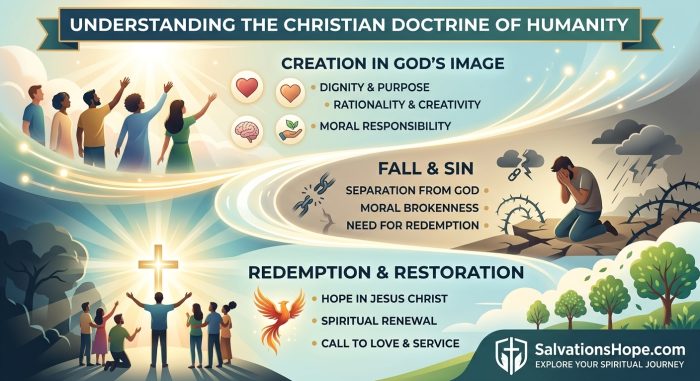
This concise declaration captures the twin foundational pillars of biblical anthropology, tracing the human story through two decisive movements:
- The greatness of our design: We are crowned with dignity, purpose, and infinite worth as God’s unique image-bearers.
- The depth of our fall: Sin has fractured that pristine design, corrupting every facet of human nature and leaving us completely helpless without divine intervention.
These truths do more than satisfy theological curiosity; they form the indispensable foundation of biblical anthropology. For pastors, theologians, and Christian leaders, this scriptural lens provides the vital standard needed to evaluate secular frameworks in psychology, sociology, philosophy, and leadership studies within the interdisciplinary pursuit known as Ministry Sciences.
Humanity Created for God’s Glory
The scriptural narrative consistently testifies that humanity’s ultimate purpose, meaning, and fulfillment are never self-generated. We were not made to be the center of our own universes; rather, we exist for the glory of the Creator.
Biblical Foundations and Cosmic Purpose
The prophet Isaiah records God’s explicit design for His people:
“Everyone who is called by my name, whom I created for my glory, whom I formed and made.” (Isaiah 43:7)
In the heavenly courts, the book of Revelation echoes this eternal reality, lifting the unceasing song of creation’s worship:
“You are worthy, our Lord and God, to receive glory and honor and power, for you created
all things, and by your will they were created and have their being.” (Revelation 4:11)
From the cosmic grandeur of the heavens to the microscopic intricacies of life, all creation reflects God’s immense power and majesty. The mountains declare His strength, the stars proclaim His vastness, and the rolling seas mirror His might. Yet humanity occupies a distinct, unparalleled place in this cosmic order.
The Imago Dei: Bearing the Divine Image
According to Genesis 1:26–27, humanity alone is created in the imago Dei—the image and likeness of God. Unlike the physical universe, which reflects God’s glory passively, humanity was designed to reflect His character consciously and actively through our words, thoughts, affections, choices, and dominion. This high calling endows every human being with inherent sanctity, inviolable worth, and a unique capacity for fellowship with the divine.
Everyday Worship in the Ordinary
Because we are image-bearers fashioned for His glory, this calling is never sequestered to Sunday morning religious rituals or formal worship services. The Apostle Paul expands our vision of worship in his letter to the Corinthians:
“So, whether you eat or drink, or whatever you do, do all to the glory of God.” (1 Corinthians 10:31)
Glorifying God is an all-encompassing, holistic vocation that permeates every ordinary corner of daily life. Whether we are laboring at a vocation, sharing a meal with family, resting in quiet solitude, navigating complex interpersonal relationships, or enduring seasons of deep suffering, every moment presents an opportunity to magnify the worth, beauty, and supremacy of our Creator.
The Restless Heart
Finding Human Flourishing in the Glory and Joy of God
At the core of the human experience lies an unshakeable, universal quest for meaning. Across every era, culture, and academic discipline, humanity has sought to answer a fundamental question: What is the ultimate purpose of human existence? While secular frameworks point inward toward self-actualization or outward toward cultural achievement, the historic Christian witness directs our gaze upward.
The Historical Witness: The Architecture of the Soul
The church fathers and historical theologians consistently affirmed that human dignity and destiny are inextricably bound to the majesty of God. The human soul is not an autonomous island; it is an echo chamber designed to resonate with divine glory.
In his Confessions, Saint Augustine captured this profound ontological reality with enduring clarity: “You have made us for Yourself, O Lord, and our hearts are restless until they find their rest in You.”
Augustine understood that human restlessness—our anxiety, our relentless ambition, and our existential dread—is symptoms of a misdirected soul. True fulfillment does not come from engineering our own greatness or manufacturing self-worth. Instead, it comes from participating in and reflecting the glory of God.
Centuries later, the Protestant Reformers and subsequent theologians echoed this foundational truth. The opening line of the Westminster Shorter Catechism summarizes the telos (ultimate purpose) of humanity with breathtaking simplicity:
“Man’s chief end is to glorify God, and to enjoy Him forever.”
Implications for Ministry Sciences
The integration of theology with the human sciences—often termed Ministry Sciences—demands that we evaluate psychological and sociological models through this rigorous biblical framework:
- Psychology and Self-Actualization: While secular psychology frequently seeks human flourishing through self-actualization, internal validation, and personal autonomy, Scripture insists that humanity's true telos is found outside of ourselves, in the glorification of God.
- Sociology and Cultural Rituals: Sociology and anthropology observe complex cultural rituals centered around honor, identity, and belonging. Theology interprets these rituals as physical expressions of a deeper, spiritual orientation: a God-shaped vacuum seeking ultimate allegiance.
- The Ministry Lens: Ministry Sciences interprets every theory of human flourishing through the lens of God's supreme worth. True human potential is only unlocked when humanity aligns with its Creator.
Created to Enjoy God: The Harmony of Duty and Delight
Humanity was designed not merely for stoic obedience or mechanical obligation, but for vibrant, participatory delight in God. Glorifying God and enjoying Him are not two separate pursuits; they are deeply intertwined. When we enjoy God supremely, we glorify Him supremely.
Scripture constantly draws our attention to God as the ultimate source of human satisfaction:
“You give them drink from your river of delights. For with you is the fountain of life; in your light we see light.” (Psalm 36:8–9)
“Delight yourself in the LORD, and He will give you the desires of your heart.” (Psalm 37:4)
True, lasting joy cannot be manufactured through material possessions, career achievements, or fleeting sensory pleasures. These are broken cisterns that hold no water. Humanity is never more fully alive, more fully human, than when experiencing deep, abiding communion with its Maker.
Implications for Ministry Sciences
Understanding this dynamic completely transforms how pastoral care, counseling, and community engagement are practiced within the church:
- Reframing Well-Being: Secular psychology often equates emotional flourishing with happiness or emotional stability. Biblical anthropology insists that true joy is deeper—it is anchored in communion with the living God, persisting even amid suffering.
- Redeeming Cultural Longings: Sociology studies how communities seek joy and cohesion through shared experiences. Theology proclaims that ultimate joy flows from God as the fountain of life, transforming temporary social bonding into eternal fellowship.
- The Ultimate Prescription: Ministry Sciences reframes holistic well-being: humans flourish most not when they look inward for healing, but when they look upward and find their ultimate satisfaction in God.
The Imago Dei
Recovering Our Divine Identity and Calling
At the foundational threshold of human history, Scripture establishes an unshakable declaration concerning who we are. The opening chapter of Genesis does not introduce humanity as a cosmic accident, a byproduct of blind evolutionary forces, or merely biological machinery. Instead, it roots human identity directly in the intentional, sovereign creative act of God:
“God created man in His own image, in the image of God He created him; male and female He created them.
And God said, ‘Be fruitful and multiply and fill the earth and subdue it. Have dominion…’” (Genesis 1:27–28)
Centuries later, the psalmists would look up at the vast expanse of the cosmos and marvel at the staggering weight of this conferred dignity:
“You made him ruler over the works of your hands; you put everything under his feet…
O LORD, our Lord, how majestic is your name in all the earth!” (Psalm 8:5, 9)
To be human is to bear the imago Dei—the image of God. This doctrine is not merely an abstract theological concept; it is the vital anchor for human worth, the blueprint for human purpose, and the lens through which we understand both our historic fall and our ultimate redemption in Jesus Christ.
The Dual Reality of the Image: Status and Vocation
In the Ancient Near Eastern world, statues of kings were placed throughout conquered territories to signify the sovereign’s absolute rule and presence. In a revolutionary twist, the God of Israel declared that all humans—not just elite pharaohs or monarchs—are His living statues. This royal commission grants humanity a profound dual reality:
- Status (Inalienable Worth): Every single human being, regardless of race, status, capability, or age, possesses inherent dignity and worth. Because we bear God’s image, human life is sacred from conception to its natural end. To diminish another person is to assault an image-bearer of the Almighty.
- Vocation (Active Representation): Bearing the image is not a passive title; it is an active calling. We are royal representatives commissioned to enact God’s loving reign over the earth, stewarding His creation, cultivating culture, and reflecting His radiant character into every corner of the world.
Threefold Dimensions of the Image
To fully grasp what it means to image God, we must look at the comprehensive ways this divine imprint touches human existence:
1. The Relational Dimension
Humanity is fundamentally wired for community because our Creator is Himself communal. The triune God—Father, Son, and Holy Spirit—exists in an eternal dance of self-giving love, communion, and harmony.
- The Reflection: Just as God is relational, humans are designed for deep, authentic connection.
- The Expression: Marriage, family, friendship, and the broader fabric of society become mirrors of God’s relational nature when they are anchored in love, self-sacrifice, and covenantal faithfulness. Isolation runs counter to the very architecture of our creation.
2. The Vocational Dimension
God has placed humanity in the garden of creation not to exploit it, but to cultivate it. Dominion is frequently misunderstood as tyrannical exploitation, but in the biblical framework, it means responsible, servant-hearted care.
- The Reflection: We reflect God’s sovereign rule by bringing order out of chaos, unlocking creation’s latent potential, and exercising creative ingenuity.
- The Expression: Whether one is painting a canvas, drafting architectural plans, writing software, or tending a literal garden, ordinary human work becomes an act of worship when performed under God’s authority and for His glory.
3. The Spiritual Dimension
At its core, the imago Dei is a spiritual reality. Humanity was uniquely breathed into by God, possessing a capacity for divine communion that distinguishes us from the rest of the created order.
- The Reflection: We mirror God’s presence by living in unbroken fellowship with Him, walking in step with the Spirit.
- The Expression: Prayer, worship, moral obedience, and the pursuit of holiness are not optional additions to human life—they are its essential atmosphere. To be fully human is to commune with God, to hear His voice, and to radiate His holiness.
The Historical Witness: From Fracture to Fulfillment
The grand narrative of Scripture does not pretend that humanity has maintained this reflection flawlessly. Sin entered the world, fracturing our relationship with God and distorting our capacity to reflect Him accurately. Christian history has long wrestled with this tension between our original glory and our fallen state:
- Irenaeus (2nd Century): The early church father famously described humanity as mirrors designed to reflect the glory of God. While sin cracked and tarnished the mirror, Jesus Christ—the ultimate and true Image of God (Colossians 1:15)—came to restore the reflection, breathing new life into humanity so we might once again mirror His likeness.
- John Calvin (16th Century): Calvin famously characterized fallen humanity as a “majestic ruin.” He observed that even after the Fall, devastating remnants of God’s image remain within us. These lingering echoes of greatness testify to our royal origins while simultaneously exposing our desperate, absolute need for divine redemption.
Furthermore, the writer of Hebrews applies the sweeping vision of Psalm 8 directly to Jesus, noting that while we do not yet see everything in subjection to humanity, we see Jesus, who was crowned with glory and honor so that He might taste death for everyone and bring many sons to glory (Hebrews 2:8–10). In Christ, our fractured human identity is redeemed, elevated, and fulfilled.
Living as Image-Bearers Today
To embrace the imago Dei is to undergo a radical shift in how we view ourselves and our neighbors. It compels us to look past superficial societal divisions and recognize the royal stamp of heaven on every human soul. It calls us to approach our daily work with dignity, our relationships with sacrificial love, and our spiritual lives with humble devotion.
As redeemed image-bearers, we are invited to let Christ reform our cracked mirrors, shining His light into a darkened world until His kingdom comes in fullness.
The Anchor of the Human Condition
Understanding the Fall and Original Sin
To understand the beauty of redemption, the depth of grace, and the urgency of the Gospel, we must first look squarely at the diagnosis Scripture provides for the human race. The narrative of Genesis is not merely an ancient myth of origins; it is the foundational explanation for why the world is simultaneously magnificent and broken. When humanity fell into sin, the shockwaves fractured the cosmos, leaving an imprint on every human heart born since.
The Genesis Narrative: The Breaking of the Covenant
In the lush perfection of Eden, humanity stood in unhindered communion with the Creator. God placed Adam and Eve in the garden as stewards, giving them freedom paired with a single, defining boundary.
“You must not eat from the tree of the knowledge of good and evil, for when you eat from it you will certainly die” (Genesis 2:17).
This command was a test of trust, a recognition of creaturely limits, and an acknowledgment of God as the ultimate source of life and authority. When the serpent twisted God’s words and tempted Eve with the promise of divine autonomy—“you will be like God”—Adam and Eve chose rebellion over reliance.
In that single act of disobedience, the covenant was broken. Death, both spiritual and physical, entered the human experience. As the Apostle Paul later encapsulates the cosmic tragedy:
“Sin entered the world through one man, and death through sin, and
in this way death came to all people, because all sinned” (Romans 5:12).
The Reality of Original Sin and Its Fourfold Fracture
The doctrine of original sin teaches that Adam’s first sin impacted all of humanity in two distinct ways: imputed guilt (we are counted guilty in Adam as our representative head) and inherited corruption (we inherit a nature bent away from God).
King David mourned this reality from the inside out, crying out in Psalm 51:5:
"Surely I was sinful at birth, sinful from the time my mother conceived me."
Because of this innate condition, sin is not merely something we do; it is something we are by nature. This corruption touches and distorts every dimension of human existence:
- Spiritually: Humanity is alienated from God, spiritually dead, and naturally hostile to divine authority (Ephesians 2:1–3).
- Relationally: Horizontal relationships instantly fractured into fear, shame, and blame-shifting, replacing harmony with conflict and domination (Genesis 3:12–16).
- Vocational: Work and human stewardship were subjected to frustration, futility, sweat, and thorns, transforming purpose into toil (Genesis 3:17–19).
- Existential: Physical decay, psychological anxiety, and the looming shadow of mortality entered the human story, reminding us that we are dust and to dust we shall return.
Historical Witness: Augustine, Pelagius, and the Reformation
Throughout church history, the church has fiercely guarded this doctrine against any worldview that underestimates human brokenness.
In the fifth century, Augustine engaged in a profound theological battle with Pelagius, who argued that humans are born with a neutral moral slate and can achieve righteousness through their own willpower. Augustine insisted—from Scripture and human experience alike—that humanity is so thoroughly disabled by sin that only sovereign, unmerited grace can heal our corruption.
Centuries later, the Magisterial Reformers recovered and sharpened this emphasis under the heading of total depravity. This does not mean every human is as evil as they possibly could be (restrained by God’s common grace), but rather that every faculty of human life—mind, will, emotion, and conscience—has been stained and compromised by sin. No single part of human nature remains untouched or capable of initiating salvation apart from the regenerating work of the Holy Spirit.
Implications for Ministry Sciences
For those engaged in ministry sciences—whether counseling, community development, leadership, or pastoral care—a robust theology of the Fall is indispensable. Secular frameworks often misdiagnose the human problem, leading to surface-level solutions.
- Psychology can skillfully identify and treat symptoms of emotional dysfunction, trauma, and behavioral patterns, but Scripture points deeper to the root disease: sin and the desperate need for heart-level reconciliation with God.
- Sociology documents systemic injustice, economic disparity, and cultural oppression, but biblical theology explains the ultimate cause: human rebellion and the corporate structures built to project human pride.
- Leadership Studies observe administrative corruption, toxic organizational cultures, and the abuse of power, but biblical anthropology names it clearly: sin’s distortion of stewardship.
By viewing ministry sciences through the lens of Scripture, we avoid the naive optimism that education, therapy, or social reform alone can perfect humanity. Instead, we approach every aspect of human struggle with eyes wide open to the depth of the Fall—knowing that while sin is deep, the redeeming grace of Jesus Christ is deeper still.
The Radical Reality
Totally Unable to Save Ourselves
To understand the breathtaking height of divine grace, we must first look unflinchingly into the deep abyss of the human condition. Modern culture often portrays humanity as fundamentally good, merely struggling with poor choices, systemic disadvantages, or environmental pressures. In this view, human beings are like patients in a hospital—sick, injured, and perhaps in critical condition, but still possessing enough inner vitality to cooperate with a doctor, take medicine, and heal themselves.
Scripture, however, presents a radically different and far more sobering diagnosis.
The Scriptural Diagnosis: Dead, Not Merely Diseased
The Apostle Paul cuts through human self-righteousness with surgical precision in his letter to the Romans:
“All have sinned and fall short of the glory of God.” (Romans 3:23)
To fall short of God’s glory is not to miss a target by a narrow margin; it is a total failure to reflect the moral perfection, holiness, and majesty for which humanity was created. Paul deepens this picture in his letter to the Ephesians, moving from a metaphor of weakness to one of utter spiritual inability:
“You were dead in your transgressions and sins, in which you once walked… by nature children of wrath.” (Ephesians 2:1–2, 3)
The biblical metaphor is not illness, but death. A corpse may appear less decayed or more physically intact than another, but both are utterly devoid of life. A dead person cannot respond to external stimuli, perform CPR on themselves, or choose to breathe.
In the spiritual realm, moral comparisons among people completely miss the ultimate point. While human beings retain their cognitive faculties, relational capacities, and relative civic decency, no one can generate spiritual life within themselves or bridge the infinite chasm separating creature from Creator. Apart from sovereign divine intervention, humanity remains entirely helpless under the weight of sin and divine judgment.
The Historical Witness of the Church
This sobering doctrine has not been invented by modern pessimism; it has been consistently confessed by the historic Christian church across centuries as a vital guardrail of the Gospel.
- The Heidelberg Catechism: The catechism asks whether we are able to keep God’s law perfectly, to which it confesses, "No, for I have a natural tendency to hate God and my neighbor." This is not framed as a series of poor habits easily broken by sheer willpower, but as an inherited, deep-seated corruption of our core nature.
- The Protestant Reformation and Sola Gratia: The Reformers staked their lives and the identity of the church on the principle of sola gratia (grace alone). Martin Luther, in his monumental work The Bondage of the Will, argued vehemently that the human will is bound, paralyzed, and enslaved by sin, utterly incapable of turning toward God apart from the liberating, monergistic work of the Holy Spirit.
- John Calvin and Total Depravity: Calvin articulated the doctrine of total depravity. This is frequently misunderstood to mean that humans are as evil as they possibly can be in every action—a claim refutable by everyday observation of human kindness. Instead, total depravity means that every faculty of human nature (intellect, emotion, will, and conscience) is tainted by sin. Because corruption touches every dimension of our being, no part of us remains pure enough to initiate our own redemption or merit God's favor.
Implications for Ministry Sciences and Pastoral Care
Recognizing our total inability is not designed to crush the human spirit into despair, but to dismantle self-reliance so that we might cling exclusively to Christ. This truth forms the foundational cornerstone of the Ministry Sciences framework.
When we engage with the social, psychological, and behavioral sciences, we must do so with theological discernment:
- Real Insights, Partial Solutions: Fields like psychology, sociology, and counseling offer profound descriptive insights into human behavior, relational dynamics, and emotional suffering. They can help diagnose functional brokenness, trauma, and societal pressures.
- The Ultimate Diagnosis: However, these secular frameworks ultimately fail to diagnose the root disease—our alienation from God and the guilt of sin—because they operate under the assumption that humanity possesses the inherent resources for self-actualization and healing.
- The Sole Remedy: True, lasting transformation requires more than therapeutic techniques or behavioral modification; it requires resurrection power.
By acknowledging that we are totally unable to save ourselves, we are driven away from human systems of self-salvation and thrown entirely upon the mercy of God. It is precisely when we realize we are dead in our sins that the life-giving, unmerited grace of Jesus Christ shines in its true, blinding glory.
Beyond Human Horizon
The Necessity of Grace in the Ministry Sciences
Modern culture is saturated with the promise of self-salvation. Across disciplines, the underlying assumption remains remarkably consistent: if humanity can just apply the right tools, uncover the correct data, or engineer the proper social structures, we can rescue ourselves from our miseries.
Yet, when measured against the profound reality of human brokenness, these secular systems inevitably reveal their limits. Within the framework of Ministry Sciences, we recognize that while human disciplines offer vital diagnostic tools and provisional insights, they are fundamentally incapable of achieving true spiritual regeneration. Flourishing is not a height to be scaled by human effort; it is a gift imparted by divine grace.
The Limits of Secular Disciplines
Psychology: Beyond Therapeutic Self-Healing
Modern psychology often operates on the premise that with enough therapy, introspective discipline, or cognitive-behavioral restructuring, the human self can repair its own fractures. Techniques such as mindfulness training, emotional regulation, and trauma-informed coping mechanisms can indeed alleviate distress and modify behavior. However, they possess a terminal boundary: they cannot raise the spiritually dead.
Ministry Sciences affirms that while psychology illuminates intricate patterns of thought, emotion, and psychological injury, the deepest wounds of the soul require divine intervention. Without the life-giving work of the Holy Spirit, therapeutic techniques function merely as bandages applied to mortal wounds. True transformation transcends behavioral adjustment; it requires radical spiritual regeneration.
Sociology and Anthropology: Beyond Cultural Optimism
Sociology and anthropology rightly celebrate the extraordinary human capacity to form complex communities, architect vibrant cultures, and pursue structural progress. They dissect the rituals, symbols, and institutional matrices that provide human life with shared meaning. Yet, no amount of cultural evolution or sociological reform can eradicate the systemic bondage of sin.
Every human culture carries a dual reality: an enduring beauty as an expression of the imago Dei (the image of God), paired with a profound brokenness born of the Fall. No civilization, governance model, or social movement is immune to structural corruption, systemic oppression, or institutionalized idolatry. Consequently, redemption must erupt from outside our cultural systems—through the person and work of Christ—rather than ascending from within them.
Philosophy and Ethics: Beyond Human Autonomy
Secular philosophy and ethics routinely exalt human autonomy, radical freedom, and infinite potential. By presenting humanity as entirely capable of charting its own destiny, authoring its own morality, and constructing its self-sustained purpose, these frameworks champion self-reliance.
Ministry Sciences exposes the inherent fragility of these intellectual constructs. Stripped of transcendent anchor points, human striving inevitably fractures into one of two extremes:
- Pelagian Pride: The delusion that human reason and moral effort are entirely sufficient for ultimate flourishing.
- Existential Despair: The crushing realization that human beings cannot bear the unbearable weight of carrying self-created ultimate purpose.
Grace radically reorients ethics. True freedom is never found in autonomy from God, but rather in profound, restorative communion with Him through Jesus Christ.
The Integrative Claim: Testing Theory Against Truth
The foundational claim of Ministry Sciences is that authentic human flourishing can never be attained by human exertion alone. While the secular sciences excel at describing human potential, diagnosing cognitive and social dysfunction, and proposing pragmatic remedies, they remain powerless to impart the new life humanity desperately needs.
"True flourishing begins when God, in Christ, breathes His Spirit into the spiritually dead." (cf. Ephesians 2:4–5)
Every credible theory of human flourishing must ultimately be tested against two unshakeable theological realities: the universal grip of sin and the absolute necessity of grace. Without this vertical alignment, social science and philosophy risk peddling false, shallow hopes. When integrated under divine truth, however, their diagnostic insights can be reframed as valuable tools for ministry, illuminated and transformed by the light of God’s word.
Humanity’s Need for a Savior
Because humanity is utterly helpless in its fallen state, our only anchor of hope is found in Jesus Christ. Holy Scripture makes this exclusivity unmistakably clear:
"For there is one God and one mediator between God and mankind, the man Christ Jesus." — 1 Timothy 2:5
"I am the resurrection and the life. The one who believes in me will live, even though they die." — John 11:25
The core crisis of humanity is not simply intellectual ignorance, emotional weakness, or malfunctioning social systems—it is spiritual death. No human wisdom, philosophical rigor, systemic reform, or moral exertion can bridge the infinite chasm separating sinful humanity from a holy God. Only Jesus Christ—fully God and fully man—stands as the definitive mediator who reconciles us back to the Father.
The Accomplished Work of Christ
The gospel message declares that what was impossible for human effort has been decisively accomplished by divine grace:
- He bridges the infinite gap: Sin severs our vertical communion with God, but Christ’s substitutionary atonement reconciles us through the cross.
- He raises the spiritually dead: The impossibility of self-resurrection is overcome by His resurrection life, poured out by the Holy Spirit.
- He restores humanity to its telos (purpose): Our original design—to glorify God, enjoy Him forever, and steward creation—finds its sole fulfillment in Christ.
"If anyone is in Christ, the new creation has come: The old has gone, the new is here!" — 2 Corinthians 5:17
The Historical Witness of the Church
The historic Christian church has consistently confessed humanity’s radical dependence on a Savior, maintaining this conviction across the centuries:
- Augustine: In his historic defense of divine grace against Pelagianism, Augustine argued that grace is never optional; without it, humanity lacks the capacity to truly choose God or perform genuinely good works.
- The Reformers: The Protestant Reformation distilled this theological conviction into the resonant cry of solus Christus (Christ alone saves). Neither religious rituals, institutional works, nor human moral effort contribute to justification. Salvation is entirely a sovereign gift of God in Christ, received exclusively through faith.
Implications for Ministry Sciences
The Ministry Sciences framework honors the empirical and observational insights of various academic disciplines, while fiercely insisting upon Christ as the indispensable center:
Academic Discipline
Secular Promise
Theological Reality in Ministry Sciences
Psychology
Aid healing of mind and emotions
Only Christ heals the core of the soul
Sociology
Suggest structural community reforms
Only Christ redeems and transforms cultures
Philosophy
Search for abstract meaning
Only Christ is the incarnate Truth
Leadership Studies
Teach growth, influence, and strategy
Only Christ transforms leaders into servants of His Kingdom
Ultimately, none of these human disciplines possess the power to save. They can describe, diagnose, and occasionally assist, but eternal salvation belongs to Christ alone. Ministry Sciences anchors every interdisciplinary insight in Him as the true Redeemer. Without Christ, there is only spiritual desolation; in Him, there is a glorious new creation and the absolute fulfillment of humanity’s deepest existential longings.
Conclusion
The Christian doctrine of humanity centers upon two defining theological pillars:
- Glory: God intentionally created humanity in His image to glorify Him, enjoy His presence, and faithfully steward His creation.
- Ruin: Humanity plunged headlong into sin, leaving us completely incapable of saving ourselves by our own ingenuity.
Only within the person and work of Christ can we rediscover our true identity, receive resurrection life, and reflect the glory for which we were originally made.
"All have sinned and fall short of the glory of God." — Romans 3:23
"If anyone is in Christ, the new creation has come." — 2 Corinthians 5:17