From Babel to Pentecost
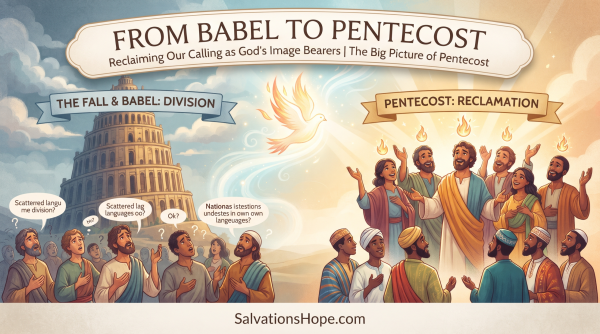
Reclaiming Our Calling as God’s Image Bearers
Scripture Reference: Genesis 1:26; Genesis 11:1–9; Genesis 12:1–3; Job 38:4–7; Psalm 89:5–8; Luke 3:38
Pentecost marks the great outpouring of the Holy Spirit upon God’s people. While the Spirit’s arrival carries many theological dimensions, one of the most profound is that Pentecost directly reverses the Tower of Babel. To grasp the magnitude of what happened in Jerusalem in Acts 2, we must first trace the biblical storyline of heaven and earth back to Genesis.
“Now the whole earth had one language and the same words. And as people migrated from the east, they found a plain in the land of Shinar and settled there. And they said to one another, “Come, let us make bricks, and burn them thoroughly.” And they had brick for stone, and bitumen for mortar. Then they said, “Come, let us build ourselves a city and a tower with its top in the heavens, and let us make a name for ourselves, lest we be dispersed over the face of the whole earth.” The Lord came down to see the city and the tower the children of man had built. And the Lord said, “Behold, they are one people, and they have all one language, and this is only the beginning of what they will do. And nothing that they propose to do will now be impossible for them. Come, let us go down, and there confuse their language, so that they may not understand one another’s speech.” So the Lord dispersed them from there over the face of all the earth, and they left off building the city. Therefore its name was called Babel, because there the Lord confused the language of all the earth. And from there the Lord dispersed them over the face of all the earth.” (Genesis 11:1–9)
“Now the Lord said to Abram, “Go from your country and your kindred and your father’s house to the land that I will show you. And I will make of you a great nation, and I will bless you and make your name great, so that you will be a blessing. I will bless those who bless you, and him who dishonors you I will curse, and in you all the families of the earth shall be blessed.” (Genesis 12:1–3)
God’s Image-bearers and the Divine Council
To understand what went wrong at Babel, we have to step all the way back to creation. Before God created the physical world and humanity, He had already created supernatural beings who dwelled with Him and served as His heavenly council.
The Old Testament refers to these beings by several titles:
- The Sons of God (bene elohim)
- The Assembly of the Holy Ones
- The Council of the Holy Ones
- The Hosts of Heaven (which is why Yahweh is frequently called the "Lord of hosts")
When God confronted Job, He asked: “Where were you when I laid the foundation of the earth… when the morning stars sang together, and all the sons of God shouted for joy?” (Job 38:4, 7). Long before humanity existed, these supernatural beings observed, praised, and collaborated with God in the heavenly realms.
The Meaning of "Let Us"
In Genesis 1:26, God declares, “Let us make man in our image, after our likeness.” Why does God use the plural “us”? He addresses His Divine Council—the heavenly sons of God who already imaged Him in the spiritual realm. God announces His intention to create an earthly counterpart: a human family that would image Him in the physical world. Hence, Luke’s genealogy of Jesus traces humanity back to “Adam, the son of God” (Luke 3:38).
Yahweh’s Incomparable Supremacy
While God surrounds Himself with a council because He delights in community and shared governance, Scripture never places these heavenly beings on par with Him:
“Let the heavens praise your wonders, O Yahweh, your faithfulness in the assembly of the holy ones! For who in the skies can be compared to Yahweh? Who among the heavenly beings [sons of God] is like Yahweh, a God greatly to be feared in the council of the holy ones, and awesome above all who are around him? O Yahweh God of hosts, who is mighty as you are?” (Psalm 89:5–8)
Yahweh alone is supreme, uncreated, and all-powerful. Yet out of love, He chooses to share His rule with both heavenly and earthly imagers.
Eden as a Cosmic Temple
In the ancient world, a temple was the sacred space where heaven and earth intersected. God designed the Garden of Eden as His cosmic temple. When God “rested” on the seventh day, He was not recovering from exhaustion; in the ancient world, a king “rested” when he took up residence in his temple to rule.
God moved into His garden-temple to dwell in close communion with Adam and Eve. Just as the supernatural council represented God’s rule in the heavenly realms, humanity was designed to act as God’s council on earth—stewarding creation and extending His kingdom across the globe. Through God’s grace in Jesus Christ, this sacred, face-to-face communion is the exact destiny to which redeemed humanity will one day be restored.
Three Rebellions and the Scattering of the Nations
Instead of fulfilling their calling, both human and heavenly imagers rebelled in three distinct stages across Genesis 3–11:
- The Fall in Eden (Genesis 3): Adam and Eve sinned and forfeited their access to the sacred space where heaven and earth met. They were driven out, and the cherubim—mighty heavenly guardians—were stationed to guard the entrance to the garden-temple.
- The Corruption Before the Flood (Genesis 6:1–4): A group of fallen heavenly imagers ("sons of God") transgressed their domain and interbred with human women, producing the Nephilim giants and filling the earth with corruption. God sent the flood to judge this rebellion and cleanse the earth.
- The Post-Flood Refusal at Babel (Genesis 9–11): God began anew with Noah’s family, reissuing the mandate to "be fruitful and multiply and fill the earth" (Genesis 9:1) as His earthly representatives. Instead, humanity banded together in Shinar, refusing to scatter and refusing to honor God on His terms.
As a result of the rebellion at Babel, God scattered the nations across the earth. Furthermore, as other texts like Deuteronomy 32:8–9 reveal, God temporarily disinherited the nations, handing them over to the rule of lesser supernatural beings from His council, while immediately calling Abram (Genesis 12:1–3) to form a new nation through whom He would eventually reclaim the whole world.
What Was Really Happening at the Tower of Babel?
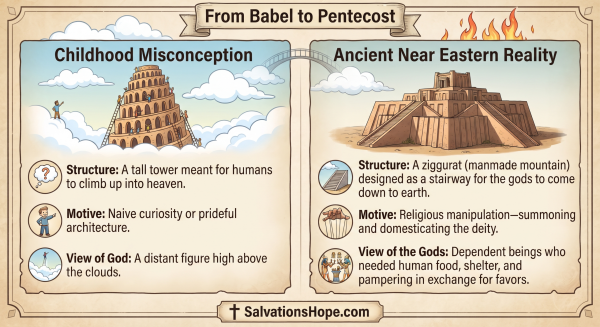
Childhood picture books often portray the builders of Babel as trying to construct a skyscraper tall enough to climb into heaven. On its face, that idea is absurd—even the tallest modern skyscraper reaches nowhere near the spiritual realm, and God certainly wouldn’t need to “come down” to stop people from stacking bricks into the clouds.
To an ancient Israelite, the architecture of Babel was immediately recognizable: they were building a ziggurat.
The Theology of the Ziggurat
In the ancient world, mountains were regarded as cosmic meeting places where the gods touched down on earth. Because the plains of Shinar (Mesopotamia) were flat, people built an artificial mountain—a stepped tower called a ziggurat—beside a temple.
Ancient idolaters did not believe a block of wood or stone was a god in itself. Rather, they believed that if they built a ziggurat reaching into the sky, the god would descend the stairway, and his spiritual essence would inhabit the idol in the adjacent temple. The top of the ziggurat was even furnished with food and a resting place so the deity could relax during his “off hours.”
The Attempt to Control God
In the pagan worldview of Mesopotamia, the gods created humans to serve as slave laborers, growing their food and maintaining their temples. This created a system of religious bribery (“You scratch my back, I’ll scratch yours”): if humans fed and housed the god at the ziggurat, the god was obligated to bless their crops and make their city prosperous.
The Tower of Babel was humanity’s ultimate attempt to domesticate and control God. Rather than spreading across the earth to reflect God’s character as His obedient image-bearers, humanity tried to confine the divine in a box of their own making and force God to serve their agenda.
Key Takeaways
- Our Identity: We were created to be God’s earthly council—His imagers who rule and steward creation in faithful communion with Him.
- The Sin of Babel: Babel was not an engineering project gone wrong; it was a religious rebellion designed to bring God down on human terms and manipulate Him for self-glorification.
- The Setup for Pentecost: What humanity tried to manufacture through pride at Babel—bringing the presence of God down to earth—God would later accomplish by grace at Pentecost, when the Holy Spirit descended to turn His people into living temples across every nation and language.
Confused, Scattered, and Disowned
The Judgment of Babel
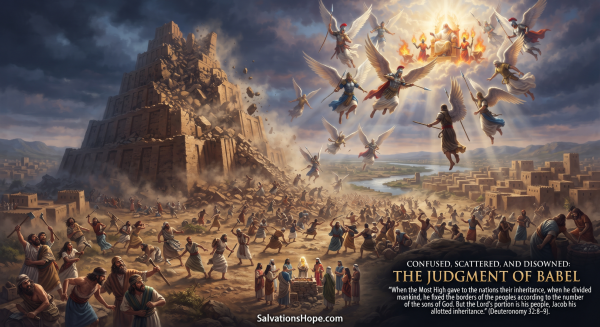
The Divine Council Descends
Scripture Reference: Genesis 10–11; Deuteronomy 4:19; Deuteronomy 32:8–9; Psalm 82:1–8; Daniel 4:17; Daniel 10:13, 20
At Babel, humanity built a ziggurat to summon God on its own terms, seeking to make a great name for itself and manipulate the divine.
(Textual Note: The word “name” in Hebrew, שֵׁם, is pronounced shem. A name reflects a person’s inner nature, identity, or destiny, not just an arbitrary word. It stands for a person’s honor, public standing, or status in the community. Linguistically and etymologically in Hebrew tradition, shem is closely tied to נְשָׁמָה (neshamah, breath or soul), suggesting that a name carries a person’s living breath and potential.)
God did indeed descend—addressing His Divine Council with the words, “Come, let us go down” (Genesis 11:7)—but He did not come to be domesticated. Instead, the Supreme Lord came in judgment, fracturing their unified rebellion by confusing their speech and scattering them across the globe.
To understand the full weight of this event, we must look at how Genesis 10 and 11 fit together:
- Genesis 10 (The Table of Nations): Lists 70 nations into which humanity was divided.
- Genesis 11 (The Tower of Babel): Backtracks chronologically to explain why and how that division happened.
However, the physical scattering of languages was only the surface of what took place at Babel. At the same time, a profound spiritual shift occurred in the unseen realm.
The Deuteronomy 32 Worldview
Moses looks back at the Babel event and reveals the spiritual transaction that accompanied the scattering of the nations:
“When the Most High gave to the nations their inheritance, when he divided mankind, he fixed the borders of the peoples according to the number of the sons of God. But the Lord’s portion is his people, Jacob his allotted inheritance.” (Deuteronomy 32:8–9)
(Textual Note: While some later Hebrew manuscripts read “sons of Israel,” Israel did not exist at the time of Babel. Older manuscripts, including the Dead Sea Scrolls and the Septuagint, preserve the original reading: “sons of God.”)
When humanity refused to submit to Yahweh at Babel, God effectively said, “If you refuse to worship Me on My terms, I will hand you over to other powers.” God temporarily disinherited the nations, placing the 70 nations under the jurisdiction of lesser supernatural beings from His council (principalities and powers). Moses confirms this judgment in Deuteronomy 4:19, warning Israel never to worship the host of heaven, “things that the Lord your God has allotted to all the peoples under the whole heaven.”
Immediately after disowning the nations at Babel, God called Abraham (Genesis 12) to form His own personal portion—a new nation He would rule directly, through whom He would eventually rescue and reclaim the rest of the world.
Corrupt Rulers in the Unseen Realm
The supernatural “sons of God” placed over the nations were meant to administer justice for Yahweh. Instead, most became corrupt rebel powers that seduced nations into worshiping them as gods and fostered injustice across the earth.
God Judges the "gods" (Psalm 82)
Psalm 82 pulls back the curtain on the Divine Council, using the Hebrew word elohim (which describes resident beings of the spiritual realm) in two distinct ways—first for Yahweh the Supreme God, and second for the lesser council members under His authority:
“God [Elohim] has taken his place in the divine council; in the midst of the gods [elohim] he holds judgment: ‘How long will you judge unjustly and show partiality to the wicked?… I said, “You are gods, sons of the Most High, all of you; nevertheless, like men you shall die, and fall like any prince.” Arise, O God, judge the earth; for you shall inherit all the nations!” (Psalm 82:1–2, 6–8)
Here, God indicts the supernatural rulers governing the nations for their corrupt rule and sentences them to ultimate defeat, culminating in the prophetic cry for God to rise and take back all the nations as His rightful inheritance.
Watchers and Territorial Princes (Daniel 4 & 10)
Throughout the Old Testament, we see these unseen powers actively influencing geopolitical history—some remaining faithful to God’s decrees, and others actively warring against His purposes:
- The Decree of the Watchers (Daniel 4:17): When King Nebuchadnezzar of Babylon grew arrogant, his temporary madness and removal from power were announced as "the sentence by the decree of the watchers, the decision by the word of the holy ones." Under God’s ultimate sovereignty, His heavenly council helped humble an earthly empire.
- The Princes of Persia and Greece (Daniel 10:13, 20): When a heavenly messenger was sent in response to Daniel’s prayers, the messenger explained that he was delayed for 21 days by "the prince of the kingdom of Persia" and noted that he would soon have to contend with "the prince of Greece." Powerful spiritual rulers stood behind earthly kingdoms, shaping national affairs.
Conflicts and Covenant
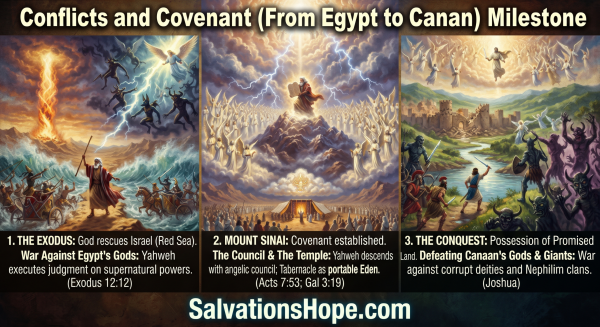
From Egypt to Canaan
Scripture Reference: Exodus 12:12; Acts 7:53; Galatians 3:19; Hebrews 2:2; The Book of Joshua
As nations fell under the sway of rebel spiritual powers, God began His long campaign to reclaim the world through Abraham’s descendants. The journey from Abraham to the Promised Land unfolds across three major spiritual milestones:
Defeating the Gods of Egypt
When Moses and Aaron performed the initial signs before Pharaoh—turning staffs into serpents or water into blood—Pharaoh’s magicians replicated them. Rather than dismissing them as mere sleight-of-hand parlor tricks, Scripture treats them as genuine demonstrations of dark supernatural power enabled by Egypt’s patron deities.
However, as the plagues progressed, Yahweh escalated His display of power until the gods of Egypt were completely overwhelmed and exposed as powerless before the Creator. As Exodus 12:12 declares, the Exodus was not merely a political liberation; it was a cosmic judgment against Egypt’s gods.
Covenant and Presence at Sinai
After liberating His people, God brought Israel to Mount Sinai. As the New Testament confirms, God did not come alone—His heavenly council accompanied Him, and angels mediated the Law (Acts 7:53; Galatians 3:19; Hebrews 2:2). There, God established His covenant and provided the blueprints for the Tabernacle. For the first time since the fall of Eden, He established a sacred space on earth where His presence would dwell directly among a redeemed community.
Reclaiming Holy Ground in Canaan
Finally, God led Israel into Canaan under Joshua, establishing a foothold for His Kingdom on earth. This required confronting Canaan’s rebel gods and driving out the Anakim—the giant offspring rooted in the pre-flood corruption of the Nephilim. By clearing the land and settling Israel there, Yahweh planted His flag in a world ruled by rebel principalities, setting the stage for the ultimate reclamation of all nations through the Messiah and the Spirit’s outpouring at Pentecost.
Key Takeaway
The Spiritual Geography of Babel: At Babel, God judged humanity’s rebellion by scattering their languages and temporarily turning the nations over to the authority of lesser supernatural beings (Deuteronomy 32:8–9).
God’s Rescue Plan: God immediately called Abraham to create a covenant family through whom He would eventually defeat the rebel powers (Psalm 82) and reclaim every nation on earth.
Cosmic Warfare in the Old Testament: The stories of the Exodus, Mount Sinai, and the conquest of Canaan are not merely human history—they record Yahweh systematically dismantling the rule of rival spiritual powers and re-establishing His sacred dwelling place on earth.
Kings, Temple, and Exile: Israel’s Rise and Fall
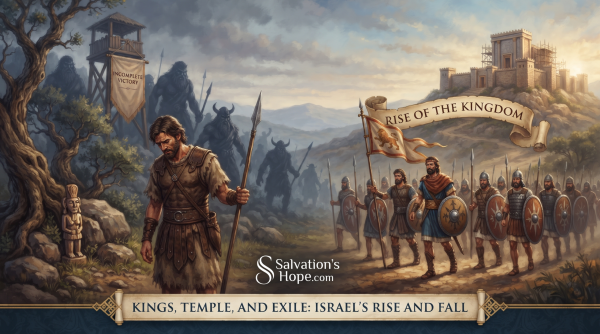
Incomplete Victory and the Rise of the Kingdom
Scripture Reference: The Book of Judges; 1 Samuel 17; 2 Samuel 21:15–22; 1 Kings 6–8; Ezekiel 10–11
Although Joshua led Israel into the Promised Land, the nation failed to drive out the giant clans completely or fully reject Canaan’s corrupt gods. Throughout the era of the Judges, Israel repeatedly compromised with the surrounding pagan cultures and bowed to the very rebel powers that Yahweh had defeated.
Furthermore, the remnants of the giant clans (Nephilim and Anakim) remained a persistent threat, particularly among the Philistines. Only in the reign of King David was this ancient spiritual and physical threat finally crushed, as David and his mighty men slew Goliath and the remaining Philistine giants (1 Samuel 17; 2 Samuel 21:15–22).
Solomon’s Temple: Heaven and Earth Reconnected
Under David’s son Solomon, Israel built the permanent Temple in Jerusalem. Like the Garden of Eden and the Tabernacle before it, the Temple was designed as a sacred intersection between heaven and earth—an earthly blueprint of God’s heavenly throne room.
However, because of human sin, access to God’s presence in the Temple was strictly graded by holiness:
- The Outer Courts: Accessible to the general worshiping public.
- The Holy Place: Accessible only to ordained priests.
- The Most Holy Place (Holy of Holies): The inner sanctuary where God’s presence dwelled between the cherubim; accessible to only one person (the High Priest), on only one day of the year (the Day of Atonement).
Failure, Division, and the Departure of Glory
Despite having God’s presence in their midst and prophets continually calling them back to faithfulness, Israel’s history was marked by spiritual decline:
- The Divided Kingdom: After Solomon’s reign, the nation fractured into two kingdoms. The northern kingdom of Israel (ten tribes) immediately set up rival shrines with golden calves, eventually falling to Assyria and being scattered among the nations.
- The Fall of Judah and the Departure of Glory: The southern kingdom of Judah persisted longer but eventually succumbed to the same idolatry. Before the Babylonians destroyed Jerusalem, the prophet Ezekiel witnessed a heartbreaking vision: the glory of the Lord rising and departing from the Temple (Ezekiel 10–11). The Temple was burned to the ground, and the people of Judah were taken into Babylonian exile.
- An Unfinished Return: Although a remnant of Jews later returned to rebuild a second temple under Ezra and Nehemiah, it was a shadow of Solomon's temple. Crucially, Scripture never records the cloud and fire of God’s glory returning to fill that second temple. Most of the Jewish people remained scattered across the pagan empires, living under foreign domination, and God’s promise to bless all the nations through Abraham (Genesis 12:3) remained unfulfilled.
The Messiah
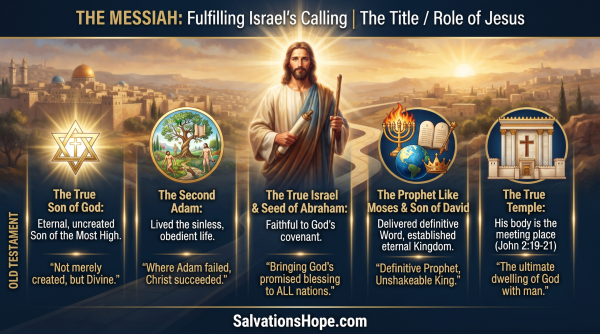
Fulfilling Israel’s Calling
Scripture Reference: John 2:19–21; Colossians 2:15
Into this long season of exile, foreign Roman occupation, and spiritual longing, Jesus the Messiah stepped in. Where every previous human image-bearer had failed, Jesus succeeded perfectly, fulfilling every major thread of the Old Testament storyline:
The Cross, Resurrection, and the Defeat of the Powers
Jesus’ death on the cross accomplished a dual victory:
Atonement for Sin: He paid the full penalty for human rebellion, removing the barrier that expelled humanity from Eden.
Victory Over Rebel Principalities: His death and resurrection dealt a fatal blow to the corrupt supernatural powers that had ruled the nations since Babel, disarming them and putting them to open shame (Colossians 2:15).
Jesus’ resurrection was not merely the resuscitation of a corpse; it began a new creation, energized by the life and power of the Holy Spirit. Before ascending to take His throne in heaven, Jesus promised to send the same Spirit to empower His followers.
Pentecost (The Reversal of Babel)
“When the day of Pentecost arrived, they were all together in one place. Suddenly, a sound like a mighty rushing wind came from heaven and filled the entire house where they were sitting. And divided tongues as of fire appeared to them and rested on each one of them. And they were all filled with the Holy Spirit and began to speak in other tongues as the Spirit gave them utterance. Now there were Jews dwelling in Jerusalem, devout men from every nation under heaven. At this sound the multitude came together, and they were bewildered, because each one heard them speak in his own language. And they were amazed, saying, “Are not all these who are speaking Galileans? And how is it that we hear, each of us in his own native language? Parthians and Medes and Elamites and residents of Mesopotamia, Judea and Cappadocia, Pontus and Asia, Phrygia and Pamphylia, Egypt and the parts of Libya belonging to Cyrene, and visitors from Rome, both Jews and proselytes, Cretans and Arabians—we hear them telling in our own tongues the mighty works of God.” And all were amazed and perplexed, saying to one another, “What does this mean?”(Acts 2:1–12)
How Pentecost Reverses the Curse of Babel
Seven weeks after Passover, during the Jewish feast of Pentecost, God brought the threads of Genesis 11, the Exile, and the Temple together in a single explosive moment.
Exile Turned into Mission
While Israel’s scattering among the nations was originally a judgment for their sin, God sovereignly used the Jewish diaspora to prepare for world mission. Because of the exile, devout Jews raised across the Roman and Parthian empires became fluent in the languages and cultures of the pagan nations.
When they gathered in Jerusalem for the festival of Pentecost, God had a culturally equipped mission force waiting there. In a single day, through the outpouring of the Spirit and Peter’s preaching of the risen Christ, the Spirit transformed 3,000 people into an army of Messianic missionaries ready to carry the gospel back to the nations.
The Glory Fills the New Temple
Notice the specific language of Acts 2:2–3:
“It filled the entire house”: This exact phrasing echoes Exodus 40 and 1 Kings 8, when the cloud of God’s glory descended to fill the Tabernacle and Solomon’s Temple. The long absence of God’s visible glory since Ezekiel’s day was over—only now, God did not fill a stone building. He filled the gathering of Jesus’ followers.
“Divided tongues as of fire… rested on each one of them”: In the Old Testament, divine fire accompanied God and His heavenly council at Mount Sinai, in the wilderness pillar of fire, and in Ezekiel’s vision of the cherubim. At Pentecost, that single pillar of fire divided and rested on each believer. In Christ, every Spirit-filled believer becomes a living stone in God’s new cosmic temple.
Reclaiming the Map of Genesis 10
When the Spirit enabled the disciples to proclaim the mighty works of God in languages they had never studied, Luke records a specific list of regions represented in the crowd: Parthians, Medes, Elamites, Mesopotamia, Judea, Cappadocia, Pontus, Asia, Phrygia, Pamphylia, Egypt, Libya, Cyrene, Rome, Cretans, and Arabs (Acts 2:9–11).
Sweeping geographically from east to west, this list covers the same territory as the Table of Nations in Genesis 10. These very peoples were fractured, confused, and handed over to lesser spiritual powers at the Tower of Babel.
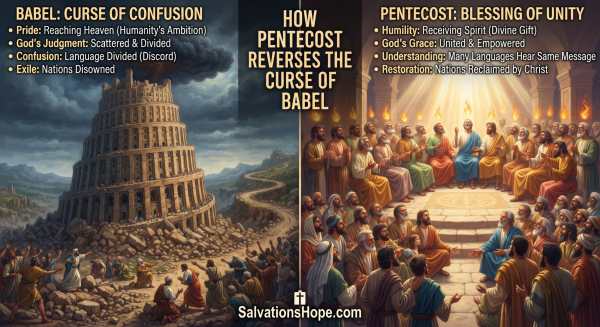
When the bewildered crowd asked, “What does this mean?” (Acts 2:12), Peter stood up to proclaim the answer: through the death, resurrection, and ascension of Jesus, the rebellion of Babel is being undone, the rebel powers are defeated, and God is calling every nation under heaven back into His family.
Key Takeaway
Christ the True Temple: Where Israel and its kings failed to keep the covenant, Jesus succeeded as the true Son of God, defeating the dark powers at the cross and becoming the ultimate meeting place between heaven and earth.
Believers as Living Temples: The tongues of fire at Pentecost signify that God’s glory has returned—not to a stone building in Jerusalem, but to indwell and empower every individual follower of Jesus.
The Reversal of Babel: Pentecost is God’s formal declaration that the disinherited nations of Genesis 10–11 are now being reclaimed through the gospel of Jesus Christ.
Babel vs. Pentecost — A Theological Comparison
The Great Reversal
Scripture Reference: Genesis 11:1–9; Acts 2:1–41
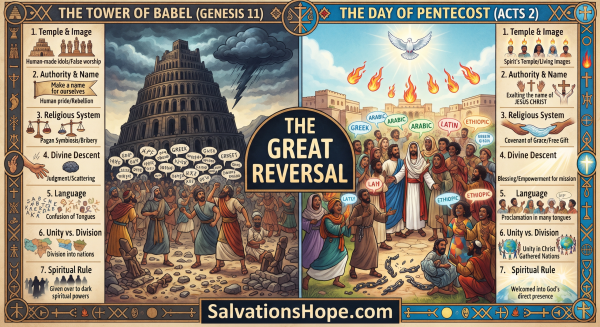
When we place Genesis 11 and Acts 2 side by side, we see that Pentecost is not an isolated New Testament miracle; it systematically reverses the curse and rebellion of the Tower of Babel. Every element of human pride at Shinar is answered by divine grace in Jerusalem.
Why Idolatry is Forbidden
Comparing Babel and Pentecost clarifies why God strictly forbids making carved images. At Babel, pagan worshipers built idols, hoping to trap a deity’s essence in an object they could control. Scripture reveals that humanity itself is God’s image. God never intended to dwell in blocks of wood or stone; He designed human beings to be filled with His Holy Spirit, reflecting His character and ruling creation on His behalf.
Pagan Symbiosis vs. Covenant Grace
Scholars of ancient religion use the term “The Great Symbiosis” to describe Mesopotamia’s worldview. In biology, symbiosis describes two organisms that depend on each other for survival. Ancient pagans believed the gods depended on humans for food and shelter, while humans depended on the gods for rain, fertility, and protection. Religion was a transactional vending machine: press the right ritual buttons, and obligate the deity to bless you.
Pentecost shatters this pagan mindset. The Creator of the universe has no unmet needs. We cannot bribe, domesticate, or put Him in our debt. Instead, God acts out of pure, overflowing grace in Jesus Christ—freely gifting us His Spirit and inviting us to partner with Him as royal stewards of His creation.
The Spirit Renews All Things
A Promise for "Everyone" and "All Who Are Far Off"
Scripture Reference: Genesis 2:7; Jeremiah 31:31–34; Ezekiel 36:24–27; Joel 2:28–32; Acts 2:17–21, 38–39; 1 Peter 2:9
Stepping back to view the sweep of Scripture, we discover that the outpouring of the Holy Spirit at Pentecost brings every major theme of the Old Testament to its glorious fulfillment:
A New Eden (Breathing Life into God’s Imagers): In Genesis 2:7, God formed Adam from the dust and “breathed into his nostrils the breath of life.” In both Hebrew (ruach) and Greek (pneuma), the word for “Spirit” also means “breath” or “wind.” When the rushing wind of the Spirit filled the disciples at Pentecost, God breathed new creation life into His redeemed imagers—inspiring the classic hymn prayer, “Breathe on me, Breath of God, fill me with life anew.”
A Reversed Babel (Scattered for Blessing): Just as God scattered humanity from Babel, the Spirit sent the 3,000 new believers and the apostles out from Jerusalem to the ends of the earth. Yet what was once a scattering of curse and confusion became a scattering of blessing and communication, carrying the Gospel to the ends of the earth.
A Fulfilled Israel (Blessing All Nations): Despite centuries of Israel’s unfaithfulness, God kept His promise to Abraham. Through Jesus the Messiah and the outpouring of the Spirit, Gentile believers from every nation are now grafted into God’s family and receive the very titles once reserved for Israel at Sinai: “a chosen race, a royal priesthood, a holy nation” (1 Peter 2:9).
A New Sinai (The Law Written on Hearts): In the Jewish calendar, the Feast of Pentecost (Shavuot) commemorates the giving of the Law at Mount Sinai. At the first Sinai, God wrote His law on stone tablets. At Pentecost, God fulfilled the New Covenant promises of Jeremiah 31:31–34 and Ezekiel 36:24–27 by sending His Spirit to write His law directly on human hearts, transforming our desires from the inside out.
A Living Temple: God’s dwelling place is no longer a geographic structure of stone, gold, and curtains. Jesus Himself is the cornerstone; the Church collectively is the temple; and every Spirit-indwelt believer is a sacred dwelling place of the Most High.
A Redeemed Exile: Even the tragedy of Israel’s dispersion among the empires was woven into God’s sovereign design, creating a multilingual, cross-cultural mission force ready to be ignited on the day of Pentecost.
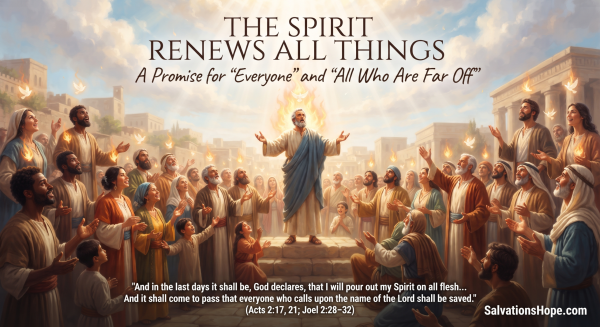
When the Apostle Peter stood up to explain the miracle of Pentecost, one word echoed throughout his message: “everyone.” Quoting the prophet Joel, Peter declared:
everyone who calls upon the name of the Lord shall be saved.” (Acts 2:17, 21; Joel 2:28–32)
And when the crowd was cut to the heart and asked what they must do, Peter replied:
“Repent and be baptized every one of you in the name of Jesus Christ for the forgiveness of your sins, and you will receive the gift of the Holy Spirit. For the promise is for you and for your children and for all who are far off, everyone whom the Lord our God calls to himself.” (Acts 2:38–39)
At the Tower of Babel, the nations were driven “far off”—linguistically fractured, spiritually disinherited, and handed over to dark powers. At Pentecost, through the death and resurrection of Jesus, the King of Kings issued a royal amnesty to “all who are far off.”
If we belong to Christ, this is our family history. We are no longer strangers, exiles, or captives to the spiritual powers of this age. We have been brought near by the blood of Jesus, filled with the fire of the Holy Spirit, and restored to our original Edenic calling: to live in intimate communion with our Creator as His living temples and faithful imagers to the ends of the earth.
Living the Reversal of Babel Today — Worship, Witness, and Warfare
A Once-for-All Launch with an Ongoing Trajectory
Scripture Reference: Isaiah 42:6; 49:6; Matthew 5:14; Acts 1:8; 1 Corinthians 3:16; Ephesians 2:19–22; Colossians 2:15; 1 John 4:4; Revelation 7:9–10
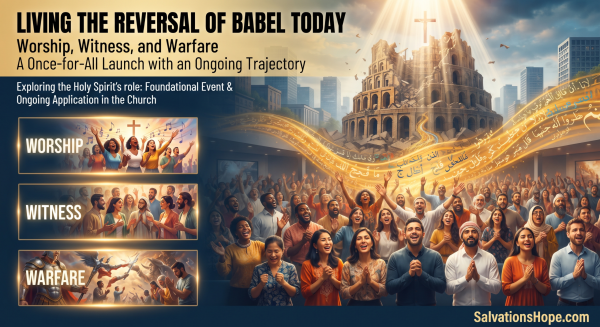
In exploring the theology of the Holy Spirit, it is vital to distinguish between a foundational redemptive-historical event and its ongoing application in the life of the Church. Just as Christ’s crucifixion, resurrection, and ascension were unrepeatable, epoch-shifting milestones in salvation history, the Day of Pentecost happened only once. At a single historical moment, the ascended Messiah poured out His Spirit upon the gathered remnant in Jerusalem, supernaturally bridging linguistic barriers and transforming three thousand Jewish diaspora pilgrims into an instant, cross-cultural mission force. Pentecost does not need to be re-enacted any more than Calvary needs to be repeated; it was the definitive launchpad of the New Covenant era.
Yet while Pentecost’s inauguration was a one-time event, the momentum it generated endures. Throughout the centuries since Acts 2, the Holy Spirit has continued to extend the ripples of that first outpouring—sending believers across geographic borders, translating the good news of Jesus into new languages, and redeeming cultural spaces once held in spiritual darkness.
When we evaluate how the Holy Spirit works today, Christians often focus exclusively on the individual dimension. How the Spirit regenerates the heart, comforts the anxious soul, and cultivates private holiness. We should certainly treasure that intimate reality. However, if we divorce our personal walk with the Spirit from the cosmic, redemptive-historical big picture—the reversal of the Babel curse and the reclamation of the nations—we reduce the Gospel to private therapy.
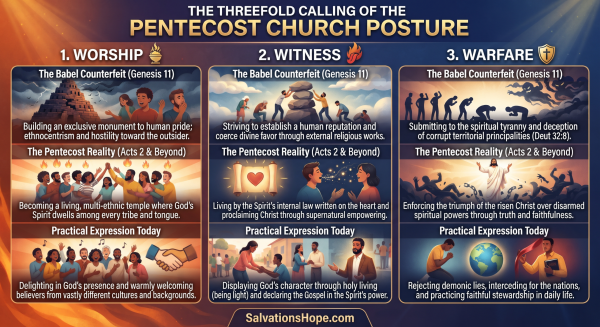
To live faithfully in light of what God launched at Pentecost, the Church is called to embrace three primary postures: Worship, Witness, and Warfare.
The Threefold Calling of the Pentecost Church
Worship: Rejoicing as God’s Multi-Ethnic Temple
The first response to Babel’s reversal is worship—specifically, enjoying our identity as God’s living sanctuary in Christ. Under the New Covenant, we no longer travel to a stone shrine in the Middle East to encounter the divine presence. Through the Spirit, the triune God has taken up permanent residence within individual believers, the local congregation, and the global Church spanning every continent. This reality carries two immediate implications for our worship:
Supreme Adoration of God: Because we are the temple of the living God (1 Corinthians 3:16; Ephesians 2:21–22), our central aim is to magnify the Father’s glory and the exalted name of Jesus. Worship is no longer a pagan transaction meant to manipulate God into serving our agenda; it is our joyful surrender to His indwelling majesty.
Radical Hospitality Across Human Divisions: Throughout history, fallen human nature has consistently gravitated toward tribalism—looking down on, fearing, or despising people from different nations, ethnicities, socioeconomic classes, or cultural traditions. Yet true Spirit-filled worship shatters ethnic pride. When we gather before the throne of grace, we step into the prophetic vision of Revelation 7:9, where a redeemed multitude from every nation, tribe, people, and language stands united before the Lamb. You cannot genuinely worship the God of Pentecost while harboring contempt for the very peoples to whom He poured out His Spirit to unite. In Christ, cultural strangers become family and fellow stones in the same sacred temple.
Witness: Embodying the Inner Law and Speaking in Power
The second way we participate in the reversal of Babel is through witness. In the Old Testament, God called Israel to be a beacon to the surrounding pagan empires, declaring through the prophet Isaiah that He had appointed His covenant people as a light to guide the nations (Isaiah 42:6; 49:6). Jesus directly transferred this vocation to His disciples when He proclaimed in the Sermon on the Mount that His followers are the light of the world (Matthew 5:14). According to Scripture, authentic Christian witness operates on two interconnected levels:
Ethical Witness: Living by the Spirit’s Inner Law
Before we can be a witness, we are something. Under the Old Covenant at Sinai, God engraved His moral standards on external stone tablets, which powerless human hearts repeatedly broke. Under the New Covenant inaugurated at Pentecost, the Holy Spirit writes God’s law directly onto the fabric of our hearts and minds.
We bear witness to the nations first and foremost by being restored imagers of God—displaying true righteousness, integrity, mercy, and holiness in a fractured world. When the Spirit transforms our inner desires so that we genuinely delight in obeying God, our distinct way of life becomes a visible sign that the Kingdom of heaven has arrived on earth.
Verbal and Charismatic Witness: Empowered by the Spirit
While a holy life demonstrates the beauty of the Gospel, people still need to hear the explicit message of salvation in Jesus Christ. Before His ascension, Jesus instructed His disciples not to attempt global mission in their own strength; instead, they were to wait until they received supernatural power from the Holy Spirit, which would equip them to serve as His witnesses from Jerusalem to the ends of the earth (Acts 1:8).
To fulfill this mandate, the Holy Spirit distributes spiritual gifts, ministries, and abilities across the body of Christ. Whether through preaching, teaching, hospitality, mercy, cross-cultural communication, or courageous personal evangelism, the Spirit supplies the exact boldness and capability required to call people out of darkness and into the fellowship of God’s Son.
Warfare: Dispossessing Disarmed Principalities
Finally, participating in the reversal of Babel requires engaging in spiritual warfare. We cannot read the biblical storyline from Deuteronomy 32 and Psalm 82 through the Gospels and Acts without recognizing that reclaiming the nations is a contested invasion.
For millennia following the judgment at Babel, rebellious supernatural powers—what the Apostle Paul calls principalities, authorities, cosmic powers over this present darkness, and spiritual forces of evil in the heavenly places (Ephesians 6:12)—exercised unchallenged dominion over the Gentile world. These hostile entities do not quietly relinquish their former territories. Whether we think of Satan himself or the lesser rebel “sons of God” who have long manipulated human empires, cultures, and institutions, these dark powers fiercely resent having their usurped domains stripped away by the spread of the Gospel.
The Nature of the Conflict: Truth vs. Deception
How, then, do these rebel powers fight back, and how does the Church wage war against them? Crucially, the New Testament declares that at the cross and in the empty tomb, Jesus has already broken their legal and spiritual claim over humanity. As Paul writes in Colossians 2:15, God disarmed the spiritual rulers and authorities and put them to open shame by triumphing over them in Christ. Because the rightful King of the universe has revoked their legitimate authority, the only weapon these defeated powers have left is deception.
Rebel spiritual forces operate like a deposed dictator continuing to issue threats over a radio broadcast after the capital city has already fallen to the liberating army. They whisper lies to individuals, churches, and entire cultures:
- "God does not truly have a claim on every area of your life."
- "This addiction, generational sin, or broken mindset is permanent; you can never be free."
- "This cultural sphere, neighborhood, or unreached nation belongs to darkness and is beyond the reach of Christ's grace."
Disarmed powers can maintain control over a person or a community only if we believe their propaganda. When believers awaken to the truth of God’s Word, renounce the enemy’s lies, and stand firm in Jesus’ finished victory, the illusion of demonic authority collapses. In Christ, we step out of spiritual captivity and into our rightful inheritance as children of the Most High.
Faithful Stewardship and Our Future Reign
Ultimately, our engagement in spiritual warfare prepares us for our eternal destiny. Humanity was created in Eden to govern creation alongside God as His earthly council. In Christ, the redeemed Church is destined to share in the Messiah’s rule over the renewed cosmos (1 Corinthians 6:2–3; Revelation 5:10; 22:5).
Right now, our earthly lives are a training ground for the future reign. Following Jesus’ parable of the talents, we are called to prove faithful in small, everyday matters—stewarding our minds, families, vocations, and local churches under Christ’s Lordship—knowing that God will eventually entrust His faithful imagers with authority over much greater realms in the age to come.
We must never yield to the intimidation of unseen forces or concede that any corner of human life belongs to the enemy. Yahweh alone holds the right to rule heaven and earth. Therefore, we step into the spiritual fray with realism and unshakable confidence: we recognize that we are in a genuine battle, yet we stand anchored in the promise of 1 John 4:4—that the Spirit of the risen Christ dwelling within us is infinitely greater than any rebel power that remains in the world.
The Grand Arc from Babel to Pentecost
As we conclude this study, take a moment to trace the breathtaking coherence of the biblical narrative:
Creation & Eden (Genesis 1–2): God, surrounded by His heavenly Divine Council, creates humanity as His earthly imagers to dwell with Him in the cosmic temple of Eden and extend His benevolent rule across the earth.
The Threefold Fall (Genesis 3–11): Through the rebellion in Eden, the pre-flood corruption of the Nephilim, and the defiant ziggurat at the Tower of Babel, humanity attempts to seize autonomy and manipulate the divine. In judgment, God fractures human language and temporarily hands the 70 nations over to lesser supernatural powers (Deuteronomy 32:8–9).
The Abrahamic Rescue Plan (Genesis 12–Malachi): God immediately calls Abraham to form His own covenant people (Israel) to serve as a light to the world. Despite Yahweh’s victories over the gods of Egypt and Canaan, Israel repeatedly succumbs to idolatry, culminating in the departure of God’s glory from the Temple and the scattering of the nation into exile.
The Victory of the Messiah (The Gospels): Jesus, the eternal Son of God and true Israelite, fulfills the covenant, pays for human sin at the cross, disarms the rebel principalities (Colossians 2:15), and launches the new creation through His bodily resurrection.
The Outpouring at Pentecost (Acts 2): The ascended Christ sends the Holy Spirit as wind and fire to fill His followers, turning believers into living temples, transforming the Jewish exile into a multi-ethnic mission force, and reversing Babel’s linguistic and spiritual curse.
The Mission of the Church Today: Indwelt by the same Spirit, we live out the reversal of Babel through unified multi-ethnic worship, holy and empowered witness, and victorious spiritual warfare—until the day when every knee in heaven and on earth bows to Jesus Christ, and God once again dwells face-to-face with His restored imagers in the New Jerusalem.