The Sovereign Christ
The Sovereign Christ and the Ephesian Lampstand
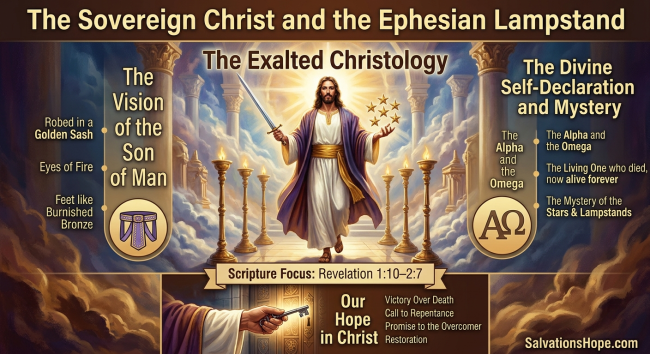
The Exalted Christology (Revelation 1:10–20)
Scripture Focus: Revelation 1:10–2:7
John’s opening vision in the Apocalypse unveils the exalted Christ ministering directly among His assemblies. Far from an abstract cosmic ruler, Jesus reveals Himself as the high-priestly Lord who evaluates, encourages, and corrects His bride. By examining the Christological revelation in Revelation 1:10–20 alongside the specific address to the church at Ephesus in Revelation 2:1–7, we discern both an exegetical framework for Christ’s authority and an applied practical lens through which every contemporary congregation must examine its own posture before God.
The Vision of the Son of Man (vv. 10–16)
John’s encounter on Patmos grounds the prophetic message in divine authority:
The Divine Self-Declaration and Mystery (vv. 17–20)
Christ comforts the overwhelmed apostle by revealing His victory over death and defining the central symbolism of the vision:
“Do not be afraid. I am the First and the Last. I am the Living One; I was dead, and behold I am alive for ever and ever!
And I hold the keys of death and Hades.” (Revelation 1:17–18)
The Evaluation of Ephesus (Revelation 2:1–7)
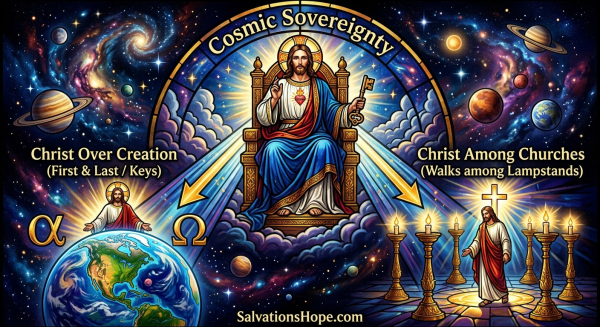
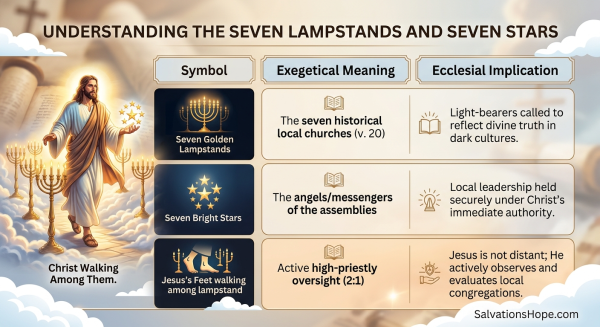
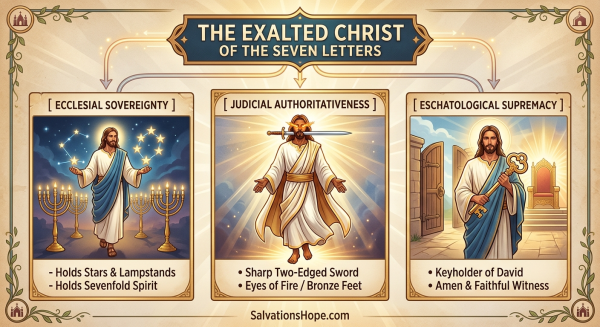
In Revelation 2:1, Jesus presents Himself specifically as the One who “holds the seven stars in his right hand and walks among the seven golden lampstands.” This title directly links His divine authority to Ephesus’s specific conditions.
Commendation for Orthodoxy and Endurance (vv. 2–3, 6)
Ephesus was a fortress of doctrinal integrity:
The Critical Indictment: Abandonment of First Love (v. 4)
Despite flawless orthodoxy, Christ issues a serious divine indictment:
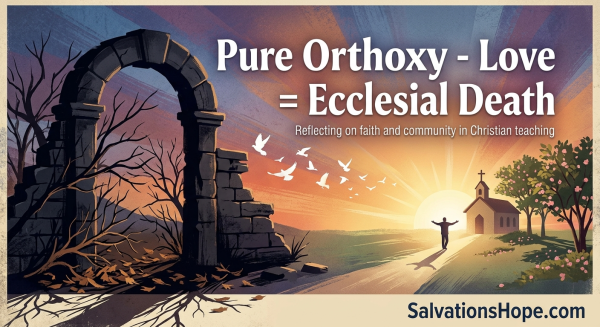
The Ephesian believers had abandoned their “first love” (prōtēn agapēn)—their initial warm, selfless devotion toward God and active love toward one another. Doctrinal correctness had curdled into institutional cynicism and loveless legalism.
The Path to Restoration (vv. 5–7)
Christ outlines a precise three-step remedy for a declining church:
Warning: Failure to repent carries an immediate consequence: “I will come to you and remove your lampstand from its place” (v. 5). A local church can retain its building, leadership, and orthodoxy while losing its spiritual right to represent Christ.
Theological Synthesis and Practical Application
Universal Application to All Assemblies: Revelation 2:7 broadens the local address into a universal imperative: “He who has an ear, let him hear what the Spirit says to the churches.”
The Overcomer’s Promise: To those who persevere in both truth and love, Christ promises access to the “tree of life, which is in the paradise of God”—a direct reversal of the Edenic fall and a pledge of eternal communion with God.
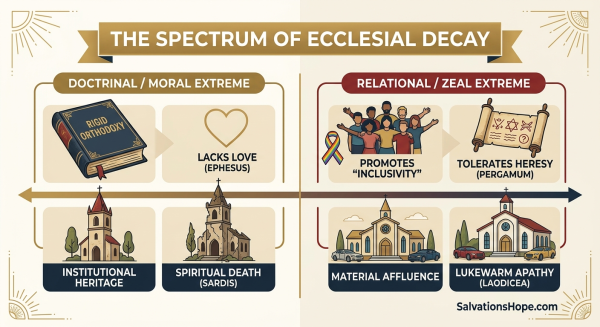
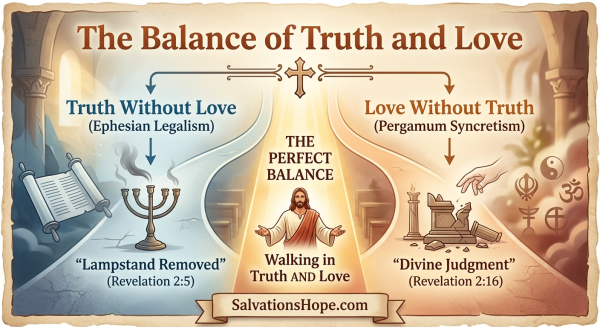
Modern Relevance: Contemporary churches often lean into one of two dangerous extremes: sacrificing biblical truth for cultural acceptance, or defending doctrinal purity while remaining cold, argumentative, and loveless. The exalted Lord demands both uncompromising truth and vibrant, self-giving love.
The Divine Perspective: How Christ Assesses His Assemblies
The Discrepancy of Perception
Scripture Focus: Revelation 2:8–11; 3:1–6, 7–13, 14–22
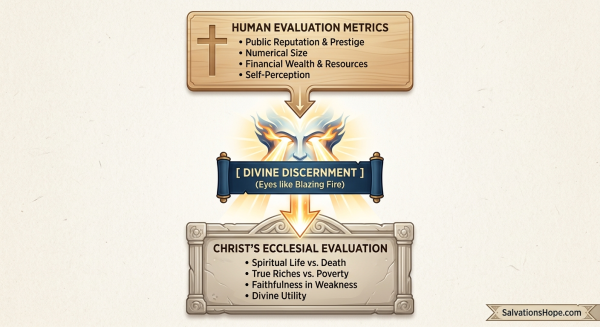
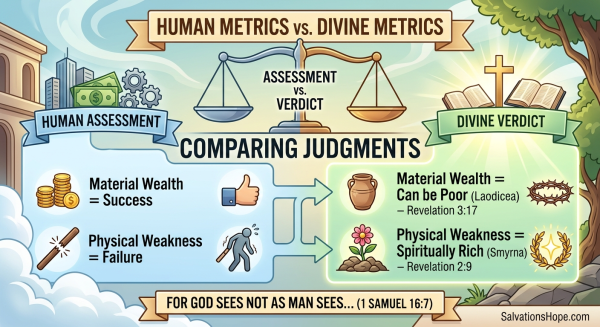
When evaluating a local church’s health and vitality, human analysis consistently relies on external metrics: numerical growth, budget size, community influence, public reputation, or internal self-satisfaction. However, the letters to the seven churches in Revelation show that divine evaluation operates on a different plane.
Jesus Christ—who walks among the lampstands with eyes of blazing fire—sees through institutional appearance, cultural standing, and congregational self-perception. His assessments often invert human judgment.
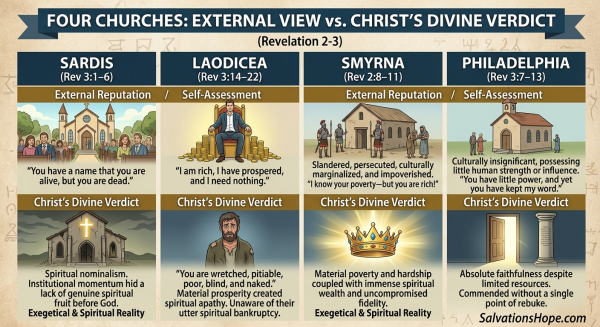
A Comparative Matrix of Divine vs. Human Evaluation
A survey of the remaining assemblies highlights the stark contrast between human opinion (both internal and external) and the authoritative verdict of Christ:
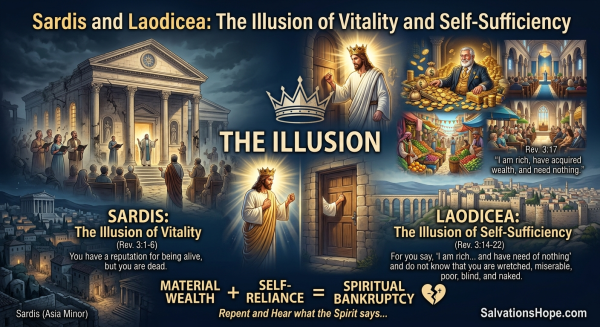
Sardis and Laodicea: The Illusion of Vitality and Self-Sufficiency
The churches in Sardis and Laodicea illustrate the danger of mistaking outward metrics for spiritual life:
Smyrna and Philadelphia: Commendation in Weakness and Suffering
Remarkably, the only two churches that receive no rebuke from Christ are Smyrna and Philadelphia—both of which were weak, impoverished, or under severe pressure:
Core Ecclesial Principle: Human weakness combined with unswerving allegiance to Christ yields maximum spiritual utility. Conversely, human success combined with spiritual compromise yields divine rejection.
The Role of the "Angels" of the Churches
Each address begins with the mandate: “To the angel of the church in…” (tō angelō tēs en… ekklēsias). Scholars have historically offered three primary interpretations regarding the identity of these “angels”:
Theological Signification: Regardless of which view one adopts, the primary point of Revelation 1:20 and 2:1 remains unchanged: Christ holds the “angels” (and, by extension, the local assemblies) directly in Christ’s right hand.
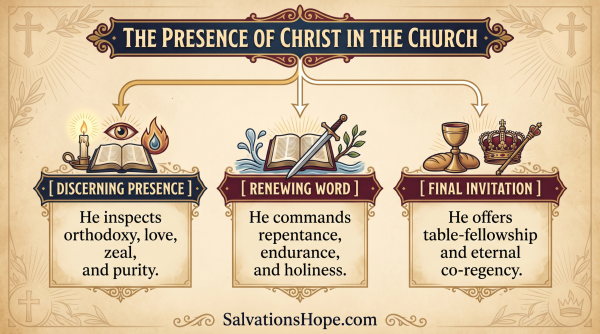
Christ exercises direct, immediate ownership over His assemblies. He communicates to them through His Spirit, inspecting their hearts and holding their leadership accountable to His supreme headship.
The letters to the seven churches serve as a timeless diagnostic tool for every local assembly. We must continuously ask:
Are we defining our success by human praise, numerical size, and material strength, or by unwavering fidelity to the Word of God?
Have we substituted activity and reputation for genuine spiritual life?
To truly align with the Lord of the Church, every congregation must align its self-assessment with Christ’s divine verdict—striving not for culture’s acclaim, but for the commendation of Him whose eyes are like blazing fire.
Structural Architecture of the Seven Letters
The Standardized Sevenfold Pattern
Scripture Focus: Revelation 2:1–3:22
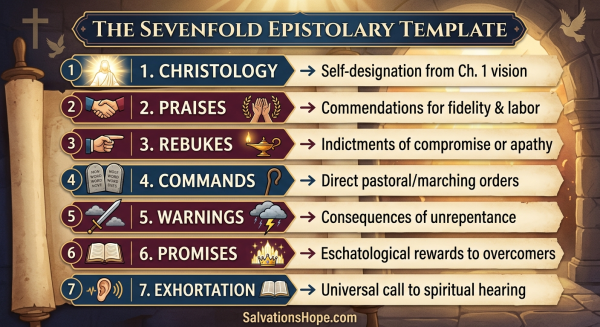
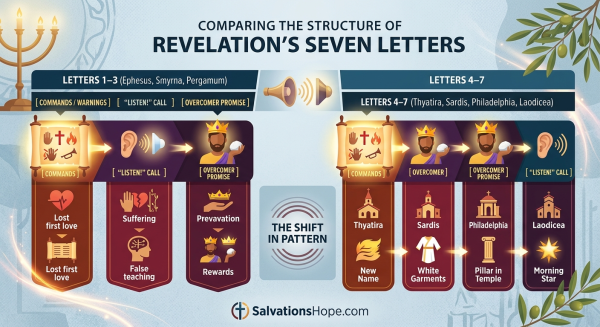
When we analyze the epistles to the seven assemblies, we find a remarkably consistent structural architecture. Rather than using varied, ad hoc epistolary styles, Christ employs a uniform, seven-part template for each message. This structural consistency reveals a deliberate judicial and pastoral design, reminiscent of ancient Near Eastern covenant treaty formulas and prophetic oracles.
While commentators often preach or teach through these chapters sequentially (letter by letter)—such as in John Stott’s classic work What Christ Thinks of the Church—a synthetic, cross-sectional approach reveals the composite picture of what Christ desires, commends, and corrects across His entire Church.
The Structural Anatomy Explained
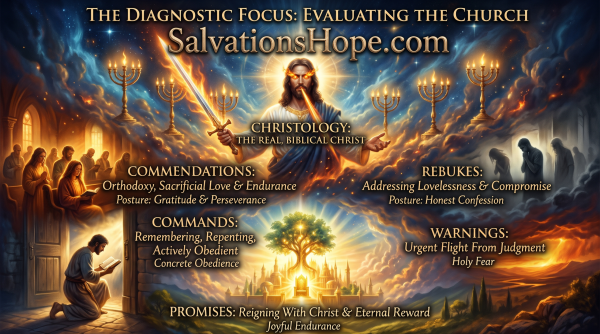
Each letter systematically integrates seven distinct structural elements:
The Christological Title: Christ introduces Himself using imagery tailored to each local assembly’s specific spiritual condition, drawing directly from the vision in Revelation 1 (e.g., holding the seven stars, wielding the sharp two-edged sword, possessing the keys of David).
The Divine Commendation (Praises): Christ highlights the congregation’s strengths, perseverance, orthodoxy, or sacrificial labor. Notably, two churches (Sardis and Laodicea) receive no praise.
The Divine Indictment (Rebukes): Christ exposes areas of spiritual decline, moral compromise, false doctrine, or lukewarmness. Two churches (Smyrna and Philadelphia) receive no rebuke.
The Pastoral Directive (Commands): Regardless of their state, Christ issues clear marching orders—calling them to repent, hold fast, wake up, or endure.
The Judicial Warning: Christ outlines the immediate or eschatological consequences if His directives are ignored (e.g., removing the lampstand, waging war with the sword of His mouth).
The Eschatological Promise: Christ pledges specific eternal rewards to “the one who overcomes” (tō nikōnti), pointing forward to the ultimate fulfillment in the New Jerusalem.
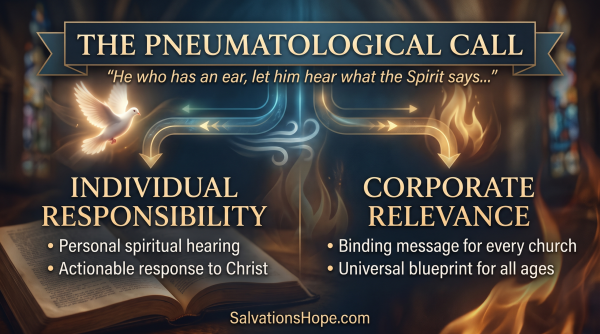
The Pneumatological Call (Listen!): Every letter concludes with an imperative exhortation: “He who has an ear, let him hear what the Spirit says to the churches.”
Structural Micro-Variations and Trinitarian Harmony
Inversion of the Closing Elements: While all seven elements are present across the letters, their sequence undergoes a notable shift after the third letter:
This structural divide creates a 3+4 macro-grouping across the seven epistles, a common numerical motif throughout the Apocalypse.
Trinitarian Voice and Spiritual Perception
The closing imperative highlights a profound Trinitarian dynamic in biblical revelation:
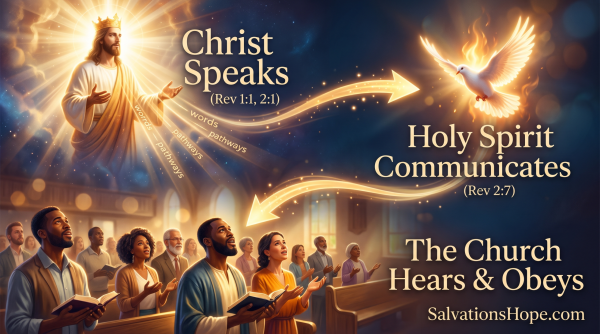
The Voice of Christ is the Voice of the Spirit: Although Jesus Christ directly speaks these letters to John, the closing refrains affirm that these words are also “what the Spirit says to the churches.”
Hearing the voice of the resurrected Savior requires spiritual ears given by the Holy Spirit. This universalizing formula also demonstrates that while each letter had an immediate historical recipient, every message carries binding authority for all churches throughout redemptive history.
Methodological Roadmap for Synthetic Study
To build a comprehensive theological understanding of Christ’s evaluation of His Church, our study moves forward by examining each structural element as a composite whole:
Synthetic Christology: The True Lord of the Church
Dismantling the Imaginary Jesus
Scripture Focus: Revelation 2:1, 8, 12, 18; 3:1, 7, 14
A central danger facing the modern church is constructing a domesticated, culturally palatable Christ—an “imaginary Jesus” crafted by human imagination rather than grounded in holy Scripture. When confronted with divine judgment, sovereign exclusion, or fierce holy indignation, contemporary voices frequently object: “My Jesus would never do that.”
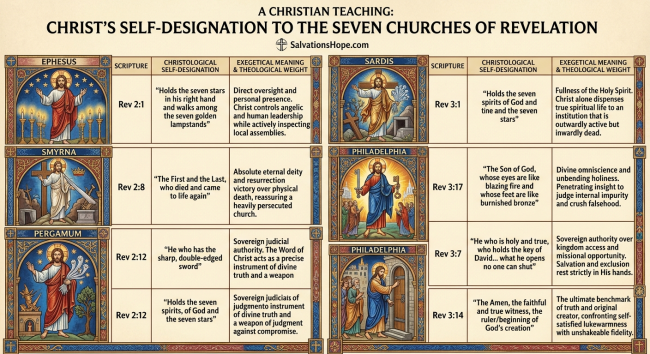
However, the opening self-designations across the seven letters in Revelation shatter sentimental caricatures. Before issuing a single commendation or rebuke, Jesus reveals His authentic, unvarnished character to His assemblies. Each title targets the specific theological and spiritual needs of a local church, collectively presenting a comprehensive portrait of the exalted Lord.
A Comprehensive Survey of Christ’s Self-Designations
The following analytical matrix summarizes the seven Christological self-revelations across Revelation 2–3, detailing their contextual significance and ecclesial weight:
The Immanent High Priest and Spiritual Presence (Ephesus & Sardis)
Christ’s presence is not abstract or distant. He walks among the lampstands (2:1). In 3:1, Christ is also presented as holding the “seven spirits of God” (ta hepta pneumata tou theou), an apocalyptic representation of the Holy Spirit in His complete, divine fullness (cf. Isaiah 11:2, Revelation 1:4).
The Uncompromising Judge (Pergamum & Thyatira)
To churches flirting with moral laxity, syncretism, or false doctrine, Christ presents Himself in terrifying judicial imagery:
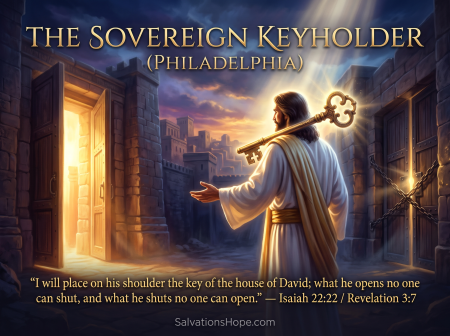
The Sovereign Keyholder (Philadelphia)
To Philadelphia, Jesus assumes the messianic imagery of Isaiah 22:22 (“the key of David”):
Modern theology often prefers an absolute “open door” policy, assuming salvation and opportunities remain perpetually accessible on human terms. Yet Christ asserts His absolute authority to grant or deny entry:
When Christ opens a door of gospel opportunity or kingdom access, no earthly power can obstruct it. Conversely, when He closes a door of grace or divine patience, no human effort can force it open.
The Supreme Witness and Creator (Laodicea)
To self-sufficient Laodicea, Jesus identifies as “The Amen” and the “Ruler/Beginning (archē) of God’s creation” (3:14). Against a congregation deceived by its material wealth, Christ stands as the sole origin of true life and the final arbiter of reality.
Hearing the Real Savior
To hear what the Spirit says to the churches, we must first abandon every reduced, comfortable image of Christ. The Lord who speaks to the churches is both tender and fierce—the resurrected Redeemer who comforts the suffering, yet also the holy High Priest who wields the sword of divine judgment and holds the keys of eternal destiny. True ecclesial health begins when a congregation bows before Christ as He actually reveals Himself in Holy Scripture.
Synthetic Analysis of Divine Commendations (Praises)
The Anatomy of Divine Approval
Scripture Focus: Revelation 2:2–3, 9, 13, 19; 3:4, 8
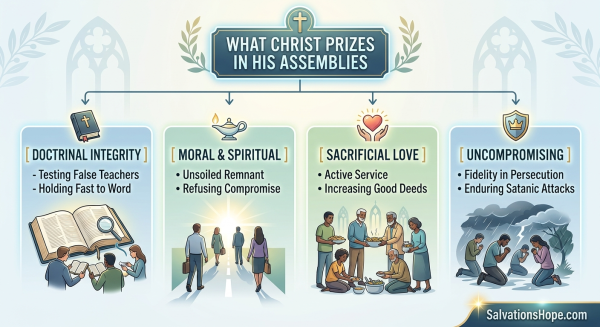
As He evaluates His assemblies, Christ reveals precisely what He prizes in His bride. Divine commendation does not mirror contemporary corporate strategy or cultural popularity; instead, it highlights balanced, multifaceted spiritual health.
When we synthesize the praises across the seven letters, we discover that Christ does not value orthodoxy at the expense of love, nor does He value active service at the expense of moral purity. Instead, He commends a comprehensive matrix of doctrinal fidelity, moral uprightness, persevering love, and unyielding allegiance under pressure.
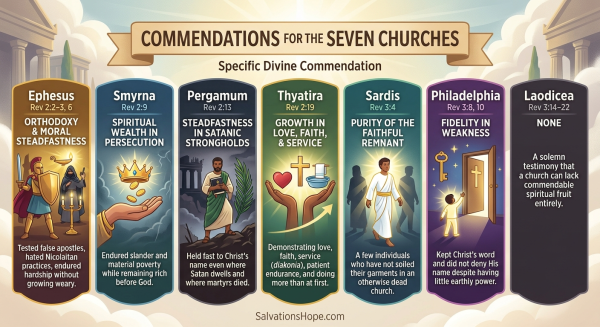
Matrix of Christ’s Commendations Across the Assemblies
The following analytical chart compiles every praise issued by Christ across the seven letters, detailing the specific grace commended and its ecclesial relevance:
Doctrinal Vigilance Combined with Moral Uprightness (Ephesus & Pergamum)
Christ praises Ephesus for rigorous discernment (“you have tested those who claim to be apostles but are not,” 2:2). In an era of rampant theological syncretism, the Ephesians maintained strict doctrinal boundaries and moral fortitude. Similarly, Pergamum held fast to Christ’s name even where “Satan’s throne” stood (2:13).
Spiritual Riches amid Physical Hardship (Smyrna & Philadelphia)
In contrast to modern prosperity theology, Christ measures wealth by spiritual standing rather than material assets:
Christ commends Philadelphia not for its size or cultural leverage, but because it “kept my word and has not denied my name” (3:8). In human terms, weakness often creates the ideal soil for divine power to operate.
Active Love, Faith, and Growth (Thyatira)
While Ephesus was strong in doctrine but cold in affection, Thyatira was praised for its active relational graces: “love, faith, service, and patient endurance” (2:19). Furthermore, Christ notes that their latest works exceeded their first—they were actively growing in practical ministry rather than coasting on past achievements.
The Unsoiled Remnant in Declining Contexts (Sardis)
In His message to Sardis, Christ provides vital encouragement for believers trapped in spiritually lifeless environments. Even when a local institution is designated as “dead,” Christ sees and values every individual who keeps their spiritual garments unsoiled (“they will walk with me, dressed in white, for they are worthy,” 3:4). Corporate spiritual decay never invalidates individual faithfulness.
A Biblical Blueprint for Church Revitalization and Prayer
Synthesizing Christ’s praises provides a balanced framework for evaluating and praying for the contemporary church. Rather than praying unquestioningly or adopting worldly metrics of success, believers can align their prayers directly with what Jesus prizes:
Synthetic Analysis of Divine Indictments (Rebukes)
The Danger of Selective Obedience and Comparative Pride
Scripture Focus: Revelation 2:4–5, 14–15, 20–21; 3:1–2, 15–17
When evaluating a local assembly’s health, people naturally tend to emphasize strengths while overlooking critical defects. A doctrinally sound church may congratulate itself on rejecting heresy while ignoring a cold, loveless culture. Conversely, an active, socially engaged congregation may celebrate its relational warmth while embracing moral laxity or theological syncretism.
Christ’s rebukes shatter this selective self-assessment. He does not evaluate churches on a curve, nor does He let strength in one area offset failure in another. To Christ, partial obedience and imbalanced priorities represent spiritual compromise.
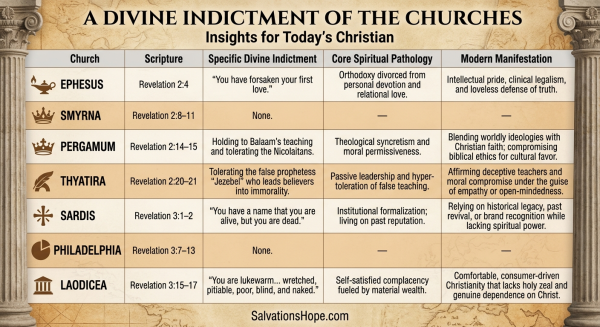
Analytical Matrix of Christ’s Rebukes
The following matrix compiles the divine indictments across the seven letters, identifying the primary sin, its modern manifestation, and its theological danger:
Loveless Orthodoxy: The Ephesian Trap (Rev 2:4)
Ephesus represents a church with exceptional doctrine and high moral standards. Yet Christ threatens to remove their lampstand—invalidating their status as an authentic witness—because they abandoned their “first love” (tēn agapēn sou tēn prōtēn).
Failing to love Christ and one another strips an assembly of its light. Sound doctrine is the required framework for truth, but without fervent love, it becomes a cold, lifeless skeleton.
Permissiveness and Syncretism: Pergamum and Thyatira (Rev 2:14–15, 20)
In sharp contrast to Ephesus, Pergamum and Thyatira leaned toward hyper-tolerance. They welcomed teachings and behaviors that eroded biblical boundaries:
The Doctrine of Balaam (Pergamum): In Numbers 22–25, when Balaam could not directly curse Israel, he instructed King Balak to corrupt them through sexual immorality and idolatrous feasts. In Pergamum, believers practiced syncretism—blending pagan cultural norms with Christian worship.
The Jezebel Spirit (Thyatira): Thyatira tolerated a charismatic false teacher who legitimized moral compromise under the banner of spiritual liberty.
Exegetical Principle: The world prizes cultural tolerance, but Christ condemns tolerating false doctrine and moral laxity within His church.
Institutional Inertia: The Dead Church of Sardis (Rev 3:1–2)
Sardis possessed a sterling public reputation (“a name”), yet Christ diagnosed them as spiritually dead (nekros). This highlights the distinction between tradition and traditionalism: “Tradition is the living faith of the dead; traditionalism is the dead faith of the living.” — Jaroslav Pelikan.
A church can inherit historic buildings, sound creeds, and community respect, yet operate entirely on institutional momentum without present spiritual life or the power of the Holy Spirit.
Material Affluence and Lukewarm Apathy: Laodicea (Rev 3:15–17)
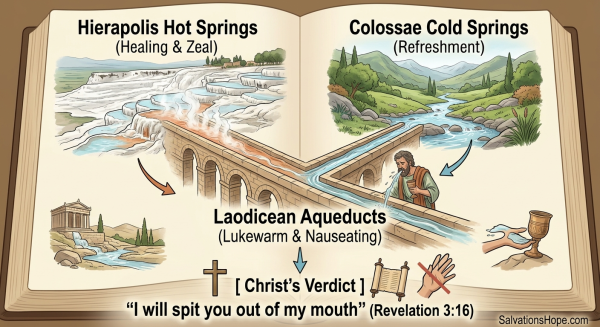
Christ delivers His most stinging indictment to Laodicea. Drawing on local geography—where nearby Hierapolis had hot thermal springs, and Colossae had cold, refreshing water—Laodicea had only lukewarm, nauseating water piped through aqueducts.
Christ uses this metaphor to describe their spiritual posture: they were neither hot (bringing healing and zeal) nor cold (bringing refreshment), but lukewarm (chliaros)—self-satisfied, self-reliant, and spiritually blind.
Overcoming Comparative Pharisaism in the Local Church
Christ’s rebukes warn against the Pharisee’s spirit: “God, I thank you that I am not like other men” (Luke 18:11). When congregations compare themselves to others, they risk celebrating their strengths while ignoring their own blind spots.
To maintain true spiritual health, a congregation must avoid comparing itself to neighboring churches and instead submit entirely to the Lord of the Church’s evaluation.
A Call to Comprehensive Self-Examination
The composite view of Christ’s rebukes forces every assembly to ask hard diagnostic questions:
In our commitment to truth, have we lost our love for Christ and one another?
In our desire to be welcoming, have we compromised biblical doctrine or moral purity?
Are we relying on a past reputation while spiritually dead in the present?
Has material comfort made us self-satisfied and lukewarm toward the Gospel?
Only when a church honestly confronts Christ’s rebukes can it hear His pastoral commands, embrace His warnings, and receive His glorious promises to the overcomer.
Synthetic Analysis of Divine Directives (Commands)
The Imperatives of the Resurrected King
Scripture Focus: Revelation 2:5, 10, 16, 25; 3:2–3, 11, 18–20
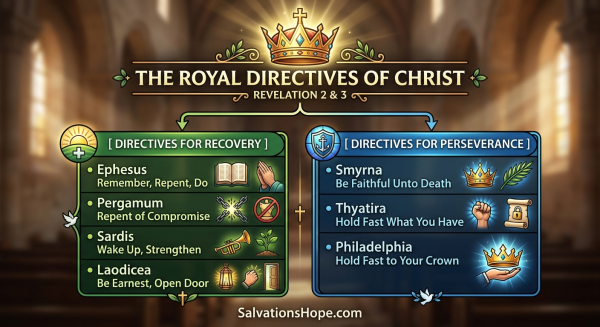
Christ does not leave His assemblies in their compromised or struggling conditions. Whether addressing a church that receives glowing praise or one exposed under divine rebuke, the Lord of the Church issues clear, authoritative directives. These pastoral commands provide a precise prescription for spiritual health, renewal, and perseverance.
Taken together, Christ’s commands reveal that the ultimate antidote to every ecclesial ailment—whether lovelessness, syncretism, institutional deadness, or Lukewarmness—is a radical return to Christ Himself: more of His presence, more of His righteousness, and unwavering fidelity to His Word.
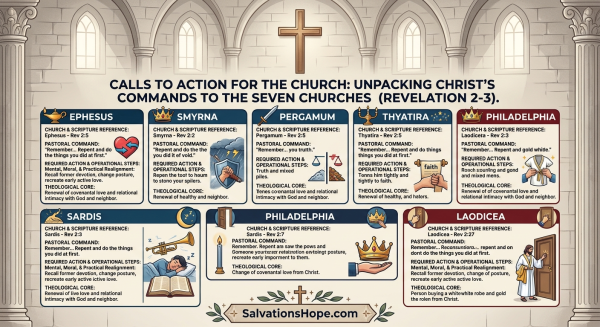
Analytical Matrix of Christ’s Directives Across the Seven Letters
The following chart compiles every command issued by Christ across Revelation 2–3, highlighting the pastoral imperative, the required action, and its theological core:
Realign the Mind & Practice (Remember, Repent, Do): Ephesus, Pergamum, Sardis. Christ requires an active, deliberate turn. Renewal does not occur through passive regret.
Memory as a Diagnostic: Believers must evaluate where current spiritual life falls short of early devotion (“Remember the height from which you have fallen”).
Decisive Repentance: Repentance (metanoia) demands a radical change of mind resulting in transformed action—severing false doctrine and abandoning institutional self-reliance.
Strengthen and Hold Fast: Sardis, Thyatira, Philadelphia. In environments of decay or extreme weakness, Christ commands His people to guard what remains:
Strengthening the Remnant: Even in a dead church like Sardis, faithful individuals exist. Christ commands them to fan into flame the lingering sparks of true faith (“strengthen what remains and is about to die”).
Tenacious Retention: To churches resisting false teaching or bearing hardship in weakness, the command is simple: Hold fast (kratēsate). Stability under pressure is victory.
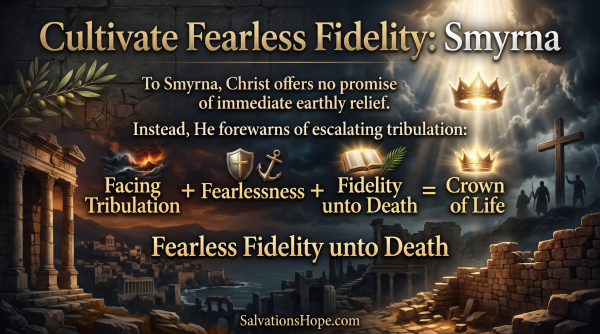
Cultivate Fearless Fidelity: Smyrna.
To Smyrna, Christ offers no promise of immediate earthly relief. Instead, He forewarns of escalating tribulation:
Faithfulness doesn’t depend on comfortable circumstances; it is an unyielding commitment to Christ that endures through physical suffering and death.
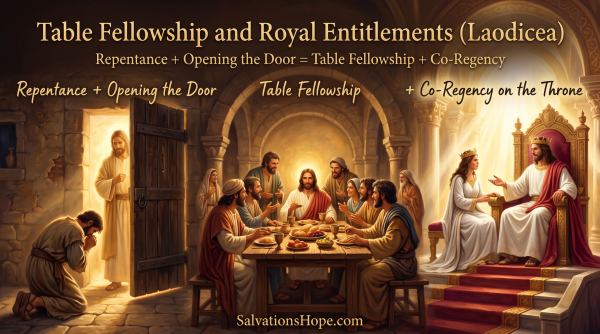
Open the Door to Christ’s Fullness: Laodicea.
The command to Laodicea contains one of the most poignant images in apocalyptic literature:
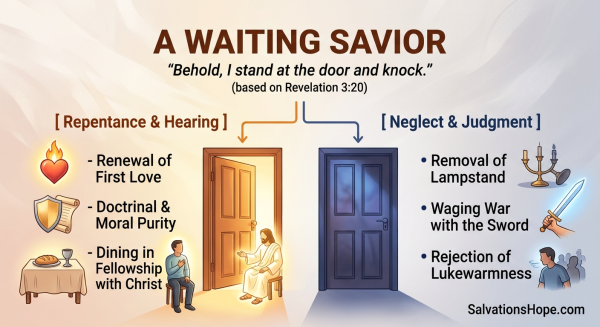
“Here I am! I stand at the door and knock. If anyone hears my voice and opens the door,
I will come in and eat with him, and he with me.” (Revelation 3:20)
Although often applied to personal evangelism, this text is, in context, an ecclesial invitation. Christ stands outside His own lukewarm church. He commands the assembly to acknowledge its spiritual poverty and restore true table-fellowship with its Lord.
"More Jesus" as the Unified Cure
A synthetic reading of these seven commands demonstrates that Christ never prescribes worldly solutions or organizational fixes for spiritual decline. The cure for every church problem is direct, unhindered communion with Jesus Christ:
Synthetic Analysis of Divine Warnings (Judicial Consequences)
Confronting the Domesticated Christ
Scripture Focus: Revelation 2:5, 16, 22–23; 3:3, 16, 19
In contemporary Christian discourse, the severe warnings of Revelation are frequently soft-pedaled or reinterpreted to align with a culturally non-threatening image of God. Many envision a Jesus who is entirely benign—a “declawed” Savior incapable of holy indignation, judicial strike, or active discipline against His own assemblies.
However, the letters to the seven churches show that the exalted Lord, who holds the keys of death and Hades, also exercises real, temporal, and direct judgment over His congregations. Christ’s warnings are not mere hyperbole; they are solemn covenantal threats designed to shock sleeping, compromising, or loveless churches out of spiritual apathy before His final hand of judgment falls.
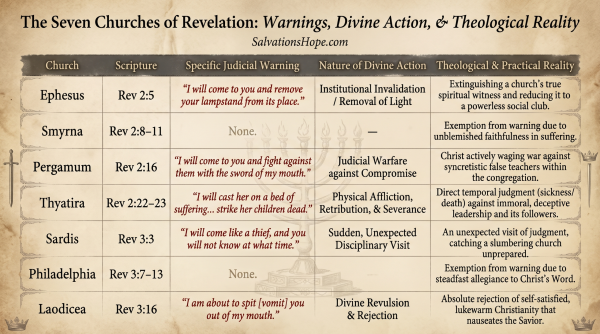
Analytical Matrix of Christ’s Warnings Across the Seven Letters
The following chart outlines the judicial warnings across Revelation 2–3, identifying the triggered consequence, its manifestation, and its theological framework:
The Removal of the Lampstand (Ephesus)
To Ephesus, Christ threatens to remove their lampstand (kinēsō tēn lychnian sou). This warning does not necessarily mean the immediate physical shutdown of the local assembly. A church can retain its building, maintain its budget, elect officers, and preach orthodox sermons—yet have its lampstand removed.
Ecclesial Principle: When Christ removes a lampstand, He strips the assembly of its spiritual right, power, and authority to bear His light. The outward shell remains, but the Spirit’s internal presence and power are gone.
Divine Warfare with the Word (Pergamum)
To Pergamum, Christ warns: “Repent therefore! Otherwise, I will come to you soon and fight against them with the sword of my mouth” (2:16).
The Fallacy of a Harmless Savior: Popular theology often contrasts a “harsh” Old Testament God with a “gentle” New Testament Jesus. Yet here, Christ Himself promises to wage war against false teachers who promote syncretism and moral permissiveness.
The Instrument of Judgment: The weapon is the sharp, two-edged sword (rhomphaia oxeia)—the authoritative, discerning Word of God that judges those who pervert divine truth (cf. Heb 4:12, Rev 19:15).
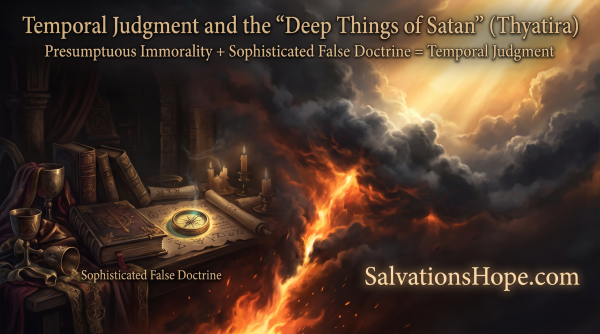
Temporal Judgment and the “Deep Things of Satan” (Thyatira)
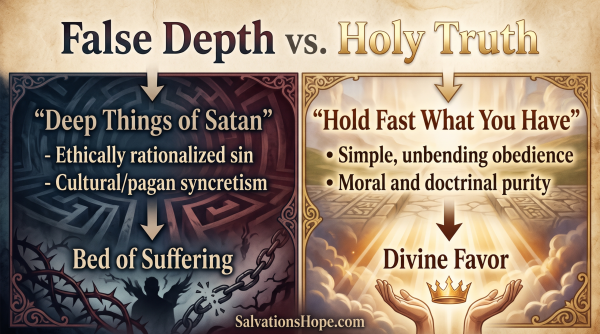
In Thyatira, a false prophetess (“Jezebel”) enticed believers into moral compromise and syncretism under the guise of exploring “deeper truths.” Christ exposes these pseudo-intellectual flexes for what they really are: “the deep things of Satan” (ta bathe tou Satana, 2:24).
Christ’s warning to Thyatira is among the most severe in the New Testament:
Physical Judgment: He threatens to cast her onto a bed of intense suffering (klinēn) and strike her followers with sickness and death (2:22–23).
Vindication of Omniscience: “Then all the churches will know that I am he who searches hearts and minds, and I will repay each of you according to your deeds” (2:23). Physical affliction within a congregation can soberly and publicly vindicate Christ’s unbending holiness.
Historical Visitations: Coming “Like a Thief” (Sardis)
When Christ warns Sardis that He will come “like a thief” (3:3), the context extends beyond His final Second Coming (Parousia). Throughout biblical history, God makes intermediate, temporal visitations in judgment against cities, empires, and churches.
Today, all seven physical locations addressed in Revelation lie in ruins or under vastly different cultural conditions. Christ’s warnings were historically validated; the lampstands were removed when repentance was withheld.
Holy Nausea and Covenant Love (Laodicea)
To Laodicea, Christ uses visceral language: “I am about to spit [vomit] you out of my mouth” (3:16). Lukewarmness—claiming Christ’s name while operating in complete self-sufficiency and moral indifference—elicits divine revulsion.
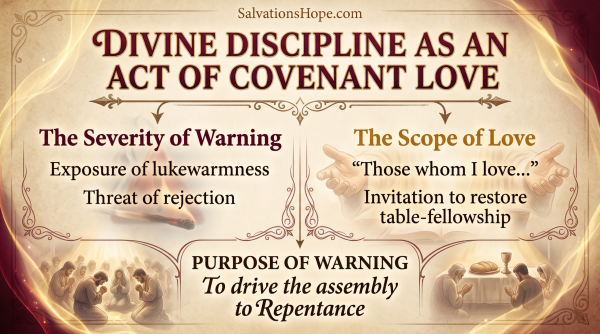
Yet, immediately following this terrifying warning, Christ reveals His true heart:
“Those whom I love I rebuke and discipline. So be earnest and repent.” (Revelation 3:19)
Warnings as Mercy
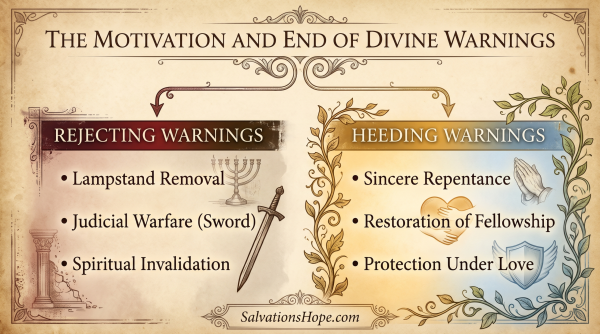
Far from contradicting grace, divine warnings extend Christ’s covenant love. A Savior who never warned His people of danger would be an indifferent, unloving shepherd.
By delivering these fierce, unvarnished warnings, Christ clears away spiritual delusion, exposes the catastrophic cost of unrepentant compromise, and offers every assembly a clear window of mercy to turn, repent, and be fully restored to Him.
Synthetic Analysis of Eschatological Promises
The Reward of the Overcomer
Scripture Focus: Revelation 2:7, 11, 17, 26–28; 3:5, 12, 20–21
While Christ’s warnings shock compromised churches out of apathy, His promises provide enduring hope that sustains believers through trial, temptation, and persecution. At the conclusion of every letter, Jesus extends a glorious eschatological promise to “the one who overcomes” (tō nikōnti).
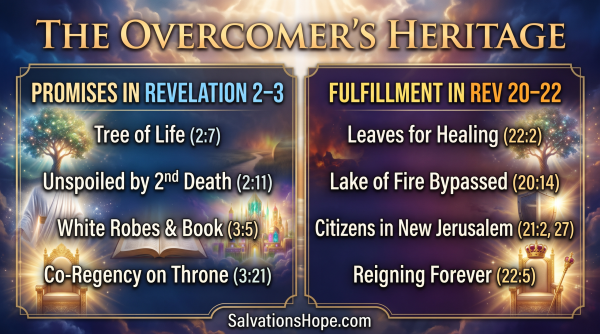
These promises are not abstract rewards; they organically foreshadow the final state described in Revelation 21–22. Everything promised to the local churches in Revelation 2–3 finds its ultimate realization in the New Jerusalem—the Tree of Life, eternal fellowship with God, freedom from the second death, and co-regency with the Lamb.
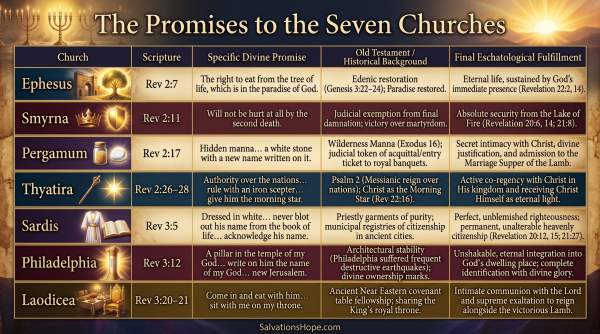
Analytical Matrix of Christ’s Promises Across the Seven Letters
The following matrix synthesizes the seven overcomer promises, highlighting their symbolic background, soteriological meaning, and final eschatological fulfillment:
Reversal of the Fall and Final Justification (Ephesus, Smyrna, Pergamum)
The Tree of Life (Ephesus): After the Fall, Adam was exiled from the Tree of Life (Genesis 3:24). Christ promises the overcomer unrestricted access to this tree in God’s paradise (paradeisos), symbolizing full restoration of eternal life and communion.
Immunity from the Second Death (Smyrna): Physical martyrdom may claim the believer’s temporal body, but Christ guarantees that the “second death” (ho deuteros thanatos)—eternal separation in the Lake of Fire—has zero power over them.
The White Stone and Hidden Manna (Pergamum): In contrast to eating meat sacrificed to idols, overcomers feed on Christ, the true Manna. The white stone (psēphon leukēn) serves as both an official token of acquittal in the divine court and a private ticket of admission into heaven’s messianic banquet, inscribed with a unique covenant name known only to God and the recipient.
Sovereignty and Unshakable Identity (Thyatira, Sardis, Philadelphia)
Messianic Rule and the Morning Star (Thyatira): Citing Psalm 2:8–9, Christ promises that believers who resist Jezebel’s spiritual prostitution will share in His messianic authority over the nations. Furthermore, receiving the “morning star” is receiving Christ Himself (Revelation 22:16)—the dawn of eternal glory.
White Garments and the Heavenly Register (Sardis): In contrast to Sardis’ dead reputation, true overcomers receive bright, clean linen representing the imparted righteousness of Christ. Their names are permanently secured in the Lamb’s Book of Life (biblos tēs zōēs), publicly validated before the Father and His angels (cf. Matthew 10:32).
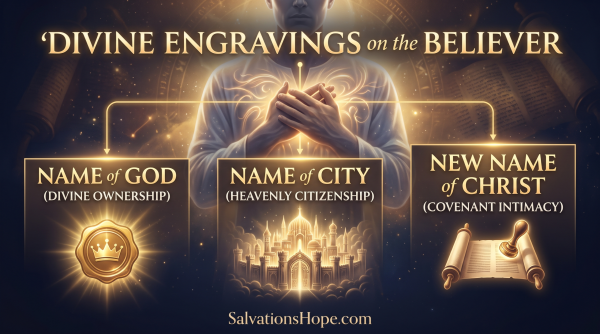
The Unshakable Pillar (Philadelphia): Severe earthquakes in AD 17 decimated Philadelphia, forcing citizens to flee the city repeatedly. Christ promises overcomers that they will become pillars in God’s sanctuary—symbolizing absolute permanence, safety, and stability. God engraves three divine titles upon them: His own Name, the name of the New Jerusalem, and Christ’s new Name, signifying divine ownership and citizenship.
Table-Fellowship and Royal Entitlements (Laodicea)
To the lukewarm church that locked Christ outside, Jesus offers the highest promise of all:
“To him who overcomes, I will give the right to sit with me on my throne, just as I overcame and
sat down with my Father on his throne.” (Revelation 3:21)
This is the ultimate elevation of redeemed humanity. Christ does not merely save believers; He exalts them to share in His sovereign, eternal administration over creation.
The "Listen Up!" Imperative
Having systematically surveyed Christ’s self-designations, commendations, rebukes, directives, warnings, and promises across the seven epistles, we arrive at the overarching refrain that concludes every single letter:
“He who has an ear, let him hear what the Spirit says to the churches.” (Revelation 2:7, 11, 17, 29; 3:6, 13, 22)
The Ultimate Takeaway for the Contemporary Church
Hear Objectively: We must evaluate our local churches not by human popularity, numerical size, or financial success, but through the sharp, penetrating eyes of Christ.
Pursue Comprehensive Balance: A healthy church must refuse to choose between orthodoxy and love, doctrinal vigilance and relational service, or moral integrity and evangelistic zeal.
Focus Entirely on Christ: The ultimate remedy for spiritual decay, dead traditionalism, or lukewarm self-sufficiency is a return to Jesus Christ—receiving His righteousness, bowing to His authority, heeding His warnings, and anchoring our hope in His glorious promises.
The Universal Imperative — "He Who Has an Ear, Let Him Hear"
The Unvarying Refrain
Scripture Focus: Revelation 2:7, 11, 17, 29; 3:6, 13, 22
Across the seven letters to the churches of Asia Minor, Christ adapts His self-revelations, commendations, rebukes, commands, warnings, and promises to each assembly’s specific circumstances. Yet, amidst this contextual variety, one element remains absolute and unvarying: the closing imperative. Seven times, with drumbeat consistency, the exalted Lord issues the same solemn command:
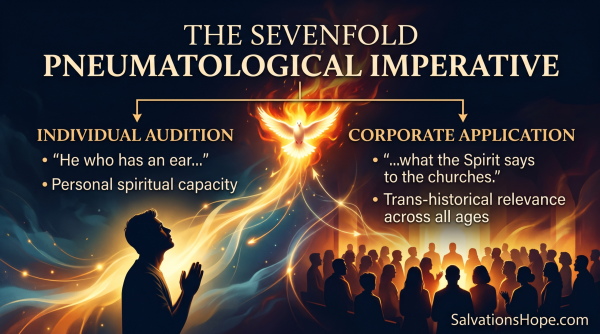
“He who has an ear, let him hear what the Spirit says to the churches.” (Revelation 2:7, 11, 17, 29; 3:6, 13, 22)
This recurring refrain shifts the messages from local 1st-century correspondence into a timeless, binding summons for every believer and congregation throughout redemptive history.
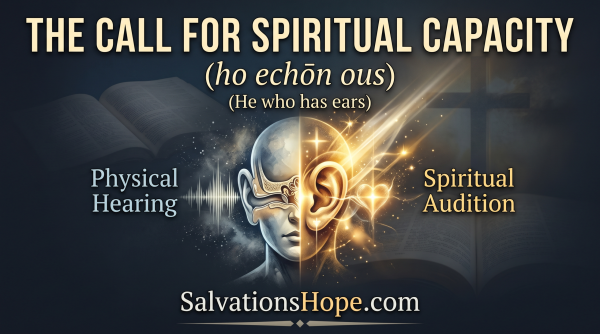
The Call for Spiritual Capacity (ho echōn ous)
The phrase “He who has an ear” echoes the teaching methodology of Jesus during His earthly ministry (cf. Matthew 11:15, 13:9; Mark 4:9). In the Synoptic Gospels, Jesus used this phrase when revealing the mysteries of the Kingdom of God, distinguishing between physical hearing and Spirit-imparted comprehension.
An individual or congregation can physically hear Scripture read, analyzed, and preached, yet remain deaf to its divine summons. Spiritual hearing requires a heart regenerated and illuminated by the Holy Spirit.
The Trinitarian Voice: Christ Speaking Through the Spirit
The refrain presents a profound Trinitarian unity in divine revelation:
Although Jesus Christ directly delivers these oracles to John, the closing refrain explicitly identifies His words as “what the Spirit says” (ti to Pneuma legei). The Godhead is in complete harmony: the exalted Son speaks, and the Holy Spirit applies His voice directly to the Church’s conscience and heart.
Plural Audience: From “Church” to “Churches”
While each letter addresses a specific local assembly in the singular (tē ekklēsia), the closing refrain shifts to the plural (tais ekklēsiais). This deliberate grammatical expansion demonstrates three critical truths:
Universal Scope: What Christ said to Ephesus, Smyrna, or Laodicea was meant to be heard and applied by the six neighboring assemblies.
Trans-Historical Authority: The seven letters form a comprehensive composite template designed to instruct, evaluate, and correct the Church in every age.
Dual Responsibility: The call addresses the congregation corporately (“the churches”) and the believer individually (“He who has an ear”).
Diagnostic Matrix for Contemporary Hearing
To truly “hear” what the Spirit is saying, a local church must apply the complete sevenfold framework as a diagnostic grid:
Walking Before the Lord of the Lampstands
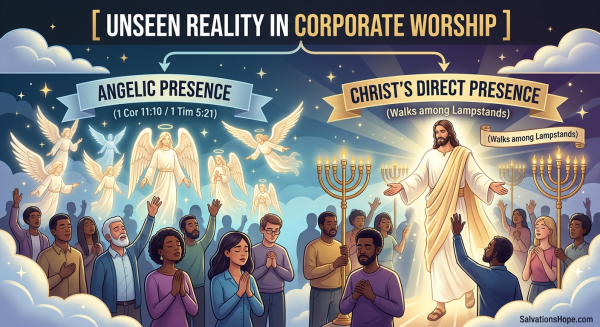
The Book of Revelation opens not with a timeline of end-time events, but with a confrontation between the exalted Christ and His local churches. Jesus walks among the golden lampstands today. He holds our leaders in His hand, inspects our ministries, weighs our motives, and speaks to our condition.
A congregation’s health, viability, and eternal fruitfulness depend on its willingness to drop its self-defenses, abandon institutional pride, and bow before the Savior’s Word.
May God grant us spiritual ears to hear, hearts to repent, and faith to overcome—until the Lord of the Church returns in all His brilliance to gather His bride into the eternal Paradise of God.