

Ministry Of Presence Among People Experiencing Homelessness
Introduction
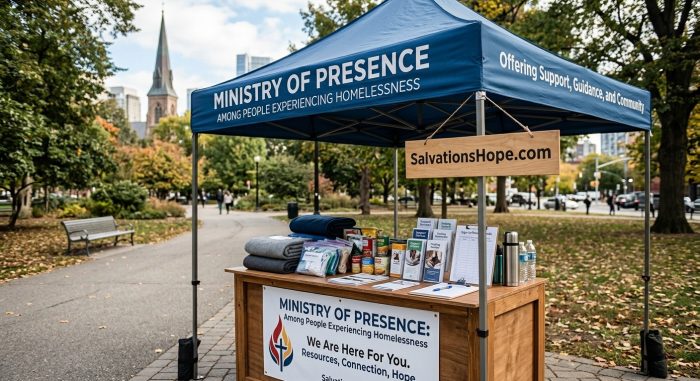
Presence may sound simple, but in ministry among people experiencing homelessness, presence is often one of the most powerful gifts a Christian can bring. Many people who live without stable housing have experienced being ignored, rushed, judged, avoided, used, managed, or treated as a problem to be solved rather than as a person to be known. Salvation's Hope Homeless Community ministry enters this field differently.
Salvation's Hope Ministers and Chaplains come as a steady Christian presence—humble, respectful, prayerful, and aware of boundaries. Salvation's Hope Ministers do not come to take over the work of shelters, social workers, counselors, law enforcement, medical providers, recovery specialists, or housing agencies. Salvation's Hope comes to offer spiritual care, dignity, listening, prayer when invited, Scripture with consent, and wise connection to proper support when needed. The ministry of presence is not passive. It is not merely standing nearby. It is the faithful act of being available, attentive, emotionally steady, spiritually grounded, and practically wise in places where people often feel unseen. For people experiencing homelessness, this kind of presence can become a quiet witness to the nearness of Christ.
Our ministry is dedicated to supporting grieving individuals, particularly those that may feel isolated in their sorrow. We understand that homelessness can be overwhelming, and the path to healing often feels lonely, especially for those who don’t typically attend church. Our mission is to create a safe, compassionate environment where they can share their experiences and emotions without judgment.




1. Jesus Saw People Others Overlooked:
The Gospels repeatedly show Jesus noticing people others ignored. He saw the sick. He saw the poor. He saw the grieving. He saw the ashamed. He saw people pushed to the edges of community life. He saw people who were known by their condition, reputation, or social location, and he restored their personhood. In Matthew 9:36, we read: “But when he saw the multitudes, he was moved with compassion for them, because they were harassed and scattered, like sheep without a shepherd.” — Matthew 9:36. Jesus did not look at people as interruptions. He saw their condition with compassion.
The words “harassed and scattered” describe more than inconvenience. They point to vulnerability, exhaustion, exposure, and lack of safe guidance. Many people experiencing homelessness know something of that scattered life. Their days may be shaped by where to sleep, where to eat, where to shower, where to store belongings, how to stay safe, how to avoid theft, how to manage weather, how to face shame, and how to keep going when hope feels thin. A Christian who follows Jesus learns to see before speaking. Seeing does not mean staring. It means noticing with compassion. It means refusing to reduce someone to a tent, a shelter bed, a meal ticket, a smell, an addiction struggle, a criminal record, a diagnosis, or a difficult behavior. The person before you is an image-bearer.
2. Presence Protects Dignity:
People experiencing homelessness often lose privacy. Their needs become public. Their struggles may be discussed by agencies, volunteers, police officers, medical workers, family members, strangers, and church people. Their belongings may be visible. Their hygiene challenges may be noticeable. Their conflicts may unfold in public spaces. This makes dignity protection essential. Salvation's Hope Ministers and Chaplains protect dignity by speaking respectfully, using names, listening without rushing, lowering the volume of sensitive conversations, avoiding unnecessary attention, and refusing to turn pain into a public lesson. Dignity protection also means avoiding language that reduces people to a category. A person may be experiencing homelessness and still be a father, mother, son, daughter, veteran, worker, musician, believer, seeker, survivor, sinner, sufferer, friend, neighbor, and someone loved by God. Genesis 1:27 says: “God created man in his own image. In God’s image he created him; male and female he created them.” — Genesis 1:27. The image of God is not erased by poverty, addiction, mental illness, trauma, failure, unemployment, family breakdown, or unstable housing. Salvation's Hope never treats dignity as something people earn by behaving well. Dignity is rooted in creation. Every person is an image-bearer before they are a ministry recipient.
3. Presence Is Not Rescue:
One of the great dangers in homeless community ministry is confusing compassion with rescue. Compassion is Christlike. Rescue behavior can become unsafe, controlling, confusing, or even harmful. A rescuer may overpromise. A rescuer may give money impulsively. A rescuer may offer rides without accountability. A rescuer may create private communication patterns. A rescuer may ignore shelter rules. A rescuer may try to become the one person a vulnerable individual depends on. A rescuer may feel needed, important, or heroic. A Christian must choose a better way. Presence says, “I will walk with you in this moment. ”Rescue says, “I will fix your whole life. ”Presence says, “Let’s find the right person or agency to help with that need. ”Rescue says, “I can handle this myself. Salvation's Hope role is to bear witness to Christ through faithful care, not to become the center of someone’s survival system. This is especially important because people experiencing homelessness may already be facing dependency pressures, survival decisions, unstable relationships, and repeated disappointment.
4. Presence Requires Consent:
Salvation's Hope offers spiritual care, but spiritual care must not be coercive. People experiencing homelessness may feel pressure in ministry settings. They may wonder, “Do I have to listen to a sermon to get food?” “Do I have to pray to receive help?” “Will this person judge me if I say no?” “Will I lose access if I do not respond spiritually?” Salvation's Hope removes that confusion. Prayer is always offered by permission. Scripture is shared with consent. Spiritual conversation is always invited, not forced. A simple question can protect dignity: “Would prayer be welcome right now?” Or: “Would it be okay if I shared a short Scripture that has encouraged many people in hard places? ”If the person says no, we always remain kind. A refusal of prayer is not a rejection of Salvation's Hope worth or of God’s power. It is a boundary to honor. The ministry of Jesus was full of invitation. He did not manipulate people into receiving care. He spoke truth with authority, but he also treated people as moral agents who could respond. In Homeless Community Ministry, consent-based care is not weakness. It is a form of love.
5. Presence Must Be Parish-Aware:
Every ministry setting is a different kind of parish. A hospital room is different from a jail pod. A public school is different from a nursing home. A digital community is different from a recovery ministry. A country club is different from a shelter dining room. Homeless Community Ministry has its own parish characteristics. It often happens in public or semi-public spaces. It may involve shelters, meal programs, warming centers, encampment-adjacent outreach, transitional housing, public libraries, church lobbies, street corners, or community resource events. Privacy may be limited. Safety concerns may be real. Shelter policies may govern what volunteers can do. Staff may already have protocols for crisis situations. People may be tired, hungry, guarded, ashamed, intoxicated, afraid, angry, or spiritually hungry. A parish-aware chaplain asks:
What kind of setting am I in?
Who has authority here? What rules apply?
What would preserve dignity here? What would create risk?
What requires referral or escalation? Do I have permission for this conversation?
For example, praying with someone in a quiet corner of a church meal ministry may be appropriate if permission is given and visibility is maintained. But moving alone into an isolated place with a vulnerable person may be unsafe or against policy. Listening to someone’s pain may be appropriate. Promising housing may not be. Encouraging someone to talk with shelter staff may be wise. Secretly trying to solve the situation alone may be harmful. Salvation's Hope ministry is not only compassionate. It is situationally wise.
6. Presence Listens Before It Speaks:
Many people experiencing homelessness have been talked at. They may have been lectured about choices, questioned about failures, confronted about addiction, criticized for appearance, warned about consequences, or given quick spiritual explanations for complex pain. Listening is not agreement with everything a person says. Listening is the act of honoring the person enough to understand before responding.
Listening helps avoid assumptions. Not everyone experiencing homelessness has the same story. Some have lost housing through job loss, medical bills, family breakdown, addiction, domestic violence, incarceration, untreated mental health strain, grief, eviction, migration, or a combination of many pressures. Some people have made destructive choices. Some have been wounded by others’ choices. Most stories are layered and Salvation's Hope listens for the whole person, not just the visible crisis.
7. Presence Recognizes Whole-Person Need:
Homelessness affects the whole person. It is physical. The body may be tired, hungry, cold, overheated, injured, sick, or sleep-deprived. It is emotional. A person may carry shame, fear, anger, grief, anxiety, numbness, or despair. It is relational. Family ties may be strained or broken.
Trust may be difficult. Loneliness may become normal. It is moral. People may face difficult choices under survival pressure. They may also carry guilt, regret, resentment, or moral injury. It is spiritual. A person may ask, “Where is God?” “Am I being punished?” “Can I be forgiven?” “Does anyone care?” “Is there any hope for me?” Salvation's Hope honors the person as an embodied soul. Spiritual care cannot ignore the body.
Physical suffering often affects spiritual openness. Emotional exhaustion affects how words land. Shame affects whether a person can receive encouragement. Fear affects whether a person can trust. This does not mean Salvation's Hope Ministers become a clinicians or case managers.
It means Salvation's Hope brings spiritual care with whole-person awareness. Sometimes the most spiritual thing any of us can do is speak gently, ask permission, notice exhaustion, and help connect the person to the right practical support.
8. Presence Includes Prayerful Realism:
Christian hope is real, but it must not become shallow. Salvation's Hope avoids phrases that sound spiritual but wound people in pain. We avoid saying:
“Everything happens for a reason.”
“God will never give you more than you can handle.”
“At least you still have...”
“Just have more faith.”
“You need to forgive and move on.”
“If you obey God, this will all turn around quickly.”
These phrases may silence grief, increase shame, or make the chaplain sound unsafe. Biblical hope is deeper than clichés. The Psalms teach lament. Jesus wept. Paul spoke of suffering honestly. The cross reveals that God meets people in pain, not from a distance but through the suffering love of Christ.
Prayerful realism can sound like:
“Lord, be near to your child tonight.”
“Jesus, bring courage for the next step.”
“God, give wisdom, safety, and help through the right people.”
“Father, remind this person that they are seen and not forgotten.”
Prayer does not need to be long to be faithful. In homeless community settings, short prayers are often best—clear, respectful, hopeful, and appropriate to the moment.
9. Presence Works With Others:
Homeless Community ministry is not solo ministry. salvation's Hope works with pastors, shelter staff, outreach leaders, recovery ministries, social workers, medical providers, counselors, law enforcement when needed, and community support systems. This does not mean Salvation's Hope shares private information carelessly. Confidentiality matters. But confidentiality has limits when there is credible concern involving self-harm, suicidal intent, abuse, exploitation, danger to a minor, violence risk, trafficking concerns, medical emergencies, or serious intoxication or overdose concern.
10. Presence Points to Christ Without Pressure:
Salvation's Hope ministers and chaplains are openly Christian, but not coercive. This balance matters. Salvation's Hope does not hide the hope of Christ or use vulnerability as an opportunity to pressure someone spiritually. Colossians 4:5–6 says: “Walk in wisdom toward those who are outside, redeeming the time. Let your speech always be with grace, seasoned with salt, that you may know how you ought to answer each one.” — Colossians 4:5–6. Grace and wisdom belong together.
A Salvation's Hope chaplain or minister may say: “My role is to offer spiritual care and encouragement. I am a Christian chaplain/minister, and I am glad to pray with you if that would be welcome.” This is clear without being forceful. When a person wants to talk about God, Scripture, forgiveness, sin, suffering, salvation, or prayer, Salvation's Hope ministers and chaplains respond with humility and confidence. But timing matters. Tone matters. Permission matters. Public setting matters. Sometimes the most faithful witness is not a long explanation. It is the combination of calm presence, respectful words, prayerful availability, and a life that does not treat people as disposable.