
The Open Door
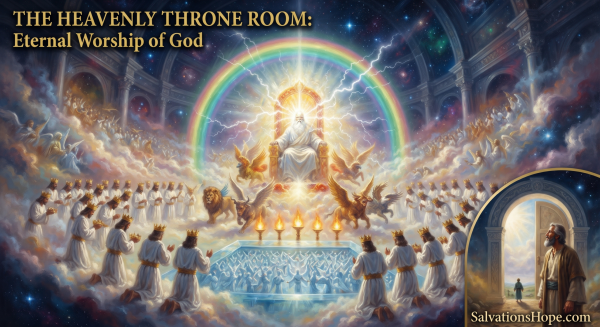
The Heavenly Throne Room
Eternal Worship of God
In Revelation 4, the Apostle John is invited past the veil of the physical world and into the universe’s celestial command center. Writing to persecuted and weary churches throughout the Roman Empire, John does not begin his apocalyptic unveiling with geopolitical turmoil or earthly terrors; instead, he directs their gaze upward.
and there before me was a throne in heaven with someone sitting on it.” (Revelation 4:1–2)
This masterclass in divine perspective shifts our focus from temporary earthly power to God’s ultimate, unshakable sovereignty.
The Sovereign Seated on the Throne
John’s vision centers on the One seated on the throne. Notably, John avoids a direct physical description of God, opting instead for transcendent imagery:
- Precious Stones: The One on the throne possesses "the appearance of jasper and carnelian" (v. 3), reflecting dazzling brilliance and unapproachable light.
- The Emerald Rainbow: Encircling the throne is "a rainbow resembling an emerald" (v. 3). While the rainbow in Genesis 9 served as a covenant of mercy after the flood, its emerald hue here radiates life, restoration, and God's enduring faithfulness amid judgment.
- The Storm of Majesty: "From the throne came flashes of lightning, rumblings, and peals of thunder" (v. 5)—a classic biblical theme of divine holiness and cosmic power, echoing God's dramatic manifestation at Mount Sinai (Exodus 19:16).
The Heavenly Council and Attendants
Surrounding the epicenter of divine glory are the attendants who anchor the eternal liturgy of heaven:
The Twenty-Four Elders
Seated on twenty-four surrounding thrones are elders clothed in white garments with golden crowns (stephanoi) upon their heads (v. 4). Representing the fullness of God’s redeemed people across the Old and New Testaments (the 12 tribes plus the 12 apostles), these elders hold royal priestly dignity, yet immediately redirect their honor to the Creator.
The Seven Spirits of God
Represented by “seven lamps blazing before the throne” (v. 5), this imagery points to the Holy Spirit in full perfection, illuminating the holiness of God’s presence.
The Four Living Creatures
Positioned at the center around the throne are four majestic beings resembling a lion, an ox, a man, and a flying eagle (v. 7). Covered in eyes and six wings, they symbolize creation at its absolute peak—wild beasts, domesticated animals, humanity, and birds of the air—all uniting to acknowledge God. Day and night, they unceasingly proclaim: “Holy, holy, holy is the Lord God Almighty, who was and is and is to come” (v. 8).
Echoes of Holiness: Connecting Revelation 4 to Isaiah 6
John’s vision does not exist in a vacuum; it deliberately echoes the prophet Isaiah’s profound encounter in the Jerusalem temple centuries prior:
they’re constantly calling, ‘Holy, holy, holy is the Lord Almighty…'” (Isaiah 6:1–3)
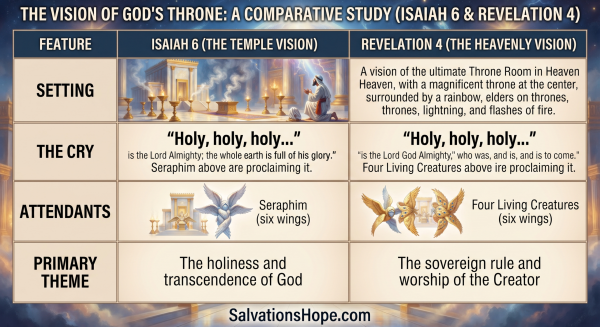
While Isaiah beheld God’s glory filling the earthly temple during a time of national crisis (the year King Uzziah died), John sees the heavenly reality that underlies all history. The God of Isaiah is the God who reigns triumphant in Revelation.
The Architecture of Worship
The climax of Revelation 4 is not merely descriptive; it is doxological. True theology always moves us toward adoration.
- The Proclamation: The living creatures offer unceasing praise to the eternal God (v. 8).
- The Surrender: Triggered by this praise, the twenty-four elders fall prostrate before the throne. They cast their golden crowns—symbols of their authority and victory—before the feet of the Almighty (v. 10).
- The Confession: Their song encapsulates the ultimate foundation of Christian worship:
and by your will they were created and have their being.” (Revelation 4:11)
For the early Christians facing hostility under Roman rule, Revelation 4 served as a vital recalibration. Caesar claimed the titles of lord and savior, demanding absolute allegiance. But the open door in heaven revealed the true King.
As modern believers navigating uncertainty, cultural shifts, and personal trials, the vision of Revelation 4 invites us to step through that same door in spirit. It reminds us that whatever chaos unfolds on earth, the throne is occupied, history is under sovereign care, and our highest calling is to join the eternal chorus: “You are worthy, O Lord.”
The Scroll and the Slain Lamb: Deepening the Theological Tapestry
The text provided captures the dramatic turning point of Revelation 4 and 5—the shift from cosmic despair to transcendent triumph. To expand on this rich theological study, we can explore several deeper dimensions: the structural nature of the scroll, the literary and theological paradox of the “Lion-Lamb,” the missiological breadth of the redemption song, and the practical ecclesiology of worship in times of crisis.
The Nature of the Scroll: More Than Just a Blueprint
While the scroll represents the divine plan for history and the execution of justice, first-century legal and historical backgrounds give the imagery even sharper teeth.
The Roman Deed (Biblion): In the ancient Greco-Roman world, a will or title deed—particularly one involving disputed inheritance or real estate—was often sealed with seven seals by witnesses, following Roman law (Lex Valeria Cornelia). The earth, usurped by the powers of darkness and rebellion, is creation waiting for its rightful Redeemer-Kinsman to claim the title deed.
The Echo of Ezekiel: Like the scroll eaten by the prophet Ezekiel, which was filled with “lamentation and mourning and woe” (Ezekiel 2:10), the scroll in Revelation 5 contains the unfolding judgment of a rebellious world. Yet, the tragedy in Revelation is that the scroll cannot even be read or unlocked, symbolizing that history is gridlocked under the weight of sin and death unless divine intervention breaks the seal.
The Paradox of the Lion-Lamb: Subverting Imperial Power
The juxtaposition in Revelation 5:5–6 is one of the most brilliant literary and theological subversions in all ancient literature.
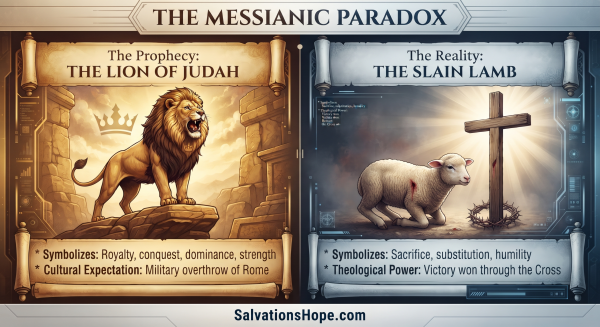
Redefining Conquest: To the persecuted, suffering church in Asia Minor, a “Lion” sounded like a military liberator who would crush Caesar’s legions with physical violence. Instead, God reveals that the true conquest of evil was accomplished not by inflicting death, but by absorbing it.
The Arnion (The Standing Slain): The Greek word used for lamb is arnion (a diminutive, endearing term). John sees this Lamb standing as though slain—bearing the eternal marks of crucifixion—yet alive and standing at the center of the throne. Christ’s scars are not erased in glory; they are the very credentials of His authority. He opens the seals because He bled.
The Multi-Tiered Symphony of Cosmic Redemption
The worship scene in Revelation 5 builds in an expanding wave that sweeps the entire cosmos into the drama of redemption.
The Particularity of Purchase (v. 9): The song of the elders highlights a deliberate multi-ethnic scope: “from every tribe and language and people and nation.” This looks backward to the scattering at Babel (Genesis 11) and forward to the ultimate fulfillment of the Abrahamic covenant—that all families of the earth would be blessed. Salvation is not tribal or nationalistic; it is radically global.
The Royal Priesthood (v. 10): The redeemed are not merely saved from judgment; they are elevated to a dual office: kingdom and priests. As a kingdom, they share in Christ’s rule; as priests, they mediate God’s grace and intercede in a hostile world. Their reigning “on the earth” points both to present spiritual authority and a future renewed creation.
The Doxological Climax (v. 13): Every creature in the universe joins in. The inanimate and animate creation—long subjected to frustration and groaning under the curse (Romans 8:20)—finds its voice through the church’s leadership, uniting the Creator and the Redeemer in a single breath of absolute praise.
Sovereignty as an Anchor for the Church
The ultimate brilliance of placing Revelation 4 and 5 before the chaos of the seals in Chapter 6 is pastoral calibration. “Before a single horseman rides… the text establishes who is running the show.”
When believers face cultural marginalization, institutional hostility, or personal suffering, the human tendency is to look at earthly thrones, economic indices, or political powers and despair. Revelation 5 acts as a spiritual eye-salve. It insists that history is teleological, not cyclical or chaotic.
The future is secure because the One who decrees history is also the One who died for His people. The seals do not slip from the Lamb’s hands; every judgment, every tribulation, and every movement of history is governed by the crucified King, working out His redemptive and purifying purposes for the cosmos.
What particular aspect of this passage—the legal background of the scroll, the subversion of power in the Lion-Lamb paradox, or its pastoral comfort for suffering believers—would you like to explore further?
The Four Horsemen and the Breaking of the Seals
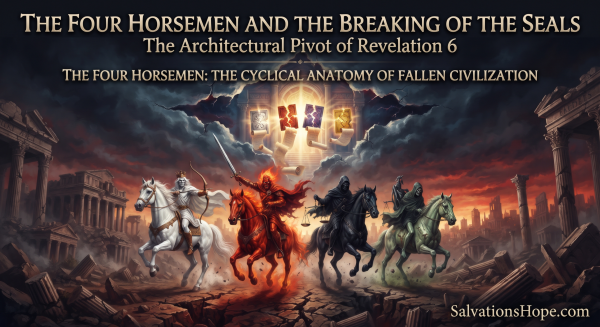
The Architectural Pivot of Revelation 6
Within Revelation’s overarching literary and theological structure, Revelation 6 marks a profound transition. Chapters 4 and 5 establish the absolute sovereign baseline: history is ruled not by blind fate, geopolitical chaos, or cosmic accident, but by the Creator on the throne and the slain Lamb, who alone is worthy to open the scroll.
When chapter 6 opens, the abstract blueprint of history becomes active reality. The breaking of the seals does not initiate a series of arbitrary divine tantrums; rather, it represents the sovereign unsealing of the consequences of human rebellion. The text utilizes apocalyptic imagery—a genre characterized by symbolic, highly charged metaphors—to pull back the veil (apokalypsis) on the spiritual and structural realities operating beneath the surface of human history.
The Four Horsemen: The Cyclical Anatomy of Fallen Civilization
The first four seals introduce the Four Horsemen, summoned by the living creatures with the command, “Come!” Far from being isolated eschatological events confined to a distant future, these riders depict the systemic, self-perpetuating miseries they inflict upon a fallen world. They represent the recurring anatomy of societal collapse:
The White Horse (Conquest):
The Imagery: Armed with a bow and crowned with a stephanos (the victor’s wreath), this rider represents aggressive human ambition, imperialism, and the ideological drive to conquer.
The Theological Meaning: Humanity’s persistent attempt to build empires and secure peace through dominance inevitably plants the seeds of global friction. It is the archetype of secular human autonomy—striving for security and glory apart from God.
The Red Horse (War):
The Imagery: Given a large sword and the authority to strip peace from the earth, this rider is the immediate progeny of unrestrained conquest.
The Theological Meaning: When nations and ideologies live by the ethos of the White Horse, violent conflict is the inevitable harvest. The sword symbolizes mutual destruction, revealing how human communities fracture when driven by rivalry rather than divine shalom.
The Black Horse (Famine and Structural Injustice):
The Imagery: Holding a pair of scales, the rider announces soaring prices for basic staples (“A quart of wheat for a day’s wages…”) while luxury goods (“do not damage the oil and the wine!”) remain untouched.
The Theological Meaning: War systematically destroys agricultural infrastructure, supply chains, and equity. The preservation of oil and wine underscores a tragic historical constant: in times of crisis, systemic economic disparity deepens. The vulnerable absorb the brunt of famine and inflation, while the wealthy easily insulate their comforts.
The Pale Horse (Death and Natural Mortality):
The Imagery: Named Death, and accompanied by Hades, this rider holds authority over a quarter of the earth to execute judgment via famine, plague, and wild beasts.
The Theological Meaning: This echoes the classic prophetic motif of the “four sore judgments” (as seen in Ezekiel 14:21). It represents total biological vulnerability. When conquest, war, and economic starvation break the fabric of society, mortality rushes in to claim its toll.
The Cry from the Altar: The Spiritual Reality of the Fifth Seal
With the breaking of the fifth seal, the lens shifts dramatically from the horizontal plane of geopolitical and physical suffering (earth) to the vertical plane of spiritual reality (heaven).
The Identity of the Martyrs: John sees the souls of those slain “because of the word of God and the testimony they had maintained.” They rest undaunted at the heavenly altar, symbolizing that God views their martyrdom as a holy, sacrificial offering.
The Nature of the Cry: Their plea—“How long, Sovereign Lord… until you judge the inhabitants of the earth and avenge our blood?”—is frequently misunderstood as petty vindictiveness. In the biblical framework, however, this is a prayer for vindication, holiness, and the execution of divine justice. It mirrors the Psalms of lament, asking God to prove His righteousness in a world where wickedness seems to triumph.
The Divine Response: The martyrs are given white robes (symbols of purity, victory, and righteousness) and told to rest a little longer until the full complement of their fellow servants is completed. This reveals a critical theological truth: history continues not because God is blind or indifferent to suffering, but because His patience encompasses a precise redemptive timeline. Grace deliberately grants space for witness, repentance, and the gathering of the full harvest of faith.
The Cosmic Collapse: The Great Reversal of the Sixth Seal
The breaking of the sixth seal brings human history to a breathtaking, terrifying crescendo. The structures of creation itself shudder under the weight of human guilt and divine confrontation.
De-Creation Language: The cosmic signs—a massive earthquake, blackened sun, blood-red moon, falling stars, and a sky receding like a scroll—draw heavily on Old Testament prophetic imagery (such as Isaiah 34:4 and Joel 2:31). The language signifies the unraveling of the created order, demonstrating that human sin impacts the cosmos itself.
The Collapse of Human Hierarchy: In verses 15–17, John lists a comprehensive cross-section of human society: kings, princes, generals, the rich, the mighty, enslaved people, and free men. In the face of ultimate reality, every artificial human distinction—power, wealth, and status—vanishes instantly.
The Universal Panic: Their hiding in caves and crying out for the mountains to fall on them (“Hide us from the face of him who sits on the throne and from the wrath of the Lamb!”) exposes the profound terror of unrepentant humanity encountering absolute holiness. The juxtaposition of the “wrath of the Lamb” is striking: the ultimate judge is the self-sacrificial Savior, indicating that rejecting God’s mercy ultimately leaves only His justice.
Anchored in the Sovereign Blueprint
Revelation 6 refuses to offer a naïve, rose-colored view of history. It unflinchingly names the dark realities of our world: imperialism, bloodshed, economic exploitation, pestilence, and the persecution of the righteous.
Yet, the chapter’s deep pastoral and theological comfort lies in its framework. The horsemen do not ride independently; they are unleashed under the authority of the throne room, bounded by divine limits. Human history is not a chaotic spiral hurtling toward meaninglessness; it is marching toward a righteous, definitive resolution where justice will roll down, and the kingdom of our God will fully reign.
Interpreting the Book of Revelation
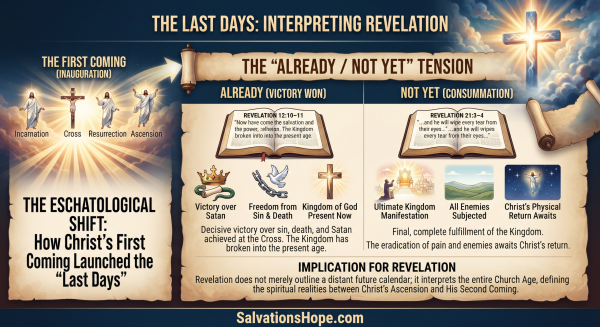
Building upon the first three foundational pillars, we can now complete the framework by exploring the remaining three principles: Principles 4 through 6. These final guardrails address the structural and temporal dynamics of apocalyptic prophecy, showing how the visions unfold across redemptive history.
The First Coming Launched the “Last Days”
The Eschatological Shift: A common misconception is that the “last days” or the “end times” are a purely future, hyper-condensed window of time yet to arrive. However, New Testament theology teaches that Christ’s first coming—His incarnation, death, resurrection, and ascension—inaugurated the final epoch of redemptive history.
The “Already / Not Yet” Tension: Revelation operates entirely within this tension.
Already: The decisive victory over sin, death, and Satan was won at the cross (Revelation 12:10–11). The Kingdom of God has broken into the present age.
Not Yet: The final, consummate manifestation of that Kingdom—where every enemy is subjected, and pain is eradicated—awaits Christ’s physical return (Revelation 21:3–4).
Implication for Revelation: The book does not merely outline a distant future calendar; it interprets the entire church age. The struggles, persecutions, and proclamations depicted in Revelation are the spiritual realities defining the time between Christ’s ascension and His second coming.
Visions Overlap, Telling the Same Story
Recapitulation: One of the most important literary keys to unlocking Revelation is recognizing that its structure is not strictly linear or chronological from chapter 1 to chapter 22. Instead, Revelation uses recapitulation—a literary technique in which multiple visionary cycles retell the same period of history from different vantage points, progressively deepening the perspective.
The Parallel Cycles: The Seals (Revelation 6), the Trumpets (Revelation 8–9), and the Bowls (Revelation 16) are not three successive, non-overlapping sequential eras. Rather, they are overlapping lenses viewing the same fundamental span between Christ’s first and second comings. Each cycle typically culminates in the same climactic event: the final judgment and Christ’s return (e.g., the cosmic shaking in Revelation 6:12–17 mirrors the conclusions of the trumpet and bowl judgments).
Implication for Revelation: Treating Revelation as a strict, sequential newsreel of future headlines leads to chronological confusion. Recognizing that the visions recapitulate the message helps us see that the book repeats and intensifies it to comfort suffering believers: God is sovereign over history from start to finish.
Partial Fulfillments Point to the Final Consummation
The Pattern of Prophecy: Biblical prophecy often operates on the principle of typology and escalation (historically called sensus plenior or multi-layered fulfillment). A prophecy may experience partial, localized fulfillments in history while pointing ultimately to a definitive, cosmic fulfillment at the end of the age.
Historical Echoes and Ultimate Horizons:
Babylon: In the Old Testament, literal Babylon destroyed Jerusalem and exiled God’s people. In Revelation 17–18, “Babylon the Great” expands into a symbol for every global, rebellious, and idolatrous socio-political system opposed to God throughout history.
Antichrist / The Beast: While figures embodying the spirit of the antichrist have arisen repeatedly throughout history (1 John 2:18), Scripture anticipates a final, concentrated embodiment of lawlessness before the end.
Implication for Revelation: We must avoid two extremes: reducing Revelation’s prophecies exclusively to ancient historical events (hyper-preterism) or ignoring the historical echoes that made the book urgently relevant to the first-century audience. Instead, God’s past and partial judgments serve as down payments and guarantees of the final, sweeping renewal of all things.
Summary of the Complete Framework
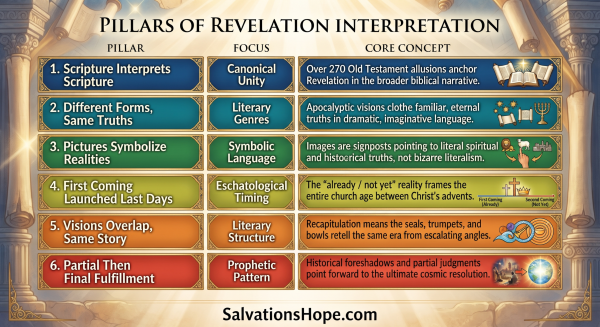
By holding these six hermeneutical pillars together, the book of Revelation stops being an impenetrable cipher or a source of sensational speculation. It emerges as a magnificent pastoral masterpiece designed to anchor our hope, fortify our endurance, and fix our eyes on the triumphant Lamb who reigns forever.
Time, Structure, and Fulfillment in Revelation
Building upon the foundational principles of the Framework of Prophecy, we can expand each major section to deepen our pastoral, theological, and historical understanding of the Book of Revelation. By moving past sensationalist readings, we unlock a richer comprehension of how the text speaks to the church across the ages.
The Timing of the “Last Days”: An Epochal Perspective
The phrase “the last days” often conjures images of chaotic countdown clocks and modern geopolitical mapping. However, a rigorous biblical theology repositions this concept entirely.
Redemptive-Historical Shift: In the Old Testament, prophets looked forward to “the latter days” as a distant eschatological horizon when God would intervene decisively. In the New Testament, the author of Hebrews declares that God “has spoken to us by his Son… in these last days” (Hebrews 1:2). Christ’s incarnation, death, resurrection, and ascension marked the decisive turning point of the ages.
The Already/Not Yet Tension: The church age operates entirely within the tension of already having received the powers of the age to come (Hebrews 6:5) and not yet experiencing the final, visible consummation of all things.
Pastoral Implication: Recognizing that we live in the “last hour” (1 John 2:18) rescues believers from temporal panic. Every generation of Christians since the first century has lived on the edge of eternity, meaning the ethical urgency, spiritual sobriety, and steadfast hope demanded by Revelation apply with equal force to every era of church history.
Narrative Structure: The Mechanics of Recapitulation
Reading Revelation like a standard historical timeline—where Chapter 10 must chronologically follow Chapter 9—misinterprets its literary genre. John’s apocalypse employs a Hebrew poetic structure known as recapitulation (or progressive parallelism).
The Symphony Analogy: Think of Revelation not as a single-file line of marching events, but as a majestic symphony where different movements return to major themes—judgment, redemption, cosmic conflict, and final victory—each time adding deeper instrumentation, nuance, and theological resolution.
Key Structural Panels: The Seven Seals (Revelation 6:1–8:1) culminate in the cosmic question: “Who can stand?”
Rather than moving forward chronologically, the subsequent Seven Trumpets and Seven Bowls re-examine history from different symbolic vantage points (e.g., spiritual warfare, institutional corruption, economic oppression, and divine patience).
Pastoral Implication: Recapitulation comforts the suffering church. It demonstrates that history is not spinning out of control into random chaos; rather, heaven repeatedly pulls back the curtain to reveal that Christ is Lord over every cycle of trial, refining His people through each recurring wave of earthly struggle.
Prophetic Fulfillment: Multi-Tiered Realization
Prophetic language in scripture rarely operates as a single-point prediction with only one historical application. Instead, it frequently functions through typology and recurring patterns.
The Principle of Multiple Fulfillments: A prophecy can find partial, localized expressions in history while pointing comprehensively toward a final, ultimate realization.
Example: When Jesus spoke of the abomination of desolation or the destruction of the Temple in Matthew 24, His words had a direct, harrowing fulfillment in the destruction of Jerusalem in 70 A.D. Yet, they also anticipate the ultimate climax of anti-Christian resistance at the end of the age.
The Antichrist Principle: John explicitly writes that “even now many antichrists have come” (1 John 2:18). Totalitarian regimes, corrupt ideologies, institutional oppressions, and cultural systems that demand absolute allegiance mimic the ultimate “Beast” of Revelation throughout history.
Pastoral Implication: This multi-tiered view prevents believers from falling into spiritual complacency during times of relative peace, while keeping them from absolute despair during regional persecutions. Whether facing a localized tyrant or anticipating the final dissolution of cosmic evil, the church recognizes that the forces opposing God have already been legally and decisively defeated at the cross.
From Vision to Endurance
When we strip away sensationalist timelines and headlines-driven decoder rings, Revelation becomes less an anxiety-inducing puzzle and more a magnificent worship manual. It assures believers that history is teleological—moving purposefully toward the wedding supper of the Lamb, not a catastrophic dead end. By grounding our interpretation in the reality of the present “last days,” the overlapping panoramic visions, and the recurring patterns of historical trial, we receive the exact pastoral medicine the early church needed: the courage to stand firm, love deeply, and proclaim Christ until He returns.
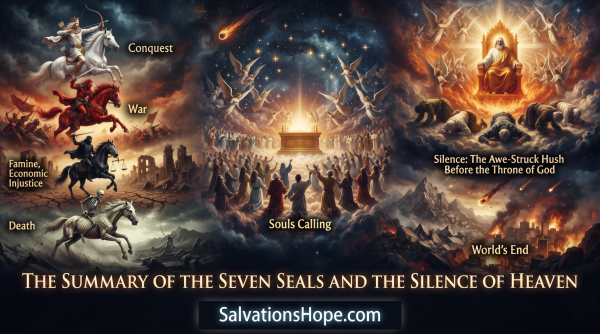
The Summary of the Seven Seals and the Silence of Heaven
The Ongoing Cycle of Tribulation
As we survey the entirety of the seven seals in the book of Revelation, the structure of the vision becomes clear:
- White Horse: Conquest and the relentless human drive for power.
- Red Horse: War and bloodshed.
- Black Horse: Famine, inflation, and economic injustice.
- Pale Horse: Death in all its harrowing forms.
- Souls Calling: The cries of the martyrs seeking divine justice.
- World’s End: The cataclysmic shaking of creation.
- Silence: The awe-struck hush before the throne of God.
A common mistake when reading Revelation is waiting for some distant, futuristic era to spot these horses. As Jesus explicitly taught in Matthew 24:6–7, wars, rumors of wars, famines, and earthquakes are the normative background radiation of the entire church age—the “last days” inaugurated by His first coming.
The Power of the Prayers of the Saints
A vital thread woven throughout Revelation is the role of prayer amidst tribulation:
- Chapter 5: The four living creatures and twenty-four elders hold golden bowls full of incense, identified as the prayers of the saints (Revelation 5:8).
- Chapter 6: The martyrs beneath the altar cry out, "How long, Sovereign Lord... until you judge... and avenge our blood?" (Revelation 6:10).
- Chapter 8: An angel offers incense with the prayers of the saints before the throne (Revelation 8:3–4).
The unfolding of history and the execution of divine judgment are intimately tied to the persistent prayers of God’s people. While modern sensibilities sometimes recoil at “imprecatory” prayers—such as the Psalms that ask God to deal justly with wicked enemies—Revelation affirms that the holy longing for God’s righteousness and vengeance against evil is an eternal, heavenly reality. When we think we have outgrown the prayers recorded in Scripture, we may have simply lost touch with the gravity of cosmic justice.
Chronology vs. Recapitulation: The Sixth and Seventh Seals
Because Revelation is not a strictly linear timeline, Chapter 6 brings us right to the brink of the end of the world with the sixth seal—prompting kings and generals alike to hide from the wrath of the Lamb (Revelation 6:15–17).
Following the pastoral interlude of Chapter 7, the seventh seal is finally opened in Revelation 8:1:
“When he opened the seventh seal, there was silence in heaven for about half an hour.”
- The Stilled Cosmos: After the roaring of judgment, the breaking of empires, and the cries of the martyrs, heaven falls utterly silent.
- Scriptural Echoes: This silence reflects Habakkuk’s ancient declaration—"The Lord is in his holy temple; let all the earth keep silence before him" (Habakkuk 2:20)—and echoes Psalm 46:10 ("Be still, and know that I am God"), which was originally written right in the midst of divine desolations brought upon the earth.
The opening of the seven seals reminds the church that history is not spiraling into random chaos. Whether we face the recurring riders of war and famine or wait patiently for the ultimate vindication of justice, our posture must be one of reverent awe.
In a hyper-connected, noisy world filled with endless opinions and alarms, the silence of the seventh seal calls us back to holy reverence. It invites us to stop, be still before the magnificent justice and power of God the Judge, and trust that the Lamb holds both our present trials and our eternal future safely in His hands.
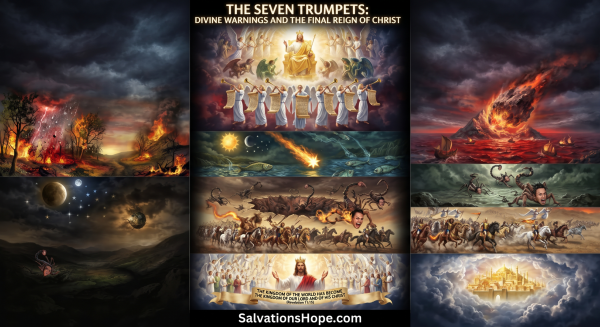
The Seven Trumpets: Divine Warnings and the Final Reign of Christ
The Overlapping Reality of the Trumpets
Following the awe and silence of the seventh seal, the book of Revelation unfolds a new series of visions: the seven trumpets. While the imagery shifts from broken seals to sounding horns, these visions do not introduce a completely disjointed timeline. Just as the seals describe the ongoing trials of the church age, the seven trumpets portray similar spiritual and historical realities—escalating warnings and partial judgments designed to awaken a rebellious world and vindicate God’s people. In ancient Israel, trumpets sounded alarms of approaching danger, gathered the assembly, or announced royal coronations. Here, they signal both divine discipline and the steady march toward Christ’s kingdom.
The Seven Trumpets Outlined
First Trumpet (Hail, Fire, and Blood): Hail and fire mixed with blood are hurled down upon the earth, consuming one-third of all green grass and vegetation. The earth’s ecological and life-sustaining systems are struck.
Second Trumpet (The Fiery Mountain): Something resembling a blazing mountain is thrown into the sea, turning a third of the oceans into blood, destroying a third of sea life, and wrecking a third of maritime shipping.
Third Trumpet (Wormwood): A blazing star named Wormwood (meaning “bitterness”) plunges from the sky, poisoning a third of the rivers and freshwater springs, causing many people to die from the bitter water.
Fourth Trumpet (Cosmic Darkness): A third of the sun, moon, and stars are struck, causing the heavenly lights to lose a third of their brilliance. The very systems of time and illumination are darkened.
Fifth Trumpet (Demonic Torment): The abyss is opened, and demonic locust-like beings emerge with the power to torment those who do not have the seal of God on their foreheads. The agony is so severe that people will seek death but be unable to find it (Revelation 9:6).
Sixth Trumpet (The 200 Million Attacking Army): The four angels bound at the Euphrates River are released, leading a massive cavalry of 200 million troops in a devastating war that claims another massive toll of human life.
Seventh Trumpet (The Reign of Christ): The final trumpet sounds, bringing history to its climax and proclaiming God’s absolute victory.
The Climax of the Seventh Trumpet: Christ Reigns
Just as the seventh seal culminated in silent reverence before the throne, the seventh trumpet brings us straight to the triumphant return of Christ and the establishment of His eternal kingdom:
world has become the kingdom of our Lord and of his Christ, and he will reign forever and ever.'” (Revelation 11:15)
Heaven’s response is immediate and deeply worshipful. The twenty-four elders fall prostrate and thank the Lord God Almighty because He has taken His great power and begun to reign (v. 16–17).
Crucially, the seventh trumpet defines the purpose of divine intervention:
- Judging the dead and executing righteous verdicts.
- Rewarding God's servants—the prophets, saints, and all who reverence His name, both small and great.
- Destroying those who destroy the earth (v. 18).
The seven trumpets remind us that suffering, ecological disruption, societal breakdown, and spiritual warfare are not random accidents. They are part of a sobering divine wake-up call in a fallen world.
Yet, we must never read these chapters with despair. The trumpets end exactly where the seals ended: with the kingdoms of this world bowing to the unshakeable dominion of our Lord and His Christ. No matter how loud the chaos of the age grows, the Lamb has already secured the final trumpet, and His reign is forever and ever.
The Seven Bowls: The Final Cup of Wrath and the Hardened Heart
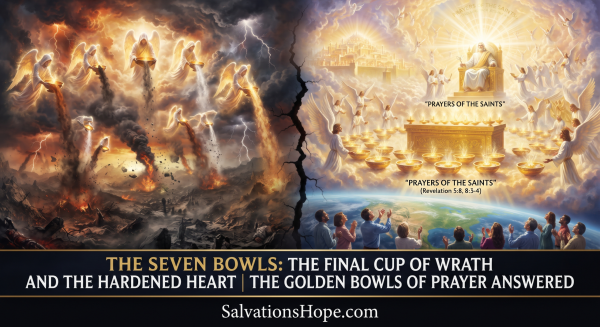
The Golden Bowls of Prayer Answered
As Revelation unfolds its final cycle of judgment, we encounter the seven bowls of God’s wrath (Revelation 16). We must connect these bowls back to earlier imagery. In Revelation 5:8, the twenty-four elders held golden bowls filled with incense, which represented the prayers of the saints. In Revelation 8, those prayers ascended before the throne. Now, the bowls of wrath are poured out in direct response to those persistent prayers—the holy cries for justice, vindication, and the end of oppression that have risen from God’s people throughout history.
The Seven Bowls Outlined
First Bowl (Sores on Beast Worshipers): Painful, festering sores break out on all those who bear the mark of the beast and worship his image.
Second Bowl (Death in the Sea): The sea turns to blood like a dead man’s blood, and every living thing in the ocean dies—echoing the plagues of Egypt.
Third Bowl (Rivers to Blood): The freshwater springs and rivers turn to blood, a righteous recompense for the blood of the saints and prophets that the wicked had shed.
Fourth Bowl (Scorching Heat): The sun is given power to scorch humanity with intense fire. The inhabitants suffer under blistering heat, yet instead of humbling themselves, they curse the name of God.
Fifth Bowl (Darkness on the Beast’s Realm): Total darkness envelops the beast’s throne and kingdom. Paralleling the ninth plague of Exodus, the darkness brings agonizing distress, yet the wicked continue to curse God and refuse to repent.
Sixth Bowl (Gathering at Armageddon): Demonic spirits go out to gather the kings of the whole world for the final battle at Armageddon, preparing the stage for the ultimate confrontation against the Lamb.
Seventh Bowl (The Final Collapse): A massive earthquake—unprecedented in human history—shakes the earth, accompanied by colossal hailstones weighing around a hundred pounds each. The earthly systems and rebellious empires collapse entirely.
The Tragedy of the Unrepentant Heart
Perhaps the most sobering and haunting truth Revelation 16 reveals is humanity’s reaction to divine discipline.
(Revelation 16:9–11)
Even amid catastrophic judgment, the unrepentant heart mirrors Pharaoh in the Old Testament. Rather than breaking before the Creator, humanity hardens itself. Tribulation exposes a terrifying reality: suffering alone does not produce repentance. Without God’s softening grace, human pride will double down in rebellion, refusing to change course even when destruction is obvious.
The vision of the seven bowls reminds us of the terrible cost of unyielding rebellion against God. It also serves as a pastoral warning for our own lives. When trials, disruptions, or personal catastrophes touch us, our immediate reflex can be self-defense or bitterness against God rather than humble self-examination.
For the church, the bowls assure us that God does not ignore injustice. History is moving toward a righteous reckoning, and the prayers of the saints will ultimately be answered.
The Purpose and Pattern of Tribulation
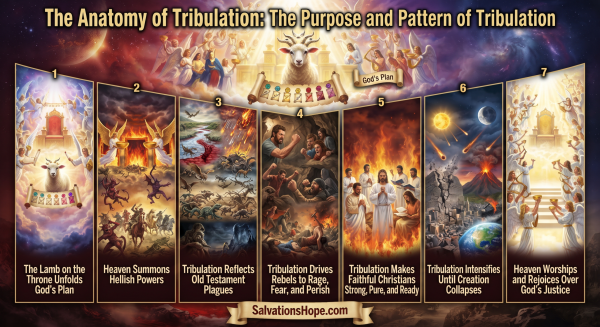
The Seven Theological Truths About Tribulation
As we draw our study of Revelation’s tribulation visions to a close, we must synthesize what these chapters teach. Far from being a random sequence of planetary horrors or a blood-curdling puzzle meant to terrify believers, the biblical depiction of tribulation serves a precise theological and pastoral purpose.
Below are the seven core truths about the nature, origin, and outcome of tribulation as revealed in the visions of the seals, trumpets, and bowls.
The Lamb on the Throne Unfolds God’s Plan
The sovereignty of God is absolute. Who is breaking the seals? The Lamb on the throne. Some modern theological systems try to distance God from painful or terrifying historical realities. Still, Revelation makes no apologies: Jesus orchestrates history’s unfolding, holding the blueprint of redemption and judgment in His scarred hands.
Heaven Summons Hellish Powers
The forces of destruction do not act on their own initiative. When the four horsemen ride forth, the cherubim—the holy living creatures surrounding God’s throne—command them: “Come!” Even hellish powers, war, famine, and death are strictly governed and bounded by the supreme authority of heaven.
Tribulation Reflects Old Testament Plagues
God does not invent entirely new categories of judgment; He re-enacts the patterns of redemption history. The plagues of Revelation mirror the judgments of Egypt, showing that the God who delivered Israel from Pharaoh is the same God who executes righteous justice against the corrupt, oppressive systems of a fallen world.
Tribulation Drives Rebels to Rage, Fear, and Perish
As seen under the bowls and seals, catastrophic judgment does not automatically soften human hearts. Instead, it frequently exposes the hardened, unrepentant rebellion of fallen humanity. Echoing Proverbs 19:3 (“A man’s own folly ruins his life, yet his heart rages against the Lord”), the wicked curse God in their agony rather than repent. This serves as an urgent biblical warning: repent while it is still the day of grace, rather than waiting until the heart is permanently hardened.
Tribulation Makes Faithful Christians Strong, Pure, and Ready
God uses the furnace of affliction not to destroy His people, but to refine them. In Revelation 7, we see a great multitude washed in the blood of the Lamb, emerging from the “great tribulation” radiant and spotless.
- The Refining Process: Earthly ease often breeds spiritual slumber. Tribulation strips away spiritual apathy, cultural compromise, and self-reliance.
- The Cultivation of Endurance: The patience and faith of the saints are forged in the crucible (Revelation 13:10). The church is purified as a bride without spot or wrinkle, learning to look past temporal comforts to anchor her hope entirely in eternity.
Tribulation Intensifies Until Creation Collapses
The judgments of Revelation do not merely skim the surface of human civilization; they systematically dismantle every false refuge humanity trusts.
- The Unshakable Kingdom: Through the cascading escalation of the seals, trumpets, and bowls, God demonstrates that every political superpower, economic engine, and idolatrous system of this world is temporary and doomed to collapse.
- Cosmic Re-creation: This escalation points to a profound theological reality: fallen creation groans under the weight of sin (Romans 8:22), and its total shaking is a necessary precursor to the new heavens and the new earth, where righteousness dwells.
Heaven Worships and Rejoices Over God’s Justice
While human sentiment often recoils from the idea of divine retribution, heaven erupts in uninhibited worship when God judges the earth (Revelation 19:1–3).
- Vindication of the Oppressed: Heaven's worship is not driven by malice, but by a holy longing for justice. The martyrs under the altar cry out, "How long, O Lord... until you judge and avenge our blood?" (Revelation 6:10).
- The Triumph of Truth: Heaven rejoices because God’s judgments finally vindicate truth over falsehood, light over darkness, and the agonizing prayers of suffering believers throughout the ages. His justice clears His holy name before a watching universe.
A Call to Grace
The visions of tribulation are given to us in love. They strip away our illusions of earthly security, unmask the false kingdoms of this age, and point us unflinchingly to the throne.
If you are reading this and feeling the conviction of the Spirit, do not wait for the storm to break. Turn to the Savior now. The Lamb who holds the scroll and breaks the seals is also the Good Shepherd who laid down His life for His sheep, and He never turns away anyone who calls upon His name.
The Refining Fire and the Victorious Multitude
The Purpose of Tribulation for the Faithful
While tribulation hardens the hearts of unrepentant rebels, it has a profoundly opposite effect on those who belong to the Lamb. For the church, trials are not meaningless suffering; they are the crucible in which faith is forged, purified, and prepared for eternity.
As the Apostle John reveals, the faithful triumph not by avoiding suffering, but by enduring it—bearing up under persecution and even laying down their lives. In doing so, they grow stronger, purer, and deeply ready for the day of Christ’s return.
Two Destinies at the Appearing of Christ
When the Lord Jesus returns, His presence elicits two radically different responses based on the posture of the heart:
- The Longing of the Redeemed: Those who have loved the Savior—even before seeing Him face-to-face—will rise to meet Him in the air, drawn irresistibly to His beautiful and welcoming grace.
- The Flight of the Rebellious: Those who have persistently rejected Him are repelled by His holiness. As Jesus noted in John 3:19–20, those who love darkness flee from the light because it exposes their deeds. For the unrepentant, the unfiltered glory of the light of the world becomes utterly unbearable.
The Climax of Creation and the Sovereignty of Peace
Tribulation intensifies across history until the old, broken world can no longer bear its weight, shaking and collapsing so a glorious new creation can rise from the ashes.
Who Is in Charge? None of these global upheavals—whether geopolitical crises or devastating pandemics—happen outside of God’s sovereign arrangement. If we do not know who holds history in His hands, panic is natural. But as believers, we rest securely in the Lord’s words: “In this world you will have tribulation. But take heart! I have overcome the world” (John 16:33).
Prepared, Not Panicked: Tribulation teaches us to depend wholly on God’s grace, making us purer and more anchored in His eternal kingdom.
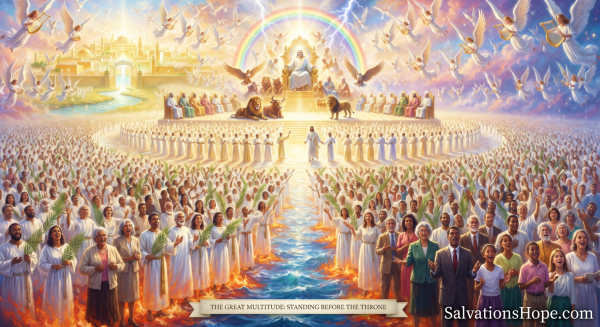
The Great Multitude: Standing Before the Throne
How do these visions ultimately conclude? Not in despair or destruction, but in transcendent, unhindered worship.
In Revelation 7, John sees two powerful pictures:
- The 144,000: Symbolizing the complete number of God's redeemed covenant people (12 tribes multiplied by 12, times a thousand, denoting absolute completeness).
- The Innumerable Multitude: A massive, global host "from every nation, tribe, people and language, standing before the throne and in front of the Lamb" (Revelation 7:9).
When one of the elders asks John who these people in white robes are, the answer defines the eternal destiny of every believer:
made them white in the blood of the Lamb.” (Revelation 7:14)
The Final Word on Tribulation
For those who belong to Jesus Christ, tribulation does not have the final say. The conclusion of the story is not sorrow, but eternal sanctuary in the presence of God:
- No More Hunger or Thirst: The desert trials are over.
- Protection from Heat: The scorching sun of judgment will never touch them.
- The Shepherd's Care: "For the Lamb at the center of the throne will be their shepherd; he will lead them to springs of living water" (Revelation 7:17).
- The Ultimate Comfort: "And God will wipe away every tear from their eyes."
This is the final word on tribulation for the faithful: an eternity of radiant worship, unbroken fellowship, and unshakeable joy in the presence of our reigning Lord.