Jesus is Greater
The Theological Foundation: What Christ Has Done
Welcome to our study of the Book of Hebrews.
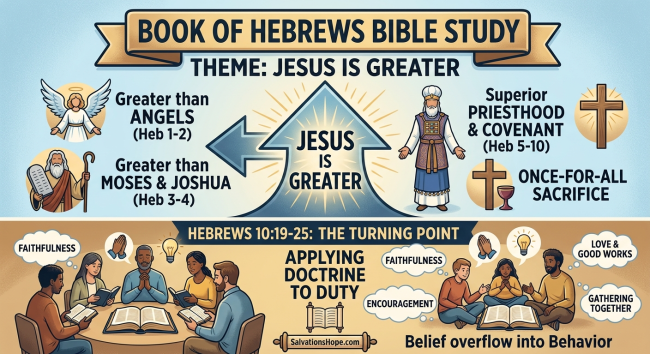
Throughout this epistle, the author has established one supreme, unmistakable thesis: Jesus is greater.
- He is greater than the angels (Hebrews 1–2).
- He is greater than Moses and Joshua (Hebrews 3–4).
- He is greater than the Aaronic priesthood, mediating a superior covenant based on better promises and a single, once-for-all sacrifice (Hebrews 5–10).
In Hebrews 10:19–25, the letter reaches a massive theological turning point. The author shifts from deep doctrinal exposition to practical application. Because Jesus’ blood has secured full access to God, doctrine must lead to duty, and belief must overflow into behavior.
Before calling us to action, the sacred text establishes our gospel grounding. Christian obedience is never an effort to earn God’s favor; it is a response to what Christ has already accomplished.
“Therefore, brothers, since we have confidence to enter the holy places by the blood of Jesus, by the new and living way that he opened for us through the curtain, that is, through his flesh, and since we have a great priest over the house of God…” (Hebrews 10:19–21)
- Bold Access (Parrēsia): In the Old Covenant, only the High Priest could enter the Holy of Holies, once a year, with fear and trembling. Now, through the shed blood of Jesus, every believer possesses bold, unhindered access into the direct presence of God.
- The New and Living Way: The earthly veil was torn at Christ’s crucifixion (Matthew 27:51). His broken body ("his flesh") opened a living, permanent way into God's presence—a way that never decays or loses its efficacy.
- Our Great High Priest: We do not approach a distant deity alone; Jesus reigns over the "house of God" as our advocate, continual intercessor, and mediator.
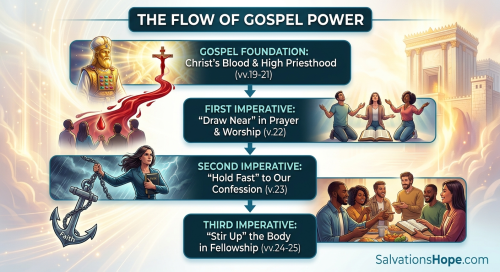
The Threefold Gospel Response
Because of this glorious foundation, the author issues three distinct exhortations, marked by the classic phrase “Let us…”
"Let us draw near..." — Our Duty Toward God
“Let us draw near with a true heart in full assurance of faith, with our hearts sprinkled clean from
an evil conscience and our bodies washed with pure water.” (Hebrews 10:22)
Because the door is open, we are commanded to approach God intimately in prayer and worship. This draw-near faith is characterized by a sincere heart and full assurance, grounded in inward cleansing (the sprinkling of Christ’s blood clearing our guilt) and outward consecrated living (symbolized by baptism and daily purity).
"Let us hold fast..." — Our Duty Toward Truth
“Let us hold fast the confession of our hope without wavering, for he who promised is faithful.” (Hebrews 10:23)
While this study examines all three imperatives, it primarily focuses on holding fast.
To “hold fast” (katechō) means to cling tightly, stubbornly, and perseveringly to the gospel truth we confess. The original Hebrew-Christian readers were facing intense societal pressure, persecution, and the temptation to drift back into the familiar rituals of Judaism.
Notice where the strength to persevere comes from: it is rooted in the character of God. We do not hold fast because our personal grip is unbreakable; we hold fast because “he who promised is faithful.” The security of our hope rests entirely on God’s unwavering fidelity to His covenant.
"Let us stir up..." — Our Duty Toward One Another
but encouraging one another, and all the more as you see the Day drawing near.” (Hebrews 10:24–25)
Persevering in faith is not a solitary endeavor. We are called to “consider” (thoughtfully deliberate) how to provoke or spur one another toward Christian love and active duty. Perseverance requires local church fellowship. Deserting the assembly weakens the soul and opens the door to apostasy. As “the Day” of Christ’s return approaches, our mutual encouragement must intensify, keeping each other vigilant and steadfast.
Summary for Reflection
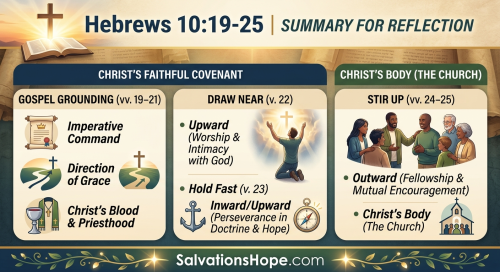
Gospel Grounding (vv. 19–21)
Imperative Command
Direction of Grace
Christ’s Blood & Priesthood
Draw Near (v. 22)
Upward (Worship & Intimacy with God)
Christ’s Faithful Covenant
Hold Fast (v. 23)
Inward/Upward (Perseverance in Doctrine & Hope)
Christ’s Body (The Church)
Stir Up (vv. 24–25)
Outward (Fellowship & Mutual Encouragement)
Drawing Near to God (Hebrews 10:22)
Before we turn our focus to the central imperative of holding fast, we must linger over the first command: “Let us draw near” (proserchōmetha).
In the divine economy of Hebrews, gospel sequence is everything. Duty always flows from doctrine, and we cannot hold fast to our faith unless we are actively drawing near to our God.
The Opened Veil and Full Assurance
Under the Old Covenant, the High Priest alone could cross the threshold of the Most Holy Place, and only once a year on the Day of Atonement (Yom Kippur), carrying the blood of bulls and goats with fear and trembling. The massive, woven curtain stood as a perpetual sign: Keep distance. God is holy; man is sinful.
When Jesus gave up His spirit on Calvary, that veil was torn from top to bottom (Matthew 27:51). The author of Hebrews reveals the profound typology behind this historic moment:
- His Torn Flesh as the Veil: Just as the temple curtain had to be passed through to reach the Shekinah glory, Christ’s own body was torn to open a permanent passage into the heavenly sanctuary.
- The Living Way: Unlike the old animal sacrifices, Jesus offers a "new and living way." His blood does not merely cover sin temporarily; it completely eradicates its guilt forever.
- Welcomed with Confidence (Parrēsia): Because we approach the Father based on the unblemished merits of the Son, we come not with dread or hesitation, but with holy boldness. When a believer approaches God through Christ, the Father does not drive us away—He says, "Come in."
The call to draw near requires a “true heart in full assurance of faith” (plerophoria pisteōs). This isn’t self-manufactured confidence; it is the firm conviction that Christ’s priestly work is entirely sufficient to make us acceptable to God.
Inner Cleansing and Sacramental Reality
To draw near, the worshiper must be clean:
“…with our hearts sprinkled clean from an evil conscience and our bodies washed with pure water.” (Hebrews 10:22b)
Here, the author draws directly upon Ezekiel’s New Covenant prophecy (“I will sprinkle clean water on you, and you shall be clean…” — Ezekiel 36:25) and Old Testament priestly consecration rites (Exodus 29:4, 21).
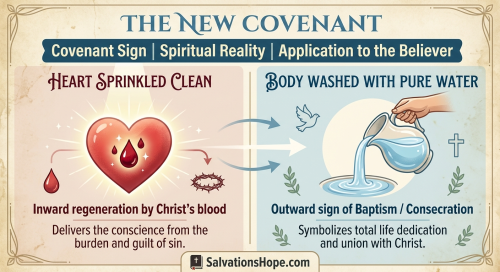
Covenant Sign
Spiritual Reality
Application to the Believer
Heart Sprinkled Clean
Inward regeneration by Christ’s blood
Delivers the conscience from the burden and guilt of sin.
Body Washed with Pure Water
Outward sign of Baptism / Consecration
Symbolizes total life dedication and union with Christ.
Why Drawing Near is the Fuel for Holding Fast
Many Christians struggle to persevere (“hold fast”) because they attempt to do so in their own strength. But in the architecture of Hebrews (10:19–25), drawing near is the prerequisite for holding fast.
If you do not spend time in God’s holy presence, your spiritual grip will inevitably slip. You cannot stand firm in a hostile world on a starved devotional life.
Old Testament Parallels: The Aroma and the Glory
When we dwell in God’s presence through prayer, word, and worship, a supernatural transformation occurs that equips us to endure and minister to others:
- The Incense of the Holy Place:
In the tabernacle, a special, holy incense formula was prepared, reserved strictly for the sanctuary (Exodus 30:34–38). When the priest served inside the Holy Place, the fragrant smoke clung to his vestments. When he stepped outside, people could immediately smell where he had been. He carried the aroma of holiness.
- The Shekinah on Moses’ Face:
When Moses descended from the Tent of Meeting after speaking face-to-face with God, his face radiated the literal shine of divine glory (Exodus 34:29–35). He didn’t generate this light; he reflected it because he was near the Light.
In the same way, when a believer spends time in the true heavenly Holy of Holies through Jesus Christ:
- Your Spiritual Strength is Renewed:
You gain the internal fortitude needed to hold fast when trials arise.
- Your Life Bears a Holy Witness:
Worldly observers and fellow believers alike sense that you have been with Jesus (cf. Acts 4:13).
Before we leap into the third imperative (“stir up”) and then spend our main time unpacking what it means to “hold fast,” take a moment to evaluate your own walk:
Is your current effort to hold fast to Christ being powered by daily, confident drawing near to His throne of grace—or are you trying to hold on in your own spiritual exhaustion?
Stirring Up One Another in Community (Hebrews 10:24–25)
Before we lock our focus on the centerpiece of this passage—what it means to hold fast—we must explore the third imperative issued by the author: “Let us consider how to stir up one another to love and good works.”
Faith in Christ is never a solo pursuit. In the divine architecture of the Christian life, holding fast and drawing near are inextricably linked to how we gather, encourage, and sharpen one another within the local body of Christ.
The Call to Holy Provocation (Paroxysmos)
“And let us consider how to stir up one another to love and good works…” (Hebrews 10:24)
The phrase “stir up” translates to the Greek noun paroxysmos (from which we get our English word paroxysm). It literally means to incite, irritate, stimulate, or provoke strongly.
While the word is often used in a negative sense (such as a sharp disagreement or outburst of anger), the author of Hebrews sanctifies the term here:
- Intentional Consideration (Katanoeō): The text does not say to passively hope community happens. It commands us to consider—to thoughtfully observe, deliberate upon, and care for—the specific spiritual condition of our brothers and sisters.
- Provoking to Love and Good Works: We are called to actively spur each other out of spiritual complacency. True Christian love (agape) and biblical good works (erga kala) are not automatic; they require holy encouragement and structural accountability.
The Danger of Neglecting the Assembly
“…not neglecting to meet together, as is the habit of some…” (Hebrews 10:25a)
Even in the first century, some believers were abandoning the corporate worship assembly. Facing social ostracism, physical persecution, and spiritual apathy, attending church had become costly—and some chose to withdraw.
Historical Realities & The Western Decline
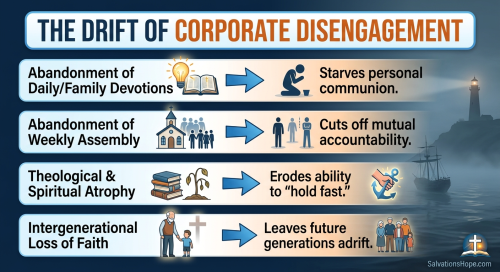
Modern church history and sociological research vividly illustrate the tragic accuracy of Hebrews 10:25. When examining the steep decline of Christianity across Western Europe and England during the 19th and 20th centuries, two critical cultural shifts repeatedly emerged:
The Cessation of Private & Family Devotions: Prayer and Scripture reading gradually vanished from individual homes and family tables.
The Slogan of Isolation: The cultural cliché arose: “You don’t need to go to church to be a Christian.”
The consequence was catastrophic. When believers neglected drawing near to God in private and meeting together in public, their faith starved. While a generation of parents may have retained a nominal, lingering remnant of Christian belief, they failed to pass a vibrant, living faith to their children.
Parents who abandoned the means of grace raised children who abandoned God altogether. Faith cannot survive in an isolated void; it requires the regular nourishment of God’s presence and the vital heat of Christian fellowship.
Mutual Encouragement as the End-Time Strategy
“…but encouraging one another, and all the more as you see the Day drawing near.” (Hebrews 10:25b)
The remedy for spiritual drift is consistent, intentional, verbal, and practical encouragement (parakaleō—the same root word used for the Holy Spirit, the Advocate). God has ordained specific channels through which He delivers His sustaining grace to us—the preaching of the Word, the sacraments/ordinances, prayer, and the local gathering of saints.
The author commands that this mutual sharpening intensify “as you see the Day drawing near.” The “Day” refers to Jesus Christ’s return and the consummation of history. As darkness in the world increases prior to His return, the church’s gathering must become more urgent, not less.
The Threefold Imperative
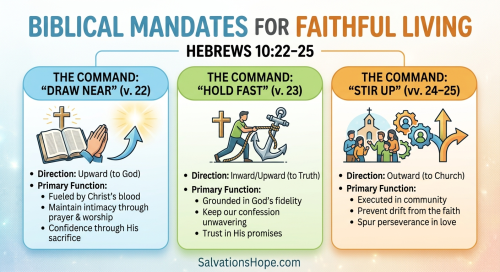
Now that we have surveyed the entire landscape of Hebrews 10:19–25, we see how the three commands fit together in an unbroken, God-designed ecosystem:
Passage
The Command
Direction
Primary Function
v. 22
“Draw Near”
Upward (God)
Fueled by Christ’s blood to maintain intimacy through prayer & worship.
v. 23
“Hold Fast”
Inward/Upward (Truth)
Grounded in God’s fidelity to keep our confession unwavering.
vv. 24–25
“Stir Up”
Outward (Church)
Executed in community to prevent drift and spur perseverance.
Our Primary Focus: "Hebrews 10:23"
Having grounded ourselves in drawing near to God’s throne (v. 22) and stirring up one another in Christian community (vv. 24–25), we are now equipped to spend the main portion of our study diving into v. 23:
“Let us hold fast the confession of our hope without wavering, for he who promised is faithful.”
"Let Us Hold Fast"
Why is this command so urgent? Because the original Hebrew-Christian readers were facing intense socio-religious pressure. Ostracized by their Jewish kin, threatened with legal persecution, and weary from long trial, many were tempted to quietly slip away from Christ and return to the familiar, culturally accepted rituals of the Old Covenant. It seemed far easier to back off, blend in, and let go.
To combat this spiritual retreat, the author issues a ringing call that echoes throughout the entire New Testament canon: Hold fast.
The Call to Hold Fast: A Recurring Theme Across Scripture
The author of Hebrews is a master preacher who repeatedly re-emphasizes his core message with slight variations in vocabulary. The call to persevere (katechō or krateō) is not a secondary theme—it is a thread woven into the fabric of the entire New Testament. The evidence throughout is clear.
- Hebrews 3:1, 6: "Consider Jesus, the apostle and high priest of our confession... Christ is faithful over God’s house as a son. And we are his house, if indeed we hold fast our confidence and our boasting in our hope."
- Hebrews 3:12–14: "Take care, brothers, lest there be in any of you an evil, unbelieving heart, leading you to fall away from the living God... For we have come to share in Christ, if indeed we hold our original confidence firm to the end."
- Hebrews 4:12, 14: "Since then we have a great high priest who has passed through the heavens, Jesus, the Son of God, let us hold fast our confession." (Notice that holding fast the confession requires holding fast both to the living Word of God and to our High Priest Jesus!)
- Hebrews 6:17–19: "God guaranteed his covenant with an oath... that we who have fled for refuge might have strong encouragement to hold fast to the hope set before us. We have this as a sure and steadfast anchor of the soul."
The Words of Jesus
In the Parable of the Sower, Jesus explicitly identifies the true believer by their capacity to retain and preserve the Truth:
and bear fruit with perseverance.” (Luke 8:15)
The mark of a regenerated, born-again heart (“a true heart”) is not merely an initial emotional response; it is a persistent holding fast to the Word that produces fruit over time. It speaks of a heart so thoroughly transformed that it completely renews the believer’s mind.
The Exhortations of Paul
1 Corinthians 15:1–2: “Now I would remind you, brothers, of the gospel I preached to you… by which you are being saved, if you hold fast to the word I preached to you—unless you believed in vain.”
2 Thessalonians 2:15: “So then, brothers, stand firm and hold to the traditions [apostolic doctrines] that you were taught by us…”
1 Thessalonians 5:21–22: “Hold fast what is good. Abstain from every form of evil.”
The Confession, Doctrine, and Deposit
When Scripture commands us to hold fast, it does not leave the object vague or subjective. We are commanded to hold fast to a Person (Jesus) and a body of Truth (His Word and Gospel).
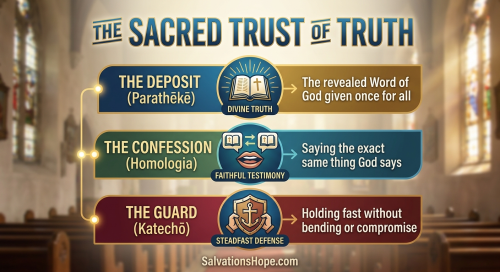
In Hebrews 10:23, we are told to hold fast our “confession” (Greek: homologia, ὁμολογία).
- Etymology: Homologia is a compound word formed from homou (“same”) and legō (“to say”). Literally, it means “to say the same thing.”
- Theological Definition: Confession is not inventing our own faith; it is verbally and intellectually agreeing with what God has spoken in His Word. When we confess, we say the exact same thing about sin, salvation, Jesus, and eternity that God says.
This homologia was publicly declared at baptism and before witnesses (1 Timothy 6:12; 2 Corinthians 9:13). It represents an unwavering allegiance to the apostolic gospel.
Sound Doctrine (Didaskalia)
This confession consists of objective doctrine. Writing to Timothy, Paul underscores the necessity of doctrinal fidelity:
“If you put these things before the brothers, you will be a good servant of Christ Jesus, being trained in the words of the faith and of the good doctrine that you have followed… Keep a close watch on yourself and on the doctrine. Persist in this, for by so doing you will save both yourself and your hearers.” (1 Timothy 4:6, 16)
For pastors, parents, and leaders of every kind, life and doctrine are contagious. Drifting into false teaching or compromised living invites spiritual ruin for us and those we care for.
The Guarded Deposit (Parathēkē)
Paul also refers to this body of truth as a solemn trust or “deposit”:
“Guard the deposit entrusted to you. Avoid the irreverent babble and contradictions of what is falsely called ‘knowledge,’
for by professing it some have swerved from the faith.” (1 Timothy 6:20)
Discerning New Revelations: Unchanging Truth in a Changing World
A critical aspect of holding fast is learning how to test spiritual claims. In Hebrews 13:7–9, the author writes:
“Remember your leaders, those who spoke to you the word of God. Consider the outcome of their way of life, and imitate their faith. Jesus Christ is the same yesterday and today and forever. Do not be led away by diverse and strange teachings…“
If someone arises claiming: “The Holy Spirit is giving us new light, leading us into novel teachings that contradict 2,000 years of biblical truth and Christian practice,” the biblically grounded Christian responds with conviction:
“If Jesus Christ is the same yesterday, today, and forever—and this new idea flatly contradicts the Scriptures and was never held by the historic body of Christ—I take a hard pass. I will not be tossed to and fro by strange teachings. I stand on the eternal Word of God.”
The Anchor of Our Endurance: "For He Who Promised Is Faithful"
How are we able to hold fast without wavering (aklinē)? If our perseverance depended entirely on human grip strength, every one of us would eventually slip and fall. But look at the glorious foundation at the end of verse 23:
Our Command: “Hold fast”>>>>>God’s Character: “For He who promised is faithful”
We hold fast to our hope because God holds fast to us. Our hope is not wishful thinking; it is anchored in God’s unchangeable character and covenant oath (Hebrews 6:17–18). He who promised eternal life through Jesus Christ cannot lie, break His covenant, or fail.
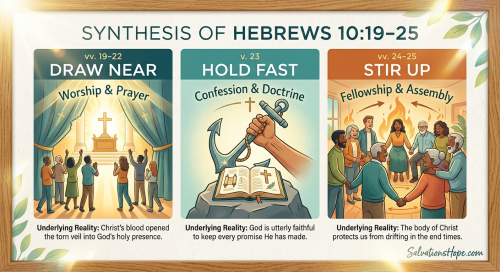
Synthesis of Hebrews 10:19–25
Verse(s)
Exegetical Focus
Essential Action
Underlying Reality
vv. 19–22
Draw Near
Worship & Prayer
Christ’s blood opened the torn veil into God’s holy presence.
v. 23
Hold Fast
Confession & Doctrine
God is utterly faithful to keep every promise He has made.
vv. 24–25
Stir Up
Fellowship & Assembly
The body of Christ protects us from drifting in the end times.
To stand firm in a world that is constantly shifting:
- Seek His Face Daily: Your ability to hold fast in public depends on drawing near to God in private.
- Guard Your Confession: Know the Scriptures, cherish sound doctrine, and reject novel, unbiblical teachings.
- Anchor in Church Community: Never attempt to walk the Christian life alone; gather regularly to be stirred up toward love and good works.
The Letters of Jesus: "Hold Fast" to the Living Lord (Revelation 2–3)
As we anchor ourselves in Hebrews 10:23—“Let us hold fast the confession of our hope without wavering, for he who promised is faithful”—it is vital to see that this is not merely an apostolic instruction from the Letter to the Hebrews. It is the direct, sovereign command of the resurrected Christ Himself.
When Jesus addresses the seven churches in Revelation, He repeatedly issues this exact summons: Hold fast.
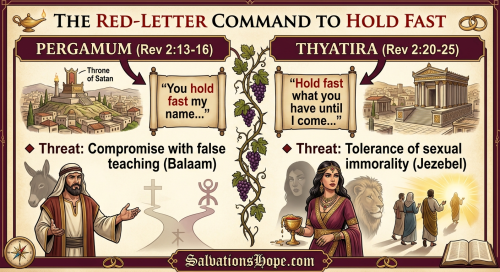
Pergamum and Thyatira: Confronting Moral & Doctrinal Compromise
In His letter to the church at Pergamum, Jesus commends their steadfastness under persecution: “You hold fast my name, and did not deny my faith” (Revelation 2:13). Yet He immediately confronts their tolerance of internal corruption:
“But I have a few things against you: you have some there who hold the teaching of Balaam… and practice sexual immorality. So also you have some who hold the teaching of the Nicolaitans. Therefore repent. If not, I will come to you soon and war against them with the sword of my mouth.” (Revelation 2:14–16)
Similarly, to the church at Thyatira, Christ issues a severe rebuke for tolerating false doctrine disguised as spiritual insight:
“You tolerate that woman Jezebel, who calls herself a prophetess and is teaching and seducing my servants to practice sexual immorality… I will throw her onto a sickbed, and those who commit adultery with her I will throw into great tribulation… and I will strike her children dead. But to the rest of you… I do not lay on you any other burden. Only hold fast what you have until I come.” (Revelation 2:20–25)
Notice the pattern: Jesus demands that His church hold fast not only against external persecution, but against internal moral and doctrinal erosion.
The Fallacy of Modern "Red-Letter" Selective Christianity
In modern discourse, some adopt the label “Red-Letter Christians,” referencing Bibles that print the earthly words of Jesus in red ink. While the desire to honor Christ’s direct speech is commendable, a dangerous theological error arises when people pit the “red letters” against the rest of Scripture—treating Jesus’ words as primary while discarding the “black letters” of the Old Testament and the Epistles.
From an exegetical and classical Christian standpoint, this selective approach suffers from fatal theological flaws:
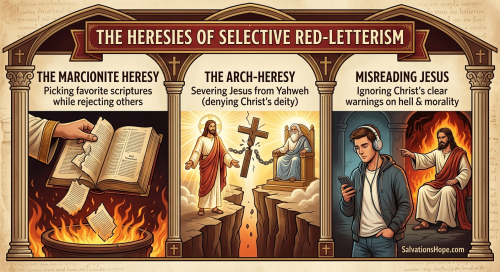
Accepting only select portions of Scripture as authoritative while rejecting others revives the ancient 2nd-century heresy of Marcion, who excised the Old Testament and altered apostolic texts to fit his preferred deity. If we decide which parts of God’s Word are acceptable, we cease standing under Scripture and instead place ourselves above it. We lose the holy deposit of truth (parathēkē).
To claim that the words of Yahweh in the Old Testament are somehow contrary to the mind of Jesus is to fall into the arch-heresy of severing the Godhead. Jesus declared, “I and the Father are one” (John 10:30). The eternal Logos who spoke in the Gospels is the same Lord who spoke to Moses, inspired the Prophets, and commissioned the Apostles.
Selective readers often present Jesus as exclusively gentle, mild, and unconcerned with strict morality. But a careful reading of the Sermon on the Mount reveals a Jesus who dramatically raised the standard of righteousness:
“You have heard that it was said, ‘Do not commit adultery.’ But I say to you that everyone who looks at a woman with lustful intent has already committed adultery with her in his heart… It is better for you to lose one of your members than that your whole body be thrown into hell.” (Matthew 5:27–29)
Furthermore, when Jesus speaks on marriage, He grounds human sexuality directly in creation design:
“Have you not read that he who created them from the beginning made them male and female… ‘Therefore a man shall leave his father and mother and hold fast to his wife, and the two shall become one flesh’? … What therefore God has joined together, let not man put asunder.” (Matthew 19:4–6)
And in Revelation—the very ultimate “red letters”—Jesus speaks not with passive indulgence, but as the glorified King who judges sexual immorality, warns of great tribulation, and calls His church to uncompromising holiness.
The Four Pillars of Holding Fast
To stand firm when surrounding culture and drifting churches push us to surrender, the Christian must anchor their soul upon four unwavering biblical pillars:

An Unchanging Christ
Our hope is anchored in a real, historical, resurrected Person: Jesus Christ, who is the same yesterday, today, and forever (Hebrews 13:8).
We do not follow a reimagined Jesus tailored to 21st-century cultural preferences, nor “another Jesus” warned against by Paul (2 Corinthians 11:4). We hold fast to the Christ revealed in Holy Scripture, whose shed blood alone opens the way into the presence of God.
An Unerring Bible
When we encounter passages in Scripture that clash with our modern sensibilities or personal desires, the worldly mind says, “Something is wrong with the Bible.” The humble, regenerated mind says, “Something is wrong with me.”
(2 Peter 1:20–21). “It is impossible for God to lie” (Hebrews 6:18).
Recognizing the Points of Attack
A soldier in battle must know where the enemy is striking the wall. Today, the cultural and ecclesiastical attacks on Scripture are concentrated on key foundational doctrines:
- Penal Substitutionary Atonement: Denying that Christ died to bear God's righteous wrath in our place, reducing the Cross to merely an example of love or moral influence.
- The Exclusivity of Christ: Embracing pluralism or universalism—claiming many paths lead to God—while silencing biblical warnings regarding hell and eternal judgment.
- Biblical Morality and Sexuality: Abandoning the historical, creation-based definition of marriage and holy living in order to conform to social trends.
- The Prosperity Gospel: Exchanging the call to self-denial and bearing the Cross for a commercialized promise of temporal wealth and comfort.
Errors rarely begin with open, loud denial; they begin with intentional silence. When pastors and institutions refuse to preach on hell, judgment, or biblical repentance, those doctrines die of neglect in one generation—paving the way for explicit denial in the next.
An Unstoppable Future
Progressive ideologies often pressure Christians by asking: “What will culture think of you in 20 or 30 years? You are on the wrong side of history!” As believers, we don’t focus on what people will think of us in a few decades. Our sole concern is how we will stand before the Sovereign Judge of the universe on the final Day. “The one who marries the spirit of the age will find himself a widower in the next generation.”
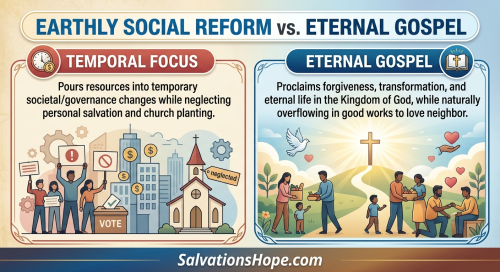
While Christians are called to shine as lights and do good in society, human social reform never replaces the eternal gospel. Societal structures rise and fall, but the Kingdom Christ purchased with His blood is an unstoppable, eternal future that culminates in a new heaven and a new earth.
In a nation that confuses conviction with arrogance and celebrates uncertainty as “humility,” the church must regain its trumpet voice (1 Corinthians 14:8).
Skeptical agnosticism (“no one can really know the truth”) is frequently used as a weapon to undermine biblical clarity. But biblical humility is not fog or doubt; true humility is taking God at His Word and joyfully and confidently stating what He has revealed.
Consider how the Apostle John concludes his first epistle:
Son of God has come and has given us understanding, so that we may know him who is true.” (1 John 5:18–20)
The Christian witness does not stutter or apologize for divine truth. We speak with assurance, clarity, and authority because our faith rests on an unshakeable foundation.
Summary of Hebrews 10:19–25
Gospel Foundation (vv. 19–21)
Our Response (vv. 22–25)
Divine Guarantee (v. 23b)
Christ’s Torn Body & Blood
1. Draw Near in prayer & worship
God’s absolute faithfulness to His covenant
Our Great High Priest
2. Hold Fast to our confession without wavering
Eternal salvation in Christ
The Opened Holy of Holies
3. Stir Up one another in Christian community
An unstoppable, glorious future
Deep Dive Exegesis: Standing Unwavering in Spiritual Battle (Hebrews 10:23)
As we conclude our verse-by-verse examination of Hebrews 10:19–25, our attention remains fixed on the second core imperative:
“Let us hold fast the confession of our hope without wavering, for he who promised is faithful.” (Hebrews 10:23)
To “hold fast” (katechō) is not a passive stance. In the original Greek context, it denotes a determined, combat-ready grip upon a holy trust. Standing firm requires spiritual discernment, moral courage, and absolute reliance on God’s faithfulness.
Perseverance rarely occurs in a neutral environment. The author of Hebrews was writing to believers under tremendous pressure to yield. To hold fast without wavering (aklinē), we must recognize and overcome four distinct pressures that seek to loosen our grip on divine truth.
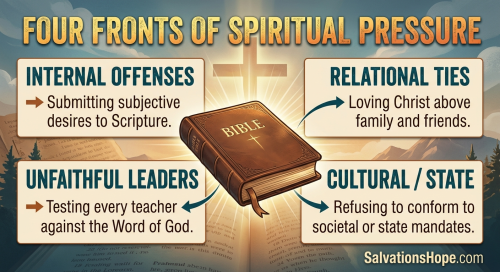
In Spite of Personal Urges and Intellectual Offenses
The human heart often rebels against the strict claims of God’s Word. When modern desires or cultural sensibilities collide with Holy Scripture, the worldly mind attempts to re-interpret, distort, or dilute the text to fit personal preferences.
- The Rule of Self-Denial: Jesus declared, "If anyone would come after me, let him deny himself and take up his cross daily and follow me" (Luke 9:23).
- Conforming to Truth: We do not discover biblical truth in order to reshape it in our own image; we seek truth so that the Holy Spirit may reshape us into the image of Christ. When a biblical command conflicts with an internal desire, true regeneration is marked by submitting our feelings to the authority of the Word.
In Spite of Relationships with Family and Friends
One of the most painful trials of faith occurs when loved ones reject biblical truth or embrace living conditions contrary to Scripture. Jesus plainly warned,
set a man against his father, and a daughter against her mother…” (Matthew 10:34–35)
Many church leaders and scholars who abandon historical orthodoxy regarding sexual ethics or salvation do so not because of new textual evidence, but due to personal relational shifts—a child, grandchild, or friend comes out, and emotional allegiance overrides allegiance to the Word of God. When friends or family abandon the faith, true love does not follow them into error. God instructed Jeremiah:
“Let them turn to you, but you must not turn to them. And I will make you to this people a fortified wall of bronze” (Jeremiah 15:19–20)
We serve our loved ones best by remaining an immovable beacon of gospel truth.
In Spite of Deceptive Church Leaders and Academics
Scripture repeatedly warns that spiritual deception frequently originates from within institutional pulpits and academic halls. While Hebrews 13:7 commands us to remember faithful leaders who spoke the Word of God, Acts 20:30 warns that “from among your own selves will arise men speaking twisted things, to draw away the disciples after them.”
False leadership is not only demonstrated by active heresy, but by calculating silence. A shepherd who refuses to warn against false doctrine or avoids preaching on eternal judgment (hell) is failing to discharge his solemn biblical duty (Ezekiel 33:7–9). Every believer is called to be like the Bereans (Acts 17:11)—examining the Scriptures daily to verify whether the teaching of pastors and professors aligns with the deposit of God’s Word.
In Spite of Societal, Corporate, and State Pressures
The surrounding world—governments, educational systems, corporations, and mainstream media—is inherently aligned against the uncompromised gospel. When institutional synods or local assemblies adjust their doctrines to avoid state disapproval or corporate backlash, they surrender their holy calling.
When pressured by earthly authorities to compromise, the apostles replied: “We must obey God rather than men” (Acts 5:29). A Christian must develop both theological conviction and spiritual backbone to endure cultural hostility.
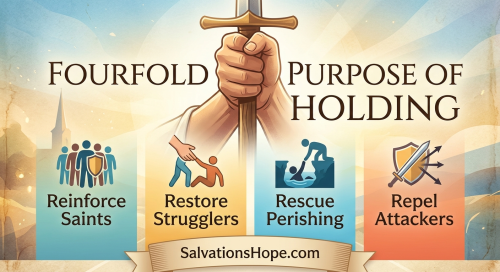
The Strategic Purpose: Four Works of Gospel Perseverance
Holding fast is not merely an exercise in self-preservation; it is an active military engagement for the spiritual health of others.
Lorem ipsum dolor sit amet, consectetur adipiscing elit. Ut elit tellus, luctus nec ullamcorper mattis, pulvinar dapibus leo.
To Reinforce Saints
Even established believers (“the choir”) require the continuous repetition of gospel doctrine. Spiritual maturity requires constant grounding in basic truths, protecting us from gradual spiritual atrophy (cf. 2 Peter 1:12–13).
To Restore Strugglers
To help a brother or sister caught in sin or wrestling with intellectual doubt, we must maintain a clear definition of truth and sin:
“Brothers, if anyone is caught in any transgression, you who are spiritual should restore him in a spirit of gentleness” (Galatians 6:1)
We must be tender toward wounded, struggling sheep, yet firm against wolves who seek to devour the flock.
To Rescue the Perishing
Without Jesus Christ, humanity faces eternal judgment. God declared to Ezekiel that a watchman who sees danger coming but fails to blow the trumpet bears the blood guilt of those who perish (Ezekiel 33:7–9). Jude 1:22–23 commands us: “Have mercy on those who doubt; save others by snatching them out of the fire.” Holding fast to the gospel gives us the tool to offer true salvation to a dying world.
To Repel Attackers
Jesus warned that false prophets come in sheep’s clothing but inwardly are ravenous wolves (Matthew 7:15). Holding fast requires church leaders, parents, and believers to actively expose error and defend the faith. Even when repelling false teachers, the goal remains redemptive where possible:
“Correcting his opponents with gentleness. God may perhaps grant them repentance leading to a knowledge of the truth” (2 Timothy 2:25)
The Example of David’s Mighty Men (2 Samuel 23)
When surrounding culture retreats and fellow believers lose their nerve, standing firm can feel intensely isolating. Yet, like Elijah, who was reminded of 7,000 faithful saints (1 Kings 19:18), we are never alone.
The Old Testament records the exploits of David’s Three Mighty Men—warriors who stood firm when the rest of the army fled:
Mighty Man
The Threat
The Action
The Result
Josheb-Basshebeth (2 Sam 23:8)
Faced 800 enemy soldiers simultaneously
Stood his ground with his spear
The Lord gave a massive victory.
Eleazar (2 Sam 23:9–10)
The army fled; Philistines attacked
Fought until his hand froze to his sword hilt
The troops returned to gather the spoils.
Shammah (2 Sam 23:11–12)
A field of lentils was swarmed; soldiers ran
Stood in the middle of the field and held it
The Lord brought about a great salvation.
These warriors did not win by their own strength; in each case, Scripture notes that “the Lord brought about a great victory.” When one believer stands firm, it inspires surrounding troops to turn back and fight.
Our strength to hold fast flows directly from the One who holds fast to us:
“Be strong in the Lord and in the strength of his might” (Ephesians 6:10)
Final Summary of Hebrews 10:19–25
Through this study, we have traced the divine architecture of Christian perseverance:
- The Doctrinal Grounding (vv. 19–21): Jesus’ broken body torn like the veil, giving us unhindered access into the Holy of Holies through His blood.
- The First Call — Draw Near (v. 22): Cultivating intimate worship and prayer in God’s presence, absorbing His holiness and glory.
- The Second Call — Hold Fast (v. 23): Clinging stubbornly to our confession, sound doctrine, and the unerring Word of God amidst hostile cultural tides.
- The Third Call — Stir Up (vv. 24–25): Gathering faithfully in corporate assembly to sharpen, encourage, and strengthen one another until the Day of Christ’s return.
Closing Prayer for Our Study
O Lord God, gracious Heavenly Father, we thank You that through the precious blood of Your Son, Jesus Christ, the curtain has been torn and a new, living way has opened for us into Your holy presence. Grant us grace to draw near to You daily with a true heart, in full assurance of faith, and a cleansed conscience. As we go out into a world filled with confusion, temptation, and opposition, clothe us in the scent of Your holiness and the light of Your truth. Grant us uncompromising courage to hold fast the confession of our hope without wavering. Keep us from bowing to cultural pressures, false teachings, personal desires, or the fear of man. Use us, Lord, to strengthen our fellow saints, gently restore those who struggle, snatch the perishing from the fire, and stand firmly against every spiritual attack. We rest not in our own grip strength, but in Your unshakeable covenant faithfulness. For He who promised is faithful. In the exalted name of Jesus Christ, our Great High Priest, we pray. Amen.