
Silencing the Accuser

Salvation, Power, and the Overthrow of Condemnation
Exegetical and Theological Study: Revelation 12
“Then I heard a loud voice saying in heaven, ‘Now salvation, and strength, and the kingdom of our God, and the power of His Christ have come, for the accuser of our brethren, who accused them before our God day and night, has been cast down.’” (Revelation 12:10)
The Book of Revelation was written by the Apostle John during a period of intense persecution under the Roman Empire (traditionally under Emperor Domitian, c. AD 95). Believers faced marginalization, pressure to participate in imperial cult worship, and martyrdom.
In Revelation 12, John receives a cosmic vision that pulls back the curtain on earthly persecution to reveal the spiritual reality behind it: a warfare between God’s kingdom and demonic powers represented by the “dragon” (Satan).
- Revelation 12:1–6: Depicts the celestial Woman (God's covenant people), the dragon, and the birth of the Messiah child, who is caught up to God’s throne.
- Revelation 12:7–9: Describes a war in heaven where Michael and his angels defeat the dragon, causing Satan to be cast down to the earth.
- Revelation 12:10–12: Serves as a heavenly hymn of victory celebrating Satan's defeat and declaring the spiritual victory of believers.
Exegetical Breakdown
Key Phrase / Term
Original Greek
Exegetical Meaning & Significance
“Loud voice… in heaven”
Phōnē megalē
Symbolizes divine authority, heavenly consensus, and a declaration meant to be heard across the universe.
“Salvation… strength…kingdom… power”
Sōtēria, dynamis, basileia, exousia
A fourfold declaration of God’s royal victory. God’s reign and Christ’s authority are fully asserted against enemy usurpers.
“Accuser of our brethren”
Katēgoros
A legal term for a prosecutor in a court of law. Translates the Hebrew title Satan (שָׂטָן), meaning “adversary” or “prosecutor.”
“Cast down”
Eblēthē
A passive verb emphasizing God’s sovereign judgment. Satan loses his legal standing and court access before God’s throne.
“Day and night”
Hēmeras kai nyktos
Expresses the unrelenting, legalistic nature of Satan’s condemnation against God’s redeemed people.
Key Theological Themes
The Overthrow of the Cosmic Prosecutor
In the Old Testament (e.g., Job 1–2, Zechariah 3), Satan appears before God as a legal accuser pointing out human sin. Revelation 12:10 marks the decisive end of this privilege. Through Christ’s sacrificial death and resurrection, the legal grounds for condemnation are erased (Colossians 2:14). Satan no longer has a case to bring before God.
The Inaugurated Kingdom ("Already / Not Yet")
The proclamation “Now have come…” highlights the reality of Christ’s victory. While the earthly effects of sin and spiritual warfare still exist (the “not yet”), the authority of Christ’s kingdom has been decisively established (the “already”). Satan is defeated fundamentally, even if his earthly tantrums continue briefly (Revelation 12:12).
Cosmic Victory Tied to Redemptive History
The defeat of Satan in verse 10 directly links to the cross and ascension described earlier in the chapter. Satan is not overthrown merely by angelic force, but because the Messiah shed His blood (Revelation 12:11), providing total forgiveness and rendering all satanic accusations powerless.
Pastoral & Practical Application for Believers
- Silence the Voice of Condemnation: Believers often wrestle with guilt, shame, and internal accusations. Revelation 12:10 reassures us that the enemy’s court cases against us have been thrown out. As Paul writes in Romans 8:33–34, “Who shall bring a charge against God’s elect? It is God who justifies.”
- Perseverance in Spiritual Warfare: When Christians face temptation, spiritual attack, or hostility from the culture, Revelation 12:10 reminds us that we fight from victory, not just for victory. The accuser is already a defeated power whose time is short.
Exegetical & Theological Focus on Revelation 12:11
“And they overcame him by the blood of the Lamb and by the word of their testimony,
and they did not love their lives to the death.” (Revelation 12:11)
Exegetical Breakdown of Revelation 12:11
Phrase
Original Greek
Exegetical & Theological Significance
“They overcame him”
enikēsan auton
Aorist Active Indicative: Describes a completed, decisive victory achieved by believers. The saints are not passive victims of spiritual warfare; they are active conquerors through Christ.
“By the blood of the Lamb”
dia to haima tou arniou
The Objective Ground of Victory: Dia + accusative indicates the cause or basis. Believers overcome Satan not by personal merit or strength, but because Christ’s sacrificial death cancelled the debt of sin and disarmed demonic powers (Colossians 2:14–15).
“By the word of their testimony”
dia ton logon tēs martyrias autōn
The Subjective Appropriation of Victory: Martyria (the root of “martyr”) refers to public confession and loyal witness to the Gospel. Believers activate and proclaim the victory of the cross in their daily lives.
“Did not love their lives to the death”
ouch ēgapēsan tēn psychēn autōn achri thanatou
The Costly Commitment of Faith: Echoes Jesus’ call to discipleship (Mark 8:35). Their commitment to Christ superseded physical self-preservation, demonstrating that Satan’s ultimate weapon—the threat of physical death—had lost its power over them (Hebrews 2:14–15).
The Threefold Armor of the Believer
VICTORY OVER THE ACCUSER: (Revelation 12:11)
- OBJECTIVE BASIS: "Blood of the Lamb" Cleanses sin & erases all legal accusation.
- PUBLIC CONFESSION: "Word of Testimony" Boldly proclaims truth under fire.
- SACRIFICIAL FIDELITY: "Did Not Love Their Lives" Disarms Satan's final weapon (fear of physical death).
Overcoming the Accuser: Living in God’s Cosmic Victory
“And I heard a loud voice in heaven, saying, “Now the salvation and the power and the kingdom of our God and the authority of his Christ have come, for the accuser of our brothers has been thrown down, who accuses them day and night before our God. And they have conquered him by the blood of the Lamb and by the word of their testimony, for they loved not their lives even unto death.”(Revelation 12:10–11)
The Invisible War Behind Visible Struggles
We often feel spiritual warfare as internal anxiety, legalistic guilt, or hostility from the surrounding world. Revelation 12 pulls back the curtain to show us that our ultimate battle is not against flesh and blood, but a defeated spiritual adversary. Because Satan has been cast down from heaven, believers can live with unshakeable assurance, bold witness, and radical courage.
The Prosecution Has Been Dismissed (Rev. 12:10)
- The Reality: Satan’s primary title here is Katēgoros—the Prosecuting Attorney who points out our sins day and night to produce guilt, shame, and distance from God.
- The Truth: When Christ died and rose again, Satan lost his legal standing before God's throne. The court case against you has been thrown out.
- Application: When you feel condemned by past mistakes, remind yourself that the Accuser has been silenced by the Righteous Judge.
“Who shall bring a charge against God’s elect? It is God who justifies.” (Romans 8:33)
Overcoming by the Blood of the Lamb (Rev. 12:11a)
- The Power of the Blood: Our defense against spiritual attacks is never "I am trying harder" or "I am good enough." It is exclusively the objective work of Jesus Christ on the cross.
- A Cleared Conscience: The blood of Jesus cleanses our conscience from dead works so we can serve the living God without fear (Hebrews 9:14).
- Application: Rest in the completed work of Jesus. Your victory was secured 2,000 years ago at Calvary.
Overcoming by the Word of Your Testimony (Rev. 12:11b)
- Faith Expressed: Victory is not meant to be kept silent. Our public allegiance to Jesus—speaking God's word, declaring His goodness, and holding fast to our confession—drives back darkness.
- Witness Under Pressure: In the 1st century, confessing "Jesus is Lord" could cost you your livelihood or life. Today, speaking God's truth brings clarity in a confused world.
- Application: Don't let culture silence your confession. Speak God's promises over your fears, your family, and your circumstances.
Fearless Faith Unto Death (Rev. 12:11c)
- The Ultimate Threat Disarmed: Satan’s greatest lever of fear is death itself. But for the Christian, physical death is merely the gateway to eternal glory with Christ (Philippians 1:21).
- Radical Commitment: When believers stop fearing physical loss, persecution, or martyrdom, the enemy completely loses his leverage over them.
- Application: What are you holding onto tightly today? Surrender your safety, reputation, and life into God's hands—true freedom begins where self-preservation ends.
You do not fight for victory; you fight from victory. The accuser is defeated, your record is clean, and your eternal destiny is secure in Christ.
How the Accuser Works
The Strategy: How the Accuser Works in Job
Looking at Job 1:9–10, We see how God holds up Job as a righteous and upright man. Satan immediately responds:
“9 Then Satan answered the Lord and said, “Does Job fear God for no reason? 10 Have you not put a hedge around him and his house
and all that he has, on every side? You have blessed the work of his hands, and his possessions have increased in the land.”
Satan claims Job’s faith is transactional and selfish. He argues that Job only loves God because of God’s physical blessings, protection, and prosperity—not because God is inherently worthy of love and worship. Satan’s charge in Job isn’t just against Job; it is an attack on God Himself. Satan implies: “God, You have to buy people’s loyalty with blessings because You aren’t truly good enough to be loved for who You are.”
By accusing the believer, Satan seeks to slander the Creator, questioning God’s wisdom in blessing and redeeming human beings.
He Demands Permission to Inflict Suffering
- The Attack: In Job 1:11 and Job 2:4–5, Satan demands:"But now, stretch out Your hand and touch all that he has, and he will surely curse You to Your face!"
- The Goal: Satan uses grief, financial devastation, health crises, and emotional isolation to press Job until he breaks, hoping Job will abandon his faith and validate Satan’s accusation.
Comparing Job's Accuser to Revelation 12:10
Aspect
The Accuser in Job (Old Covenant Context)
The Defeated Accuser in Revelation 12:10 (New Covenant Context)
Access
Had access to present charges before God’s throne in heaven.
Cast down—loses all legal standing and court access.
Basis of Accusation
Pointed to human fragility, imperfection, or selfish motives.
Silenced—the sins of believers are completely paid for by the Blood of the Lamb.
Legal Verdict
Satan acts as an active prosecutor before God.
Dismissed—“Who shall bring a charge against God’s elect? It is God who justifies” (Romans 8:33).
Key Takeaway for Believers Today
THE HEAVENLY COURTROOM
- OLD TESTAMENT (Job 1–2): Satan stands before God accusing Job's righteousness.
- NEW TESTAMENT (Revelation 12:10 / 1 John 2:1): Satan is CAST DOWN and silenced. Jesus Christ stands as our righteous advocate before the Father (1 John 2:1), presenting His blood as full payment for sin.
When Satan tries to use Job-like tactics today—whispering that your faith is fake, that God doesn’t care, or that you are only serving God for what you get—believers can rest in the truth of Revelation 12:10–11: the prosecutor has been thrown out of court, and Christ’s victory is final.
The Heavenly Courtroom
The Setting: Zechariah 3:1–5
In addition to the Book of Job, Zechariah 3:1–5 offers one of the clearest and most powerful Old Testament portraits of how Satan functions as “the Accuser.”
While Job shows Satan attacking a believer’s motives, Zechariah shows Satan attacking a believer’s worthiness and moral standing. In a vision given to the prophet Zechariah, Joshua the High Priest stands before the Angel of the LORD (a pre-incarnate appearance of Christ), with Satan standing at his right hand to accuse him.
“Then he showed me Joshua the high priest standing before the Angel of the Lord, and Satan standing at his right hand to oppose him. And the Lord said to Satan, ‘The Lord rebuke you, Satan! The Lord who has chosen Jerusalem rebuke you! Is this not a brand plucked from the fire?’ Now Joshua was clothed with filthy garments, and was standing before the Angel.” (Zechariah 3:1–3)
How the Accuser Works in Zechariah
In Job, Satan argued that a righteous man was secretly selfish. In Zechariah, Satan points to a man who is genuinely dirty. High priests were required by God’s Law to wear clean, holy vestments (Exodus 28). Yet Joshua stands in “filthy garments” (tsō’îm in Hebrew—a word referring to human excrement or gross defilement).
Satan’s charge here is technically true: Joshua is dirty and morally unqualified to stand before a Holy God. Satan uses God’s own righteous Law to demand judgment against God’s people.
He Opposes Grace and Restoration
- The Tactic: Satan stands at Joshua's right hand—the traditional posture for an attorney bringing formal charges in an ancient courtroom.
- The Goal: Satan seeks to convince God (and Joshua) that mercy is impossible. He argues that because sin exists, God’s holiness demands condemnation rather than restoration.
How God Silences the Accuser in Zechariah
God does not deny Joshua’s filthiness; instead, God overrules the prosecutor through Sovereign Grace and Imputed Righteousness:

Connecting Job, Zechariah, and Revelation 12:10
Comparing these three key passages shows the complete Biblical story of how the Accuser is defeated:
Scripture
Satan’s Tactic
The Target
How God Answers
Job 1–2
Accuses motives (“He only serves You for blessings”)
Man’s Heart
God proves true faith endures through trials.
Zechariah 3
Accuses moral standing (“Look at his filthy garments”)
Man’s Sin
God strips away filth and clothes us in His righteousness.
Revelation 12:10
Cast down forever (“The accuser of our brethren is cast down”)
The Entire Court
Christ’s blood permanently cancels all legal accusations.
In Job, Satan claims our good works are self-serving.
In Zechariah, Satan points out that our bad works render us unclean.
In both cases, Satan tries to pull us into a courtroom where we must defend ourselves by our own merit—a fight we will always lose.
Revelation 12:10–11 is the ultimate gospel fulfillment of Zechariah 3:
- Our Filthy Garments were placed on Christ at the cross.
- His Pure Robes of righteousness have been given to us.
- The Prosecuting Attorney has been thrown out of court because the case against us was paid in full by the Blood of the Lamb!
“There is therefore now no condemnation to those who are in Christ Jesus.” — Romans 8:1
The Accuser vs. The Advocate
To contrast the tactics of the Accuser in Job, Zechariah, and Revelation with the work of Jesus Christ, we can see how the Bible reveals a profound heavenly courtroom dynamic. While Satan stands as the relentless prosecutor, Jesus Christ acts as our divine Advocate, High Priest, and Defender.
Here is how Jesus actively works on behalf of the believer to defeat every accusation and secure our standing before God.
Feature
The Accuser (Satan)
The Advocate (Jesus Christ)
Courtroom Role
Prosecuting Attorney (Katēgoros)
Defense Advocate (Paraklētos) & High Priest
Legal Strategy
Demands judgment based on our real or perceived sins.
Offers His own blood as full payment for our debt.
Motivations
To condemn, destroy, and isolate us from God (John 10:10).
To justify, restore, and draw us into union with God (Hebrews 7:25).
Frequency
Accuses “day and night” (Revelation 12:10).
Intercedes “always” without ceasing (Hebrews 7:25).
Current Status
Cast down, disarmed, and silenced (Revelation 12:10).
Seated at the right hand of the Father (Romans 8:34).
Four Ways Jesus Defends and Works for Believers
As Our Heavenly Advocate (Paraklētos)
In the ancient legal world, a paraklētos was someone called alongside a defendant to speak on their behalf in court.
“My little children, these things I write to you, so that you may not sin. And if anyone sins, we have
an Advocate with the Father, Jesus Christ the righteous.” (1 John 2:1)
When we sin and Satan points out our guilt, Jesus does not argue that we are innocent in ourselves. Instead, He points to His own cross and righteousness. He tells the Father, “Their debt has already been paid in full by My sacrifice.”
As Our High Priest Who Intercedes Continually
While Satan continuously brings accusations, Jesus continuously offers intercession.
“Therefore He is also able to save to the uttermost those who come to God through Him,
since He always lives to make intercession for them.” (Hebrews 7:25)
Jesus prays for us in the midst of our weaknesses and spiritual battles, just as He did for Peter: “I have prayed for you, that your faith should not fail” (Luke 22:32). His ongoing intercession guarantees that no accusation can overturn our salvation.
As the Provider of Clean Garments (Imputed Righteousness)
Just as God stripped Joshua the High Priest of his filthy clothes in Zechariah 3, Jesus removes our sin and robes us in His perfection.
“For He made Him who knew no sin to be sin for us, that we might become the righteousness of God in Him.” (2 Corinthians 5:21)
Satan cannot successfully accuse someone who is clothed in the flawless righteousness of Christ. When the Father looks at the believer, He sees the perfection of His Son.
As the Victor Who Cancelled the Legal Debt
Satan’s only leverage was the moral law that condemned human sinners. Jesus destroyed that leverage on the cross.
(Colossians 2:14–15)
The “charge sheet” against us was physically and spiritually nailed to the cross. Because the penalty is paid, Satan’s legal case is thrown out of court.
The Divine Courtroom Summary
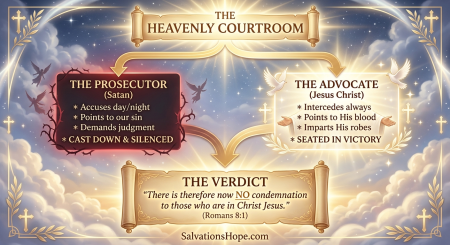
Standing on Christ’s Defense
When believers experience thoughts of shame, spiritual accusation, or unworthiness, Paul gives the ultimate courtroom challenge in Romans 8:33–34:
and furthermore is also risen, who is even at the right hand of God, who also makes intercession for us.”
You do not need to defend yourself against the Accuser. Your Defender is the Judge’s Son, and He has already won your case!
How Satan Shifts from Heavenly to Earthly Accusation
Four Specific Dangers Christians Face from False Accusations
While Revelation 12:10 celebrates the cosmic reality that Satan’s legal access to accuse believers before God has been permanently revoked, it also warns us of the dynamic on earth: when Satan is cast down from heaven, he shifts his strategy to accusing believers before men (Revelation 12:12).
Throughout church history and across culture, when human beings are influenced by demonic power or systemic deception, false accusations become one of Satan’s most dangerous weapons against the body of Christ.
When Satan can no longer condemn a believer in God’s courtroom, he turns to the public square, legal systems, and interpersonal relationships to destroy their earthly life, witness, and ministry.
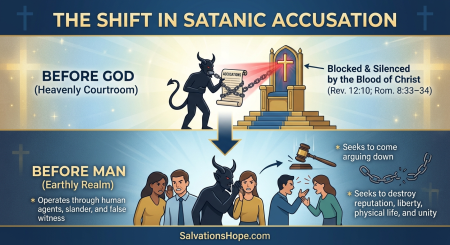
Judicial & Institutional Persecution (Legal Weaponization)
In the trial of Jesus Christ, religious and civil leaders relied on manufactured charges and bribed false witnesses (Matthew 26:59–60). Similarly, Paul was repeatedly dragged into Roman courts under false political charges of stirring up sedition (Acts 24:5).
When state powers or legal systems are influenced by hostile ideologies or spiritual darkness, false accusations are used to criminalize Christian faith, censor biblical truth, confiscate property, and inflict imprisonment or martyrdom.
Character Assassination & Destruction of Ministry Witness
Satan’s name Diabolos literally means “slanderer.” If Satan cannot corrupt a Christian’s integrity, he will attack their reputation. A false charge of hypocrisy, abuse, financial dishonesty, or malice—once broadcast—can destroy a minister’s reputation and undermine public trust in the Gospel. Satan knows that even if a believer is fully innocent, public suspicion often sticks long enough to derail their kingdom work.
Psychological & Spiritual Exhaustion (Discouragement & Isolation)
False accusations from family, friends, or trusted church community members produce deep emotional wounds. The burden of defending oneself against continuous, malicious lies can lead to severe spiritual burnout, bitterness, anger, or despair. Believers may feel abandoned by God or tempted to withdraw completely from fellowship and ministry.
Relational Division Within the Church Body
Satan frequently uses false or exaggerated claims within Christian communities to spark division, suspicion, and infighting (Proverbs 6:16–19). Unverified accusations break trust between believers, leading to fractured assemblies, broken marriages, and scandal that grieves the Holy Spirit (Ephesians 4:29–31).
Biblical Examples of Earthly False Accusations
Person
False Accusation Made
Satanic Influence / Human Agent
Outcome & God’s Deliverance
Joseph (Genesis 39)
Accused of attempted sexual assault.
Potiphar’s wife
Imprisoned, but God remained with him and eventually elevated him to save nations.
Naboth (1 Kings 21)
Bribed false witnesses claimed he blasphemed God and the king.
Queen Jezebel
Stoned to death for his vineyard, showing the ultimate cruelty of corrupt power.
Stephen (Acts 6:11–14)
False witnesses claimed he spoke against the Temple and the Law.
Religious Sanhedrin
Stoned, but died seeing heaven open and Jesus standing to receive him.
How Believers Must Respond When Falsely Accused
Jesus prepared His followers explicitly for this reality:
“Blessed are you when they revile and persecute you, and say all kinds of evil against you falsely for My sake” (Matthew 5:11)
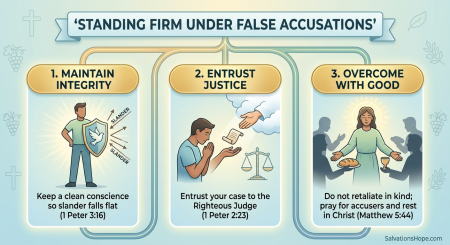
- Keep a Clear Conscience: “having a good conscience, that when they defame you as evildoers, those who revile your good conduct in Christ may be ashamed” (1 Peter 3:16). Integrity is the best shield against slander.
- Refuse to Retaliate with Lies: Follow Christ’s example, who “when He was reviled, did not revile in return… but committed Himself to Him who judges righteously” (1 Peter 2:23).
- Anchor Your Identity in God’s Heavenly Verdict: Human courts and public opinion are temporary. What matters eternally is that before the throne of God, your defense attorney is Jesus Christ, and your vindication is guaranteed.
The Call to Holy Living
While Christ stands as our divine Advocate before God and silences Satan’s accusations, Scripture gives a solemn, explicit warning: grace is never a license for hypocrisy, greed, or dishonest living.
When people adopt the outward appearance of Christianity—or use the name of Jesus as a brand—to enrich themselves, deceive others, or exploit the flock, they play directly into the hands of the Accuser. Instead of representing Christ, they bring reproach upon the Gospel, open themselves to severe divine judgment, and cause others to stumble.
Integrity as the Ultimate Defense
A living faith always produces real transformation and ethical integrity. Believers are called to walk in holiness, honesty, and financial transparency so that the enemy is given no legitimate foothold.
- A Clean Conscience Disarms the Enemy: In 1 Peter 3:16, Christians are instructed to maintain "a good conscience, that when they defame you as evildoers, those who revile your good conduct in Christ may be ashamed." When a believer lives uprightly, Satan’s earthly false accusations eventually collapse under the weight of truth.
- Integrity in Business and Daily Life: Scripture repeatedly condemns fraud, dishonest scales, and deceptive gain (Proverbs 11:1, Micah 6:11). True followers of Jesus do not use religion to mask dishonesty, cheat employers or clients, or shirk legal and moral responsibilities.
- Walking Worthy of the Calling: Paul exhorts believers to "walk worthy of the calling with which you were called" (Ephesians 4:1). A holy life is not an attempt to earn salvation, but the natural, Spirit-led fruit of someone whose dirty garments have been removed by Christ.
Using Jesus’ Name for Profit and Popularity: A Satanic Counterfeit
Using the Christian faith as a vehicle for personal gain, wealth accumulation, or narcissistic influence is not a minor error—it is a spiritual perversion exposed throughout the New Testament.
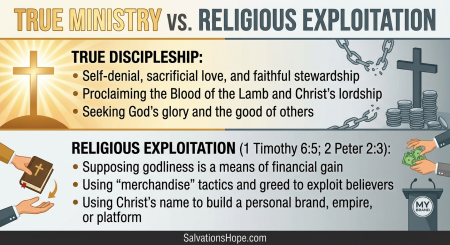
"Godliness as a Means of Gain"
In 1 Timothy 6:5, Paul warns against corrupt teachers who suppose that “godliness is a means of gain.” He follows this with a stark warning to those who use ministry for wealth:
which drown men in destruction and perdition. For the love of money is a root of all kinds of evil…” (1 Timothy 6:9–10)
Exploiting the Flock with Deceptive Words
The Apostle Peter explicitly prophesied the rise of religious scam artists who would leverage Christ’s name for profit:
has not been idle, and their destruction does not slumber.” (2 Peter 2:3)
Biblical Warnings: The Devastating Effects of Religious Hypocrisy
Scripture records harrowing examples of individuals who attempted to use sacred things for personal clout or financial gain:
Biblical Example
The Hypocrisy / Sin
The Consequence & Warning
Simon the Sorcerer (Acts 8:18–23)
Tried to buy spiritual authority with money to build status.
Peter rebuked him: “Your money perish with you… your heart is not right in the sight of God.”
The Seven Sons of Sceva (Acts 19:13–16)
Used the name of Jesus like a magic formula for personal clout without a real relationship with Him.
The demon-possessed man overpowered them, leaving them naked and wounded. The demon declared: “Jesus I know, and Paul I know; but who are you?”
Ananias & Sapphira (Acts 5:1–11)
Lied about their giving to gain a public reputation for holiness while withholding money.
Struck dead by the Holy Spirit to preserve the purity of the early church.
Balaam (2 Peter 2:15; Jude 11)
A prophet who loved the wages of unrighteousness and compromised his calling for financial reward.
Became the Biblical prototype of a false teacher who sells out God’s truth for profit.
The Major Consequences of Using Christ for Personal Gain

- The Name of God Is Blasphemed Among Unbelievers: When prominent Christians or church leaders are exposed for cheating, financial scams, or abusing power for personal gain, the world scoffs at the Gospel. As Paul warned, "The name of God is blasphemed among the Gentiles because of you" (Romans 2:24).
- Valid Ammunition Given to the Enemy: While Satan is a false accuser, religious hypocrisy gives him real ammunition to parade before the world. When a professing Christian steals or cheats, they validate the world's cynicism and destroy their own local testimony.
- Severe Divine Judgment: Jesus saved His most scorching warnings not for secular sinners, but for religious hypocrites who performed spiritual deeds for human applause (Matthew 23).
- Eternal Disqualification: In Matthew 7:21–23, Jesus delivers one of the most sobering declarations in all of Scripture:"Not everyone who says to Me, 'Lord, Lord,' shall enter the kingdom of heaven, but he who does the will of My Father in heaven. Many will say to Me in that day, 'Lord, Lord, have we not prophesied in Your name, cast out demons in Your name, and done many wonders in Your name?' And then I will declare to them, 'I never knew you; depart from Me, you who practice lawlessness!'"
A Holy Life Reflects a Defeated Accuser
The glorious truth of Revelation 12:10–11—that the Accuser of the brethren has been cast down by the Blood of the Lamb—is never a cloak for dishonesty.
- The Blood of the Lamb cleanses us from genuine guilt.
- The Word of Our Testimony is lived out in uncompromised truth, honesty, and humility.
- Loving Not Our Lives Unto Death means crucifying greed, selfish ambition, and the desire to exploit Christ for personal glory.
True victory over darkness is seen when believers live lives of unassailable integrity, using their resources to serve others, honor God, and point a watching world to the real Jesus.
The End-Time Sifting — Form of Godliness vs. the Power of the Holy Spirit
As the age draws to a close and the end-time tribulation intensifies, the spiritual warfare described in Revelation 12 will reach its earthly climax. When Satan—furious because his time is short—directs his wrath toward those on earth, the spiritual landscape will no longer tolerate lukewarm Christianity, cultural church attendance, or empty religious performance.
Scripture explicitly warns that in the final days, a severe sifting will take place across the visible Church, separating those who merely hold a religious title from those who are truly born again and filled with the Holy Spirit.
The Peril of Nominal Christianity: A Form of Godliness Without Power
For generations, many have populated church pews out of tradition, social routine, or a desire for personal gain. They may carry the name “Christian,” understand biblical vocabulary, and maintain an outward appearance of morality. Yet, without the supernatural rebirth (John 3:3–5) and the indwelling power of the Holy Spirit, their faith is an empty shell.
The Apostle Paul prophesied this precise end-time dynamic:
“Having a form of godliness but denying its power. And from such people turn away!” (2 Timothy 3:5)

When pressure comes, human willpower, religious heritage, and superficial morality will completely fail. Fleshly strength cannot withstand demonic deception or intense tribulation.
Why Unregenerated Churchgoers Will Not Stand in the Tribulation
Lack of Oil: The Parable of the Ten Virgins
In Matthew 25:1–13, Jesus compares the end-time church community to ten virgins waiting for the Bridegroom. Five were wise, and five were foolish.
- The foolish virgins had lamps (outward profession, church attendance, religious appearance), but they had no oil in their vessels.
- In Scripture, oil frequently symbolizes the Holy Spirit. When the midnight cry went out and darkness fell, the foolish virgins could not keep their lamps burning. They tried to buy oil at the last minute, but the door was shut, and the Lord declared: "Assuredly, I say to you, I do not know you."
Susceptibility to Great Deception
Without the Holy Spirit to guide them into all truth (John 16:13), those who do not genuinely love and obey the truth will be swept away by the miraculous signs, false peace, and economic pressure of the end-time antichrist system:
“The coming of the lawless one is according to the working of Satan, with all power, signs, and lying wonders, and with all unrighteous deception among those who perish, because they did not receive the love of the truth, that they might be saved.” (2 Thessalonians 2:9–10)
Falling Away Under Persecution (The Stony Ground)
In the Parable of the Sower, Jesus describes those represented by the stony ground: they receive the Word with initial joy, but because they have no deep root in themselves, “when tribulation or persecution arises because of the word, immediately they stumble” (Matthew 13:21). When standing for Christ carries a steep price—losing employment, social standing, financial access, or physical life—the nominal believer will abandon their profession to protect themselves.
The Urgent Call: Moving From the Pew to Divine Regeneration
The message of Revelation 12:10–11 is ultimately a call to authentic, Spirit-empowered faith. The Accuser is defeated not by human religious effort, but by those who are truly united with Christ:

As the end times approach, merely sitting in a pew is a dangerous position. The day is coming when every person’s faith will be tested by fire (1 Corinthians 3:13).
Only those who have been washed in the Blood of the Lamb, who are sealed and empowered by the Holy Spirit, and whose lives bear the genuine word of their testimony will stand firm, overcome the darkness, and celebrate the final, glorious manifestation of the Kingdom of our God and the power of His Christ.