
Prophets for Profit
Testing the Spirits
Modern Self-Proclaimed Prophets and False Teaching
In an era of spiritual confusion, many believers face leaders who claim prophetic title and authority. However, a biblical analysis shows that claiming such an office requires a divine calling, not self-appointment.
Scripture issues strong warnings against those who speak from their own imagination or exploit the flock for personal gain. This study explores biblical standards for prophetic ministry, key distinctions between Old and New Testament models, and practical guidance for identifying and responding to false teaching.
The Biblical Call: God Appoints, Man Does Not Self-Appoint
A defining feature of true biblical messengers is that they never declared their own office, applied for status, or took titles upon themselves. God called, commissioned, and sent them directly.
- Divine Commissioning: God personally set prophets apart—such as Isaiah, purified by the altar coal (Isaiah 6), or Jeremiah, commissioned before birth (Jeremiah 1:5).
- No Human Origin: Prophecy never originates from human will, ambition, or cleverness. As 2 Peter 1:20–21 affirms, "no prophecy of Scripture came about by the prophet’s own interpretation of things... but prophets, though human, spoke from God as they were carried along by the Holy Spirit."
- Condemnation of Self-Styled Messengers: Scripture strongly condemns those who run without being sent. God warned through Jeremiah:
“I did not send these prophets, yet they have run with their message; I did not speak to them, yet they have prophesied.” (Jeremiah 23:21)
Gift of Prophecy vs. The Office of an Old Testament Prophet
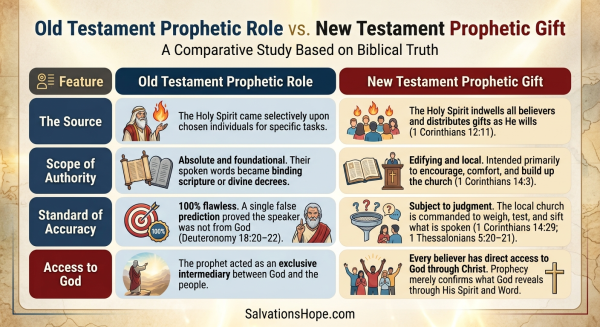
To evaluate modern claims, we must distinguish between the Old Testament prophetic office and the New Testament gift of prophecy.
Feature
Old Testament Prophetic Role
New Testament Prophetic Gift
The Source
The Holy Spirit came selectively upon chosen individuals for specific tasks.
The Holy Spirit indwells all believers and distributes gifts as He wills (1 Corinthians 12:11).
Scope of Authority
Absolute and foundational. Their spoken words became binding scripture or divine decrees.
Edifying and local. Intended primarily to encourage, comfort, and build up the church (1 Corinthians 14:3).
Standard of Accuracy
100% flawless. A single false prediction proved the speaker was not from God (Deuteronomy 18:20–22).
Subject to judgment. The local church is commanded to weigh, test, and sift what is spoken (1 Corinthians 14:29; 1 Thessalonians 5:20–21).
Access to God
The prophet acted as an exclusive intermediary between God and the people.
Every believer has direct access to God through Christ. Prophecy merely confirms what God reveals through His Spirit and Word.
Six Biblical Tests of a True Prophet
When evaluating any minister, teacher, or self-proclaimed prophet, Scripture provides clear criteria to test their message and character:
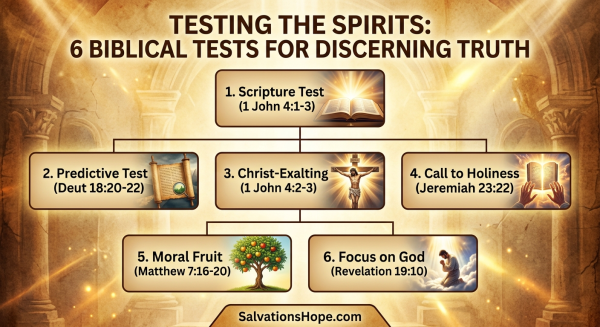
- Total Alignment with Scripture: A true messenger never contradicts the established Word of God. If a teaching distorts biblical truth or excuses sin, reject it (1 John 4:1–3).
- Absolute Accuracy of Predictions: In Deuteronomy 18:20–22 and Jeremiah 28:9, any predictive proclamation spoken “in the name of the Lord” must come to pass.
- Exaltation of Jesus Christ: True prophecy confesses Christ come in the flesh, honoring His person, deity, and finished work on the cross (1 John 4:2–3).
- Call to Repentance and Holiness: Authentic prophetic messages turn people away from sin and back to God’s righteousness, rather than flattering listeners with cheap comfort or appealing to selfish desires.
- Character and Fruit of the Spirit: Jesus taught, “By their fruit you will recognize them” (Matthew 7:16–20). True messengers model humility, self-sacrifice, and integrity rather than greed, manipulation, or lust for power (2 Peter 2:1–3).
- Focus on God’s Glory: A true prophet points people directly to God’s mercy and justice—never to their own personal platform, empire, or brand.
Scripture declares that “the spirits of prophets are subject to the control of prophets” (1 Corinthians 14:32). True leaders willingly submit their claims to Scripture and the local church’s oversight.
Dangers of Demanding OT Titles Today
When modern leaders use Old Testament titles such as “Prophet” or “Prophetess” to demand absolute submission, they introduce significant theological errors into the church.
Bypassing Biblical Accountability
In the New Testament, the community evaluates leadership declarations (1 Corinthians 14:29). Claiming an untouchable Old Testament status often seeks to silence questions and insulate a leader from accountability.
Promoting Spiritual Manipulation
Misusing titles to demand compliance often weaponizes passages like Psalm 105:15 (“Do not touch my anointed ones”). This insulates leaders from constructive critique, allows them to control life decisions (e.g., marriage, finances, personal moves), and fosters spiritual codependency.
Recognizing Red Flags in Modern Teaching
To guard your heart and church community, watch for these common marks of false prophetic ministry:
- Demanding Blind Submission: Equating disagreement with the leader’s personal "word" to rebelling against God Himself.
- Isolating the Flock: Discouraging believers from testing teachings against independent biblical resources, godly counsel, or Church history.
- Financial Exploitation: Conditioning personal blessings, breakthroughs, or "prophetic insights" on financial gifts, seed-sowing, or paying for private access (2 Peter 2:3).
- Shifting Blame for Failed Words: When predictions fail, false leaders rarely repent. Instead, they often accuse the hearer of lacking faith, claim the fulfilled word occurred purely in "the spiritual realm," or alter their claims without accountability.
How Believers Should Respond
If you encounter false prophetic authority, Scripture provides a clear, compassionate path forward:
- Do Not Fear Their Claims: Deuteronomy 18:22 ends with a comforting command: “do not be afraid of him.” Unbiblical pronouncements and threats carry zero authority before God.
- Evaluate the Fruit: Measure every teaching, personal directive, and leader by God’s Word and the fruit of the Spirit (Matthew 7:15–20; Galatians 5:22–23).
- Withdraw and Protect: Paul instructs believers in Romans 16:17 to “watch out for those who cause divisions and put obstacles in your way that are contrary to the teaching you have learned. Keep away from them.” You are under no biblical obligation to remain under or support manipulative leadership.
Prophetic Claims and The Dangers of Hyper-Charisma
A Discernment Analysis of Heidi Baker and the New Apostolic Reformation (NAR)
Heidi Baker co-founded Iris Global, an international humanitarian organization operating primarily in Mozambique. While widely celebrated in charismatic and Pentecostal circles for her relief work and passionate delivery, her public ministry serves as a prominent case study in contemporary spiritual deception.
Characterized by ecstatic worship practices, claims of supernatural sign-gifts, and alignment with the New Apostolic Reformation (NAR), Baker’s ministry demonstrates how experience-driven theology degrades biblical authority. This study examines five major theological errors in her teaching and ministry model and highlights the danger these aberrations pose to Christ’s flock.
The Elevation of Subjective Experience over Objective Revelation
Theological Issue: Mysticism and Pneumatological Disorder
A primary mark of false teaching is prioritizing subjective, sensory experiences over the objective, written Word of God. Baker’s ministry relies heavily on physical manifestations—such as uncontrollable laughter, falling to the ground, bodily tremors, and trance-like states—which are falsely attributed to the direct action of the Holy Spirit.
Biblical Refutation: Scripture teaches that true worship must be conducted “in spirit and truth” (John 4:24). Furthermore, Paul teaches that God is not the author of confusion but of peace and order in the assembly (1 Corinthians 14:33, 40). A primary fruit of the Spirit is self-control (enkrateia), not the loss of physical or mental composure (Galatians 5:22–23). When physical manifestations and emotional highs become the standard for assessing God’s presence, believers are left vulnerable to psychological manipulation and spiritual deception.
The Intrusion of NAR Ecclesiology and Unbiblical Apostolic Claims
Theological Issue: Aberrant Ecclesiology and Modern Revelationism
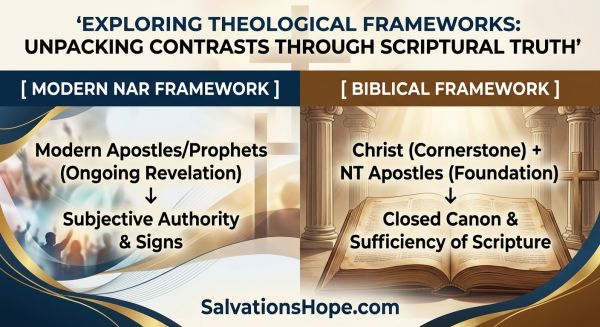
Baker is deeply interconnected with the New Apostolic Reformation (NAR), a movement that asserts God is restoring the foundational offices of “Apostle” and “Prophet” to the modern Church. Under this framework, Baker claims direct prophetic revelation and functions as a modern-day apostolic figure who imparts special spiritual authority.
Biblical Refutation: The NT church was built upon the historical foundation laid by the original Apostles and Prophets, with Jesus Christ Himself as the chief cornerstone (Ephesians 2:20). The foundational apostolic office required being a direct witness to the resurrected Christ (Acts 1:21–22) and receiving divine inspiration to pen canonical Scripture. Claiming modern apostolic authority undermines the finality of the apostolic foundation and creates an unbiblical hierarchy that demands compliance with self-appointed leaders.
The Evisceration of Exegesis in Favor of Scripture Twisting
Theological Issue: Hermeneutical Failure and Eisegesis
Faithful biblical teaching requires sound exegesis—extracting the author’s intended meaning from the text based on context, grammar, and history. Baker’s teaching regularly exhibits eisegesis (reading one’s own ideas into the text), using isolated verses out of context to validate dramatic claims, miraculous healings, or personal anecdotes.
Biblical Refutation: The Apostle Paul charges ministers to rightly divide the word of truth (2 Timothy 2:15). Peter specifically warns that the unlearned and unstable twist Scripture to their own destruction (2 Peter 3:16). A teacher who misuses the text to validate personal spiritual experiences fails to feed the flock the true, unadulterated counsel of God (Acts 20:27), leaving believers spiritually malnourished.
The Distortion of the Gospel into an Experience-Centered Message
Theological Issue: Anthropocentric (Man-Centered) Soteriology
In hyper-charismatic frameworks like Iris Global, the Gospel message often shifts from Christ’s substitutionary atonement on the cross to a pursuit of personal encounters, sign-gifts, and spatial manifestations of God’s presence. This transforms the Gospel from an objective truth to be believed into a subjective state to be felt.
Biblical Refutation: The Gospel is the power of God for salvation, centered on the historic life, death, and resurrection of Jesus Christ and the forgiveness of sins (Romans 1:16; 1 Corinthians 15:3–4). When faith depends on ongoing physical sensations or signs, it promotes spiritual elitism—where those who experience manifestations are seen as “anointed,” while those who stand on Scripture alone are seen as lacking faith.
The Denial of the Sufficiency of Scripture via Extra-Biblical Revelation
Theological Issue: Compromise of Sola Scriptura
Baker routinely claims to receive direct, extra-biblical spoken words, visions, and messages from God. By delivering these to audiences as authoritative instructions or divine insights, her ministry operates under the premise that the written Bible is insufficient for Christian living and guidance.
Biblical Refutation: The doctrine of Sufficiency of Scripture (Sola Scriptura) affirms that the Bible contains all things necessary for Christian faith, life, and godliness (2 Timothy 3:16–17; 2 Peter 1:3). The biblical canon is closed (Jude 3; Revelation 22:18–19). Claiming to deliver fresh, divine revelations outside Scripture undermines the Bible’s authority and exposes the Church to subjective errors and spiritual instability.
Discernment Application
While Iris Global engages in humanitarian work in impoverished regions, charitable deeds cannot cover or excuse doctrinal heresy. Scripture instructs the Church to test all spirits (1 John 4:1) and to evaluate teachers not by their outward zeal or works alone, but by their alignment with Apostolic doctrine (Galatians 1:8–9).
Criterion
Faithful Biblical Teaching
Baker / NAR Teaching Model
Primary Authority
The Written Word of God (Sola Scriptura)
Personal Revelations & Ecstatic Encounters
Gospel Focus
Substitutionary Atonement & Repentance
Power Manifestations & Subjective Encounters
Pneumatology
Holy Spirit produces order, self-control, and truth
Holy Spirit produces chaos, loss of control, and sensory highs
Ecclesiology
Elder-led, built on the historic NT foundation
Led by modern self-proclaimed Apostles and Prophets
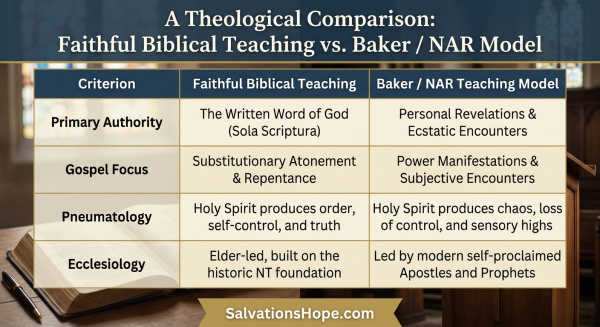
Believers must exercise discernment regarding Heidi Baker and associated NAR networks. Christians are instructed to avoid teachers who promote extra-biblical revelations, sensual spiritual practices, and a distorted Gospel, turning instead to the supreme authority and sufficiency of God’s written Word.
- How does the biblical definition of the Holy Spirit’s fruit (Galatians 5:22–23) contrast with the manifestations observed in hyper-charismatic revival meetings?
- Why is the doctrine of the closed canon crucial for protecting the local church from spiritual abuse and false prophecy?
Evaluating the Teachings of Juanita Bynum Through a Biblical Lens
In contemporary Christian leadership, discernment is essential to evaluate whether prominent public figures align with sound doctrine. Juanita Bynum, a well-known televangelist, author, and self-designated prophetess, rose to prominence through televised conferences and media platforms—most notably her teachings on relationships and personal restoration. While her ministry has attracted a massive following within charismatic and Pentecostal circles, a careful theological comparison against Scripture reveals critical departures from orthodox biblical teaching.
For believers seeking to uphold biblical fidelity, several major theological concerns warrant a critical evaluation and rejection of her ministry.
The Promotion of the Prosperity Gospel
A central pillar of Bynum’s platform is the prosperity message, which asserts that God’s primary intent for believers is material wealth, physical health, and worldly success. Her ministry often links financial contributions—often directed toward her own programs—to divine favor, suggesting that giving is a transactional seed that unlocks supernatural breakthroughs.
Biblical Standard: Scripture nowhere teaches that physical wealth measures spiritual health, nor that faith can manipulate divine provision. Jesus explicitly warned against storing up earthly riches (Matthew 6:19), while the Apostle Paul reminded believers that “godliness with contentment is great gain” (1 Timothy 6:6) and that the “love of money is a root of all kinds of evils” (1 Timothy 6:10). Conditioning spiritual blessings on financial transactions replaces the free grace of God with a form of materialism.
Reliance on Extra-Biblical Revelation and Prophetic Authority
Bynum frequently presents herself as a prophetess receiving direct, specialized revelations from God, encouraging her audience to treat her words as authoritative guidance for their lives.
Biblical Standard: Historic Christianity affirms the biblical canon’s sufficiency and finality (2 Timothy 3:16-17). While God sovereignly communicates through His written Word, claims of ongoing foundational revelation that rival or supersede Scripture undermine biblical authority. Deuteronomy 18:20-22 establishes that true prophetic utterances must correspond exactly with established divine truth and never lead believers away from Scripture.
Cultivating an Experience-Driven, Emotion-Centered Faith
The atmosphere of Bynum’s services relies heavily on intense emotional responses, dramatic physical manifestations, and ecstatic expressions, which are routinely attributed directly to the immediate work of the Holy Spirit. This environment conditions followers to measure their spiritual vitality by the intensity of their emotional experiences rather than grounded doctrinal maturity.
Biblical Standard: While emotions naturally accompany encounters with God, authentic Christian faith is anchored in objective truth and cognitive renewal. Paul exhorted believers to be “transformed by the renewal of your mind” (Romans 12:2). Grounding faith primarily in subjective feelings produces spiritual instability, leaving believers vulnerable to deception when emotional highs fade.
The Manipulation and Decontextualization of Scripture
A recurring method in Bynum’s teaching involves proof-texting—extracting verses from their literary and historical contexts to validate personal ministry agendas, particularly financial appeals and promises of supernatural breakthrough.
Biblical Standard: Scripture commands teachers to “rightly handle the word of truth” (2 Timothy 2:15) and explicitly condemns those who “peddle the word of God for profit” (2 Corinthians 2:17). Twisting biblical texts to pressure audiences into financial transactions distorts the Gospel and exploits vulnerable believers for personal or organizational gain.
Character, Lifestyle, and the Biblical Standard for Leadership
Bynum’s public ministry has frequently intersected with high-profile personal controversies, volatile relationships, and an emphasis on luxury and materialism. These elements stand in stark contrast to the behavioral patterns Scripture demands of spiritual guides.
Biblical Standard: The New Testament outlines rigorous character requirements for those who teach in the church, requiring leaders to be “above reproach,” “self-controlled,” “gentle,” and “not greedy for money” (1 Timothy 3:2-3; Titus 1:7). A lifestyle characterized by unrepentant public scandal and self-promotion disqualifies an individual from exercising trustworthy spiritual oversight.
Because her platform merges extra-biblical claims, prosperity theology, and experience-driven emotionalism while disregarding proper biblical context, discerning Christians should reject Juanita Bynum’s ministry. Believers are called to test all teachings against Scripture’s objective standard (Acts 17:11) and to adhere firmly to sound doctrine that honors Christ rather than human personality.
Key Beliefs and How They Differ from Confessional Christianity
Scripture vs. Self-Proclaimed Prophecy: Evaluating Cindy Jacobs and the Prosperity Gospel
Cindy Jacobs is a prominent figure in the New Apostolic Reformation (NAR), known for her teachings on prosperity, prophecy, and spiritual warfare. As a self-proclaimed prophetess, she leads Generals International, an organization focused on prophetic ministry, intercession, and transforming nations. Her teachings often align with the Word of Faith movement and the prosperity gospel, which differ significantly from confessional Christianity, especially in her views on wealth, prophecy, and the church’s role.
Beliefs about Prosperity and Wealth
Jacobs teaches that God wants His people to experience financial prosperity and that poverty often results from curses or a lack of faith. She encourages believers to break these curses through prophetic declarations, prayer, and faith-based giving. Jacobs often promotes the idea that sowing financial “seeds” into her ministry or others will lead to material blessings and financial breakthrough, a core teaching of the prosperity gospel.
Confessional Christianity: Confessional Christianity rejects the prosperity gospel as a distortion of biblical teaching. The Bible teaches that God’s blessings are not primarily material and that believers may experience suffering, trials, or financial hardship as part of their faith journey (Philippians 4:11-13; 1 Timothy 6:6-10). It also emphasizes that true riches are found in Christ and that believers should seek spiritual growth and contentment rather than material wealth. Generosity is an act of worship, not a transaction to gain material blessings (2 Corinthians 9:6-7).
Role of Prophecy and Modern Revelation
Jacobs claims to receive direct revelations from God and frequently delivers prophecies about political events, natural disasters, economic changes, and individual destinies. She teaches that the office of prophet remains active today and that believers should seek prophetic words to guide their decisions and unlock God’s blessings. Jacobs’s ministry often focuses on prophetic declarations, calling believers to “decree and declare” outcomes in their lives, finances, and health.
Confessional Christianity: Confessional Christianity teaches that Scripture fully reveals God’s will (Hebrews 1:1-2; 2 Timothy 3:16-17). God’s revelation is sufficient, and God is not giving new, authoritative prophecies today. Reformed theology emphasizes that while God may guide believers through providence and the illumination of Scripture, prophecy, in the sense of receiving new divine revelations, is neither valid nor necessary.
Spiritual Warfare and Deliverance
Jacobs emphasizes the need for spiritual warfare and deliverance, teaching that Christians must actively engage in breaking demonic strongholds, curses, and territorial spirits. She often speaks of “binding” and “loosing” spirits and encourages believers to use prophetic declarations to exercise authority over spiritual forces. Jacobs’s teachings often suggest that spiritual attacks can hinder prosperity, health, and success, and that believers must overcome them through warfare prayers.
Confessional Christianity: Confessional Christianity acknowledges the reality of spiritual warfare but teaches that Christ’s victory over Satan is complete and that believers engage in spiritual warfare primarily through faith, prayer, the Word of God, and the means of grace (Ephesians 6:10-18; Colossians 2:15). The Bible emphasizes that the power to resist the devil comes through the strength and grace of Christ, not through human declarations or techniques. Reformed theology emphasizes resting in Christ’s finished work rather than aggressive spiritual warfare practices.
Teachings on Dominionism and the Kingdom of God
Jacobs is associated with dominionism, the belief that Christians are called to take authority over every sphere of society (government, education, business, media, etc.) to establish God’s kingdom on earth. She frequently speaks of transforming nations and influencing political structures through prophetic declarations, intercession, and strategic spiritual warfare. This teaching implies that the church’s mission is to bring about societal change and establish God’s kingdom in the present world.
Confessional Christianity: Confessional Christianity teaches that the kingdom of God is both a present spiritual reality and a future hope that will be fully realized at Christ’s return (Matthew 28:18-20; John 18:36). Scripture emphasizes that the church’s primary mission is to proclaim the gospel and make disciples, not to establish a political or societal dominion, although political influence will certainly be a fruit of revival. While believers are to be salt and light in the world and vote according to their conscience in light of the Bible, the ultimate transformation of society is God’s work, not something achieved through human efforts or declarations.
Emphasis on Personal Experience and Extra-Biblical Revelations
Jacob’s teachings heavily emphasize personal experiences, visions, dreams, and extra-biblical revelations. Her ministry often encourages followers to seek direct encounters with God and to act on prophetic words received through supernatural experiences. This approach places a high value on subjective experiences and new revelations as sources of guidance for the Christian life.
Confessional Christianity: Confessional Christianity teaches that Scripture is the ultimate authority and that believers must test experiences against the Word of God (Acts 17:11; 1 John 4:1). Believers should rely on the Bible for all matters of faith and practice, since God’s Word is sufficient to guide the Christian life. The Holy Spirit works through the ordinary means of grace, such as preaching, prayer, and the sacraments, rather than through new revelations or prophetic experiences.
Doctrinal Discernment & The Threat of False Teaching
Theological Case Study: Evaluating Paula White-Cain
In an era of televised ministry and cultural prominence, discerning false doctrine requires an unyielding adherence to Holy Scripture (1 John 4:1). A teacher must be evaluated not by their personality, net worth, audience size, or political influence, but strictly by their public handling of God’s Word (2 Timothy 2:15).
While Paula White-Cain—televangelist, author, and government religious adviser—maintains a formal statement of faith that affirms foundational Christian doctrines (such as the Trinity, the deity and resurrection of Christ, and salvation by grace), her documented, public ministry consistently operates in direct opposition to orthodox Christianity.
Through her propagation of Word of Faith constructs, Prosperity Theology, misuse of Old Covenant ceremonial laws, and claims to extra-biblical revelation, Paula White-Cain acts as an unsafe guide to Christian doctrine and should be classified as a false teacher. Her formal orthodoxy makes her functional error more subtle and, therefore, more spiritually perilous.
Evaluative Standard: Scripture Alone (Sola Scriptura)
The Church must maintain clear boundaries when assessing any public ministry. This theological evaluation deliberately excludes:
- Sensationalized rumors or personal allegations.
- Political affiliations or public appointments.
- Financial wealth, lifestyle, or celebrity status.
A teacher’s political appointment or cultural platform neither establishes nor invalidates their theological credibility. The sole test of any minister of the Gospel is their alignment with the written Word of God (Isaiah 8:20; Acts 17:11).
Seven Primary Theological Errors
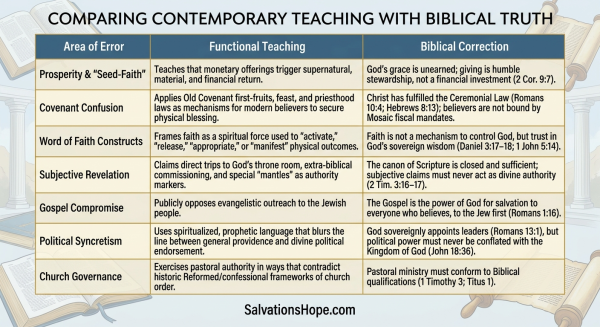
Despite formal statements affirming historic orthodox theology, Paula White Ministries exhibits seven key areas of doctrinal distortion when its sermons, teachings, and fundraising literature are closely analyzed:
Area of Error
Functional Teaching
Biblical Correction
1. Prosperity & “Seed-Faith”
Teaches that monetary offerings trigger supernatural, material, and financial return.
God’s grace is unearned; giving is humble stewardship, not a financial investment (2 Cor. 9:7).
2. Covenant Confusion
Applies Old Covenant first-fruits, feast, and priesthood laws as mechanisms for modern believers to secure physical blessing.
Christ has fulfilled the Ceremonial Law (Romans 10:4; Hebrews 8:13); believers are not bound by Mosaic fiscal mandates.
3. Word of Faith Constructs
Frames faith as a spiritual force used to “activate,” “release,” “appropriate,” or “manifest” physical outcomes.
Faith is not a mechanism to control God, but trust in God’s sovereign wisdom (Daniel 3:17–18; 1 John 5:14).
4. Subjective Revelation
Claims direct trips to God’s throne room, extra-biblical commissioning, and special “mantles” as authority markers.
The canon of Scripture is closed and sufficient; subjective claims must never act as divine authority (2 Tim. 3:16–17).
5. Gospel Compromise
Publicly opposes evangelistic outreach to the Jewish people.
The Gospel is the power of God for salvation to everyone who believes, to the Jew first (Romans 1:16).
6. Political Syncretism
Uses spiritualized, prophetic language that blurs the line between general providence and divine political endorsement.
God sovereignly appoints leaders (Romans 13:1), but political power must never be conflated with the Kingdom of God (John 18:36).
7. Church Governance
Exercises pastoral authority in ways that contradict historic Reformed/confessional frameworks of church order.
Pastoral ministry must conform to Biblical qualifications (1 Timothy 3; Titus 1).
Prosperity Theology & Word of Faith Terminology
The Prosperity Gospel reshapes Christian giving from a grateful response into a transactional contract. In her First Fruits 2025 material, White explicitly linked a specific financial gift ($2,025) to securing a “supernatural harvest,” unlocking favor, and multiplying wealth for the remainder of the year. Donors were told that their money was: “planting a seed for your supernatural harvest for the remainder of the year.”
This framework turns faith into an exercise in self-interest and shifts faith’s power from the Object (God) to the mechanism (the believer’s decree/offering).
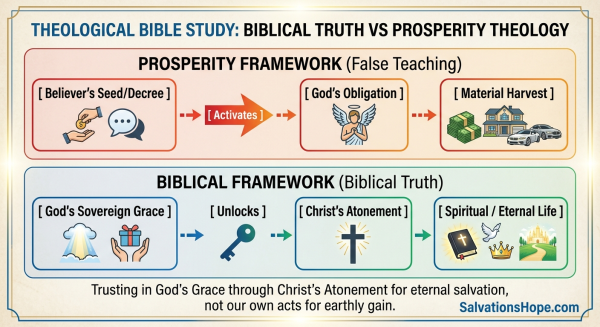
Biblical faith is demonstrated by Daniel’s three friends before Nebuchadnezzar:
“Our God whom we serve is able to deliver us… But if not, be it known to you, O king, that we will not serve your gods” (Daniel 3:17–18).
Biblical faith trusts God’s sovereignty regardless of temporal, material outcomes.
Unbiblical Claims of Extra-Biblical Revelation
In her public preaching, White claimed her spirit was transported to the “throne room of God,” where she perceived the face of God and received a special spiritual “mantle” for specific earthly assignments.
The Theological Violation: When a preacher claims private, direct revelation from God to validate their ministry, subjective experience usurps Sola Scriptura (Scripture Alone). While Christianity is fundamentally supernatural, the Holy Spirit works through and in accordance with the written Word, not through private revelations that bypass Scripture (1 Thessalonians 5:21).
Why "First-Fruits" Distortion Is Particularly Perilous
Sensational errors are easy to spot, but errors that mimic biblical language pose the greatest danger to the flock (2 Corinthians 11:14–15).
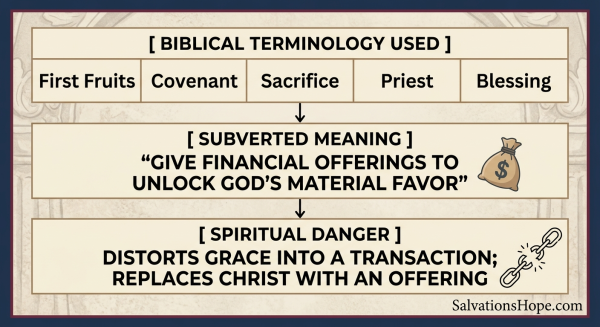
When a teacher takes Old Covenant terms (first fruits, priest, altar) and promises that a financial transaction will unlock spiritual favor:
- It obscures Christ's finished work: Christ is our ultimate First Fruit (1 Corinthians 15:20) and High Priest (Hebrews 4:14). Teaching that a financial gift secures God's favor denies that Christ's sacrifice was sufficient.
- It exploits uninformed believers: It targets those seeking to obey God, trapping them in a system of legalistic commercialism.
- It re-imagines God’s favor: God's favor cannot be bought or unlocked with money.
“He who did not spare his own Son but gave him up for us all, how will he not also with him graciously give us all things?” (Romans 8:32)
Paula White-Cain must be identified as a false teacher.
This conclusion is not rooted in personal animus, wealth, or political engagement, but in a persistent, documented pattern of unfaithful handling of God’s Word.
Her public ministry:
- Replaces grace with transactional mechanics.
- Distorts Old Covenant legislation to request money.
- Elevates subjective experiences over Scripture.
- Compromises the universal necessity of the Gospel for salvation.
A teacher’s formal adherence to a basic statement of faith does not excuse dangerous error in practice. The Church must guard the flock by rejecting teachings that turn God into a means to material gain, and instead point believers to the true Gospel: salvation and favor found in Jesus Christ alone.
Case Study in Unsound Doctrine
Evaluating Andrew Wommack Ministries
Andrew Wommack is a prominent American charismatic television teacher, author, and the founder of Andrew Wommack Ministries and Charis Bible College in Woodland Park, Colorado. After entering full-time ministry in 1968, Wommack launched the Gospel Truth broadcast in the 1970s and founded his Bible college in 1994. Today, his reach spans an international audience through television, radio, publishing, online media, and global satellite campuses.
Like many influential Word of Faith and charismatic figures, Wommack affirms foundational orthodox Christian doctrines, including:
- The deity of Jesus Christ
- Christ’s substitutionary, atoning death
- Justification by grace through faith
- The necessity of Christ’s imputed righteousness
However, the primary concern in evaluating his ministry is not that everything he teaches is explicitly false, but rather that his distinctive, core doctrines fundamentally alter the biblical parameters of God’s character, human responsibility, and the gospel itself.
The Discernment Verdict: Is Andrew Wommack Biblically Sound?
Andrew Wommack is not a safe, trustworthy, or biblically sound teacher of Scripture.
While appearing grounded in grace and faith, Wommack’s overall theological system systematically undermines core historic Christian truth. Together, his core doctrines alter the biblical doctrines of:
- God & Providence: Rejection of God’s comprehensive sovereignty over human suffering.
- Faith & Prayer: Transformation of faith from dependent trust into an operational mechanism or human activation force.
- Satan & Authority: Elevation of human spiritual authority over God’s direct sovereign will.
- Suffering & Sanctification: The erosion of biblical endurance, framing illness and affliction as self-inflicted spiritual failures.
Denial of God’s Comprehensive Sovereignty over Providence
In works such as Living in the Balance of Grace and Faith, Wommack explicitly rejects the biblical truth that God governs all events according to His sovereign decree, asserting that “everything isn’t up to God.” He frames sickness, disaster, and tragedy as operating entirely outside God’s providence—attributing them strictly to Satan, human choices, or a believer’s failure to exercise spiritual authority.
The Biblical Response: While Scripture affirms that God is not the author of sin or evil, it explicitly declares His exhaustive sovereignty over all creation:
- God "works all things according to the counsel of his will" (Ephesians 1:11).
- Not a single sparrow falls apart from the Father's will (Matthew 10:29).
- What men intend for evil, God sovereignly disposes for good (Genesis 50:20; Acts 2:23).
By attempting to “protect” God’s goodness at the expense of His sovereignty, Wommack leaves suffering Christians with an agonizing worldview: trials are seen as chaotic events outside God’s control rather than severe mercies used by a wise Father for their ultimate sanctification (Romans 8:28–39; 2 Corinthians 4:16–18).
The Guarantee of Universal Physical Healing in the Present Age
Wommack teaches that God’s immediate will is always to physically heal every believer of every sickness. In You’ve Already Got It!, he argues that God already paid for physical healing and provided it spiritually in the atonement; whether it manifests physically depends entirely on the believer’s knowledge, actions, and level of faith.
The Biblical Response: While the atonement secures complete freedom from sickness and death, the full manifestation of bodily redemption occurs at the future resurrection, not in this present mortal age (Romans 8:23; 1 Corinthians 15:50–54). Scripture directly refutes guaranteed present healing:
- Paul’s thorn in the flesh remained so that God’s power might be perfected in weakness (2 Corinthians 12:7–10).
- Timothy suffered recurring ailments (1 Timothy 5:23).
- Paul left Trophimus sick at Miletus (2 Timothy 4:20).
This doctrine places a crushing legalistic burden on the sick. If bodily healing is guaranteed now, then persistent illness is attributed to personal failure, lack of faith, or unconfessed sin, stripping the afflicted of biblical comfort.
Re-Definition of Divine Authority and Prayer
In The Believer’s Authority, Wommack claims God has constrained His own actions on earth to depend on human authorization. He instructs Christians to stop asking God to heal or intervene, but rather to command sickness to leave and release divine power themselves.
The Biblical Response: Scripture teaches creaturely dependence, not human entitlement. Christ alone possesses absolute authority in heaven and on earth (Matthew 28:18).
- Apostolic commissions (Matthew 10:1–8) were specific redemptive-historical markers, not a template for believers to command God's power at will.
- The New Testament church continually asked God in prayer for boldness, healing, and open doors rather than demanding results (Acts 4:24–31; Colossians 4:2–4).
Prayer is converted from humble supplication before a Sovereign King into a mechanism of human command, fostering pride and a false sense of control over the Godhead.
Word-of-Faith / Power of Spoken Words
In The Power of Faith-Filled Words, Wommack draws on standard Word-of-Faith theology, comparing God’s creation of the world through speech (ex nihilo) to believers’ activation of spiritual realities through the power of their words.
The Biblical Response: God alone possesses omnipotent speech that calls non-existent things into being (Romans 4:17; Genesis 1). Human speech possesses moral power to encourage, hurt, or speak truth (Proverbs 18:21; James 3:1–12), but it lacks sovereign metaphysical power to alter physical reality or bind outcomes.
This produces superstition and fear. Believers are trained to hide honest grief or medical realities out of fear that naming an illness will “give it power,” contrasting strongly with the raw honesty of the Psalms (Psalms 42–43).
Prosperity Theology (Anointing for Wealth)
Wommack teaches that material wealth and financial prosperity are guaranteed provisions of the gospel. In his teaching on Financial Stewardship, he describes prosperity as a spiritual “anointing” that generates wealth and calls failure to “abound” financially a form of spiritual or practical selfishness.
The Biblical Response: God commands generous giving and stewardship (1 Timothy 6:17–19), but nowhere does Scripture guarantee wealth to every believer:
- Jesus had no permanent home (Matthew 8:20).
- The apostles frequently endured poverty and hunger (1 Corinthians 4:9–13).
- Scripture warns that the desire to be rich traps believers in harmful lusts (1 Timothy 6:6–10).
Framing material gain as a sign of spiritual maturity redefines biblical blessing, turning conditional covenant promises into a law-based transaction for wealth.
Theological Comparison: Historic Christianity vs. Andrew Wommack
Theological Issue
Historic Confessional Christianity
Andrew Wommack’s Teaching
Providence
God sovereignly governs all events, creatures, and actions for His glory and our good, without authoring sin (WCF 5.1–4).
God’s government is limited; evil, sickness, and tragedy occur entirely outside His decree or sovereign will.
Healing
Guaranteed physically in the future resurrection body; prayed for submissively and dependently in the present age.
Guaranteed physically now; already fully provided, awaiting human faith and declaration to manifest.
Believer’s Authority
Derivative and dependent; exercised through humble prayer, proclamation, and obedience to Christ’s sovereign rule.
Autonomous and decisive; God limits His actions to what believers command and release on earth.
Faith
A gift of grace that trusts, relies upon, and rests in the person and finished work of Jesus Christ.
A spiritual force or law the believer uses to activate God’s promises and influence circumstances.
Prosperity
Spiritual wealth in Christ; material provision is managed wisely according to God’s varied distribution and callings.
A guaranteed divine covenant/anointing for physical wealth; poverty or lack is a failure of faith or stewardship.
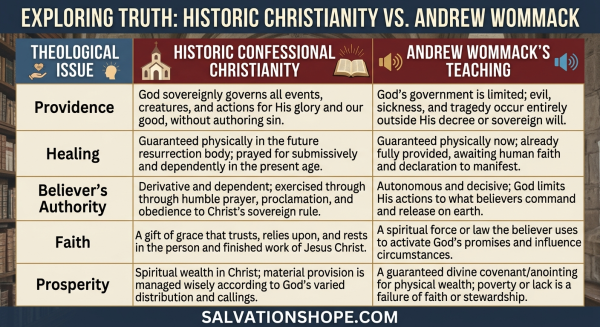
While Andrew Wommack’s teachings use historic Christian vocabulary, his central framework rests on key Word of Faith premises that undermine God’s sovereignty and the nature of biblical faith. Believers evaluating his material should exercise strong theological caution and test his claims against the whole counsel of God’s Word (1 Thessalonians 5:21; Acts 17:11).
Analyzing Modern Prophetic Distortions
Steven Furtick, Therapeutic Prosperity, and the Dangers of Misleading Preaching
In contemporary evangelicalism, false teaching rarely arrives as an open denial of historic creeds. More often, it appears as a subtle shift in emphasis—a reorientation of the biblical narrative that subordinates God’s redemptive drama to human ambition.
A prominent case study in this trend is Steven Furtick, founder and lead pastor of Elevation Church in Charlotte, North Carolina. A prolific author and influential social media figure, Furtick represents a contemporary iteration of theological distortion: therapeutic prosperity theology. While he formally maintains orthodox statements of faith, his preaching shows how slight hermeneutical shifts can subvert apostolic doctrine, turning the gospel of self-denial into a doctrine of self-elevation.
Defining the Theological Profile: Prosperity-Adjacent Preachers
To evaluate a teacher accurately, theological discernment requires nuance rather than broad brushstrokes:
Formal Orthodoxy vs. Functional Practice: Elevation Church’s official statement of faith affirms orthodox doctrines, including the Trinity, the full deity and humanity of Christ, His substitutionary atonement, bodily resurrection, and justification by grace through faith. Furtick does not explicitly teach the classic “word-of-faith” formula guaranteeing wealth and physical health in exchange for financial seeds.
The “Soft” Prosperity Paradigm: Furtick operates within a prosperity-adjacent framework. Rather than promising material riches, he preaches psychological, relational, and vocational activation. The overarching motif of his ministry—“See what God can do through you”—recasts the Christian life around realized potential, personal breakthroughs, and overcoming self-limiting beliefs.
The fundamental danger of this model is not an outright denial of truth, but a functional displacement: the central problem of humanity is framed as unrealized potential rather than sin against a holy God, and the solution becomes personal empowerment rather than redemption through the cross.
Critical Doctrinal and Hermeneutical Concerns
Evaluating Furtick’s methodology against historic Christian orthodoxy reveals several key areas of concern for theological studies.
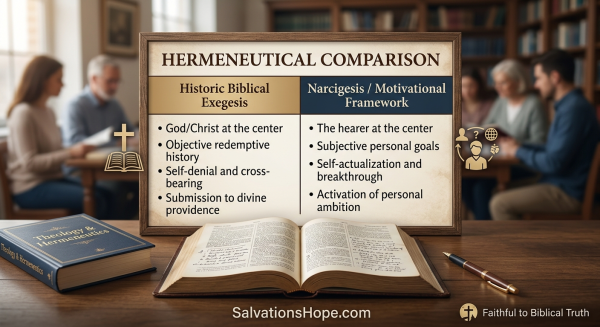
Hermeneutical Distortion: Narcigesis Over Exegesis
Faithful Christian preaching draws out the text’s original intent (exegesis). Furtick’s methodology consistently reads the hearer into the center of the biblical narrative (narcigesis).
- Example: Redemptive-historical accounts—such as David defeating Goliath or Joshua commanding the sun to stand still—are detached from their covenantal context and converted into allegories for personal success, overcoming emotional “giants,” or daring to execute large personal visions.
- Theological Critique: Scriptural narrative serves to reveal the character, sovereignty, and redemptive acts of God culminating in Jesus Christ (Luke 24:27). Subverting redemptive history into a blueprint for personal accomplishment violates apostolic mandates to “rightly divide the word of truth” (2 Timothy 2:15).
Re-definition of Biblical Faith: Faith as Activation
In confessional theology, saving faith is passive regarding justification—it accepts, receives, and rests on Christ alone (cf. Westminster Confession of Faith 14.2). Subsequent Christian faith trusts God’s promises and submits to His holy providence.
- Furtick's Model: Faith is framed as an "audacious expectation", a catalytic force or spiritual mechanism that unlocks personal destiny, breaks mental barriers, and compels divine action.
- Theological Critique: Scriptural faith is not a leverage tool to actualize human ambition. Faith submits to the sovereign will of God, declaring with Christ, "Not my will, but yours, be done" (Luke 22:42). True faith trusts God equally in earthly victory and in severe, unalleviated trial (Hebrews 11:33–39).
Anthropocentric Soteriology and Discipleship
The New Testament defines discipleship as radical self-denial and death to self (Mark 8:34; Galatians 2:20).
- Furtick's Model: The Christian life is presented as a journey to discover latent greatness, cultivate personal growth, and expand influence.
- Theological Critique: The gospel does not rehabilitate or optimize the natural self; it crucifies it (Romans 6:1–6). Man's chief end is not to achieve personal impact, but to glorify God and enjoy Him forever (Westminster Shorter Catechism, Q.1). Framing the Christian walk around personal optimization creates an anthropocentric (man-centered) worldview under a spiritual gloss.
Functional Displacement of the Cross
A ministry may endorse orthodox creeds while simultaneously displacing those truths in daily practice.
- Theological Critique: When pulpits consistently focus on overcoming insecurity, silencing negativity, and achieving personal vision, they reduce Christ’s substitutionary atonement to a background assumption. Paul explicitly resolved to preach "Jesus Christ and him crucified" (1 Corinthians 2:2), ensuring that God's power and grace—not human wisdom or potential—remain the focal point of the church's faith.
Misunderstanding Providence and Suffering
Success-oriented theology struggles to accommodate biblical teaching on suffering, weakness, and divine providence.
- Theological Critique: God frequently sanctifies His saints not through immediate breakthrough, but through enduring weakness and trial (2 Corinthians 12:7–10; 1 Peter 1:6–7). God sovereignly governs all events for His own glory and His people's ultimate good (WCF 5.1). Teaching that continuous breakthrough is the baseline normative experience leads believers to despair or disillusionment when faced with the ordinary, providential afflictions of the Christian life.
Viewed through the lens of historical Christian doctrine, Steven Furtick’s ministry reveals the subtle dangers of modern false teaching. Rather than openly rejecting orthodoxy, it offers a therapeutic reinterpretation of the Christian faith.
Scriptural evaluation requires Christians to look beyond dynamic delivery, emotional appeal, and formal doctrinal statements. A teacher must be judged by whether their regular, functional instruction exalts the sovereign Christ through careful textual exposition or exalts human ambition through motivational self-actualization.
Because Furtick’s homiletical pattern routinely converts the holy Scriptures into a platform for personal achievement, he cannot be recommended as a reliable expositor of God’s Word. Pastors, students, and believers should seek faithful teaching grounded in sober, Christ-centered, text-driven exposition (Titus 1:9; Acts 20:27).
- How does “therapeutic prosperity” differ from traditional “Word of Faith” prosperity theology, and why is it often harder to identify?
- In what ways does narcigesis weaken a congregation’s understanding of God’s redemptive timeline in Scripture?
- What practical steps can local church leaders take to ensure their preaching remains Christ-centered rather than hearer-centered?
Identifying False Teachers
Theological Evaluation of Word of Faith and Prosperity Theology
False teachers rarely introduce themselves as adversaries of the faith; instead, they subtly twist orthodox terminology to mask heterodox doctrines (2 Corinthians 11:13–15). Within contemporary evangelicalism, few movements have exerted as pervasive an influence as the Word of Faith (WoF) and Prosperity Gospel movements.
At the forefront of this movement are Kenneth and Gloria Copeland, founders of Kenneth Copeland Ministries (KCM). While they use traditional Christian vocabulary—such as faith, atonement, grace, and blessing—their core doctrines depart fundamentally from historical, confessional Christianity.
This study evaluates KCM’s major theological tenets against historical orthodox theology (specifically Reformed and confessional standards), demonstrating why these teachings constitute a dangerous distortion of the Gospel.
Systematic Analysis: Confessional Orthodoxy vs. Word of Faith Theology
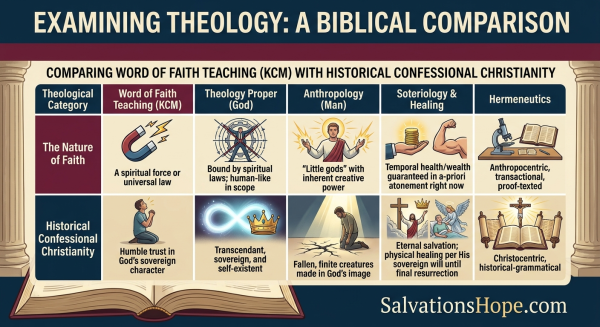
The Ontology of Faith and "Positive Confession": Word of Faith View
KCM posits that faith is an exact, force-like substance governed by spiritual laws analogous to physical laws like gravity. Believers utilize “positive confession”—speaking words aloud—to activate this force and manipulate reality. In this framework, human speech possesses creative power to bring forth health, wealth, or misfortune.
Confessional Biblical Response: Scripture presents faith not as a force to wield, but as an Instrument of reliance on God (the instrumental cause of justification). Faith is a sovereignly bestowed gift (Ephesians 2:8–9), not a legal mechanism to bind the Creator.
- Believers do not speak reality into existence; God alone creates out of nothing (ex nihilo) by the word of His power (Genesis 1:3; Hebrews 11:3).
- Biblical confession is homologeō—agreeing with what God has already revealed—not decreeing personal desires into existence (James 4:13–15).
Theology Proper and Anthropology: The "Little Gods" Doctrine: Word of Faith View
Kenneth Copeland explicitly teaches that God is bound by spiritual laws and that Adam was created as an exact duplicate of God’s nature. Consequently, redeemed believers are taught to consider themselves “little gods” on earth, possessing divine capabilities, if not on the same scale.
Confessional Biblical Response: This teaching erases the fundamental biblical distinction between Creator and creature (creator-creature distinction), committing the core error warned against in Romans 1:22–25.
- God alone is uncreated, self-existent (aseity), transcendent, and infinite (Isaiah 46:9–10; 1 Timothy 6:15–16).
- Humanity is created in the image of God (Genesis 1:27), reflecting His moral attributes in a finite, creaturely capacity, but never partaking in divine ontology or godhood (Isaiah 43:10). The claim to godhood echoes the original satanic deception (Genesis 3:5).
Soteriology, Atonement, and Divine Healing: Word of Faith View
KCM teaches that physical healing and immunity from sickness are guaranteed present-day rights secured in the Atonement. Sickness is categorized as a failure of faith or the result of a “negative confession.” Therefore, believers are encouraged to reject physical symptoms and demand bodily health.
Confessional Biblical Response: Orthodox Christian theology affirms that Christ bore our sicknesses and that His redemptive work secures full bodily restoration (Isaiah 53:4–5). However, redemption applies in two stages: the “already” and the “not yet.”
- While spiritual regeneration occurs immediately upon conversion, the redemption of the physical body awaits the final resurrection (Romans 8:22–23; 1 Corinthians 15:51–54).
- Scripture explicitly records faithful believers experiencing ongoing physical illnesses without spiritual fault, such as Paul’s thorn in the flesh (2 Corinthians 12:7–10), Trophimus (2 Timothy 4:20), and Timothy (1 Timothy 5:23). God sovereignly uses physical suffering for sanctification and His glory (Job 42:1–6; John 9:1–3).
The Prosperity Gospel and Materialism: Word of Faith View
The Copelands teach that financial wealth is a covenant entitlement for every Christian. Poverty is treated as a curse or a spiritual defect. Through “seed-faith” giving, followers are taught that financial contributions to the ministry are an investment that obligates God to return a multi-fold financial harvest.
Confessional Biblical Response: Scripture routinely condemns reducing godliness to a means of financial gain (1 Timothy 6:3–5).
- The Gospel's primary gift is God Himself, reconciled to man through Christ (1 Peter 3:18), not earthly possessions.
- Christ explicitly warned against accumulating earthly treasure (Matthew 6:19–21), and Paul commended godly contentment over the pursuit of riches (Philippians 4:11–13; 1 Timothy 6:6–10).
- Promising material wealth in exchange for financial seeds exploits the vulnerable and directly reverses biblical teaching on stewardship, sacrificial giving, and humility (2 Peter 2:1–3).
Hermeneutical Methodology: Word of Faith View
KCM relies heavily on anthropocentric, proof-texting hermeneutics. It regularly isolates passages from their redemptive-historical context, literary structure, and grammatical syntax to serve pre-constructed narratives of personal empowerment and material success.
Confessional Biblical Response: Confessional Christianity utilizes the historical-grammatical method guided by the analogy of faith (Scripture interprets Scripture).
- Passages must be read through a Christocentric lens rather than an ego-centric one (Luke 24:27).
- Proper biblical interpretation requires submitting personal desires to the totality of God’s revealed Word (2 Timothy 2:15; 3:16–17), honoring the historical context, authorial intent, and canonical harmony.
Theological Assessment: Why KCM Must Be Rejected
The teachings of Kenneth and Gloria Copeland are not mere structural variations or secondary stylistic differences. They constitute an alter-gospel (heteron euangelion, Galatians 1:6–9).
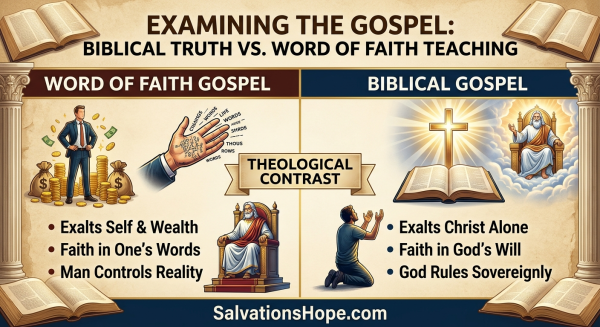
- Subversion of the Cross: By placing the primary focus of salvation on temporal health, financial prosperity, and self-actualization, WoF theology diminishes the true peril of sin and the ultimate purpose of Christ’s sacrifice—reconciliation with a holy God.
- Erosion of God’s Sovereignty: Demoting God to a entity subject to spiritual laws activated by human speech strips Him of His absolute sovereignty, rendering Him a servant to human desire.
- Pastoral Harm: Telling believers that sickness or poverty stems solely from a lack of faith inflicts severe spiritual and emotional damage on those undergoing trials, leading to deep disillusionment when promises fail to materialize.
Pastoral Conclusion & Call to Discernment
“I charge you in the presence of God and of Christ Jesus… preach the word; be ready in season and out of season; reprove, rebuke, and exhort, with complete patience and teaching. For the time is coming when people will not endure sound teaching, but having itching ears they will accumulate for themselves teachers to suit their own passions…” (2 Timothy 4:1–3)
The Church is commanded to test all doctrines against the standard of Holy Scripture (1 Thessalonians 5:21; 1 John 4:1) and to contend earnestly for the faith once for all delivered to the saints (Jude 1:3).
Because the doctrines propagated by Kenneth and Gloria Copeland replace self-denial with self-exaltation, subvert God’s sovereignty, and distort the nature of faith, they must be recognized as false biblical teachings. Faithful Christian leaders and believers ought to actively reject these teachings, shepherd others away from their influence, and remain anchored in the sovereign grace, true sufficiency, and glory of Jesus Christ.