
Unveiling the Truth
Responding to The Da Vinci Code with the Gospel of John
The Power and Peril of Pop-Culture Theology
“Now Jesus did many other signs in the presence of the disciples, which are not written in this book; but these are written so that
you may believe that Jesus is the Christ, the Son of God, and that by believing you may have life in his name.” (John 20:30–31)
Few works of modern fiction have captured the public imagination as much as Dan Brown’s The Da Vinci Code. With tens of millions of copies sold, its fast-paced plot twists and conspiratorial secrets captivated readers worldwide.
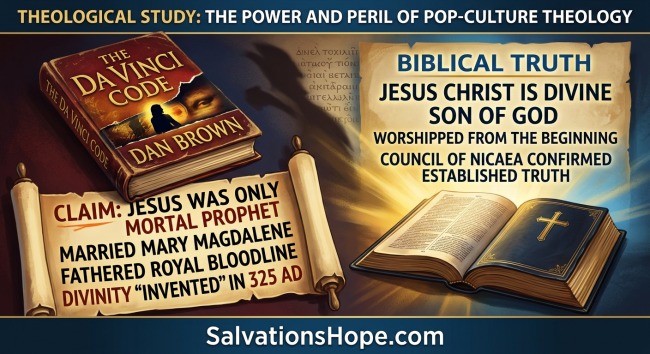
However, The Da Vinci Code was marketed as more than mere fiction. Opening with a bold claim that all descriptions of documents and historical records within its pages were accurate, the novel presented a radical redefinition of Jesus Christ:
- The Novel’s Claim: Jesus was a mortal prophet who married Mary Magdalene, fathered a royal bloodline in France, and his early followers never viewed him as divine.
- The Alleged Conspiracy: The deity of Christ was "invented" in AD 325 by Emperor Constantine and the Council of Nicaea to consolidate church power and suppress the truth.
As Christians, how do we respond when popular culture rewrites the identity of our Savior?
Fact vs. Fiction: Examining the Historical and Biblical Record
Dan Brown’s assertion—that Jesus was viewed merely as a mortal man until the Council of Nicaea—gets church history completely backward.
The Nicaea Misconception
The Council of Nicaea (AD 325) did not invent Jesus’ divinity; rather, it formalized and defended what the Universal Church had believed and proclaimed since the apostolic era. The council met to refute Arius, a teacher who claimed Jesus was created. The overwhelming majority of bishops affirmed the historic, biblical faith: Jesus is “true God from true God, begotten, not made.”
The Original Witnesses
Long before Emperor Constantine, the earliest disciples and eyewitnesses worshipped Jesus as God incarnate:
- Apostolic Writings (1st Century): Decades before the first century closed, Paul wrote that in Christ "the whole fullness of deity dwells bodily" (Colossians 2:9) and proclaimed Him as "our great God and Savior Jesus Christ" (Titus 2:13).
- Early Church Fathers (2nd Century): Figures like Ignatius of Antioch (c. AD 110) explicitly referred to Jesus as "our God" over a century before Nicaea.
Far from a late-stage political invention, Christ’s deity is the bedrock on which the early Church stood, suffered, and triumphed.
The True Mystery Revealed: The Gospel of John
If you genuinely want to explore the mystery of Jesus’ true identity, you need a guide far more reliable than modern fiction. You need the inspired Word of God—specifically, the Gospel according to John.
Written by one of Jesus’ closest earthly companions, John’s Gospel reveals the deep, eternal truth about who Jesus is.
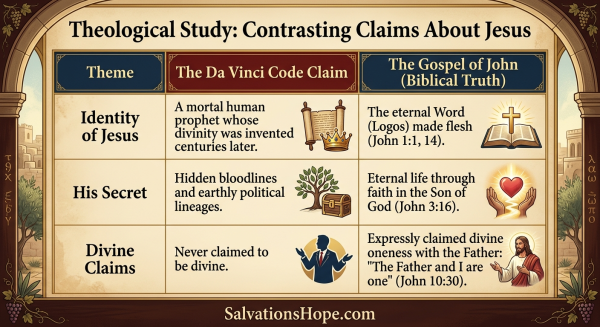
Theme
The Da Vinci Code Claim
The Gospel of John (Biblical Truth)
Identity of Jesus
A mortal human prophet whose divinity was invented centuries later.
The eternal Word (Logos) made flesh (John 1:1, 14).
His Secret
Hidden bloodlines and earthly political lineages.
Eternal life through faith in the Son of God (John 3:16).
Divine Claims
Never claimed to be divine.
Expressly claimed divine oneness with the Father: “The Father and I are one” (John 10:30).
While The Da Vinci Code presented a skewed history, its popularity highlights a deep human hunger to know the real Jesus. We can use cultural interest as a bridge to share the Gospel’s truth.
- Examine the Evidence: Read John 1:1–18 and John 8:56–59. How do these passages directly address the claim that Jesus’ divinity was a later invention?
- Understanding the ‘I AM’ Statements: In the Gospel of John, Jesus uses the divine name (“I AM”) seven distinct times (e.g., “I am the bread of life,” “I am the resurrection and the life”). What does this reveal about His self-awareness and mission?
- Engaging the World: How can you turn a conversation about popular culture or sensational books into an opportunity to share the true Gospel of John with a skeptical friend?
A Trustworthy Source
The Reliability and Deity of Christ in the Gospel of John
In an era flooded with alternative histories, revisionist novels, and modern skepticism about the origins of Christian doctrine, believers often ask: Can we sincerely trust our accounts of Jesus?
Popular culture—through works like The Da Vinci Code—has frequently attempted to cast doubt on the divinity of Christ and the historical reliability of the New Testament, suggesting that Jesus’ deity was a late invention cooked up by institutional religion centuries after His life.
However, a careful examination of Scripture reveals a vastly different reality. The Apostle John, writing as a firsthand eyewitness, presents a testimony rooted in physical reality, divine inspiration, and unshakeable historical truth.
The Purpose of the Witness: Why John Wrote
John held a unique, intimate position as the disciple whom Jesus loved. He knew Jesus personally, loved Him dearly, and recognized Him not merely as a great moral teacher, but as God the Son incarnate.
John’s objective was never sensationalism or commercial gain; it was pastoral and evangelistic. He explicitly states the core thesis of his Gospel:
“These are written that you may believe that Jesus is the Christ, the Son of God, and that by believing you may have life in his name.” (John 20:31)
John wanted his readers to encounter the living Christ, leading them from doubt to life-transforming faith.
Historical Continuity: Setting the Record Straight on Nicaea
Skeptics often claim that the deity of Christ was a novel invention fabricated by the Council of Nicaea in 325 AD. History tells a different story.
When the Council of Nicaea convened, they were not inventing a new doctrine; they were defending the ancient faith against Arius’s novel, renegade teachings. For three centuries, Christians had already been worshipping Jesus as God because that is how the eyewitnesses—including John, Peter, and Paul—presented Him.
Furthermore, the doctrine of Christ’s divinity does not rely on a single fourth-century council. All four Gospels consistently depict Jesus doing what only God could do and saying what only God could say. In the climax of John’s Gospel, after witnessing the resurrected Lord, Thomas declares the unvarnished truth:
“My Lord and my God!” (John 20:28)
Exposing Modern Fictions vs. Biblical Realities
Human nature often seeks to reshape God into an image that accommodates personal agendas. Whether through ancient Gnostic heresies or modern conspiracy-driven fiction, critics have frequently attempted to reinvent figures like Mary Magdalene or downplay the divine nature of Jesus.
The Truth About Mary Magdalene: Scripture records that Jesus delivered Mary Magdalene from demonic possession (Luke 8:2). She was a devoted follower, a steadfast witness at the cross, and the very first person to behold the resurrected Christ. Jesus was her Savior and Lord, not her husband, and no verifiable early texts support this contradiction.
The Immutability of Truth: As cultural tides shift and popular novels come and go, Jesus’s identity remains anchored in historical reality. Jesus does not change with every passing heresy, and divine truth does not bend to modern fiction.
The Foundation of Eyewitness Testimony
The strength of the Christian faith rests heavily on verifiable eyewitness testimony. John contrasts his firsthand, physical interaction with the Savior with the deceptive speculation of false teachers:
“That which was from the beginning, which we have heard, which we have seen with our eyes, which we have looked at and
our hands have touched—this we proclaim concerning the Word of life.” (1 John 1:1)
The Apostle Peter echoes this exact validation, distancing the apostolic message from human fabrication:
“We did not follow cleverly invented stories when we told you about the power and coming of our Lord Jesus Christ,
but we were eyewitnesses of his majesty.” (2 Peter 1:16)
The writers of the New Testament did not offer myths; they offered testimony grounded in history, validated by personal experience, and guided by the Holy Spirit.
Examine the Evidence: Are you viewing Jesus through the lens of modern cultural skepticism, or through the robust, historical witness of those who walked and talked with Him?
Stand Firm in Truth: In a world that constantly tries to redefine Jesus, take comfort in the apostolic witness. The Jesus of the New Testament is fully God and fully man—our unchanging Savior, Lord, and Friend.
- How does John’s explicit purpose in John 20:31 shape how we should read and apply his Gospel today?
- Why is it spiritually dangerous to rely on cultural narratives or modern fiction regarding biblical history rather than Scripture?
- How do John’s and Peter’s firsthand accounts strengthen your personal confidence in the reliability of the New Testament?
The Eternal Word and Son of God
Beyond Human Speculations
“In the beginning was the Word, and the Word was with God, and the Word was God. He was in the beginning with God. All things were made through him, and without him was not any thing made that was made. In him was life, and the life was the light of men. The light shines in the darkness, and the darkness has not overcome it. There was a man sent from God, whose name was John. He came as a witness, to bear witness about the light, that all might believe through him. He was not the light, but came to bear witness about the light. The true light, which gives light to everyone, was coming into the world. He was in the world, and the world was made through him, yet the world did not know him. He came to his own, and his own people did not receive him. But to all who did receive him, who believed in his name, he gave the right to become children of God, who were born, not of blood nor of the will of the flesh nor of the will of man, but of God. And the Word became flesh and dwelt among us, and we have seen his glory, glory as of the only Son from the Father, full of grace and truth.” (John 1:1–14)
Long before history began or creeds were written, Jesus existed as the eternal Word and divine Son. To truly know Jesus, we must look beyond human speculation and gaze into the deep, transcendent mystery revealed in Sacred Scripture.
In recent years, countless books, movies, and scholarly articles have peddled the fiction of a “secret Jesus”—a human teacher whose true identity was allegedly hidden or altered by later church councils.
Yet the true, biblical Jesus is a glorious mystery beyond anything human imagination could invent. The problem with skeptical views isn’t that they probe the mystery of Jesus too much, but that they don’t probe it enough. They claim to find the “real” Jesus by going back before creeds and doctrines were formulated.
However, the Apostle John takes us back far beyond early history. Guided by the Holy Spirit, John takes us back past the rise and fall of nations and the creation of the cosmos to the ultimate origin of all things.
Before Time Began: The Pre-Existence of Christ
Look at how John begins his Gospel:
“In the beginning was the Word, and the Word was with God, and the Word was God…
The Word became flesh and made his dwelling among us.” (John 1:1, 14)
Notice where John starts his journey:
- Before the church formulated doctrines or wrote the New Testament.
- Before Jesus preached His first sermon, worked His first miracle, or lay in the manger.
- Before Rome was founded, the Exodus led by Moses, or the call of Abraham.
- Before the creation of the sun, moon, stars, light, or matter itself.
Back, back, back—through all ages to the absolute beginning.
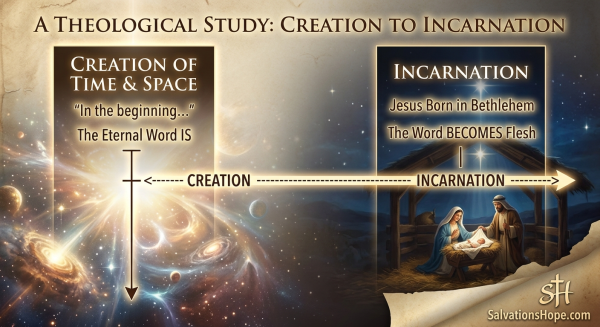
Christ Has No Beginning
The Word is eternal. When time and space came into existence, the Word already existed. His life did not begin in Mary’s womb; that was the beginning of His human nature, not His divine existence.
The Mystery of the Eternal Son
If you want to view a child in the womb, modern technology offers an ultrasound. But to behold the truth of Jesus before His earthly birth, we need spiritual vision. John’s Gospel takes us past the womb, past the outer limits of space, into the very heart of God.
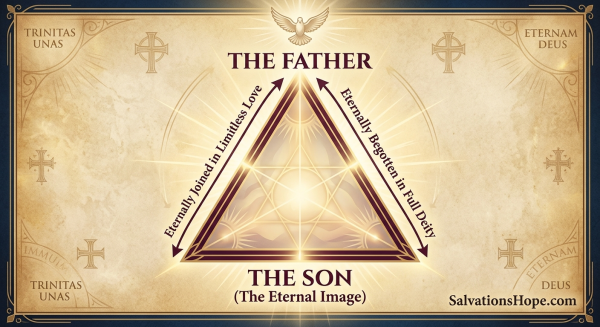
Scripture reveals that Jesus did not become the Son of God when He became Mary’s son. He has always been God the Son—co-eternal, co-equal, and of the exact same divine nature as the Father.
Divine Begetting vs. Human Begetting
- Human Sons: Begin at a specific point in time, start small, and grow to maturity.
- The Divine Son: Eternally begotten without a starting point. He is a "full-grown" deity from all eternity, the perfect, uncreated image of the Father.
When Jesus was born in Bethlehem, eternal God sent His pre-existent Son into the world, uniting His eternal divine nature with true human nature.
The Written Word vs. The Living Word
We rightly call the Bible the Word of God because God breathes out every Scripture (2 Timothy 3:16). However, at the highest level, the Word of God is more than black ink on white paper—the Word of God is an eternal, divine Person.
The Written Word (Scripture)
The Living Word (Jesus Christ)
God’s truth revealed through human language
God’s absolute self-expression in a Person
Breathed out by God (Theopneustos)
Co-eternal and divine with God from the beginning
Points us to the Savior
Is the Savior
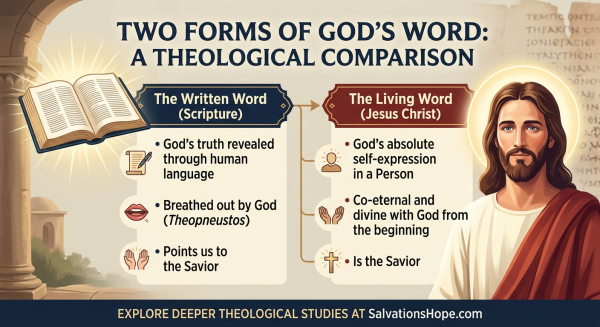
The primary purpose of the written Word (the Bible) is to reveal and bring us into fellowship with the living Word (Jesus Christ).
The divine Word is not a temporary sound or a set of spoken syllables; He is the Father’s mind, character, and self-expression—personally distinct, yet forever one with God in perfect love.
The Mystery of the Incarnation: The baby in the manger was not a newly created being, but the eternal God who spoke the stars into existence, coming down to dwell among us in love.
The Cosmic Logos: Christ as the Creator and Sustainer of All Things
The Mystery of the Word Made Flesh
To fully comprehend the significance of the Incarnation—the “mystery behind the manger”—one must look beyond the narrative of a helpless infant in Bethlehem and consider the eternal reality of the One who assumed human flesh. Scripture reveals that the child born in the manger is the eternal Son of God: the supreme architect, vital force, and divine logic behind the entire created order.
The Divine Logos: Logic and Life
In the prologue of his Gospel, the Apostle John identifies Jesus Christ using the Greek term Logos (translated as “the Word”). In ancient philosophy, logos referred to the supreme reason or unifying principle that ordered the cosmos. However, biblical revelation elevates this concept from an abstract philosophy into a divine Person:
“Through him all things were made; without him nothing was made that has been made. In him was life,
and that life was the light of all mankind.” (John 1:3–4)
- The Agent of Creation: The Son had no beginning and is co-eternal with the Father. He is the active agent through whom the Father brought all matter, space, and time into existence out of nothing (ex nihilo).
- The Source of Life and Light: As John 1:3–4 establishes, no created thing exists apart from Him. He is the original source of physical life, spiritual consciousness, beauty, and love within the universe.
Creation by the Spoken Word: Bridging Old and New Testaments
The doctrine of Christ as the Logos grounds the New Testament firmly in the foundational truth of Hebrew Scripture:
- Genesis 1:1: God the Father created the heavens and the earth through His creative command. When God declared, “Let there be…”, the divine Word executed that creative decree.
- The Psalms: Psalmic literature repeatedly attributes the cosmos’s formation to God’s spoken word and divine command (cf. Psalm 33:6, Psalm 148:5).
While ancient Greek thinkers postulated an impersonal force governing the universe, the Hebrew Scriptures revealed a personal God whose Word possesses creative power. New Testament revelation ultimately discloses that this creative Word is the second Person of the Triune Godhead.
Christ as the Sustainer and Purpose of Creation
The Apostle Paul further expands this Christological foundation in his letter to the Colossians, demonstrating that the Son is not merely the historical agent of creation, but its ongoing sustainer and ultimate goal.
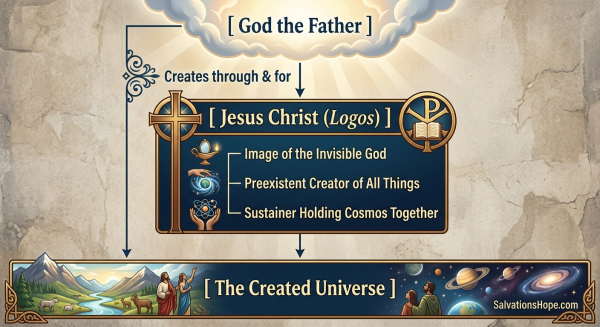
- The Image of the Invisible God: Christ makes the unseen God visible and known to creation (Colossians 1:15).
- Cosmic Cohesion: Paul asserts that in Christ, "all things hold together" (Colossians 1:17). His divine power continually maintains the laws of nature, molecular structures, and biological systems.
- Teleology (Purpose): Creation exists not only by Him, but for Him; every aspect of nature ultimately redounds to His glory.
Theological Application: From Creation to Redemption
Understanding Christ’s role as the Creator provides the essential foundation for understanding His role as Redeemer:
Dimension
Biblical Reality
Practical Implication
Natural Revelation
The cosmos’s intricate design—from galactic structures to biological systems—reflects Christ’s divine logic (Logos).
Observing the natural world ought to lead the believer to worship the Son.
Redemptive Necessity
When creation fell into sin and corruption, redemption required the intervention of its original Source of life and structure.
Only the Creator Himself possessed the authority and life-giving power to restore fallen creation.
The Incarnation
In Jesus of Nazareth, the infinite Creator entered His own creation as a creature to rescue humanity.
The manger reveals God’s astonishing humility: the Sustainer of the universe became dependent as a human child.
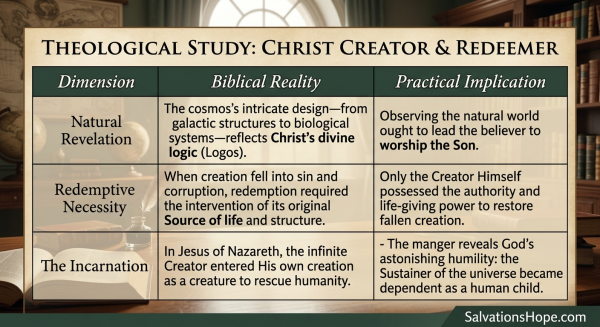
When believers reflect on the Incarnation, worship must extend to the total biblical portrait of Jesus Christ. The infant resting in the manger is the same eternal Word who spoke galaxies into existence, ordained the intricate systems of life, and continually holds the cosmos in place. In making Him known, the Father invites all creation to delight in the Son through whom all things were made.
- How does recognizing Christ as the Logos ( divine logic/reason) shape how we view the relationship between science, nature, and faith?
- Why is it essential to understand Jesus as Creator before we can fully grasp His work as Redeemer?
- How does Colossians 1:15–17 challenge modern, secular views about the universe’s origin and purpose?
Born of God: Light, Life, and Spiritual Rebirth in John’s Gospel
The Eternal Logos: The Divine Identity of Jesus Christ
To understand what it means to be “born of God,” we must first look to the nature and identity of the One who makes this new birth possible: Jesus Christ, the eternal Son of God.
- The Agent of Creation: The Word (the Logos) created all things. In Jesus’ divine nature reside the universe's fundamental wisdom, order, and logic. Apart from Him, human existence devolves into spiritual folly and confusion.
- The Source of Life: Christ's divine nature sustains all existence. Without Him, the created order faces ultimate death and spiritual decay.
- The Unquenchable Light: As the Light of the World, Christ stands in stark opposition to moral and spiritual darkness.
“In him was life, and that life was the light of men. The light shines in the darkness, but the darkness has not understood it.” (John 1:4–5)
Universal Blindness and National Rejection
Despite the continual revelation of God in creation, humanity’s fall into sin disrupted our spiritual perception. God never abandoned His creation; instead, human hearts darkened, leading mankind to build self-serving religions and ideologies.
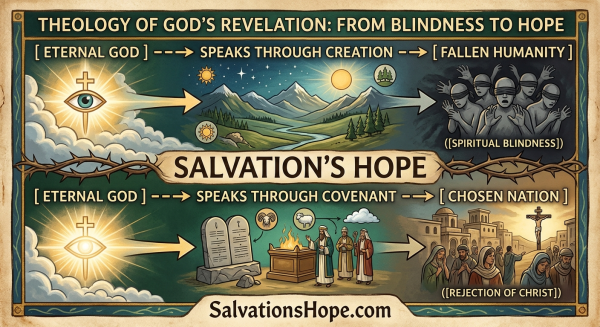
- General Revelation Ignored: Human beings became blind to God's presence and failed to recognize their Creator when He walked among them.
- Special Revelation Rejected: Out of the fallen world, God called a covenant people—Israel. He granted them the Law, the prophets, and sacred promises. Yet, when God the Son was incarnated as the baby in Bethlehem, there was no room for Him. His own people ultimately despised, rejected, and crucified the Lord of Glory.
The Miracle of Adoption: What It Means to Be "Born of God"
The tragic reality of human rejection leads directly into the glory of God’s redemptive grace. John shifts from the tragedy of unbelief to the triumph of salvation:
“Yet to all who received him, to those who believed in his name, he gave the right to become children of God—children born not of natural descent, nor of human decision or a husband’s will, but born of God.” (John 1:12–13)
- Eternally Begotten vs. Adopted: Jesus Christ alone is the eternal, uncreated Son of God. Yet, in His boundless love, He extends the gift of spiritual sonship to fallen sinners, inviting us to be born from above by His life-giving Spirit.
- Not by Human Effort: Spiritual rebirth cannot be inherited through physical lineage (natural descent), achieved through willpower (human decision), or granted by earthly status (a husband’s will). It is purely God’s sovereign act.
- Received by Faith: God grants the right to become children of God to those who receive Him and believe in His name—trusting in the person and work of Jesus Christ, the eternal Word made flesh.
Embracing the Divine Mystery
The Incarnation and the doctrine of regeneration involve deep mysteries that transcend full human comprehension:
Doctrine
The Theological Truth
Human Response
The Incarnation
God took on human flesh without ceasing to be fully God.
Wonder and Worship
Regeneration
Through faith, God gives dead souls divine life.
Faith and Gratitude
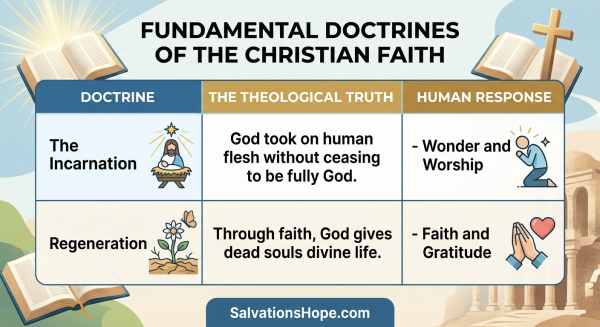
We are not called to fully master these mysteries intellectually before we can benefit from them. Scripture invites us to receive, trust, and delight in the truth that God has revealed, trusting His grace even where our understanding reaches its limit.
The Exclusivity and Necessity of Christ
Because of who Jesus is—the very logic, life, and light of creation—no other path leads to God. The gospel presents an unavoidable choice:
- Separation from Christ: Rejection of the Son is a rejection of the Father. Apart from the living Logos, humanity remains in spiritual darkness, moral folly, and ultimate judgment.
- Life in Christ: Jesus does not merely point to salvation; He is salvation. He does not simply teach truth; He is the Truth.
“He who has the Son of God has life; he who does not have the Son of God does not have life.” (1 John 5:12)
Because humanity, in our fallen state, was incapable of ascending to God, God descended to us. In the condescension of the Incarnation, the infinite God became tangible, visible, and audible, entering our world of sin and death to rescue us.
- Examine Your Trust: Have you attempted to rely on heritage, good intentions, or self-effort for your spiritual standing, or have you relied solely on being “born of God”?
- Receive the Word: Spiritual transformation begins when we stop resisting Christ and simply open our hearts to receive Him.
- Rest in His Promise: Meditate on the foundational promise of the Gospel:
“For God so loved the world that he gave his one and only Son, that whoever believes in him shall not perish but have eternal life.” (John 3:16)
The Miracle of the Incarnation and the Mission of the Savior
God’s Intervention in Human Crisis
“Now the birth of Jesus Christ took place in this way. When his mother Mary had been betrothed to Joseph, before they came together she was found to be with child from the Holy Spirit. And her husband Joseph, being a just man and unwilling to put her to shame, resolved to divorce her quietly. But as he considered these things, behold, an angel of the Lord appeared to him in a dream, saying, “Joseph, son of David, do not fear to take Mary as your wife, for that which is conceived in her is from the Holy Spirit. She will bear a son, and you shall call his name Jesus, for he will save his people from their sins.” (Matthew 1:18–21)
The narrative of Christ’s nativity begins not with immediate celebration, but with deep human crisis and moral dilemmas. In Matthew 1:18–21, Joseph faces an agonizing predicament. Betrothed to Mary—a binding covenant in first-century Jewish culture—he learns she is pregnant. Knowing he is not the father, Joseph assumes she is unfaithful.
Yet, character and grace define Joseph’s response. Bound by the Mosaic Law, he seeks to resolve the matter righteously while shielding Mary from public humiliation and legal execution (Deuteronomy 22:23–24). He resolves to divorce her quietly.
Before Joseph can enact his plan, God intervenes through divine revelation:
“An angel of the Lord appeared to him in a dream and said, ‘Joseph, son of David, do not be afraid to take Mary home as your wife, because what is conceived in her is from the Holy Spirit.’” (Matthew 1:20)
This angelic revelation establishes two foundational truths of Christian doctrine:
- The Virgin Birth (Incarnation): The Holy Spirit conceived Christ without human agency (Luke 1:35). Jesus is fully God and fully man—untainted by inherited original sin (Romans 5:12).
- The Covenant Lineage: By calling Joseph the "son of David," the angel affirms that Jesus will legally inherit David's throne, fulfilling God's covenant promises (2 Samuel 7:12–16; Isaiah 9:6–7).
The Name Above All Names: Yeshua
The angel continues by declaring the child’s name and defining His eternal ministry:
“She will give birth to a son, and you are to give him the name Jesus, because he will save his people from their sins.” (Matthew 1:21)
In the ancient Near East, names carried profound theological significance. The name Jesus (Hebrew: Yeshua or Joshua) translates to “Yahweh Saves” or “The Lord is Salvation.” This name was not merely a cultural preference; it revealed the purpose of the Incarnation.
Exegesis of Matthew 1:21: The Architecture of Salvation
To grasp the full weight of the Nativity, we must carefully analyze each clause of Matthew 1:21.
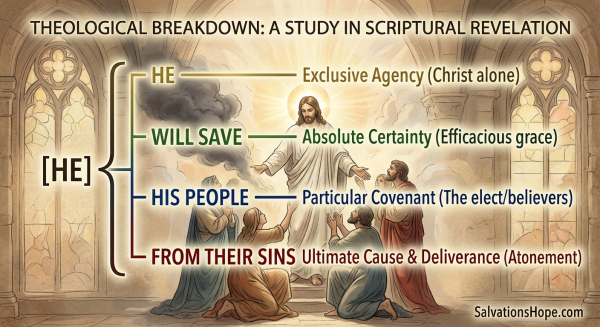
"HE" — The Exclusive Savior
Salvation is strictly Christocentric. Fallen humanity cannot redeem itself (Psalm 49:7–8; Ephesians 2:8–9). Jesus does not merely help us reform ourselves, nor does He offer one path among many. He is the sole Mediator between God and man (1 Timothy 2:5).
“Salvation is found in no one else, for there is no other name under heaven given to mankind by which we must be saved.” (Acts 4:12)
"WILL SAVE" — Sovereign Certainty
The angel speaks with absolute divine necessity: “He WILL save.” The Incarnation was not an experiment, a hopeful endeavor, or a conditional offer. It carried out God’s sovereign plan of redemption, established before the foundation of the world (Ephesians 1:4–5; Revelation 13:8). What God decrees in Christ cannot fail.
"HIS PEOPLE" — The Covenant Community
Christ’s redemptive mission targets a specific covenant community. While the Gospel invitation goes out globally to all people (Matthew 28:19), Christ’s saving efficacy applies to those who belong to Him through faith.
Jesus describes this covenant relationship in John 10:
“My sheep listen to my voice; I know them, and they follow me.” (John 10:27)
Unbelief reflects an absence of covenant belonging:
“You do not believe because you are not my sheep.” (John 10:26)
Salvation is applied through personal faith, placing believers into the body of “His people.”
"FROM THEIR SINS" — The Core Problem of Humanity
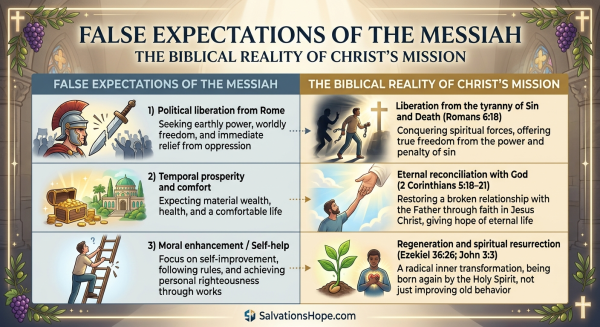
Christ’s primary objective in His First Coming was not social reformation, political liberation, physical healing, or economic relief—though His Kingdom ultimately renews all creation (Romans 8:20–23).
The fundamentally lethal condition of humanity is sin—moral rebellion against a Holy God, resulting in spiritual death and condemnation (Romans 3:23; 6:23).
False Expectations of the Messiah
The Biblical Reality of Christ’s Mission
Political liberation from Rome
Liberation from the tyranny of Sin and Death (Romans 6:18)
Temporal prosperity and comfort
Eternal reconciliation with God (2 Corinthians 5:18–21)
Moral enhancement / Self-help
Regeneration and spiritual resurrection (Ezekiel 36:26; John 3:3)
The message given to Joseph demystifies the Nativity. The manger was not a comfortable scene of earthly sentimentality; it was the entry point of God’s sovereign rescue mission into a fallen world.
Acknowledge Human Helplessness: We cannot overcome sin through moral effort, tradition, or good works.
Trust in the Efficacious Work of Christ: Rest in the absolute certainty that Christ’s substitutionary death on the cross fully accomplished redemption for all who trust in Him.
Embrace the Good News: True joy in Christ comes from recognizing the severity of our sin and the glory of God’s grace in rescuing us from eternal judgment.
- How does Joseph’s obedience in Matthew 1 model submitting our human plans to God’s divine revelation?
- How do modern views of Jesus downgrade His mission from Savior from sin to moral teacher or life coach?
- What assurance does the phrase “He WILL save” provide for your personal faith and security in Christ?
The Sinless Son
A Theological Study on the Virgin Birth of Christ
The doctrine of the Virgin Birth (parthenogenesis) is not a peripheral narrative nuance within the New Testament; it is a foundational pillar of Christian soteriology and Christology. This study examines the historical reliability, theological necessity, and soteriological implications of the Holy Spirit’s miraculous conception of Jesus Christ, showing how His sinless humanity and full deity depend directly on this miraculous entry into human history.
Historical Realism vs. Modern Skepticism
A common critique from secular naturalism posits that early belief in the virgin birth was merely the product of a scientifically naive, pre-modern culture. However, Scripture shows that first-century people understood basic human biology.
- The Response of Joseph: When Joseph learned of Mary's pregnancy, he did not initially accept it with gullible credulity, but instead suspected infidelity (Matthew 1:18–19).
- Divine Revelation over Ignorance: Joseph accepted the miracle only after an angelic messenger intervened directly (Matthew 1:20).
Belief in the virgin birth did not stem from scientific ignorance, but from supernatural revelation confirming a historical event.
The Agent and Mystery of Conception
The Biblical narrative intentionally omits complex physical descriptions and focuses entirely on the Holy Spirit’s divine agency.
“What is conceived in her is from the Holy Spirit.” (Matthew 1:20)
The third Person of the Trinity directly intervened in human history, forming an embryo in Mary’s womb without a human biological father. Where natural procreation was absent, divine omnipotence brought forth life (creatio ex nihilo dynamics in utero), showing that nothing is impossible for Almighty God (Luke 1:37).
The Soteriological Necessity: A Sinless Nature
Sin is not merely an external action; it is a fallen inclination inherited from our first parents (Romans 5:12).
As King David observed: “Surely I was sinful at birth, sinful from the time my mother conceived me.” (Psalm 51:5)
Standard human procreation transmits this fallen, corrupted nature (corruptio naturae).
The Unblemished Sacrifice: To save humanity from the guilt and power of sin, Jesus had to satisfy two criteria:
- Fully Human: He had to be truly one of us to represent us (Hebrews 2:17).
- Sinlessly Perfect: He had to be free from inherited guilt and original sin to serve as the spotlessly pure sacrifice (1 Peter 1:18–19; 2 Corinthians 5:21).
Had Jesus been born through the union of two fallen human parents, He would have inherited a fallen human nature, rendering Him in need of a Savior Himself rather than qualified to be one.
The Christological Mystery: True God and True Man
The Virgin Birth is also the historical point where the Hypostatic Union—the union of Christ’s divine and human natures in one Person—was realized in human time.
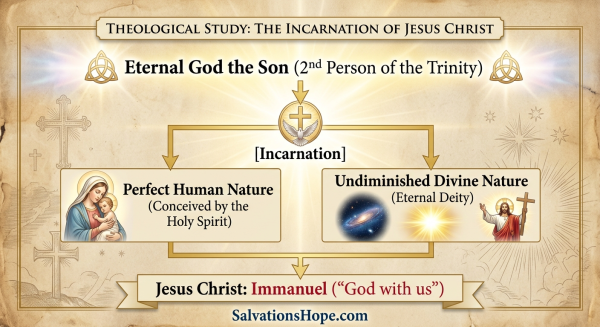
Through the Holy Spirit, the eternal Son of God, who existed with the Father prior to creation (John 1:1–3), united His eternal divine nature with a genuine, uncorrupted human nature in Mary’s womb. This directly fulfilled Old Testament prophecy:
“The virgin will be with child and will give birth to a son, and they will call him Immanuel—
which means, ‘God with us.'” (Isaiah 7:14)(Matthew 1:23)
Theological Compromise and Its Consequences
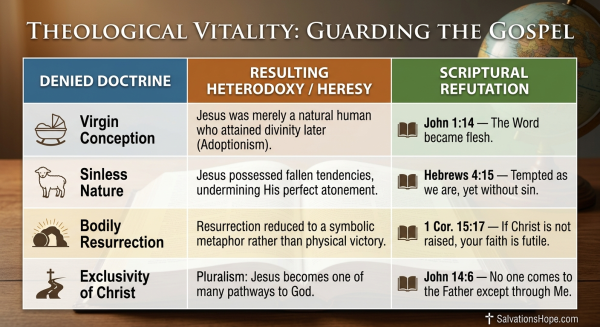
Denying the virgin birth inevitably leads to a breakdown across essential Christian doctrines. When theological liberalism reduces miraculous historical events to metaphorical “literary devices” or “myths,” foundational truths collapse:
Denied Doctrine
Resulting Heterodoxy / Heresy
Scriptural Refutation
Virgin Conception
Jesus was merely a natural human who attained divinity later (Adoptionism).
John 1:14 — The Word became flesh.
Sinless Nature
Jesus possessed fallen tendencies, undermining His perfect atonement.
Hebrews 4:15 — Tempted as we are, yet without sin.
Bodily Resurrection
Resurrection reduced to a symbolic metaphor rather than physical victory.
1 Cor. 15:17 — If Christ is not raised, your faith is futile.
Exclusivity of Christ
Pluralism: Jesus becomes one of many pathways to God.
John 14:6 — No one comes to the Father except through Me.
As historical evidence and pastoral witness show, the historical Christian faith cannot rest on metaphors. The gospel rests on the literal, physical, and historical realities of Christ’s miraculous incarnation, sinless life, atoning death, and bodily resurrection.
Integral to the Gospel: The Virgin Birth is not an isolated miracle; it guarantees both a sinless humanity and the absolute deity of Jesus Christ.
Our Only Redeemer: Because He was born without the taint of original sin and is fully God, Christ alone qualifies as the perfect substitute for sinners.
Anchor of Truth: Unwavering confidence in Christ’s miraculous origin strengthens our faith in His redeeming work as a whole.
How does understanding the direct link between Christ’s virgin birth and His sinless nature deepen your appreciation for His sacrifice on the cross?
Redemptive Grace: How Christ Delivers Us from the Root and Results of Sin
The incarnation of Jesus Christ stands at the center of the Christian faith. When the angel announced the birth of Jesus to Joseph, the mission was made plain: “He will save his people from their sins” (Matthew 1:21). To fully appreciate the magnitude of this promise, we must explore both the foundational problem of our human condition and the expansive nature of God’s redemptive solution.
The Reality of Original Sin: The Problem of Human Nature
Before addressing individual transgressions, theology points us to a deeper human reality: our innate disposition toward sin.
Scripture and daily life both attest that humanity inherits a fallen condition from our first parents, Adam and Eve. This foundational state is historically termed original sin.
Universal Observation: We do not need to teach young children to be selfish, throw tantrums, or defiantly claim ownership. While children are precious gifts and image-bearers of God, these early behaviors demonstrate an inherent inclination toward self-centeredness.
Personal Reality: Original sin is not merely observed in others; it is present within every human heart. We inherit both spiritual death and a fractured nature that requires divine intervention.
The Divine Solution: Supernatural Rebirth
Human efforts cannot reform a fallen nature. Just as Christ was conceived in Mary’s womb not by natural means but through the power of the Holy Spirit, believers receive salvation through supernatural work rather than human effort.
“To all who did receive him, to those who believed in his name, he gave the right to become children of God—children born not of natural descent, nor of human decision or a husband’s will, but born of God.” (John 1:12–13)
Through regeneration (being “born again”), the Holy Spirit imparts new spiritual life, freeing the believer from the dominance of the old nature inherited through human lineage.
Total Forgiveness: Overcoming the Guilt and Power of Sin
Christ’s saving work extends to every dimension of active sin and spiritual guilt. Believers often struggle with doubts about the limits of God’s forgiveness, asking whether certain categories of sin fall outside His grace.
Category of Burden
The Promise of Christ’s Salvation
Habitual & Chronic Sins
Christ breaks the ongoing power and enslavement of habitual patterns.
Relational Impact
Christ provides mercy and restoration for sins that have misled or harmed others.
Longstanding Guilt
His finished work completely cleanses years of past rebellion.
Persistent Doubts
Christ offers assurance and peace to minds burdened by fear or weak faith.
The Logic of Divine Miracles
For those who feel their guilt is too severe or their habits too deeply ingrained to change, Scripture points to the power demonstrated in the incarnation itself.
As the angel Gabriel declared to Mary, “For no word from God will ever fail” (Luke 1:37). The miracle of the virgin birth assures us that the God who entered human history supernaturally possesses unlimited power to redeem, transform, and pardon any soul.
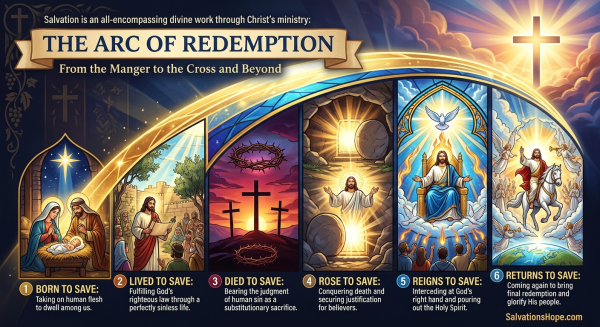
The Arc of Redemption: From the Manger to the Cross and Beyond
Salvation is not a single past event, but an all-encompassing divine work encompassing every aspect of Christ’s ministry:
- Born to Save: Taking on human flesh to dwell among us.
- Lived to Save: Fulfilling God’s righteous law through a perfectly sinless life.
- Died to Save: Bearing the judgment of human sin as a substitutionary sacrifice.
- Rose to Save: Conquering death and securing justification for believers.
- Reigns to Save: Interceding at God’s right hand and pouring out the Holy Spirit.
- Returns to Save: Coming again to bring final redemption and glorify His people.
The Ultimate Purpose: Saved From Sin, Saved For Glory
Christian theology emphasizes that salvation involves both a departure and a destination. Christ saves us from the penalty and power of sin, but He also saves us for a glorious calling:
- Restored Fellowship: Re-entering an intimate, harmonious relationship with God.
- Conformity to His Image: Growing progressively in wisdom, moral purity, and divine love.
- Eternal Stewardship: Participating in Christ’s ultimate reign over a renewed creation.
In an incredible display of grace, the King of glory humbled Himself to assume human frailty so that humanity might be elevated into eternal communion with God.
Trust His Power: Trust fully in Jesus’ finished work for forgiveness of past sins and freedom from present struggles.
Pursue His Likeness: Seek daily to reflect Christ’s character in wisdom, purity, and selfless love, knowing that He who began a good work in you will carry it on to completion.