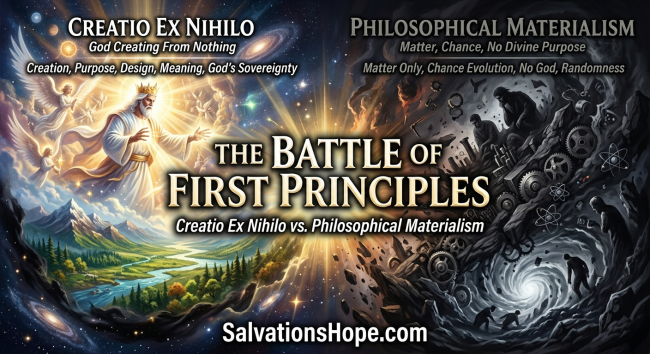
The Battle of First Principles
Creatio Ex Nihilo vs. Philosophical Materialism
Textual Analysis & Biblical Exegesis
Genesis 1:1 (NASB): “In the beginning God created the heavens and the earth.”
Hebrew Text: To understand the theological weight of Genesis 1:1, we must examine its key original terms:
B’reshit (בְּרֵאשִׁית) – "In the beginning"
Linguistic Structure: Composed of the preposition b’ (“in”) and reshit (“beginning,” “first-fruits,” or “chief point”).
Theological Import: The text establishes an absolute temporal start for space-time reality. Before this point, physical time did not exist. The cosmos is not eternal; it has an origin point rooted in the divine act.
Bara (בָּרָא) – "Created"
Linguistic Structure: A verb used strictly with God as the subject throughout the Old Testament (Tanakh). Humans may “fashion” (yatzar) or “make” (asah) from existing materials, but only Yahweh bara.
Theological Import: This word undergirds the doctrine of creatio ex nihilo (creation out of nothing). God did not reorganize pre-existing, eternal matter; He brought physical reality into existence by sovereign decree (cf. Hebrews 11:3; Psalm 33:6).
Elohim (אֱלֹהִים) – "God"
Linguistic Structure: A grammatically plural noun used with a singular verb (bara).
Theological Import: While Elohim reflects divine majesty and fullness of power, the singular verb stresses unity of action, pointing to the uncaused First Cause who sits outside the cosmos He calls into being.
Ha'shamayim ve'et ha'aretz (הַשָּׁמַיִם וְאֵת הָאָרֶץ) – "The heavens and the earth"
Linguistic Structure: A Hebrew merism—a figure of speech in which two opposite parts represent a complete whole.
Theological Import: “The heavens and the earth” encompasses the totality of the physical universe—matter, energy, space, and time.
Theological Reflection: The Collision of Presuppositions
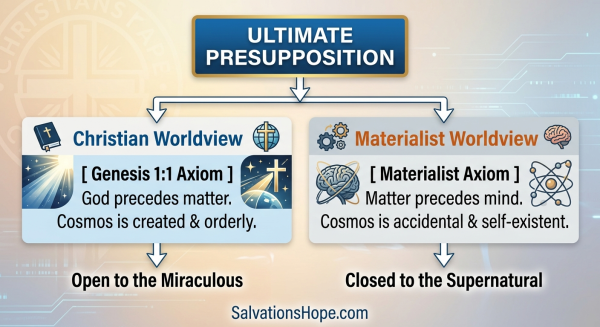
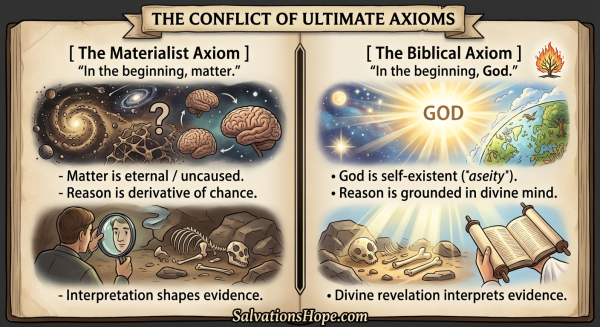
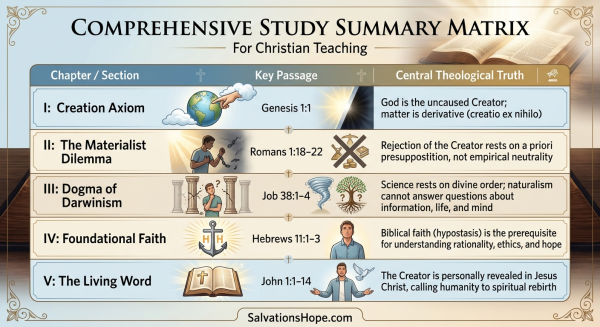
Every worldview begins with an unprovable ultimate starting point (an axiom or presupposition). Genesis 1:1 provides the foundational axiom of Christian theology: God is the ultimate reality, and matter is derivative.
In stark contrast stands the worldview of modern Philosophical Materialism (or Naturalism).
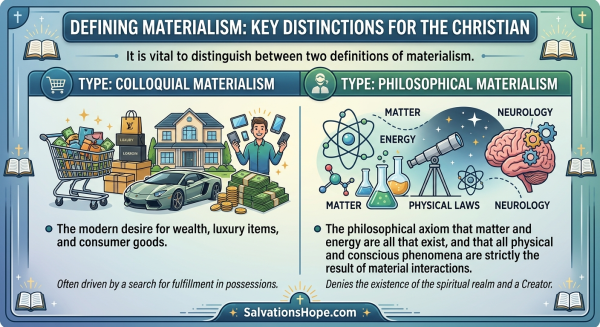
Defining Materialism
It is vital to distinguish between two definitions of materialism:
The Materialist Axiom in Modern Academia
The late Harvard geneticist Richard Lewontin provided a remarkably candid description of Philosophical Materialism: “We exist as material beings in a material world, all of whose phenomena are the consequences of material relations among material entities.”
Lewontin’s stance is notable because he openly admits that intellectuals do not accept this commitment because scientific discovery or objective empirical evidence forces it on them. Rather, it is a prior commitment—an a priori presupposition brought to the evidence: “Our willingness to accept scientific claims that are against common sense is the key to an understanding of the real struggle between science and the supernatural. We take the side of science despite the patent absurdity of some of its constructs… because we have a prior commitment, a commitment to materialism… That materialism is absolute, for we cannot allow a Divine Foot in the door.”
Epistemological Implications
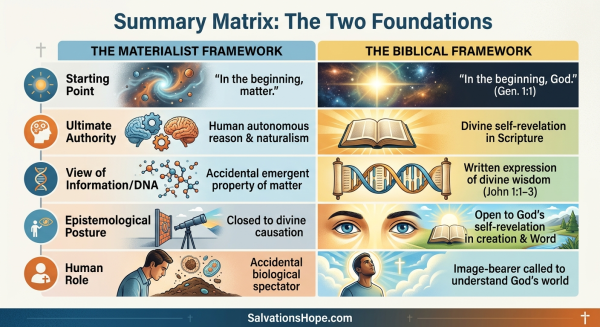
The contrast between Scripture and Naturalism reveals two distinct epistemological paths:
The Fear of Divine Sovereignty
Why must the materialist rule out God before analyzing the evidence? Lewontin’s rationale exposes the underlying fear: “To appeal to an omnipotent deity is to allow that at any moment the regularities of nature may be ruptured, that miracles may happen.”
From a secular perspective, acknowledging God creates an intellectual threat. If God exists, human autonomy is subordinated to divine authority, and human reason is no longer the ultimate arbiter of truth.
The Biblical Reality of Order and Miracles
Scripture presents a far more robust framework:
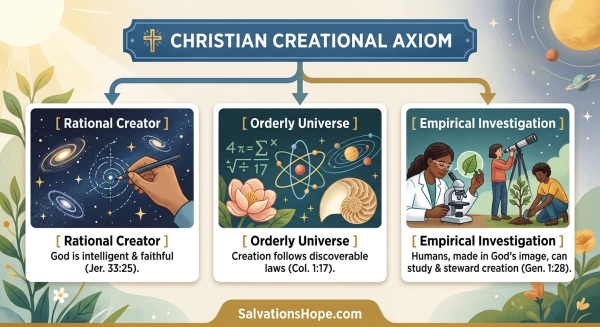
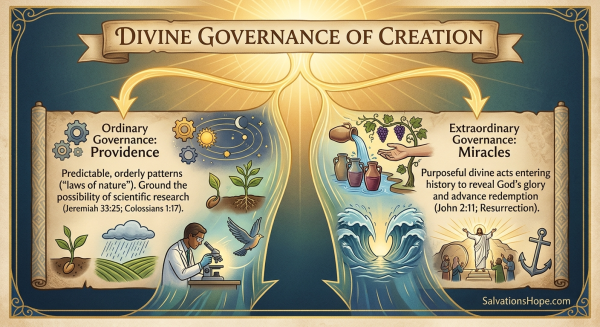
Natural Regularity: Miracles are not chaotic “ruptures” of nature without purpose; they are purposeful divine interventions. God’s creation displays predictable order precisely because God is faithful and rational (Colossians 1:17; Jeremiah 33:25).
The Source of Rationality: Science itself depends on the uniformity of nature—a principle grounded directly in the character of the God of Genesis 1:1.
Application for the Believer
Key Takeaway
When someone rejects the Creator, it is rarely a problem of insufficient evidence; it is a problem of presupposition. Genesis 1:1 does not argue for God’s existence—it declares it as the essential starting point for all true understanding.
How does creatio ex nihilo in Genesis 1:1 shape our understanding of human purpose and value compared to the materialist model?
How do you see philosophical materialism influencing modern culture outside the scientific community?
How can understanding a person’s prior commitments (presuppositions) help us share the Gospel more effectively?
The Dogma of Darwinism and the Mirage of Scientific Consensus
Having established that philosophical materialism operates as an unproven axiom, we must now examine how this presupposition manifests within macro-evolutionary theory, often functioning more as a dogmatic belief system than an open, empirical inquiry.
Epistemological Blindspots: Faith in Materialistic Miracles
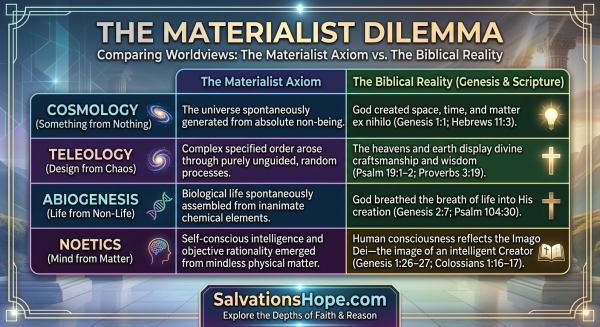
When a worldview mandates a prior commitment to absolute materialism, it forces its adherents to accept four monumental “materialistic miracles”—events that violate known physical laws and logical principles:
To believe that mindless matter, non-being, and chance produced self-conscious, morally accountable human beings requires a profound degree of naturalistic faith.
Internal Division: The Myth of Evolutionary Consensus
Popular culture and educational curricula often present the naturalistic account of origins as a monolithic, undisputed monolith of scientific consensus. However, closer inspection of the academic literature reveals deep internal fractures among evolutionary theorists.
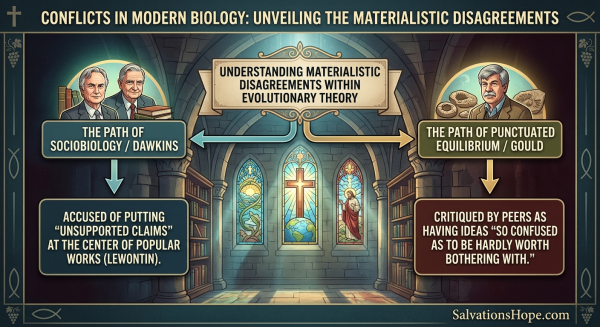
Internal Critiques of Sociobiology and Gene-Centric Views
Richard Lewontin openly criticized fellow evolutionary biologists, noting that popular presentations often vulgarize Darwinism and rest on unsubstantiated assumptions:
He argued that E. O. Wilson’s sociobiological assertions “rest on the surface of a quaking marsh of unsupported claims.”
He challenged Richard Dawkins’ gene-centric reductionism as being out of step with advanced genetic research.
The Tactical Silence Around Conceptual Confusion
Similarly, renowned British neo-Darwinist John Maynard Smith remarked regarding Stephen Jay Gould’s evolutionary models:
“The evolutionary biologists with whom I have discussed [Gould’s] work tend to see him as a man whose ideas are so confused as to be hardly worth bothering with, but as one who should not be publicly criticized because he is at least on our side against the creationists.”
This exposes an underlying imperative within the naturalistic community: maintaining unified opposition against creationism often takes precedence over internal scientific cohesion.
Historical Context: Science as a Christian Paradigm
It is a historical error to assume that genuine scientific inquiry requires an atheistic or naturalistic framework. The modern scientific revolution was not born despite Christian theology, but largely because of it.
Historical giants of modern science—including Isaac Newton, Johannes Kepler, Blaise Pascal, Louis Pasteur, and Robert Boyle—were devout believers. They viewed scientific research as “thinking God’s thoughts after Him” (Kepler). They expected order in nature precisely because they believed in an orderly Creator.
Synthesis: Starting Points and Spiritual Discernment
Ultimately, the debate over origins is not a conflict between “science” and “faith.” It is a clash between two competing faith commitments:
When students or believers encounter anti-creationist rhetoric, they must recognize that the ultimate barrier to accepting God as Creator is not intellectual or empirical, but philosophical and spiritual (Romans 1:18–22). When a system decides in advance that it will not “allow a Divine Foot in the door,” no amount of empirical evidence will compel submission to the Creator.
Core Takeaways
Questions for Further Study
Why do you think naturalistic scientists often hesitate to publicly voice disagreements about evolutionary mechanisms?
How does recognizing that “science” and “philosophical materialism” are distinct alter your approach to apologetics and evangelism?
How can Christians better foster a rigorous appreciation for science while staying grounded in the truth of Genesis 1:1?
Epistemological Sovereignty: B’reshit Elohim as the Ultimate Axiom
Having examined materialism’s dogmatic nature and its internal scientific fractures, we arrive at the foundational presupposition of biblical revelation. Every system of thought rests on a self-authenticating, non-negotiable starting point.
The Necessity of a First Principle (Principium Conoscendi)
Scripture does not open with an apologetic argument for God’s existence. It makes an unvarnished, authoritative declaration:
“In the beginning God created…” (Genesis 1:1a:)
Why does Scripture present this truth without preliminary logical proofs?
The Transcendence of God’s Authority: If God’s existence required proof from human observation or finite logic to be deemed valid, then human reason would sit as the supreme judge over God. Divine revelation, by its very nature, demands recognition as the ultimate standard of truth (epistemically ultimate).
The Architecture of Thought: Human reasoning cannot regress into infinity; every worldview must anchor itself upon a fundamental assumption that cannot be proven by something before it. For naturalism, that axiom is eternal matter/energy. For Christian theology, that axiom is the self-existent Creator (God’s aseity).
Epistemology: Believing Is Seeing
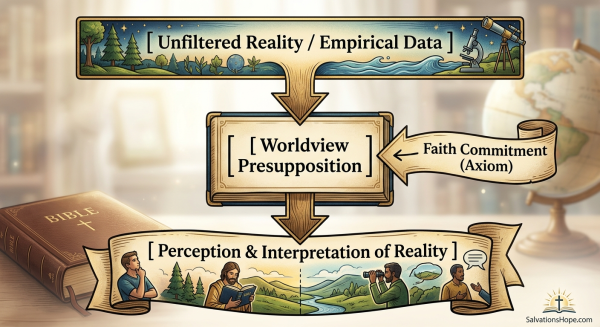
It is a common misconception that human reasoning is entirely neutral and driven solely by objective empirical data—that “seeing is believing.” However, human perception is mediated by an interpretive framework (a worldview lens).
The Delusion of Empirical Neutrality
If an individual holds a prior commitment to absolute materialism, no amount of empirical phenomena—no matter how miraculous—will compel them to acknowledge a divine cause. Consider an epistemological thought experiment:
If a committed materialist could travel back in time to witness the cosmos’s origin, the emergence of biological life, or the encoding of the human genome, would they see the hand of God?
From a naturalistic starting point, the answer is no. Without a framework open to the supernatural, the observer would see the event as an extraordinary, unexplained material anomaly that future naturalistic science will eventually resolve.
The Complexity of Biological Information
Consider the immense information density contained within biological life: A single human cell contains a DNA code equivalent to roughly 1,000 volumes of 500 pages each of specified, functional information.
Information theory demonstrates that specified complex information consistently originates from a conscious mind (authorial intent).
Yet, because the naturalistic axiom forbids a “Divine Foot in the door,” materialists attribute this immense library to unguided, stochastic processes. This demonstrates that the dispute over origins is not an information deficit, but an interpretive commitment.
Exegetical Insight: The divine Interrogation (Job 38:1–4)
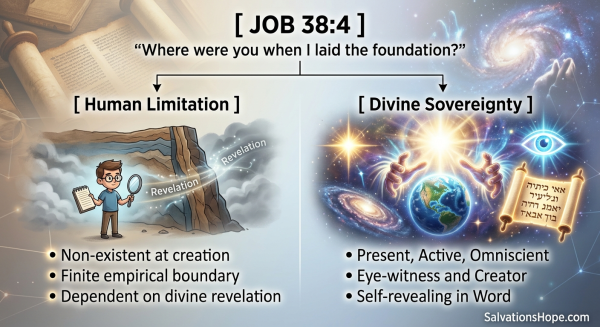
When human reason oversteps its finite boundaries and claims ultimate authority regarding the origins of space, time, and matter, God’s response in Job 38 provides the definitive corrective:
“Then the LORD answered Job out of the whirlwind and said, ‘Who is this who darkens counsel by words without knowledge?… Where were you when I laid the foundation of the earth? Tell Me, if you have understanding.’” (Job 38:1–4)
Exegetical Principles from Job 38:
Core Takeaways
Questions for Further Study
Why is it impossible for human reasoning to operate without an unproven starting axiom? What is the danger of assuming our thinking is completely “neutral”?
How does the reality of specified complex information in DNA challenge the claim that materialism is based purely on observation?
How can we use the truth of Job 38:4 to lovingly challenge someone who demands empirical proof before believing in God?
Foundational Faith: The Necessity of Epistemic Anchors
Naturalistic thinkers often argue that grounding an entire understanding of reality in “faith” is epistemologically weak. However, Scripture reclaims the definition of faith (pistis), elevating it from modern mischaracterizations of “blind credulity” to its proper biblical status: a God-given epistemic anchor and the foundation of all genuine knowledge.
Exegesis of Hebrews 11:1–3 — Faith as Epistemic Certainty
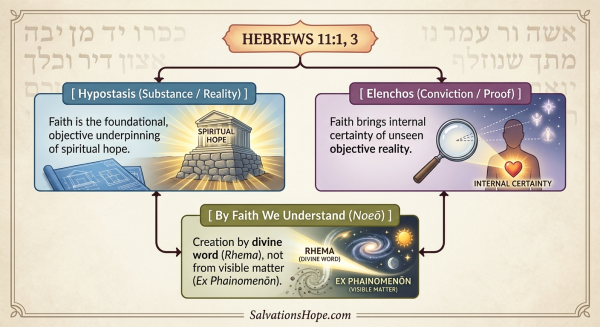
“Now faith is the assurance [hypostasis] of things hoped for, the conviction [elenchos] of things not seen… By faith we understand [noeō] that the worlds were prepared by the word [rhema] of God, so that what is seen was not made out of visible things.” (Hebrews 11:1, 3)
Key Theological Terms:
Hypostasis (ὑπόστασις) — “Assurance / Substance”: Lit. “a standing under” or “foundation.” Biblical faith is not a tentative guess; it is the concrete foundation upon which genuine hope rests.
Elenchos (ἔλεγχος) — “Conviction / Evidence”: Denotes legal proof or undeniable evidence. Far from being “blind,” divine faith produces an internal certainty wrought by the Holy Spirit that recognizes divine reality.
Noeō (νοέω) — “We Understand”: The writer of Hebrews asserts that faith precedes intellectual comprehension. We do not comprehend and then believe; rather, we understand by faith. Faith opens the mind to perceive the world as it truly is.
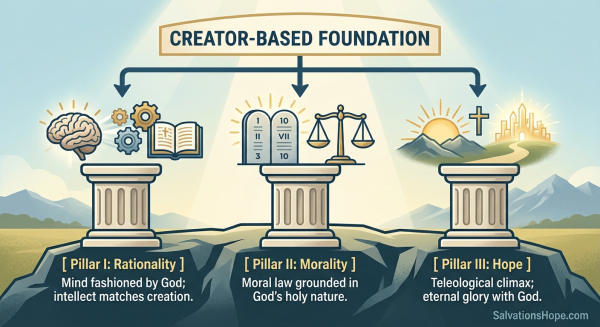
The Three Pillars of Creational Epistemology
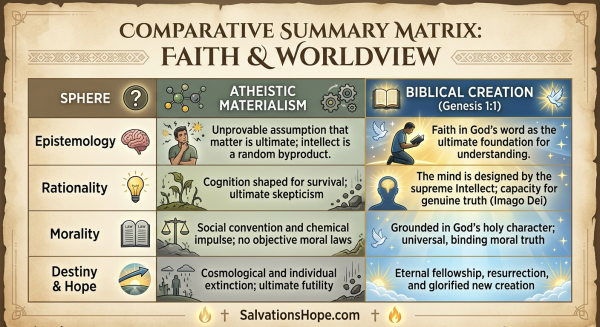
Without the foundation of Genesis 1:1, the crucial pillars of human existence—Rationality, Morality, and Hope—collapse under the weight of naturalistic assumptions.
Pillar I: The Foundation of Human Rationality (The Argument from Mind)
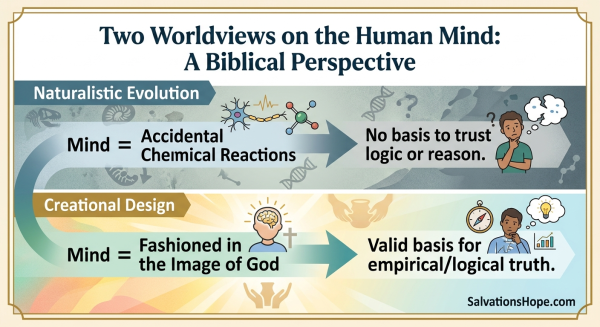
To believe in the validity of human reason, the materialist must unwittingly rely on a Christian worldview while denying its source.
The Materialist Dilemma: If human cognition is merely the product of unguided chemical reactions, evolutionary pressure, and natural selection (which selects for survival, not abstract truth), then one has no logical basis to trust one’s own thought processes.
Charles Darwin famously recognized this internal contradiction in his letter to William Graham (1881): “With me the horrid doubt always arises whether the convictions of a man’s mind, which has been developed from the mind of the lower animals, are of any value or at all trustworthy. Would anyone trust in the convictions of a monkey’s mind, if there are any convictions in such a mind?”
The Biblical Paradigm:
Because an all-wise Creator (Logos) constructed both the physical universe and the human mind, human cognition and objective reality align harmoniously. Faith in the Creator provides the only coherent grounding for logic, science, and intellect.
Pillar II: The Foundation of Human Morality (The Argument from Value)
A purely material world knows only description (what is), never prescription (what ought to be).
The Collapse of Materialist Ethics: If human beings are merely the result of biological accidents, objective right and wrong do not exist. As the late evolutionary biologist William Provine candidly acknowledged: “Modern science directly implies that there are no inherent moral or ethical laws, no absolute guiding principles for human society.”
Under strict materialism, human conscience is reduced to neurochemical impulses, and moral wickedness becomes no different than a physical ailment. Darwin reflected this logical conclusion: “Wickedness is no more a man’s fault than bodily disease!”
Without an absolute Creator, we cannot judge actions against an objective moral standard. Kindness and cruelty become morally equivalent evolutionary adaptations.
The Biblical Paradigm:
Scripture anchors moral values in God’s holy character and humanity’s creation in the Imago Dei (Image of God, Genesis 1:26–27). Human dignity is intrinsic because humans carry divine value. Objective moral law exists because God is inherently righteous, making humans accountable for their choices (Romans 2:14–15).
Pillar III: The Foundation of Human Hope (The Argument from Teleology)
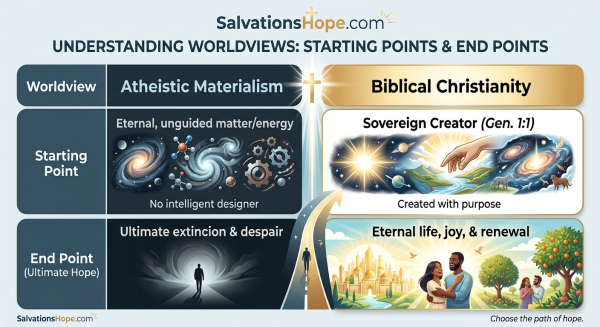
Every worldview leads to an ultimate destiny. A worldview’s endpoint is dictated entirely by its starting point.
The Despair of Naturalism:
Atheistic materialism offers no final purpose (teleology). Secular philosopher Bertrand Russell captured the bleak reality of this worldview:
“There is darkness without, and when I die, there will be darkness within. There is no splendor, no vastness anywhere, only triviality for a moment, and then nothing.”
The Biblical Paradigm:
Because history began with God’s intentional decree (Genesis 1:1), it moves toward a glorious, purposeful conclusion (Revelation 21:1–4). Faith in the Creator transforms suffering, gives human existence meaning, and grounds the believer in the living hope of resurrection (1 Peter 1:3–5).
Key Takeaways
Questions for Further Study
How does Hebrews 11:1–3 challenge the cultural idea that faith is “believing something without evidence”?
Why is Charles Darwin’s “horrid doubt” a serious challenge for those who rely strictly on naturalistic evolution to explain human reason?
In what practical ways does a belief in the Imago Dei (Image of God) protect human rights and dignity compared to a purely materialistic view of humanity?
The Christological Climax: In the Beginning Was the Word
Having established that B’reshit Elohim (“In the beginning God…”) is the foundational axiom for all rationality, morality, and hope, we must confront the central question of divine revelation: Who is this Creator, and how has He made Himself known?
Creation reveals God’s power and invisible attributes (Romans 1:20), but creation alone cannot reveal His redeeming heart. To know God clearly, definitely, and personally, we must move from the cosmic declaration of Genesis 1:1 to its glorious Christological fulfillment in John 1:1–14.
Exegetical Link: Genesis 1:1 and John 1:1–4
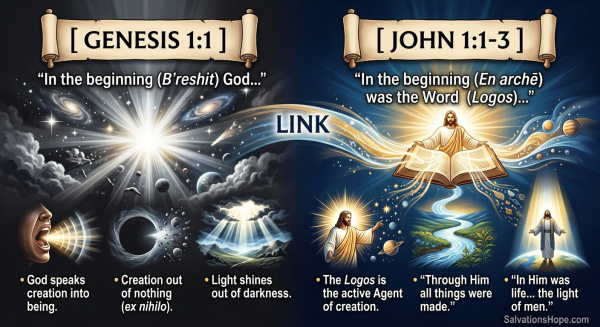
The Apostle John intentionally crafts the opening of his Gospel to echo the very first words of the Hebrew Scriptures:
“In the beginning was the Word [Logos], and the Word was with God, and the Word was God. He was in the beginning with God. All things came into being through Him, and apart from Him nothing came into being that has come into being. In Him was life, and the life was the Light of men.” (John 1:1–4)
Key Exegetical & Linguistic Insights:
En Archē (Ἐν ἀρχῇ) — “In the Beginning”: John places the Logos before the origin of time and matter. When the beginning began, the Logos already existed (imperfect verb ēn = continuous past existence). The Word is not created; He is eternal.
Logos (Λόγος) — “The Word”:
In Greek Philosophy: Logos referred to the impersonal, rational principle that held the cosmos together.
In Hebrew Thought (Dabar): The Word of Yahweh is the active, dynamic agency of divine power and creation (“God said… and it was so”).
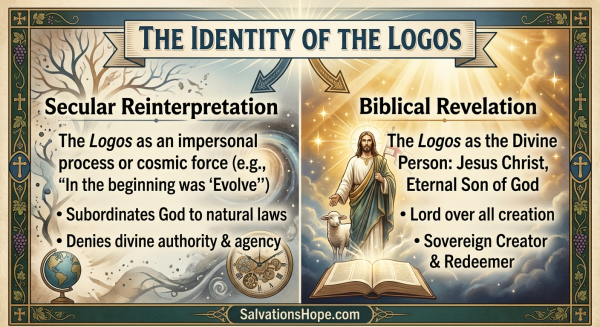
John’s Synthesis & Correction: John radically transforms both concepts. The Logos is neither an impersonal principle nor a transient spoken sound. The Logos is a Person—distinct from the Father (pros ton Theon = “face-to-face with God”), yet fully God (Theos ēn ho Logos).
Dia Autou (δι’ αὐτοῦ) — “Through Him”: Jesus Christ, the second Person of the Trinity, is the ultimate divine Agent through whom every particle, galaxy, biological system, and law of physics was brought into existence.
Refuting Hermeneutical Distortion: The Word Is a Person, Not a Process
In modern secular and theological discourse, people often reinterpret John 1:1 through naturalistic lenses—suggesting that “the Word” represents evolutionary processes, impersonal natural laws, or an emergent force.
To reduce the Logos to an impersonal, naturalistic mandate like “Evolve!” is to commit a grave hermeneutical distortion. Scripture explicitly identifies the Logos not as a process, but as an all-powerful, self-existent Person:
“And the Word became flesh, and dwelt among us, and we saw His glory, glory as of the only begotten
from the Father, full of grace and truth.” (John 1:14)
The Creator did not remain distant, nor did He leave His universe to unguided natural forces. He entered His own creation in space, time, and history through the Incarnation.
Miracles, Science, and the Sovereign Creator
Revisiting the materialist objection raised by Richard Lewontin—that allowing a “Divine Foot in the door” ruins scientific inquiry because “miracles may happen”—we find a profound misunderstanding of both science and supernatural intervention.
Why Christianity Encourages True Science
Belief in the God of John 1:1 does not hinder scientific investigation; it justifies it:
The Regularity of Nature: Because God is faithful, rational, and orderly, creation exhibits predictable patterns (Providence). Scientists can observe, test, and codify these patterns precisely because chaotic, unpredictable forces do not govern the cosmos.
The Distinction Between Providence and Miracles: A miracle is not a chaotic “rupture” that invalidates science. It is an extraordinary act of the Creator entering His own orderly system for a specific, redemptive purpose.
The Logic of Miracles
If Genesis 1:1 is true—if God brought the entire universe into existence out of absolute non-being—then secondary miracles (healing the sick, walking on water, rising from the dead) are not only logically possible, but entirely expected when the Creator walks among His creation.
The Ultimate Transition: From Creation to New Creation
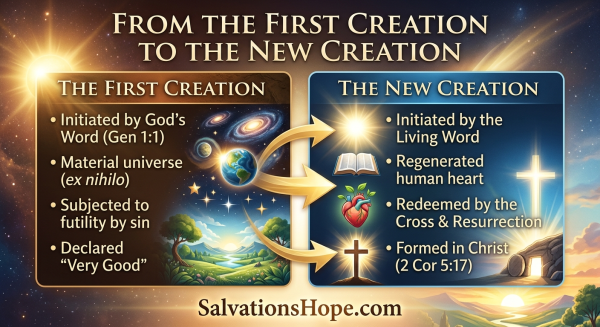
The study of biblical origins cannot remain purely academic. Epistemology, exegesis, and apologetics naturally culminate in a personal call to faith and transformation.
Conclusion & Call to Action
The fundamental divide in human thought boils down to two options:
A Commitment to Materialism: An unproven axiom that matter is all that exists, leading to a closed universe without objective rationality, ultimate morality, or eternal hope.
Submission to the Creator: A faith anchor grounded in B’reshit Elohim and fulfilled in Jesus Christ, providing the foundation for true knowledge, moral accountability, and eternal life.
We are invited not merely to recognize God as an abstract intellectual First Cause, but to bow before the Lord Jesus Christ—the living Logos:
Acknowledge: Admit our sin, self-autonomy, and intellectual independence.
Praise: Glorify Him as the eternal Creator through whom all things were made (Colossians 1:16).
Trust: Rest in His substitutionary sacrifice on the cross for the forgiveness of sins and His bodily resurrection for our justification.
Embrace: Become a new creation in Christ Jesus:
“Therefore if anyone is in Christ, he is a new creature; the old things have passed away; behold, new things have come.” (2 Corinthians 5:17)
Questions to Consider:
How does recognizing Jesus as the active Agent of creation in John 1:1–3 deepen your worship and view of His divine authority?
In what ways can you share the Gospel with someone who claims they cannot believe in God because they “only believe in science”?
What does it practically mean, in your daily life, to live as a “new creation” (2 Corinthians 5:17) while glorifying the Creator of the original creation?