
ish itti: Designated Man
Fallen Angel: Demon Lore
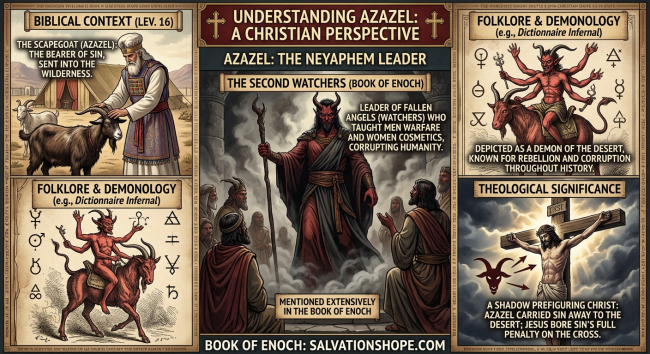
Azazel is a biblical figure that appears as a wilderness designation for the “scapegoat” in the Hebrew Bible and later evolved into a fallen angel or demon in Second Temple and rabbinic literature.
Hebrew Bible & Yom Kippur Origins
- The Ritual: In Leviticus 16:8–10, during the Day of Atonement (Yom Kippur), the high priest casts lots over two goats: one "for the Lord" and the other "for Azazel".
- The Scapegoat: The goat designated for Azazel has the sins of the community symbolically transferred onto it before being driven out into the desolate wilderness.
- Etymology: The name comes from Hebrew roots—either meaning a rugged cliff/mountain (az-el) or combining elements meaning "goat" and "to go away" (ez and ozelle), which gave rise to the English word "scapegoat".
Book of Enoch
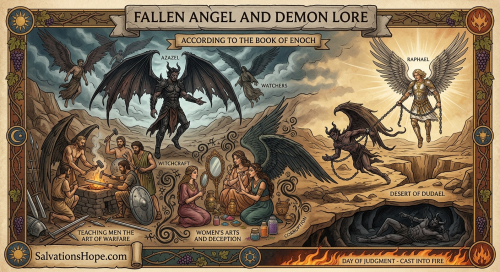
Azazel is portrayed as a leader of the Watchers (rebellious angels) who descended to Earth. He taught men the art of warfare (making swords, shields, and metalwork) and women the art of cosmetics and deception, while introducing witchcraft and corruption.
For corrupting humanity, Azazel is bound hand and foot by the archangel Raphael, cast into the darkness of the desert of Dudael, and destined to be thrown into fire on the Day of Judgment.
Popular Culture
- Marvel Comics: Azazel is depicted as an ancient, teleporting mutant leader of the Neyaphem who resembles a demonic or red-skinned entity.
- Literature and Lore: Featured across various works of dark fantasy, demonology compilations (such as Collin de Plancy's Dictionnaire Infernal), and modern occult fiction.
Within Jewish exegesis, the Book of Enoch, and modern media, Azazel transitions from an abstract ritual concept into a highly personified cosmic rebel and iconic modern villain.
Jewish Exegesis & Rabbinic Commentary
Classical Jewish commentators grapple with whether Azazel refers to a literal demon, a physical location, or a symbolic process during the Yom Kippur ritual.
The Literal Place (The Rugged Mountain): Rashi (Rabbi Shlomo Yitzchaki) and Yoma 67b in the Talmud interpret Azazel as a compound word meaning a hard, rough mountain (az – strong, el – tough). They argue it refers to a steep, rocky cliff in the wilderness from which the scapegoat was pushed to its death.
The Prince of the Wilderness: Nachmanides (Ramban) suggests that Azazel is a real demonic entity or chieftain governing the desolate wilderness. He explains that sending the goat to Azazel is not an act of worship or sacrifice to a demon, but a symbolic way of casting Israel’s sins back to the ultimate source of impurity and devastation.
The Absolute Removal of Sin: Ibn Ezra aligns closely with the literal geographical interpretation but notes a hidden mystery in the word, hinting at forces of chaos that dwell away from human civilization.
The Book of Enoch (Second Temple Literature)
In the pseudepigraphal 1 Enoch, Azazel is no longer a ritual destination but a highly individualized, catastrophic figure—one of the chief Watchers (fallen angels) who corrupted the antediluvian world.
- The Teacher of Forbidden Arts: Unlike other angels who simply mated with humans, Azazel specifically receives blame for teaching mankind the arts of warfare, metallurgy, weapon manufacturing, and cosmetic deception (makeup and jewelry).
- The Catalyst for the Flood: 1 Enoch explicitly states that “the whole earth has been corrupted through the works that were taught by Azazel: to him ascribe all sin.” This theological shift positions him as a primary catalyst for the Great Flood.
- The Desert Imprisonment: The text details a specific divine punishment: God commands the archangel Raphael to bind Azazel hand and foot, cast him into a jagged pit in the desert of Dudael, and cover him with sharp rocks and total darkness until the final Day of Judgment.
Depictions in Modern Media
In contemporary pop culture, Azazel is stripped of ancient ritual context and transformed into a signature antagonist in fantasy, horror, and comic books.
- Marvel Comics & Film: He is introduced as an ancient, red-skinned, teleporting mutant who is the biological father of Nightcrawler (Kurt Wagner). He appeared in the live-action movie X-Men: First Class.
- Supernatural (TV Series): Azazel serves as the overarching villain of the first two seasons. He is the iconic “Yellow-Eyed Demon” responsible for killing Mary Winchester and bleeding into the mouth of an infant Sam Winchester, triggering the entire plot.
- In the 1998 supernatural thriller movie Fallen, Denzel Washington plays Philadelphia homicide detective John Hobbes, who tracks an ancient, formless fallen angel and demon named Azazel After Hobbes witnesses the execution of serial killer Edgar Reese (played by Elias Koteas), similar murders start happening again Azazel is a disembodied spirit that can jump from one person to another through simple physical touch, making anyone on the street a potential host While possessing people, the demon taunts Hobbes by singing the Rolling Stones’ song “Time Is on My Side” While possessing people, the demon taunts Hobbes by singing the Rolling Stones’ song “Time Is on My Side” Azazel is referenced in the Hebrew Bible and ancient traditions as a scapegoat or wilderness spirit associated with uncleanness
- Video Games: He appears as a major playable character or boss in titles like The Binding of Isaac (where he starts with mini-brimstone lasers), Helltaker, and the Tekken fighting game franchise.
The structural parallels between the Yom Kippur ritual in Leviticus 16 and the judgment of Azazel in 1 Enoch (chapters 8–10) are striking. Scholars widely agree that the author of 1 Enoch did not invent their version of Azazel out of thin air; rather, they used the temple ritual as a theological blueprint to explain the cosmic origin of sin and ultimate judgment.
The two texts closely mirror each other through specific structural similarities:
The Total Concentration of Sin
Leviticus 16: The high priest confesses all the iniquities, transgressions, and sins of the children of Israel, symbolically placing them onto the head of the scapegoat. The goat carries the collective guilt of the community away.
1 Enoch: After detailing the corruption of the earth by the fallen angels, God commands the archangel Raphael regarding Azazel, stating: “To him ascribe all sin.” Azazel becomes the ultimate reservoir and origin point for human wickedness, mirroring how the scapegoat bears all the sins of Israel.
Banishment to a Desolate, Jagged Wilderness
- Leviticus 16: The goat for Azazel is sent away into a “solitary land” or “fretful desert” (eretz gezerah—an isolated, cut-off area). Rabbinic tradition later codified this as a steep, jagged cliff in the desert.
- 1 Enoch: Raphael is commanded to bind Azazel hand and foot and cast him into Dudael, which is described as a specific desert characterized by jagged, sharp rocks. The geography of punishment in Enoch explicitly mirrors the harsh terrain intended for the biblical scapegoat.
The Use of a “Designated Man” vs. an Archangel
- Leviticus 16: The high priest does not lead the goat into the wilderness himself; the text specifies it must be driven out by an appointed proxy, a “man who is in readiness” or a designated handler (ish itti).
- 1 Enoch: God delegates the handling and binding of Azazel to a specific proxy—the archangel Raphael, who acts as the cosmic executor of the ritual.
Covering and Confinement
- Leviticus 16: The ritual demands that the sins be completely removed from the sight of the community and hidden away in a land of no return.
- 1 Enoch: Raphael is told to place rough, sharp stones on top of Azazel and “cover him with darkness” so that he cannot see the light. This represents the total spiritual and physical containment of impurity, isolating it from the realm of the living.
Final Destruction on a Day of Judgment
- Leviticus 16: The ultimate goal of the ritual is total purification. While Leviticus leaves the goat in the wilderness, late Second Temple practice and the Talmud record that the goat was pushed backward off the cliff to its destruction so it could never wander back to contaminate the camp.
- 1 Enoch: The desert imprisonment of Azazel is not his final end. He is kept bound in darkness specifically until the “great day of judgment,” at which point he will be cast directly into the fire to be consumed.
The Theological Shift
In Leviticus, the ritual is cyclical and preventative—it is performed every year to cleanse the sanctuary and keep human sin from driving God’s presence away.
In 1 Enoch, the narrative takes this exact structure and turns it into an eschatological (end-times) reality. The author of Enoch uses the mechanics of Yom Kippur to reassure readers that just as Israel’s sins are removed and destroyed once a year, God will permanently round up the ultimate sources of cosmic evil, bind them in the dark wilderness, and cast them into the fire once and for all.
The Dead Sea Scrolls, discovered at Qumran, serve as the crucial missing link between the ritual instructions of Leviticus and the full-blown demonology of 1 Enoch. They explicitly demonstrate how ancient Jewish sectarians read the enigmatic “Azazel” of the temple ritual and organically fused it with the story of the rebellious angels from Genesis 6. [1, 2, 3]
The fragmentary text known as the Pesher on the Periods (4Q180) bridges this gap through specific interpretive frameworks:
Merging Ritual Impurity with Ontological Evil
In Leviticus, Azazel is an ambiguous destination for a physical goat carrying Israel’s ritual pollution. In 1 Enoch, he is a cosmic rebel. The Pesher on the Periods directly fuses these concepts by utilizing the pesher method—an interpretive technique that unlocks hidden, contemporary, or eschatological meanings within older scriptural ideas.
Fragments 7–8 of 4Q180 read: “A pesher on Azazel and the angels who [laid with human women and they] gave birth to giants, and about Azazel [who taught the commission of violence]…”
By spelling the name identically to the Day of Atonement text, the text explicitly declares that the “Azazel” who inherits Israel’s sins every Yom Kippur is the exact same cosmic entity responsible for introducing violence and forbidden arts into the antediluvian world.
Dualistic Inheritance and "Lots"
The Levitical ritual relies on the casting of two matching lots: “one lot for the Lord, and the other lot for Azazel” (Lev. 16:8).
- The Qumran community seized upon this language to build their highly structured, cosmic dualism. In the Pesher on the Periods (and related texts like 4Q181), humanity and the spiritual realm are divided into two distinct, predetermined “lots” or “heritages” (goralot).
- 4Q180 explains that Azazel’s lot is a domain of wickedness, and he has been given an “inheritance” of deception to lead Israel astray for designated periods of time. This transforms the literal, wooden lots cast by the High Priest over two goats into a grand cosmic metaphor for the division between the Children of Light (God’s lot) and the Children of Darkness (Azazel’s lot).
Structural Chronology (Periodization)
The Pesher on the Periods is deeply preoccupied with how God has structured human history into fixed blocks of time.
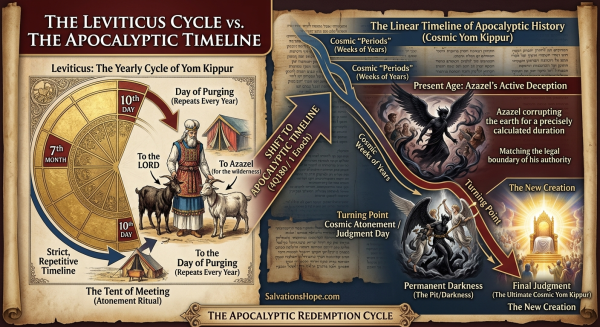
- In Leviticus, the day of purging happens on a strict, repetitive timeline (the tenth day of the seventh month).
- 4Q180 shifts this cyclical timeline into a linear timeline of apocalyptic history. It positions Azazel’s active deception of the world within specific cosmic “periods” or weeks of years. This provides the mechanical backdrop for 1 Enoch: Azazel is allowed to corrupt the earth for a precisely calculated duration, matching the legal boundary of his authority, before being permanently locked away in darkness until the ultimate cosmic Yom Kippur—the Final Judgment.
Through the Dead Sea Scrolls, modern readers can see that the transition of Azazel from a “scapegoat cliff” to a “fallen angel” wasn’t a sudden invention, but a careful, deeply theological meditation by Second Temple scribes who used the vocabulary of the Levitical temple service to make sense of cosmic evil.
Beyond the Pesher on the Periods, other foundational Qumran texts build a highly sophisticated demonology around Azazel, tailoring his mythological character to directly reinforce the community’s strict legal, moral, and cosmic worldview.
The Book of Giants (4Q203) — The Celestial Scapegoat
While 1 Enoch outlines Azazel’s crimes, the Qumran Book of Giants clarifies his precise legal role in cosmic judgment. In fragment 7, the giants (the offspring of the Watchers) realize their impending doom through ominous dreams and plead for mercy.
The Substitutionary Sentence: The text records a fascinating legal pivot where the giants note that the ultimate punishment will fall not on them, but on Azazel: “Then he punished, and not us, [bu]t Aza[ze]l…”
The Cosmic Expiation: Scholars like Andrei Orlov point out that 4Q203 line 6 specifically utilizes the exact spelling “for Azazel” (la-azazel), directly mirroring Leviticus 16. In this community’s theology, Azazel acts as a celestial scapegoat. Just as the biblical goat carries away Israel’s sins, the Book of Giants views Azazel as the cosmic vessel onto whom the totality of the world’s pre-flood violence, corruption, and angelic sin is permanently transferred and locked away.
The Damascus Document (CD) — The Anatomy of Human Error
The Damascus Document shifts away from the epic, cosmic narratives of Enoch and applies the warning of Azazel/the Watchers to daily community discipline and halakha (law). In CD Column 2, the text offers an architectural history of human rebellion to warn the sect members against following their own hearts.
- The Watchers as the Prototype of Sin: The Damascus Document notes that even the “heavenly Watchers” fell because they walked in the stubbornness of their hearts.
- The Demonic Traps of Belial: While the text often uses the name Belial or Mastema for the active prince of demons leading people astray, the underlying theology relies entirely on the framework introduced by Azazel. The Damascus Document warns that human sin is not purely internal; it is fueled by the lingering spirits and the “forbidden knowledge” (occultism, illicit wealth, and vanity) that Azazel originally introduced to the earth. For the Qumran community, refusing to compromise on minor legal details of the Torah was how they actively resisted the overarching spirit of Azazel.
Summary of Qumran's Theological Development
When these texts are viewed together, the Qumran community’s theology transforms Azazel into a multi-faceted tool for survival:
Qumran Text
Azazel’s Function
Theological Impact on the Community
Pesher on the Periods (4Q180)
The Sovereign Divider of History
Assured the sect that their present persecution was part of a predetermined divine timeline.
Book of Giants (4Q203)
The Ultimate Legal Container of Sin
Guaranteed that cosmic justice is substitutionary and absolute; evil will be entirely gathered and disposed of.
Damascus Document (CD)
The Archetype of the Spiritual Fall
Acted as a severe behavioral warning that even holy beings can be corrupted by stubbornness and worldly distraction.
Through this literature, the Essenes of Qumran looked at their corrupt world, blamed its broken state on the spiritual lineage of Azazel, and viewed their strict, isolated desert community as the literal “Lot of God” destined for vindication.
The Apocalypse of Abraham (a Jewish pseudepigraphal text dating to the late 1st or early 2nd century CE) represents the absolute climax of this trajectory. In this text, Azazel transitions completely from an ambiguous desert entity or a localized pre-flood angel into the personification of cosmic evil—the literal counterpart to the devil.
The text accomplishes this final transformation through three distinct theological and narrative shifts:
The Physical Form of the Adversary
In earlier Second Temple texts like 1 Enoch, Azazel is described as an angel who falls from heaven. The Apocalypse of Abraham removes his celestial glory entirely, stripping away any lingering angelic dignity and giving him a grotesque, animalistic appearance that mirrors classical devil imagery.
In Chapter 13, as Abraham is offering a sacrifice to God, Azazel descends upon the carcasses.
The text explicitly describes him as an impure bird (often translated as a raven or vulture), a creature of prey associated with spiritual pollution, death, and the demonic realm.
The Great Reversal of Garments (The Cosmic Scapegoat)
The most striking structural parallel to the Yom Kippur ritual occurs during a dramatic confrontation between the archangel Yahoel, Abraham, and Azazel. Yahoel explicitly banishes Azazel using the language of spiritual inheritance:
- The Exchange of Robes: Yahoel tells Azazel that the garment of heavenly light that once belonged to him has now been set aside for Abraham. Conversely, the corruption, wrath, and sins of humanity that dwell on earth are permanently transferred onto Azazel.
- The Final Scapegoat: This mirrors the exact mechanics of Leviticus 16 but on an eternal scale. Azazel is explicitly told that his “lot” is to bear the iniquity of the godless, effectively making him the cosmic trash bin for all human sin, while the righteous inherit the heavenly realm.
Ruler of the Underworld and Tempter of Humanity
The Apocalypse of Abraham completely finalizes Azazel’s evolution into the devil by giving him his own independent domain of malice and assigning him the role of the original serpent in Eden.
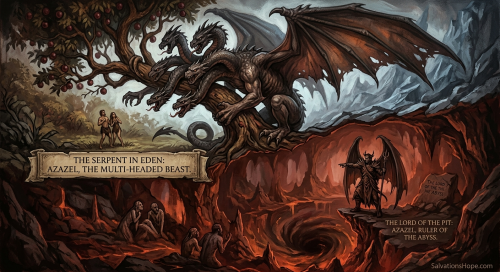
- The Lord of the Pit: In Chapter 14, Azazel is told: “Be a spark of the furnace of the earth… go, Azazel, into the inaccessible parts of the earth.” He is given absolute domain over the abyss, ruling over the wicked.
- The Serpent in Eden: In Chapter 23, Abraham is shown a vision of the Fall of Man. Instead of a standard serpent, Abraham sees a massive, multi-headed beast with the hands and feet of a man, and wings like a dragon, wrapped around the Tree of Knowledge. The text explicitly identifies this monstrous, Edenic tempter as Azazel, pinning the origin of human mortality and sin entirely on him.
The End Result of the Trajectory
The historical-theological journey of Azazel comes full circle in the Apocalypse of Abraham:
- Leviticus: A passive ritual container (a goat) sent into the wilderness to cleanse the community.
- 1 Enoch: A rebellious, imprisoned angel blamed for pre-flood corruption.
- Qumran Literature: A cosmic “lot” or force of darkness opposing the children of light.
- Apocalypse of Abraham: The literal Devil—the Ruler of Hell, the Tempter of Eden, and the ultimate cosmic adversary of God and humanity.
The final, devilish evolution of Azazel in texts like the Apocalypse of Abraham and 1 Enoch heavily saturated the theological air that the early Church breathed. While the New Testament authors predominantly chose the Hebrew title Satan (“the Accuser”) or the Greek term Diabolos (“the Devil”) for their chief antagonist, the structural identity, crimes, and ultimate fate of the New Testament Satan are profoundly shaped by the earlier traditions surrounding Azazel.
How Azazel's Lore Shaped Early Christian Demonology
Early Church Fathers (the Christian writers of the 1st through 4th centuries) did not separate the canonical scriptures from Second Temple angelology. They relied directly on Azazel’s narrative to build the foundational architecture of Christian demonology:
The Origin of Demonic Magic and Deception: Church Fathers like Justin Martyr, Tertullian, and Clement of Alexandria explicitly cited the Enochic tradition of Azazel. They argued that pagan mythologies—and specifically modern vanities like makeup, jewelry, dye, and metallurgy—were not neutral human inventions but the lingering, corrupting “forbidden sciences” introduced by the fallen angels. Tertullian famously used this to lecture Christian women on modesty, explicitly channeling the ancient Jewish polemic against Azazel.
The Demonic Offspring: Early Christianity universally accepted the Second Temple view that the demons plaguing the earth in the present day were actually the disembodied, restless spirits of the Nephilim (the giants), who were spawned because of the rebellion led by Azazel and his cohorts.
Comparing Azazel to the New Testament Satan
When we place the New Testament’s depiction of Satan side-by-side with the finalized depiction of Azazel, the conceptual overlap reveals that the two figures effectively merged into a single composite entity.
The Geography of Punishment (The Abyss)
- Azazel: In 1 Enoch, God commands that Azazel be bound hand and foot and cast into a dark, subterranean pit in the desert (Dudael), locked away beneath sharp rocks until the final judgment.
- Satan: This precise spatial imagery is applied directly to Satan and his forces in the New Testament. In Luke 8:31, the demons beg Jesus not to cast them into the Abyss. In 2 Peter 2:4 and Jude 1:6, the text explicitly notes that God did not spare the angels who sinned, but cast them into Tartarus, binding them in “gloomy dungeons” and “eternal chains” until the judgment of the great Day—a direct literary echo of Azazel’s desert confinement.
The Ultimate Fate (The Lake of Fire)
- Azazel: The ancient texts state that Azazel’s desert prison is merely a holding cell; on the Day of Judgment, he will be cast directly into the fire to be consumed.
- Satan: In Revelation 20:10, the climax of Christian eschatology mirrors this exact structural sequence. Satan is released briefly from his abyss, only to be permanently thrown into the Lake of Fire and Sulfur, where he is tormented forever alongside his angels.
The Master Tempter and Ruler of the World
- Azazel: In the Apocalypse of Abraham, Azazel is the multi-headed serpent in Eden, holding cosmic authority over the “lot of the wicked” and exercising dominion over the godless elements of the earth.
- Satan: The New Testament mirrors this absolute personification of evil. Satan is called “the ruler of this world” (John 12:31) and “the god of this age” (2 Corinthians 4:4). Like the finalized Azazel, he is explicitly identified as “that ancient serpent” (Revelation 12:9) who deceives the whole world.
Summary of the Convergence
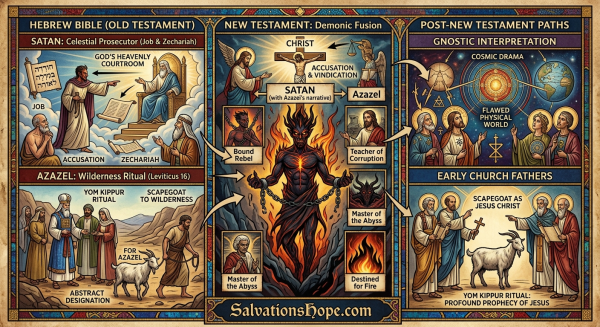
In the Hebrew Bible, Satan and Azazel were entirely distinct: Satan was a celestial prosecutor in God’s heavenly courtroom (as seen in Job and Zechariah), while Azazel was an abstract designation for a wilderness ritual.
By the time the New Testament was written, Jewish apocalyptic thought had fused them. The New Testament writers adopted the name Satan because of its rich courtroom imagery of accusation and vindication through Christ, but they imported the entire narrative framework of Azazel—the bound rebel, the teacher of worldly corruption, the master of the abyss, and the prisoner destined for the fire—to describe who that adversary actually was.
Would you like to examine how this demonic fusion influenced Gnostic Christian texts, or look at how the early Church interpreted the Leviticus 16 scapegoat ritual as a prophecy for Jesus instead of the Devil?
The early Church and various Gnostic movements took this rich demonic fusion in two radically opposite directions. While the Gnostics amplified the cosmic drama of Azazel to explain a deeply flawed physical world, the orthodox Church Fathers executed a stunning theological reversal, interpreting the Yom Kippur scapegoat ritual not as a story about the Devil, but as a profound prophecy of Jesus Christ.
Gnostic Christian Texts: Cosmic Corruption Amplified
Gnosticism—a diverse movement of early mystical Christian sects (2nd–4th centuries CE)—reinterpreted mainstream Judeo-Christian theology through a heavily dualistic lens. They believed the material world was inherently flawed, created not by the supreme, transcendent God, but by an ignorant, inferior deity known as the Demiurge (often named Yaldabaoth or Saklas). The demonic fusion of Azazel and Satan heavily influenced this framework in several ways:
The Archons as Watchers: In Gnostic texts like the Apocalypse of John (Apocryphon of John) and the Hypostasis of the Archons, the Demiurge creates planetary rulers called Archons. These Archons are heavily modeled after the fallen Watchers of the Enochic tradition. Like Azazel, the Archons are portrayed as cosmic trespassers who are obsessed with trapping divine light within human flesh and corrupting humanity through material desires, fate (Heimarmene), and physical ignorance.
The Origin of Physical Desires: Gnostics weaponized the ancient Enochic polemic (that Azazel taught humans cosmetics, jewelry, and warfare) to argue that the entire material culture of the world was a demonic trap. In the Apocryphon of John, the chief Archons send minor spirits to human women to introduce them to gold, silver, metallurgy, and luxuries. This wasn’t just to cause “sin,” but to distract humans so deeply with worldly pleasures that they would forget their true, transcendent spiritual home.
Azazel as a Cosmic Border Guard: Because the Gnostic cosmos was a prison, the abyss where Azazel/Satan was confined was expanded to encompass the lower material realm itself. To escape back to the true God, a Gnostic believer had to possess secret knowledge (gnosis) to pass by these planetary Archons, effectively treating them as cosmic versions of the ancient desert demon blocking the way to freedom.
The Orthodox Early Church: The Stunning Christological Reversal
While Gnostics used Azazel to explain cosmic evil, orthodox Christian theologians looked back at Leviticus 16 and did something completely unexpected: they extracted the scapegoat ritual entirely from its demonic associations and mapped it directly onto Jesus Christ.
In the Epistle of Barnabas (c. 70–132 CE), Justin Martyr’s Dialogue with Trypho, and the writings of Origen, the early Church developed The Typology of the Two Goats. They argued that the two goats of Yom Kippur did not represent God vs. the Devil, but rather two distinct aspects of Jesus’s single salvific mission.
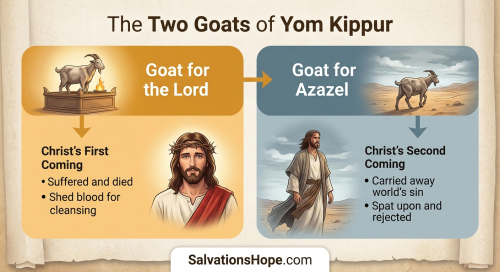
The First Goat: The Death of Christ
The goat that was slaughtered “for the Lord” as a sin offering was viewed as a type (a prophetic symbol) of Jesus’s crucifixion. Its blood was brought into the Holy of Holies to cleanse the sanctuary. Similarly, early Christians believed that Jesus’s shed blood provided definitive purification for human sin, rendering the old temple rituals obsolete (mirroring the arguments in the New Testament Book of Hebrews).
The Second Goat (The Scapegoat): The Rejection and Expiation
Instead of seeing the scapegoat as a gift or banishment to a demon named Azazel, Church Fathers argued that this goat represented Jesus bearing the sins of the world outside the camp:
- The Crimson Thread: Rabbinic tradition held that a scarlet sash was tied to the scapegoat’s head. The Epistle of Barnabas highlights this, pointing out that Jesus was mockingly wrapped in a scarlet robe during his passion.
- Driven Outside the Gate: Just as the scapegoat was led out of Jerusalem into the barren wilderness by an appointed man, Jesus was led outside the city gates of Jerusalem to Golgotha, driven out by the crowd to die in a desolate place of execution.
- Bearing the Curse: Justin Martyr argued that the scapegoat was cursed by bearing Israel’s sins. He connected this to the crucifixion, explaining that Christ willingly took the curse of the law upon himself to carry human transgression completely away into oblivion, fulfilling the structural reality of the ritual.
The Ultimate Convergence
By the mid-Patristic era, orthodox Christian theology had successfully split the legacy of Azazel:
- They took the mythological narrative of Azazel (the fallen angel, the master of the abyss, the corrupter of earth) and fused it into their concept of Satan.
- They took the temple ritual of Azazel (the scapegoat bearing sin into the wilderness) and completely re-baptized it as a prophetic mirror of Jesus Christ, stripping the devil of his ancient Levitical heritage.
Comparing the early Christian interpretation of the scarlet thread to the later rabbinic accounts in the Talmud reveals a fascinating divergence: while the early Church viewed the thread as a static symbol of Christ’s physical suffering, the Talmud interpreted it as a dynamic, miraculous barometer of divine forgiveness.
Despite drawing from a shared Second Temple practice that is absent from the original text of Leviticus 16, each tradition reshaped the meaning of the thread to anchor its own theological reality.
The Early Church Interpretation (Static & Christological)
In early Christian texts—most notably the Epistle of Barnabas (c. 70–132 CE)—the scarlet thread tied to the scapegoat is stripped of any magical or transformative properties. Instead, it functions strictly as a typological prophecy of the Passion of Christ.
The Mirror of the Crucifixion: Barnabas (Chapter 7) notes that the crowd would spit upon, pierce, and bind scarlet wool around the head of the scapegoat before driving it out. The Church Fathers directly equated this scarlet wool with the crown of thorns and the mock imperial scarlet robe placed on Jesus during his trial.
The Permanent Stain: For the early Church, the thread does not change color. It stays red, symbolizing the physical reality of Christ’s shed blood, his human suffering, and the curse he bore “outside the gate” to take away the sins of the world.
The Crimson on the Thorn: Barnabas details that the handler would strip the wool from the goat and place it on a thorny desert shrub called Rachia. The early Church interpreted this as an allegory: anyone wishing to grasp the “scarlet wool” (the kingdom of Christ) must endure the pain of the thorns (tribulation and suffering).
The Rabbinic Account in the Talmud (Dynamic & Liturgical)
In contrast, the Babylonian Talmud (Tractate Yoma 39b, 67a) and the Mishnah record a supernatural, transformative tradition. They explicitly link the physical color change of the thread to the immediate state of Israel’s relationship with God, using Isaiah 1:18 as their proof-text: “Though your sins be as scarlet, they shall be as white as snow.”
- The Miraculous Barometer: According to rabbinic memory, a portion of the crimson thread was tied to the horns of the scapegoat, and another portion was tied to the doors of the Temple portico. When the proxy handler pushed the goat backward off the wilderness cliff to its death, the piece of the thread remaining on the Temple doors would miraculously turn from scarlet to white.
- The Communal Relief: This whitening served as an immediate, visible confirmation that God had accepted the Day of Atonement sacrifices and that Israel’s national guilt was completely erased. If it stayed red, the community would sink into mourning, knowing their repentance was insufficient.
The 30 CE Convergence: Where the Narratives Clash
The most striking historical intersection between these two interpretations occurs in a famous passage in Tractate Yoma 39b.
The Talmud records that forty years prior to the destruction of the Second Temple (which occurred in 70 CE, placing this shift precisely around 30 CE), a series of unsettling omens began to occur at Yom Kippur. Among these omens, the scarlet thread completely stopped turning white, remaining stubbornly crimson or turning an even deeper shade of red.
This historic detail created a profound theological split in how both groups read the exact same event:
- The Messianic Christian Perspective: Christian theologians and modern Messianic believers look at this specific Talmudic text as an unintentional Jewish confirmation of the Gospel. They argue that around 30 CE—the traditional date of the crucifixion—the Temple’s scarlet thread stopped turning white because animal sacrifices were made permanently obsolete by the final, singular sacrifice of Jesus Christ. In their view, the thread stayed red because the blood of the Messiah had been poured out once and for all.
- The Rabbinic Jewish Perspective: Within classical Judaism, the failure of the thread to turn white after 30 CE was understood as a tragic manifestation of spiritual decay, unrepentance, and a symptom of the growing internal corruption of the late Second Temple priesthood. It was a divine warning that the Temple’s glory was fading and that its structural destruction was imminent due to baseless hatred within the community.
Direct Comparison Summary
Attribute
Early Church Interpretation (Epistle of Barnabas)
Rabbinic Account (Talmud Yoma)
Nature of the Thread
Static symbol; a physical marker of Christ’s mockery and suffering.
Dynamic barometer; a miraculous sign of national ritual purity.
Color Mechanics
Stays scarlet; mimicking the blood of Jesus and the scarlet robe.
Turns white; physically manifesting the promise of Isaiah 1:18.
Theological Core
Christ took the permanent curse of human sin outside the city walls.
Repentance and proper execution of the ritual triggers divine forgiveness.
Meaning of the “30 CE Stop”
The ultimate sacrifice was finished on the cross; Temple animal rites were invalidated.
A divine warning of spiritual decline and the impending destruction of Jerusalem.
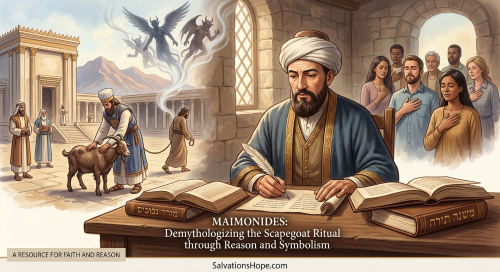
As a rigorous Aristotelian rationalist, Moses Maimonides (Rambam) rejected any literal belief in fallen angels, desert demons, or magical color-changing threads. In his philosophical masterpiece, The Guide for the Perplexed, and his legal code, the Mishneh Torah, Maimonides systematically demythologized the scapegoat ritual.
He explained the mechanics of the Yom Kippur service using psychological symbolism, societal catharsis, and historical context rather than supernatural phenomena.
The Principle of Radical Impossibility
Maimonides begins his rationalization by addressing the literal mechanics of the ritual, stating bluntly that it is physically and metaphysically impossible for an animal to actually absorb human wrongdoing.
In The Guide for the Perplexed (3:46), he writes: “There is no doubt that sins cannot be carried like a burden, and taken off the shoulder of one being to be laid on that of another being.”
Because sins are moral and intellectual failures, they have no physical weight. Therefore, Maimonides argues that the entire ritual is strictly symbolic in character, designed to create a specific impression on the human mind to shock it into genuine repentance (teshuva).
The Psychology of Behavioral Catharsis
For Maimonides, the scapegoat operates as a grand visual metaphor to solve a profound psychological problem: the paralyzing weight of guilt and shame.
The Visual Departure of Sin: Maimonides notes that humans are sensory creatures. It is incredibly difficult for a person to emotionally accept that they are clean and forgiven simply through an internal abstract thought.
The “Casting Behind the Back”: By watching the high priest physically confess national sins over a live animal, and then watching that animal be physically driven away until it completely disappears over the horizon of a desolate desert, the human mind receives a visible representation of departure. It serves as a behavioral trigger, convincing the sinner: “We have freed ourselves of our previous deeds, have cast them behind our backs, and removed them from us as far as possible.”
Historical Context: Combatting Pagan Superstition
Maimonides’ overarching view of the Torah’s sacrificial system (Ta’amei ha-Mitzvot) is that it was a divine pedagogical strategy to slowly transition the Israelites away from pagan idolatry without completely shocking their cultural expectations.
- In the ancient Near East, neighboring polytheistic cultures routinely offered sacrifices directly to desert spirits, satyrs, or demons to appease them.
- Maimonides argued that by regulating the scapegoat ritual under strict monotheistic law—and casting a random lot that placed the entire ceremony under God’s supreme authority—the Torah actively stripped the wilderness of its demonic power. The goat was not a bribe or a sacrifice to an entity named Azazel; it was a sensory tool used to demonstrate that the domain of chaos and desolation has no power over God’s camp.
Distinguishing Atonement from Cleansing
In his Laws of Repentance (1:2), Maimonides categorizes the legal mechanics of how the two goats operate in tandem to achieve structural balance:
- The Lord’s Goat (Legal Atonement): The slaughtered goat represents kapparah—the technical, legal payment and accountability for violating divine law.
- The Scapegoat (Moral Cleansing): The banished goat represents taharah—the emotional and communal purification from the psychological stain of wickedness.
By breaking down the ritual this way, Maimonides removed the need for magical explanations. The scapegoat didn’t change reality through a supernatural transaction; it changed the mindset and behavior of the nation, allowing them to break cycles of past trauma and start the new year with a completely clean slate.
The clash between Maimonides (Rambam) and Nachmanides (Ramban) over the scapegoat ritual represents one of the most famous intellectual battles in medieval Jewish thought. Writing a century after Maimonides, Nachmanides was a master of Kabbalah (Jewish mysticism). He launched a scathing critique against Maimonides’ purely rational, psychological framework, arguing that reducing a divine commandment to mere “group therapy” or an anti-pagan pedagogical trick stripped the Torah of its cosmic power.
Nachmanides attacked Maimonides’ position on several fundamental levels, offering a mystical alternative that transformed the scapegoat from a psychological metaphor back into a real cosmic transaction.
Rejecting the "Anti-Pagan Trick" Theory
Maimonides famously argued that God allowed the scapegoat ritual merely as a concession to primitive human psychology, channeling ancient pagan habits toward monotheism. Nachmanides found this idea deeply offensive to the dignity of the Torah.
In his commentary on Leviticus 16:8, Nachmanides launched a direct assault: “He [Maimonides] said words of emptiness… making a mock of the table of the Lord.”
Nachmanides argued that if a ritual’s only purpose was to combat ancient Egyptian or Babylonian superstitions, then once those pagan cultures faded from history, the commandment would become completely meaningless. He insisted that every commandment (mitzvah) contains an eternal, intrinsic cosmic reality (sod) that remains vital regardless of human historical context.
The Mystical Reality of Azazel (The Demonic Chieftain)
While Maimonides dismissed Azazel as a mere geographical name for a rough mountain cliff, Nachmanides revived the ancient Second Temple demonology found in the Book of Enoch and the Dead Sea Scrolls—reinterpreting it through a Kabbalistic lens.
Samael and the Left Side: Nachmanides identified Azazel as Samael (the angelic prince of Rome/Esau, associated with Satan and the serpent). In the Kabbalistic map of reality, Azazel represents the forces of Gevurah (strict judgment) and Tumah (impurity) that govern the desolate, uncultivated wilderness.
The “Bribe” That is Not a Sacrifice: Nachmanides addressed a dangerous theological problem: if the high priest is sending a goat to a demon, isn’t that idolatry? He solved this with a famous parable:A king throws a massive feast for his loyal subjects. To prevent a known, disruptive troublemaker from ruining the party, the king tells the butler, “Take this portion of food and throw it to that fellow outside.”For Nachmanides, the scapegoat is not an act of worship directed to Azazel. Rather, God commands Israel to throw a portion of the feast to the prosecuting angel (Satan/Azazel) to fulfill his legal right to accuse them, keeping him occupied so he cannot disrupt Israel’s intimate day of connection with God.
Psychological Metaphor vs. Cosmic Metaphysics
The core of the debate centers on what actually happens during the ritual:
- Maimonides’ Vertical View: The ritual is purely pedagogical. It operates strictly from the text to the human mind. The goat goes away, the human feels forgiven, and their psychological relief drives them to change their behavior. Reality changes because human behavior changes.
- Nachmanides’ Horizontal View: The ritual is metaphysical. It operates on the cosmic gears of the universe. By sending the goat to the wilderness, Israel is physically restructuring the balance of spiritual energy in the cosmos—banishing the forces of impurity back to their rightful place of desolation, thereby physically cleansing the earthly and heavenly sanctuaries.
Summary of the Philosophical Divide
Theological Point
Maimonides (Rambam)
Nachmanides (Ramban)
Nature of Azazel
A physical location; a rough cliff or mountain meant to destroy the goat.
A spiritual entity; the demonic prince of the wilderness and forces of chaos.
Purpose of the Ritual
Psychological catharsis; a visual tool to help humans let go of guilt.
Cosmic realignment; keeping the prosecuting angel (Satan) from accusing Israel.
Torah’s Strategy
Concession to history; weaning Israel off of ancient pagan habits.
Eternal mystery (Sod); manipulating spiritual energies according to divine blueprints.
Mechanism of Atonement
Direct repentance by human beings sparked by a symbolic event.
A dynamic legal transaction in the heavenly courtroom.
This debate permanently split Jewish interpretation. Maimonides’ view laid the groundwork for modern, rationalist Jewish thought, while Nachmanides’ critique successfully preserved the ancient, apocalyptic, and mystical legacy of Azazel, passing it down into the core text of mainstream Kabbalah.
When modern critical scholars analyze Maimonides and Nachmanides, they arrive at an ironic conclusion: both medieval thinkers were partially right, but each was projecting their own era’s philosophy onto an ancient Near Eastern ritual text.
Modern scholarship bridges the gap between the two views by analyzing the historical, linguistic, and structural evidence of Leviticus 16:
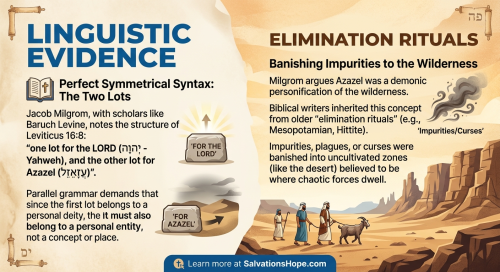
Scholars Side with Nachmanides: Azazel is Indeed a Demon
Modern academic scholarship overwhelmingly agrees with Nachmanides over Maimonides regarding the literal identity of Azazel.
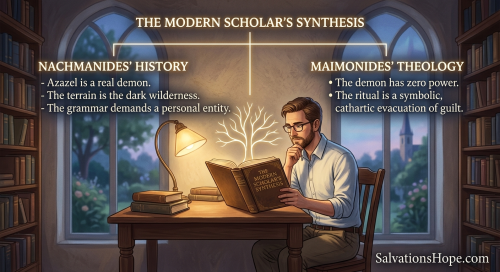
Linguistic Evidence: Jacob Milgrom, along with other prominent scholars like Baruch Levine, notes that the structural syntax of Leviticus 16:8 is perfectly symmetrical: “one lot for the Lord, and the other lot for Azazel.” Because the first lot belongs to a personal deity (Yahweh), the parallel grammar demands that the second lot must also belong to a personal entity, not a physical cliff or abstract concept as Maimonides argued.
Elimination Rituals: Milgrom argues that Azazel was originally a pre-biblical, demonic personification of the wilderness. The biblical writers did not invent this entity; they inherited it from older Mesopotamian and Hittite “elimination rituals,” where impurities, plagues, or curses were routinely banished into uncultivated zones (like the desert or open fields) where chaotic forces were believed to dwell.
Scholars Side with Maimonides: The Ritual is Stripped of Demonic Power
However, when it comes to the theological function of the ritual, modern scholarship sides entirely with Maimonides’ rationalist intuition. Milgrom highlights a massive “monotheistic revolution” taking place within the Priestly text (P) of the Hebrew Bible:
- No Bribes Allowed: Milgrom completely rejects Nachmanides’ Kabbalistic idea that the goat is a “bribe” or a gift thrown to Satan to keep him quiet. The Torah strictly forbids making sacrifices to any entity other than Yahweh.
- Demoted to a Trash Can: Milgrom explains that the Priestly writers performed a brilliant theological operation: they stripped Azazel of any active personality, will, or power. Azazel is not an adversary fighting God in an arena; he is reduced to a passive cosmic dumpster.
- Elimination, Not Appeasement: The goat sent to the wilderness is not a sacrifice to appease a demon; it is an evacuation vehicle. The desert is used simply because it is the ultimate non-life zone. Sending the sins there means sending them to a place where they will dissolve into nothingness, far away from God’s holy tabernacle.
The Modern Verdict: A Psychological Reality Wrapped in Ancient Myth
In the end, Jacob Milgrom and modern academics create a fascinating synthesis of the medieval debate:
Modern scholarship shows that the Torah utilized an existing, ancient myth about a desert demon (validating Nachmanides’ literal and historical reading) but completely neutralized that demon’s power, transforming the entire ceremony into a brilliant, sensory-driven psychological purge to assure a human community that their sins were completely gone (validating Maimonides’ brilliant psychological and pedagogical insight).
In his work—most notably in The Unseen Realm and his teaching on Hebrew worldview—the late Old Testament scholar Dr. Michael S. Heiser offered a compelling perspective on the figure of Azazel in Leviticus 16.
Heiser argued that understanding Azazel requires viewing Israel’s worship through the lens of the ancient Near East and “cosmic geography”—the idea that Yahweh’s domain (holy space) stands in direct contrast to the unholy world outside His presence.
Who or What is Azazel?
In standard English translations of Leviticus 16:8–10, the Hebrew word ‘ăzā’zēl (עֲזَאזֵל) is often translated as “scapegoat” or “the goat that goes away.” However, Heiser emphasizes that:
Azazel is a Proper Name: Rather than describing an action or an animal, Azazel is a proper noun referring to a demonic entity or spiritual power associated with the wilderness.
Second Temple Jewish Context: In intertestamental Jewish texts (such as 1 Enoch and fragments from the Dead Sea Scrolls), Azazel is identified as a leader of the fallen heavenly beings (the Watchers of Genesis 6) who corrupted humanity and was cast into dark, desolate places.
Parallel Structure in the Yom Kippur Ritual
Heiser points to the strict grammatical parallelism in Leviticus 16:8:
“And Aaron shall cast lots over the two goats, one lot for the Lord [la-YHWH] and the other lot for Azazel [la-Azazel].”
Heiser argues that if the first goat is dedicated to a personal spiritual Being (la-YHWH = “for Yahweh”), then symmetry requires the second goat to be designated for a personal spiritual figure (la-Azazel = “for Azazel”).
Atonement and Cosmic Geography
A critical distinction Heiser highlights is that the goat for Azazel was not a sacrifice to a demon. Yahweh’s law strictly forbade sacrificing to demons (Leviticus 17:7). Instead, the two goats served distinct theological roles in the Day of Atonement (Yom Kippur):
Goat
Recipient
Function
Theological Meaning
First Goat
For the LORD (la-YHWH)
Sacrificed, blood sprinkled
Purification / Propitiation: Cleanses the sanctuary and people from moral pollution.
Second Goat
For Azazel (la-Azazel)
Loaded with sin, sent into the wilderness
Expiation / Banishment: Removes defilement from holy ground and sends it back to its dark origin.
The Wilderness as Unholy Ground
In ancient Israelite thought, the Tabernacle/Temple camp was sacred space occupied by Yahweh’s holy presence. The desolate wilderness outside the camp represented chaos, spiritual death, and the realm of darkness ruled by evil forces.
By placing Israel’s sins on the goat and driving it into the wilderness, Israel was not offering a ransom to Azazel; rather, they were returning sin and defilement to the demonic domain where it belonged.
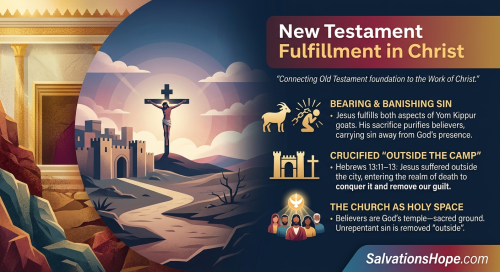
New Testament Fulfillment in Christ
Heiser connects this OT foundation to the Work of Christ in the New Testament:
- Bearing and Banishing Sin: Jesus fulfills both aspects of the Yom Kippur goats. Through His sacrifice, He purifies believers, and as the ultimate sin-bearer, He carries sin entirely away from God’s holy presence.
- Crucified “Outside the Camp”: Hebrews 13:11–13 notes that Jesus suffered outside the city gate. He entered the realm of death and darkness to conquer it and remove our guilt forever.
- The Church as Holy Space: In the New Testament, believers indwelt by the Holy Spirit are God’s temple—sacred ground. Unrepentant sin must be removed “outside” into the realm of the world.
Key Takeaway for Believers
Dr. Heiser’s insight transforms how we read Leviticus 16: Yom Kippur is not just an ancient administrative ritual, but a spiritual declaration. Christ does not merely cover our sins; He banishes them out of God’s presence, completely disarming the spiritual forces of darkness.