
The Divine Calculus of Eternity
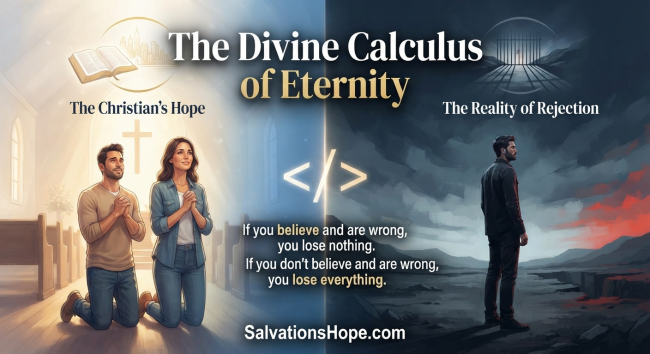
Logical Examination of the Christian Wager
The Intersection of Faith, Reason, and Existence
Throughout the history of human thought, the intersection of logic and theology has served as the crucible for the deepest questions of human existence. At the heart of these inquiries lies a pragmatic yet profound observation often associated with Christian apologetics: the existential asymmetry between belief and unbelief.
This formulation posits a stark comparison regarding the ultimate stakes of human life. If an individual dedicates their life to following Christ, living according to biblical precepts, and anchoring their identity in Christ Jesus, yet upon death finds that the universe is merely material and the Christian narrative is false, what have they lost? Conversely, if an individual chooses a life of rejection and denial of Christ Jesus, yet upon death discovers that the Creator of the universe is real and the gospel is true, the consequence is catastrophic eternal separation and an eternity in hell.
This study examines the biblical logic underlying this proposition, exploring how scripture addresses the rationality of faith, the nature of eternal consequences, and the transformative power of a life aligned with divine truth.
The Biblical Framework of Reason and Choice
Contrary to the caricature of faith as a blind leap devoid of intellect, biblical literature consistently appeals to human reason, conscience, and logical consequence. Scripture does not invite belief in a vacuum; it presents reality through a framework of cause and effect, ultimate truth, and moral accountability.
The Call to Rational Reflection
From the opening pages of the prophetic literature to the discourses of the New Testament, God repeatedly invites humanity to engage in logical evaluation:
- Isaiah 1:18: "Come now, and let us reason together, says the Lord." This divine invitation establishes that faith is not antithetical to rational thought, but rather the highest expression of it—engaging the human mind with ultimate reality.
- Romans 1:19–20: Paul argues that God’s eternal power and divine nature have been clearly perceived through the things that have been made, leaving humanity without excuse. Creation itself presents a logical premise from which the conclusion of a Creator naturally follows.
The Wisdom Literature and the Cost of Error
The book of Proverbs contrasts the path of wisdom (alignment with God’s moral order) with the path of folly (rejection of divine governance). Wisdom is portrayed not merely as a set of abstract rules, but as the very fabric of reality (Proverbs 8). To live in alignment with this reality is to anchor one’s existence in truth, whereas rebellion against it is described as self-destructive folly (Proverbs 8:36: “All those who hate me love death”).
The Asymmetry of the Ultimate Outcome
The core of the proposition presented lies in the radical asymmetry of the two potential outcomes at the threshold of mortality. To evaluate this logically, one must examine the relative gains, losses, and eternal implications of both paths.
Path A: The Life of Faith in the Face of Oblivion
Consider the individual who embraces the Christian life, cultivating virtues such as forgiveness, compassion, self-sacrifice, and hope, while dedicating their existence to serving others in Christ’s name.
- Temporal Value: Even within a purely secular framework, studies in psychology, sociology, and ethics consistently demonstrate that a life oriented around transcendent purpose, tight-knit community, and moral discipline yields profound temporal well-being, resilience, and societal contribution.
- Terminal Outcome: If materialism is true and death is the absolute end of consciousness, this individual experiences no awareness of their "mistake." They perish having lived a life rich in meaning, love, and service, suffering no net loss compared to any other human being.
Path B: The Life of Autonomy in the Face of Eternity
Conversely, consider the individual who consciously rejects God, living entirely for temporal autonomy and self-determination.
- Temporal Value: This life may offer various degrees of earthly pleasure, independence, or self-actualization.
- Terminal Outcome: If Christianity is true and moral accountability to a holy Creator is the foundational reality of the universe, the stakes are absolute. Scripture describes this state not merely as cessation of being, but as active alienation from the source of all life, goodness, and joy—commonly termed eternal damnation or hell (2 Thessalonians 1:9).
From a purely logical standpoint of risk management and existential calculus, the disparity between finite temporal sacrifice and infinite eternal consequence is infinitely vast.
Beyond Pragmatism—The Transformative Reality of Faith
While the logical comparison of outcomes provides a powerful apologetic tool, biblical theology insists that faith is never merely an insurance policy against future judgment. True Christian faith transforms the believer’s present existence, making the journey itself intrinsically valuable.
The Impartation of Abundant Life
Jesus did not frame discipleship solely around post-mortem security, but around present transformation. In John 10:10, He declares,
“I came that they may have life and have it abundantly.”
- The Vertical Dimension: Reconciliation with God through Christ introduces peace (eirene) that transcends human understanding (Philippians 4:7). The believer experiences adoption into the divine family, removing the existential dread of cosmic abandonment.
- The Horizontal Dimension: The command to love one's neighbor as oneself creates a horizontal network of grace, healing broken relationships, fostering forgiveness, and alleviating human suffering.
The Problem of Superficial Pragmatism
A purely pragmatic approach to faith—believing in God simply to avoid hell—misses the transformative heart of the gospel. Authentic biblical faith requires a relational surrender:
- Hebrews 11:6: "And without faith it is impossible to please him, for whoever would draw near to God must believe that he exists and that he rewards those who seek him."
- The reward of seeking God is not merely an escape from punishment, but God Himself. The ultimate fulfillment of Christian hope is encapsulated in Revelation 21:3: "Behold, the dwelling place of God is with man. He will dwell with them, and they will be his people."
When human logic confronts the horizon of eternity, the options narrow to a definitive crossroads. To dismiss God is to gamble finite temporal autonomy against the infinite reality of a holy Creator—accepting ultimate risk for momentary independence. Conversely, to embrace Christ Jesus is to align oneself with the eternal order of the universe, gaining a life of profound purpose in the present and infinite hope for the future.
Ultimately, biblical logic demonstrates that faith in God is not only the safest pathway through the uncertainties of mortal existence; it is the only posture that honors the structural reality of a creation designed to reflect the glory of its Maker.
The rational weight of eternity transforms how we evaluate daily choices. Following Christ Jesus secures both the highest possible earthly meaning and the ultimate inheritance of eternal life, rendering faith not a leap into darkness, but an awakening to ultimate truth.
The Logic of Redemption
Ignorance, Divine Sovereignty, and Human Responsibility in Acts 3:17
The crucifixion of Jesus Christ stands at the absolute center of Christian theology, presenting one of the most profound paradoxes in scripture: the convergence of human wickedness and divine sovereignty. In Acts 3:17, during his sermon at Solomon’s Portico, the Apostle Peter addresses the crowd, stating,
“And now, brethren, I wot that through ignorance ye did it, as did also your rulers.”
This declaration forms a critical cornerstone in understanding biblical logic. It does not minimize human culpability, nor does it diminish God’s absolute sovereignty. Instead, it invites a rigorous theological inquiry into how willful spiritual blindness, divine foreordination, and moral accountability coexist within the framework of biblical epistemology and redemptive history.
Epistemological Limitations: The Nature of Biblical "Ignorance"
To grasp the logic of Peter’s statement, one must properly define the biblical concept of ignorance (agnoia). In secular Greek thought, ignorance is often viewed simply as a lack of data, an intellectual deficit easily corrected by education. However, in the biblical narrative, particularly within Luke-Acts, ignorance is deeply moral and spiritual.
- Spiritual Blindness vs. Intellectual Deficiency: The Jerusalem populace and their leaders were not lacking historical awareness of Jesus of Nazareth; rather, they suffered from a radical failure of spiritual perception.
- The Noetic Effects of Sin: Scripture teaches that sin darkens the human intellect (Ephesians 4:18). Their inability to recognize the Messiah was rooted in hardened hearts and preconceived expectations of a political conqueror rather than a suffering servant.
- Pauline Parallel: This echoes the Apostle Paul’s assertion in 1 Corinthians 2:8, noting that “had they known it, they would not have crucified the Lord of glory.” Their lack of comprehensive understanding was total regarding Christ's divine identity, yet their actions proceeded from a corrupted moral will.
The Logic of Divine Sovereignty and Human Agency
Biblical logic operates on a plane where absolute divine decree and genuine human responsibility are held in dynamic, non-contradictory tension—often theological termed compatibilism.
- Fulfillment of Prophecy: Peter immediately connects their ignorant act to the overarching logic of divine plan: “But those things, which God before had showed by the mouth of all his prophets, that Christ should suffer, He hath so fulfilled” (Acts 3:18).
- The Intentionality Paradox: Human actors intended malice, rejection, and murder (Acts 2:23—“him, being delivered by the determinate counsel and foreknowledge of God, ye have taken, and by wicked hands have crucified and slain”). Simultaneously, God intended redemption, reconciliation, and atonement through the exact same historical event (Genesis 50:20).
- Axiom of Biblical Logic: Human ignorance does not cancel out moral agency. The perpetrators acted according to their own sinful desires, yet they unknowingly served as instruments in executing the immutable blueprint of divine salvation.
Culpability Without Full Comprehension
A vital facet of biblical ethics is that a lack of full comprehension does not equate to absolute innocence. Peter’s acknowledgment that they acted in ignorance is immediately followed by a call to repentance (“Repent ye therefore, and be converted, that your sins may be blotted out”, Acts 3:19).
- Accountability in Darkness: In biblical logic, ignorance is often blameworthy because it is willful. The light had come into the world, but men loved darkness rather than light because their deeds were evil (John 3:19).
- Mitigation vs. Exculpation: Peter uses their ignorance to explain the possibility of forgiveness rather than to excuse the crime. Because they acted out of spiritual blindness rather than the unpardonable, fully-enlightened defiance seen in hardened blasphemy against the Holy Spirit, the door to grace remained open.
- “Father, forgive them; for they know not what they do” (Luke 23:34)—Christ’s prayer from the cross operates on this exact theological logic, distinguishing between malicious rebellion and blind culpability while still requiring the remedy of the cross.
Peter’s declaration in Acts 3:17 bridges the chasm between human sin and divine grace. The crucifixion was humanity’s supreme act of rebellion committed in profound spiritual darkness, yet it was simultaneously God’s supreme act of illumination and rescue.
Biblical logic demonstrates that human limitation and blindness cannot thwart the redemptive purposes of God. Instead, God utilizes the very apex of human ignorance and sin to manifest His mercy, offering forgiveness precisely to those whose hands nailed the Savior to the tree—transforming their darkest ignorance into the dawn of eternal salvation.
The Architecture of Divine Truth
Biblical Logic, Epistemology, and Discernment
In an era characterized by post-truth relativism, fluid definitions of reality, and subjective emotionalism, the Christian faith stands on an unyielding premise: God is Truth, and He has revealed His Truth objectively to humanity. Far from being a mere collection of comforting moral platitudes, biblical logic anchors human thought, ethics, and spirituality in the immutable character of God.
The mandate to know, believe, test, and proclaim God’s Word is not an optional discipline for the spiritual elite; it is the foundational architecture of the Christian life. Ignorance, rather than being a state of blissful exemption from accountability, is a perilous vulnerability that compromises spiritual vitality, breeds sin, and invites misery. This theological study examines the biblical imperative of truth through four pillars: cognition (knowing the truth), conviction (believing the truth), discernment (testing everything), and proclamation (telling and defending the truth).
The Cognitive Imperative: Knowing God's Truth
A foundational error in modern spirituality is the assumption that uncalculated innocence or willful ignorance shields an individual from moral and spiritual consequences. Scripture emphatically rejects this notion. In the Old Testament, the Mosaic law instituted specific sin offerings for unintentional transgressions committed out of ignorance:
“If anyone sins unintentionally in any of the things by any commandment of the Lord things not to be done, and does not know it, yet realizes his guilt and bears his iniquity, he shall bring to the priest a ram without blemish…” (Leviticus 4:2-3, ESV)
The Levitical system underscores that breaking God’s moral order out of a lack of knowledge still produces corruption and requires atonement. Ignorance does not alter objective reality; it merely blinds the subject to their impending peril.
The Apostle Paul reiterates this principle when addressing the Gentiles, noting that while God overlooked times of ignorance in the past, He now “commands all people everywhere to repent” (Acts 17:30). Ignorance of God’s standard is a breeding ground for ethical drift. As the Psalmist declares, “I have stored up your word in my heart, that I might not sin against you” (Psalm 119:11). The intentional acquisition of biblical truth is the believer’s primary prophylactic against spiritual deviation.
The Bible as the Daily Epistemological Guide
Because human reason is fallen and culturally conditioned, humanity cannot generate divine truth from within. True knowledge requires divine revelation. The Scriptures must function not as an occasional reference manual, but as a daily epistemic anchor. Neglecting this discipline surrenders the mind to the prevailing zeitgeist, leaving the believer defenseless against sophisticated cultural deceptions designed to mimic light.
The Affective Imperative: Believing God's Truth: From Intellectual Assent to Deep Conviction
Epistemology in Scripture is never merely academic; it is intensely relational and transformational. There is a vast chasm between knowing a theological proposition in the intellect and embodying it in the heart. James notes that even the demonic realm possesses orthodox theology—they “believe, and shudder” (James 2:19)—yet they lack saving, submissive faith.
Believing the truth means internalizing God’s revelation to the point where it governs decisions, shapes worldviews, and commands ultimate allegiance. True biblical faith involves pistis—trust, loyalty, and reliance that moves the soul to action.
Standing Firm in an Unpopular Culture
As biblical fidelity becomes increasingly counter-cultural, superficial assent will inevitably collapse under social pressure. Only a deep-seated conviction rooted in the absolute trustworthiness of God will sustain a believer through persecution, marginalization, or cultural ostracization.
- Fighting spiritual warfare with half-hearted convictions results in moral capitulation.
- Believing that God's Word is absolute Truth equips the believer to withstand the sophisticated deceptions of a hostile world, transforming passive readers into courageous witnesses.
The Discernment Imperative: Testing and Evaluating Reality
In an age saturated with digital media, ideological noise, and conflicting philosophies, the Apostle Paul’s directive in 1 Thessalonians 5:21 serves as a vital safeguard: “Test everything; hold fast what is good.”
The Greek verb for “test” (dokimazo) was used in the ancient world for assaying metals—testing coins or gold to determine their authenticity and purity against counterfeit elements. Believers are called to be rigorous spiritual metallurgists. Every cultural narrative, political ideology, media broadcast, and philosophical trend must be placed against the infallible standard of Scripture.
A common logical fallacy of our time is argumentum ad populum—the assumption that if a majority embraces an idea, it must be valid. Biblical history repeatedly demonstrates the inverse: truth is frequently unpopular, minoritized, and opposed by the cultural mainstream. Noah’s warning, the Hebrew prophets’ messages, and the early apostolic witness were all rejected by the contemporary majorities of their eras. The consensus of a fallen world is a poor metric for divine verity.
The Proclamative Imperative: Telling and Defending the Truth
Knowing and testing the truth are internal prerequisites for an external mission. Believers are not called to hoard truth in isolation, but to actively confront falsehood within their spheres of influence—families, friendships, workplaces, and broader communities.
However, confronting lies requires more than blunt force; it demands the fruit of the Spirit:
- Wisdom to discern the root of the error.
- Tact to deliver correction without unnecessary antagonism.
- Prayer to soften hearts and open spiritual blind eyes.
As Peter exhorts, believers must always be prepared to make a defense, yet do so “with gentleness and respect” (1 Peter 3:15).
The Peace of Divine Reality
The pursuit of biblical truth is ultimately a pursuit of God Himself, for Jesus declared, “I am the way, and the truth, and the life” (John 14:6).
Ignorance is never a shelter; it is a trap that leads inevitably to moral wreckage and existential misery. Conversely, aligning one’s mind and heart with the objective, revealed Truth of God’s Word cultivates spiritual clarity, resilience against deception, and profound, unshakeable peace. In a world drowning in confusion, the anchor of biblical logic remains the believer’s surest guide.
How can you apply the practice of testing everyday media and cultural messages against Scripture in your personal routine this week?
Overcoming Ignorance in Salvation, Eternity, and Ministry
In Scripture, biblical logic—rooted in the divine logos—transcends fallen human reasoning. While worldly logic often relies on self-sufficiency, utilitarianism, and temporal survival, biblical logic unveils eternal realities, diagnosing the root cause of human tragedy as spiritual and doctrinal ignorance. As the apostle Paul frequently laments, ignorance is not merely an intellectual deficit; it is a fatal misalignment with divine truth that impacts human destiny, emotional stability, and ecclesial vitality.
Soteriological Logic: Imputed Righteousness Versus Self-Salvation
The most critical arena of biblical logic concerns how a sinful humanity is reconciled to a holy God. Fallen human reasoning naturally gravitates toward transactional religion—the belief that divine favor can be earned through moral achievement, ritual observance, or ascetic discipline.
- The Tragedy of Self-Justification: As Paul observed regarding his Jewish contemporaries (Romans 10:3), individuals often labor under a profound ignorance of God’s absolute holiness, seeking to establish their own righteousness rather than submitting to God's standard.
- The Logic of Grace: Biblical logic flips human merit upside down. Salvation is not a wage earned (Romans 6:23), but a legal and relational transfer.
- The Imputation of Christ: Through the substitutionary atonement, Christ's perfect moral obedience is imputed (credited) to the believer, while human sin is placed upon Him on the cross (2 Corinthians 5:21). To reject this through self-righteous striving is to fundamentally misunderstand the character of grace.
Eschatological Logic: The Epistemology of Hope in Death
Humanity’s relationship with death is often characterized by paralyzing fear or nihilistic despair because natural observation sees only finality in the grave. Biblical logic, however, reframes mortality through the lens of resurrection history.
- Sorrow Anchored in Truth: In 1 Thessalonians 4:13–14, Paul urges believers not to be ignorant concerning those who have fallen asleep, "that ye sorrow not, even as others which have no hope." Christianity does not forbid grief, but it radically transforms it.
- The Historical Anchor: The logical foundation of Christian eschatology is historical fact: "For if we believe that Jesus died and rose again, even so them also which sleep in Jesus will God bring with him."
- The Defeat of Nihilism: Biblical logic demonstrates that death is a temporary dormancy ("sleep") for the believer, superseded by the pneumatic reality of Christ's resurrection victory. Ignorance here breeds despair; biblical logic breeds resilient hope.
Ecclesiological Logic: The Functional Necessity of Spiritual Gifts
Moving from personal salvation and eternity to present-day practice, another tragic blind spot occurs within the corporate body of Christ. Many believers remain spiritually paralyzed due to ignorance regarding divine empowerment.
- The Ignorance Prohibition: Paul explicitly states in 1 Corinthians 12:1, "Now concerning spiritual gifts, brethren, I would not have you ignorant."
- The Anatomy of the Body: Passages across the New Testament (Romans 12, 1 Corinthians 12 and 14, Ephesians 4) outline a divine blueprint where every believer is gifted for the edification of the whole.
- The Cost of Neglect: When Christians ignore, mismanage, or undervalue their spiritual gifts, the local church suffers from spiritual anemia. Biblical logic dictates that spiritual gifts are not optional decorations, but vital organs necessary for the church to function in maturity and unity.
Biblical logic calls believers out of the darkness of self-reliance, existential dread, and ecclesial passivity. By anchoring the mind in imputed righteousness, resurrection hope, and Spirit-empowered service, the Scriptures provide a coherent, life-transforming worldview that secures both present ministry and eternal destiny.
Which of these three areas—soteriological assurance, eschatological hope, or the activation of your spiritual gifts—do you feel requires the most intentional focus in your own spiritual growth right now?