

Unity Without Separation
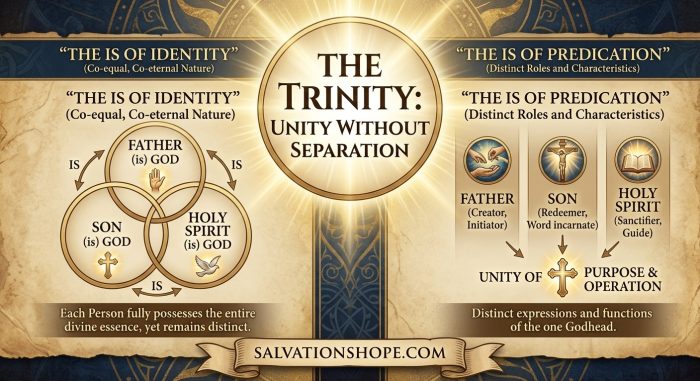
The Is Of Identity And The Is of Predication
One of the arguments that critics (Muslims, Unitarians, etc.) raise against the Trinity deals with the “Is of Identity” and the “Is of Predication.” It states that if the three persons are all identity in nature (Is of Identity) and in all attributes (Is of Predication), then there is no distinction, and the Trinity is false. This argument is virtually identical to another criticism that deals with unity and distinction. Basically, it asserts that the Trinity is impossible because one cannot have a unity of persons who are identical in nature and attributes but are also distinct. That particular criticism is answered in the article The Trinity and Unity in Distinction without Separation.
The answer to this criticism is simple. The three persons of the Trinity share the same divine essence (Is of Identity) but exist in distinction as they relate to one another (Is of Predication). The relationship is found in Scripture, which states that the Father is the One who begets the Son (John 1:14). The Son is the one Who is begotten (John 3:16). The Holy Spirit is the one that proceeds from the Father (John 15:26) (See the Article on the Filioque Controversy). Their distinction is due to their relationship. So they can have the same identity (ontology) and the same predication (attributes) yet retain distinction in their relationship to one another (see Ontological and Economic Trinity). Let’s go a little more in-depth. Is of Identity and Is of Predication. The “Is of Identity” deals with how things are identical. For example, “Clark Kent is Superman.” One is identical to the other. “Fluffy is my cat” would be another example. The “Is of Predication” deals with a quality or attribute of something, for example. “Clark Kent is strong” is ascribing an attribute to Clark Kent: strength. “Fluffy is white” ascribes an attribute to my cat: white. In each case, a quality is assigned to something.
Conclusion
To continue, the “is of predication” infers that the three persons are distinct and separate since each person has predication; that is, attributes of holiness, omniscience, omnipresence, etc. Each person has identical attributes, so each person is identical to the other. If each person is identical to the other, then there is no distinction. If there is no distinction, therefore, the Trinity is false. If God is a Trinity that is one essence (Identity), He cannot also be three distinct persons with identical attributes (predication) because identity (essence) and predication (attributes) are not the same thing.
True, they are not. But that doesn’t mean that the Trinity is false. The Trinity is one Being with three distinct persons who are expressed in their relationship to each other (the Father is the One who begets the Son (John 1:14). The Son is the one Who is begotten (John 3:16). The Holy Spirit is the one that proceeds from the Father (John 15:26). Furthermore, the statement “God is a Trinity” is both the “Is of Identity” and the “Is of Predication.” It is the “Is of Identity” in that it shows what God is, by nature, a Trinity (identity). It also shows that God is Trinitarian and has the characteristics of three persons (predication). The three persons are distinct in their relationship but not their essence or attributes. Therefore, there is no contradiction.