

Deacons: The Seed of All Ministers
Introduction
The Christian church has long recognized the role of deacons as essential to its mission. The term deacon (Greek: diakonos) appears twenty-nine times in the New Testament and is most often translated as servant or minister. This linguistic reality highlights an important truth: diaconal service is not confined to a narrow office but belongs to the identity of every Christian. The very essence of discipleship is marked by servanthood.
Jesus taught His followers, “The greatest among you will be your servant [deacon]” (Matthew 23:11), and “Whoever wants to become great among you must be your servant [deacon], and whoever wants to be first must be your slave—just as the Son of Man did not come to be served, but to serve, and to give his life as a ransom for many” (Matthew 20:26–28; cf. Mark 10:45). Here we see that the King of kings defines His reign not by domination but by diaconal sacrifice. Christ Himself is the ultimate deacon, the Suffering Servant prophesied in Isaiah 53, who embodies perfect service by laying down His life for His people.
The apostles and early church continued this pattern. In Acts 6, when the daily distribution to widows became a source of division, the church appointed seven servants to administer the work so that the apostles could devote themselves to prayer and the ministry of the Word. This was not a demotion of service to “practical matters” but a recognition that the Word and service (diakonia) are inseparably linked in the mission of the church. Paul likewise calls himself a diakonos of the gospel (Colossians 1:23, 25), and commends Phoebe as a deacon of the church in Cenchreae (Romans 16:1). Clearly, the New Testament views deacons not as marginal helpers but as representative servants who embody Christ’s mission. From this foundation, we can make a bold but biblical claim: all ministers are deacons. The very word minister itself derives from diakonos, and every form of Christian leadership flows from the seed of servanthood. Pastors, missionaries, elders, and teachers are not elevated above deacons but rather are deacons who have matured into greater responsibility.
In this sense, elders are mature and educated deacons. Both offices share the same DNA of service, yet the elder’s role expands to include oversight, teaching, and guarding the flock (Acts 20:28; 1 Timothy 3:1–7). What distinguishes the elder from the deacon is not a different nature of ministry but a deeper maturity and a broader scope of responsibility. The seed of all Christian leadership is the diaconal spirit of servanthood, which grows into oversight, shepherding, and governance.
The claim that “all ministers are deacons” is therefore not rhetorical flourish but biblical reality. It means that whether one serves as a deacon in mercy ministries, an elder in teaching and oversight, or a missionary planting churches, the foundation is always the same: “Whoever serves [deacons] must do so with the strength God provides, so that in all things God may be praised through Jesus Christ” (1 Peter 4:11).
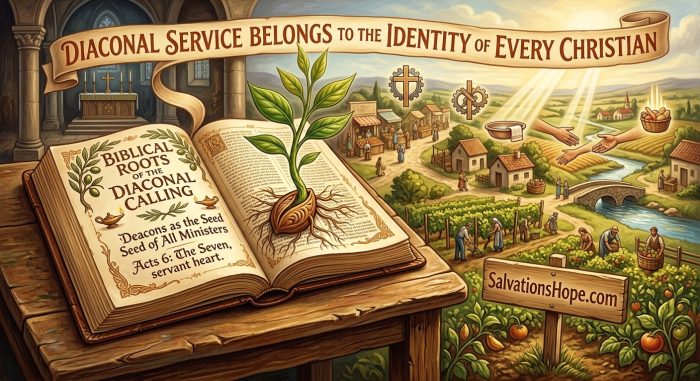
Deacons as the Seed of All Ministers/Biblical Roots of the Diaconal Calling.
The Christian church has long recognized the role of deacons as essential to its mission. The word deacon (Greek: diakonos) appears twenty-nine times in the New Testament and is usually translated as servant or minister.
This repeated use demonstrates that diaconal service is not confined to a specific office but extends to all believers. Every Christian is called to reflect the character of Christ through humble service. Jesus reinforced this truth when He declared, “The greatest among you will be your servant [deacon]” (Matthew 23:11). Greatness in the kingdom of God is not measured by authority, wealth, or prestige, but by willingness to serve. The Christian life is essentially a diaconal life.
Jesus: The Ultimate Deacon: The fullest expression of this calling is found in Jesus Christ Himself. He is described as the Suffering Servant in Isaiah 53 and identifies His mission in profoundly diaconal terms: “For even the Son of Man did not come to be served [deaconed], but to serve [to deacon], and to give his life as a ransom for many” (Mark 10:45).Here, the King of kings defines His reign not by domination but by sacrificial service. Jesus washed His disciples’ feet (John 13:14–15), embodying the servant identity He commands all His followers to adopt. His death on the cross is the supreme act of diaconal ministry—the laying down of life for the sake of others.
The Apostolic Pattern: The early church followed Christ’s model by establishing structures of service. In Acts 6:1–6, when the daily distribution of food caused tension, the apostles appointed seven men to oversee this work. Their service was not merely logistical but profoundly spiritual, preserving the church’s unity and witness. This account shows two important realities:
The ministry of Word and service are inseparably linked.
The apostles devoted themselves to prayer and preaching, but they ensured that practical mercy was faithfully administered. The deacon office formalized what every Christian is called to do—serve. Paul likewise referred to himself as a diakonos of the gospel (Colossians 1:23, 25) and commended Phoebe as a deacon of the church in Cenchreae (Romans 16:1–2). These passages confirm that the word deacon applies broadly—from official roles to the very essence of Christian ministry.
Elders as Mature and Educated Deacons: While the New Testament distinguishes between elders (or overseers) and deacons, the difference is not one of essence but of maturity and scope. Both roles are grounded in the same spirit of servanthood.
Deacons: serve by meeting tangible needs, fostering unity, and embodying mercy.
Elders: serve by teaching, overseeing, guarding the flock, and exercising spiritual authority (Acts 20:28; 1 Timothy 3:1–7; Titus 1:5–9).Elders, then, may be described as mature and educated deacons. They are those who have grown in faith, been tested in character, and entrusted with broader responsibility. The qualifications for elders and deacons in 1 Timothy 3 overlap significantly, reinforcing that eldership grows out of the diaconal seed.
All Ministers Are Deacons: The English word minister itself comes from the Latin minister, meaning servant. This parallels the Greek diakonos. Whether one serves as a deacon, elder, pastor, missionary, or chaplain, the essence of ministry is the same: to serve as a deacon of Christ. Paul: “I became its servant [deacon] by the commission God gave me to present to you the word of God in its fullness” (Colossians 1:25).Phoebe: “I commend to you our sister Phoebe, a deacon of the church in Cenchreae” (Romans 16:1).Peter: “Each of you should use whatever gift you have received to serve [deacon] others, as faithful stewards of God’s grace in its various forms” (1 Peter 4:10).Thus, ministry is not an escape from servanthood but a deepening into it.
The seed of all Christian leadership is the diaconal spirit of servanthood.
Contemporary Application: Recovering the Diaconal Church:
One of the greatest critiques against the church today is Judgmentalism and Hypocrisy. Surveys reveal that many have left the church not because of Jesus Himself, but because His body has failed to embody servant-hearted love. A recovery of the deacon identity of all Christians offers the antidote. The early church grew not because it had polished programs but because it overflowed with service: caring for widows, rescuing abandoned children, visiting the sick, and feeding the poor. The world saw Christ in the diaconal life of His people. Today’s elders and leaders must remember: they are not CEOs or managers, but servants who set the tone for the entire church’s calling to be a community of deacons.