

Qualified Christian Leaders and Ordination
Introduction
2 Timothy 2:15: "Do your best to present yourself to God as one approved, a workman who does not need to be ashamed and who correctly handles the word of truth.
"When you apply for a job, a job description is usually posted. The purpose of the job description is to describe the duties and qualifications of the job. Often those qualifications ask for previous experience and training awards. Employers want to know your experience and your study areas. They also want to know if you completed a study program. Employers look for character qualifications when someone gets an interview for a job.
In the early church, most positions were voluntary, but the Apostle Paul laid out qualifications for leadership positions. These qualifications did not focus on any specific role in the church. They focused on character. The leaders needed to be those who walked with God and displayed the fruits in their lives. Paul gives these qualifications in 1 Timothy 3.
Traditionally, these qualifications are applied to official church leaders, and I like that. But I want to challenge students who are called to any enterprise to aspire to these expectations. If you are coming out of a difficult past, these expectations will transform your life if you live them. If you are called to be a Christian business leader, these qualifications will help keep you safe from behavior that will discredit you. Married, you will thrive more in your loving commitment to your spouse.
Christians who practice these qualifications out of faith will be effective in their personal life, family life, church life, and businesses or jobs. If someone is called into formal ministry, these qualifications are launching you to effectiveness! Let me explain more about the early church's offices and leadership positions. You will be amazed at how practical they are today for any Christian Leader in any enterprise.
Qualifications for Credentialed Leaders in the Early Church:
The early church credentialed the leaders of their religious society. They were given mentoring and training. We read in the book of Acts about the lecture hall of Tyrannus, where discipleship and ministry training happened for two years. Acts 19:9-10. He took the disciples with him and had discussions daily in the lecture hall of Tyrannus. This went on for two years so that all the Jews and Greeks who lived in the province of Asia heard the word of the Lord. In 1 Timothy 3 and Titus 1, the apostle Paul gives us the qualifications for credentialed ministers. He specifically refers to the episcopates (ἐπισκοπῆς) and deacons (Διακόνους).
These words have much written about them connected to specific religious societies or traditions. There is another word that also gets thrown into the mix as well. This other word, πρεσβυτέρος, appears 67 times in the New Testament, it usually refers to mature or older ones. This word is often translated as "elder."
In Titus 1, we read, Τούτου χάριν ἀπέλειπον σε ἐν Κρήτῃ, ἵνα τὰ λείποντα ἐπιδιορθώσῃ καὶ καταστήσῃς κατὰ πόλινπρεσβυτέρους, ὡς ἐγώ σοι διεταξάμην, "I left you in Crete for this reason, that you would set in order the things that were lacking, and appoint elders in every city, as I directed you."
Paul says that when you appoint leaders in Crete, ensure they are tested and mature leaders. This maturing included spiritual testing, ministry training, and life experiences. Do not be hasty in the laying on of hands. (1Timothy 5:22)
Make sure leaders appointed to the credentialed offices of the church are not only called and desire to do the work but are also ready to serve. Episcopates (ἐπισκοπῆς) and deacons (Διακόνους)need to be ready.
A Relationship with God – The Real Spiritual Dream
We have asked this question hundreds of times in various parts of the world: “What is your spiritual dream?
”How would you answer it? Take a moment to stop reading and think about the question. Get a sheet of a paper and take three or four minutes to jot down some ideas. There is something powerful about this question because many people think of their spiritual state as a yes-or-no kind of question: Either I am religious or irreligious. Either I am trying to pursue God or I don’t really believe in him. Either I am in the kingdom of God or in the kingdom of this world.
To be able to name a spiritual dream means that you have purpose and direction, something to strive for and something to live for. “What do you mean by spiritual?” most people ask, and we tell them to define it however they want. What are the hopes, ambitions, goals, and dreams you have for your life that are going to fulfill you on a deeper level?
By now most people have an idea of what we are after, but are stumped by how to answer. We are not often taught to dream in a spiritual sense. What’s more, if we define for ourselves a dream, then we have a certain obligation to fulfill it. Sometimes people are wary about speaking a dream out loud because often they know they have done nothing really to pursue it. How about you? Have you come up with a dream yet?
“If you could have anything in the world.”
Once people get talking, we find it amazing how people give such very similar answers to this question. Most every answer falls into two categories: Some will give an answer concerning their understanding of God. I have heard of answers like, “I want to be close to God,” or “I want to be filled with the Holy Spirit even more.” Some will say things like, “I want to be one with the whales.” Although this is not strictly a God answer, a person who answers this way still has an inner prompting toward worshiping something beyond himself or herself. Some will give answers concerning their relationships with people.
I have heard of answers like, “I just want my kids to know God,” or “I want to fight for my cause.” One person told us he wanted to give down-and-out children boat rides paid for by the government. These answers are almost always about benefiting a specific person or a broad group of people.
Most spiritual dreams are in some way connected to worshiping a higher being and showing love to other people. It is interesting because the way most people actually live out their lives is to benefit themselves and enrich their own standing, but the moment they are asked to pay attention to their spiritual side, they gravitate toward looking outside of themselves.
We like to start out with this question about spiritual dreams because it places on the table two important desires that the average person has not fulfilled: connection with God and connection with people. We do not need to convince a person that he or she needs to have a spiritual life, because the person has just told us so in his or her own words. Suddenly the nice car and nice house aren’t quite as adequate a safeguard from needing something more.
Jesus of Nazareth taught that true fulfillment comes through a relationship with God your creator and through loving the people of this world. That’s what the Christian life is all about—living out our spiritual dreams of worshiping the God of the universe and giving of ourselves to our friends and neighbors: One of the teachers of the law came and heard them debating. Noticing that Jesus had given them a good answer, he asked him, “Of all the commandments, which is the most important?”
“The most important one,” answered Jesus, “is this: ‘Hear, O Israel, the Lord our God, the Lord is one. Love the Lord your God with all your heart and with all your soul and with all your mind and with all your strength.’ The second is this: ‘Love your neighbor as yourself.’ There is no commandment greater than these.” (Mark 12:28-31 NIV)God instilled in us our spiritual dreams, and he taught us how to pursue them by revealing himself as the one true God who deserves our worship and by revealing that every person we meet is a neighbor who deserves our love and attention.
Many have rejected this call because it is too difficult. It can be easier to pop in a CD of whale calls or to throw money at a social program and pretend you are fulfilling a deeper connection. It feels like you have more control. What God asks of us is to give up control, to submit ourselves to the law of love—and through pursuing our dreams by His means rather than our own, we will find real fulfillment.
The Seven Connections
Connection One: You and God:
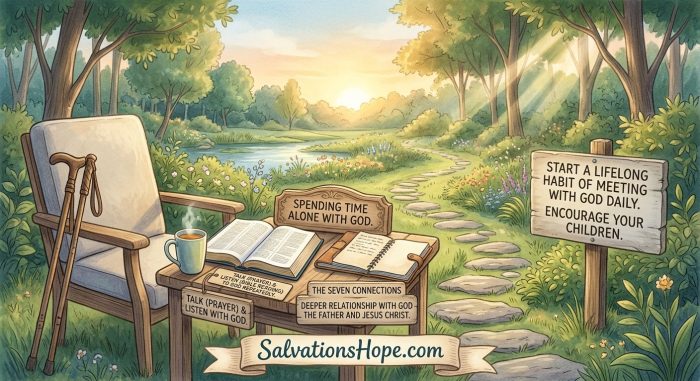
The discipleship practice of spending time alone with God gives each of us an opportunity to talk (prayer) and listen (Bible reading) to God repeatedly. Talking and listening repeatedly leads to a deeper relationship with God the Father and Jesus Christ. Encourage your children to start a lifelong habit of meeting with God daily.
Connection Two: You and Your Spouse:
Connecting with your husband or wife on a spiritual level builds a strong relationship for the two of you. Relationships are built with constant communication. God creates a special oneness and "connectedness" in marriage when a husband and wife meet with Him together.
Connection Three: You and Your Family:
One of our home discipleship practices includes having a family worship time every day for at least 15 minutes. This includes reading the Bible together, practicing a memory verse together and singing. Establishing these habits together goes a long way toward passing on your faith and values to your children and encouraging them to have lifelong habits of building a relationship with God.
Connection Four: Your Family with Others:
Connections outside your family create a sense of community and fellowship. God created us to need each other for encouragement and accountability. Practicing the habit of hospitality helps us reach out and connect with other individuals and families.
Connection Five: You and Your Church:
Worshiping together builds our relationship with God and each other. The church service is the celebration of the daily listening and talking with God and with one another that has occurred at home, at school, or at work during the week. It is a time to celebrate how God has been with you and those you know. Church gatherings provide support and encouragement to like-minded people who are trying to grow in their relationship with God and the people in their lives.
Connection Six: You and the Kingdom:
As a Christian, you are part of a worldwide family of faith that honors the God of the Bible as King. Families and individuals need habits in their lives that connect them to Christians all over the world – past and present. God's people connect to the Christian past through understanding church history and singing hymns. God's people connect today through the habits of prayer and giving for each other's needs.
Connection Seven: You and the World:
As we are experiencing closer connection to God in our lives, we will naturally want to share with others who are struggling in their connection to God and others. As God's ambassadors, we invite others to seek a relationship with Christ. Evangelism is about helping the unchurched or non-believers to begin their quest of faith by reading the Bible and praying as their first seeking moments. Our outreach includes seeing and meeting the spiritual and physical needs of the unbelieving world. God has called Christians to build bridges to the world.