
A Testament Born
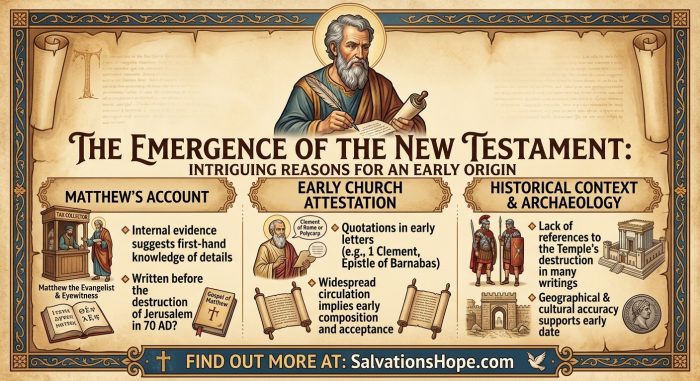
Could Matthew Take Shorthand?
Ink, Dust, and Eyewitnesses: The Historical Reliability of the Gospels
"But Jesus bent down and started to write on the ground with his finger” (John 8:6).
For generations, biblical scholarship has often been shadowed by a skeptical hypothesis: the idea that the life and teachings of Jesus floated through decades of fluid, unwritten oral tradition—a game of ancient telephone where legends multiplied before anyone finally put pen to papyrus. However, a deeper look into the historical, linguistic, and material realities of first-century Palestine shatters this narrative. God, in His sovereign providence, prepared a culture uniquely equipped to record, preserve, and transmit the words of His Son with astonishing precision and immediacy.
A Literate Culture and a Writing Savior
We catch a subtle yet profound glimpse of this reality in the Gospel of John, during the confrontation over the woman caught in adultery. When Jesus stoops down and writes in the dust (John 8:6), we are reminded of a fundamental truth: Jesus knew how to write. While He was primarily a Rabbi and a teacher—leaving the systematic composition of His life and ministry to His followers—literacy was not an elite luxury reserved for a tiny scribal class in ancient Israel.
The ability to read, write, and comprehend complex texts was far more widespread than modern assumptions suggest. Alongside a culture that mastered the art of oral memorization—capable of retaining long, intricate theological discourses verbatim—the ordinary Israelite lived in a world where literacy was woven into the fabric of daily life. Jesus could confidently operate knowing that His disciples possessed the intellectual capacity not only to memorize His parables and beatitudes, but to anchor them in ink.
The Multilingual Mosaic of First-Century Judea
The communicative landscape of Jesus’ ministry was remarkably dynamic, spanning three distinct languages, each serving a unique sphere of life:
- Aramaic: The primary vernacular of daily life, commerce, and intimate conversation among the common people of Judea and Galilee.
- Hebrew: The sacred language of religious life, preserved for the reading of the Torah and Prophets in the synagogues and liturgical worship (e.g., Luke 4:16–30).
- Greek: The global lingua franca of the eastern Roman Empire.
Recent archaeological discoveries—such as bilingual tombstone inscriptions and handwritten correspondence unearthed in places like the Masada fortress—reveal that even orthodox, devout Jews used Greek in everyday interactions. Jesus Himself engaged this multilingual reality. We see Him conversing fluently with the Greek-speaking Syrophoenician woman (Mark 7:24–30), and utilizing pointed Greek wordplay during the tense theological dispute regarding paying taxes to Caesar (Mark 12:13–17).
The Art of the Scribe: Shorthand and the Call of Matthew
Writing materials in antiquity were precious commodities. High-grade leather and parchment were costly, and imported papyrus was scarce. Consequently, writers were frequently forced to improvise, utilizing broken pottery shards (ostraca) or wax tablets with severely limited surface area. To capture prolonged teachings in such an environment, an advanced administrative skill was required: tachygraphy, or shorthand writing.
“My tongue is the pen of a skillful writer” — literally rendered from the ancient Greek translation of Psalm 45:1 as “a stenographer.”
The existence of shorthand in the Greco-Roman world provides a fascinating window into how the Gospels may have been recorded. And remarkably, Jesus called precisely the right man for this task into His inner circle.
Levi-Matthew, the despised tax collector (telones), was professionally trained in record-keeping, documentation, and swift administration. If Matthew had encountered or heard portions of Jesus’ ministry—such as the Sermon on the Mount—before his dramatic conversion, his immediate and decisive response to follow Jesus makes profound historical sense. He was uniquely qualified to act as a swift, precise recorder, meaning that the rich theological architecture of Matthew 5 through 7 may well trace back to an eyewitness shorthand protocol captured in real time.
Eyewitness Reliability and Divine Providence
Even if the exact editorial reconstruction of every early notebook remains shrouded in history, the New Testament itself points to an immediate literary ecosystem surrounding the early church. In the prologue to his Gospel, Luke explicitly acknowledges this rich foundation of early documentation:
"Many have undertaken to draw up an account of the things that have been fulfilled among us, just as they
were handed down to us by those who from the first were eyewitnesses and servants of the word." (Luke 1:1–2)
Luke did not rely on late, mythological legends; he drew from a deep well of existing eyewitness accounts, contemporary notes, and early written traditions that began during the very days of Jesus’ earthly ministry.
Ultimately, historical scholarship converges with biblical theology: the transmission of the Gospel was neither delayed nor vulnerable to decades of unvarnished distortion. God orchestrated a time when literacy was accessible, languages bridged cultures, and skilled disciples stood ready with pen and scroll. The Gospels we hold today are rooted in the solid, verifiable ground of historical eyewitness testimony, penned by those who walked, heard, and wrote down the life-changing words of the Savior.
Christian Libraries
Early Christians soon gathered such writings. They were profoundly interested in the literary world. Occasionally, they talk about it with humor: "Jesus did many other things as well. If every one of them were written down, I suppose that even the whole world would not have room for the books that would be written” (John 21:25). Or they ask for writing material: "When you come, bring the cloak that I left with Carpus at Troas, and my scrolls, especially the parchments” (2 Tim. 4:13). Or they are seen in the process of writing: "Write on a scroll what you see and send it to the seven churches” (Rev. 1:11).So well acquainted were they with a literary tradition, literature was used in symbolic ways: "The sky receded like a scroll, rolling up . . . ” (Rev. 6:14).
This advanced interest in writing had an obvious consequence: texts had to be collected in archives and libraries, and even in stores from which copies could be ordered and supplied. Christians from a Jewish background would have known the collected scrolls of the Torah, the Prophets, the Psalms, and so forth. Those of Greco-Roman background would have known the collections of philosophers and poets like Aratus, Cleanthes, Menander, Euripides, and others, to which Paul alludes in his letters and speeches.
The discovery of the Dead Sea Scrolls helps us to understand how Jews and Jewish Christians organized their libraries. There were three types of books: copies of Holy Scripture (what we now call the Old Testament), commentaries on Scripture, and theological writings.
For Christians, the first Scriptures they thrived on were the Law and the Prophets. These were copied and distributed since they provided the sources for one vital ingredient of the Christian message: the suffering and redemption of Jesus the Messiah had been predicted many centuries earlier.
The Ink of Faith: How the Early Church Embraced the Written Word
From its very inception, the Christian movement was uniquely tethered to the written word. Far from being a purely oral phenomenon that only later transitioned to ink and parchment, early believers stepped directly into a rich, vibrant literary world. They did not merely tolerate literature; they collected, studied, debated, and treasured it as an indispensable vehicle for divine truth.
1. A Culture of the Scroll and the Pen
The New Testament itself bears witness to an early Christian culture deeply preoccupied with texts, reading, and writing. The writers and recipients of these documents operated in a society where scrolls and codices were prized commodities.
We see this preoccupation expressed in various ways throughout the apostolic writings:
- With hyperbole and wonder: The Apostle John concludes his Gospel with a vivid literary exaggeration:"Jesus did many other things as well. If every one of them were written down, I suppose that even the whole world would not have room for the books that would be written." (John 21:25)
- With practical urgency: The Apostle Paul, shivering in a Roman dungeon, urgently requests his companion to bring intellectual and spiritual sustenance:"When you come, bring the cloak that I left with Carpus at Troas, and my scrolls, especially the parchments." (2 Tim. 4:13)
- With prophetic command: John is instructed on the island of Patmos:"Write on a scroll what you see and send it to the seven churches." (Rev. 1:11)
So thoroughly acquainted were early Christians with this literary tradition that literature itself provided rich symbolic imagery for cosmic events, as when John writes, “The sky receded like a scroll, rolling up . . .” (Rev. 6:14).
2. Converging Heritages: The Jewish and Greco-Roman Literary Worlds
This advanced interest in writing had an inevitable logistical consequence: texts had to be systematically collected, organized in archives and private libraries, and copied for distribution. Early believers inherited and synthesized two distinct literary streams:
- The Jewish Heritage: Believers from a Jewish background were already steeped in the collected scrolls of the Law (Torah), the Prophets (Nevi'im), and the Writings (Ketuvim), recognizing them as the breathing Word of God.
- The Greco-Roman Heritage: Believers and interlocutors from a Hellenistic background were familiar with classical philosophy and poetry. Paul himself brilliantly navigates this world, famously alluding to Greco-Roman poets and philosophers such as Aratus, Cleanthes, Menander, and Euripides in his letters and public speeches to bridge the gap for pagan audiences.
3. The Architecture of Early Libraries
Discoveries like the Dead Sea Scrolls at Qumran offer profound historical insight into how ancient Jewish communities—and by extension, early Jewish-Christian communities—organized their libraries. Archaeological and textual evidence reveals that these libraries generally categorized literature into three distinct buckets:
- Copies of Holy Scripture: The foundational, authoritative texts of the Law and the Prophets.
- Scriptural Commentaries: Works designed to interpret how ancient prophecies applied directly to the current generation.
- Theological and Community Writings: Rules, hymns, and treatises defining the community's identity and eschatological hope.
This tripartite framework provides a clear window into how the early Church began to organize its own burgeoning literature—setting the Old Testament alongside the unfolding apostolic witness of the Gospels and Epistles.
4. The Foundation: Anchoring the Messiah in Prophecy
For the earliest Christians, the primary scriptures they lived and thrived on were the Law and the Prophets. These texts were painstakingly copied and distributed across the Mediterranean world for a vital theological reason: they provided the objective, verifiable proof that the suffering, death, and resurrection of Jesus of Nazareth were not accidental tragedies, but the fulfillment of divine redemption orchestrated centuries beforehand.
By anchoring the Gospel in written prophecy, the early Church ensured that faith was not built on clever myths, but on the historic, verifiable convergence of God’s written word and God’s living Word, Jesus Christ.
Anchored in History: The Reliable Origins of Our Fourfold Gospel
For the believer, the Gospels are not merely ancient literature; they are the life-giving breath of God, preserving the earthly ministry, crucifixion, and resurrection of Jesus Christ. Yet, a common skepticism often suggests that the Gospels were written centuries after Christ, subject to endless rewrites, political editing, and the addition of late, fanciful myths.
Modern historical scholarship—grounded in rigorous manuscript evidence and early church history—tells a profoundly different story. Far from being late inventions, the four canonical Gospels were recognized, named, and cataloged with astonishing proximity to the events themselves.
1. The Scroll and the Tag: How the Gospels Received Their Names
To understand how the early church managed and identified their sacred texts, we must step back into the ancient world of the first century. Unlike modern books, which proudly display titles and authors on their spines, ancient texts were preserved on scrolls.
World-renowned New Testament scholar Martin Hengel of Tübingen University illuminated a fascinating piece of ancient library mechanics that sheds light on this process. When scrolls were stored vertically in jars or pigeonholes, an observer would only see the top handle of the scroll. To identify what was inside, ancient scribes attached small parchment or leather strips called sittibos to the handle.
- The Single-Gospel Era: Initially, when only one account of Jesus' life circulated within a specific community, a simple label sufficed: Euangelion, meaning "Good News" or "Good News of Jesus Christ."
- The Multi-Gospel Necessity: The moment a second Gospel arrived in a community, a system of differentiation became an absolute necessity. To avoid confusion, scribes had to specify which Euangelion was being read, leading immediately to designations like "according to Matthew" and "according to Mark."
Because the church rapidly shared and collected these accounts, this systematic cataloging of authors occurred long before the end of the first century. The multiplicity of the accounts drove the early church to codify authorship with precision from the very beginning.
2. The Early Witnesses: Papias and the Apostolic Bridge
By the dawn of the second century, the four Gospels and their apostolic authors were already firmly established across the Mediterranean. Our earliest literary window into this reality comes from Papias, Bishop of Hierapolis, writing around A.D. 110.
Papias’s writings destroy the myth that alternative, gnostic texts (such as the Gospels of Thomas, Nicodemus, or James) held equal weight in the early church. Those late, sectarian writings simply did not exist yet. Instead, Papias demonstrates an intimate knowledge of the canonical Gospels, passing along fascinating, eyewitness-adjacent details about their composition:
- Mark as Peter’s Interpreter: Papias notes that Mark served as the hermeneutes (interpreter, translator, or editor) of the Apostle Peter, faithfully recording the eyewitness testimony of the chief apostle. Papias even records an affectionate, colorful description of Mark as "stubble-fingered" (perhaps referring to physical clumsiness or handwriting quirks).
- Matthew’s Compilation of Sayings: Papias records that Matthew compiled the logia (sayings and deeds of Jesus) in a Hebrew or Aramaic style/dialect, preserving the foundational public addresses of our Lord right from the source.
Papias’s testimony proves that a recognized, authoritative collection of Gospels was already circulating at the turn of the century—pointing backward to an even earlier apostolic origin.
3. Unlocking the Timeline: Irenaeus and the Dating of Mark
As the second century progressed, the church continued to formalize its collective witness. Around A.D. 180, the church father Irenaeus provided the earliest explicit listing of the four Gospels in the exact order we hold today: Matthew, Mark, Luke, and John.
Irenaeus also offered a crucial historical marker, noting that Mark’s Gospel was written after the “exodus” of Peter and Paul. For generations, critics debated this timeline, assuming the Greek word exodus meant “death,” thereby dating Mark’s Gospel to around A.D. 67—the traditional year of the apostles’ martyrdoms in Rome.
However, a breakthrough by American scholar E. Earle Ellis revolutionized this understanding. Ellis exhaustively analyzed every single writing of Irenaeus and discovered a vital linguistic truth: Irenaeus never used the word exodus when he meant death. When referring to death, Irenaeus invariably used the unequivocal Greek word thanatos.
“Thus, Mark’s Gospel was likely written not after the deaths of Peter and Paul, but after their temporary departure from Rome—pushing the composition of Mark back to an even earlier date in the mid-60s or late 50s.”
The Theological Assurance of God's Providence
What does all of this mean for the modern Christian? It means our faith is anchored in real history, verified by textual markers, ancient library practices, and early church testimony.
God did not leave the transmission of the Good News to chance or late-century myth-makers. Through the careful oversight of the early Christian communities, the testimony of eyewitnesses like Peter and Matthew, and the meticulous preservation of scrolls and tags, the Holy Spirit guided the church to securely preserve the life and teachings of Jesus Christ. We can open our Bibles today with absolute confidence that we are reading the authentic, historically grounded Word of God.
The Tapestry of Truth
How the Early Church Recognized the Voice of the Shepherd
When we hold a modern Bible in our hands, it is easy to assume that the 66 books were bound together and handed down from the sky as a finished product right after the ascension of Christ. However, the historical reality of how the New Testament canon came to be is a profound testimony to the providence of God working through the living, breathing, and sometimes messy history of the early Christian communities.
Understanding this history does not weaken our faith in Scripture; rather, it deepens our appreciation for how the Holy Spirit guided the Church through regional isolation, theological threats, and human choices to preserve the infallible Word of God.
Regional Roots and the Journey of 2 Peter
In the first and second centuries, local churches lived in a vastly different communication landscape than we do today. There were no printing presses, digital archives, or instant mail systems. Letters circulated by hand, traveling along Roman roads from one fellowship to another.
Consequently, early Christian communities had their favorite texts, and many writings remained localized for decades. A striking example of this is Second Peter. For much of its early history, this letter was read almost exclusively in its original target area of northern Asia Minor.
- The Witness of Clement: Clement of Rome is the earliest known author to quote from 2 Peter around A.D. 96, but communities elsewhere in the Roman Empire had simply not heard of it yet.
- The Test of Apostolic Scrutiny: When copies finally reached other regions, believers rightly exercised caution. Some communities expressed doubts about its apostolic authorship, demanding proof that it belonged in the body of authoritative apostolic writings.
- The Voice of Antiquity: Over time, rigorous theological examination prevailed. By the third century, great scholars like Origen defended its authenticity, famously noting that the Apostle Peter had proclaimed the gospel of Christ on “the twin trumpets of his two letters.”
This rigorous vetting process demonstrates that the early Church was not gullible; they took the task of identifying authentic apostolic witness with profound seriousness.
The Unique Voices of the Gospels: Mark and Matthew
The formation of the Gospels reveals a similar dynamic of human history intersecting with divine purpose. Historical evidence suggests that Mark’s Gospel was likely the first full narrative account of Jesus’ life ever completed. Yet, because of how manuscripts were copied and distributed, it did not immediately achieve the sweeping popularity of other accounts.
Instead, Matthew’s longer, richly structured Gospel—with its extensive discourses and deep Jewish context—quickly captured the imagination of the early Christian communities. This is why we possess significantly more early manuscript fragments of Matthew than we do of Mark.
This variance does not point to a flaw in transmission, but rather to the pastoral needs of different congregations. God inspired four distinct Gospel accounts, each tailored to highlight different facets of the glory of Christ, allowing the Church to experience the life of Jesus through a multifaceted lens.
The Crisis of Canon: Marcion and the Defense of Orthodoxy
As the decades progressed, the decentralized nature of the early Church invited human error, and sometimes, intentional distortion. The proliferation of various Christian writings made it inevitable that some would attempt to curate the collection to fit their own theological agendas.
The most dangerous of these early revisionists was Marcion, a shipowner and teacher who arrived in Rome around A.D. 140. Marcion developed a deeply flawed, dualistic view of God, contrasting the “harsh” Creator God of the Old Testament with the “loving” God revealed by Jesus.
To fit his theology, Marcion took a redactor’s pen to the nascent Christian writings, purging anything that contradicted his worldview:
- Rejection of Jewish Roots: He systematically stripped away any connection between Christianity and its Hebrew foundations, rejecting the entire Old Testament.
- Denial of the Physical Resurrection: He dismissed texts that emphasized Christ's physical resurrection and bodily reality.
- The Mutilated Canon: In the end, Marcion accepted only a severely edited version of Luke's Gospel—surgically removing the Nativity narratives and detailed resurrection appearances—alongside ten heavily edited letters of Paul.
The Church's Response
Marcion’s aggressive editing forced the early Church to move from an implicit trust in apostolic tradition to an explicit, formalized definition of the canon. Church leaders quickly recognized Marcionism for what it was: a destructive heresy that severed the gospel from history. Marcion and his followers were formally condemned, and their movement eventually faded into history.
However, the crisis left a permanent, positive legacy: it catalyzed the universal Church to accelerate its work of defining, testing, and universally recognizing the true apostolic writings that preserved the full, unvarnished truth of the incarnation, crucifixion, and physical resurrection of Jesus Christ.
The Theological Assurance for Believers Today
When we look back at the historical journey of the New Testament—the regional delays of letters like 2 Peter, the varying popularity of the Gospels, and the existential threat of Marcion’s heresy—we do not see a chaotic accident.
Instead, we see divine providence at work. God preserved His Word not by magically dropping a leather-bound book from heaven, but by walking with His Church through every debate, every regional border, and every theological defense. The canon we hold today is a testament to a Church that wrestled deeply with the text, tested its authenticity by the Holy Spirit, and ultimately preserved the unchanging truth of the Gospel for every generation to come.
Embracing the Tapestry
How God Guided the Formation of the New Testament Canon
When we open our Bibles to the New Testament, we hold in our hands a volume of twenty-seven distinct documents. For many believers, the Bible feels static and absolute—as though it dropped straight from heaven bound in leather. Yet, historical reality reveals a far more dynamic, deeply human, and profoundly providential process. The formation of the New Testament canon was not a matter of ecclesiastical politicians stamping books with arbitrary authority, but a centuries-long journey of the Holy Spirit guiding the global body of Christ to recognize His inspired voice.
The Catalyst of Crisis: Marcion and the Multi-Voiced Witness
Every major theological development in church history seems to be born out of a crisis, and the canon is no exception. In the mid-second century, a radical teacher named Marcion of Sinope shook the early church. Marcion constructed his own truncated “Bible,” rejecting the entire Old Testament and editing down a heavily censored version of Luke’s Gospel alongside selected Pauline letters, all driven by a hostile view of the Creator God of Israel.
While Marcion’s motivation was deeply misguided, his heresy acted as an indispensable catalyst. It forced the early church to move from an implicit, unwritten consensus to an explicit, formal consideration of which texts authentically belonged together.
In this process of reflection, the church firmly resisted the temptation to “harmonize” the documents into a single, flattened narrative (a temptation famously attempted by Tatian with his Diatessaron). Instead, the church preserved:
- Distinct Theological Emphases: Matthew, Mark, Luke, and John were never seen as an embarrassing multitude with conflicting details.
- Complementary Perspectives: They were embraced as the God-given fullness of reports delivered by human authors operating with their unique individualities, styles, and theological goals.
- Unedited Integrity: Rather than erasing differences to create a uniform story, the church celebrated the diverse, multi-faceted witness to the life, death, and resurrection of Jesus Christ.
The Brilliance of Complementarity: Embracing Tension Rather Than Uniformity
Early Christians were remarkably perceptive readers. They did not read the growing corpus of sacred literature with blinders on; they engaged the texts with rigorous intellectual honesty and spiritual discernment.
Consider the literary relationship between the Epistle of Jude and 2 Peter. Early Christian readers noticed that Jude had incorporated large portions of 2 Peter (or vice versa). Rather than viewing this literary borrowing with modern suspicions of plagiarism, they recognized it as an authentic window into how apostolic traditions, warnings, and applications were shared and contextualized during the foundational generations of the church.
Likewise, the tension between Paul and James was recognized long before Martin Luther pointed it out.
- Paul emphasizes justification by grace through faith, fiercely guarding the gratuitous nature of salvation against legalism.
- James stresses the vital importance of works, fiercely guarding the living reality of faith against moral complacency.
Rather than pitting the apostle of grace against the brother of our Lord in a contradictory duel, early Christians chose to view these themes as deeply complementary. Paul guards the root of salvation, while James guards its fruit. This principle of “unity in diversity” became the enduring yardstick applied to the burgeoning collection that would become our New Testament.
The Long Process of Discernment: Codices, Councils, and the Margins of the Canon
As decades passed, the church faced a pressing logistical and theological question: Where do we draw the line? How extensive should this diverse collection finally be? Which books and letters should be read aloud in liturgical gatherings and treated as the final rule of faith and practice?
At the fringes of the emerging canon sat several beloved second-century writings, such as the Didache, the Letter of Barnabas, the Shepherd of Hermas, and the early letters attributed to Clement of Rome.
Writing at the dawn of the fourth century, the church historian Eusebius of Caesarea surveyed the landscape. He largely confirmed the boundaries found in earlier snapshots, such as the fragmentary Muratorian Canon (dating back to around A.D. 200). Eusebius noted that while some books—such as James, Jude, 2 Peter, 2 and 3 John, and Revelation—were still subject to localized debate in certain regions, he was adamant that texts like the Shepherd of Hermas, the Apocalypse of Peter, the Acts of Paul, and the Didache were “not genuine” in terms of apostolic origin.
The archaeological record of the fourth century captures this transitional fluidity:
- Codex Vaticanus: A magnificent Greek Bible containing the complete New Testament as we know it today.
- Codex Sinaiticus: Produced around the same era, yet still incorporating the Letter of Barnabas and the Shepherd of Hermas alongside the canonical books.
- Codex Alexandrinus: Dating slightly later, this codex excluded Hermas and Barnabas, but included the two letters of Clement instead.
These major, high-cost official codices demonstrate that even into the fourth century, there was a degree of regional freedom at the absolute margins of the collection. The closure of the canon was a gradual settling of dust, culminating in broad ecclesiastical consensus driven by the internal authority of the texts themselves.
A Gift Trusted Across the Ages
The formation of the New Testament canon is a testament to the sovereign, guiding hand of God working through human history, debate, and scholarship. The church did not create the authority of the New Testament books; rather, it recognized the inherent, self-authenticating power of the writings left behind by the apostles and their immediate associates.
By preserving the rich diversity of the four Gospels, honoring the complementary voices of Paul and James, and carefully filtering out peripheral writings lacking apostolic roots, the early church bequeathed to us a sacred library. It is a canon defined not by rigid uniformity, but by a magnificent, Holy Spirit-inspired unity in diversity—a reliable and living anchor for the Christian faith.
The Anchor of Truth
How the Church Recognized the New Testament Canon
For the believer today, holding a completed Bible in one’s hands is a daily comfort. Yet, the path by which these twenty-seven distinct documents were recognized, gathered, and unified as the definitive New Testament canon is a testament to the sovereign providence of God guiding His Church through history. Far from a political decree manufactured by imperial force, the canon emerged through a profound consensus of worship, pastoral discernment, and historical witness.
Athanasius and the 39th Festal Letter (367 AD)
A pivotal milestone in this journey occurred in the spring of 367 AD. Athanasius, the steadfast Bishop of Alexandria, utilized his annual Easter Festal Letter—written to shepherd the churches and monasteries under his care—to address a rising tide of confusion regarding sacred writings.
Within this letter, Athanasius explicitly enumerated the exact twenty-seven books that comprise our New Testament today. Describing these texts with pastoral warmth and theological precision, he wrote:
“These are the ‘springs of salvation,’ so that anyone who is thirsty may be satisfied with the messages contained in them. Only in them is the teaching of true religion proclaimed as the ‘Good News.’ Let no one add to these or take anything away from them.”
Athanasius recognized what the Church had long sensed: these apostolic writings possessed a self-authenticating power, rooted directly in the eyewitness testimony of the Apostles and their close companions.
Edification Versus Authority: The Status of Early Writings
In the same letter, Athanasius provided vital nuance regarding other widely read Christian literature of the early centuries. He noted that works like the Shepherd of Hermas and the Teaching of the Apostles (the Didache)—though deeply cherished and spiritually edifying—were not part of the canonical scriptures.
- The Didache: A priceless early manual on Christian ethics, church order, and liturgy.
- The Shepherd of Hermas: An apocalyptic text focused on repentance and moral renewal.
Athanasius did not dismiss these books as useless; rather, he recommended them as helpful reading for new converts seeking grounding in the faith. However, he drew a sharp, immovable boundary line: historical edification is not the same as canonical authority. Only the apostolic writings carried the definitive, rule-of-faith weight required to anchor universal Christian doctrine.
The March Toward Consensus: Unity Amid Diversity
Athanasius’s declaration did not instantly erase every regional variation across Christendom. The ancient world was vast, and communication was slow. For instance:
- Decades after the Festal Letter, manuscripts like the Codex Alexandrinus occasionally still included extra epistles or early texts alongside the standard canon.
- As late as 414 AD, the brilliant scholar and translator Jerome mused in a letter that the Letter of Barnabas deserved a place in the New Testament, given that its author was closely associated with the Apostle Paul.
Crucially, however, Jerome demonstrated a profound posture of ecclesiastical humility. Despite his personal scholarly opinion regarding Barnabas, he ultimately submitted to the broader consensus that had already taken root across the universal Church. Jerome’s acceptance confirmed a vital reality: by the dawn of the fifth century, the New Testament canon possessed a solemn, unshakable status. It was recognized as a closed corpus that individual speculation could no longer alter.
Approved by History, Tradition, and Worship
The stabilization of the twenty-seven books was not enforced from the top down by a single council; rather, it bubbled up from the grassroots life of the Body of Christ. Over centuries, these texts proved themselves through:
- Liturgy: They were the books read aloud week after week in the Christian assemblies.
- Worship: They continually nourished the prayers, hymns, and spiritual devotion of the saints.
- History: They survived the fires of persecution and the tests of theological heresy, standing tall as the unchanging rule of faith.
Today, despite occasional modern scholarly debates or attempts to add or subtract texts, these twenty-seven books remain the non-negotiable nucleus of global Christianity. They are the unchanging voice of the Good News, echoing down through the centuries to satisfy the spiritual thirst of every generation.