

The Trinity
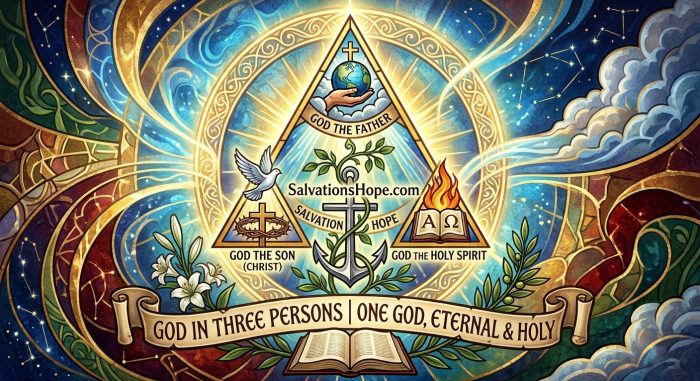
How Can God Be Three Persons, Yet One God?
The doctrine of the Trinity is one of the most important doctrines of the Christian faith. To study the Bible’s teachings on the Trinity gives us great insight into the question that is at the center of all of our seeking after God: What is God like in Himself ? Here we learn that in Himself, in His very being, God exists in the persons of Father, Son, and Holy Spirit, yet He is one God.
Explanation And Scriptural Basis
We may define the doctrine of the Trinity as follows: God eternally exists as three persons, Father, Son, and Holy Spirit, and each person is fully God, and there is one God.
The Doctrine of the Trinity Is Progressively Revealed in Scripture
The word trinity is never found in the Bible, though the idea represented by the word is taught in many places. The word trinity means “tri-unity” or “three-in-oneness.” It is used to summarize the teaching of Scripture that God is three persons yet one God.
Sometimes people think the doctrine of the Trinity is found only in the New Testament, not in the Old. If God has eternally existed as three persons, it would be surprising to find no indications of that in the Old Testament. Although the doctrine of the Trinity is not explicitly found in the Old Testament, several passages suggest or even imply that God exists as more than one person.
For instance, according to Genesis 1:26, God said, “Let us make man in our image, after our likeness.” What do the plural verb (“let us”) and the plural pronoun (“our”) mean? Some have suggested they are plurals of majesty, a form of speech a king would use in saying, for example, “We are pleased to grant your request.” However, in Old Testament Hebrew there are no other examples of a monarch using plural verbs or plural pronouns of himself in such a “plural of majesty,” so this suggestion has no evidence to support it.
Another suggestion is that God is here speaking to angels. But angels did not participate in the creation of man, nor was man created in the image and likeness of angels, so this suggestion is not convincing. The best explanation is that already in the first chapter of Genesis we have an indication of a plurality of persons in God Himself. We are not told how many persons, and we have nothing approaching a complete doctrine of the Trinity, but it is implied that more than one person is involved. The same can be said of Genesis 3:22 (“Behold, the man has become like one of us knowing good and evil”), Genesis 11:7 (“Come, let us go down, and there confuse their language”), and Isaiah 6:8 (“Whom shall I send, and who will go for us?”). (Note the combination of singular and plural in the same sentence in the last passage.)
Moreover, there are passages where one person is called “God” or “the Lord” and is distinguished from another person who is also said to be God. In Psalm 45:6–7 (NIV), the psalmist says, “Your throne, O God, will last for ever and ever....You love righteousness and hate wickedness; therefore God, your God, has set you above your companions by anointing you with the oil of joy.” Here the psalm passes beyond describing anything that could be true of an earthly king and calls the king “God” (v. 6), whose throne will last “forever and ever.” But then, still speaking to the person called “God,” the author says that “God, your God, has set you above your companions” (v. 7). So two separate persons are called “God” (Heb. אֱלֹהִים, H466). In the New Testament, the author of Hebrews quotes this passage and applies it to Christ: “Your throne, O God, is for ever and ever” (Heb. 1:8).
Similarly, in Psalm 110:1, David says, “The Lord says to my lord: “Sit at my right hand until I make your enemies a footstool for your feet”. Jesus rightly understands that David is referring to two separate persons as “Lord” (Matt. 22:41-46), but who is David’s “Lord” if not God himself ? And who could be saying to God, “Sit at my right hand” except someone else who is also fully God? From a New Testament perspective, we can paraphrase this verse: “God the Father said to God the Son, “Sit at my right hand.”’ But even without the New Testament teaching on the Trinity, it seems clear that David was aware of a plurality of persons in one God. Jesus, of course, understood this, but when he asked the Pharisees for an explanation of this passage, “no one was able to answer him a word, nor from that day did any one dare to ask him any more questions” (Matt. 22:46). Unless they are willing to admit a plurality of persons in one God, Jewish interpreters of Scripture to this day will have no more satisfactory explanation of Psalm 110:1 (or of Gen. 1:26, or of the other passages just discussed) than they did in Jesus day.
Isaiah 63:10 says that God’s people “rebelled and grieved his Holy Spirit”, apparently suggesting both that the Holy Spirit is distinct from God Himself (it is “his Holy Spirit”), and that this Holy Spirit can be “grieved,” thus suggesting emotional capabilities characteristic of a distinct person. (Isa. 61:1 also distinguishes “The Spirit of the Lord GOD” from “the Lord,” even though no personal qualities are attributed to the Spirit of the Lord in that verse.)
Similar evidence is found in Malachi, when the Lord says, “The Lord whom you seek will suddenly come to his temple; the messenger of the covenant in whom you delight, behold, he is coming, says the Lord of hosts. But who can endure the day of his coming, and who can stand when He appears?” (Mal. 3:1-2). Here again the one speaking (“the Lord of hosts”) distinguishes Himself from “the Lord whom you seek,” suggesting two separate persons, both of whom can be called “Lord.”
In Hosea 1:7, the Lord is speaking, and says of the house of Judah, “I will deliver them by the Lord their God,” once again suggesting that more than one person can be called “Lord” (Heb. יהוה, H3378) and “God” (אֱלֹהִים, H466).
And in Isaiah 48:16, the speaker (apparently the servant of the Lord) says, “And now the Lord God has sent me and his Spirit.” Here the Spirit of the Lord, like the servant of the Lord, has been “sent” by the Lord GOD on a particular mission. The parallel between the two objects of sending (“me” and “his Spirit”) would be consistent with seeing them both as distinct persons: it seems to mean more than simply “the Lord has sent me and his power.” In fact, from a full New Testament perspective (which recognizes Jesus the Messiah to be the true servant of the Lord predicted in Isaiah’s prophecies), Isaiah 48:16 has trinitarian implications: “And now the Lord God has sent me and his Spirit,” if spoken by Jesus the Son of God, refers to all three persons of the Trinity.
Furthermore, several Old Testament passages about “the angel of the LORD” suggest a plurality of persons in God. The word translated “angel” (Heb. מַלְאָךְ, H4855) means simply “messenger.” If this angel of the LORD is a “messenger” of the LORD, he is then distinct from the LORD himself. Yet at some points the angel of the LORD is called “God” or “the LORD” (see Gen. 16:13; Ex. 3:2–6; 23:20–22 [note “my name is in him” in v. 21]; Num. 22:35 with 38; Judg. 2:1–2; 6:11 with 14). At other points in the Old Testament “the angel of the LORD” simply refers to a created angel, but at least at these texts the special angel (or “messenger”) of the LORD seems to be a distinct person who is fully divine.
One of the most disputed Old Testament texts that could show distinct personality for more than one person is Proverbs 8:22–31. Although the earlier part of the chapter could be understood as merely a personification of “wisdom” for literary effect, showing wisdom calling to the simple and inviting them to learn, vv. 22–31, one could argue, say things about “wisdom” that seem to go far beyond mere personification. Speaking of the time when God created the earth, “wisdom” says, “Then I was the craftsman at his side. I was filled with delight day after day, rejoicing always in his presence, rejoicing in his whole world and delighting in mankind” (Prov. 8:30–31 NIV). To work as a “craftsman” at God’s side in the creation suggests in itself the idea of distinct personhood, and the following phrases might seem even more convincing, for only real persons can be “filled with delight day after day” and can rejoice in the world and delight in mankind.
But if we decide that “wisdom” here really refers to the Son of God before He became man, there is a difficulty. Verses 22-25 (RSV) seem to speak of the creation of this person who is called “wisdom”:
The Lord created me at the beginning of his work,
The first of his acts of old.
Ages ago I was set up, at the first, before the beginning of the earth.
When there were no depths I was brought forth, when there were no springs abounding with water.
Before the mountains had been shaped, before the hills, I was brought forth.
Does this not indicate that this “wisdom” was created?
In fact, it does not. The Hebrew word that commonly means “create” (בָּרָא, H1343) is not used in verse 22; rather the word is קָנָה, H7865, which occurs eighty-four times in the Old Testament and almost always means “to get, acquire.” The NASB is most clear here: “The Lord possessed me at the beginning of his way” (similarly KJV). (Note this sense of the word in Gen. 39:1; Ex. 21:2; Prov. 4:5, 7; 23:23; Eccl. 2:7; Isa. 1:3 [“owner”].) This is a legitimate sense and, if wisdom is understood as a real person, would mean only that God the Father began to direct and make use of the powerful creative work of God the Son at the time creation began : the Father summoned the Son to work with him in the activity of creation. The expression “brought forth” in verses 24 and 25 is a different term but could carry a similar meaning: the Father began to direct and make use of the powerful creative work of the Son in the creation of the universe.
More Complete Revelation of the Trinity in the New Testament.
When the New Testament opens, we enter into the history of the coming of the Son of God to earth. It is to be expected that this great event would be accompanied by more explicit teaching about the trinitarian nature of God, and that is in fact what we find. Before looking at this in detail, we can simply list several passages where all three persons of the Trinity are named together.
When Jesus was baptized, “the heavens were opened and he saw the Spirit of God descending like a dove, and alighting on him; and lo, a voice from heaven, saying, “This is my beloved Son, with whom I am well pleased”’ (Matt. 3:16-17). Here at one moment we have three members of the Trinity performing three distinct activities. God the Father is speaking from heaven; God the Son is being baptized and is then spoken to from heaven by God the Father; and God the Holy Spirit is descending from heaven to rest upon and empower Jesus for his ministry.
At the end of Jesus’ earthly ministry, he tells the disciples that they should go “and make disciples of all nations, baptizing them in the name of the Father and of the Son and of the Holy Spirit” (Matt. 28:19). The very names “Father” and “Son,” drawn as they are from the family, the most familiar of human institutions, indicate very strongly the distinct personhood of both the Father and the Son. When “the Holy Spirit” is put in the same expression and on the same level as the other two persons, it is hard to avoid the conclusion that the Holy Spirit is also viewed as a person and of equal standing with the Father and the Son.
When we realize that the New Testament authors generally use the name “God” (Gk. θεός, G2536) to refer to God the Father and the name “Lord” (Gk. Κύριος, G3261) to refer to God the Son, then it is clear that there is another trinitarian expression in 1 Corinthians 12:4-6: “Now there are varieties of gifts, but the same Spirit; and there are varieties of service, but the same Lord; and there are varieties of working, but it is the same God who inspires them all in every one.”
Similarly, the last verse of 2 Corinthians is trinitarian in its expression: “The grace of the Lord Jesus Christ and the love of God and the fellowship of the Holy Spirit be with you all” (2 Cor. 13:14). We see the three persons mentioned separately in Ephesians 4:4-6 as well: “There is one body and one Spirit just as you were called to the one hope that belongs to your call, one Lord one faith, one baptism, one God and Father of us all, who is above all and through all and in all.”
All three persons of the Trinity are mentioned together in the opening sentence of 1 Peter: “According to the foreknowledge of God the Father, by the sanctifying work of the Spirit, that you may obey Jesus Christ and be sprinkled with his blood” (1 Peter 1:2 nasb). And in Jude 20-21, we read: “But you, beloved, build yourselves up on your most holy faith; pray in the Holy Spirit; keep yourselves in the love of God; wait for the mercy of our Lord Jesus Christ unto eternal life.”
However, the kjv translation of 1 John 5:7 should not be used in this connection. It reads, “For there are three that bear record in heaven, the Father, the Word, and the Holy Ghost: and these three are one.”
The problem with this translation is that it is based on a very small number of unreliable Greek manuscripts, the earliest of which comes from the fourteenth century a.d. No modern translation (except NKJV) includes this kjv reading, but all omit it, as do the vast majority of Greek manuscripts from all major text traditions, including several very reliable manuscripts from the fourth and fifth century a.d., and also including quotations by church fathers such as Irenaeus (d. ca. a.d. 202), Clement of Alexandria (d. ca. a.d. 212), Tertullian (died after a.d. 220), and the great defender of the Trinity, Athanasius (d. a.d. 373).
Three Statements Summarize The Biblical Teaching
In one sense the doctrine of the Trinity is a mystery that we will never be able to understand fully. However, we can understand something of its truth by summarizing the teaching of Scripture in three statements:
God Is Three Persons.
The fact that God is three persons means that the Father is not the Son; they are distinct persons. It also means that the Father is not the Holy Spirit, but that they are distinct persons. And it means that the Son is not the Holy Spirit. These distinctions are seen in a number of the passages quoted in the earlier section as well as in many additional New Testament passages.
John 1:1–2 tells us: “In the beginning was the Word, and the Word was with God, and the Word was God. He was in the beginning with God.” The fact that the “Word” (who is seen to be Christ in vv. 9–18) is “with” God shows distinction from God the Father. In John 17:24 (NIV), Jesus speaks to God the Father about “my glory, the glory you have given me because you loved me before the creation of the world,” thus showing distinction of persons, sharing of glory, and a relationship of love between the Father and the Son before the world was created.
We are told that Jesus continues as our High Priest and Advocate before God [p. 232] the Father: “If any one does sin, we have an advocate with the Father, Jesus Christ the righteous” (1 John 2:1). Christ is the one who “is able for all time to save those who draw near to God through him, since he always lives to make intercession for them” (Heb. 7:25). Yet in order to intercede for us before God the Father, it is necessary that Christ be a person distinct from the Father.
Moreover, the Father is not the Holy Spirit, and the Son is not the Holy Spirit. They are distinguished in several verses. Jesus says, “But the Counselor, the Holy Spirit, whom the Father will send in my name, he will teach you all things, and bring to your remembrance all that I have said to you” (John 14:26). The Holy Spirit also prays or “intercedes” for us (Rom. 8:27), indicating a distinction between the Holy Spirit and God the Father to whom the intercession is made.
Finally, the fact that the Son is not the Holy Spirit is also indicated in the several trinitarian passages mentioned earlier, such as the Great Commission (Matt. 28:19), and in passages that indicate that Christ went back to heaven and then sent the Holy Spirit to the church. Jesus said, “It is to your advantage that I go away, for if I do not go away, the Counselor will not come to you; but if I go, I will send him to you” (John 16:7).
Some have questioned whether the Holy Spirit is indeed a distinct person, rather than just the “power” or “force” of God at work in the world. But the New Testament evidence is quite clear and strong. First are the several verses mentioned earlier where the Holy Spirit is put in a coordinate relationship with the Father and the Son (Matt. 28:19; 1 Cor. 12:4–6; 2 Cor. 13:14; Eph. 4:4–6; 1 Peter 1:2): since the Father and Son are both persons, the coordinate expression strongly intimates that the Holy Spirit is a person also. Then there are places where the masculine pronoun he (Gk. ἐκεῖνος, G1697) is applied to the Holy Spirit (John 14:26; 15:26; 16:13–14), which one would not expect from the rules of Greek grammar, for the word “spirit” (Gk. πνεῦμα, G4460) is neuter, not masculine, and would ordinarily be referred to with the neuter pronoun ἐκεῖνο. Moreover, the name counselor or comforter (Gk. παράκλητος, G4156) is a term commonly used to speak of a person who helps or gives comfort or counsel to another person or persons, but is used of the Holy Spirit in John’s gospel (14:16, 26; 15:26; 16:7).
Other personal activities are ascribed to the Holy Spirit, such as teaching (John 14:26), bearing witness (John 15:26; Rom. 8:16), interceding or praying on behalf of [p. 233] others (Rom. 8:26–27), searching the depths of God (1 Cor. 2:10), knowing the thoughts of God (1 Cor. 2:11), willing to distribute some gifts to some and other gifts to others (1 Cor. 12:11), forbidding or not allowing certain activities (Acts 16:6–7), speaking (Acts 8:29; 13:2; and many times in both Old and New Testaments), evaluating and approving a wise course of action (Acts 15:28), and being grieved by sin in the lives of Christians (Eph. 4:30).
Finally, if the Holy Spirit is understood simply to be the power of God, rather than a distinct person, then a number of passages would simply not make sense, because in them the Holy Spirit and his power or the power of God are both mentioned. For example, Luke 4:14, “And Jesus returned in the power of the Spirit into Galilee,” would have to mean, “Jesus returned in the power of the power of God into Galilee.” In Acts 10:38, “God anointed Jesus of Nazareth with the Holy Spirit and with power,” would mean, “God anointed Jesus with the power of God and with power” (see also Rom. 15:13; 1 Cor. 2:4).
Although so many passages clearly distinguish the Holy Spirit from the other members of the Trinity, one puzzling verse has been 2 Corinthians 3:17: “Now the Lord is the Spirit, and where the Spirit of the Lord is, there is freedom.” Interpreters often assume that “the Lord” here must mean Christ, because Paul frequently uses “the Lord” to refer to Christ. But that is probably not the case here, for a good argument can be made from grammar and context to say that this verse is better translated with the Holy Spirit as subject, “Now the Spirit is the Lord....” In this case, Paul would be saying that the Holy Spirit is also “Yahweh” (or “Jehovah”), the Lord of the Old Testament (note the clear Old Testament background of this context, beginning at v. 7).
Theologically this would be quite acceptable, for it could truly be said that just as God the Father is “Lord” and God the Son is “Lord” (in the full Old Testament sense of “Lord” as a name for God), so also the Holy Spirit is the one called “Lord” in the Old Testament—and it is the Holy Spirit who especially manifests the presence of the Lord to us in the new covenant age.
Each Person Is Fully God.
In addition to the fact that all three persons are distinct, the abundant testimony of Scripture is that each person is fully God as well.
First, God the Father is clearly God. This is evident from the first verse of the Bible, where God created the heaven and the earth. It is evident through the Old and New Testaments, where God the Father is clearly viewed as sovereign Lord over all and where Jesus prays to his Father in heaven.
Next, the Son is fully God. Although this point will be developed in greater detail in chapter 26, “The Person of Christ,” we can briefly note several explicit passages at this point. John 1:1-4 clearly affirms the full deity of Christ:
In the beginning was the Word, and the Word was with God, and the Word was God. He was in the beginning with God; all things were made through him, and without him was not anything made that was made. In him was life, and the life was the light of men.
Here Christ is referred to as “the Word,” and John says both that he was “with God” and that he “was God.” The Greek text echoes the opening words of Genesis 1:1 (“In the beginning...”) and reminds us that John is talking about something that was true before the world was made. God the Son was always fully God.
The translation “the Word was God” has been challenged by the Jehovah’s Witnesses, who translate it “the Word was a god “ implying that the Word was simply a heavenly being but not fully divine. They justify this translation by pointing to the fact that the definite article (Gk. ὁ, G3836, “the”) does not occur before the Greek word θεός (G2536, “God”). They say therefore that θεός should be translated “a god.” However, their interpretation has been followed by no recognized Greek scholar anywhere, for it is commonly known that the sentence follows a regular rule of Greek grammar, and the absence of the definite article merely indicates that “God” is the predicate rather than the subject of the sentence. (A recent publication by the Jehovah’s Witnesses now acknowledges the relevant grammatical rule but continues to affirm their position on John 1:1 nonetheless.)
The inconsistency of the Jehovah’s Witnesses’ position can further be seen in their translation of the rest of the chapter. For various other grammatical reasons the word θεός (G2536) also lacks the definite article at other places in this chapter, such as verse 6 (“There was a man sent from God”), verse 12 (“power to become children of God”), verse 13 (“but of God”), and verse 18 (“No one has ever seen God”). If the Jehovah’s Witnesses were consistent with their argument about the absence of the definite article, they would have to translate all of these with the phrase “a god,” but they translate “God” in every case.
John 20:28 in its context is also a strong proof for the deity of Christ. Thomas had doubted the reports of the other disciples that they had seen Jesus raised from the dead, and he said he would not believe unless he could see the nail prints in Jesus’ hands and place his hand in his wounded side (John 20:25). Then Jesus appeared to the disciples when Thomas was with them. He said to Thomas, “Put your finger here, and see my hands; and put out your hand, and place it in my side; do not be faithless, but believing” (John 20:27). In response to this, we read, “Thomas answered him, “My Lord and my God!”’ (John 20:28). Here Thomas calls Jesus “my God.” The narrative shows that both John in writing his gospel and Jesus himself approve of what Thomas has said and encourage everyone who hears about Thomas to believe the same things that Thomas did. Jesus immediately responds to Thomas, “Have you believed because you have seen me? Blessed are those who have not seen and yet believe” (John 20:29). As far as John is concerned, this is the dramatic high point of the gospel, for he immediately tells the reader—in the very next verse—that this was the reason he wrote it:
Now Jesus did many other signs in the presence of the disciples, which are not written in this book; but these are written that
you may believe that Jesus is the Christ, the Son of God, and that believing you may have life in his name. (John 20:30-31)
Jesus speaks of those who will not see him and will yet believe, and John immediately tells the reader that he recorded the events written in his gospel in order that they may believe in just this way, imitating Thomas in his confession of faith. In other words, the entire gospel is written to persuade people to imitate Thomas, who sincerely called Jesus “My Lord and my God.” Because this is set out by John as the purpose of his gospel, the sentence takes on added force.
he Jehovah's Witnesses' booklet Should You Believe in the Trinity? offers two explanations for John 20:28: (1) "To Thomas, Jesus was like "a god,' especially in the miraculous circumstances that prompted his exclamation" (p. 29). But this explanation is unconvincing, because Thomas did not say, "You are like a god," but rather called Jesus "my God." The Greek text has the definite article (it cannot be translated "a god") and is explicit: ὁ θεός μου is not "a god of mine" but "my God." (2) The second explanation offered is that "Thomas may simply have made an emotional exclamation of astonishment, spoken to Jesus but directed to God" (ibid.).
The second part of this sentence, "spoken to Jesus but directed to God," is simply incoherent: it seems to mean, "spoken to Jesus but not spoken to Jesus," which is not only self-contradictory, but also impossible: if Thomas is speaking to Jesus he is also directing his words to Jesus.
The first part of this sentence, the claim that Thomas is really not calling Jesus "God," but is merely swearing or uttering some involuntary words of exclamation, is without merit, for the verse makes it clear that Thomas was not speaking into the blue but was speaking directly to Jesus: "Thomas answered and said to Him "My Lord and my God!"' (John 20:28, nasb). And immediately both Jesus and John in his writing commend Thomas, certainly not for swearing but for believing in Jesus as his Lord and his God.
Other passages speaking of Jesus as fully divine include Hebrews 1, where the author says that Christ is the “exact representation” (vs. 3, Gk. χαρακτήρ, G5917, “exact duplicate”) of the nature or being (Gk. ὑπόστασις, G5712) of God—meaning that God the Son exactly duplicates the being or nature of God the Father in every way: whatever attributes or power God the Father has, God the Son has them as well. The author goes on to refer to the Son as “God” in verse 8 (“But of the Son he says, ‘Your throne, O God, is for ever and ever’”), and he attributes the creation of the heavens to Christ when he says of him, “You, Lord, did found the earth in the beginning, and the heavens are the work of your hands” (Heb. 1:10, quoting Ps. 102:25). Titus 2:13 refers to “our great God and Savior Jesus Christ,” and 2 Peter 1:1 speaks of “the righteousness of our God and Savior Jesus Christ.” Romans 9:5, speaking of the Jewish people, says, “Theirs are the patriarchs, and from them is traced the human ancestry of Christ, who is God over all, forever praised! Amen” (NIV).
In the Old Testament, Isaiah 9:6 predicts, “For to us a child is born, to us a son is given; and the government will
be upon his shoulder, and his name will be called ‘Wonderful Counselor, Mighty God.’”
As this prophecy is applied to Christ, it refers to him as “Mighty God.” Note the similar application of the titles “Lord” and “God” in the prophecy of the coming of the Messiah in Isaiah 40:3, “In the wilderness prepare the way of the Lord, make straight in the desert a highway for our God,” quoted by John the Baptist in preparation for the coming of Christ in Matthew 3:3.
Many other passages will be discussed in chapter 26 below, but these should be sufficient to demonstrate that the New Testament clearly refers to Christ as fully God. As Paul says in Colossians 2:9, “In him the whole fulness of deity dwells bodily.”
Next, the Holy Spirit is also fully God. Once we understand God the Father and God the Son to be fully God, then the trinitarian expressions in verses like Matthew 28:19 (“baptizing them in the name of the Father and of the Son and of the Holy Spirit”) assume significance for the doctrine of the Holy Spirit, because they show that the Holy Spirit is classified on an equal level with the Father and the Son. This can be seen if we recognize how unthinkable it would have been for Jesus to say something like, “baptizing them in the name of the Father and of the Son and of the archangel Michael—this would give to a created being a status entirely inappropriate even to an archangel. Believers throughout all ages can only be baptized into the name (and thus into a taking on of the character) of God himself. (Note also the other trinitarian passages mentioned above: 1 Cor. 12:4–6; 2 Cor. 13:14; Eph. 4:4–6; 1 Peter 1:2; Jude 20–21.)
In Acts 5:3-4, Peter asks Ananias, “Why has Satan filled your heart to lie to the Holy Spirit...? You have not lied to men but to God.” According to Peter’s words, to lie to the Holy Spirit is to lie to God. Paul says in 1 Corinthians 3:16, “Do you not know that you are God’s temple and that God’s Spirit dwells in you?” God’s temple is the place where God himself dwells, which Paul explains by the fact that “God’s Spirit” dwells in it, thus apparently equating God’s Spirit with God himself.
David asks in Psalm 139:7-8, “Whither shall I go from your Spirit? Or whither shall I flee from your presence? If I ascend to heaven, you are there!” This passage attributes the divine characteristic of omnipresence to the Holy Spirit, something that is not true of any of God’s creatures. It seems that David is equating God’s Spirit with God’s presence. To go from God’s Spirit is to go from his presence, but if there is nowhere that David can flee from God’s Spirit, then he knows that wherever he goes he will have to say, “You are there.”
Paul attributes the divine characteristic of omniscience to the Holy Spirit in 1 Corinthians 2:10-11: “For the Spirit searches everything, even the depths of God. For what person knows a man’s thoughts except the spirit of the man which is in him? So also no one comprehends the thoughts of God [Gk., literally “the things of God’] except the Spirit of God.”
Moreover, the activity of giving new birth to everyone who is born again is the work of the Holy Spirit. Jesus said, “unless one is born of water and the Spirit, he cannot enter the kingdom of God. That which is born of the flesh is flesh, and that which is born of the Spirit is spirit. Do not marvel that I said to you, “You must be born anew”’ (John 3:5-7). But the work of giving new spiritual life to people when they become Christians is something that only God can do (cf. 1 John 3:9, “born of God”). This passage therefore gives another indication that the Holy Spirit is fully God.
Up to this point we have two conclusions, both abundantly taught throughout Scripture:
1. God is three persons.
2. Each person is fully God.
If the Bible taught only these two facts, there would be no logical problem at all in fitting them together, for the obvious solution would be that there are three Gods. The Father is fully God, the Son is fully God, and the Holy Spirit is fully God. We would have a system where there are three equally divine beings. Such a system of belief would be called polytheism—or, more specifically, “tritheism,” or belief in three Gods. But that is far from what the Bible teaches.
There Is One God.
Scripture is abundantly clear that there is one and only one God. The three different persons of the Trinity are one not only in purpose and in agreement on what they think, but they are one in essence, one in their essential nature. In other words, God is only one being. There are not three Gods. There is only one God.
One of the most familiar passages of the Old Testament is Deuteronomy 6:4-5 (niv): “Hear, O Israel: The Lord our God, the Lord is one. Love the Lord your God with all your heart and with all your soul and with all your strength.”
When Moses sings, “Who is like you, O Lord, among the gods? Who is like you, majestic in holiness, terrible in glorious deeds, doing wonders?” (Ex. 15:11) the answer obviously is “No one.” God is unique, and there is no one like him and there can be no one like him. In fact, Solomon prays “that all the peoples of the earth may know that the Lord is God; there is no other” (1 Kings 8:60).
When God speaks, he repeatedly makes it clear that he is the only true God; the idea that there are three Gods to be worshiped rather than one would be unthinkable in the light of these extremely strong statements. God alone is the one true God and there is no one like him. When he speaks, he alone is speaking—he is not speaking as one God among three who are to be worshiped. He says:
When Moses sings, “Who is like you, O Lord, among the gods? Who is like you, majestic in holiness, terrible in glorious deeds, doing wonders?” (Ex. 15:11) the answer obviously is “No one.” God is unique, and there is no one like him and there can be no one like him. In fact, Solomon prays “that all the peoples of the earth may know that the Lord is God; there is no other” (1 Kings 8:60).When God speaks, he repeatedly makes it clear that he is the only true God; the idea that there are three Gods to be worshiped rather than one would be unthinkable in the light of these extremely strong statements. God alone is the one true God and there is no one like him. When he speaks, he alone is speaking—he is not speaking as one God among three who are to be worshiped. He says:
“I am the Lord, and there is no other, besides me there is no God; I gird you, though you do not know me, that men may know, from the rising of the sun and from the west, that there is none besides me; I am the Lord, and there is no other.” (Isa. 45:5-6)Similarly, he calls everyone on earth to turn to him:“ There is no other god besides me, a righteous God and a Savior; there is none besides me. “Turn to me and be saved, all the ends of the earth! For I am God, and there is no other.” (Isa. 45:21-22; cf. 44:6-8)
The New Testament also affirms that there is one God. Paul writes, “For there is one God and there is one mediator between God and men, the man Christ Jesus” (1 Tim. 2:5). Paul affirms that “God is one” (Rom. 3:30), and that “there is one God, the Father, from whom are all things and for whom we exist” (1 Cor. 8:6).1 Cor. 8:6 does not deny that God the Son and God the Holy Spirit are also "God," but here Paul says that God the Father is identified as this "one God." Elsewhere, as we have seen, he can speak of God the Son and God the Holy Spirit as also "God." Moreover, in this same verse, he goes on to speak of "one Lord, Jesus Christ, through whom are all things and through whom we exist." He is here using the word Lord in its full Old Testament sense of "Yahweh" as a name for God, and saying that this is the person through whom all things were created, thus affirming the full deity of Christ as well, but with a different name. Thus this verse affirms both the unity of God and the diversity of persons in God. Finally, James acknowledges that even demons recognize that there is one God, even though their intellectual assent to that fact is not enough to save them: “You believe that God is one; you do well. Even the demons believe—and shudder” (James 2:19). But clearly James affirms that one “does well” to believe that “God is one.”
We now have three statements, all of which are taught in Scripture:
1. God is three persons.
2. Each person is fully God.
3. There is one God.
Throughout the history of the church there have been attempts to come up with a simple solution to the doctrine of the Trinity by denying one or another of these statements. If someone denies the first statement then we are simply left with the fact that each of the persons named in Scripture (Father, Son, and Holy Spirit) is God, and there is one God. But if we do not have to say that they are distinct persons, then there is an easy solution: these are just different names for one person who acts differently at different times. Sometimes this person calls himself Father, sometimes he calls himself Son, and sometimes he calls himself Spirit.
The technical name for this view is modalism, a heresy condemned in the ancient church: see discussion below. We have no difficulty in understanding that, for in our own experience the same person can act at one time as a lawyer (for example), at another time as a father to his own children, and at another time as a son with respect to his parents: The same person is a lawyer, a father, and a son. But such a solution would deny the fact that the three persons are distinct individuals, that God the Father sends God the Son into the world, that the Son prays to the Father, and that the Holy Spirit intercedes before the Father for us.