

The Doctrine of Angels and Demons
Introduction
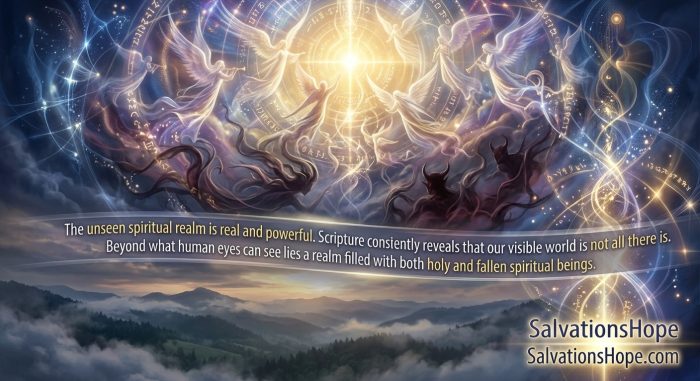
The unseen spiritual realm is real and powerful. Scripture consistently reveals that our visible world is not all there is. Beyond what human eyes can see lies a realm filled with both holy and fallen spiritual beings. The Bible speaks of angels—mighty messengers who worship God (Isaiah 6:2–3; Revelation 5:11–12), deliver His words (Luke 1:26–38), guard His people (Psalm 91:11), and carry out His purposes (Hebrews 1:14).
Yet Scripture also warns of fallen angels—Satan and his demons—who rebelled against God and now seek to oppose His will. Jesus described Satan as a liar and murderer from the beginning (John 8:44). Peter warns that the devil prowls around like a roaring lion, seeking someone to devour (1 Peter 5:8). These beings stir up temptation, deception, oppression, and destruction in the world, aiming to drag humanity away from God.
The Statement of Faith of Salvation's Hope summarizes this truth with biblical balance and Christ-centered confidence:
“God’s holy angels defend and help God’s people. Satan and other fallen angels are dangerous but doomed. Christ is Victor.”
This simple confession highlights two central realities:
Why This Matters
The doctrine of angels and demons is not a side issue but an essential reminder of the spiritual conflict that shapes human history and Christian life. Paul reminds us: “Our struggle is not against flesh and blood, but against the rulers, against the authorities, against the powers of this dark world and against the spiritual forces of evil in the heavenly realms”(Ephesians 6:12).
For Salvation's Hope clergy this truth brings both sobriety and hope:
God’s Holy Angels
God of Angel Armies
Scripture frequently reveals God as Yahweh Sabaoth—the Lord of hosts, commander of angel armies. The psalmist exclaims:
“Who in the skies above can compare with the Lord? Who is like the Lord among the heavenly beings?
In the council of the holy ones God is greatly feared; He is more awesome than all who surround Him.” (Psalm 89:6–8)
The sheer magnitude and majesty of the angelic host testify to God’s supremacy. Angels, though awe-inspiring, do not rival His power—they magnify it. Their existence reminds us that the God we serve is not weak or passive but enthroned above countless multitudes of celestial warriors.
Worshipers of God
When angels appear, humans are often tempted to worship them (Revelation 19:10). Yet angels always deflect worship upward, pointing to God alone. Their essence is worship, their voice eternal praise.
Their primary vocation is clear: to glorify God and exalt Christ the Lamb. Angels show us what humanity, too, is created for—unceasing worship of the living God.
Messengers of God
The very word angel means “messenger.” Throughout redemptive history, God has sent angels to communicate His purposes:
Gabriel’s words to Zechariah reveal their authority: “I am Gabriel. I stand in the presence of God, and I have been sent to speak to you and to tell you this good news” (Luke 1:19). When angels speak, they carry heaven’s message to earth with clarity and power.
Guardians of God’s People
God entrusts His angels with the protection of His people:
This protective role has comforted God’s people for generations. Angels are God’s warriors on behalf of His children, especially the weak and vulnerable.
Ministering Spirits
The writer of Hebrews identifies angels as “ministering spirits sent to serve those who will inherit salvation” (Hebrews 1:14). Their greatness does not lead to pride but to humble service. Even more, Paul declares that one day believers will judge angels (1 Corinthians 6:3)—a reminder that their ministry, though majestic, is subordinate to God’s plan for His redeemed people.
History and testimony abound with accounts of angelic intervention—protection in battle, rescue from danger, visions in times of persecution. While Christians must avoid unhealthy fascination or angel worship, we can be assured that God still commands His angels for the good of His people.
Historical Witness
The witness of the church has been consistent: angels are real, mighty, and active, but always servants of God’s greater glory.
Fallen Angels
The Devil and His Schemes
Not all angels remained faithful. Scripture reveals that some rebelled against God and became demons under Satan’s leadership (2 Peter 2:4; Jude 6). Once glorious, these beings chose pride and rebellion, setting themselves against their Creator. Now they are real, personal, and hostile to God’s purposes.
Paul warns clearly:
“Our struggle is not against flesh and blood, but against the rulers, against the authorities, against
the powers of this dark world and against the spiritual forces of evil in the heavenly realms.” (Ephesians 6:12)
Satan, called the accuser (Revelation 12:10) and deceiver (John 8:44), works with his demons to tempt, divide, oppress, and destroy. They stir up evil beyond ordinary human wickedness, fueling idolatry, corruption, and violence. To deny their reality is naïve and dangerous; Scripture calls us to sober watchfulness.
Christ’s Triumph
Though powerful, fallen angels are already defeated. At the cross, Christ decisively broke their power:
“Having disarmed the powers and authorities, He made a public spectacle of them, triumphing over them by the cross.” (Colossians 2:15)
Satan’s greatest weapons—sin and death—were shattered. By bearing our sin, Jesus removed the grounds of accusation. By rising from the dead, He robbed the devil of his power to enslave. As John declares:
“The reason the Son of God appeared was to destroy the works of the devil.” (1 John 3:8)
The devil still prowls, but his defeat is certain and irreversible.
Resist the Devil
Because Satan is real, Scripture urges vigilance:
Though dangerous, the devil cannot force believers into sin. Those indwelt by the Spirit are empowered to resist his schemes. Victory comes not by human strength but by God’s armor—truth, righteousness, faith, the Word, and prayer (Ephesians 6:13–18).
Their Doomed End
Satan and his demons are on borrowed time. Jesus foretold their destiny:
“The eternal fire prepared for the devil and his angels.” (Matthew 25:41)
Revelation 20:10 declares the final judgment:
“The devil, who deceived them, was thrown into the lake of burning sulfur… and will be tormented day and night for ever and ever.”
The cosmic battle is real, but its outcome is not in doubt. Evil powers are temporary; Christ’s victory is eternal.
Historical Witness
Implications for Clergy
For Salvation's Hope clergy the doctrine of angels and demons is not abstract theology. It provides a framework for daily ministry, reminding leaders that their work unfolds within a spiritual battle. Just as Paul warned that “we are not unaware of Satan’s schemes” (2 Corinthians 2:11), so clergy must both resist evil and proclaim Christ’s victory with confidence.
For Ministers
Preachers of Spiritual Realities
Ministers must keep spiritual warfare at the forefront of preaching and teaching.
Implications for Ministry Sciences
The doctrine of angels and demons shapes Ministry Sciences by insisting that human life is lived not only on a natural plane but also in a spiritual conflict. To neglect this truth risks flattening reality into material or psychological categories alone. To embrace it provides a fuller, biblically faithful vision of humanity and ministry.
Psychology
Beyond Dysfunction to Spiritual Conflict
Sociology/Anthropology
Beyond Ritual to Revelation
Philosophy
Beyond Abstractions to Personal Rebellion
Leadership Studies
Beyond Influence to Spiritual Warfare
The Integrative Vision
Shepherding in a Realistic and Hopeful Way
Without this doctrine, Ministry Sciences risks reducing flourishing to therapy, social reform, or human wisdom, ignoring the unseen spiritual forces that Scripture makes plain. With it, leaders are prepared to shepherd God’s people realistically and confidently.
Thus, the doctrine of angels and demons guards Ministry Sciences from naïve reductionism and grounds it in the victory of Christ. Leaders can face the reality of opposition without fear, for the Lord of angel armies walks with His people, and His Spirit empowers them to overcome.
Conclusion
God wants His people to know both truths:
Above all, Christ is Victor. His cross disarmed Satan, His resurrection conquered death, and His return will end evil forever.
For clergy, this doctrine cultivates both humility and courage: humility in knowing angels serve God’s people, courage in knowing demons cannot prevail. For Ministry Sciences, it provides a framework for integrating human experience of good and evil with the biblical witness of spiritual realities.