
Visions Of Revelation
Profound Hardship
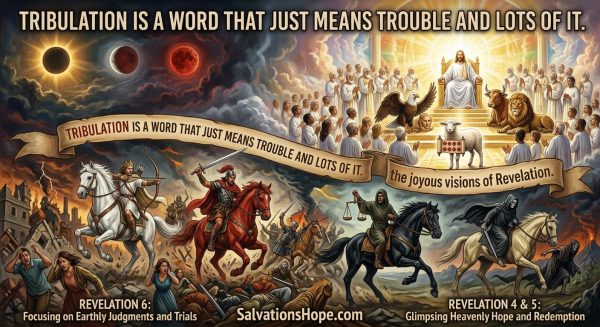
At its core, "tribulation" just means trouble—and lots of it. While Revelation certainly paints a vivid picture of severe hardship, it balances those dark moments with magnificent, joyful visions. We will be focusing on Revelation 6, but to see those trials in their proper context, we need to look at Revelation 4 and 5 first.
In Revelation 4, John describes a heavenly vision: "I looked up and saw an open door in heaven. The voice I had heard earlier called out, 'Come up here, and I will show you what must take place after this.' Immediately caught up in the Spirit, I saw a magnificent throne in heaven. The One seated upon it gleamed with the brilliance of precious jasper and carnelian."
A ring of vivid green, shimmering like a cut emerald, wrapped the throne in supernatural light. Arrayed around it sat twenty-four elders upon twenty-four thrones, draped in pristine white robes with golden crowns glittering on their heads. From the core of the throne erupted violent flashes of lightning and cascading rolls of thunder. Seven blazing lamps burned bright before the seat—the fiery essence of God's seven spirits. At the heart of the vision, flanking the throne, moved four surreal living beings, every surface of their bodies covered with eyes before and behind.
Four celestial beings emerged: the first resembling a lion, the second a powerful ox, the third bearing a human face, and the fourth an eagle caught in mid-flight. Each was cloaked in six wings and covered endlessly in eyes—spanning across their bodies and peering out from beneath every feather.
Without pause, day and night, they proclaim: "Holy, holy, holy is the Lord God Almighty—the One who was, who is, and who is to come." Whenever these living creatures offer glory, honor, and gratitude to the Eternal One on the throne, the twenty-four elders bow low in worship. Casting their crowns before Him, they declare: "You are worthy, our Lord and God, to receive all glory, honor, and power. For You created everything that exists, and by Your will, all things were brought into being."
Revelation 4 presents a breathtaking vision of God’s throne room that directly echoes Isaiah 6:1–3. Just as Isaiah saw the Lord "high and lifted up" while six-winged seraphim unceasingly cried, "Holy, holy, holy is the Lord Almighty," John experiences a similar opening of heaven—beholding divine glory and continuous celestial worship.
The Central Throne
Revelation 4 uses imagery rooted in Old Testament prophecy (Ezekiel 1 and Isaiah 6) to depict God's absolute sovereignty and the worship due to Him as Creator.
The Four Living Creatures:
Positioned around the central throne, these exalted angelic beings represent the majesty, strength, and vigilance of all created order continuously offering praise.
The 24 Elders:
Seated on surrounding thrones and clothed in white, the elders function as a heavenly council representing the complete body of God's redeemed people.
The Golden Crowns (Stephanoi)
The Setting Details
Scroll Vision
After witnessing God enthroned alongside His heavenly attendants and the twenty-four elders—likely angelic guardians who care for God’s people—John catches sight of a mysterious scroll. Held in the right hand of the One on the throne, it is inscribed on both sides and secured with seven seals. A mighty angel cries out, “Who is worthy to break the seals and open the scroll?”
Yet a heavy silence falls over creation. Neither angels nor elders, heavenly creatures nor earthly souls—no one anywhere—is found worthy to break the seals or even glance inside (Revelation 5:1–3). Overwhelmed by this universal inadequacy, John despairs: “I wept and wept because no one was found who was worthy to open the scroll or look inside” (Revelation 5:4).
Toward the end of Daniel, God commands that the scroll revealing the final chapters of history be sealed until the end of time. Fast-forward to the Book of Revelation, where the Apostle John weeps bitterly because no one in heaven or on earth is worthy to break those seals and unlock God’s master plan.
In Revelation 5:5, one of the elders offers words of hope: “Do not weep. See, the Lion of the tribe of Judah, the Root of David, has triumphed. He is able to open the scroll and its seven seals.” This moment brings long-standing Old Testament prophecy to its ultimate climax. Centuries earlier, God promised a victorious ruler would emerge from the tribe of Judah. Jesus fulfilled that promise through His victory, proving that He alone possesses the ultimate authority to break the seals and open the scroll.
At the very center of the divine throne stood a Lamb, bearing the visible marks of sacrifice yet standing upright in absolute triumph. It possessed seven horns and seven eyes, representing the full power and all-seeing vision of the sevenfold Spirit of God sent into all creation. Stepping forward, the Lamb took the sealed scroll directly from the right hand of the One enthroned above.
The instant the scroll changed hands, the entire celestial court was moved to worship. The four living creatures and the twenty-four elders fell prostrate before the Lamb. A breathtaking new anthem echoed across heaven.
"You alone are worthy to take the scroll and break its seals, for you were slain. With your own blood, you ransomed people for God from every
tribe, language, culture, and nation. You have forged them into a kingdom of priests to serve our God, and they will reign over the earth."
I looked up and heard the thunderous voices of millions upon millions of angels surrounding the central throne, the four living beings, and the elders. In a unified, deafening shout, they declared: "The slain Lamb is fully worthy to receive all authority, wealth, wisdom, power, honor, glory, and praise!" Instantly, the entire cosmos erupted in song—every creature in heaven, on earth, under the ground, and across the ocean joined together: " To the One seated on the throne and to the Lamb be endless praise, honor, glory, and power, forever and ever!" The four living beings shouted, "Amen!" and the elders fell to their knees in deep adoration.
Only one figure is worthy to break the seals and open the scroll: the Lamb. It’s easy to skip straight to the drama of the Four Horsemen in Revelation 6, but spending time in chapters 4 and 5 keeps our eyes anchored where they belong. Before we watch the riders rush out, we need to remember who is actually running the show—and whose hand breaks the seals to send them.
First Scroll
I watched as the Lamb unsealed the first of the seven seals. The heavens shuddered, and one of the four living creatures bellowed in a voice like rolling thunder, “Come!” Before my eyes stood a majestic steed of stark, blinding white. Its rider gripped a drawn bow, a golden crown rested upon his brow, and he rode forth—an irresistible force of conquest, bent solely on dominion.
When the Lamb tore open the second seal, the second creature called into the haze, “Come!” Out from the smoke burst a horse of blazing, fiery crimson. To its rider was given the terrifying authority to strip peace from the earth, driving humanity to butcher one another, while a massive, gleaming broadsword was thrust into his grip.
The Lamb shattered the third seal, and the third creature summoned, “Come!” I looked, and there emerged a horse as black as midnight. Its rider held a set of iron scales, measuring out human survival. From among the four living creatures came a voice echoing like a solemn decree: “A single measure of wheat for a full day’s wages, and three measures of barley for a day’s hard labor—yet spare the oil and the wine!”
When the Lamb broke open the fourth seal, the voice of the fourth living creature roared, “Come!” I looked, and there appeared a horse of sickly, corpse-pale ash. Its rider was Death itself, with the dark abyss of Hades trailing close behind his heels. Authority was unleashed upon them over a fourth of the earth—to harvest human lives by the edge of the blade, by crushing famine, by sweeping pestilence, and by the wild beasts of the earth.
Often known as the Four Horsemen of the Apocalypse—a title rooted in the Greek word for revelation—these figures represent a compounding chain reaction of human tragedy.
It begins with the white horse, embodying conquest and imperial ambition. When aggressive rulers seek to expand their borders, war inevitably follows, bringing forth the rider on the red horse. War shatters infrastructure and disrupts supply lines, ushering in the black horse of famine—an economic crisis where basic food becomes unaffordable for ordinary people while luxuries remain reserved for the wealthy. Finally, the pale horse arrives, bearing death in all its forms: pestilence, disease, violence, and starvation.
Summoned by the four living creatures as the first four seals are broken, these riders portray a timeless, terrifying domino effect of human suffering.
When the fifth seal was opened, John saw the souls of those slain for the word of God gathered beneath the altar. Their cry echoed with urgent longing: "How long, Sovereign Lord, holy and true, until You judge the earth and avenge our blood?"
Each was handed a white robe and told to rest a little longer. History itself moves along this divine timeline, unfolding until the full measure of faithful martyrs is complete.
Immediately, the scene escalates with the opening of the sixth seal. A violent earthquake shatters the earth. The sun turns as dark as goat-hair sackcloth, the moon bleeds red, and stars fall like late figs shaken by a gale. The sky recedes like a scroll being rolled up, ripping mountains and islands from their foundations.
Panic grips every level of society—kings, generals, the powerful, the enslaved, and the free all flee to the mountain caves. Their desperate cry shifts from a plea for justice to a plea for cover: "Fall on us and hide us from the face of Him who sits on the throne, and from the wrath of the Lamb! For the great day of their wrath has come, and who can stand?"
Interpreting
Reading the book of Revelation requires an open heart to hear God's voice and an active mind to wrestle with its vivid imagery. We depend entirely on the power of the Lord and the quiet work of the Holy Spirit to enlighten us, yet God also calls us to use our minds to understand what He is unfolding. Before we dive into today's passage, let’s ground ourselves in a few key principles for interpreting Revelation—and Scripture as a whole.
Scripture interprets Scripture
To truly understand the Book of Revelation, one foundational principle stands above the rest: Scripture interprets Scripture. Revelation cannot be read in isolation; it is deeply interwoven with the entire biblical canon. While some prominent figures, like pastor Andy Stanley, famously argue that Christians should "unhitch" the New Testament from the Old, doing so strips Revelation of its essential context. You simply cannot grasp the Bible's final chapter without the foundation of everything that came before it.
Now it would be very hard to unhitch Revelation from the Old Testament. The book of Revelation has a grand total of 404 verses in it, and of those 404 verses, 270 have a reference to the Old Testament. If we don't just count direct references, G. K. Beale says there are more than 500 allusions to the Old Testament in the book of Revelation. Good luck unhitching! You cannot read a sentence from the book of Revelation without having it linked to something that is stated in the Old Testament part of the Bible.
We've got to remember that all Scripture is God-breathed and is profitable (2 Timothy 3:16), as the New Testament says of the Old Testament. So we need to keep in mind that we need Scripture to interpret Scripture. As we do that, we don't unhitch one part from another. Also, when we get to a very difficult portion of Scripture, let's look at what a clearer portion says, and it might help us make sense of the more difficult part. When we're dealing with parts that we struggle with, let's look at the parts that are easier to understand.
Different Forms Same Truths
Second, effective interpretation hinges on a key principle: Scripture frequently uses different literary genres to convey the exact same truths. In reality, Revelation introduces very little brand-new doctrine; almost everything in its pages is expressed elsewhere in the Bible, just through a different lens. If that feels disappointing, you might naturally ask: Why keep Revelation at all if its message is already scattered throughout the rest of Scripture?
Although Revelation shares its core themes with the rest of Scripture, its distinction lies in its mode of communication. While epistles utilize direct exposition and historical narratives recount events, Revelation conveys its message through symbolic imagery and visionary experience.
Why does the Bible express the same core realities through so many different styles? Because God doesn't just want to inform your mind; He wants to awaken your heart. He meets us where we think, appealing to facts and logic, but He also speaks to how we feel, stirring our imagination and entire soul. Visionary books like Revelation bypass plain prose to grip us in ways standard text never could.
The Book of Revelation doesn't actually introduce many unique doctrines or end-times details that aren't already covered elsewhere in Scripture. For instance, 2 Thessalonians 2 offers a much more straightforward explanation of the Antichrist—the "man of sin." Likewise, 1 John 2:18 speaks plainly, reminding us that while the Antichrist is coming, "many antichrists have already gone out into the world." When Revelation uses apocalyptic symbolism, such as the vision of the bizarre beast, it isn't revealing entirely new facts; it is simply providing a vivid visual of those same antichrist forces at work.
You receive direct descriptions in the letters, whereas other forms of divine communication rely on visions and symbols. God has a clear purpose for using different formats to convey the same truths.
Images Symbolize Realities
In Revelation, imagery always points to reality. Sound biblical interpretation requires anchoring ourselves in clear, straightforward scripture before tackling complex figurative visions. Without that baseline, unchecked imagination leads to wild speculation—or as G. K. Chesterton famously quipped, "The book of Revelation contains many strange monsters, but none so strange as some of its interpreters."
We must avoid taking these apocalyptic pictures hyper-literally. Jesus is the incarnate God, not a bizarre, surreal creature. The vivid imagery serves a distinct purpose: depicting Him as a Lamb highlights His sacrificial death for human sin, the seven horns symbolize His complete authority, and the seven eyes represent the all-seeing Spirit of Christ moving across the earth.
Apocalyptic imagery in Revelation always points past itself to a deeper reality. Sound biblical interpretation anchors itself in clear, explicit scripture before attempting to decode complex figurative visions. Without that foundation, unchecked imagination runs wild—a hazard G. K. Chesterton famously captured when he observed, "The book of Revelation contains many strange monsters, but none so strange as some of its interpreters."
Reading Revelation requires distinguishing symbolic imagery from literal physical description. Jesus is God incarnate, not a bizarre, surreal creature. The vivid symbols carry precise theological weight:
The Bible isn't written in just one style. A book like Revelation relies heavily on vivid symbolism, but many other books simply record history as it happened. Some people try to claim that Jesus’ death and resurrection are just mythical archetypes repeated throughout history. But Scripture is clear: Jesus was a real man who died on a real cross and physically rose from the dead in a tangible body—one that could be touched and could share a meal.
Just because Revelation and certain apocalyptic passages use symbolic language doesn't mean the entire Bible is an open-ended metaphor you can reshape to mean whatever you want. Scripture includes straightforward history as well as rich symbolism, and reading it faithfully means taking each part for what it truly is.
First Coming Ushered In Last Days
"A foundational principle for interpreting the book of Revelation is that the 'last days' were inaugurated by Christ's first coming. Scripture uses terms like 'the last hour' (1 John 2:18) to denote the entire epoch between the Incarnation and the Second Coming. It is a mistake to restrict Revelation’s scope to only the final moments of human history; while there may be a final period within the end times, the entire present church age constitutes the 'last days.'"
Shared vision. One narrative.
A common mistake when reading Revelation is treating it like a linear timeline—assuming vision A leads directly into vision B, which then leads into vision C. Revelation records the order of John’s experience, not a step-by-step schedule of human history. The visions often overlap, revisit, and view the same events from entirely different angles.
Though Revelation 6 already depicts the end of the world, the narrative doesn't move in a straight chronological line. Instead, later chapters loop back to this ultimate climax again and again—much like a single dramatic scene shot from multiple camera angles. As you read, you’ll notice these overlapping visions aren't separate future events; they are retelling the same central story with a fresh emphasis, tone, and perspective each time.
Partial Fulfillments Then Final
A crucial principle for interpreting Revelation is recognizing that its visions often have multiple layers of fulfillment. Prophetic fulfillment is rarely a strict binary. First John 2:18 illustrates this balance well: "You have heard that the antichrist is coming, and even now many antichrists have come." When a corrupt teacher or tyrannical dictator persecutes Christians, they do not have to be the ultimate False Prophet or the final "man of sin" to embody that spirit. Rather, anti-Christian rulers and deceptive leaders throughout history function as preliminary fulfillments of the final antichristian power.
I believe history will climax in an unprecedented crisis—marked by a final tyrant, a supreme religious deception, and an ultimate "Babylon" that commodifies human lives. Yet history is full of dress rehearsals. God did not inspire Revelation to satisfy our curiosity about the final act of world history; He gave it first to comfort first-century believers in the furnace of affliction, and He preserved it to sustain the church through every trial since.
Rather than wondering if the end-times tribulation is right around the corner, remember where we stand on the biblical timeline: we live in the last days right now, between Christ's first and second comings, with these very dynamics playing out today.
That principle forms the backbone of how I approach Revelation. I realize that dissecting a chapter like Revelation 6 can feel like throwing cold water on a fire. We just experienced a thrilling, picture-rich vision, only to follow it up with a theology breakdown. I get it! Systematic analysis rarely matches the visual power of apocalyptic literature. But careful interpretation remains critical: it allows us to take these dramatic visions to heart while keeping our feet on the ground, far away from wild or far-fetched theories.
Seven Seals
As previously observed, thematic overlap is common throughout Revelation. Chapter 6 introduces the motif of tribulation via the seven seals, where the initial four unleash symbolic horsemen representing conquest, warfare, severe economic shortage, and death.
Must we wait for the final curtain of history to realize those horses are already riding? They are actively at work today. As Jesus plainly stated in Matthew 24:6–7, "You will hear of wars and rumors of wars… famines and earthquakes. But the end is not yet." These trials span the entire era between His first and second comings—they mark the ongoing reality of this age, not necessarily its immediate conclusion.
Pay close attention to the weight of the fifth seal. Beneath the altar, the souls of the martyrs cry out: "How long, O Sovereign Lord, holy and true, until you judge and avenge our blood?"
Notice how John continuously weaves this thread throughout Revelation. In chapter 5, the four living creatures and twenty-four elders hold golden bowls full of incense, which are explicitly identified as the prayers of the saints (Revelation 5:8). In chapter 6, those same prayers rise from beneath the altar. By chapter 8, an angel stands before God with a golden censer, mingling incense with the prayers of all God's people (Revelation 8:3–4). John repeats this imagery deliberately: heavenly incense is the prayer of the saints.
Do you see the profound implication? The coming tribulation is not random destruction—it unfolds in direct response to the persistent prayers of God's people calling out for divine justice.
We often cringe at the imprecatory Psalms—those raw Old Testament prayers begging God to strike down enemies—assuming modern faith has evolved past such harshness. Yet Revelation pictures heavenly souls offering a remarkably similar cry: "How long, Lord, until you avenge our blood?" Thinking we have spiritually outgrown the prayers of Scripture is rarely the mark of progress we imagine it to be.
The sixth seal depicts nothing less than the final judgment of the world. If Revelation unfolded in a strict chronological timeline, human history would reach its conclusion by the end of chapter six, where the powerful of the earth cry out for the mountains to fall on them and hide them from the wrath of God and of the Lamb (Revelation 6:15–17).After a dramatic interlude in chapter seven, the seventh seal opens at the start of chapter eight, bringing an unexpected response: absolute silence in heaven for about half an hour. Following God’s devastating judgment upon the earth, all of creation falls hushed.
This solemn silence echoes Habakkuk 2:20: “The Lord is in his holy temple; let all the earth keep silence before him.” Though traditionally used as a reflective call to corporate worship, it carries a weight of holy dread. Similarly, the familiar command, “Be still, and know that I am God” (Psalm 46:10), is spoken in the context of divine desolations brought upon the earth.
When confronted with the sheer magnitude of God the Judge—His supreme power, flawless justice, and righteous vengeance—the only fitting response is a profound, reverent silence.
Seven Trumpets
Following the vision of the seven seals, the revelation shifts to the seven trumpets. While the specific plagues and imagery differ, I contend that both series depict the same historical realities unfolding through complementary symbolic lenses.
As history reaches its climax, the sounding of the seven trumpets unleashes catastrophic divine judgments upon the earth:
With the first trumpet, hail and fire mingled with blood fall from the sky, scorching a third of the earth and destroying a third of all plant life and vegetation.
The second trumpet summons a massive, burning mountain cast into the ocean, turning a third of the seas into blood and destroying a third of all marine life and ships.
Cosmic devastation deepens with the third trumpet, as a brilliant star named Wormwood falls from heaven, poisoning a third of the rivers and fresh springs with deadly bitterness.
Upon the fourth trumpet, darkness strikes the heavens—a third of the sun, moon, and stars are blotted out, darkening a third of both day and night.
The ordeal grows severe with the fifth trumpet, as the pit opens to release demonic forces sent to torment unrepentant humanity. The anguish is so overwhelming that people desperately long for the escape of death, yet death eludes them.
The sixth trumpet brings total war as bound forces at the great river Euphrates are released, unleashing a staggering army of 200 million troops to execute widespread destruction.
Finally, the seventh trumpet signals the ultimate triumph of heaven. Judgment yields to eternal victory, and the heavenly host breaks into glorious worship, proclaiming that the kingdom of this world has forever become the kingdom of Christ:
"The seventh angel sounded his trumpet, and there were loud voices in heaven, which said, 'The kingdom of the world has become the kingdom of our Lord and of his Christ, and he will reign forever and ever.' And the twenty-four elders, who were seated on their thrones before God, fell on their faces and worshiped God, saying: 'We give thanks to you, Lord God Almighty, the One who is and who was, because you have taken your great power and have begun to reign. The nations were angry, and your wrath has come. The time has come for judging the dead, and for rewarding your servants the prophets and your saints and those who reverence your name, both small and great—and for destroying those who destroy the earth.'" (Revelation 11:15–18)
The seventh trumpet brings divine reckoning—destroying those who ruin the earth—and fulfills the heavenly declaration: "The kingdom of the world has become the kingdom of our God and of his Christ." Ultimately, the cycle of trumpets mirrors the outcome of the seven seals: resolving in judgment, silence, and the sovereign reign of Christ over all things.
Seven Bowls
Later chapters introduce the central antagonists—the dragon, the beast, the false prophet, and the infamous prostitute Babylon. Their downfall arrives through the pouring out of the seven bowls of God's wrath. This creates a striking parallel: just as golden bowls of incense earlier held the prayers of the saints, these bowls of judgment serve as God's direct answer to those very prayers.
The First Three Bowls: The first bowl unleashes painful sores upon those who worship the beast. The second turns the sea into blood, extinguishing all marine life, while the third transforms fresh rivers and springs into blood as well—unmistakable echoes of both the Egyptian plagues and the earlier trumpet judgments.
The Fourth Bowl: Relentless solar heat scorches humanity on a global scale. Yet, despite suffering under this scorching judgment, the inhabitants of the earth curse the name of God and refuse to repent.
The Fifth Bowl: The beast’s kingdom is plunged into suffocating darkness, echoing the paralyzing plague that once struck ancient Egypt. But even in this agonizing gloom, humanity's stance remains unyielding: they curse God and stubbornly refuse to turn back.
The Sixth & Seventh Bowls: The sixth bowl summons demonic spirits to rally the world's leaders for war against the Lamb. Finally, the seventh bowl triggers complete earthly collapse through a colossal earthquake and devastating hail. Creation crumbles, yet humanity’s tragic response remains unchanged—they curse God to the very end.
Some of the darkest verses in Revelation appear in chapter 16: “They cursed the name of God, who had control over these plagues, but they refused to repent and glorify him... Men gnawed their tongues in agony and cursed the God of heaven because of their pains and their sores, but they refused to repent of what they had done” (Revelation 16:9–11).No matter how intense the agony gets, their defiance never breaks. They refuse to stop and ask the obvious question: “How’s that working out for you?”
We see this same pattern play out individually every day. We choose our own agenda over God’s design, and even when self-inflicted trials hit, we double down. We convince ourselves we are right, refusing to turn around or pay attention. It takes overwhelming disaster to even get our attention—and even then, pride often wins out.
Just like Pharaoh in the Old Testament, extreme judgment exposes a heart so hardened against God that repentance is entirely rejected.
Tribulation
Let's summarize and highlight some of the most important things that are taught in Revelation's visions about tribulation.
The Lamb on the Throne Unfolds God’s Plan:
After confronting the grim realities of the tribulation, we must return to the central question: Who is truly in charge? Look closely at who unseals the scroll. From the first seal to the seventh, it is the Lamb on the throne who opens every single one. In the face of tragedy and terror, many try to shield God's reputation by claiming He has no hand in suffering. Yet Revelation offers no apologies or qualifiers—it simply shows the Lamb breaking the seals. Jesus is not passive; He is in absolute control of it all.
Heaven Commands the Shadows:
It is easy to be captivated by the terrifying march of the four horsemen—the conquest of the white horse, the bloodshed of the fiery red, the scarcity of the black, and the grim reality of the pale horse of death. Yet we often overlook who holds the reins. It is the Lamb who breaks every seal, and it is the living creatures around God’s throne who issue the command to ride. With a single word—"Come!"—the cherubim summon each horseman in succession.
These horsemen may unleash hellish forces, but they move only under divine constraint. They are summoned, directed, and governed by the sovereign power of God through His heavenly court. How divine sovereignty weaves through human wickedness and worldly catastrophe remains a profound mystery. Yet this vision leaves no doubt about ultimate authority: the forces of judgment do not run wild; they ride only when heaven calls them forth.
The tribulations in Revelation directly echo the plagues of the Old Testament. Nearly every judgment described has an Old Testament precursor—from the plagues sent upon Egypt during Israel’s enslavement to prophetic warnings throughout the Hebrew Scriptures.
Drives rebels to rage, fear, perish:
What does tribulation actually do? For the rebellious, it doesn't bring repentance—it drives them to rage, paralyzes them with fear, and leads them to ruin. There is a terrifying reality here: the harder life gets, the more hardened people often become against God.
Proverbs 19:3 captures this perfectly: "A man's own folly ruins his life, yet his heart rages against the Lord." How often do we hear people cry, "How could God do this to me?" when they are simply reaping the catastrophic consequences of their own choices? Notice that no one asks "Why me?" when life is smooth and prosperous; they assume blessing is simply God doing His job. But the moment the fallen world fractures, the finger points at heaven: "God, why?"
Hardship doesn't transform us; it exposes us. Tribulation alone will never make someone a follower of Jesus—only the Gospel and the Holy Spirit can do that. Turning up the heat of judgment doesn't melt a stubborn heart; it usually just makes it angrier and more resistant. When God allows judgment, it serves as a urgent warning: respond while it is still the day of grace.
Do not wait for crisis to seek Him. While God is showing you kindness and gentleness today, that is the moment to repent. "Seek the Lord while he may be found; call on him while he is near" (Isaiah 55:6). Do not wait for the terrifying day when the unrepentant beg the mountains to fall on them just to hide from the face of the Lamb (Revelation 6:16).Tragically, it is possible for the door of opportunity to close even before death arrives. A heart can become so callous that its day of grace passes while a person is still breathing.
This isn't meant to cause despair, but to compel action: yield to Jesus now. If you find yourself asking, "Is it too late for me?" take comfort. The very fact that you care enough to ask proves your heart is not yet hardened beyond hope. Turn to Jesus today. He has never once turned away anyone who comes to Him for salvation.
Makes faithful Christians strong, pure, ready:
While tribulation drives the rebellious to rage, fear, and ruin, it works a vastly different grace in those who love the Lamb. Their triumph is not measured by worldly success, but by steadfast faith—enduring persecution, standing firm in trial, and conquering even in death. Though they may fall at the hands of oppressors and appear stripped of earthly honor, they are being refined: strengthened, purified, and made ready for the day of His return.
When Christ returns, two eternal destinies will unfold:
Intensifies until creation collapses:
Tribulation builds to a crescendo until the old world gives way, clearing the path for a new one to emerge from the ashes. Far from being chaotic, every event unfolds under God’s sovereign control. When hardships like global pandemics strike, we shouldn't act surprised or fall into panic. Despair is for those who believe the world is spinning out of control; peace belongs to those who know who governs it.
God holds history in His hands, and nothing ends until He says so. Until that day, trials serve a purpose: they push us to seek God, refining our faith and preparing us to meet Him. Jesus summed up all end-times hardship in one simple promise: "In this world you will have tribulation. But take heart! I have overcome the world" (John 16:33). Trouble is inevitable, but Christ’s triumph is absolute.
Heaven worships and rejoices:
So, how does this vision actually conclude? It doesn't end with panicked crowds begging the mountains to fall on them. While there is still one final seal to open—the one that brings silence—John receives a breathtaking view of heaven first.
Before the Seventh Seal breaks, John sees a massive gathering. It begins with the 144,000 from the twelve tribes of Israel. Given Revelation’s deeply symbolic nature, this isn't merely a literal census of ethnic Israel; it represents the absolute completeness of God’s entire redeemed people.
Then, following a common pattern in Revelation where a second vision immediately expands upon the first, John looks up and sees an uncountable multitude. People from every nation, tribe, language, and tongue stand before the throne, clothed in white and holding palm branches. They cry out in praise: “Salvation belongs to our God, who sits on the throne, and to the Lamb!”
When asked who these white-robed worshippers are, the elder tells John:
"These are they who have come out of the great tribulation; they have washed their robes and made them white in the blood of the Lamb. Therefore, 'they are before the throne of God and serve him day and night in his temple... Never again will they hunger; never again will they thirst... For the Lamb at the center of the throne will be their shepherd; he will lead them to springs of living water. And God will wipe away every tear from their eyes.'" (Revelation 7:14–17)
That is the ultimate, triumphant word for those who belong to Christ. Though they passed through the great tribulation, their story ends in the presence of God—worshipping, comforted, and shepherded forever.