
King James Only
Navigating Digital Discourse and Doctrine
A Study in Galatians 6 and the Grace of True Unity
One of the most perceptive cultural observations regarding modern digital communication comes from the writer behind SlateStarCodex. He described the early days of internet forums and chat rooms as spaces where individuals logged on with a singular, triumphant expectation: the thrilling prospect of the argument they were about to win. The psychological posture was one of pre-emptive victory—the triumphant mental image of ideological opponents buckling under the sheer, undeniable weight of superior logic, finally forced to surrender.
As anyone who has spent more than five minutes on social media knows, that is rarely how reality unfolds. Sociological and psychological data consistently confirm a sobering truth: virtually no one has ever been genuinely persuaded, softened, or converted to a new worldview by a snarky comment thread, a condescending meme, or an aggressive digital takedown. Once a person logs on and raises their ideological shields, they become, by psychological definition, entrenched. In the digital public square, pride is easily inflamed, and defensiveness reigns supreme.
For the Christian, this digital landscape presents a profound spiritual challenge. How are we, as followers of Christ, called to engage a fractured online culture marked by polarization, dogmatism, and hostility? The answer lies not in clever rhetoric or intellectual dominance, but in the timeless wisdom of Scripture.
The Divine Sequence: Gentleness and Burden-Bearing
It is no theological accident that immediately following Paul’s instructions in Galatians 6:1, we find the mandate of Galatians 6:2. Scripture places these two verses in a precise, intentional relationship:
“Brothers, if anyone is caught in any transgression, you who are spiritual should restore him in a spirit of gentleness. Keep watch on yourself, lest you too be tempted. Bear one another’s burdens, and so fulfill the law of Christ.” (Galatians 6:1–2, ESV)
Notice the posture commanded by the Apostle Paul. When dealing with someone caught in an error, a trap, or a theological distortion, our approach must not be predatory or combative. We are not entering an arena to secure a trophy; rather, we are entering a rescue mission to restore a sibling.
- The Spirit of Gentleness: Restoration cannot happen through coercion. It requires humility, recognizing our own vulnerability to sin and deception ("Keep watch on yourself, lest you too be tempted").
- The Weight of the Burden: Paul explicitly notes that helping someone break free from error is a burden. It is emotionally, mentally, and spiritually exhausting. It requires patience, repeated conversations, active listening, and long-suffering love.
- The Law of Christ: What empowers us to carry this heavy burden over the long haul? It is the law of Christ—the command to love our neighbor as ourselves. Without this supernatural, sacrificial love, we will quickly grow weary, lose our temper, and resort to the fleshly tactics of the internet.
A Case Study in Modern Legalism: Understanding "KJV-Onlyism"
To understand how this pastoral mandate applies in real-time, we must examine specific traps that ensnare sincere believers today. One of the most widespread and persistent theological traps within certain pockets of modern Christianity is “KJV-Onlyism.”
KJV-Onlyism is the belief that the King James Version (KJV) of the Bible—first published in 1611—is not merely an excellent, historically significant English translation, but the only divinely inspired and preserved English Bible text, with some extreme factions even viewing modern translations (such as the ESV, NIV, or NASB) as products of a corrupt conspiracy.
While born out of a deep, commendable desire to honor God’s Word and resist theological liberalism, KJV-Onlyism often hardens into a form of legalism and tribalism. Adherents can easily become trapped in an unbiblical framework that:
- Elevates an Elizabethan English translation above the original Hebrew, Aramaic, and Greek manuscripts.
- Binds the conscience of believers with man-made traditions rather than historical-grammatical truth.
- Fosters a spirit of elitism, viewing fellow believers who use modern translations as spiritually compromised.
Carrying the Burden: Practical Counsel for Graceful Engagement
When Christians encounter someone trapped in KJV-Onlyism—or any other rigid legalistic mindset—the temptation is either to mock them online or to write them off entirely. Both responses violate the law of Christ.
If we are to truly bear this burden, our engagement must be characterized by specific, grace-driven practices:
- Dismantle the Spirit of Contention: Stop treating theological disagreements as combat sports. Approach the conversation with the deep empathy of someone who realizes that legalism often stems from fear, insecurity, or a zealous (though misdirected) love for God's Word.
- Educate with Historical and Textual Patience: Help believers understand how textual criticism and translation work without making them feel intellectually inferior. Explain that translation is an act of stewardship over original-language manuscripts, and that multiple faithful English translations enrich our understanding rather than dilute it.
- Exercise Long-Suffering Grace: Breaking free from deeply entrenched systems of thought takes time. It requires months or years of gentle dialogue, answered questions, and modeled Christian liberty. You cannot argumentatively bludgeon someone out of legalism; you must love them out of it.
Fulfilling the Law of Christ
The internet will likely remain a battleground where people log on looking for arguments to win. But the church of Jesus Christ is called to a radically different standard. By embracing the divine rhythm of Galatians 6—combining uncompromising truth with a spirit of gentleness and the heavy, holy lifting of burden-bearing—we fulfill the law of Christ and bear witness to a watching world that is desperately weary of conflict.
Navigating Translation Convictions
Is Being "KJV-Only" a Sin?
In the landscape of modern evangelicalism, few topics spark as much heated debate—or pastoral confusion—as the King James Only (KJV-Only) movement. Believers often find themselves caught between deep-seated loyalties to a cherished historical text and contemporary textual criticism. To address whether holding to KJV-Onlyism constitutes a sin, we must first examine the nature of theological error, pastoral trust, and biblical hermeneutics.
The Nature of Authority and Honest Misinformation
To understand the heart of the matter, we must ask: What transgression, exactly, are KJV-Only Christians caught in? The answer is rarely straightforward. Most adherents are not malicious actors seeking to divide the body of Christ; rather, they are simply trusting their spiritual leaders. They have been taught two primary premises:
- The King James Version is the only truly trustworthy translation of the Scriptures.
- The KJV is uniquely anchored in the pure, uncorrupted Hebrew and Greek underlying texts.
However, believing something that is historically or textually inaccurate does not automatically equate to moral transgression. Consider a parallel scenario: if a trusted physician misreads laboratory data and informs a patient that their white blood cell count is dangerously high, the patient is not sinning by believing that report. Lacking medical training and diagnostic tools, the patient has every rational reason to trust the person in the white lab coat.
In the same way, countless believers trust their pastors—men seemingly qualified in the faith—when warned that modern translations like the English Standard Version (ESV) or New International Version (NIV) have “omitted verses” or “attacked the deity of Christ.” Most churchgoers lack the time, resources, or fluency in ancient languages to check the Greek and Hebrew manuscripts themselves. They trust the man in the pulpit.
The Linguistic Barrier and the Principle of Edification
While ignorance of textual criticism is not a sin, the insistence on an archaic linguistic standard does run headlong into clear biblical principles regarding communication.
"In the church I had rather speak five words with my understanding, that by my voice I might
teach others also, rather than ten thousand words in an unknown tongue." — 1 Corinthians 14:19
The overarching scriptural mandate of 1 Corinthians 14 is that spiritual edification requires intelligibility. Language shifts over centuries, and words change their semantic domains. The English of the 1611 King James Version is no longer fully accessible to the modern ear without a secondary dictionary. Insisting on a translation that requires specialized archaic vocabulary for basic comprehension can inadvertently create a barrier to the very edification the Word of God is designed to produce.
Character, Contention, and Christian Charity
It must be acknowledged honestly: a disproportionate number of vocal KJV-Only advocates—particularly in digital spaces—exhibit a contentious spirit. They are frequently characterized by traits that scripture explicitly warns against:
- Malice and Guile: Violating the exhortation of 1 Peter 2:1 to lay aside all malice, deceit, and hypocrisy.
- Sectarian Strife: Falling into the works of the flesh listed in Galatians 5:20, such as "contentions, jealousies, outbursts of wrath, selfish ambitions, dissensions, [and] heresies."
- Arrogant Dogmatism: Elevating a preference for a specific English translation to a secondary or primary test of Christian fellowship.
Yet, being a divisive antagonist is not unique to KJV-Onlyism; human nature plagues every theological camp. Furthermore, robust theological critique demands that we evaluate a position at its best, through its most thoughtful and gracious adherents, rather than its most toxic internet trolls. There are deeply pious, humble Christians who prefer the KJV out of a sincere reverence for God’s Word.
Examining the Position at Its Logical Conclusion
When we strip away the harsh rhetoric and look at the position held by its most intelligent and careful proponents—those who simply maintain that the KJV is the best translation derived from the best texts—we must ask a deeper question: What biblical teaching or theological doctrine is someone actually violating by making the KJV their exclusive standard?
The error, when it arises, is not typically found in the mere preference for majestic Elizabethan prose. Rather, it surfaces when exclusivity hardens into dogmatic legalism—when human tradition and a specific historical printing are elevated to the level of divine inspiration, effectively placing a fence around the global Church that God Himself never erected.
Navigating the King James Only Discussion
The Theological Priority of Intelligibility: Moving Beyond the Manuscript Maze
For many believers who care deeply about biblical fidelity, engaging in discussions surrounding the King James Only (KJV-Only) movement can feel like navigating a theological minefield. It is easy to develop a form of intellectual frustration—a sense of seeing an obvious reality about the history of English Bible translation that others seem blind to. Yet, the louder one shouts about the complexities of textual criticism, the more entrenched opposing views become.
To shepherd our brothers and sisters effectively, we must step back from academic combat and reorient our approach. Instead of arguing over manuscripts and historical variants, we need a distinctly pastoral and biblical framework rooted in what Scripture actually commands regarding how God’s word is communicated to His people.
The Pastoral Trap: Why We Must Avoid Textual Criticism with Laypeople
At its core, KJV-Onlyism often functions as an insular worldview, sometimes bordering on a conspiracy narrative that suggests dark, hidden forces have deliberately corrupted modern translations. Textual criticism—the rigorous, highly technical academic study of ancient Greek and Hebrew manuscripts—is a vast “briar patch” of dense detail.
- The Barrier of Expertise: Textual criticism requires years of training in ancient languages, codicology, and paleography. Expecting a lay Christian, who has not studied these fields, to be argued out of a deeply held conviction through raw manuscript evidence is unrealistic.
- The Authority Dynamic: People rarely adopt KJV-Only views purely through independent textual analysis; rather, they embrace them on the authority of pastors, mentors, or teachers they trust.
- The Relational Cost: Telling a layperson they are entirely wrong about the text often sounds to them like an invitation to distrust their spiritual leaders. Consequently, defensiveness replaces dialogue.
The Takeaway: When we drag everyday believers into technical debates about the Textus Receptus versus critical texts, we move away from common ground and build unnecessary walls. It is wiser, kinder, and more faithful to drop the manuscript argument entirely.
The Scriptural Anchor: Edification Requires Intelligibility
If we move past the debate over textual origins, what should we discuss with our KJV-Only brothers and sisters? We should talk about what the Bible itself explicitly commands concerning human language and corporate worship: edification requires intelligibility.
"If with your tongue you utter speech that is not intelligible, how will anyone
know what is said? For you will be speaking into the air."— 1 Corinthians 14:9 (ESV)
In 1 Corinthians 14, the Apostle Paul establishes a foundational principle for the body of Christ: spiritual gifts and communication in the assembly must build people up (edification), which is impossible if the words used are incomprehensible to the hearers.
A Historical Parallel: The English Reformation
Consider the faithful plowboys of pre-Reformation England. They bore no personal responsibility for the complex state of New Testament textual transmission in their era, nor could they audit the Latin Vulgate. Yet, they rightly demanded—and eventually received, through the heroic translation work of men like William Tyndale—God’s word in their native tongue. They instinctively understood that Vulgate-Onlyism hindered spiritual growth because the language had become dead to the common worshiper.
While the linguistic gap between our modern English and the 1611 King James Version is vastly smaller than the gap between Latin and Tyndale’s English, the principle remains identical. Four centuries of dramatic linguistic evolution have left their mark. Even enthusiastic defenders of the KJV acknowledge this reality, having produced extensive glossaries and archaic word lists just to help modern readers navigate the text.
Linguistic Drift: Dead Words and False Friends
Language is a living, breathing reality. Words shift, morph, and change meaning over time. In evaluating the readability of the KJV, we must distinguish between two types of linguistic barriers:
- Inherent Textual Difficulties: These are challenges intentionally embedded in the text by the Holy Spirit—such as cultural artifacts (mandrakes), historical terms (shekel), or untranslated emotional markers (Selah, Sheol). These belong in the text, and we do not object to them.
- Accidental Linguistic Barriers: These are difficulties introduced purely by the passage of time—barriers God did not place in the original text, but which emerged naturally through language change.
Within these accidental barriers, linguists categorize two major hazards for the modern KJV reader:
Dead Words (Obsolete Lexemes)
These are words that have entirely fallen out of contemporary usage. Modern readers instantly recognize that they do not know what words like besom (broom), chambering (sexual immorality), or emerod (tumor/hemorrhoid) mean.
False Friends (Semantic Shift)
These are far more dangerous because they are words we think we know, but whose meanings have completely inverted or shifted since 1611. Simple words like halt or common connective phrases like so that could signify the exact opposite in seventeenth-century English compared to today.
The Crucial Question: How can believers look up words in a dictionary when they do not even realize they are misunderstanding them? And at what point does the accumulation of dead words and false friends necessitate a linguistic update or replacement?
A Grace-Filled Pathway Forward
To engage our brothers and sisters constructively, our argument must be built on grace, shared reverence for God’s word, and undeniable pastoral reality.
- Assume the Best: Trust that our KJV-Only brothers and sisters desire to understand their Bibles just as deeply as we do.
- Focus on Language, Not the Translation: By attributing reading difficulties to the impersonal, neutral force of language change rather than attacking the historical majesty of the KJV itself, we prevent people from instantly putting up emotional walls.
- Appeal to Common Sense: Every layperson inherently recognizes that words like caul and blains are no longer part of active English vocabulary, whereas fat and boils are universally understood.
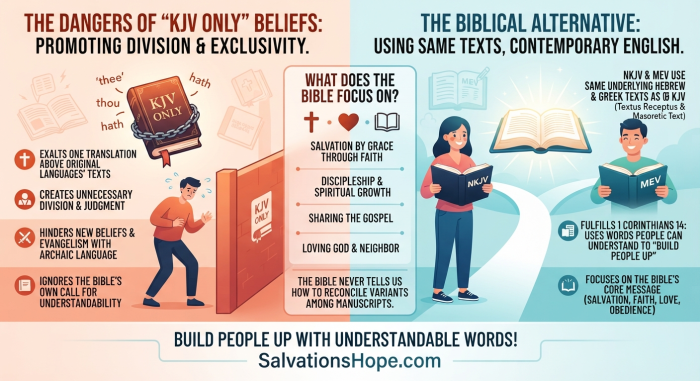
- Honor Their Underlying Texts (If Needed): If changing views on textual criticism proves too high a hurdle, point them toward modern faithful translations (such as the New King James Version or the Modern English Version) that utilize the exact same underlying Hebrew and Greek textual tradition they cherish, while rendering it in clear, modern English.
Ultimately, the Bible never provides a strict manual on how to reconcile complex manuscript variants, but it does explicitly tell us that if we wish to build people up, we must use words they can understand. When another believer’s conscience is entangled by tradition, the safest and most effective way to help them is by prying open that trap using what God actually said: Edification requires intelligibility.
Navigating the Boundaries of Scripture
In the rich tapestry of Christian history, few debates have caused as much unnecessary division within the English-speaking church as the phenomenon known as “KJV Onlyism.” While the fervor surrounding this movement has seen fluctuations over recent decades, its underlying theological errors continue to impact believers.
At its core, KJV Onlyism asserts that the King James Version (KJV) of 1611 is not merely a magnificent, historically significant translation, but rather the only truly inspired and preserved English Bible, often elevating it above the very Hebrew and Greek manuscripts from which it was translated. To evaluate this movement properly, we must examine its psychological roots, its theological contradictions, and the historical pattern of resistance that has accompanied every major shift in Bible translation throughout church history.
The Historical and Psychological Roots of the Movement
To understand why KJV Onlyism took root in the 20th century, we must look beyond complex textual criticism and examine human nature. Ecclesiastes 1-9 reminds us that “there is nothing new under the sun.”
When modern, meticulously researched English translations began flooding the market in the mid-to-late 20th century, a profound wave of discomfort swept through traditional congregations. Believers who had spent decades memorizing passages, anchoring their devotion, and structuring their preaching around the majestic cadences of the 1611 King James Version faced a daunting reality: learning a new vocabulary and adapting to updated phrasing.
Rather than acknowledging a natural human resistance to change—the simple reluctance to unlearn and relearn familiar texts—advocates began constructing elaborate theological defenses. Over time, these defensive arguments evolved into a rigid dogmatic system passed down through generations. What began as a preference for a beloved literary masterpiece hardened into a test of orthodox fellowship.
The Theological Fallacy: De Facto Re-Inspiration
The most critical theological error of strict KJV Onlyism is its logical endpoint. To maintain that the KJV is flawless and infallible, its advocates are forced into a theological corner: they must implicitly believe that God re-inspired the scriptures in 1611.
Consider the logical progression of the argument:
- The Claim: If any modern translation that departs from the KJV wording is deemed "corrupt," then the KJV is elevated to the status of an absolute standard.
- The Contradiction: If the KJV translators made even minor translational choices, editorial slips, or stylistic adjustments (which they undeniably did), claiming absolute perfection for their work requires believing that divine inspiration bypassed the original Hebrew and Greek autographs and settled directly upon King James's commissioned scholars.
- The Rejection of Scholarship: Even when moderate KJV proponents appeal to the Textus Receptus (the received Greek text compilation), their logic collapses when applied consistently. If the underlying manuscripts are the true standard, why do they vehemently oppose new translations derived from those very same manuscript families (such as the NKJV)?
Ultimately, strict KJV Onlyism demands an untenable view of revelation, suggesting that God locked His living Word inside the linguistic framework of 17th-century Jacobean England, barring subsequent generations from accessing the text in their own contemporary tongue.
A Historical Echo: The Cycle of Resistance to Translation
The hostility directed toward modern Bible translations is not unique to our era. Church history reveals a recurring pattern where defenders of an established translation view any new linguistic rendering as a threat to divine truth.
“When Jerome translated the Bible into Latin in the fourth century, he was accused of tampering with the sacred text by traditionalists who preferred the older Old Latin versions. Centuries later, when Jerome’s Latin Vulgate had itself become the entrenched institutional standard, those who attempted to update or translate it into the vernacular were branded as heretics—and some were executed.”
When the Reformation ignited a passion for vernacular translations, Reformers like William Tyndale insisted that God’s Word belonged in the common language of the people. Tyndale famously declared to a theological opponent that, if God spared his life, he would cause a boy that driveth the plough to know more of the scripture than the clergy did. For this “vulgarity,” Tyndale was betrayed, strangled, and burned at the stake.
KJV Onlyism commits the exact same historical error. By making a specific historical translation the exclusive custodian of divine truth, it mirrors the very institutional legalism that the Reformers fought against, substituting an English translation in place of the living voice of God speaking through the original languages.
The Principle of the Vernacular and the Nature of Scripture
Scripture itself testifies to the importance of communication in the common tongue. When the Holy Spirit descended at Pentecost, the message of God was declared not in an archaic, guarded liturgical language, but in the native dialects of the listeners gathered from every nation under heaven. The New Testament was written in Koine Greek—the everyday, common language of the marketplace, not the elevated classical Greek of elite literature.
When we approach the translation of the Bible today, several essential theological principles must guide us:
- Inspiration belongs to the Autographs: Historic orthodox Christianity maintains that verbal, plenary inspiration applies strictly to the original Hebrew, Aramaic, and Greek manuscripts penned by the prophets and apostles (2 Timothy 3:16).
- Translation is Interpretive Transfer: Because humans communicate in changing languages, translation is an ongoing task of transferring meaning accurately from the original languages into the current, living vocabulary of contemporary readers.
- Accessibility is a Divine Priority: God desires His Word to be understood. A translation that requires a glossary to comprehend 17th-century English idioms obscures the direct, piercing clarity that God intended for His message to have.
Embracing Fidelity Over Tradition
While the King James Version remains a monumental achievement in English literature and a faithful translation that God has used mightily for over four centuries, it is not the sole standard of divine truth.
Believers should feel entirely liberated to utilize careful, scholarly, and faithful modern translations that render the timeless truths of Scripture into the clear, current language of our day. We must reject the divisive legalism of KJV Onlyism, choosing instead to anchor our faith in the infallible original texts while celebrating the rich heritage of biblical translation that brings God’s Word to every tribe, tongue, and generation.
Where does the Bible ever teach that the King James Bible would be the version through which God would preserve His Word?
Did God Promise to Preserve His Word?
Is it a sin to use a Bible that has mistakes?
Why is the King James Version missing verses or parts of verses?
Why does the King James Version add verses or parts of verses?
Navigating Textual Variants
A Closer Look at Hebrews 1:6 and 1 John 5:7–8
For the Christian believer, the divine inspiration and reliability of Scripture are foundational. However, a deeper study of biblical transmission, manuscripts, and historical translations occasionally brings up challenging questions.
To grow in our understanding of God’s Word, it is helpful to examine how ancient texts were copied, preserved, and translated. Two notable passages—one involving an Old Testament quotation in the New Testament, and another concerning a disputed verse in the General Epistles—offer valuable insights into the science of textual criticism.
The Voice of the Septuagint: Hebrews 1:6
The author of the Epistle to the Hebrews frequently drew from the Old Testament to establish the supremacy of Christ. In Hebrews 1:6, while demonstrating the superiority of the Son of God over the angels, the writer states:
“And again, when he bringeth in the firstbegotten into the world, he saith, ‘And let all the angels of God worship Him.’” (Hebrews 1:6)
The Textual Challenge
A familiar difficulty arises here: while this text is clearly presented as an inspired quotation from the Old Testament, the exact phrase “And let all the angels of God worship Him” is not found in the standard Hebrew Old Testament (the Masoretic Text) traditionally used for modern English Old Testament translations.
Some readers point to Psalm 97:7 (“worship Him, all you gods”), but thematic similarities aside, the wording does not match precisely.
The Solution in the Ancient Manuscripts
The exact match for the Hebrews quotation appears in Deuteronomy 32:43 within the Septuagint (the ancient Greek translation of the Old Testament) and in a Hebrew manuscript variant discovered among the Dead Sea Scrolls (4QDeut).
- The Masoretic Text (Standard KJV Old Testament): Reads shorter, focusing primarily on God's judgment and mercy toward His people.
- The Septuagint and 4QDeut: Include an expanded reading that explicitly commands heavenly beings to worship God alongside the nations:"Rejoice, O heavens, with him, and let all the angels of God worship him..."
This demonstrates that New Testament writers often utilized the Septuagint, which reflected ancient textual traditions circulating among Greek-speaking Jews of that era. Far from undermining the authority of Scripture, this highlights the rich manuscript heritage God used to communicate His truths.
Additions and Removals
The Comma Johanneum (1 John 5:7–8)
Another prominent discussion in textual studies centers on the doctrine of the Trinity and 1 John 5:7–8. Critics of modern translations sometimes argue that alternative manuscript traditions intentionally removed key theological statements. A closer look at the historical evidence provides clarity.
Here is how the passage reads in translations that include the disputed phrasing:
“For there are three that bear witness in heaven: the Father, the Word, and the Holy Spirit; and these three are one. And there are three that bear witness on earth: the Spirit, the water, and the blood; and these three agree as one.” (1 John 5:7–8, emphasis added)
in heaven: the Father, the Word, and the Holy Spirit; and these three are one. And there are three that bear witness on earth:
The bolded portion is historically known as the Comma Johanneum. Textual notes in modern Bibles point out that these words do not appear in the earliest and most reliable Greek manuscripts.
Historical Facts Regarding the Text
- Late Appearance: The verse does not appear in any known Greek manuscript until the tenth century, and even then, only as a marginal note. It does not enter the running Greek text until the fourteenth century, with a notably altered wording.
- Erasmus and the Printed Text: When Desiderius Erasmus published his pioneering Greek New Testament in 1516, he omitted the phrase because it was absent from his Greek sources. He only agreed to include it in his third edition (1522) after intense pressure from ecclesiastical authorities, despite his own scholarly objections.
The Testimony of the Early Church Fathers
A vital theological takeaway is that the early church did not need this verse to defend the Trinity.
Countless theological debates took place during the first few centuries of Christianity. Saint Augustine, for instance, authored a monumental, multi-volume work titled De Trinitate (On the Trinity). Yet, neither Augustine nor any other ante-Nicene or post-Nicene church father ever quoted the Comma Johanneum in their extensive defenses of the Trinity.
They did not omit it; rather, they did not quote it simply because it was not part of the original text written by the Apostle John.
Confidence in God’s Preserved Word
Encountering textual variants can initially feel unsettling, but it ultimately strengthens our confidence in the Bible. The vast wealth of ancient manuscripts—numbering in the thousands—allows scholars to reliably reconstruct the original words of the biblical authors.
By studying Scripture with diligence, intellectual honesty, and reliance on the Holy Spirit, we gain a deeper appreciation for how God has faithfully preserved His Word across the centuries. Let’s face it, If God wanted to use a donkey to bring someone to the cross of Christ, I am sure He has the ability to do it. It is only God that can save anyone and it will only be through Jesus Christ and His atoning work on the cross.. It was Jesus who said this.
39 Search the scriptures; for in them ye think ye have eternal life: and they are they which testify of me. 40 And ye will not come to me, that ye might have life. 41 I receive not honour from men. 42 But I know you, that ye have not the love of God in you. 43 I am come in my Father’s name, and ye receive me not: if another shall come in his own name, him ye will receive. 44 How can ye believe, which receive honour one of another, and seek not the honour that cometh from God only? 45 Do not think that I will accuse you to the Father: there is one that accuseth you, even Moses, in whom ye trust. 46 For had ye believed Moses, ye would have believed me; for he wrote of me. 47 But if ye believe not his writings, how shall ye believe my words?