
Drinking the Cup
Suffering, Sacrifice, and Kingdom Greatness
The Weight of the Cup
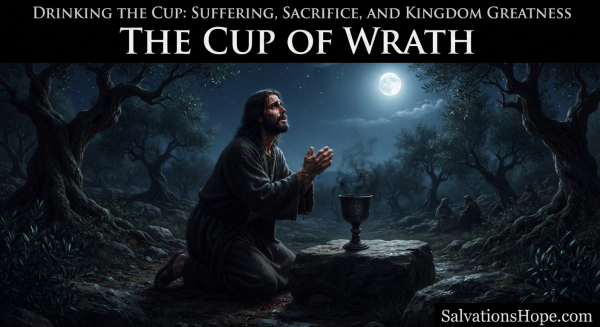
In the quiet, silvery landscape filled with deep shadows and ghostly, twisting shapes under the moonlight. Praying in the evening chilled olive groves of Gethsemane, the Savior of the world faced an hour of unmatched extreme emotional, spiritual, and physical anguish as he prepared to take upon himself the sins of the world.
According to the Gospel of Luke, Jesus experienced such intense psychological and physical stress that his sweat became like great drops of blood falling to the ground, a rare medical condition known as hematidrosis. Jesus told his disciples that his soul was “overwhelmed with sorrow to the point of death,” expressing profound grief and dread. The centerpiece of this profound agony was a single, terrifying metaphor: the cup.
When Jesus prayed, “My Father, if it is possible, may this cup be taken from me. Yet not as I will, but as you will” (Matthew 26:39), He was not simply shrinking from the physical torture of Roman crucifixion. He was recoiling at the horrific spiritual reality contained within that cup—the full, unmitigated fury of God’s wrath against human sin, which He was about to absorb in our place.
Throughout Scripture, few metaphors are as sobering or as consistently developed as the image of the “cup.” While culture often associates a cup with celebration, communion, or provision—as seen in Psalm 23 (“my cup overflows”)—biblical prophecy frequently employs the cup to symbolize divine judgment, holy indignation, and the inescapable consequences of human rebellion.
When God’s holiness collides with human sin, the metaphor of the cup illustrates how divine judgment is measured, administered, and ultimately endured. Understanding this motif deepens our appreciation of both the absolute justice of God and the staggering cost of redemption.
Old Testament Roots: The Cup of Divine Judgment
Isaiah and the City of Jerusalem
In Isaiah 51:17, the prophet issues a startling wake-up call to the covenant community:
“Wake yourself, wake yourself, stand up, O Jerusalem, you who have drunk from the hand of the Lord the
cup of his wrath, who have drunk to the dregs the bowl, the cup of staggering” (ESV).
Here, Jerusalem has experienced the destabilizing effects of divine discipline and judgment. The imagery of drinking “to the dregs” signifies total consumption—nothing of the judgment is left behind. The result is a “cup of staggering,” illustrating how divine judgment disorients, strips away human pride, and leaves nations utterly helpless. Sin produces a spiritual intoxication; those who rebel against God lose their footing, stumbling in moral and political confusion.
Jeremiah and the Nations
Expanding this horizon, Jeremiah 25:15–16 extends the cup beyond Jerusalem to the geopolitical landscape of the ancient Near East:
They shall drink and stagger and be crazed because of the sword that I am sending among them” (ESV).
God is portrayed as the sovereign Host, passing the cup of judgment from nation to nation. No human power is exempt from divine accountability. The “crazed” or delirious reaction of the nations underscores the terror of standing exposed before a holy God without a mediator.
Some say the concept of nations reacting with delirium or panic when confronting the divine or facing sudden collapse is a powerful theme found throughout theology, literature, and historical commentary, and many modern observers draw direct parallels to the current cultural and spiritual anxieties in America. This perspective often reflects the idea that a society experiencing deep moral or existential confusion is reacting to a loss of foundational truth or accountability.
When people come out in droves to support murderers like Lindsay Clancy just because her defense lawyers argue she suffered from a severe mental illness called postpartum psychosis—a rare condition where a new mother loses touch with reality. The case has deeply divided the public. Supporters do not view her actions through a standard criminal lens, while critics argue no excuse justifies the deaths of children.
In Texas a congresswoman is leading the voice of online activists enraged over the guilty verdict in Karmelo Anthony’s murder trial, and is spreading outright lies and racially inflammatory rhetoric after the 19-year-old was sentenced to 35 years in prison for stabbing Austin Metcalf to death.
An online fundraiser on GiveSendGo titled the “Help Karmelo Official Fund” raised nearly $634,000 ($633,908) to support his family and pre-trial needs after he was arrested for the April 2025 fatal stabbing of Austin Metcalf. To some this is madness, to others it is the wine of Wrath being poured out on a Nation that has turned it’s back on Christ Jesus. I know many Christian Non Profits that have never seen the first donation and they are feeding the homeless and hungry among us.
When Jesus looked into the spiritual horizon of the cross, He saw the cumulative guilt of humanity compressed into that divine cup. He knew He would have to drink it down to the very dregs.
Wrath
Why does Scripture use such intense imagery? The cup of God’s wrath is not an expression of arbitrary malice or capricious anger; rather, it is the necessary judicial response of a holy and just Creator.
- The Demand of Holiness: God’s holiness means He is entirely separate from and opposed to moral evil. Habakkuk 1:13 declares that God’s eyes are "too pure to look upon evil." He cannot tolerate, sweep under the rug, or ignore sin.
- The Demand of Justice: Because God is just, He must punish wrongdoing. As Paul writes in Romans 1:18, "The wrath of God is revealed from heaven against all ungodliness and unrighteousness of men." Wrath is the settled, righteous opposition of God's nature to everything that destroys His creation and rebels against His character.
This trajectory finds its final, eschatological expression in the book of Revelation, where the end-times tribulation culminates in “bowls” (a variation of the cup vessel) filled with the wrath of God being poured out upon an unrepentant earth (Revelation 16:1). Jesus willingly stepped into the dock as the accused, though He was entirely innocent, taking the punishment that humanity rightfully deserved. The agony in Gethsemane captured the terrifying prospect of bearing our sin, enduring emotional anguish, physical torment, and, worst of all, the momentary eclipse of fellowship with His Heavenly Father. Because Jesus drank the cup of judgment to its absolute finish, believers are forever spared from facing that wrath. His suffering secured our ultimate peace and redemption.
The Ultimate Turning Point: The Cup at Gethsemane
The true theological weight of the “cup of wrath” is only realized when we look to the New Testament and the Garden of Gethsemane. On the night before His crucifixion, Jesus Christ faced the ultimate cup:
let this cup pass from me; nevertheless, not as I will, but as you will'” (Matthew 26:39, ESV).
What was “the cup” Jesus dreaded? It was not merely physical suffering or the agony of Roman crucifixion; countless martyrs faced death with courage. The cup Jesus recoiled from was the cup of God’s wrath—the accumulated fury of divine judgment against the sin of all humanity, poured out without dilution. Now many of us when we look at that word humanity, for some reason we always look at everybody else.
The lesson we are supposed to get here is Jesus took upon Himself the divine judgement of the Father for our sin. Our own personal individual sin. So it is easy for me to see because of my sin, He was punished with the full weight of God’s wrath.
At Calvary, Jesus willingly drank the cup to its very dregs so that all who believe would never have to taste it. He who knew no sin became sin for us, absorbing the stagger, the judgment, and the separation we deserve.
The Son’s Cup Versus the Disciples’ Cup
Scripture makes a vital distinction between the cup Jesus drank and the cup experienced by His followers: “You will indeed drink from my cup,” Jesus told the disciples in Matthew 20:23, acknowledging that they, too, would face persecution, tribulation, and martyrdom.
However, the qualitative difference between their cups is infinite:
- The Disciples' Cup of Suffering: Believers throughout history face trials, opposition, and earthly suffering for the sake of Christ. This suffering refines character, deepens faith, and identifies us with our Savior, but it contains zero drop of divine wrath.
- Jesus’s Cup of Wrath: Jesus alone bore the judicial punishment for humanities sin.
Drinking the Cup of Discipleship
Long before Gethsemane, Jesus introduced this very concept of “the cup” in an unexpected dialogue recorded in Matthew 20:20–28.
Seeking political prominence and status in an earthly mindset, the mother of James and John approached Jesus, asking that her sons be seated at His left and right in His kingdom. In response, Jesus posed a piercing question to the brothers: “Are you able to drink the cup that I am to drink?” (Matthew 20:22).
Clueless about the profound depths of His mission, the brothers eagerly replied, “Yes, we are able.”
The Path of Sacrifice
Jesus used their naive ambition to reframe the entire structure of spiritual authority. When the other disciples grew indignant—jealous because they desired those same positions of honor—Jesus stepped in to redefine greatness entirely:
- Upside-Down Values: In God’s economy, accumulation is not achievement. Being served is not success, and human honor is not true greatness.
- The Path of Love: True kingdom impact is paved along the road of humble sacrifice, active service, and willing suffering.
- The Ultimate Example: Jesus reminded them of His own mission statement: "The Son of Man came not to be served but to serve, and to give his life as a ransom for many" (Matthew 20:28).
Golgotha: Draining the Dregs to Offer Fellowship
At Calvary, the ultimate theological exchange took place. Jesus drained God’s cup of burning anger down to the dregs. He did not sip it; He emptied it completely, leaving no drop of wrath for those who place their trust in Him.
As the Apostle Paul encapsulates this monumental reality in 2 Corinthians 5:21:
“For our sake he made him to be sin who knew no sin, so that in him we might become the righteousness of God.”
This substitutionary atonement alters the eternal destiny of the believer. Because Jesus drank the cup of wrath, we never will. Instead, the cup is permanently repurposed.
The Cup We Share Today
Where once there was a cup of terrifying judgment, God now extends the cup of eternal fellowship. Our earthly lives may still involve trials, but our ultimate portion is the sweet, unbroken, and satisfying communion with the Creator through the indwelling Holy Spirit. This transformed reality demands a response. We partake of this cup in remembrance of His sacrifice, and we turn outward to a watching world. With urgent mercy, we echo the invitation: Come, drink this cup of grace with us, because Jesus already drank the cup of wrath for us.
To follow Jesus is to step onto the path of His self-giving love. While we will never drink the cup of atoning wrath—a task belonging to Christ alone—we are called to share in the “cup” of His self-denial, enduring hardship, serving others selflessly, and laying down our lives for the advancement of His Gospel.
Key Thought: True greatness in the kingdom of God is never found in sitting above others, but in kneeling to wash their feet.
How is God calling you to embrace the path of service and sacrifice in your everyday relationships this week?