The Crisis of Spiritual Starvation
The Anatomy of Holy Hunger
In an era characterized by unprecedented technological connectivity yet profound spiritual isolation, the contemporary Church faces a silent crisis. Despite possessing vast libraries of theological literature, sophisticated digital tools for biblical exposition, and orthodox doctrinal statements, many believers experience a deep, aching void.
For the vast majority of modern humanity, including many seated within the pews of our churches week after week, God remains an abstraction—a theological deduction rather than a living, breathing reality. To the secular mind, God is an inference derived from cosmological complexity or moral necessity; people look at the universe, conclude that “He must be,” and file that premise away as an intellectual convenience. Others know Him merely by hearsay, inheriting a creed the way one inherits family heirlooms without ever personally examining them. To a philosophical elite, He is reduced to an impersonal ideal—a synonym for goodness, abstract truth, beauty, or the primal creative impulse humming beneath the surface of natural phenomena.
While these notions vary wildly in texture, they share a catastrophic common denominator: the total absence of experiential encounter. The revolutionary biblical proposition that God can be intimately, personally, and consciously known has scarcely crossed the threshold of their minds. Even within nominal Christianity, where creeds explicitly affirm the personality of God and the intimate address of the Lord’s Prayer (“Our Father, which art in heaven”), millions live practical atheism. They drift through life trying to love an ethical ideal and remain loyal to a bloodless theological principle, entirely divorced from the burning, luminous center of divine fellowship.
“Blessed are those who hunger and thirst for righteousness, for they shall be satisfied.” — Matthew 5:6
At the heart of genuine revival is a sacred discontent. While secular culture seeks fulfillment in materialism, and nominal religion seeks comfort in cultural routine, the Holy Spirit awakens a different impulse within the regenerate heart:
- Rejection of Empty Formalism: Spiritually awakened believers refuse to be pacified by theological jargon, programmatic church growth strategies, or intellectualized sermons that lack unction.
- The Thirst for the Living God: Drawing from Psalm 42:1—"As a deer pants for flowing streams, so pants my soul for you, O God"—this hunger transcends a desire for blessings; it is a relentless pursuit of the Blesser Himself.
- Experiential Knowledge: Echoing Ephesians 3:19, the soul yearns to "know the love of Christ that surpasses knowledge," moving from abstract dogma to the transformative taste of divine grace.
The Dilemma of Orthodoxy Without Presence
A critical danger facing the modern pulpit is the separation of orthodoxy from orthopathy (right affections) and orthopraxy (right living). Correct doctrine is the indispensable skeleton of the Christian faith, but a skeleton alone is a corpse.
- The Limit of Instruction: Many congregations are expertly taught the fundamentals of the faith year after year, yet remain spiritually undernourished because instruction is divorced from encounters with the manifest Presence of God.
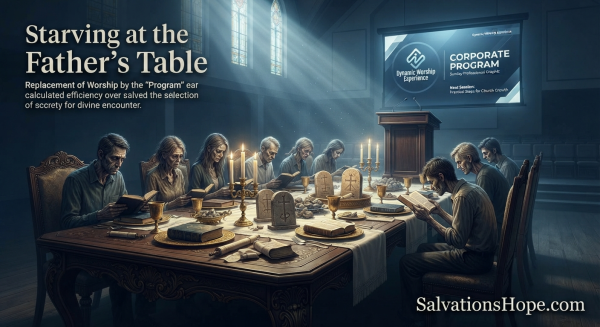
- Starving at the Father's Table: It is a tragic irony that believers possessing accurate biblical knowledge can suffer from severe spiritual malnutrition, sitting amidst abundance while failing to feed upon Christ, the Bread of Life (John 6:35).
- The Replacement of Worship by the "Program": When the experiential art of worship is lost, it is frequently replaced by the calculated efficiency of the stage performance or the corporate program, substituting human entertainment for divine encounter.
The Proper Role of Scripture
To restore true worship, we must recover the proper theological understanding of the Holy Scriptures. The Bible is not an academic textbook designed merely to be dissected; it is the living voice of the Creator calling His children into fellowship. Sound biblical exposition is an absolute prerequisite for a New Testament church. However, exposition functions as a map, not the destination. In John 5:39-40, Jesus rebuked the religious leaders: “You search the Scriptures because you think that in them you have eternal life; and it is they that bear witness about me. Yet you refuse to come to me that you may have life.” The ultimate goal of studying Scripture is to bring the believer into an intimate, satisfying, and transforming knowledge of God, where His presence becomes the center of human joy.
Following Hard After God
The Pursuit of the Divine
“My soul followeth hard after thee: thy right hand upholdeth me.” — Psalm 63:8
The Christian life begins not with human initiative, but with divine excavation. When the soul begins its ascent toward the Creator, it does so entirely because an antecedent grace has sparked the flame. As Jesus declared, “No man can come to me, except the Father which hath sent me draw him” (John 6:65). This divine drawing strips away human boasting, ensuring that the credit for redemption belongs solely to God.
Yet, this sovereignty does not negate human agency; rather, it empowers it. The divine “upholding” and the human “following” coexist without contradiction.
- The Divine Prerogative: God initiates the desire, plants the spiritual seed, and sustains the believer underneath His righteous right hand.
- The Human Responsibility: The believer actively pursues God, echoing the desperate cry of the Psalmist: "As the hart panteth after the water brooks, so panteth my soul after thee, O God" (Psalm 42:1).
In the economy of grace, God’s prior working meets man’s present, active response. This is the heartbeat of deep spiritual communion—the Creator calling to the creature, and the redeemed heart answering the call.
Rescuing Justification from Mechanization
A major crisis in modern evangelicalism is the reduction of justification by faith into a cold, mechanical transaction. While justification is a glorious, biblical truth that frees believers from legalism and self-effort, it has frequently been divorced from transformational vitality. Many treat faith as a purely forensic exercise that requires no moral shock, no re-ordering of affections, and no burning love for Christ. Believers are often taught to be satisfied with minimal spiritual appetite, resting secure in a static salvation while remaining entirely unthirsty for the living God. When religion becomes a sterile formula, the vibrant, personal nature of our faith is lost. Modern Christians are in severe danger of idolizing the Word of God while losing sight of the Person of God.
God is a Living, Knowable Person
Religion, at its core, is the dynamic response of created personalities to the ultimate Creating Personality. God is not a cosmic abstraction, a philosophical proposition, or a theological system; He is a living Person who thinks, wills, feels, desires, loves, and communicates.
“This is life eternal, that they might know thee the only true God, and Jesus Christ, whom thou hast sent.” — John 17:3
Because we are made in His image, our inner faculties—mind, will, and emotion—serve as the bridges for divine communion. Regeneration by the Holy Spirit awakens our dormant spiritual senses, allowing us to recognize our divine kinship. However, new birth is merely the launching pad. It is the inception of an endless, joyful exploration into the infinite, bottomless depths of the Triune Godhead.
The Paradox of the Burning Heart
To find God and yet continuously pursue Him is the ultimate paradox of Christian love. Those touched by grace experience a holy dissatisfaction that deepens with every encounter. As St. Bernard aptly captured:
“We taste Thee, O Thou Living Bread, / And long to feast upon Thee still: / We drink of Thee, the Fountainhead / And thirst our souls from Thee to fill.”
Scripture is replete with saints whose lives were defined by this holy restlessness:
- Moses: Having already experienced divine favor, he boldly petitioned, "I beseech thee, show me thy glory" (Exodus 33:18), a request that delighted the heart of God.
- David: His psalms oscillate seamlessly between the anguish of the seeker and the triumphant joy of the finder.
- Paul: He counted all earthly achievements and securities as absolute refuse compared to the supreme excellency of knowing Christ Jesus his Lord (Philippians 3:8).
Tragically, modern church culture often treats the initial act of “accepting” Christ as the terminal point of the journey, discouraging believers from craving further revelations of His glory. We have substituted experiential communion with a smug, intellectualized orthodoxy.
Overcoming Religious Complexity for Ultimate Simplicity
Contemporary church life is heavily plagued by institutional complexity, frantic programming, and worldly methodologies. These busy activities occupy time while starving the soul. The shallowness of modern worship is a direct result of our departure from acute, desperate spiritual desire.
- The Shallow Modern Approach: Focuses on mechanical conversion and static assurance, relies on complex programs, metrics, and methods, settles for knowing about God intellectually.
- The Biblical Path of the Burning Heart: Pursues continuous, unceasing fellowship with God, embraces the guileless candor and simplicity of childhood, demands to experience and taste the glory of God.
When we strip away religious externals and return to a childlike, undivided focus on God, we find that we lose nothing by making Him our absolute All. Like the tribe of Levi—who received no territorial inheritance in Canaan because God Himself was their portion—the believer who possesses God possesses all things purely, legitimately, and eternally.
The Blessedness of Possessing Nothing
The Original Design and the Tragedy of Misplaced Sovereignty
In the prologue of redemptive history, the Genesis narrative reveals a Creator who meticulously prepared a habitation of stunning beauty and abundant utility before introducing humanity to the cosmos. Every created object—every tree yielding fruit, every mineral of worth, and every living creature—was designed to be an external blessing, a token of divine benevolence meant to sustain and delight the human vessel.
At the core of human architecture was a sacred enclosure, an internal sanctuary intended exclusively for the divine presence. Within man dwelt God; without man were a thousand secondary gifts.
The catastrophe of the Fall inverted this holy architecture. Sin dethroned the Creator from the central shrine of the human heart, allowing created things to usurp His authority. This shift birthed a profound existential restlessness. Because God is no longer crowned within, humanity seeks substitute monarchs, developing an artificial, bondage-producing dependency on external possessions. The Apostle Paul identifies this distorted priority in Romans 1:25, noting that fallen humanity exchanged the truth of God for a lie, worshiping and serving the creature rather than the Creator. This monstrous substitution upends the natural order, turning divine provisions into idols that tyrannize the soul.
The Tyranny of the Self-Life and the Necessity of the Cross
Our Lord Jesus Christ unmasked this spiritual enslavement when He issued the foundational mandate of discipleship in Matthew 16:24-25:
For whosoever will save his life shall lose it: and whosoever shall lose his life for my sake shall find it.”
Within every unregenerate or partially surrendered heart lurks an insidious enemy: the self-life. Defined by an insatiable instinct for acquisition, retention, and self-preservation, the self-life measures value through the vocabulary of profit, gain, and accumulation. To tolerate this internal usurper is to forfeit ultimate spiritual vitality. Conversely, to repudiate it through radical surrender is to preserve everything unto eternal life.
The Paradox of Kingdom Economics: True spiritual acquisition is exclusively unlocked through radical renunciation. To keep is to lose; to surrender is to keep eternally.
The singular instrument designed by God to dismantle this possessive ego is the Cross. The Cross does not merely reform the self-life; it executes it. Entering into the deeper knowledge of God requires traversing the lonely, humbling valleys of soul poverty, where the believer strips away every illusion of autonomy and self-mastery.
The Anatomy of the "Poor in Spirit"
“Blessed are the poor in spirit: for theirs is the kingdom of heaven.” — Matthew 5:3
The “poor in spirit” are not those suffering from material poverty, nor those lacking psychological confidence. They are individuals who have systematically rooted out of their inner life every sense of independent ownership. Having broken the yoke of the oppressor not through carnal warfare, but through absolute surrender, they experience a revolutionary paradox: though possessing nothing, they inherit everything.
The Three Dimensions of Renunciation:
- Material Treasures: Fear often paralyzes believers from releasing physical possessions, particularly loved ones, into God's sovereign care. Yet, divine logic dictates that nothing is genuinely safe except that which is unreservedly committed to the Redeemer.
- Talents and Abilities: Natural gifts, intellectual capacities, and artistic skills are divine loans, never personal achievements. As the Apostle Paul asks in 1 Corinthians 4:7, "What hast thou that thou didst not receive?" Claiming intrinsic credit for these traits violates the fundamental posture of creaturely dependence.
- The Ego: The hardest fortress to dismantle is the human ego, which constantly demands self-defense, justification, and autonomy before both God and humanity.
Practical Steps Toward Radical Surrender
When the awakened conscience recognizes the symptoms of the “possession malady,” passivity becomes spiritually fatal. A deliberate, unsparing course of action must be undertaken.
- Abandon Self-Defense: Cease all attempts at self-justification before God or humanity. Whoever defends himself relies on a frail human shield, but the defenseless soul receives Almighty God as its ultimate defender.
- Engage in Holy Business: Treat this transaction with the utmost solemnity. Casual religion cannot purge deep-seated idolatry. Approach the throne of grace with a holy stubbornness, demanding that God sweep clean the temple of the heart.
- Be Specific: General confessions yield general victories. The seeker must name specific idols, possessions, relationships, and ambitions one by one, handing them over explicitly to the Lord.
The Agony of Cleansing and the Dawning of the Light
Divine transformation is rarely painless. The deep-rooted attachment to things is woven into the fabric of our fallen nature. The “tough old miser” residing within does not quietly expire; he must be uprooted with holy violence, expelled from the sanctuary of the soul just as Christ forcefully cleansed the Jerusalem temple of the money changers. Believers must steel themselves against the deceptive whispers of self-pity, recognizing them as resistance from a dying ego.
Those who press on through this testing place discover a profound interior transformation. When the heart is emptied of rivals, the Divine Inhabitant fills the vacuum with His uncreated light, turning the inner sanctuary into a radiant dwelling place of glory.
Removing the Veil
Entering the Holy Presence of God
“Having therefore, brethren, boldness to enter into the holiest by the blood of Jesus.” (Hebrews 10:19)
Among the most enduring and profound declarations of the ancient Church is the timeless confession of Saint Augustine: “Thou hast formed us for Thyself, and our hearts are restless till they find rest in Thee.”
At the foundation of Christian ontology is the truth that humanity was designed specifically for divine pleasure and intimate communion. We were fashioned so that Creator and creature might experience the sweet, mysterious mingling of kindred personalities. God intended for humanity to gaze upon His glory, walk in fellowship with His counsel, and draw the very breath of life from His smile. Yet, through the tragedy of the Fall, humanity broke covenant with its Maker. Driven by guilt, fear, and rebellion, mankind fled as far as possible from the immediate, manifest Presence of God, plunging human history into a state of profound and unceasing spiritual displacement.
The Tragedy of the Exiled Soul and the Work of Redemption
While the omnipresence of God remains an inescapable reality—as the Psalmist and prophets attest, His Spirit fills the cosmos—the manifest Presence is an altogether different reality. Adam fled this luminous Presence to hide among the trees of the garden, and every human heart since has inherited that same spiritual exile. The earthly life of man, severed from the blissful center of divine fellowship, is the true root cause of universal restlessness.
The entire redemptive arc of Scripture is God’s sovereign initiative to undo this catastrophic revolt. Redemption is not merely a legal transaction calculated to secure a future heavenly destiny; it is the divine rescue operation designed to bring fallen man back into conscious, vibrant, and eternal relationship with God. This divine restoration required:
- The Judicial Remedy: The complete and satisfactory disposal of sin through substitutionary atonement.
- The Relational Bridge: The opening of a new and living way back into conscious communion with the Holy One.
- The Internal Drawing: The secret, gracious working of the Holy Spirit within the human heart, awakening a holy nostalgia that prompts the cry, "I will arise and go to my Father."
The Typology of the Tabernacle: Progressing Into the Holy of Holies
The interior journey of the soul from the spiritual wilderness into the enjoyed Presence of God finds its ultimate Old Testament illustration in the desert Tabernacle.
- The Outer Court: The returning sinner first encountered the brazen altar of blood sacrifice and the laver of cleansing water. Here, justification and regeneration were prefigured.
- The Holy Place: Passing through the first screen, the worshipper entered a place devoid of natural light, illuminated solely by the golden candlestick (Christ, the Light of the World), nourished by the shewbread (Christ, the Bread of Life), and enveloped by the sweet-smelling altar of incense (unceasing intercession). Yet, despite these profound spiritual blessings, the worshipper remained outside the inner sanctuary.
- The Holy of Holies: Separated by a thick, heavy veil dwelt the Shekinah glory—the very dwelling place of Almighty God. Under the old covenant, access was strictly forbidden to all save the high priest, and that only once a year with blood.
When Jesus yielded up His spirit on Calvary, the miraculous rending of the Temple veil from top to bottom tore open the way. The writer of Hebrews affirms that this opened path is not reserved for a spiritual elite, but is the birthright of every believer who comes by the blood of Jesus. God’s ultimate design is that ransomed men and women should push past hesitation, enter the Holy of Holies, and live their entire lives within the conscious, experiential awareness of His Presence.
Encountering the Transcendent Trinity
Behind the veil stands God in His uncreated, dazzling perfection. Christian theology confesses this transcendent reality through the historic creeds and the infallible Word: One God in Trinity, and Trinity in Unity. He is the Father Almighty, the eternal Son begotten before all worlds, and the Holy Ghost, the Lord and Giver of life.
Consider the vast attributes of the Godhead that invite the soul into endless exploration:
- Eternity: He antedates time, existing wholly independent of it; time begins and ends in Him, untouched by change or decay.
- Immutability: He cannot change, for being absolute perfection, He cannot improve nor diminish.
- Omniscience: He comprehends all matter, spirit, and event in one effortless, eternal act of pure knowing.
- Ineffable Holiness: A purity so intense that earthly metaphors fail, symbolized throughout Scripture by sacred, unconsuming fire—from the burning bush and the wilderness pillar of cloud to the tongues of flame at Pentecost.
True knowledge of this glorious God cannot be reduced to a dry, intellectual orthodoxy. Because God is Spirit, He must be apprehended by the spirit of man. Those rare saints throughout church history who spoke with true spiritual authority—the authentic prophets rather than the academic scribes—did so because they had penetrated the veil and gazed upon the majesty of Deity with the eyes of the heart.
The Internal Obstacle: The Veil of the Self-Life
If the veil of separation has been miraculously torn from God’s side, and if experiential communion is freely available to every child of God, why do so many believers languish in the outer courts? Why do decades pass while Christians remain spiritually dry, cold, and exhausted?
The true hindrance is rarely mere emotional coldness; it is the presence of a second, unbroken veil residing within the human heart. This is the veil of the unjudged, uncrucified self-life.
These subtle, deeply ingrained traits are not merely actions we commit, but the very disposition of our fallen nature. Shockingly, the self-life can thrive even within orthodox circles. It can study theology, champion historical creeds, defend the faith, and even simulate a longing for revival while secretly feeding its own ego. Self can watch the bleeding Sacrifice die on Calvary without experiencing genuine transformation, using religious activity as a cloak for self-promotion.
The Way Through: The Operation of the Cross
This opaque veil of self cannot be educated away, reformed, or dismantled through human cleverness. It demands radical surgical intervention by the Spirit of God. We must invite the cross to execute its deadly, definitive work within our inner life. We must actively bring our self-righteousness, self-love, and self-sufficiency to the judgment seat of Christ. Once the self-life is reckoned crucified, the pain of the process is swallowed up in the overwhelming joy of resurrection life. The inner veil is gone, replaced by the unbroken, luminous reality of fellowship with the living God.
The Biblical Standard of Immediate Apprehension
Against this pale backdrop of cloudy vagueness stands the robust, unapologetic witness of Holy Scripture: God can be known in personal, immediate experience.
The God of the Bible is not a distant clockmaker or a philosophical abstraction; He is a loving Personality who walks among the trees of the garden, breathes fragrance over the landscape of human history, and manifests His presence wherever receptive hearts make room for Him. The Scriptures treat the knowledge of God not as a mystical impossibility, but as a self-evident reality perceivable with the same immediate certainty as any physical object in our environment.
Notice the robust sensory language employed by the Holy Spirit throughout the biblical text:
- Taste: "O taste and see that the Lord is good" (Psalm 34:8).
- Smell: "All thy garments smell of myrrh, and aloes, and cassia, out of the ivory palaces" (Psalm 45:8).
- Hearing: "My sheep hear my voice, and I know them, and they follow me" (John 10:27).
- Sight: "Blessed are the pure in heart: for they shall see God" (Matthew 5:8).
These passages are not poetic hyperbole; they are descriptions of the human soul operating as it was originally designed to function. Just as the body possesses physical senses to navigate the material world, the human constitution possesses spiritual faculties—inner organs of perception—endowed for the express purpose of apprehending God.
The Pathology of Unbelief and the Awakening of Regeneration
If spiritual faculties are native to human creation, why do believers experience such profound spiritual dullness and wander through long seasons of dryness?
The root problem is twofold: the inherited paralysis of the Fall and the chronic unbelief of the believer.
- The Fall and Regeneration: By virtue of our rebellion in Adam, a spiritual stroke fell upon the human race. The spiritual faculties of the unregenerate man lie dormant, asleep, and effectively dead to the divine realm. However, through the atoning work of Jesus Christ on the cross and the regenerative power of the Holy Spirit, those dead faculties are quickened back to active life.
- The Paralysis of Unbelief: Even among the ransomed children of God, habitual conscious communion is rare. Why? Because of chronic unbelief. Faith is the vital element that allows our spiritual senses to function; where faith is weak or defective, spiritual numbness and insensibility follow.
A spiritual kingdom encloses us on every side, entirely within reach of our inner selves. God Himself is present, waiting for our conscious response. The eternal world flashes into vivid color the moment we stop doubting and begin to reckon upon its absolute reality.
Defining Reality—The Seen versus the Unseen
To understand the life of faith, we must define what we mean by reality.
- True Reality: That which has existence apart from any idea our minds may entertain concerning it. It does not depend on the observer for its validity; it would exist even if every human mind were extinguished.
- God as the Ultimate Reality: God is real in an absolute and final sense that nothing else is. All created reality is contingent upon Him. The worshipping soul does not create its Object through imagination; it finds Him already there upon waking from moral slumber.
The Trap of the World of Sense
Why do we struggle to perceive this ultimate reality? Because we have formed catastrophic thought habits. The visible, physical world is clamorous, insistent, and self-demonstrating. It assaults our five senses day and night, demanding to be accepted as the final standard of truth.
Because sin has clouded the lenses of our hearts, the visible becomes the mortal enemy of the invisible. The temporal crowds out the eternal. To live the Christian life successfully, we must break the habit of ignoring the spiritual and shift our entire orientation from the seen to the unseen, anchoring our souls in the premier axiom of faith:
“He that cometh to God must believe that he is, and that he is a rewarder of them that diligently seek him” (Hebrews 11:6).
Practical Application—Practicing the Presence of God
How do we transition from a theoretical faith to an experimental, vibrant apprehension of God?
1. Understand the Nature of Faith: Faith is not imagination or positive visualization. Imagination projects unreal human constructs out of the mind; faith creates nothing, but simply reckons upon what God has already established in the spiritual realm.
2. Cultivate Spiritual Perception: Just as physical eyes adjust to the dark when we step away from blinding lights, our inner eyes must be retrained. Through deliberate obedience to Christ’s commands (such as John 14:21-23), the Holy Spirit brings an inward revelation of the Godhead.
3. Shift Your Focus Daily: Intentionally quiet the clamor of the physical senses. Acknowledge God’s immediate presence in your workspace, your home, and your quiet moments. Let a new “God-consciousness” seize your mind until His presence becomes the defining wonder of your existence.
God is not hiding behind a veil of impenetrable mystery; He is pressing against the boundaries of our consciousness, waiting for us to open the eyes of our hearts. As our spiritual faculties grow sharper through use, God ceases to be a theological hypothesis and becomes our supreme treasure—our life, our breath, and our all.
O God, quicken to life every power within me, that I may lay hold on eternal things. Open my eyes that I may see; give me acute spiritual perception; enable me to taste Thee and know that Thou art good. Make heaven and Thy presence more real to me than any earthly thing has ever been. I repent of my sinful preoccupation with the visible, passing things of this world. The noise of this life has been too loud within me. Thou hast been here all along, and in my blindness, I knew it not. I confess my dullness toward Thy majestic Presence. Open the eyes of my heart that I may behold Thee—not just in distant heavens, but moving and working in and around me. Remake my inner life, restore my spiritual receptivity, and draw me into deeper, unhindered fellowship with Thyself. For Christ’s sake, Amen.