
The Supreme Gift
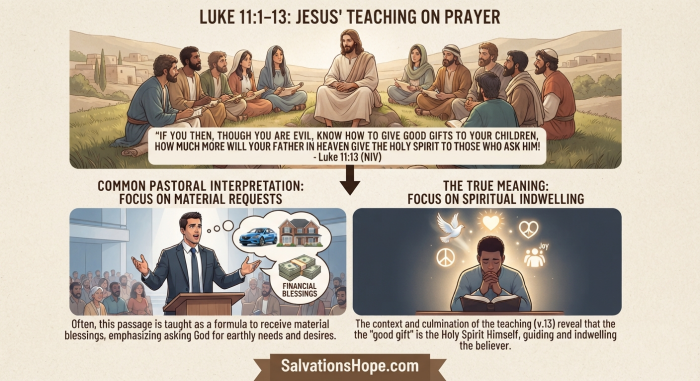
Understanding True Prayer Through Luke 11:1-13
11 And it came to pass, that, as he was praying in a certain place, when he ceased, one of his disciples said unto him, Lord, teach us to pray, as John also taught his disciples. 2 And he said unto them, When ye pray, say, Our Father which art in heaven, Hallowed be thy name. Thy kingdom come. Thy will be done, as in heaven, so in earth. 3 Give us day by day our daily bread. 4 And forgive us our sins; for we also forgive every one that is indebted to us. And lead us not into temptation; but deliver us from evil. 5 And he said unto them, Which of you shall have a friend, and shall go unto him at midnight, and say unto him, Friend, lend me three loaves; 6 For a friend of mine in his journey is come to me, and I have nothing to set before him? 7 And he from within shall answer and say, Trouble me not: the door is now shut, and my children are with me in bed; I cannot rise and give thee. 8 I say unto you, Though he will not rise and give him, because he is his friend, yet because of his importunity he will rise and give him as many as he needeth. 9 And I say unto you, Ask, and it shall be given you; seek, and ye shall find; knock, and it shall be opened unto you. 10 For every one that asketh receiveth; and he that seeketh findeth; and to him that knocketh it shall be opened. 11 If a son shall ask bread of any of you that is a father, will he give him a stone? or if he ask a fish, will he for a fish give him a serpent? 12 Or if he shall ask an egg, will he offer him a scorpion? 13 If ye then, being evil, know how to give good gifts unto your children: how much more shall your heavenly Father give the Holy Spirit to them that ask him?
The dynamic of prayer is one of the most transformative elements of the Christian life. In Luke 11:1-13, we are granted a profound window into the heart of communion with God. When the disciples witnessed Jesus praying, they were gripped by a holy desire not just for religious mechanics, but for a living, breathing connection with the Divine. Their request—“Lord, teach us to pray”—initiates a divine tutorial that radically redefines what we ought to seek when we approach the throne of grace.
The Request for Bread and the Reality of Human Need
In the central parable of this passage (verses 5–8), Jesus tells the story of a man going to his friend at midnight to ask for three loaves of bread to feed an unexpected traveler. I find two things here that really stick out.
- The Midnight Hour: Midnight symbolizes the dark, desperate, and helpless moments of human experience where earthly resources fail.
- The Request for Sustenance: The petitioner asks for bread—a fundamental symbol of provision, life, and survival.
When Jesus transitions from this earthly parable to spiritual realities in verses 9–13, He uses the imagery of children asking their earthly fathers for food: a loaf of bread, a fish, or an egg. Human instinct ensures that a father will never mock a starving child by handing them a stone, a venomous snake, or a stinging scorpion.
Shifting the Horizon: From Material Bread to the Holy Spirit
It is easy to read verses 9–13 (“Ask, and it shall be given you”) through a modern, material lens. Many approach this text with a consumerist mindset, treating God as a cosmic vending machine designed to dispense financial wealth, career success, or temporary comforts.
In contemporary Christian culture, the profound petition of Luke 11:3—“Give us each day our daily bread”—is frequently co-opted by a prosperity-driven theology. All too often, modern pastors use this verse to preach messages centered on material provision, financial breakthroughs, career success, and earthly comfort. Believers are told to treat God as a cosmic provider of commodities, praying expectantly for physical blessings, luxury, and debt relief.
However, divorcing this passage from its immediate literary and theological context trivializes the entire teaching of Christ. When read through the lens of first-century Jewish expectation and Luke’s broader theological narrative, it becomes clear that Jesus was not teaching His disciples how to secure groceries or financial stability. Instead, He was using physical sustenance as a vivid metaphor to point toward the ultimate spiritual necessity: the life-giving gift of the Holy Spirit.
However, Jesus provides the definitive interpretation and climax of His own teaching in verse 13:
The Context of Luke 11: Bread, Ask, and the Ultimate Gift
To understand what Jesus meant by “daily bread,” we must examine the progression of Luke 11:1–13. The passage begins with the disciples watching Jesus pray and asking a pivotal question: “Lord, teach us to pray.” Jesus responds by giving them a concise model of prayer, culminating in the request for daily bread.
Crucially, Jesus immediately follows the prayer with a parable about persistence: the story of a man waking his sleeping friend at midnight to ask for three loaves of bread for an unexpected guest. On the surface, this looks like a lesson on persistence in asking God for physical needs. Yet, Jesus dramatically shifts the meaning of the parable’s conclusion in verse 13:
how much more shall your heavenly Father give the Holy Spirit to them that ask him?”
Here lies the ultimate theological revelation of the passage: The definitive, supreme answer to the prayer of faith is not money, physical comfort, or material accumulation—it is the person and power of the Holy Spirit. The Spirit gives life and sustenance is the Bread Of Life, Jesus Christ
Why the Holy Spirit is God's Ultimate Good Gift
- The Spirit Satisfies the Deepest Hunger: Just as physical bread sustains the physical body for a season, the Holy Spirit satisfies the eternal hunger of the human soul. Temporary wealth decays, but the indwelling Spirit provides rivers of living water that never run dry.
- The Spirit Aligns Us with the Father: Money cannot change a rebellious heart, but the Holy Spirit transforms us from the inside out, writing God’s law on our hearts and minds and enabling us to cry out, “Abba, Father” (Romans 8:15).
- The True Meaning of “Daily Bread”: When Jesus teaches us to pray for “our daily bread” (verse 3), He is acknowledging our daily dependence on God for physical life, but He elevates our ultimate pursuit toward spiritual vitality. The greatest provision God can give a believer facing the trials of midnight is His own supernatural presence, guidance, strength, and comfort. God, The Holy Spirit.
Notice the striking substitution. In the parable, the persistent man asks for bread. But in the theological application, Jesus identifies the ultimate gift God gives in response to persistent prayer as the Holy Spirit. The “bread” that sustains us day by day is not harvested from physical fields; it is divine life imparted by the Spirit of God.
The Scriptural Echo: Manna and Spiritual Sustenance
Jesus’ use of bread as a metaphor for spiritual life is deeply rooted in the Old Testament. In the wilderness, God sustained the Israelites with physical manna (Exodus 16). Yet, as Moses later explained in Deuteronomy 8:3, physical bread served a deeper theological purpose: “He humbled you, causing you to hunger and then feeding you with manna… to teach you that man does not live on bread alone but on every word that comes from the mouth of the Lord.”
When Jesus declared in John 6:35, “I am the bread of life,” He explicitly rejected the crowd’s desire for physical food and directed their hunger toward eternal realities.
Therefore, praying for “daily bread” in Luke 11 is an act of spiritual dependence. It is a daily acknowledgment that our souls cannot survive on earthly achievements, wealth, or comfort. We require a fresh, daily indwelling and empowering of the Holy Spirit. Just as the Israelites gathered manna fresh every morning because it spoiled overnight, believers must daily seek the renewing presence of the Spirit, recognizing that yesterday’s spiritual experience cannot sustain today’s spiritual warfare.
Moving Beyond Prosperity Theology
When pastors reduce Luke 11 to a formula for material acquisition, and most do, several theological errors occur:
- It flattens the Gospel: It turns the radical call of discipleship into a transaction for earthly comfort, mirroring secular consumerism rather than cross-bearing faith.
- It misinterprets Scripture: It ignores Luke's specific editorial emphasis in verse 13, where the Holy Spirit is explicitly identified as the supreme gift of the Father.
- It breeds disillusionment: When believers are taught that faithful prayer guarantees material prosperity, they face profound spiritual crises when hardship, poverty, or illness strikes.
By contrast, recovering the true meaning of the text liberates believers from the endless pursuit of materialism. It aligns our prayers with the heart of God, who is infinitely more eager to give us Himself than He is to grant us temporary earthly luxuries.
As the Church today, we must heed the warning of Christ and elevate our corporate and private prayer lives. When we pray “Give us each day our daily bread,” we are crying out for sustenance that transcends the temporal realm. We are asking the Father to fill us afresh with His Spirit, to empower our weakness, to comfort our grief, and to guide our steps in holiness.
Let us reject the shallow promises of a gospel of comfort and instead hunger for the only reality that truly satisfies: the living, transforming presence of the Holy Spirit.
Prayer is the vital breath of the Christian life, yet it is also one of the most frequently misunderstood and misapplied practices in the modern church. Luke 11:1-13 records Jesus teaching His disciples how to pray, culminating in the parable of the persistent friend and the well-known promises of asking, seeking, and knocking.
Tragically, this passage is sometimes hijacked by aberrant teaching. Certain ministries and teachers twist these verses into a “formula” or a spiritual transaction—treating God like a magical entity whose will can be coerced if we just use the right words, maintain the right emotional pitch, or pray with enough repetition.
The Danger of "Magical Prayer" in Modern Pulpits
The most dangerous corruption of Luke 11 is teaching that prayer operates on spiritual “laws of attraction” or coercive mechanics. This error manifests in several ways:
- The Formulaic Trap: Treating phrases like "asking, seeking, knocking" (Luke 11:9–10) as a magical code. The underlying false premise is: If you push the right button three times, God is legally or spiritually obligated to dispense your request.
- Reduction of God to a Genie: Treating the Sovereign Creator as an impersonal energy force or a subservient entity that obeys human declarations and decrees. This strips God of His holiness, autonomy, and wisdom.
- Blaming the Victim of Unanswered Prayer: When pastors teach that prayer is a magical formula, they inevitably blame believers for unanswered prayers, claiming they "didn't have enough faith" or "failed to pray correctly." This inflicts deep spiritual abuse on the flock.
“Do not be like them, for your Father knows what you need before you ask him.” — Matthew 6:8
Jesus explicitly warned against treating prayer like pagan incantations that rely on vain repetition or manipulative techniques to gain the deity’s attention. When churches and pastors reduce Luke 11 to a formula for getting what we want, they cheapen the Gospel and lead believers into a syncretic form of folk magic. True prayer is the humble, dependent cry of an adopted child resting in the goodness of a Sovereign Father who already knows our needs and delights to give us Himself.
The Tragedy of Misdirected Desire: Unpacking James 4:1–3
At the heart of the human condition lies an unquenchable thirst. We search desperately for peace, security, and fulfillment, yet find ourselves navigating relational conflict, spiritual dryness, and an underlying sense of profound emptiness. In James 4:1–3, the Apostle James exposes the root cause of this turbulence. He diagnoses a spiritual sickness that infects not only our relationships with one another, but our very relationship with God: the tyranny of misplaced desire.
The Anatomy of Conflict and Covetousness
“From whence come wars and fightings among you? come they not hence, even of your lusts that war in your members? Ye lust, and have not: ye kill, and desire to have, and cannot obtain: ye fight and war, yet ye have not, because ye ask not.” (James 4:1–2)
James does not mince words. He traces the bitter fruits of strife, division, and anxiety directly to their source: the human heart ruled by hedone—the Greek term for selfish pleasures and sensual desires.
- Internal Warfare: The conflicts we experience in our marriages, families, and churches are external manifestations of an internal civil war. Desires wage a campaign within us, demanding to be satisfied.
- The Cycle of Frustration: When earthly cravings become our ultimate gods, we enter a destructive loop of coveting, grasping, and failing. Because finite things cannot satisfy infinite souls, the frustration of unmet lusts inevitably breeds anger, bitterness, and even relational destruction.
- The Prayer Deficiency: James notes a startling paradox: "ye have not, because ye ask not." Instead of bringing our legitimate needs to our Heavenly Father in humble dependence, we often try to manipulate, control, and seize what we want through our own strength.
The Danger of Ask-Amiss Prayers
“Ye ask, and receive not, because ye ask amiss, that ye may consume it upon your lusts.” (James 4:3)
Even when we do pray, James warns that our petitions often bounce off the ceiling. Why? Because we “ask amiss.”
To ask amiss (kakos) is to pray with a corrupted motive. It is treating the Sovereign Creator of the universe as a cosmic vending machine, summoning divine power merely to service our temporary, material comforts. When our prayer lives are entirely consumed by requests for financial ease, professional prestige, social status, and physical preservation, we reveal a heart that is spiritually misaligned, spiritually dead.
When prayer becomes a vehicle for self-indulgence rather than communion with God, it ceases to be true prayer and becomes a symptom of idolatry. We are asking God to bless our kingdom rather than yielding to His Kingdom.
The True Treasure: The Presence of God and the Spirit
The tragedy of unanswered prayers for material things is that we settle for the creation while the Creator offers Himself. Earthly commodities—wealth, comfort, applause, and security—are passing shadows. They cannot redeem a soul, quiet a conscience, or grant eternal life.
True spiritual maturity shifts the horizon of our petitions away from temporal provisions toward eternal realities. Jesus Himself taught that the Father is eager to give the Holy Spirit to those who ask Him (Luke 11:13). The supreme treasure of the Christian faith is not a gift from God detached from God; it is God Himself.
To pray rightly is to echo the posture of David: “One thing have I desired of the Lord, that will I seek after; that I may dwell in the house of the Lord all the days of my life” (Psalm 27:4). When we cry out for the presence of God and the fullness of the Holy Spirit, our chaotic lusts are crucified. The Spirit reorders our affections, replacing the frantic pursuit of material wealth with the fruit of love, joy, peace, and righteousness.
Practical Application for the Believer
- Audit Your Petitions: Examine your prayer life. Are you spending the majority of your energy asking God for temporary material adjustments, or are you pleading for a deeper infilling, cleansing, and empowering of the Holy Spirit?
- Trust the Father’s Wisdom: Just as a wise father refuses to give a dangerous scorpion disguised as food, our Heavenly Father lovingly withholds or redirects material blessings that might distract or destroy us spiritually, opting instead to give us the infinitely greater gift of Himself.
- Pray with Bold Persistence: Emulate the persistent friend at midnight, not by demanding worldly riches, but by relentlessly pursuing spiritual intimacy, holiness, and the dynamic working of the Holy Spirit in your daily walk.
James 4:1–3 serves as both a loving rebuke and an invitation. It calls us to examine the hidden motives of our hearts and the true nature of our prayer lives. Are we coming to God merely to pad our comfort zones with temporary blessings, or are we hungering for the life-transforming presence of His Spirit?
When we repent of our self-centered striving and begin to seek God for who He is—asking for His grace, His holiness, and His Spirit to fill us—we align our hearts with heaven, and our prayers find their ultimate, glorious fulfillment.