
The Preeminence of Christ
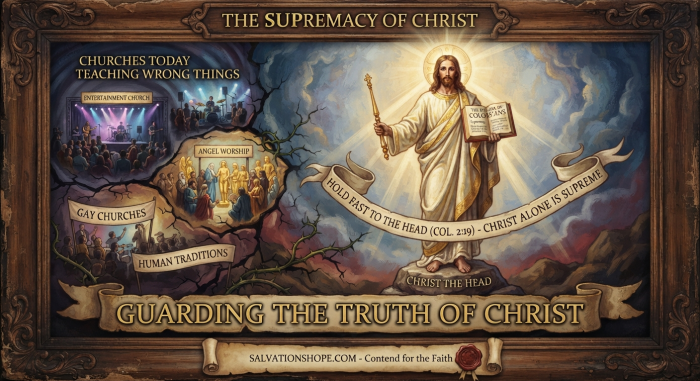
Guarding the Head
The Apostle Paul’s letter to the Colossians was written to combat a distinct spiritual crisis: the infiltration of syncretistic philosophies that threatened to dilute the absolute supremacy and sufficiency of Jesus Christ. The Colossian heresy—a mixture of local mysticism, asceticism, and elements of Jewish legalism—did not necessarily demand that believers outright deny Christ. Instead, it sought to relativize Him by placing Him alongside other spiritual systems, traditions, and elementary principles of the world.
Today, the church faces a remarkably similar assault. Modern secular ideologies—specifically Critical Race Theory (CRT) and revisionist views on human sexuality and gender (including same-sex relationships)—frequently enter contemporary churches not as hostile external attacks, but as frameworks wrapped in the language of compassion, justice, and empathy. Using the lens of Paul’s letter to the Colossians, this study examines how these frameworks function as competing worldviews that undermine the sufficiency of Christ, distort biblical anthropology, and replace the Gospel with a secular standard of righteousness.
The Sufficiency of Christ vs. Human Tradition
“See to it that no one takes you captive through philosophy and empty deception, according to the tradition of men, according to the elementary principles of the world, rather than according to Christ.” — Colossians 2:8
Paul issues a stark warning against intellectual captivity. The Greek word for “takes you captive” (sylagogeo) evokes the image of a plunderer carrying off a prisoner of war. Paul identifies the danger not as physical violence, but as abstract “philosophy and empty deception” anchored in human tradition.
Critical Race Theory as a Secular Philosophy: CRT is not merely a legal tool or an objective historical analysis; it is a comprehensive worldview. It views society through the perpetual lens of power dynamics, dividing humanity into rigid categories of “oppressors” and “oppressed” based on racial and social constructs. When introduced into the church, it shifts the foundational lens of the believer from spiritual unity in Christ to secular tribalism based on identity groups.
The Re-definition of Morality and Relationships: Similarly, the normalization of same-sex sexual behavior (“men with men and women with women”) and fluid gender identities flows from postmodern anthropologies that reject divine design in favor of autonomous self-creation.
The Colossian Parallel: Just as the false teachers in Colossae claimed that Christ alone was insufficient for spiritual maturity and needed to be supplemented by secret knowledge or rigorous human rules, modern ideologies claim that Scripture is insufficient to diagnose or solve society’s deepest ills (such as injustice or broken identity). They demand that the church bow to secular analytical frameworks to achieve true enlightenment.
Deconstructing the Anthropology of Critical Race Theory via Colossians 3:9–11
A worldview is fundamentally defined by its anthropology—its view of what human beings are, what is wrong with them, and how they are redeemed.
“Do not lie to one another, seeing that you have put off the old self with its practices and have put on the new self, which is being renewed in knowledge after the image of its creator. Here there is not Greek and Jew, circumcised and uncircumcised, barbarian, Scythian, slave, free; but Christ is all, and in all.” — Colossians 3:9–11
The Locus of Sin and Division
- The Secular View (CRT): Sin is systemic, structural, and rooted primarily in historical and institutional power imbalances. Moral status is assigned by group identity and intersectional standing (oppressor vs. oppressed). Redemption is found through perpetual political critique, self-flagellation over group guilt, and the dismantling of power structures. Reconciliation is an endless, unachievable horizon.
- The Biblical View (Colossians): Scripture teaches that sin resides in the human heart, cutting across every ethnic, cultural, and social line uniformly ("all have sinned"). The ground is level at the cross. Colossians 3:11 explicitly dismantles ethnic and social stratification within the body of Christ. The ultimate identity of a believer is not found in their racial or cultural heritage, but in their union with Christ ("Christ is all, and in all"). CRT re-tribalizes humanity, whereas the Gospel of Colossians creates a radically new, unified humanity.
The Distortion of Creation, Holiness, and the Body (Colossians 3:5–6)
“Put to death therefore what is earthly in you: sexual immorality, impurity, passion, evil desire, and covetousness, which is idolatry. On account of these the wrath of God is coming.” — Colossians 3:5–6
The Bible’s sexual ethic is inextricably linked to creation and the character of God. The endorsement or minimization of same-sex sexual behavior within contemporary churches represents a profound departure from apostolic teaching.
- Creation Order and Telos: Genesis establishes that humanity was created male and female, designed for complementary union. Throughout both the Old and New Testaments, homosexual practice is consistently identified as falling outside God’s holy design (e.g., Leviticus 18:22, Romans 1:26–27, 1 Corinthians 6:9–10).
- Idolatry of the Self: When churches adopt cultural accommodations for sexual immorality, they commit the exact error Paul warns against in Colossians 3:5—renaming sin as acceptable expression and substituting God’s standard of holiness with human autonomy. Paul labels such desires as "earthly" and warns that they invite divine wrath. To excuse or celebrate what God calls sin is to strip the cross of its necessity and the Gospel of its transforming power.
- The Power of Transformation: The hope of the Colossian epistle is encapsulated in Colossians 1:13: "He has delivered us from the domain of darkness and transferred us to the kingdom of his beloved Son." The church’s calling is not to baptize unrepentant lifestyles or worldly philosophies, but to proclaim the transforming power of Christ, who cleanses sinners and empowers them to walk in newness of life (Colossians 3:7–8).
The Supremacy of Christ over Every Ideology (Colossians 2:19)
“And not holding fast to the Head, from whom the entire body, being supplied and held together by the joints and ligaments, grows with a growth which is from God.” — Colossians 2:19
The ultimate danger of allowing Critical Race Theory and revisionist sexual ethics to dictate church life is that it detaches the church from its Head, Jesus Christ.
A Competitor for Lordship: When secular ideologies take root in a pulpit, they subtly replace the authority of Scripture with the authority of sociological consensus. Justice is no longer defined by the character and law of God, but by modern critical theorists. Morality is no longer anchored in divine revelation, but in shifting cultural sentiments.
The Call to Epistemological Standpoint: Christians must view culture through Scripture, rather than viewing Scripture through culture. Colossians 2:2–3 states that in Christ “are hidden all the treasures of wisdom and knowledge.” Believers do not need to borrow the bankrupt analytical tools of secular Marxism, postmodernism, or queer theory to understand human dignity, combat genuine injustice, or love their neighbors. The Gospel provides a far superior framework: true justice rooted in the character of God, true reconciliation effected by the blood of the cross (Colossians 1:20), and true human dignity grounded in being created by Him and for Him (Colossians 1:16).
The Powerless Substitute in the Modern Church
The Allure of Human Ingenuity
The Epistle to the Colossians stands as the apostolic antidote to a perennial disease within the household of faith: the temptation to supplement the all-sufficiency of Christ with human philosophy, cultural trends, and religious pragmatism. Writing from a Roman prison, the Apostle Paul confronted a nascent heresy at Colossae that threatened to dilute the supremacy of Jesus Christ.
Today, this ancient warning resonates with urgent clarity. Modern evangelicalism faces a subtle yet devastating drift. Across the global landscape, many churches have quietly abandoned the raw, supernatural power of the Gospel in favor of corporate methodologies. Pastors often find themselves trapped in a cycle of performance, mistaking the mechanics of institutional growth for the miraculous work of the Holy Spirit.
The Danger of "Philosophy and Empty Deceit"
In Colossians 2:8, Paul issues a stark command:
“See to it that no one takes you captive by philosophy and empty deceit, according to human tradition, according to the elemental spirits of the world, and not according to Christ.”
The Colossian believers were being enticed by intellectualism, mysticism, and legalism—systems that promised a deeper, more elite spiritual experience, but ultimately severed believers from their life-source. Paul counters this not by offering a more refined cultural strategy, but by elevating the cosmic supremacy and sufficiency of Jesus Christ.
- The Fullness of Deity: Paul insists in Colossians 2:9 that "in him the whole fullness of deity dwells bodily."
- Complete in Christ: He reminds them in verse 10 that "you have been filled in him, who is the head of all rule and authority."
When a church introduces external substitutes, it implicitly communicates that Christ is insufficient. The danger of the modern church mirrors the Colossian error: replacing the living, reigning Head of the Church with secondary, humanly devised systems.
The Modern Substitute: Programs, Entertainment, and Motivational Speaking
In many contemporary pulpits, the pulpit has been downgraded to a stage, the pastor to a CEO or life coach, and the corporate gathering to an entertainment production.
- The Program-Driven Church: Faith is often managed through administrative ingenuity rather than spiritual vitality. Discipleship is reduced to a matrix of classes and small groups detached from the transformative power of the Word.
- The Entertainment-Driven Service: Aesthetics, lighting, and emotional manipulation are deployed to manufacture an experience that mimics the awe of God, substituting atmospheric highs for the conviction of sin and the fear of the Lord.
- The Motivational Speech: Biblical exposition is frequently replaced by self-help monologues peppered with psychological terminology and inspirational anecdotes. The focus shifts from "Thus says the Lord" to "How to achieve your best life now."
The Narcissism of the Pulpit
When pastors lean heavily on motivational speaking and the art of storytelling, a dangerous self-indulgence takes root. Preaching becomes a platform for personal expression rather than prophetic declaration. Many preachers fall in love with the sound of their own voice, intoxicated by the immediate emotional feedback of an entertained audience. They craft clever narratives, witty illustrations, and polished rhetoric, yet leave the text of Scripture largely unexamined. This creates a tragic irony: the more entertaining the sermon, the more powerless the message.
The Theological Crisis: Form Without Power
The ultimate tragedy of this pragmatic approach is structural impotence. Paul describes a similar condition in 2 Timothy 3:5, warning of those who hold “the appearance of godliness, but denying its power.”
- The Illusion of Success: Numerical growth, bustling parking lots, and sophisticated production values are frequently mistaken for spiritual revival. However, institutional expansion does not equate to kingdom transformation.
- The Absence of Regeneration and Sanctification: Programs and motivational talks can modify behavior temporarily, but they cannot perform the ontological miracle of new birth or crucify the flesh. Only the Gospel is the power of God for salvation (Romans 1:16).
- Spiritual Stagnation: Believers fed on a diet of psychological anecdotes and moralistic tips remain spiritual infants, unanchored in sound doctrine, vulnerable to cultural winds, and utterly devoid of supernatural fruit (Galatians 5:22-23).
The Pauline Remedy: Returning to the Supremacy of Christ
To rescue the church from its current reliance on human methodology, a radical return to the theology of Colossians is required. Paul outlines the true marks of a spiritually vibrant church:
- Christ-Centered Proclamation: The central task of the minister is not to entertain or motivate, but to preach Christ. As Paul writes in Colossians 1:28: "Him we proclaim, warning everyone and teaching everyone with all wisdom, that we may present everyone mature in Christ."
- Rooted and Built Up: Believers must be anchored in sound doctrine. Colossians 2:6-7 commands: "Therefore, as you received Christ Jesus the Lord, so walk in him, rooted and built up in him and established in the faith..."
- The Word Indwelling Richly: The congregation must be saturated with Scripture. "Let the word of Christ dwell in you richly, teaching and admonishing one another in all wisdom..." (Colossians 3:16).
The contemporary church does not need better marketing strategies, slicker productions, or more charismatic storytelling. It requires a profound repentance from its reliance on human cleverness and a courageous return to the foolishness of preaching. When pastors abandon the crutch of entertainment and trust the inherent, explosive power of God’s Word, dead hearts awaken, broken lives are mended, and the church truly reflects the glory of its Head.
A Pastoral Mandate Against Asceticism and for the Preeminence of Christ
The Pastoral Urgency of Colossians
To young pastors stepping into ministry, the letter to the Colossians serves as an indispensable manual for doctrinal defense and pastoral care. The church in Colossae was facing a subtle, syncretistic threat—the “Colossian Heresy”—which blended elements of Jewish legalism, mysticism, and early asceticism with philosophical speculation.
At its core, this false teaching sought to dethrone Christ by relegating Him to a mere intermediary step in a spiritual hierarchy, while advocating rigorous self-denial (asceticism) as the true path to spiritual maturity. Paul’s response is a soaring theological masterpiece centered on the absolute supremacy of Jesus Christ. For the modern minister, this passage provides the ultimate antidote to cultural and theological compromises that subtly diminish the person and work of our Savior.
What Young Pastors Must Preach: The Preeminence of Christ (Colossians 1:15-20)
In an age driven by pragmatic sermon series and self-help moralism, Paul commands our focus back to cosmic, ontological Christology. If a pastor does not preach Christ in His absolute supremacy, he is not preaching the Gospel at all.
Christ's Supremacy in Creation (vv. 15–17):
The Image of the Invisible God (v. 15): Christ is the exact representation and manifestation of the unseen God (cf. Hebrews 1:3). He is not merely a reflection; He is the visible embodiment of deity.
The Firstborn of All Creation (v. 15): This term (prototokos) denotes priority of rank, sovereignty, and preeminence over all creation, not that He was a created being (as Arians argued). Verse 16 settles this by declaring that by Him all things were created.
The Sustainer of the Universe (v. 17): Christ is the cosmic glue. Without His sustaining power, the subatomic and macro-level universe would instantly disintegrate.
Christ's Supremacy in Redemption (vv. 18–20):
Head of the Church (v. 18): Just as He is first in creation, He is first in the new creation—the Church. He dictates its direction, life, and doctrine.
The Dwelling Place of Fullness (v. 19): All the divine attributes, divine essence, and divine glory (pleroma) permanently reside in Jesus bodily. There is no supplemental spirituality to be found outside of Him.
The Peacemaker (v. 20): Reconciliation is not achieved through human effort or mystical elevation, but exclusively through the blood of His cross.
Your preaching must be unashamedly Christ-centered. Never assume your congregation knows the majesty of Christ. Exalt His person, celebrate His work, and tether every moral exhortation directly to His finished cross.
The Danger of Asceticism and False Spirituality (Colossians 1:21-23)
The false teachers in Colossae promoted a brand of asceticism—the belief that harsh treatment of the body, strict dietary regulations, and self-inflicted rigor could earn spiritual favor or tame the flesh. Paul exposes the futility of this mindset by contrasting it with the transformative reality of grace.
The Trap of Self-Effort: Asceticism fundamentally misunderstands the human condition. It attempts to cure internal moral corruption through external physical discipline. Paul later warns against regulations that have “an appearance of wisdom in promoting self-made religion and asceticism and severity to the body, but they are of no value in stopping the indulgence of the flesh” (Colossians 2:23).
The Shift from Alienation to Reconciliation (vv. 21–22): Spiritual transformation is not achieved by climbing a ladder of ascetic rules, but by recognizing what Christ has already done. Believers were once hostile and alienated, but Christ has reconciled them in His body of flesh by His death.
The Goal of Grace: The purpose of the cross is not to produce rigid, legalistic ascetics, but to present believers holy and blameless and above reproach before Him (v. 22). Holiness is the fruit of grace, not the product of self-mortification.
Pastoral Warning: Guard your flock against any ministry philosophy that subtly adds conditions to the finished work of Christ. Whenever a sermon implies that Jesus is not enough—that you need Christ plus a specific lifestyle code, emotional tier, or cultural asceticism to be truly spiritual—it has departed from the Gospel.
Perseverance as the Evidence of Grace (Colossians 1:23)
Paul concludes this section with a crucial pastoral caveat regarding perseverance: “if indeed you continue in the faith, stable and steadfast, not shifting from the hope of the gospel that you heard.”
- The Test of Genuine Faith: True grace is persevering grace. The evidence that a person has truly encountered the preeminent Christ and received His reconciliation is that they do not drift away from the core message of the Gospel toward counterfeit systems (like asceticism or legalism).
- The Minister's Joy: Paul notes that he became a minister of this global proclamation. Young pastors must view themselves not as innovators of new cultural techniques, but as faithful stewards and heralds of an ancient, unchanging, and unshakeable Gospel.
For the young pastor, Colossians 1:15-23 is both a shield and a sword. Use it to shield your church from the deceptive allure of asceticism, self-reliance, and legalism. Use it as a sword to cleave through cultural noise by lifting high the magnificent, all-sufficient preeminence of Jesus Christ.
The Centrality of the Finished Work
In an age obsessed with religious innovation and emotional highs, your primary task as a pastor is singular: preach Christ and Him crucified, risen, and reigning. Paul writes in Colossians 1:28, “Him we proclaim, warning everyone and teaching everyone with all wisdom, that we may present everyone mature in Christ.”
- Preach Content, Not Just Techniques: Your sermons must be saturated with deep biblical theology. Avoid moralistic therapeutic deism—the notion that the Bible is merely a self-help manual.
- Proclaim Union with Christ: Emphasize that believers have been "hidden with Christ in God" (Colossians 3:3). Our identity, security, and righteousness are not derived from our spiritual resume, but entirely from our union with the Savior.
- Magnify the Sufficiency of Scripture: Teach your people that God has given us everything we need for life and godliness through His Word. Guard them against the temptation to look for "secret knowledge" or extra-biblical revelations.
Rules That Cannot Save
In Colossians 2:20–23, Paul issues a stern warning against asceticism—the practice of severe self-discipline and deprivation as a means of achieving higher holiness. The false teachers in Colossae were promoting rules such as: “Do not handle, Do not taste, Do not touch.”
The Illusion of Rigor: Asceticism looks impressive. It appeals to human pride because it offers a visible, measurable way to earn spiritual status through fasting, physical deprivation, or rigid behavioral codes.
The Inefficacy of Fleshly Control: Paul dismantles this by stating that these regulations “have indeed an appearance of wisdom in promoting self-made religion and asceticism and severity to the body, but they are of no value in stopping the indulgence of the flesh.” External rules cannot change a corrupt heart; only the indwelling Holy Spirit can transform human desires.
Pastoral Application: Guard your congregation from legalism. When we preach that a person is made right with God through moral performance or rigid cultural taboos, we subvert the Gospel of grace. Teach your flock to find their delight in Christ, rather than finding their righteousness in what they give up or abstain from.
The Error of Angel Worship: Guarding the Mediator
Another threat facing the Colossian church was a fascination with spiritual intermediaries, specifically the worship or veneration of angels (Colossians 2:18). These teachers claimed that God was too transcendent to approach directly, so believers needed lesser heavenly beings to bridge the gap.
- The Uniqueness of Christ’s Mediation: The Bible explicitly teaches that "there is one God, and there is one mediator between God and men, the man Christ Jesus" (1 Timothy 2:5). To look to angels, saints, or cosmic forces for spiritual access is to deny the finished, all-sufficient work of Christ.
- Disarming the Powers: Paul reminds the church that Jesus has already "disarmed the rulers and authorities and put them to open shame, by triumphing over them" (Colossians 2:15). There are no rival spiritual powers left to appease or worship.
- Pastoral Application: Warn your people against any system of thought that diminishes the direct access believers have to the Father through the Son. Whether through outright occult fascination, excessive veneration of created beings, or looking to modern cultural gurus for ultimate truth, remind them that Christ holds the monopoly on divine revelation and reconciliation.
The Absolute Deity of Jesus Christ: The Anchor of Orthodoxy
At the heart of the Colossian epistle lies the highest, most majestic declaration of the deity of Christ in the New Testament. If you compromise on who Jesus is, you lose everything.
The Creator and Sustainer: “For by him all things were created, in heaven and on earth, visible and invisible… all things were created through him and for him. And he is before all things, and in him all things hold together” (Colossians 1:16–17). Jesus is not a created being; He is the uncreated Creator. He is the cosmic glue holding the universe together.
The Fullness of Deity Bodily: “For in him the whole fullness of deity dwells bodily” (Colossians 2:9). Jesus did not merely have a spark of divinity or an “anointing” of the Spirit; the entirety of the divine essence took on human flesh in the person of Jesus of Nazareth.
Pastoral Application: Never assume your people understand or embrace the full deity of Christ. Cultists and religious revisionists frequently target the vulnerable by chipping away at the divinity of Jesus. Stand firm in your pulpits and declare that to look at Jesus is to look at God Himself. Any gospel that makes Jesus anything less than fully God is a false gospel that cannot save.
A Final Word to the Shepherd:
Brother, feed your sheep on the rich pastures of Christ’s supremacy. Do not be swayed by the shifting winds of modern pragmatism or ancient heresies repackaged for the twenty-first century. Lift high the banner of the crucified and risen Lord, for He alone is supreme over all creation and sufficient for every spiritual need.