
Sower, Seed, and Soil
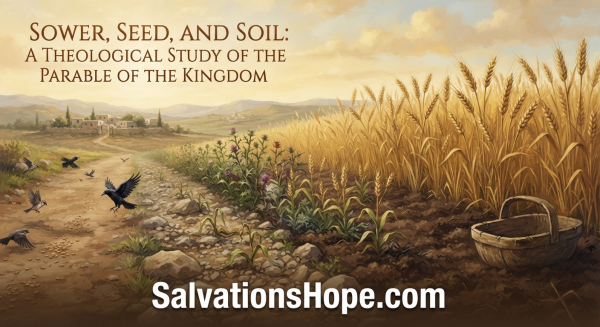
Theological Study of the Parable of the Kingdom
The Paradox of the Crowds
“A farmer went out to sow his seed. As he was scattering the seed, some fell along the path…
Still other seed fell on good soil… He who has ears to hear, let him hear.” (Luke 8:5–8)
In the earthly ministry of Jesus, moments of immense popularity often carried a hidden theological pivot. As recorded in Luke 8, the crowds surged around Him with electric anticipation. To the human eye, His ministry was experiencing a meteoric rise—a celebrity status built on miraculous healings and compelling authority.
Yet, rather than capitalizing on this momentum with a grand programmatic speech or a populist manifesto, Jesus delivered a simple, rustic agricultural illustration about a farmer and four types of dirt. To the onlookers, it was baffling. To the modern reader, it serves as a profound diagnostic tool for examining the human heart, the nature of the Word, and the true definition of spiritual fruitfulness.
The Divine Anatomy of the Parable
To properly exegete the Parable of the Sower (or more accurately, the Parable of the Soils), we must examine its three core theological components as defined by Christ Himself in Luke 8:11–15:
- The Seed: The incorruptible Word of God (Luke 8:11; cf. 1 Peter 1:23). The power resides entirely within the seed; it possesses inherent, generative life.
- The Sower: Christ and, by extension, every faithful proclaimer of divine truth who scatters the Gospel indiscriminately.
- The Soil: The human heart in its various conditions of receptivity, hardness, distraction, or readiness.
Unlike modern agricultural practices where farmers carefully till and optimize every inch of soil before planting, this sower scatters seed broadly across a complex landscape. The variance in harvest is not due to a defect in the seed or a lack of effort by the sower, but entirely due to the condition of the receiving heart.
Exegesis of the Four Soils
The Path: The Hardened Heart (Luke 8:12)
“Those along the path are the ones who hear, and then the devil comes and takes away the word from their hearts…”
- Condition: Packed down by the heavy traffic of a busy, hardened life, this soil allows no penetration.
- Spiritual Reality: A conscience calloused by habitual sin, pride, or cynicism. Because the heart is unyielding, the Word sits merely on the surface.
- The Adversary's Work: Satan actively snatches the truth away before it can take root, preventing saving faith. Indifference is an open door for spiritual theft.
The Rock: The Superficial Heart (Luke 8:13)
“Those on the rock are the ones who receive the word with joy… but they have no root.
They believe for awhile, but in the time of testing they fall away.”
- Condition: A thin layer of earth resting over unyielding bedrock. Initial growth is rapid and emotionally enthusiastic because there are no obstacles underground—at first.
- Spiritual Reality: Emotionalism without deep conviction. This is the danger of superficial discipleship that seeks the comforts of grace without counting the cost of cross-bearing.
- The Test: When tribulation, persecution, or testing arrives, the lack of depth becomes fatal. Without deep root systems in Christ, the plant withers under the heat of affliction.
The Thorns: The Divided Heart (Luke 8:14)
“The seed that fell among thorns stands for those who hear, but as they go on their way they are choked by life’s worries,
riches and pleasures, and they do not mature.”
- Condition: Soil mixed with dormant root systems of weeds and thorns that compete aggressively for nutrients, light, and space.
- Spiritual Reality: The crowded, compartmentalized life. It is not necessarily marked by gross immorality, but by competing loyalties.
- The Danger: The daily anxieties of survival, the allure of wealth, and the endless pursuit of pleasure quietly strangle spiritual vitality. The plant survives, but it never matures or bears fruit.
The Good Soil: The Receptive Heart (Luke 8:15)
“The seed on good soil stands for those with a noble and good heart, who hear the word, retain it, and by persevering produce a crop.”
- Condition: Deep, cultivated, and receptive earth—prepared by the sovereign grace of the Holy Spirit.
- Spiritual Reality: A life characterized by three distinct marks:
- Hearing: Listening with humble attentiveness.
- Retaining: Treasuring the Word in the inner man (storing it up like Mary at Jesus’ feet).
- Persevering: Enduring through seasons of testing to yield a harvest (“a hundred times more”).
Theological Implications for Christian Ministry and Discipleship
Redefining Success
In an era obsessed with metrics, rapid growth, and algorithmic reach, Jesus radically redefines success. The size of the crowd is no proof of spiritual vitality. Christ’s own ministry experienced massive defection when the hard sayings of the cross were introduced (John 6:66). True ministerial success is measured not by immediate emotional responses, but by long-term transformation and endurance.
Self-Examination over Spectatorship
Jesus turned the parable from a public spectacle into a private diagnostic for His disciples. The critical question for every believer is not “How powerful is the preaching?” but “How is my heart receiving the Word?”
- Is your heart impervious to conviction?
- Are you living on surface-level emotion that collapses under pressure?
- Is your spiritual energy choked out by the relentless pursuit of worldly comforts and anxieties?
- Or are you actively yielding to the Master Gardener, allowing His truth to take deep root and bear lasting fruit?
A Call to Heed
The parable concludes with a haunting imperative: “He who has ears to hear, let him hear.” Hearing is universal; spiritual perception is rare. May we approach the Scriptures not as casual observers looking for entertainment, but as good soil—ready to be broken, deeply rooted, and transformed by the living Word of God for His eternal glory.
The Danger of the Path
Understanding the Hard Soil Heart
In the Parable of the Sower (found in Matthew 13, Mark 4, and Luke 8), Jesus describes four different types of soil that receive the seed of the Word of God. Each represents a distinct heart condition.
The first soil Jesus describes is the path—the hard soil. It is ground that has been constantly walked on, packed down so tightly that a seed cannot sink beneath the surface. Left exposed, it is quickly trampled and devoured by the birds of the air.
Spiritually speaking, this path depicts a heart that has become hardened against God. When the message of Christ is proclaimed, it makes no lasting impression.
Anatomy of a Hardened Heart
A hardened heart resists the Word of God in distinct, recognizable ways:
- Immediate Rejection: Some people mentally or spiritually "switch off" the moment the conversation turns to Jesus, unwilling to give the claims of Christ a fair hearing.
- Passive Dismissal: Others may listen out of politeness or habit, but the moment the service, message, or broadcast ends, the thoughts vanish, replaced instantly by the routine of daily life.
- Habitual Churchgoing Without Transformation: Sitting through sermons week after week without change is a warning sign. Attending out of social obligation or mere tradition rather than a genuine hunger for God leaves the soul completely exposed.
When the Word remains on the surface of a hard heart, Satan and his demonic forces swoop in like birds to snatch it away before it can take root, germinate, and produce godly fruit (Luke 8:12).
What Causes the Soil to Harden?
Why does the heart become like a hardened path? Scripture and pastoral experience point to two primary causes:
Intellectual Pride, Skepticism, and Unbelief
Years of secular conditioning, cynicism, or worldly education can trample the mind. A person may begin to view themselves as too “sophisticated” or “clever” to need the simplicity of the gospel. To confess sin, humble oneself before Christ, and relying on the Holy Spirit feels foolish to a hardened intellectualism that refuses to submit to God.
Dead Religion and Hypocrisy
Paradoxically, a heart can also be hardened by religion without relationship.
- The Skeptic of Hypocrisy: Witnessing religious people who act dishonestly at work or unlovingly at home can cause a person to write off all of Christianity as fake.
- The Practice of Ritualism: Others adopt the outward habits of piety without experiencing new life in Christ. Years of empty rituals and religious traditions create a spiritual crust that the living Word of God cannot penetrate.
The Eternal Stakes: A Matter of Life and Death
If you find the Bible boring, if Christ feels irrelevant to your daily life, or if your faith is reduced to hollow routine, it is easy to shrug it off. But Jesus makes it clear that the condition of our heart is not a minor detail.
“Those along the path are the ones who hear, and then the devil comes and takes away
the word from their hearts, so that they may not believe and be saved.” — Luke 8:12
The hard soil represents a soul in mortal spiritual danger. Satan is actively working to steal the only message capable of granting eternal life. A heart that remains stubbornly closed to God risks eternal separation from Him in hell.
Softening the Soil: A Call to Repentance
Can hard soil be broken up? By the grace of God, yes. Just as a farmer uses a plow to break up uncultivated ground (Hosea 10:12), the Holy Spirit can break through the hardest spiritual crusts—if we are willing to let Him.
- Examine Your Heart: Ask the Lord to reveal any areas of cynicism, pride, or dead ritualism in your life.
- Humble Yourself: Acknowledge your need for Christ, turning away from self-reliance or empty religion.
- Receive the Word: Invite the Holy Spirit to plow your heart so that His Word can sink deep, take root, and bring forth eternal fruit.
The Anatomy of Temporary Faith: Understanding the Parable of the Shallow Soil
The Illusion of Immediate Growth
In the Parable of the Sower, Jesus outlines four distinct heart conditions that receive the seed of the Kingdom of God. While the path represents complete rejection, the second soil—the rocky ground—presents a far more subtle and spiritually dangerous illusion: superficial receptivity.
Unlike the hard-hearted skeptic, the person represented by the shallow soil appears to experience immediate, vibrant spiritual life. Yet, beneath an enthusiastic exterior lies an unchanged heart incapable of sustaining true spiritual endurance. For believers exploring spiritual authenticity, examining this soil reveals the critical difference between emotional resonance and genuine regeneration.
Exegetical Analysis: The Mechanics of Rocky Ground
“And these are the ones sown on rocky ground: the ones who, when they hear the word, immediately receive it with joy. And they have no root in themselves, but endure for a while; then, when tribulation or persecution arises on account of the word, immediately they fall away.” — Mark 4:16-17
The Deceptive Surface
In the agricultural reality of the ancient Near East, “rocky soil” did not simply mean dirt mixed with loose stones. It referred to a thin layer of arable earth resting directly over a solid, impenetrable shelf of bedrock.
Spiritually, this depicts a heart where religious ideas find a temporary lodging place, but where the hard, unyielding bedrock of unrepentant self-will remains untouched beneath. The seed can germinate, but it cannot anchor itself.
The Trap of Emotionalism
The response of the shallow soil is marked by immediate, uncritical enthusiasm:
- The High of the Moment: Individuals in this category often respond powerfully to the emotional dynamics of a gathering, a passionate sermon, or an urgent altar call.
- Misplaced Metrics: They mistake goosebumps, tears of joy, and temporary psychological relief for the supernatural work of the Holy Spirit.
- The Missing Element: True saving faith involves conviction of sin, repentance, and a surrender of lordship. Shallow soil religion often embraces Jesus as a healer, comforter, or life-enhancer without embracing Him as Lord and Savior.
The Anatomy of Apostasy: When the Sun Rises
Jesus notes that when the sun rises and the weather heats up, the plant withers because it lacks depth. In the spiritual life, the “sun” represents trials, persecution, testing, and the unglamorous realities of carrying a cross.
The Catalyst of Hardship
When the initial emotional high fades, the true test of faith begins. The shallow-soil believer encounters trials that expose the lack of a root system:
- Social Pressure: Mockery from peers, family tension, or professional marginalization for the sake of Christ.
- Providential Disappointments: Unanswered prayers, personal grief, chronic illness, or financial ruin that contradict the expectation of an easy, trouble-free life.
The Reversion
When faith demands sacrifice rather than supplying continuous emotional rewards, the motivation to follow Jesus evaporates. Prayer ceases, Scripture gathering dust becomes the norm, and the individual drifts back into their pre-conversion lifestyle, proving that the heart was never truly transformed.
Theological Distinction: Temporary Trials vs. Terminal Apostasy
A vital pastoral distinction must be made between the temporary spiritual drought experienced by a genuine believer and the terminal apostasy of the shallow soil.
Feature
The Shallow Soil (False Conversion)
The Good Soil (Genuine Faith Under Trial)
Root System
Completely absent; rests on bedrock.
Present and deep; anchored in Christ.
Response to Trial
Anger, offense, and permanent abandonment of faith.
Temporary struggle followed by deeper trust and reliance on God.
Ultimate Outcome
Withering away and spiritual death.
Persevering fruitfulness over the long term.
True faith is sustained not by human willpower or perpetual emotional highs, but by the indwelling Holy Spirit, who uses trials to drive the roots of a believer deeper into the grace of God. The danger of the shallow soil is self-deception. It is entirely possible to mistake a past emotional experience for present spiritual life. True spiritual vitality is not proven by how brightly a plant sprouts in the spring of emotional excitement, but by whether it bears fruit when the winter winds and summer droughts of life arrive.
The Choking Clutter of the Soul: Exposition of the Thorny Soil
Exegesis and Contextual Framing
In the synoptic transmission of the Parable of the Sower (Matthew 13, Mark 4, Luke 8), the imagery shifts from the impenetrable path and the shallow bedrock of the rocky ground to a more insidious horticultural failure: the thorny soil. Here, the seed actually germinates, sinking its roots downward and shooting its stem upward. Life appears to have begun. Yet, this localized vitality is ultimately aborted because the surrounding environment is choked by competing vegetation.
In the ancient agricultural world of the Levant, fields were frequently interspersed with dormant weed seeds and perennial root systems. If a farmer failed to thoroughly clear and plow the earth, the indigenous thorns (akanthas) would rapidly outgrow the cultivated grain. Thorns require less deliberate cultivation; they thrive in the fallen order of creation, drawing moisture, sunlight, and nutrients away from the desirable crop until the productive plant is withered, starved, and rendered barren.
Theologically, Jesus defines these thorns with absolute precision in Luke 8:14: “The seeds that fell among thorns stand for those who hear, but as they go on their way they are choked by life’s worries, riches and pleasures, and they do not mature.”
This is not a sudden, violent rejection of the faith like the persecution that destroys the rocky-ground believer. Instead, it is a slow, asphyxiating suffocation. The human heart becomes a crowded ecosystem where the transcendent claims of the Kingdom of God are systematically edged out by the immanent demands of terrestrial life.
The Anatomy of Worldliness: Worries, Riches, and Pleasures
Jesus groups three seemingly distinct categories into a single, unified destructive force:
- The Anxieties of Life (Merimnai): The paralyzing, future-oriented fear of scarcity, failure, and insecurity. Anxiety operates on the subtle heresy that God is either unable or unwilling to provide for His creatures, forcing the individual to act as their own ultimate providence.
- The Deceitfulness of Riches (Ploutos): Material accumulation, economic standing, and the illusion of self-sufficiency purchased through financial capital. Wealth is characterized as "deceitful" because it whispers promises of ultimate security and joy while delivering perpetual maintenance and spiritual bankruptcy.
- The Pleasures of This Life (Hedonai): Sensual gratification, recreational escapism, and the relentless pursuit of entertainment. These are not merely neutral activities; when elevated to life's primary objective, they dull the spiritual palate, making the word of God tasteless compared to the immediate dopamine hit of the culture.
The Psychological and Spiritual Synergy of Thorns
Human rationalization attempts to isolate these three elements. The destitute individual assumes that worries belong exclusively to poverty, while riches and pleasures belong to security. However, our Lord diagnoses a profound existential entanglement: worries, riches, and pleasures are symbiotic.
Whether one lacks wealth and burns with the anxiety of acquisition, or possesses wealth and trembles at the prospect of depreciation, the internal posture is identical: autonomy. The heart is turned inward, obsessed with the preservation and enhancement of the ego within a temporal framework. This is the biblical definition of worldliness (kosmos): a value system organized independently of God, where temporal commodities supersede eternal realities.
The Deceit of the Choked Life
The most terrifying theological reality of the thorny heart is its invisibility to the host. The rocky-soil hearer experiences immediate tribulation and falls away visibly. The thorny-soil hearer, however, may maintain an unblemished external religious resume.
Because the process is gradual, the victim feels no acute spiritual alarm. They attend worship, engage in community, and manage their moral boundaries, all while their spiritual arteries are slowly hardening with the cholesterol of secularism.
- The Mind as a Broadcast Tower: The cognitive bandwidth of the soul is finite. If it is saturated from dawn until dusk with professional ambitions, algorithmic entertainment cycles, portfolio management, and social calendars, the voice of the Holy Spirit is drowned out.
- The Displacement of Devotion: Energy is a finite resource. When human vigor is poured entirely into building a terrestrial empire, kingdom-building is reduced to an occasional, token hobby. The Word of God is heard, appreciated, and promptly filed away as irrelevant to the immediate pressures of survival and success.
The Eschatological Imperative: Clearing the Ground
The remedy for the thorny heart is not mild trimming; it is radical, grace-empowered clearing. Jesus explicitly commands a reordering of ultimate loyalties in the Sermon on the Mount:
“So do not worry, saying, ‘What shall we eat?’ or ‘What shall we drink?’ or ‘What shall we wear?’ For the pagans run after all these things, and your heavenly Father knows that you need them. But seek first his kingdom and his righteousness, and all these things will be given to you as well.” (Matthew 6:31-33)
To overcome the thorny soil, the believer must embrace the absolute transience of the created order. As the Apostle John warns: “Do not love the world or anything in the world… The world and its desires pass away, but whoever does the will of God lives forever” (1 John 2:15, 17).
Every earthly structure—careers, portfolios, recreational pursuits, and physical vitality—has an expiration date. To anchor one’s ultimate hope in these passing shadows is to ensure that when the world passes, the soul passes with it. True spiritual maturity requires cultivating a deep, daily dependence on the Creator, trusting His provision, and ruthlessly yanking out the intrusive weeds of anxiety, greed, and hedonism before they rob the soul of eternal life.
Theological Reflection and Application
Examine the ecosystem of your own inner life. What thoughts dominate the quiet spaces of your mind when your attention is not forcibly engaged by labor? Are those spaces occupied by the kingdom of Christ, or are they overrun by the thick briars of tomorrow’s anxieties, financial calculations, and recreational escapes?
Cultivating the Good Soil: Heart Preparation and Spiritual Fruitfulness
The Parable of the Soils and the Heart of Man
In the landscape of biblical teaching, agricultural metaphors frequently bridge the gap between physical reality and spiritual truth. Among these, the Parable of the Sower—recorded in Matthew 13, Mark 4, and Luke 8—stands as a foundational text for understanding how the human heart interacts with divine revelation. While the parable highlights four distinct conditions of the ground, our focus centers on the final category: the good soil.
Unlike the hard path where seeds remain exposed to predators, the shallow rocky ground that stunts root growth, or the thorn-infested earth that eventually chokes out life, the good soil represents a receptive, responsive spiritual condition. When the seed of God’s Word lands here, it does not bounce off or wither away; rather, it sinks deeply, takes firm root, and multiplies exponentially, yielding a harvest thirty, sixty, or a hundredfold (Matthew 13:8).
The Manifestation of the Good Heart
What does it look like when the Word of God takes root in a truly receptive heart? The evidence is not merely emotional enthusiasm or intellectual assent, but visible, enduring transformation. Jesus explicitly defines this group as those who, “with a noble and good heart, hear the word, retain it, and by persevering produce a crop” (Luke 8:15).
This supernatural harvest is precisely what the Apostle Paul describes as the fruit of the Spirit:
“The fruit of the Spirit is love, joy, peace, patience, kindness, goodness, faithfulness, gentleness and self-control” (Galatians 5:22-23).
When the living and active Word of God dwells within an individual, divine virtues begin to multiply. While many hearts remain impervious to the long-term impact of divine truth, the believer whose heart has been rendered fertile experiences profound, eternal results. Listening carefully, storing truth in the inner depths, and persevering through faith lead to a life marked by spiritual abundance and Kingdom productivity.
The Necessity of Divine Preparation
A critical theological question naturally arises: If a person lacks a “good and noble heart,” are they beyond hope? Can an unyielding heart be transformed?
To answer this, we must return to the agricultural reality of farming. Productive soil is rarely found in a pristine, untouched state; it is the result of intentional, rigorous preparation:
- Compacted soil must be broken, tilled, and loosened to allow moisture and roots to penetrate.
- Shallow soil concealing hidden bedrock must undergo deep plowing and the arduous removal of obstructions.
- Weed-Choked soil requires the total eradication of invasive plants before any valuable crop can thrive.
Spiritually speaking, an uncultivated heart is inherently unproductive. Scripture repeatedly calls for this deep-seated preparatory work:
“Break up your unplowed ground and do not sow among thorns” (Jeremiah 4:3).
“Break up your unplowed ground; for it is time to seek the Lord” (Hosea 10:12).
“Rid yourselves of all offenses you have committed, and get a new heart and a new spirit” (Ezekiel 18:30-31).
Crucially, human beings cannot manufacture this transformation on their own strength. Just as a field requires an external farmer, the human heart requires the divine intervention of the Great Farmer. God initiates this profound inner renewal, fulfilling His sovereign purpose:
“You did not choose me, but I chose you and appointed you to go and bear fruit—fruit that will last” (John 15:16).
The Mechanics of Heart Transformation
When God initiates the work of heart preparation, every layer of the inner self undergoes a profound spiritual tillage:
- Deep Repentance: The soul is plowed deeply, breaking up surface pride and intellectual resistance so that the gospel of salvation through Christ’s atoning sacrifice can penetrate deeply rather than eliciting a superficial, momentary emotional response.
- Removal of Obstacles: The hidden stones of bitterness, unaddressed sin, and hardened cynicism are painstakingly excavated.
- Uprooting Worldliness: The invasive thorns of worldly anxieties, deceptive riches, and hedonistic pleasures are pulled out by the roots, clearing vital space for the Kingdom of God to expand.
This transformation results in a heart that is noble and receptive—not through human self-improvement, but entirely through the regenerative power of the Holy Spirit.
Human Responsibility and Spiritual Discernment
While heart preparation is fundamentally a divine work, Scripture simultaneously holds individuals strictly accountable for the condition of their hearts and their posture toward divine truth. Jesus continually emphasized active listening and spiritual stewardship:
“He who has ears to hear, let him hear” (Luke 8:8).
“Consider carefully how you listen. Whoever has will be given more; whoever does not have,
even what he thinks he has will be taken from him” (Luke 8:18).
This principle establishes a vital spiritual dynamic: truth that is ignored, neglected, or unapplied gradually erodes, whereas truth that is embraced, obeyed, and integrated into daily life multiplies.
Diagnostic Self-Examination of the Soil Types:
- The Hard Soil: Characterized by passive church attendance where biblical messages glance off the surface without engagement. Those with this posture possess nothing lasting, and even nominal perceptions will ultimately fade.
- The Shallow Soil: Typified by historical emotional experiences or brief religious fervor that quickly dissipates when trials, persecutions, or cultural pressures arise.
- The Thorny Soil: Marked by intellectual belief overshadowed by the relentless pursuit of wealth, daily distractions, and worldly pleasures, ultimately choking out genuine spiritual vitality.
- The Good Soil: Demonstrated by humble Bible reading, receptive listening to biblical preaching, deep sorrow over sin coupled with trust in Christ's mercy, a hatred for unrighteousness, and a supreme treasure found in Christ alone.
The Abundant Life of the Harvest
To be identified with the good soil is to possess the life of God within. Those who hunger for holiness, cherish the supremacy of Christ, and cultivate the fruit of the Spirit in their daily conduct receive an ever-increasing measure of grace. This is not a static state, but a dynamic, joyful, and eternally productive life that flourishes both now and throughout eternity.
Reflection and Application
In light of the four soil types described by Jesus, what specific areas of unplowed ground, hidden stones, or worldly thorns might the Holy Spirit be calling you to surrender to the Great Farmer today so that His Word may yield a deeper harvest in your life?
In which of the four soil conditions do you find yourself most easily tempted to drift during busy or stressful seasons of life?
How does recognizing the reality of spiritual warfare (the stealing of the seed on the path) change the way you prepare your heart to read the Bible on Sunday mornings?
In what areas of your life has routine, pride, or skepticism created a “hard path,” and how can you invite God to soften your heart today?
Is your faith sustained by yesterday’s emotional memory, or is God’s Word actively anchoring your soul and bearing fruit in your life today?