
Science and Authority of Biblical Interpretation
A Theological Inquiry
The Inescapable Reality of Interpretation
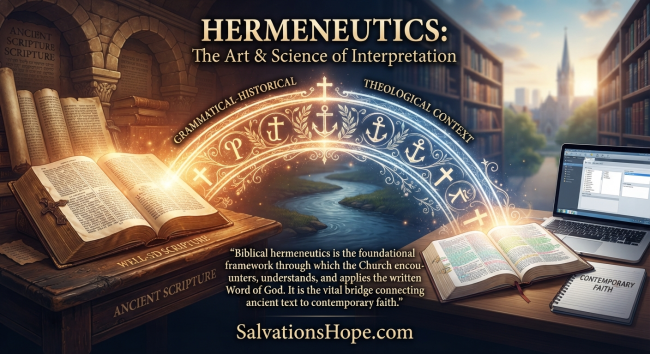
Hermeneutics—defined formally as the art and science of interpretation—constitutes the foundational framework through which the Church encounters, understands, and applies the written Word of God. Biblical hermeneutics is not merely an academic sub-discipline or an optional tool for the professional theologian; it is the vital bridge connecting ancient text to contemporary faith.
During the sixteenth-century Reformation, theological debates transcended superficial disagreements over specific prooftexts. The Reformers did not merely argue over divergent interpretations; they locked horns over the very nature of interpretation itself. The core of the controversy probed the locus (a specific place, location, or the set of all points that satisfy a particular rule or condition) of ecclesiastical and spiritual authority:
- Where does final interpretive authority reside—in the magisterium of the institutional church, the subjective promptings of the individual conscience, or the objective, self-authenticating voice of Scripture (sola scriptura)?
- What is the dynamic relationship between the illumination of the Holy Spirit and the grammatical-historical labor of human exegesis?
Fast forward to the contemporary landscape, where hermeneutical theory has fractured into a labyrinth of postmodern, post-liberal, and deconstructionist methodologies. Paradoxically, modern academia often exhibits a debilitating preoccupation with the theoretical machinery of hermeneutics at the expense of actual biblical exposition—studying the lens rather than gazing through it at the glory of God. Conversely, an alternate error persists among believers who harbor a subtle, unacknowledged suspicion of interpretation altogether. While avoiding crude articulations, they operate under the naive assumption that while others offer mere interpretations, they simply receive and repeat “what the Bible says” unmediated.
Adapting the astute observation of Carl F. H. Henry regarding presuppositions, we must recognize a fundamental axiom: There are two kinds of practitioners of hermeneutics—those who admit it, and those who don’t. Every encounter with the biblical text, whether rigorous or casual, structural or intuitive, involves the act of interpretation. While interpretations may be categorized as faithful or unfaithful, sound or unsound, there is no conceptual escape from interpretation itself.
Navigating the Labyrinth: From Postmodern Theory to Practical Exegesis
It is beyond the scope of a preliminary study to chart the vast expanses of the “new hermeneutic,” radical theology, or the destabilizing currents of postmodern pluralism—subjects treated at length elsewhere (such as D. A. Carson’s The Gagging of God: Christianity Confronts Pluralism). Instead, our focus must pivot to a deeply practical, persistent dilemma that confronts every serious student of Scripture:
How do we properly distinguish between temporary, culturally conditioned elements within the biblical text and abiding, universally binding mandates for the Church today?
To state the problem sharply, consider the following tension-filled comparative matrix:
Biblical Text / Command
Cultural / Historical Practice
Contemporary Church Response
The Hermeneutical Tension
Romans 16:16
Greet one another with a holy kiss
Practiced in select global cultures; largely abandoned in Western liturgies
Are we unbiblical for substituting handshakes or hugs?
John 13:14
Jesus washing the disciples’ feet
Celebrated as a rare ordinance by specific traditions; ignored by most
Why do we bypass this explicit command while rigorously maintaining the Lord’s Supper?
1 Corinthians 11:23–26
Bread and wine at the Lord’s Table
Universally retained across orthodox Christianity
Can contextual elements (e.g., yams and goat’s milk) replace bread and wine in indigenous contexts?
Old Testament Law
Mosaic covenant legislation (e.g., stoning of adulterers)
Abandoned under the New Covenant framework
Do civil and judicial laws of the Mosaic code carry continuing legislative force for modern nations?
1 Corinthians 14:33–36
Injunctions regarding women keeping silent in church
Interpreted dynamically, complementarianly, or egalitarianly
Is this situational instruction absolute for all assemblies across all epochs?
Luke 18:22
Selling all possessions to give to the poor
Applied selectively as a radical call rather than a universal economic mandate
Why is the new birth (John 3:3) treated as an absolute universal while this command is contextualized?
Preliminary Guidelines for Sorting Binding Mandates from Cultural Particulars
The questions raised above are not idle academic curiosities; they strike at the heart of biblical obedience and authority. While a comprehensive resolution requires exhaustive canonical analysis, we can establish several preliminary, apostolic guidelines to help believers faithfully navigate the text.
Recognizing Redemptive-Historical Context
Scripture is not a flat manual dropped out of heaven, but a progressive, historical unfolding of God’s redemptive plan. Commands given under specific covenants (such as the patriarchal, Mosaic, or Davidic eras) must be interpreted through the fulfillment of the New Covenant in Jesus Christ. The abrogation of the ceremonial and civil aspects of the Mosaic law in the New Testament (Hebrews 8:13) explains why modern Christians do not enforce ancient Israelite civil penalties, even while recognizing the abiding moral reflection of God’s character found within the law.
Discerning Descriptive Narrative from Prescriptive Norm
A frequent interpretive error treats every recorded biblical action as a normative command. The Bible faithfully records human sin, cultural eccentricities, and historical contingencies without necessarily endorsing them. Hermeneutical integrity demands that we distinguish between what the text records (descriptive) and what the text commands or mandates (prescriptive).
Identifying Cultural Accommodation and Trans-Cultural Principles
Many New Testament practices are embedded within the socio-cultural architecture of the ancient Greco-Roman or Near Eastern world.
- The holy kiss and head coverings in 1 Corinthians 11 are culturally idiomatic expressions of greeting and submission within a specific historical milieu.
- The underlying theological principles—such as Christian affection, familial unity, and modesty—are permanent, trans-cultural mandates, even if the local cultural vehicles used to express them shift across time and geography.
Evaluating the Inner Canonical Witness and Apostolic Intent
When evaluating the binding nature of a command, we must examine how the rest of the New Testament—and the apostolic corpus in particular—handles the theme. Practices reinforced by creation orders (e.g., Genesis foundations in marriage), explicit re-affirmation in subsequent epistles, or direct association with the finished work of Christ carry a heavier presumptive weight of abiding normativity than isolated, culturally localized practices.
The Unity and Harmony of Divine Truth
The Peril of Theological Disjunctions
In the life of the church, the pursuit of doctrinal fidelity is often undermined not by outright denial of the truth, but by its selective isolation. When one biblical theme is wrenched from its canonical context and elevated to an absolute system, the resulting distortion ruptures the organic unity of Scripture.
Historically and contemporarily, theologians and believers alike have fallen into the trap of false dichotomies—pitting one portion of God’s Word against another. To handle the Word of truth rightly (2 Tim. 2:15), the church must consciously seek the whole counsel of God, resisting historical and theological disjunctions that fracture the harmony of divine revelation.
Deconstructing False Dichotomies in Biblical Interpretation
Throughout church history, various traditions have introduced unnecessary wedges into the text of Scripture, creating artificial conflicts where harmony was intended by the Holy Spirit.
Liberal and Sectarian Disjunctions
Liberal theology has frequently introduced corrosive disjunctions designed to pit biblical authors and epochs against one another. Examples include:
- Jesus versus Paul: Treating the ethical teaching of the earthly Jesus as normative while dismissing the profound redemptive-historical theology of the Apostle Paul.
- The Charismatic Community versus the "Early Catholic" Church: Characterizing the primitive, Spirit-empowered movement as inherently opposed to the developing institutional structures of subsequent generations, thereby fragmenting the unified trajectory of the New Testament church.
Evangelical and Traditional Disjunctions
Even within orthodox communities, interpretive imbalances frequently emerge:
- Paul and James: Protestants have occasionally created a false tension between Paul’s insistence on justification by faith apart from works (Rom. 3:28) and James’s emphasis on faith demonstrated by works (Jas. 2:4). When read in their proper complementary contexts, Paul addresses the root of justification before God, while James addresses the fruit before men.
- Galatians 3:28 and Pauline Pastoral Epistles: Some traditions absolutize Galatians 3:28 ("There is neither Jew nor Greek, there is neither slave nor free, there is no male and female, for you are all one in Christ Jesus") as an all-encompassing social template while attempting to explain away context-specific instructions like 1 Timothy 2:12—or conversely, elevating the latter while ignoring the profound redemptive equality established in Christ.
A Historical Caution: Hyper-Calvinism and the Eclipse of the Gospel Call
The danger of losing scriptural balance is not merely theoretical; it has real, pastoral consequences. A striking historical example occurred among many Particular (Reformed) Baptists in England from the mid-eighteenth to the mid-twentieth century.
Driven by a hyper-logical defense of God’s sovereign grace in election, these churches grew deeply uncomfortable with universal, free-offer gospel proclamations. Their reasoning was ostensibly pious yet profoundly unbiblical: How could unregenerate sinners, who are dead in trespasses and sins and potentially non-elect, be commanded to repent and believe?
Consequently, pulpit ministry shifted away from calling sinners to Christ. Instead, unbelievers were directed inward to examine themselves for preliminary signs of the Spirit’s conviction, such as shame, distress, or moral remorse.
The Cost of Losing Balance
On the surface, this approach masqueraded as a jealous defense of divine sovereignty. In reality, it was a profound departure from the apostolic pattern, which boldly commanded all people everywhere to repent (Acts 17:30).
When one element of biblical truth—in this case, divine election—is elevated to a position where it domesticates or nullifies another clear biblical mandate—the universal free offer of the gospel—the church loses its spiritual equilibrium.
The Multifaceted Nature of "Biblical Balance"
Maintaining the balance of Scripture is an intricate discipline because biblical balance is not monolithic; it manifests in several distinct ways across the canon:
The Balance of Diverse Responsibilities (Priorities)
Scripture lays a wide array of concurrent obligations upon the believer:
- Cultivating a vibrant devotional life through prayer and the Word.
- Maintaining diligence and integrity in daily vocation.
- Fulfilling the distinct callings of Christian marriage and parenting.
- Engaging in intentional evangelism with neighbors and coworkers.
- Practicing mercy ministry toward the vulnerable, such as orphans and widows (Jas. 1:27).
These duties require careful stewardship of time and energy, balancing multiple overlapping priorities without neglecting any clear command of God.
The Balance of Canonical Emphases (Plot-Line)
Individual texts must always be interpreted in light of the grand redemptive-historical plot-line of Scripture—moving from Creation, Fall, and Redemption to Consummation. Emphases shift according to covenantal epochs, yet cohere around the person and work of Jesus Christ.
The Balance of Paradoxical Truths
Scripture frequently presents profound truths that human logic struggles to fully reconcile. Rather than trimming away the edges of these mysteries to achieve a tidy system, faithful theology embraces them as Scripture presents them:
- The Person of Christ: Jesus is simultaneously fully God and fully man, possessing two distinct natures united in one divine person without confusion or division.
- Divine Sovereignty and Human Agency: God is the absolute, transcendent sovereign over all things, yet humanity is genuinely responsible for its moral choices.
- Particular Redemption and God’s Heart for the Lost: The elect alone are finally saved through the efficacious blood of Christ, yet God’s compassionate posture toward rebellious humanity is so profound that Jesus weeps over unrepentant Jerusalem, and God declares, "As I live, declares the Lord God, I have no pleasure in the death of the wicked, but that the wicked turn from his way and live; turn back, turn back from your evil ways, for why will you die, O house of Israel?" (Ezek. 33:11).
The Rhetoric of Paradox
Interpreting Antithesis in Biblical Hermeneutics
A casual reader of Scripture can easily be startled by its stark contrasts. The biblical text frequently employs sweeping, uncompromising language: commands to “hate” family members, rejections of religious ritual in favor of moral obedience, and seemingly contradictory instructions regarding spiritual disciplines.
To the modern reader, these expressions can create confusion or the impression of inner contradiction. However, a sound theological methodology recognizes that the antithetical nature of certain biblical texts—including key elements of Jesus’ own preaching—serves as a intentional rhetorical device rather than a rigid, absolute dichotomy. Discerning the true meaning requires careful attention to biblical context, Hebrew idiom, and pastoral intent.
Absolute Versus Rhetorical Antitheses
Scripture certainly contains absolute antitheses that demand unwavering affirmation. For example, the profound disjunction between the divine curses and blessings outlined in Deuteronomy 27–28 is not mutually delimiting. The conduct that invokes God’s judgment and the obedience that wins His approval stand in fundamentally opposite camps. These moral and spiritual categories cannot be intermingled, relativized, or diluted.
Yet, biblical writers and prophets also frequently utilize a rhetorical form known in Hebrew studies as synthetic parallelism or comparative negation (often expressed as “not X, but Y” or “X, not Y”). In these instances, the language is designed to jolt the listener’s perspective, shatter complacency, and establish a hierarchy of spiritual priorities rather than completely abolish one element for the sake of another.
Case Study 1: Prophetic Priority in Hosea
Eight centuries before the incarnation, the prophet Hosea recorded a divine declaration that sounds like a total rejection of the Levitical sacrificial system:
“For I desire mercy, not sacrifice, and acknowledgment of God rather than burnt offerings” (Hos. 6:6).
If read through a strictly literalistic lens, one might conclude that God abrogated the entire Mosaic covenant regarding ritual sacrifice. Yet, the broader context of biblical theology reveals that God Himself instituted those very sacrifices.
Instead of destroying the sacrificial system, this Hebrew antithesis operates as a vivid, emphatic idiom meaning: “If push comes to shove, mercy is infinitely more vital than ritual.”
God is issuing a severe warning against empty formalism. Believers must never rank external religious markers—such as mandated rituals and burnt offerings—above the fundamental internal posture of knowing God, nor confuse the relative value of ritual with the absolute moral imperative of divine compassion.
Case Study 2: The Radical Claims of Discipleship
In the Gospels, Jesus routinely pushes rhetorical language to its absolute limit to jar His listeners out of cultural comfort. A striking example occurs in Luke’s Gospel:
brothers and sisters—yes, even their own life—such a person cannot be my disciple” (Lk. 14:26).
Taken in isolation, this verse appears to violate the fifth commandment to honor one’s parents and contradicts the overarching Christian ethic of love. However, recognizing the Semitic idiom of comparative affection clarifies Jesus’ true intent.
As the parallel passage in Matthew clarifies, the requirement is comparative rather than malicious: “Anyone who loves their father or mother more than me is not worthy of me” (Mt. 10:37). Jesus is not sanctioning raw hatred of family; rather, He is declaring that the claims of the Kingdom of God are so supreme, urgent, and binding that they eclipse even the most precious and deeply prized human relationships.
Case Study 3: The Nuance of Prayer
Apparent antitheses also emerge when comparing teachings across different pastoral contexts. Consider the diverse instructions Jesus gives regarding prayer:
- Against Babbling: Jesus warns His followers not to heap up empty phrases like the pagans, who mistakenly assume they will be heard because of their many words (Mt. 6:7).
- For Persistence: Elsewhere, Jesus tells a direct parable designed to teach that disciples should pray perseveringly and never lose heart (Lk. 18:1–8).
To view these two injunctions as a formal, irreconcilable contradiction betrays both an unfamiliarity with Jesus’ dynamic preaching style and an insensitivity to real-world pastoral needs.
The first injunction serves as a vital correctives against manipulative religiosity—those who imagine they can coerce God through mechanical, interminable repetition. The second injunction is equally crucial as an antidote for spiritual apathy—those whose commitments are so shallow that a hasty, distracted sentence constitutes their entire prayer life. The text demands both humility in approach and persistence in petition.
Discerning the Mind of God
Principles for Faithful Biblical Interpretation
In the task of biblical interpretation, the believer stands before the living word of God with a dual calling: to listen with absolute reverence and to understand with disciplined discernment. Scripture is not a static list of decontextualized decrees, but a rich, organic tapestry of divine revelation communicated through human authors, historical epochs, and diverse literary genres. To handle this word rightly, the church must employ sound hermeneutical principles that honor both the divine authorship of Scripture and its historical-cultural embedding.
Two vital principles—accounting for the frequency and context of biblical statements, and carefully examining the underlying theological rationale of biblical commands—protect the community of faith from both legalistic distortion and cultural reductionism.
The Principle of Frequency and Context: Guarding Against Isolation
A foundational rule of biblical interpretation is that we must be exceedingly cautious about absolutizing what is said or commanded only once.
This caution does not stem from a flawed view of divine inspiration. It is not that God must repeat Himself for a truth to be true or a divine mandate to be binding. God’s word is eternally settled in heaven, and a single declaration from His mouth possesses absolute authority.
The rationale, rather, is epistemic and pastoral: if something is stated only once, it is inherently more susceptible to misunderstanding, misapplication, and private interpretation. When a theme, truth, or instruction is repeated across multiple occasions, in varying literary genres, and within slightly different historical contexts, the reader enjoys a much clearer, multi-dimensional grasp of what is meant and what is truly at stake.
The Danger of Isolated Passages
Consider the famous “baptism for the dead” passage found in 1 Corinthians 15:29:
“Otherwise, what do people mean by being baptized on behalf of the dead? If the dead are not raised at all, why are people baptized on their behalf?”
Down through the history of the church, over forty distinct interpretations of this verse have been offered. Because the text is isolated—appearing nowhere else in the canon of Scripture—it has been vulnerable to speculative maneuvering.
Mormons, for instance, build an entire sacramental practice upon it, yet they can only do so with confidence because they read it through the lens of external, extra-biblical books they claim are inspired and authoritative. Within the closed canon of Holy Scripture, however, the verse remains an obscure, incidental reference rather than a foundational pillar of Christian practice. It is precisely for this reason that historic confessions of faith, such as the Heidelberg Catechism or the Westminster Confession, do not unpack this passage at length to build major theological frameworks.
The Analogy of Sacraments and Ordinances
This same principle governs why most historic Christian traditions do not view Christ’s command to wash one another’s feet (John 13) as a third sacrament or ordinance alongside baptism and the Lord’s Supper.
- Baptism and the Lord's Supper: Both are treated extensively and recurrently across the New Testament narratives and epistles, with ample, undeniable evidence that the apostolic church regularly observed both as foundational markers of the covenant community.
- Footwashing: While commanded by the Lord in a profound moment of humility, it appears strictly once as an institutional or mandated action in the New Testament.
Frequency and corporate apostolic practice provide the necessary structural context to separate universal, enduring church ordinances from unique, culture-specific enactments of profound spiritual truths.
The Principle of Theological Rationale: Discernment Beyond the Surface
The second vital hermeneutical principle is to carefully examine the biblical rationale behind any saying or command.
The purpose of this exercise is never to suggest that if a human interpreter cannot immediately discern the divine rationale, they are free to flout or dismiss the command. God is neither arbitrary nor whimsical; He is the Lord of all logic, wisdom, and design. By and large, He provides reasons, motifs, and structures of thought behind the truths He discloses and the moral demands He makes.
Trying to uncover this rationale is an essential aid in distinguishing between what is of the permanent essence of what God is saying, and what is the peculiar cultural expression of that truth.
The Incarnational Reality of Scripture
Before examining examples, we must candidly recognize that all of Scripture is culturally bound.
- Linguistic Incarnation: Scripture was given in human languages—Hebrew, Aramaic, and Greek—and human language is inherently a cultural phenomenon. The Greek of the New Testament is not generic or abstract; it belongs specifically to the Hellenistic period. Furthermore, this language flexes and changes from writer to writer (Paul’s vocabulary and syntax differ distinctively from Matthew’s) and from genre to genre (apocalyptic literature sounds vastly different from an instructional epistle).
- Divine Accommodation: None of this should frighten the believer. It is part of the breathtaking glory of our great God that He stooped to accommodate Himself to human speech, which is necessarily time-bound and ever-changing.
Despite the skepticism of postmodern philosophers, this human embedding does not jeopardize God’s capacity to speak absolute truth. It does mean, however, that finite human beings will never know truth exhaustively (which would require divine omniscience), but there is zero reason why we cannot know some truth truly.
Nevertheless, all truth disclosed by God comes dressed in specific cultural garments. Careful, godly interpretation does not involve stripping away those cultural forms to find some abstract, formless “truth” floating beneath—an impossible quest, for finite creatures cannot escape their own creaturely framework. Instead, faithful interpretation means deeply understanding those cultural forms, and by the illuminating grace of the Holy Spirit, discovering the timeless truth God has disclosed through them.
Case Studies in Hermeneutical Discernment
To see how this principle operates in practice, we can examine several biblical commands that employ distinct ancient cultural forms.
Biblical Command / Practice
Cultural Form / Expression
Underlying Theological Rationale
Permanent Essence
Rending Clothes & Ashes
Tearing garments, wearing sackcloth, sitting in ashes (Old Testament repentance)
A physical demonstration of radical grief, self-abased humiliation, and mourning over sin before a holy God.
Radical sorrow, inward contrition, and profound repentance that yields true life change.
The Holy Kiss
A customary Mediterranean greeting between family members and close associates (Romans 16:16)
Expressing warm, familial, unfeigned affection and unity within the new covenant community.
Mutual love, authentic fellowship, and relational warmth among members of Christ’s body.
Footwashing
Washing dusty feet in a 1st-century Middle Eastern household context (John 13)
Acting out the servant-hearted posture of the Master in light of His impending substitutionary cross.
Christlike humility, mutual service, and self-sacrificial love among God’s people.
Head-Coverings
Wearing veils or coverings in public worship in first-century Corinth (1 Cor. 11)
Signaling social decorum and distinct gender markers within a specific Hellenistic urban setting.
The proper, God-designed relationships, mutual honor, and order between men and women, husbands and wives.
Moving from Form to Essence
When we examine the rationale for ancient actions like tearing clothes and wearing ashes, we ask whether ashes and sackcloth are integratively and universally bound to God’s ultimate revelation. The answer is clearly no: there is no permanent “theology of kissing” or “theology of sackcloth”; rather, there is a profound, unyielding theology of repentance that demands radical sorrow and profound moral change.
Applying this same reasoning brings profound clarity to contentious modern discussions surrounding footwashing and head-coverings:
- Footwashing: Apart from appearing only once in the New Testament as an explicit command by the Lord, the act itself is inextricably tied in John 13 to the urgent need for humility among God’s people in light of the cross. The form (washing feet) addresses a specific ancient hygienic need; the essence (radical, cross-shaped humility and servitude) is an eternal mandate for the church.
- Head-Coverings: Similarly, while the specific practice of wearing cloth head-coverings was a first-century Corinthian cultural expression, the underlying text points to a permanent and recurrent theology: the beautiful, God-ordained relationships between men and women, and between husbands and wives, characterized by mutual honor and divine order.
Wisdom, Context, and Culture
Navigating the Hermeneutical Challenges of Scripture
When studying and applying the Scriptures, believers frequently encounter texts that appear contradictory, statements that defy absolute enforcement, or cultural elements deeply embedded in a different time and place. Approaching the Bible faithfully requires more than just reading the words on the page; it demands sound hermeneutics—the science and art of biblical interpretation.
Mistakes in interpretation inevitably lead to errors in pastoral care and Christian living. Examining how proverbs function, how sociopolitical instructions apply across history, and how cultural symbols are translated provides crucial guidance for faithful Christian discipleship.
The Nature of Proverbs: Wisdom vs. Statute
A foundational error in biblical interpretation is treating the formal universality of proverbs as absolute, ironclad law. If proverbs are read as statutes or case law, major interpretive and pastoral errors will inevitably ensue.
Consider two adjacent proverbs in Proverbs 26:
Proverbs 26:4: “Do not answer a fool according to his folly, or you will be like him yourself.”
Proverbs 26:5: “Answer a fool according to his folly, or he will be wise in his own eyes.”
Placed side by side, these two statements appear to present an unavoidable contradiction if treated as rigid case law. However, the second line of each proverb provides the necessary rationale: one warns against descending to the fool’s level and losing one’s own integrity, while the other advises offering a sharp, piercing rejoinder to strip away the fool’s false pretensions.
Proverbs are not statutes; they are distilled wisdom packaged in pungent, aphoristic forms. They demand reflection, describe general societal patterns rather than universal individual outcomes, and require discernment regarding when and how they apply.
The Pastoral Danger of Misapplying Proverbs
This hermeneutical error frequently surfaces with Proverbs 22:6:
“Train up a child in the way he should go, and when he is old he will not depart from it.”
When treated as an absolute covenantal promise or case law rather than a proverb, this verse is often stripped of its true force. While it remains a powerful incentive for responsible, God-fearing child-rearing, it does not function as an unconditional guarantee or specify the exact timeline of a child’s spiritual journey.
Many godly parents bear immense, unnecessary burdens of guilt and shame when their adult children—perhaps forty years old and demonstrably unconverted—walk away from the faith. Applying a proverb to engineer or reinforce such guilt is pastorally incompetent and hermeneutically flawed. Proverbs provide insight into how relationships and life under God generally operate, without spelling out every individual exception, footnote, or contingency.
Navigating Shifts in Social Structures: The Case of Civil Authority
The application of biblical themes requires special care due to intrinsic complexity and essential shifts in social structures between biblical times and the modern era.
Consider the apostolic instruction in Romans 13:1–2:
Consequently, he who rebels against the authority is rebelling against what God has instituted…”
Believers have historically wrestled with this passage. Some argue for passive obedience—submitting to authorities in all cases except direct violations of conscience (Acts 4:19), and even then, peacefully accepting the civil sanctions. Others argue that since Paul notes rulers are meant to uphold justice (Romans 13:3–4), systemic injustice may eventually justify righteous opposition or overthrow.
The Democratic Shift
A new dimension enters the debate when transitioning from historical settings like totalitarian regimes, oligarchies, or absolute monarchies to modern democratic structures. While democracy is not an ultimate spiritual institution, it changes the mechanism of governance: in a democracy, citizens theoretically possess the structural means to alter or “overthrow” leadership peacefully through civic engagement, voting, and the rule of law.
If systemic injustice persists in such a system, it often reflects a broader cultural miasma—a lack of moral will, courage, and vision within the populace to use the tools they have been given. New social structures do not invalidate Paul’s words, but they force us to recognize that valid, thoughtful application requires bringing contemporary realities into the discussion—reminding us that while God foresaw these changes, our hermeneutical responsibilities remain fully our own.
Symbols, Translation, and Cultural Context
Interpreting Scripture also requires determining how symbols, customs, metaphors, and models function, and what broader theological threads they are tied to.
Bible translators face this continuously. For example, in translating Isaiah 1:18 (“Though your sins are like scarlet, they shall be as white as snow…”), translating into the language of an equatorial rainforest community that has never seen snow poses a challenge. Substituting a culturally accessible simile can successfully communicate the purity God intends, provided it does not clash with other biblical passages.
The Complications of the Lord's Supper
However, when elements are deeply integrated into the overarching biblical storyline, alterations carry heavier consequences.
Consider attempts to contextualize the elements of the Lord’s Supper by replacing bread and wine with local staples like yams and goat’s milk, or the novelty of utilizing modern snack foods like chips and soda in youth ministry settings. While cross-cultural sensitivity is vital, the elements of the Lord’s Supper are inextricably linked to other biblical strands:
- The Passover: Which strictly mandated unleavened bread.
- The Manna: Connecting God's provision in the wilderness directly to Jesus as the Bread of Life (John 6).
Changing these elements without theological grounding creates severe interpretive and ecclesiastical friction down the road. Bread and wine are anchored in historical redemptive history. Changing them out of a desire for novelty, iconoclasm, or superficial relevance severs the connection to both the words of Christ and two millennia of global church history.
Navigating Scripture with Discernment
The Danger of Oversimplified Exegesis
One of the most persistent temptations in biblical interpretation is the desire for neat, frictionless application. Believers and teachers alike often look to Scripture for direct templates, lifting texts out of their historical, literary, and theological frameworks to address modern questions.
However, faithful exegesis demands a more rigorous approach. As D.A. Carson demonstrates in his foundational hermeneutical principles, misinterpreting Scripture often stems from three common errors:
- Overextending analogies beyond their intended planes of comparison
- Ignoring the specific pastoral occasions behind biblical mandates
- Isolating historical narratives from their broader canonical context
To handle the Word of truth accurately (2 Timothy 2:15), we must examine how comparisons, pastoral contexts, and biblical narratives operate across Scripture.
The Self-Limiting Nature of Analogies and Comparisons
Consider a common misuse of Hebrews 13:8:
“Jesus Christ is the same yesterday and today and forever.”
Because Jesus never finally refused to heal anyone who approached him during his earthly ministry, some argue that he is obligated to heal every person who asks today. But by that exact same logic, Hebrews 13:8 could be manipulated to prove absurdities: since Jesus was mortal before the cross, he must still be mortal today; or since he was crucified by Roman authorities, he must still be hanging on a Roman cross today.
Discovering the Planes of Parallel
Analogies are always self-limiting. If two things were identical in every respect, they would not be an analogy—they would be the same thing. What makes an analogy function is that two different things share similarity within a specific, limited scope.
- Identify the point of contact: What specific attribute or action is being compared?
- Respect the boundaries: Do not push the metaphor into areas the text never intended.
For instance, believers are called to imitate Christ and follow in the footsteps of the Apostles. Yet we must ask:
- Should we walk on physical water?
- Should we cleanse local sanctuaries with a whip?
- Should we miraculously multiply a child's lunch to feed thousands?
Most questions of this scale cannot receive a flat “yes” or “no.” Instead, Scripture anchors imitation in self-abnegation:
- As he was hated, we expect to be hated (John 15:18)
- As he took the form of a servant and washed feet, we wash one another's feet (John 13)
- As he went to the cross, we take up our cross and follow him (Matthew 16:24)
Thus, the answer to whether we should be crucified is both “no” (not literally on a Roman timber) and “yes” (in terms of radical self-denial and death to self). The analogy holds true only on the designated plane of spiritual sacrifice.
The Vital Importance of Pastoral Context
Many biblical mandates are deeply shaped by the specific historical occasion, culture, or community being addressed. Ignoring this pastoral diagnostic leads to legalism or confusion.
The Case of Oaths
Jesus explicitly commands:
anything beyond this comes from the evil one” (Matthew 5:34–36).
Yet Paul frequently invokes strong oath-like language to validate his ministry (Romans 9:1; 2 Corinthians 11:10; Galatians 1:20), and God Himself puts Himself under an oath in Hebrews 6:17–18.
Why the apparent contradiction?
- The Problem: Jesus was confronting the sophisticated, casuistic use of oaths in first-century Judaism—devices akin to crossing one's fingers behind one's back to evade truth-telling.
- The Divine Oath: By contrast, God’s oath in Hebrews is designed to maintain a typological priesthood and to offer profound reassurance to weak, doubting human faith.
The pastoral diagnosis dictates the application: the heart of Jesus’ command is uncompromising honesty, not the absolute abolition of legal or solemn vows in every conceivable human context.
The Pastoral Balance of 1 Corinthians 7
Paul advises that it is good for a person not to marry (1 Corinthians 7:1), yet immediately balances this by defending marriage, ultimately declaring both celibacy and marriage to be gifts (charismata) from God (1 Corinthians 7:7).
A careful reader perceives the pastoral reality: the Corinthian church contained both ascetic factions and individuals in severe danger of sexual immorality. Paul’s nuanced, “Yes, but” pastoral strategy demonstrates that application must fit the spiritual ailments of the audience. What brings comfort to an anxious conscience (e.g., Romans 8 assurance) is not always what challenges a complacent church (e.g., 2 Corinthians 13:5 self-examination).
Interpreting Narratives within the Canonical Horizon
Postmodern literary approaches often celebrate open-ended meaning, treating biblical narratives as isolated stories whose significance is entirely up to the reader’s subjective interpretation. While narratives are evocative, affective, and memorable, stripping them of context invites distortion.
To interpret a narrative faithfully, we must read it across widening concentric circles:
- The Immediate Context: The events within the specific chapter.
- The Book Context: How the theme operates throughout the entire biblical book.
- The Corpus Context: How it fits within an author’s broader writings (e.g., the Pentateuch or Pauline epistles).
- The Entire Canon: How the narrative points forward to Christ and redemptive history.
Case Study: Joseph in Genesis 39
Consider Joseph’s temptation with Potiphar’s wife:
- Moralizing Level: We can read Genesis 39 simply as a practical manual on how to resist sexual temptation by viewing sin as an offense against God and choosing integrity over comfort.
- Book Context (Genesis): Judah is contrasted with Joseph. Judah succumbs to temptation in comfort and plenty; Joseph maintains integrity in slavery and injustice. Furthermore, Joseph's integrity becomes the vehicle for God's providential famine relief.
- Pentateuch & Canonical Horizon: This narrative explains how God's covenant people arrived in Egypt, setting the stage for the Exodus. Ultimately, Joseph's faithfulness is a thread in the grand tapestry of redemptive history that preserves the lineage leading to King David and, finally, to Jesus Christ.
Reading Scripture Without Blinders
Cultural Location and Theological Systems in Biblical Interpretation
When we open the pages of Scripture, we rarely do so as a blank slate. Every reader approaches the text carrying an invisible backpack filled with cultural assumptions, linguistic nuances, historical perspectives, and deeply ingrained theological frameworks. Recognizing this reality is not an admission of postmodern relativism; rather, it is an essential step toward humble, faithful exegesis that allows the Word of God to truly challenge and reform us.
Acknowledging Our Cultural and Theological Location
It is a common mistake to view the biblical text as culturally conditioned while imagining ourselves to be neutral, dispassionate observers. In truth, thoughtful readers must acknowledge that they are thoroughly “located” in a specific time, place, and culture. We are awash in language, unacknowledged assumptions, and distinct perspectives on race, education, humor, wealth, honor, and time.
While postmodern philosophy uses these realities to argue that all interpretations are entirely relative—claiming that objective truth is unreachable—a robust Christian epistemology rejects this extreme. As the Apostle Paul and faithful theologians have long maintained, finite and fallen human beings cannot possess exhaustive omniscience, but we can know truth truly. However, doing so frequently requires a deliberate process of self-distancing from our inherited cultural prejudices.
The Power of Lifelong Immersion vs. Critical Reflection
This self-distancing can happen organically. Consider an 80-year-old believer who has read her Bible cover-to-cover once or twice every year for decades. She may never have formally studied hermeneutics or engaged in self-conscious cultural analysis, yet she has become so steeped in biblical outlooks that she lives in a radically different spiritual “world” from her secular neighbors—and even from many shallow, poorly informed Christians.
Nevertheless, this process can be intentionally accelerated through:
- Meditative and Self-Critical Reading: Approaching the text humbly and honestly to expose where modern values clash with divine commands.
- Diverse Christian Community: Participating in small-group Bible studies that include devout believers from entirely different cultural backgrounds.
- Expository Preaching: Listening to faithful sermons that challenge contemporary orthodoxies.
Confronting Cultural Blind Spots
Every culture brings its own distortions to the text. For instance:
- Individualism: Does Western hyper-individualism blind us to the robust biblical emphasis on family, the corporate body of Christ, and God's judgment upon entire nations and cultures for collective corruption?
- Gender Ideologies: Are interpretations advanced by evangelical feminists compromised by modern secular liberation movements, or are traditionalist interpretations enslaved to unexamined patriarchal assumptions?
- Materialism: Do we conveniently overlook the hard sayings of Jesus regarding poverty simply because we live in relative material wealth?
Honest recognition of our biases is the necessary starting point. As our culture grows progressively more secular, this disciplined approach becomes urgent if we are to avoid domesticating Scripture to fit our own comfortable worlds.
Recognizing the Influence of Larger Theological Systems
Beyond our general culture, many interpretive decisions are nestled deep within comprehensive theological systems. Some Christians assume that mastering Greek, Hebrew, and basic hermeneutics allows one to bypass historical and systematic theology to pull pure, unadulterated truth straight from the text.
In reality, exegesis is rarely performed in a vacuum. We invariably approach the text as an Arminian, a Reformed Presbyterian, a dispensationalist, a Lutheran, a theonomist, or another theological tradition. Even those who claim to be unaligned eclectics often produce exegesis that is simply more inconsistent than that of systematic thinkers.
The Value and Danger of Systems
Systems are not inherently evil. They provide practical utility by making interpretation manageable:
- Efficiency: They prevent us from having to reinvent the wheel at every verse, saving us from returning to zero-level basics with every text.
- Guardrails: A broadly orthodox system acts as a compass, steering us away from historic heresies and heterodox extremes.
However, systems can also become cages. A system can be so tightly controlled that it refuses to be corrected, modified, or overturned by Scripture itself. Furthermore, many interpretive disputes are bound to massive, interlocking architectural structures of thought. Changing one’s mind on a single secondary detail might require dismantling an entire theological framework—a daunting prospect that explains why a devout Reformed Presbyterian and a devout Reformed Baptist cannot easily resolve differences over baptism or church governance in a casual Friday afternoon chat.
The Path to Renewal: Bringing Systems Under Scripture
If systems were entirely rigid, the postmodernists would win, leaving the interpretive community as the ultimate arbiter of truth. But true Christian faith holds that believers can—and must—remain humbly willing to change their minds.
When Christians bring everything, including their cherished theological systems, back to the absolute test of Scripture, and when they engage in courteous, open dialogue with brothers and sisters who share an equal eagerness to let the Word reign supreme, systems can be modified, abandoned, and reformed.
Modern Application: The Limits of Precedent
Consider how this applies to contemporary debates. In recent years, some Christians have appealed to Acts 15:28 (“It seemed good to the Holy Spirit and to us…”) as a definitive blueprint for how the modern church should handle major institutional changes and disputed ethical areas, such as the ordination of women.
Yet, believers who hold a high view of the exclusive authority of the canon—and who understand redemptive-historical progression (such as how new covenant believers re-thought circumcision in light of the cross)—recognize the danger in this logic. Does every historical church shift automatically possess divine sanction simply because leaders invoked a biblical phrase? Can the modern church alter foundational apostolic structures as if we were standing at another strategic turning point in redemptive history?
Resolving such questions requires careful attention to how our interpretive parameters are tied to deeper, more substantial theological foundations, rather than superficial proof-texting.
The Task Before Us
Advancing these principles does not mean erecting a new set of human hermeneutical controls above Scripture to domesticate its power. Rather, each of these checks is itself mandated by the nature of Scripture as God’s living and active Word. By recognizing our cultural locations and holding our theological systems with open hands before the throne of grace, we ensure that the Bible remains the final, uncompromised authority for faith and life.
The discipline of biblical hermeneutics is ultimately an act of humble, worshipful submission to the Lord of the text. To handle the Bible responsibly requires vigilance against both hyper-critical skepticism and uncritical naivety. By embracing sound, Spirit-empowered principles of interpretation, the Church can navigate the shifting sands of culture and time, faithfully distinguishing the temporary garments of history from the eternal, life-giving Word of God that endures forever.
The Call to Canonical Fidelity
To maintain the balance of Scripture is to yield humbly to the entirety of divine revelation. It requires intellectual humility, pastoral wisdom, and a willingness to let text interpret text.
By refusing to pit Scripture against Scripture, and by embracing both the explicit commands and the profound mysteries of God’s Word, the church preserves its integrity, guards its witness, and honors the God who inspired every word.
Rightly dividing the word of truth requires theological discernment. When we appreciate Scripture’s use of hyperbole, idiom, and rhetorical antithesis, we move past superficial confusion. We begin to hear the biblical text not as a collection of static contradictions, but as a living, multi-faceted witness calling believers to a deeper, more mature engagement with the heart and mind of God.
To read Scripture faithfully is to look past the surface level of cultural drapery while fully respecting the historical integrity of the text. By honoring the frequency of biblical themes and diligently laboring to uncover the theological rationale behind divine commands, the church is delivered from both dead legalism and relativistic dismissal. We are equipped to hear God’s voice across the centuries, obeying not merely the shadow of ancient customs, but the blazing light of their eternal, unchanging reality.
Diligent Bible study requires patience, humility, and structural awareness. By refusing to stretch analogies past their breaking point, respecting the pastoral pressures behind specific commands, and tracing narratives upward into the full light of the canon, we honor the text as God intended it.
rightly handling the word of truth” (2 Timothy 2:15).