
The Curse of Canaan
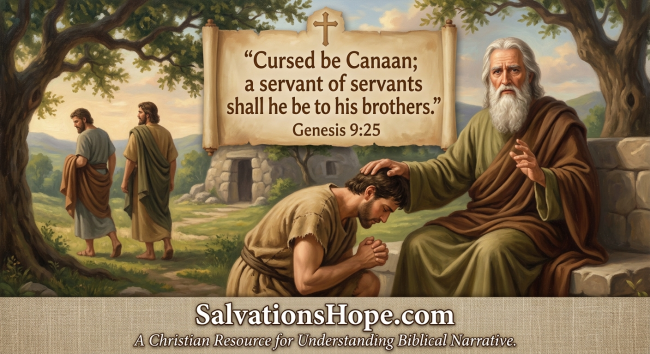
The Curse of Canaan & Hebrew Idioms
Genesis 9:18–25
18: The sons of Noah who went forth from the ark were Shem, Ham, and Japheth. (Ham was the father of Canaan.) 19: These three were the sons of Noah, and from these the people of the whole earth were dispersed. 20: Noah began to be a man of the soil, and he planted a vineyard. 21: He drank of the wine and became drunk and lay uncovered in his tent. 22: And Ham, the father of Canaan, saw the nakedness of his father and told his two brothers outside. 23: Then Shem and Japheth took a garment, laid it on both their shoulders, and walked backward and covered the nakedness of their father. Their faces were turned backward, and they did not see their father’s nakedness. 24: When Noah awoke from his wine and knew what his youngest son had done to him, 25: he said, “Cursed be Canaan; a servant of servants shall he be to his brothers.”(Genesis 9:18–25 ESV):
Why This Passage Confuses Readers
While this is a familiar narrative, it has puzzled commentators and readers for centuries. Why does Ham’s action lead to a curse on his son, Canaan? Why is the reaction of Shem and Japheth so specific?
As we dig into the text, you will see that if we are not attuned to specific idiomatic expressions in biblical Hebrew, it becomes very easy to misinterpret what actually takes place here. By the end of this study, I hope you will see just how crucial this linguistic context is for understanding the author’s original intent.
Traditional Approaches to the Text
Historically, interpreters have wrestled with how to understand Noah’s curse and Ham’s offense. Over time, three primary interpretations have emerged across Jewish tradition and Christian commentary:
- The Literal View: Taking the text strictly at face value—that Ham simply looked upon his father’s physical exposure and inappropriately gossiped about it.
- The Transgression View: Suggesting a more severe physical act or assault occurred in the tent, given Noah’s strong reaction upon waking.
- The Familial/Honor View: Viewing the issue through the lens of Ancient Near Eastern honor culture and covenantal inheritance rights.
View 1: Simple Voyeurism (The Literal View)
The first traditional position is the voyeurism view. Under this interpretation, Ham’s sin was simply looking at Noah’s exposed body while Noah was drunk in his tent.
The rationale behind this view is that Ham violated an ancient taboo against observing parental nudity, embarrassed his father, and subsequently brought Noah’s curse upon his own son, Canaan.
Why Has This View Been So Popular?
This has likely been the leading traditional view since antiquity, primarily because it stems from a plain, literal reading of verse 22:
“…and Ham, the father of Canaan, saw the nakedness of his father.”
As theological scholars note, the greatest strength of this position is its conservatism: it refuses to read anything into the passage that is not explicitly stated in the surface text.
The Major Weaknesses of the Voyeurism View
Despite its popularity, this interpretation faces two massive hurdles that make it deeply unsatisfying upon closer inspection:
Lack of Biblical & Historical Evidence
There is simply no record—either in Mosaic law or in Ancient Near Eastern literature—of a cultural taboo where merely coming across a parent’s accidental nudity carried a criminal penalty or severe moral judgment. As scholar Donald J. Wold remarks:
“Scholars who accept the literal view… must defend a custom about which we know nothing.”
It Fails to Match the Severity of the Curse
If Ham merely walked into a tent and unexpectedly saw his father naked, does that truly warrant a generational curse on his son, Canaan? Taken literally, voyeurism functions as a “non-explanation.” It fails to elucidate either the gravity of Ham’s offense or why Noah’s reaction was so severe. Cursing an entire lineage over an accidental glance seems like complete overkill.
While simple voyeurism remains the most common view among readers due to its straightforward language, it leaves us with more questions than answers. To understand why Noah reacted so strongly, we have to look deeper into ancient idiom and culture.
View 2: Castration (The Rabbinic View)
Believe it or not, the second traditional view is that Ham entered the tent and castrated his father, Noah.
This interpretation originates in ancient rabbinic commentary and has been discussed by Jewish sages for centuries. The premise is that Ham violently mutilated Noah to usurp his father’s authority over the family and the post-flood world.
The Rationale Behind This View
Why would interpreters propose such an extreme theory? Scholars John Bergsma and Scott Hahn summarize the thought process behind it:
“One can cite examples from ancient Near Eastern mythology (although none from the Bible) of a son castrating his father as part of an effort to usurp his authority… This view also provides some rationale, albeit complex, for the cursing of Canaan: Noah curses Ham’s fourth son since Ham deprived Noah of a fourth son.” Under this logic, Noah’s reaction was retributive: because Ham prevented Noah from having a fourth son, Noah placed a curse on Ham’s fourth son, Canaan.
The Weaknesses of the Castration Theory
While this view tries to solve the mystery of why Noah’s response was so severe, it falls apart under scrutiny:
- Zero Textual Evidence: There is no lexical hint or vocabulary anywhere in Genesis 9:20–27 that suggests physical violence or castration took place.
- Strained Logic: The explanation for cursing Canaan requires us to make massive, unstated assumptions—namely, that Noah desperately wanted a fourth son, and that Ham knew this and deliberately thwarted it. The biblical text makes no such claim.
- Extrabiblical Parallels Only: While castration themes appear in surrounding pagan myths (such as Greek or Hittite mythology), no biblical narrative or law supports reading such an act into this passage.
While castration is probably the least common view held by modern interpreters, it remains an important historical footnote in Rabbinic tradition. However, its lack of textual support makes it a highly improbable explanation for Genesis 9.
View 3: Paternal Incest (Homosexual Violation)
The third major traditional view is that Ham’s sin was paternal incest—specifically, that Ham sexually assaulted or violated his father Noah while Noah was incapacitated in his tent.
This view enjoys a significant following among modern scholars and theologians. For instance, Dr. Robert A.J. Gagnon presents this argument in his book, The Bible and Homosexual Practice. While Gagnon’s work on biblical theology and sexuality is generally outstanding, this is a point where many scholars disagree with his conclusion.
The Rationale for Paternal Incest
Proponents of this view build their argument on two primary textual observations:
1. “What His Youngest Son Had Done to Him” (v. 24) Verse 24 states that when Noah awoke, he “knew what his youngest son had done to him.” Proponents point out—quite rightly—that the text implies an active crime or physical act committed against Noah, going far beyond accidental observation or simple voyeurism.
2. The Idiomatic Nature of “Nakedness” Proponents recognize that the phrase “saw the nakedness of” is a biblical idiomatic expression referring to sexual intercourse (as seen in Leviticus 18 and 20).
Combining these two points, proponents argue: if an active crime was committed against Noah, and “uncovering/seeing nakedness” is a sexual idiom, then Ham must have sexually assaulted Noah.
The Major Flaw: A Misapplied Idiom
While this theory correctly identifies that a Hebrew idiom is at play, it misapplies the idiom’s grammatical structure (which we will explore in detail shortly). Beyond the linguistic breakdown, it suffers from the exact same fatal flaw as the previous views:
It still fails to explain why Canaan is cursed instead of Ham.
If Ham was the sole perpetrator who sexually assaulted his father, why is Ham never cursed in Genesis 9? Noah clearly knew what his son had done to him, yet he turns and pronounces a generational curse directly on Ham’s son, Canaan.
If Ham committed paternal incest, cursing Canaan remains an arbitrary and unfair punishment that leaves the actual offender untouched.
Comparison of the Three Traditional Views
View
Proposed Sin
Strength
Primary Weakness
1. Voyeurism
Looking at a father’s nakedness
Strictly follows literal text
No ancient taboo exists; doesn’t justify curse on Canaan
2. Castration
Mutilating Noah to usurp authority
Explains severity of Noah’s anger
No textual/lexical evidence in Genesis 9
3. Paternal Incest
Homosexual assault of Noah
Recognizes active crime & sexual idiom
Misapplies idiom; fails to explain why Canaan is cursed
All three traditional views leave us at a dead end: none of them adequately explain why Canaan bears the curse for Ham’s sin.
To resolve this mystery, we have to look past simple literalism and examine how Leviticus and the ancient Hebrew language actually use the idiom “uncovering/seeing the nakedness of a father.”
The Key to the Puzzle
Understanding Hebrew Idioms
Over the years I have heard many Pastors try to teach on this, I have read many teachings that centered on Genesis 9. I am always amazed at how many pastors and Christians for that matter that assume that Ham is the one who gets cursed.
He isn’t! Read the text carefully:
“Cursed be Canaan; a servant of servants shall he be to his brothers.” (Gen 9:25)
Ham is the one who enters the tent, yet Ham is never cursed in this passage—his son Canaan is. If Ham had just committed a horrific sexual assault against his own father, why would Noah pronounce a curse on his grandson while letting the perpetrator go entirely unaddressed? From a text-critical perspective, that simply does not make sense.
We need an explanation that actually aligns with the biblical data. The paternal incest view gets part of the clue right by recognizing that sexual language is present, but it misapplies the grammar. To see what is really happening, we first have to understand how idioms work in the ancient world.
What Is an Idiom?
An idiom is a figure of speech where the overall meaning completely transcends the literal words used.
Take a current expression like “rent-free”: if someone tells you, “That argument is living rent-free in my mind,” analyzing the words “rent” or “free” won’t get you anywhere. Looking up property leases or monetary costs in a dictionary won’t shed any light on what they actually mean.
You grasp the phrase not through grammatical analysis, but because you participate in today’s shared culture. You instinctively know through modern slang that when something lives “rent-free” in your head, it means you can’t stop obsessing or fixating on it, even though it serves no purpose.
Idioms in Ancient Hebrew
Just as we use idioms today, the ancient Hebrew writers used them throughout the Old Testament.
When Genesis 9 says that Ham “saw the nakedness of his father,” it is not giving us a literal physical description of an accidental glance or a direct assault on Noah. It is using a specific, culturally understood Hebrew idiom.
Once we look at how this exact idiom is defined and used elsewhere in Moses’ writings, the confusion over Canaan’s curse completely evaporates.
Decoding the Idiom
Seeing vs. Uncovering Nakedness
To understand what took place in Noah’s tent, we must look at how the Old Testament authors used two key Hebrew verbs alongside the word for “nakedness” (‘erwah):
- To see (ra'ah) nakedness
- To uncover (galah) nakedness
While modern readers might treat “seeing” and “uncovering” as entirely different actions, biblical Hebrew treats them as interchangeable parallel expressions for sexual intercourse.
Parallelism in Leviticus 20:17
We see this exact overlap demonstrated in Leviticus 20:17:
“If a man takes his sister, a daughter of his father or a daughter of his mother, and sees her nakedness (ra’ah,) and she sees his nakedness (ra’ah), it is a disgrace, and they shall be cut off in the sight of the children of their people. He has uncovered his sister’s nakedness (galah), and he shall bear his iniquity.”
Notice how Moses equates the two phrases in the exact same verse. “Seeing her nakedness” is directly parallel to “uncovering her nakedness.” Removing clothing for sexual relations (uncovering) and the resulting sexual exposure (seeing) are two ways of describing the same act.
The Holiness Code of Leviticus 18
If we turn to Leviticus 18—the Torah’s definitive code on sexual ethics—the phrase “uncover nakedness” (galah ‘erwah) is used repeatedly as the standard Hebrew legal idiom for prohibited sexual relations:
1.“None of you shall approach any one of his close relatives to uncover nakedness. I am the LORD.
2.You shall not uncover the nakedness of your father, which is the nakedness of your mother; she is your mother, you shall not uncover her nakedness.
3.You shall not uncover the nakedness of your father’s wife; it is your father’s nakedness…” (Lev 18:6–8)
The chapter continues through verse 18, applying this same idiomatic formula to relationships with sisters, granddaughters, aunts, and daughters-in-law. To “uncover nakedness” is never about accidental glances or literal wardrobe malfunctions—it is the formal Hebrew idiom for sexual intimacy.
Prophetic Imagery in Ezekiel 16
We see this same usage in the prophetic books. In Ezekiel 16, God uses graphic sexual metaphors to describe Jerusalem’s spiritual adultery:
36: “Thus says the Lord GOD, ‘Because your lust was poured out and your nakedness uncovered (galah) in your whorings with your lovers… 37: behold, I will gather all your lovers… and will uncover your nakedness to them, that they may see all your nakedness (ra’ah).’”
(Ezekiel 16:36–37)
Once again, “uncovering” nakedness and “seeing” nakedness are used side-by-side in a explicitly sexual context.
When Genesis 9:22 tells us that Ham “saw the nakedness of his father,” the original Hebrew audience would not have pictured Ham casually walking past a tent flap and catching a glance. They would have recognized a well-established Hebrew idiom for a prohibited sexual act.
However, the question remains: Whose nakedness was actually uncovered, and how does this explain the curse on Canaan?
Further Prophetic Evidence: Ezekiel 22 & 23
This idiomatic usage of “uncovering nakedness” isn’t an isolated occurrence—it is consistent across the Hebrew scriptures. We see it repeatedly in the book of Ezekiel:
Addressing Jerusalem’s moral corruption, God says, “In you men uncover their fathers’ nakedness;
in you they violate women who are unclean in their menstrual impurity.”(Ezekiel 22:10: )
Describing spiritual unfaithfulness under the imagery of sexual promiscuity, the text warns,
“These uncovered her nakedness… when she carried on her whoring so openly and flaunted her nakedness…
and the nakedness of your whoring shall be uncovered.”(Ezekiel 23:10, 18, 29:)
Across Leviticus and the Prophets, the conclusion is undeniable: To “uncover nakedness” or “see nakedness” is an established Hebrew idiom for engaging in sexual relations.
Where the Paternal Incest View Gets It Right (And Where It Breaks Down)
To this point, proponents of the paternal incest view (such as Dr. Robert Gagnon) have solid ground beneath them:
- They correctly recognize that "seeing/uncovering nakedness" is a sexual idiom, not a literal description of an accidental glance.
- They correctly observe that Noah realized something active had been "done to him" (Gen 9:24), pointing to a transgression far more severe than voyeurism.
Based on this, they reason: If Ham “saw the nakedness of his father,” and that idiom means to have sex, then Ham must have sexually assaulted his father.
The Fatal Flaw in That Logic
While that reasoning sounds straightforward in English, it misinterprets how the Hebrew idiom “the nakedness of your father” is actually defined in the Torah.
If Ham had directly committed paternal incest against Noah, we are left right back where we started with two massive unsolved problems:
- Why is Ham never cursed or punished in the narrative?
- Why does Noah immediately turn around and pronounce a curse on Ham's son, Canaan?
To solve this riddle, we must look at how Moses himself defines the specific phrase “the nakedness of your father” in the Law.
The Turning Point
What Does "Father's Nakedness" Actually Mean?
This is where the paternal incest view misses the mark—and where the legal text of the Old Testament provides the exact key to unlocking Genesis 9. Proponents of paternal incest conclude: “Ham saw the nakedness of his father, therefore Ham had sex with his father.” However, in ancient Hebrew culture and patriarchal law, a husband’s “nakedness” was defined as the woman who belonged to him.
When we look closely at Leviticus 18, Moses explicitly defines this exact phrase for us.
Decoding Leviticus 18:7–8 & 16
Read carefully to how the Torah defines a man’s “nakedness”:
7: “You shall not uncover the nakedness of your father, which is the nakedness of your mother; she is your mother, you shall not uncover her nakedness 8: You shall not uncover the nakedness of your father’s wife; it is your father’s nakedness.” (Leviticus 18:7–8)
Did you catch that equality of terms?
- Leviticus 18:7: states that the nakedness of your father IS the nakedness of your mother.
- Leviticus 18:8: states that to uncover the nakedness of your father’s wife IS to uncover your father’s nakedness.
Notice how this same formula is applied to other male relatives throughout the chapter:
- Leviticus 18:14: "You shall not uncover the nakedness of your father's brother, that is, you shall not approach his wife; she is your aunt."
- Leviticus 18:16: "You shall not uncover the nakedness of your brother's wife; it is your brother's nakedness."
The Cultural & Legal Formula
To modern readers, this phrasing sounds repetitive or confusing. But in ancient Semitic culture, the principle was crystal clear:
To uncover or see the nakedness of a man means to have sexual relations with that man’s wife.
It does not refer to a homosexual violation of the father. It refers to heterosexual incest with the father’s wife (Ham’s mother or stepmother).
TRADITIONAL MISINTERPRETATION= “Saw the nakedness of father”= Literal Homosexual Act
BIBLICAL HEBREW IDIOM=”Saw the nakedness of father”=Heterosexual Act with His Wife=(Noah’s Wife/Mother)
What Actually Happened in the Tent?
When we apply the true Hebrew idiom back to Genesis 9:22—“And Ham, the father of Canaan, saw the nakedness of his father”—the narrative suddenly makes perfect, coherent sense:
- The Act: While Noah was incapacitated from wine, Ham engaged in illicit sexual relations with Noah’s wife.
- The Crime: In the Ancient Near East, usurping a leader’s bed was a recognized method of attempting to usurp his authority and covenantal headship (a dynamic we see later with Absalom in 2 Samuel 16:21–22).
- The Consequence: This was not a passive glance or simple voyeurism. It was a severe, active violation of Noah’s household and marriage bed.
More importantly, this definition finally solves the ultimate mystery of Genesis 9: Why Noah cursed Canaan.
Maternal Incest
What Really Happened in Genesis 9
What we have in Genesis 9 is not paternal incest (a homosexual act). What we have is maternal incest—a prohibited heterosexual act between Ham and Noah’s wife.
The Linguistic Distinction
In biblical Hebrew, whenever the Old Testament condemns homosexual acts (such as in Leviticus 18:22 or 20:13), it uses explicit vocabulary like shakab (“to lie with” another man). The idiom “to uncover/see the nakedness of a man” is never used for homosexual relations. Instead, as Leviticus 18 proves, this idiom consistently means: “Do not engage in sexual relations with the woman who belongs to that man.”
When Ham “saw the nakedness of his father,” he didn’t assault Noah. Ham had sex with his father’s wife—his own mother.
Resolving the Narrative Details
Once we understand that Ham committed maternal incest, every perplexing detail in Genesis 9:20–23 falls neatly into place.
- HAM'S SIN (MATERNAL INCEST): Engages in sexual relations with Noah's wife while Noah is incapacitated
- SHEM & JAPHETH'S REACTION: Walk backward with a cloak to complicity or dishonor (v. 23)
- THE CURSE ON CANAAN (v. 25): Canaan is the resulting offspring of this illicit incestuous union (the product of Ham's violation)
The Righteous Response of Shem and Japheth
After committing this act, Ham goes outside and tells his brothers. Shem and Japheth are horrified. Notice what they do in verse 23:
Their faces were turned backward, and they did not see their father’s nakedness.”
Why do they walk in backward with a garment?
- Honoring Their Family: By covering their exposed mother without looking at her, they actively distance themselves from Ham’s sin.
- Rejecting Complicity: They refuse to participate in, approve of, or gaze upon the violation Ham had just committed. Their actions telegraph deep respect for patriarchal honor and covenantal boundaries, establishing them as the righteous heirs.
What About "His Tent"? (Genesis 9:21)
An obvious objection arises: verse 21 says Noah “became drunk and lay uncovered in his tent.” If it was Noah’s tent, doesn’t that mean Noah was the only one in there? Not at all. Consider two simple historical and contextual realities:
- A Shared Space: Married couples in the ancient world shared tents and sleeping quarters. Noah and his wife could have easily been together in the tent. After Noah became intoxicated and passed out, Ham took advantage of his father’s physical incapacitation to violate his mother.
- Noah Was Defenseless: Noah’s drunkenness created the window of opportunity. He was unable to defend his wife or uphold the honor of his household.
Ham’s act was an attempt to dishonor his father and usurp his authority by taking his woman. This severe transgression—maternal incest—sets the stage for why Noah’s response upon waking was so precise and devastating.
The Textual Evidence
"His Tent" or "Her Tent"?
Even if we look closely at the phrase translated “his tent” in Genesis 9:21 (“and lay uncovered in his tent”), there is a significant textual and grammatical detail that strongly reinforces the maternal incest view.
A Suffix Misunderstood by the Masoretes
In standard English Bibles, verse 21 says Noah was in “his tent.” However, if you examine the Hebrew text (Ketiv, the written consonants as preserved in the manuscript), the word used is oholo (אָהֳלֹה). Grammatically, this consists of the noun ohel (“tent”) combined with a third-person feminine singular suffix (the letter He, ה). Strictly translated according to Hebrew grammar, the written text says: “her tent” (i.e., Noah’s wife’s tent) Centuries later, the Masoretic scribes suggested a textual note (Qere, “what is to be read”), proposing that the letter He (ה) should be corrected to a Waw (ו)—which would make it a third-person masculine singular suffix (“his tent”). Most modern English translations follow this scribal correction rather than the written Hebrew text itself.
However, if we stick with the written text as preserved in Genesis, Ham does not enter Noah’s private tent—Ham enters his mother’s tent.
Proof from Genesis 24:67 (Sarah's Tent)
We see this exact same grammatical construction used elsewhere in Genesis to denote a matriarch’s tent. In the story of Isaac and Rebekah, Genesis 24:67 reads:
“Then Isaac brought her into the tent of Sarah his mother…” (Gen 24:67)
In the underlying Hebrew, the text literally says:
“…Isaac brought her into her tent [oholo], the tent of Sarah, his mother.”
In ancient nomadic patriarchal culture, family encampments consisted of large tents divided into distinct living compartments or separate tents for the primary wives. When Sarah passed away, her specific tent/living space remained known as “her tent.”
Reconstructing the Scene
When we put the textual, cultural, and grammatical pieces together, the scenario becomes clear:
- The Setting: Ham enters his mother's tent space within the patriarchal complex.
- The Circumstance: Noah is present in his wife's tent—perhaps having retired there after drinking wine—and is completely incapacitated and passed out.
- The Crime: Ham seizes upon his father's defenseless state, enters his mother's living quarters, and violates his mother (“saw the nakedness of his father”).
Whether Noah was in the tent or not, the underlying crime remains the same: Ham took advantage of his father’s incapacitation to dishonor him by violating his wife.
Summary of the Passage Thus Far
- Not Voyeurism: Mere accidental observation fails to explain the severity of Noah's reaction or the generational curse.
- Not Castration: There is zero lexical evidence in the text to support physical mutilation.
- Not Paternal Incest: Biblical Hebrew never uses "uncovering/seeing nakedness" for homosexual acts; Leviticus 18 explicitly defines a father's nakedness as his wife.
- Maternal Incest: Ham violated Noah's wife (his own mother) in her tent, attempting to usurp his father's authority.
Why Canaan Was Cursed
The Usurpation & The Product of Incest
We now arrive at the ultimate question that has stumped interpreters for centuries: If Ham was the perpetrator, why does Noah pronounce a curse directly on Canaan instead of Ham?
Maternal incest is the only view that provides a seamless, scripturally grounded explanation. It unlocks the mystery through two crucial factors: the product of the union and the ancient strategy of dynastic usurpation.
Canaan Was the Offspring of the Incestuous Act
Notice how Genesis 9 goes out of its way to emphasize a specific detail—twice—before the curse is ever spoken:
- Genesis 9:18: “The sons of Noah who went forth from the ark were Shem, Ham, and Japheth. (Ham was the father of Canaan.)”
- Genesis 9:22: “And Ham, the father of Canaan, saw the nakedness of his father...”
Why does the author proleptically highlight that Ham is the father of Canaan right here in the text? Because Canaan was the direct product of this incestuous union between Ham and his mother.
By cursing Canaan, Noah formally disqualifies this illegitimate offspring from inheriting family headship or covenantal blessings. Ham attempted to “raise up competitive seed” through his father’s wife to steal control of the post-flood patriarchal line and pass it to his son. Noah’s curse publicly strips Canaan of any right to succession.
Usurping Leadership via the Patriarchal Bed
In Ancient Near Eastern and biblical culture, taking possession of a father’s or ruler’s woman was a recognized, aggressive political strategy to usurp authority and claim dynastic leadership.
Ham was not just committing a personal sin; he was attempting a silent coup against Noah’s patriarchal headship over the post-flood world.
We see this exact pattern repeated throughout Scripture:
Reuben and Bilhah (Genesis 35:22 & 49:3–4)
As the firstborn, Reuben had the right to headship. However, he went in and lay with Bilhah, his father Jacob’s concubine. As a direct result, Jacob stripped Reuben of his rights as the leader of the brothers.
David and Saul’s Wives (2 Samuel 12:7–8)
When God anointed David as king over Israel, Nathan the prophet reminded David how God established his throne: “I gave you your master’s house and your master’s wives into your arms…” (2 Sam 12:8). Transferring the royal harem signified the legal transfer of the crown.
Absalom’s Public Coup (2 Samuel 16:20–22)
When Absalom tried to overthrow his father King David, Ahithophel gave him explicit political advice:
and the hands of all who are with you will be strengthened.” (2 Sam 16:21)
Absalom pitched a tent on the roof and publicly went in to David’s concubines to broadcast to all Israel that he had seized his father’s authority.
Adonijah’s Bid for the Throne (1 Kings 2:13–25)
After Solomon was crowned, Adonijah tried a subtle back-door attempt to seize royal legitimacy by asking for Abishag—David’s concubine—as his wife. Solomon instantly recognized this request as a treasonous bid for the kingdom and had Adonijah executed.
Bringing It All Together
When we re-examine Genesis 9 through the lens of biblical Hebrew idioms and ancient cultural context, the puzzle pieces fit together perfectly:
- NOAH'S DRUNKEN INCAPACITATION
- HAM'S CRIME: Enters his mother's tent & commits incest in an attempt to usurp family leadership
- CANAAN CONCEIVED: Canaan is the resulting illegitimate offspring of this illicit union
- NOAH'S PRONOUNCEMENT: Disqualifies Canaan from the line of blessing and authority ("Cursed be Canaan")
- The Idiom: “Seeing/uncovering the nakedness of a father” means engaging in sexual relations with his wife (Leviticus 18:7–8).
- The Crime: Ham committed maternal incest with Noah’s wife to claim the family headship.
- The Textual Detail: Ham entered her tent (the feminine suffix in Genesis 9:21).
- The Consequence: Canaan was born from this act. Noah cursed Canaan to permanently cut off Ham’s illegitimate lineage from inheriting the covenantal succession.
By looking past English surface readings and understanding biblical Hebrew idioms, what once seemed like an arbitrary or unfair story becomes a profound, cohesive account of ancient covenantal inheritance and family honor.
The Chronological Objection (and Why It Fails)
At this point, a common objection is often raised against the maternal incest view:
“If Canaan was conceived through this act, how could Noah wake up from his drunkenness in verse 24 and immediately pronounce a curse on Canaan before the child was even born?”
To modern readers accustomed to strict chronological reporting, this might seem like a timeline disconnect. However, biblical narrative—especially in Genesis—frequently compresses time to highlight the theological meaning of events rather than providing a play-by-play diary.
Understanding Compressed Narrative in Genesis
Drs. John Bergsma and Scott Hahn address this exact objection in their scholarly analysis of the passage:
“The objection has also been raised that vv. 24–25 imply that Noah pronounced the curse on Canaan immediately, before the nine months necessary for him to be born according to the maternal-incest theory. But the narrator may have simply compressed the chronology at this point, as he does elsewhere. After all, Gen 5:32 (‘After Noah was five hundred years old, Noah became the father of Shem, Ham, and Japheth’) should not be taken to mean that Noah’s wife bore triplets shortly after his five-hundredth birthday.”
In Genesis 5:32, the author compresses decades of family history into a single sentence. The text doesn’t mean Noah had triplets on his 500th birthday; it simply summarizes that during this period of his life, these three sons were born.
Similarly, in Genesis 9, the narrator links Ham’s crime directly with its ultimate resolution: the permanent exclusion of Canaan from the patriarchal blessing.
By cursing Canaan, Noah strikes a devastating, long-term blow to Ham’s attempt at usurpation. Canaan—the illegitimate fruit of Ham’s sin—would outlive Ham, yet remain a servant to his brothers’ lineages forever.
The Most Coherent Explanation
No single interpretive view answers every single peripheral question with the absolute mathematical precision we might wish for. However, when we weigh all four traditional views against the total witness of Scripture, the maternal incest view stands out as far and away the most coherent:
- It respects the Hebrew grammar: It recognizes that "seeing/uncovering nakedness" is a well-attested sexual idiom throughout Leviticus and the Prophets.
- It aligns with Levitical law: Leviticus 18:7–8 explicitly defines "the nakedness of a father" as sexual relations with his wife.
- It accounts for ancient near eastern culture: It makes sense of Ham’s act as an attempt to usurp patriarchal leadership by taking his father's woman (just as Reuben, Absalom, and Adonijah attempted later).
- It solves the ultimate mystery: It provides a clear, logical reason why Canaan—the offspring of that illicit union—bore the curse instead of Ham.
When we take off our modern western lenses and let the Old Testament interpret itself through its own idioms and cultural context, a passage that once seemed baffling and bizarre becomes a clear, powerful account of covenantal righteousness, judgment, and authority.
Genesis 9 & The History of "Biblical Racism"
Before we close our study on Genesis 9, we must address a tragic and infamous chapter in church history. For centuries—particularly during the transatlantic slave trade and the American Antebellum period—this passage was distorted to justify racial hierarchy and the enslavement of dark-skinned people.
This false framework, often referred to historically as the “Curse of Ham,” was part of a broader matrix of ideas in Europe and America used to subjugate African peoples.
When you examine the text carefully, however, the entire biblical “justification” for racial slavery collapses under the weight of basic exegesis.
Why the "Curse of Ham" Argument Fails Completely
1. Ham Is Never Cursed in the Text!: As we have emphasized throughout this study, Noah never curses Ham. Read Genesis 9:25 again: “He said, ‘Cursed be Canaan; a servant of servants shall he be to his brothers.’” The text explicitly places the curse on Canaan, not on Ham or Ham’s other sons (Cush, Mizraim, and Put). Using this text to claim that all descendants of Ham were cursed to be slaves requires completely ignoring what the Bible actually says.
2. The Canaanites Were Not Dark-Skinned Africans: Geographically and ethnically, the Canaanites settled in the Ancient Near East (modern-day Israel, Palestine, Lebanon, and Syria). The biblical text is focused on the immediate geopolitical context of the ancient Middle East—specifically Israel’s relationship with the Canaanite nations in the Promised Land—not modern global racial categories.
3. Skin Color Is Completely Absent from the Text: Genesis 9 contains zero mention of skin color, pigmentation, or race. Reading racial distinctions into Noah’s pronouncement is a classic example of eisegesis—forcing modern prejudices back into an ancient text.
The Historical Context: The Age of Discovery & "Biblical Racism"
How did European and American thinkers end up with such distorted interpretations?
During the Age of Discovery (roughly the 15th through 18th centuries), European explorers began crossing the Atlantic and encountering indigenous populations in lands never mentioned in the Bible. This created a massive worldview crisis for theologians and scholars of that era:
- How did these people get here?
- Why aren't these lands listed in the Table of Nations in Genesis 10?
- How do we account for different physical characteristics, like skin color?
To answer these questions—and to justify the economic exploitation and colonization of these newly encountered lands—theologians and philosophers invented non-biblical theories. Some proposed Pre-Adamism or Polygenism (the idea that non-white races were created separately from or before Adam, making them inherently different or inferior).
Others distorted Genesis 9 to claim that dark skin was the physical “mark” of Noah’s curse on Ham’s lineage.
The Bottom Line
The biblical arguments used to justify racial slavery were not just bad theology—they were built on a complete refusal to read the text as it was written.
- The Text: Ham is not cursed; Canaan is disqualified from family headship over an incestuous crime of usurpation.
- The Misuse: A political and economic system co-opted the Bible to create a racial hierarchy that Scripture itself never teaches.
When we honor the Hebrew idioms, respect the legal context of the Torah, and pay attention to what the words on the page actually say, the “Curse of Ham” myth completely disappears—leaving us with a clear view of God’s word untainted by human prejudice.
Summary Checklist of Genesis 9
Question
Surface Misconception
Biblical & Hebrew Context
Who was cursed?
Ham and all his descendants
Canaan specifically (Gen 9:25)
What was Ham’s sin?
Looking at a naked body or homosexual assault
Maternal incest to usurp patriarchal authority
What does “father’s nakedness” mean?
Literal paternal exposure
Idiom for having sex with his father’s wife (Lev 18:7–8)
Does this passage teach racial slavery?
Yes (“The Curse of Ham”)
No. Skin color and race are completely absent from the text.
The Convergence of Cultural Shocks: The Intellectual Hotbed of "Biblical Racism"
To truly understand how a passage like Genesis 9 became weaponized to justify chattel slavery and racial hierarchy, we have to look beyond simple malice and examine the massive intellectual and cultural upheavals sweeping Western civilization between the 16th and 19th centuries.
This period—stretching from the Age of Discovery to the dawn of the Industrial Revolution—blindsided Christian thinkers with an avalanche of new, disruptive knowledge. The traditional world described in Western theology was suddenly blown wide open by several converging forces:
- THE AGE OF DISCOVERY: Explorers find populated, non-biblical continents and cultures
- THE INTELLECTUAL CRISIS: New discoveries challenge traditional biblical worldviews
- Deciphered texts (Sanskrit, cuneiform, Egyptian hieroglyphs)
- Emerging deep-time geology (Earth is millions of years old)
- Darwinian evolutionary theory & new biological taxonomies
- DESPERATE BIBLICAL EXEGESIS: Theologians attempt to force new discoveries into Scripture
- Polygenism & Pre-Adamism (Separate creations for non-whites)
- The "Curse of Ham" myth (Distorting Genesis 9 to explain Africa)
- The "Mark of Cain" myth (Claiming dark skin was a divine mark)
- HISTORICAL TRAGEDY: Bad hermeneutics are co-opted to justify transatlantic slavery, colonial exploitation, and institutionalized racial hierarchies
The Global Expansion & Non-Biblical Peoples
When European navigators crossed the Atlantic and Pacific, they encountered vast landmasses inhabited by millions of indigenous human beings. These populations, cultures, and geographical territories were nowhere to be found in the Table of Nations in Genesis 10. Theologians faced an unprecedented question: Where did these people fit into the line of Adam and Noah?
Deciphering Ancient Near Eastern & Eastern Texts
As scholars unlocked ancient languages—Sanskrit in India, cuneiform in Mesopotamia, and hieroglyphs in Egypt—they discovered written histories, king lists, and origin accounts that predated standard European biblical chronologies.
The Birth of Deep-Time Geology & Evolutionary Theory
Geologists began demonstrating that the Earth was millions of years old, directly challenging traditional Usherite timelines that dated creation to roughly 4004 BC. Decades later, Charles Darwin’s evolutionary frameworks added another layer of complexity to questions of human origins and biological diversity.
The Fatal Leap: Preserving Faith Through Desperate Interpretation
Confronted by these massive cultural shocks, many Christian scholars, pastors, and institutions panicked. They operated under a misguided assumption: “If we cannot account for every newly discovered culture, geography, and scientific theory within our existing interpretation of the Bible, then Scripture itself will be discarded as false.”
Instead of allowing the ancient Near Eastern text to speak for itself within its own original context, interpreters began forcing the text to answer modern questions it was never written to address.
Out of this pressure-cooker of intellectual desperation emerged a series of unfounded, nonsensical theories:
European Superiority & The Adamic Line
A logical leap took hold among Western thinkers: “Europeans are the primary heirs of the biblical text, the Judeo-Christian worldview, and the Christianized Roman Empire. Therefore, Europeans must represent the purest, most direct continuation of the Adamic race.”
The "Curse of Ham" & African Geography
To explain dark-skinned populations in Africa and elsewhere, commentators mapped these groups onto Ham’s lineage. They assumed—without a shred of textual or geographical evidence—that Ham’s descendants migrated into Africa, carrying an inherent, generational curse of bondage.
The "Mark of Cain" Myth
In a similar exercise of bad exegesis, interpreters claimed that the mark God placed on Cain in Genesis 4:15 was dark skin pigmentation. This unbiblical assertion was used alongside Genesis 9 to double-down on the idea that dark skin was a divine identifier of moral corruption or servitude.
The "Lost Tribes" Theories
When evaluating the tragedy of biblical racism, it is essential to distinguish between two distinct groups of people involved in its spread:
THE CRISIS OF BIBLICAL EXEGESIS
RACIAL HATE MONGERS:
1. The Active Exploitation by Racial Ideologues: Slave traders, plantation owners, political leaders, and overt white supremacists eagerly seized upon these distorted readings. For them, the “Curse of Ham” provided a convenient, divine stamp of approval for a brutal, highly lucrative economic system based on human exploitation.
WELL-INTENTIONED BELIEVERS:
2. The Passive Acceptance of Misguided Believers: For many average churchgoers, however, the motivation was not explicit personal hatred toward dark-skinned human beings. Rather, they were taught by their pastors, theologians, and academic institutions that this was the only way to read Genesis 9 without compromising the authority of the Bible.
They passively accepted a worldview that treated other human beings as “lesser races” because they believed their faith depended on upholding that interpretation. As horrifying as the outcome was, their driving concern was preserving the Bible’s historical accuracy in the face of modern science and exploration.
Why Hermeneutics Matters: The Lesson of Genesis 9
POOR HERMENEUTICS
- Forces modern racial categories onto ancient Near Eastern texts
- Ignores explicit wording (Canaan is cursed, not Ham)
- Produces damaging, unbiblical
HISTORICAL HERMENEUTICS
- Recognizes Hebrew idioms ("seeing nakedness" = maternal incest)
- Observes text-critical details (Canaan is cursed, Ham is not)
- Upholds biblical authority without twisting text to fit cultural agendas
When we abandon a text’s original grammatical, historical, and cultural context—forcing it to serve our own contemporary anxieties, cultural prejudices, or political agendas—the consequences are devastating.
As we have demonstrated throughout this study:
- The text never mentions race or skin color.
- Ham is never cursed in Genesis 9.
- The narrative is about covenantal succession and an act of maternal incest in ancient Israel’s immediate geopolitical neighborhood—not a global racial mandate.
Proper Bible interpretation matters deeply. When we let Scripture speak in its own context through its own idioms, the false structures of “biblical racism” dissolve completely—leaving us with a clear, untainted view of God’s Word.
- How can modern Christians safeguard against forcing their own cultural or political assumptions into difficult biblical passages?
- Why is understanding the historical context of an ancient Near Eastern writer crucial for preventing dangerous misinterpretations today?