
Counterfeit Unity
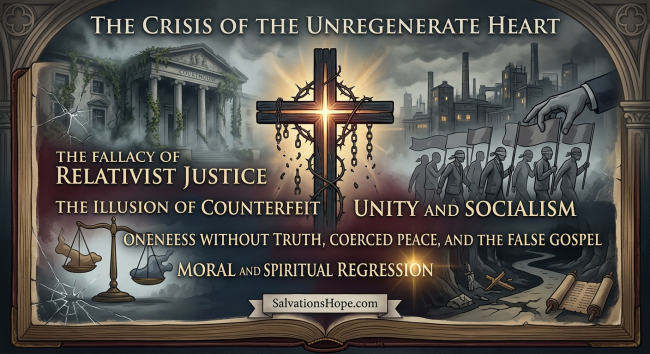
The Fallacy of Relativist Justice
The Illusion of Counterfeit Unity
In contemporary cultural discourse, few terms carry as much emotional weight as justice, unity, and equality. However, when these concepts are detached from biblical truth, they undergo a subtle transformation—shifting from divine principles grounded in the character of God to humanistic counterfeits.
To understand the modern appeal and ultimate failure of relativist justice, counterfeit unity, and political socialism, we must examine their underlying logic through a biblical and theological lens.
Modern relativist justice assumes that morality is culturally constructed and subjective. Rather than evaluating right and wrong against an absolute standard, relativist justice redefines virtue based on shifting human power dynamics, feelings, or political ideologies.
The Theological Fallacy:
- A Law Without a Lawgiver: Scripture teaches that God’s character is the ultimate foundation for justice ("He is the Rock, His work is perfect; for all His ways are justice," Deuteronomy 32:4). True justice is objective because God is unchangeable.
- Subjective Moral Collapse: When justice is disconnected from divine authority, it becomes arbitrary. If society defines justice, then whoever holds power determines what is good and evil. Isaiah warned against this inversion: "Woe to those who call evil good, and good evil" (Isaiah 5:20).
Without an absolute Moral Lawgiver, “justice” ceases to be an objective moral good and becomes merely an instrument of human political will.
Counterfeit Unity: Oneness Without Truth
Worldly ideologies often demand a surface-level consensus or enforced conformity in the name of “togetherness.” However, this unity frequently requires the compromise or outright suppression of objective truth.
The Theological Fallacy:
- The Lesson of Babel: Genesis 11 presents the Tower of Babel as the ultimate biblical example of counterfeit unity. The human race was united in purpose, yet entirely opposed to God. Unity in pursuit of human autonomy leads to spiritual rebellion and divine judgment.
- Unity Rooted in Christ: True biblical unity (koinonia) is never achieved by lowering the bar of truth; it is established through shared alignment with Jesus Christ. Paul writes that believers are united by "one Lord, one faith, one baptism" (Ephesians 4:5).
Unity is not a supreme virtue in itself. Unity in error is collective rebellion; unity in truth is Christian fellowship.
Socialism and Counterfeit Compassion: Coercion vs. Stewardship
Socialism presents itself as the economic application of human solidarity and care for the poor. It promises to eliminate inequality by centralizing power and redistributing resources through the state.
The Theological Fallacy:
- State Coercion vs. Generosity: The Bible places a heavy emphasis on voluntary, heart-motivated generosity ("Each of you should give what you have decided in your heart to give, not reluctantly or under compulsion, for God loves a cheerful giver," 2 Corinthians 9:7). Redistributing wealth through state force strips charity of its moral value and replaces sacrificial love with political compulsion.
- Distortion of Stewardship: Biblical ethics recognize individual conscience, personal property ("Thou shalt not steal," Exodus 20:15), and personal responsibility before God. Socialism shifts responsibility from the individual and the local church to an impersonal state apparatus, fostering dependency on government rather than trust in God.
True compassion requires a heart transformed by grace, expressing voluntary love. A system that uses state power to confiscate and redistribute wealth imitates the outcome of charity while eliminating its moral essence.
The Gospel Alternative
The logical trajectory of relativist justice, counterfeit unity, and political socialism leads to a profound spiritual illusion: an earthly kingdom promises the blessings of God’s rule—justice, peace, and equality—while rejecting God Himself.
Concept
The Secular Counterfeit
The Biblical Truth
Justice
Subjective, power-driven, constantly shifting
Absolute, rooted in God’s immutable holy character
Unity
Conformity built on compromised truth
Fellowship (Koinonia) centered on Christ and Gospel truth
Compassion
State-enforced coercion and wealth redistribution
Heart-led voluntary stewardship and personal charity
As believers, our calling is not to embrace humanistic substitutes, but to embody authentic biblical righteousness. Real justice flows from God’s holiness, real unity is forged in Jesus Christ, and real compassion is powered by the Holy Spirit working through a transformed heart.
Shadows of Shalom
Analyzing the Logic of Broken Human Systems
When human power attempts to construct righteousness apart from God, it inevitably produces counterfeit virtues. Scripture repeatedly warns against substituting human political or moral effort for the authentic Gospel of Jesus Christ.
By analyzing three distinct phases of human self-redemption—Coerced Peace, Moral & Spiritual Regression, and The Paradox of Partial Justice—we can trace the logical progression of man’s failed endeavor to save himself.
Coerced Peace and the False Gospel
“They have healed the wound of my people lightly, saying, ‘Peace, peace,’ when there is no peace.” — Jeremiah 6:14
True peace (Shalom) is not merely the absence of external conflict; it is the presence of divine order, right relationship with God, and internal transformation through grace.
When human systems try to establish peace without biblical repentance and heart transformation, they must rely on external pressure, law, or force.
- The Counterfeit: Coerced peace demands external compliance while leaving the human heart unrenewed. It acts as a legalistic dynamic that imposes quietness from the outside in.
- The False Gospel: The true Gospel works from the inside out via regeneration (Regeneratio through the Holy Spirit). A false gospel promises salvation or societal harmony through compliance, social conformity, or institutional power.
- The Structural Breakdown: Power without grace produces an illusion of tranquility. Because the underlying sin nature (Incurvatus in se—the heart turned inward) remains unaddressed, the forced calm is fragile and superficial.
The Result: Moral and Spiritual Regression
“Having begun by the Spirit, are you now being perfected by the flesh?” — Galatians 3:3
When a culture or individual relies on coerced peace and false gospels, moral progress does not occur. Instead, an inevitable process of decay takes root. Because external compliance is enforced, outward appearance becomes paramount. Internal morality regresses into performance and self-righteousness (resembling the Pharisees in Matthew 23). When righteousness is reduced to rule-following under threat of force, personal discernment and faith-driven conviction wither away (Romans 14:23). Coercion suppresses sin rather than mortifying it. Suppressed sin acts like pressurized gas—eventually erupting into overt lawlessness, hostility toward God, and moral collapse.
Human effort to force morality naturally produces spiritual death, hardening hearts against the very grace that brings life.
The Paradox of Partial Justice: Man’s Broken Endeavor
“For the anger of man does not produce the righteousness of God.” — James 1:20
Because man possesses God’s image (Imago Dei), humanity retains a basic desire for justice. However, because man is fallen (Total Depravity), human justice is always limited, biased, and incomplete.
Human Desire for Justice + Fallen Nature = Incomplete & Oppressive Systems
- The Trap of Partiality: Human systems can fix one dimension of injustice only to introduce another. Seeking justice without divine wisdom often trades one form of oppression for another under a different name.
- Self-Deception: Man mistakenly views his partial, flawed justice as ultimate righteousness, creating a delusion of self-sufficiency (Romans 10:3).
- The Need for the True Gospel: Partial justice points to our fundamental need for a Divine Judge. Human systems can restrain bad behavior to a degree, but they can never justify the sinner, repair the cosmos, or make all things new.
Man’s endeavor to establish order apart from God is logically bound to fail. Coerced peace masks underlying sin, leading directly to spiritual regression, which ultimately yields only broken, partial justice.
True Shalom and true justice cannot be engineered through human force; they are gifts received only at the cross of Christ, where “Steadfast love and faithfulness meet; righteousness and peace kiss each other” (Psalm 85:10).
"Only in America"
A Theological Critique of Modern Cultural Paradoxes
Cultural idioms often serve as mirrors, reflecting both a society’s values and its internal contradictions. The phrase “Only in America” frames a series of paradoxical statements regarding freedom, sanctity of life, morality, and faith. When analyzed through a Biblical lens, these statements highlight a tension between authentic Christian theology and the contemporary secular socialist mindset. In 1997, the rock band Creed released their debut album My Own Prison, which contained the hard-hitting track “In America”. Written from a place of spiritual search and frustration with societal hypocrisy, the song holds up a mirror to a modern culture that calls evil good and good evil (Isaiah 5:20).
"We're slaves to be free"
Modern individualism promises freedom through absolute self-determination, yet often results in bondage to materialism, careerism, addiction, and public opinion. Scripture asserts that absolute autonomy is an illusion—human beings are inherently bound to something.
- In Romans 6:16–18, the Apostle Paul explains that every person is either a servant to sin leading to death, or a servant to obedience leading to righteousness.
- Biblical freedom (eleutheria) is not the liberty to do whatever one desires, but the spiritual liberation from sin to live according to God’s design (Galatians 5:13). Attempting to define freedom apart from God results in a paradoxical spiritual enslavement.
"We kill the unborn to make ends meet"
Human life is commodified and subjected to economic convenience, where financial security or personal progress is prioritized over the inherent right to life. This statement exposes a conflict between a materialist worldview and the Christian doctrine of the Imago Dei (Image of God).
Scripture teaches that human life possesses intrinsic value from conception (Psalm 139:13–16, Jeremiah 1:5), grounded in God’s creative design rather than socioeconomic utility. Sacrificing human life for financial or practical convenience mirrors ancient warnings against placing economic security or self-preservation above God’s moral law (Exodus 20:13). True faith relies on God’s provision while upholding the sanctity of life (Matthew 6:31–33).
"Sexuality is democracy"
Morality and sexual ethics are determined by majority consensus, personal identity, and individual preference rather than objective truth. “Democratizing” sexuality assumes that human desire is the ultimate moral authority. Scripture establishes that morality is rooted in God’s unchanging character and revealed design, not popular vote (Genesis 1:27, Matthew 19:4–6). When society treats morality as a democracy, truth becomes relative—a condition described in Judges 21:25: “Everyone did what was right in his own eyes.” Christian theology holds that sexual ethics are designed by God for holiness, flourishing, and human good, rather than subjective governance.
"We stamp our dollar 'In God We Trust'"
A nation places sacred declarations on its currency while simultaneously pursuing systems and behaviors that contradict that trust. Stamping a holy phrase onto financial currency creates an immediate theological tension between national identity and spiritual reality. Jesus explicitly warned of the competing devotions between God and wealth: “You cannot serve both God and money” (Matthew 6:24). Proclaiming trust in God while prioritizing material prosperity or secular self-reliance risks solemn hypocrisy, echoing God’s indictment in Isaiah 29:13: “These people come near to me with their mouth and honor me with their lips, but their hearts are far from me.” True trust in God requires alignment between national practice, individual obedience, and public confession.
When evaluated through a Christian worldview, these statements reveal a broader cultural malaise: the attempt to retain the language of blessing and God’s favor while operating on principles detached from Biblical truth. For the Christian believer, this critique serves as a call to discern the spirit of the age, live faithfully as citizens of the Kingdom of God (Philippians 3:20), and practice a faith defined by obedience rather than cultural compromise.
A Theological Reflection
The Crisis of Commercialized Faith and Cultural Disillusionment
In modern American culture, religious imagery often exists in tension with spiritual reality. The provided text offers a poignant critique of religious consumerism, spiritual exploitation, and the existential confusion that arises when institutional Christianity becomes tangled with performative spectacles and financial demands.
Below is an analysis examining the biblical and theological logic embedded within these lyrics.
The Perversion of Corporate Worship
“Church bells ringing / Pass the plate around / The choir is singing / As their leader falls to the ground”
The scene opens with traditional markers of sacred assembly—bells, choir music, and the collection of tithes. However, this outward appearance of piety stands in stark contrast to the leader’s dramatic collapse. Biblically, spiritual leaders are called to shepherd the flock with integrity and humility (1 Peter 5:2–3). When a leader falls—whether through moral failure, burnout, or the weight of a manufactured persona—it exposes the fragility of a faith built on human charisma rather than the Gospel. Passing the plate while tragedy or moral collapse occurs underscores a haunting reality: religious systems often continue their financial and operational machinery even when spiritual death is happening in plain sight.
Transactional Religion and the Exploitation of the Vulnerable
The terminology “mister prophet man” reflects the commodification of divine revelation. When faith is reduced to a commercial enterprise, spiritual guidance becomes a product sold by self-proclaimed prophets. The line “I gave my last dollar” echoes Jesus’ observation of the widow in Mark 12:41–44, as well as His harsh condemnation of religious leaders who “devour widows’ houses” (Mark 12:40). Asking “Can I still come to your show?” exposes the tragic shift from worshiping the Creator to consuming a performance. When the sanctuary becomes a theater, grace is falsely presented as something earned or purchased rather than freely received (Isaiah 55:1).
Moral Disorientation and the Lost Soul
The lyrics express deep moral confusion—“What is right or wrong / I don’t know who to believe in.” When religious institutions prioritize gain over truth, the surrounding culture loses its moral compass. As Proverbs 29:18 notes, where there is a corruption or lack of divine vision, people cast off restraint. The phrase “My soul sings a different song” highlights the dissonance between institutional demands and personal conviction. The individual recognizes that the commercialized version of faith does not align with true spiritual truth written on the heart (Romans 2:15). The repeating refrain grounds this struggle within the specific framework of American civil religion, where consumerism, individualism, and Christianity frequently intersect. It critiques a culture where spiritual truth is often drowned out by cultural noise and prosperity theology.
Institutional Ritual + Spiritual Exploitation
↓
Moral Disorientation & Disillusionment
↓
A Cry for Authentic Truth & Grace
The logic of these lyrics traces the journey from outward religious performance to deep spiritual disillusionment. By reducing faith to transactional promises and grand spectacles, religious institutions leave seekers confused, impoverished, and alienated.
Ultimately, this critique serves as a sobering biblical reminder: true faith is not a paid performance or a human enterprise, but a free gift of grace that brings clarity, truth, and genuine rest to the weary soul (Matthew 11:28–30).
Betrayal, Suffering, and the Limits of Retribution
Have you ever found yourself in a wilderness where logic fails, justice seems absent, and the steady rhythms of life collapses? This question captures a profoundly human experience recorded throughout the Scriptures: the anguish of spiritual disequilibrium and moral betrayal.
When exposed to the deceitful words of men and the destruction of divine wisdom, the human soul naturally wrestles with the desire for vengeance. By examining the aspects of this question through a biblical lens, we can chart the journey from disorientation to the critical crossroad of human retribution versus God’s justice.
The Theological Logic:
Human intellect and philosophy (“reason”) are limited when confronted with unprovoked malice. Suffering caused by groundless attacks destabilizes our understanding of divine order (Ecclesiastes 1:17–18). God created time and seasons as symbols of order, promise, and covenant continuity (Genesis 8:22). Severe personal trial disrupts this temporal stability, leaving the believer feeling untethered from God’s created order—a frequent theme in the Psalms of lament (Psalm 13:1–2). Being groundlessly maligned echoes the experience of the righteous sufferer throughout Scripture, ultimately finding its fulfillment in Christ, who stated, “They hated me without a cause” (John 15:25).
The Severing of Wisdom (Deceit and Internal Bleeding)
You cannot rest beneath the trees of wisdom when your own hands have severed their roots. A tongue untamed brings bitter words, and its power can break a heart from the inside out. The “tree of wisdom” is a biblical image of life, security, and spiritual nourishment (Proverbs 3:18). However, hypocritical or malicious teachers cut at the roots of truth. You cannot rest in a structure or system of wisdom that has been intentionally undermined by bad-faith actors (Psalm 11:3). Scripture repeatedly warns of the destructive power of ungodly speech. James describes the unbridled tongue as a world of iniquity set on fire by hell (James 3:6). Deceitful speech (“forked tongues”) inflicts internal, spiritual trauma—causing a person to “bleed from inside out.” True peace and spiritual sleep are gifts from God (Psalm 4:8). Deceit and false teaching rob the soul of the peaceful repose that divine wisdom provides.
The Crossroad of Retribution (The Temptation of Vengeance)
“What if you stumbled? What if you fell short? What if you seek revenge—or demand an eye for an eye? The world calls for retaliation, but Christ calls us to forgiveness, grace, and redemption.”
- Facing Deceit Realistically: The questions begin by acknowledging the reality of sin: What if the betrayal actually happened? What if it was all a lie? Faith does not require us to deny reality; it requires us to bring reality before God.
- The Trap of Self-Vengeance: The human heart, wounded by deceit, instinctively turns toward retaliation: “What if I avenge?” However, Scripture warns that human anger does not produce the righteousness of God (James 1:20).
- Misunderstanding Old Covenant Justice: The principle of “eye for an eye” (Lex Talionis, Exodus 21:24) was originally established to limit escalation and govern civil courts—not to grant individuals a license for personal revenge.
Jesus directly transformed this paradigm in the Sermon on the Mount: “You have heard that it was said, ‘An eye for an eye and a tooth for a tooth.’ But I tell you, do not resist an evil person…” (Matthew 5:38–39). Rather than taking vengeance, the believer is called to yield judgment to God: “‘Vengeance is Mine, I will repay,’ says the Lord” (Romans 12:19).
When Jesus was groundlessly accused, struck by bitter mouths, and cut down, He did not demand an “eye for an eye.” Instead, He entrusted Himself to Him who judges righteously (1 Peter 2:23).
When our seasons feel lost and our roots severed, the answer is not personal vengeance—which only deepens the internal wound—but casting our anguish upon the One who heals the brokenhearted and restores the soul.
“What if you stumbled? What if you fell short? What if you seek revenge—or demand an eye for an eye? The world calls for retaliation, but Christ calls us to forgiveness, grace, and redemption.”
The Root and the Harvest: "The Wicked Fruit"
The corrupt fruit of a foolish heart destroys those who lack spiritual discernment.
The passage opens with an organic metaphor reminiscent of Jesus’ teachings in the Gospels: a tree is known by its fruit (Matthew 7:16–20). Sin is not merely an isolated action; it stems from a root system—a “vine.” When evil or corrupt leadership bears “wicked fruit,” its primary casualties are those whose minds are unguarded or vulnerable. Scripture repeatedly warns that an disciplined mind is susceptible to destruction (Proverbs 4:23). Without spiritual discernment and biblical truth as an anchor, human beings easily absorb the toxicity of the environment around them.
The Genesis of Vengeful Pride
Hurt, mistreatment, and being “walked on” generate deep wounding. However, when that pain is processed through human self-reliance rather than divine grace, it turns into pride. Pride then demands justice on its own terms, birthing a desire for revenge. Pride is the original sin (Isaiah 14:12–14). When humans experience injustice, pride convinces us that we have the ultimate right to judge and punish. Instead of leaving vengeance to God (Romans 12:19), human pride composes its own “vengeful song.”
The Power of Shared Suffering and Solidarity
Persecution and oppression rarely suppress the human spirit indefinitely; often, they forge solidarity. The gesture of lifting hands high echoes worship, showing that shared pain can become a communal rally. God designed humanity for community, and there is legitimate strength in solidarity against oppression. However, scripture draws a sharp distinction between godly endurance (James 1:2–4) and defiant self-reliance. While pressing on through trial is a virtue, the source of that strength determines whether it leads to spiritual victory or hardened bitterness.