
The Sword of the Spirit
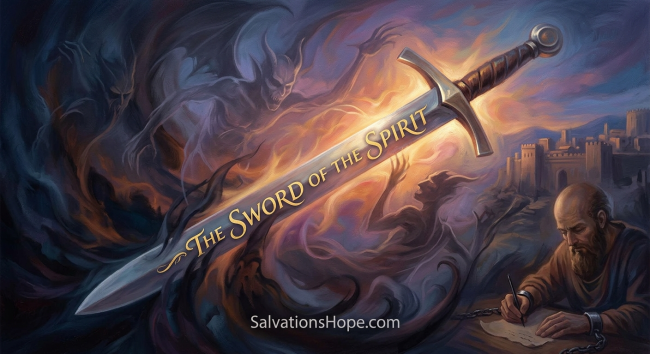
The Weapon of Light
In the spiritual realm, victory is not won through human strength, fleshly wisdom, or worldly tactical advantage. Writing from his Roman imprisonment, the Apostle Paul reminds the church at Ephesus that our struggle is not against flesh and blood, but against spiritual forces of evil (Ephesians 6:12).
To stand firm against the schemes of the enemy, God equips His children with divine armor. At the center of this battle array stands a unique piece of weaponry: the Sword of the Spirit.
By examining the original biblical context and cross-referencing the broader testimony of Scripture, we discover how God’s Word functions both as an illuminating shield that exposes evil and an authoritative weapon that dismantles darkness.
The Divine Armory: Exegesis of Ephesians 6:17
In Ephesians 6:17, Paul commands believers to:
“Take the helmet of salvation and the sword of the Spirit, which is the word of God.”
Machaira vs. Rhomphaia
In ancient Greek military contexts, two primary words described a sword:
- Rhomphaia: A long, heavy, broad sword designed for massive swinging blows (often used in the Septuagint to describe large battle swords).
- Machaira: A smaller, short sword or dagger (typically 6–18 inches long) used by Roman legionaries (gladius) in close-range, precise hand-to-hand combat.
Paul intentionally chooses the term machaira. The spiritual battle described here is intimate, immediate, and direct. The Sword of the Spirit is not meant for vague, distant theories; it is a precise instrument designed for personal encounter and strategic defense.
Rhema vs. Logos
Furthermore, Paul specifies that the sword is the “word” (rhema) of God, rather than logos.
- While logos often refers to the entire revelation or grand counsel of God, rhema refers to a specific, uttered statement or spoken proclamation.
In practical terms, the Sword of the Spirit is the specific application of God’s truth applied directly to a targeted spiritual conflict. When Satan tempted Christ in the wilderness (Matthew 4), Jesus did not simply quote general theology; He deployed specific scriptures (rhema) tailored precisely to refute each specific falsehood of the enemy.
Dual Nature: The Sword that Illuminates
Scripture presents God’s Word as both a piercing blade and an unyielding light. These two metaphors do not contradict one another; rather, they reveal how the Holy Spirit protects the believer from deception.
Scripture
Function
Theological Principle
Hebrews 4:12
Piercing / Discernment
“The word of God is alive and active. Sharper than any double-edged sword…” It penetrates deep into the heart to judge thoughts and attitudes.
Psalm 119:105
Guidance / Direction
“Your word is a lamp to my feet and a light for my path.” Truth exposes hidden snares in a dark world.
Proverbs 6:23
Instruction / Warning
“For these commands are a lamp, this teaching is a light…” Directives guard the soul against moral pitfalls.
2 Peter 1:19
Prophetic Clarity
“Pay attention to it as to a light shining in a dark place…” God’s truth shines brightly amid surrounding darkness.
The Spirit’s Warning System: Spiritual Discernment
Consider how light functions when evil draws near. Light makes the invisible visible.
In classical literature, authors often utilized physical symbolism to convey spiritual truths—such as J.R.R. Tolkien’s depiction of Sting, the short-sword that glowed blue in the presence of evil orcs, or Andúril, the historic blade that signaled the defeat of the dark power. While literature uses fictional allegory to capture human imagination, Scripture reveals the actual, spiritual reality: the Spirit-led mind inherently senses spiritual danger through the light of truth.
When a believer is deeply grounded in the Word and indwelt by the Holy Spirit:
- The Word Acts as a Spiritual Alarm: When confronted with unbiblical doctrine, subtle manipulation, or ethical compromise, an inner conviction signals that something is amiss. As Psalm 19:8, 11 declares, “The commands of the Lord are radiant… By them is your servant warned.”
- The Anointing Teaches Discernment: John reassures the early church against false teachers: “The anointing you received from him remains in you, and you do not need anyone to teach you… his anointing teaches you about all things” (1 John 2:27). The Holy Spirit uses the written Word stored in our hearts to illuminate error before we fall into its trap.
The Historic Victory: The Sword that Defeats Darkness
The Sword of the Spirit does not merely detect enemy assault—it decisively defeats it.
Unlike earthly weapons that rust or break, the Word of God possesses an enduring lineage of victory:
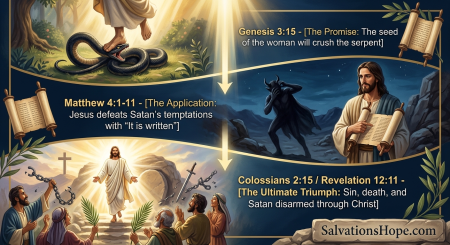
Christ's Model in the Wilderness
When Jesus faced Satan in the desert (Matthew 4:1–11), He did not rely on His divine privilege or philosophical argument. Three times He wielded the machaira of the Spirit, responding to every temptation with the exact rhema of scripture: “It is written.”
Deprived of his deceptions by the light of absolute truth, the devil fled.
The Sovereign Authority of the Word
Satan does not fear human intellect, traditions, or moral resolve. He fears the spoken, believed, and obeyed Word of God.
Through the cross and resurrection, Jesus stripped the enemy of his authority (Colossians 2:15). Today, when believers wield the Scripture in faith, we are applying the benefits of Christ’s definitive victory.
Key Takeaways for Personal Study & Application
- Memorize Specific Scripture (Rhema): To use a sword in close-quarters combat, it must be readily at hand. Memorize specific passages that address your personal areas of temptation or doubt.
- Cultivate Discernment: Pay attention to spiritual "warning signs." When a teaching or situation feels contrary to Scripture, test it against the totality of God's Word (1 Thessalonians 5:21).
- Stand Firm in Christ’s Victory: Remember that spiritual warfare is fought from victory, not just for victory. The Word of God has defeated Satan in the past, and it remains supreme today.
Which areas of your life currently require you to pick up the Sword of the Spirit and speak specific scripture (“It is written”) against subtle lies or temptations?
The Master Swordsman
Christ’s Victory and the Believer’s Weapon
In the spiritual realm, victory is never secured through human intellect, physical power, or earthly strategy. When believers face spiritual warfare, they do not fight with an untested instrument. The sword placed into our hands is the exact same weapon wielded by Jesus Christ Himself in His triumph over the powers of darkness.
By examining Christ’s showdown in the wilderness and His delegation of kingdom authority, we learn how the Master Swordsman wields the Word of God—and how we, as His apprentices, are called to use it today.
The Wilderness Showdown: Exegesis of Luke 4:1–13
Before Jesus began His public ministry—healing the sick, driving out demons, and proclaiming the reign of God—He was led into a direct conflict with Satan.
“Jesus, full of the Holy Spirit, left the Jordan and was led by the Spirit into the wilderness,
where for forty days he was tempted by the devil.” (Luke 4:1–2)
The Theological Purpose of the Wilderness
Why would the Holy Spirit lead Jesus into a harsh desert to face the enemy?
- The Second Adam Victory: Where the first Adam fell into sin in a lush, fruitful garden, Jesus—the Last Adam (1 Corinthians 15:45)—triumphed over temptation in a barren wilderness while physically exhausted from forty days of fasting.
- Kingdom Preparation: Jesus proved His absolute allegiance to the Father before ministering to others. Spirit-led wilderness experiences are not meant to destroy the believer, but to dismantle the enemy’s influence and forge spiritual authority.
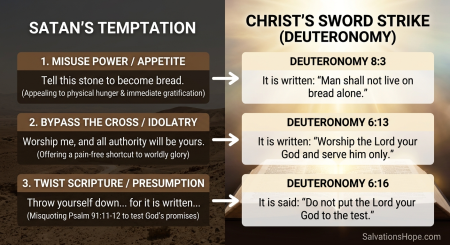
Analyzing the Enemy's Assaults & Christ's Strikes
In Luke 4, Satan launches three distinct thrusts aimed at Christ’s identity, mission, and submission to the Father. Jesus responds every single time with the same decisive stance: “It is written.”
Key Exegetical Insight: Refuting Twisted Scripture
In the third temptation, Satan himself quotes Scripture (Psalm 91:11–12). However, the Bible is not the sword of Satan; it is the Sword of the Spirit.
Satan isolates promises out of context to tempt Jesus into reckless presumption. Jesus, fully immersed in the totality of God’s truth, counters with Deuteronomy 6:16. All three of Christ’s counter-strikes originate from the book of Deuteronomy—a section of the Law focused on covenant loyalty in the wilderness.
Christ demonstrates that handling Scripture requires precise biblical context, not selective proof-texting.
Delegation of Authority: Passing the Sword to the Disciples
Christ’s victory in the wilderness was not for Himself alone; it was the foundation for equipping His followers to advance God’s Kingdom.
Text
Commission
Spiritual Authority Granted
Luke 9:1–6
The Twelve Apostles
Given “power and authority to drive out all demons and to cure diseases” as they proclaimed the Kingdom.
Luke 10:1–17
The Seventy-Two Disciples
Sent out two-by-two; returned with joy saying, “Lord, even the demons submit to us in your name.”
Luke 10:18–20
Christ’s Declaration
“I saw Satan fall like lightning from heaven… I have given you authority to overcome all the power of the enemy.”
"Satan Fall Like Lightning"
When the seventy-two disciples deployed the Word and declared the Kingdom in Jesus’ name, Jesus observed a cosmic reality: Satan’s reign collapsed wherever the truth was proclaimed. The kingdom of darkness cannot withstand the authoritative application of God’s Word spoken in the power of the Holy Spirit.
The Ultimate Ground for Joy
While exercising spiritual authority is exhilarating, Jesus refocuses His disciples’ perspective on eternal grace:
“However, do not rejoice that the spirits submit to you, but rejoice that your names are written in heaven.” (Luke 10:20)
Our primary identity is not found in our spiritual conquests, but in our redemption. Authority flows out of our covenant relationship with the Father.
Becoming the Master’s Apprentice: How to Wield the Sword Today
The events recorded in Luke’s Gospel are not distant historical footnotes—they reveal our current operating model for spiritual warfare. As followers of Christ, we are called into apprenticeship under the Master Swordsman.
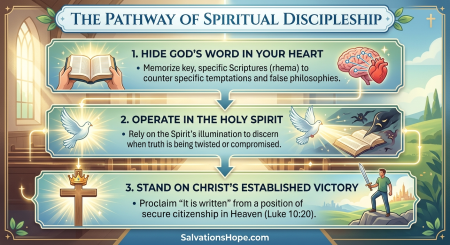
Strategic Principles for Believers
- Know Your Weapon Intimates: Jesus knew Deuteronomy so thoroughly that He could instantly deploy its passages under extreme physical exhaustion. Deep, regular study of Scripture equips us for unexpected spiritual battles.
- Recognize Satan’s Subtle Tactics: Satan often uses partial truths or misapplied promises to induce doubt, pride, or self-reliance. Testing every thought against the whole counsel of God protects us from deception.
- Advance the Kingdom Boldly: You do not fight for victory; you fight from the victory Christ has already won. When you proclaim God's Word and share your testimony (Revelation 12:11), the enemy is forced to retreat.
Key Takeaways for Personal Study
- Examine Your Armor: Are there specific areas of temptation where you need to memorize a targeted passage of Scripture to speak back to the enemy?
- Evaluate Your Authority: Do you approach spiritual warfare in your own willpower, or by standing in the delegated name and authority of Jesus Christ?
In what current “wilderness” or area of testing is the Holy Spirit asking you to pick up the Sword of the Spirit and declare “It is written”?
A Neglected Weapon
Scriptural Engagement and Spiritual Warfare
In the theater of spiritual warfare, defeat rarely comes because the armor of God is defective. More often, it occurs because the believer’s weapon has been left resting on a shelf.
When observing the contemporary professing church, a striking paradox emerges: nations overflowing with printed Bibles and cultural affirmations of Christianity often witness high rates of spiritual apathy, moral compromise, and societal brokenness. The issue is not that the Sword of the Spirit lacks edge; it is that it has become a neglected weapon.
Examining this reality through the lens of Scripture and sound theology reveals why active, daily engagement with the Word of God is essential for victory over the powers of darkness.
The Paradox of Possession: Exegesis of the Warning to the Church
Throughout Scripture, spiritual lethargy is consistently tied to a departure from God’s revealed law. When Israel possessed the Promised Land yet neglected the Torah, they fell into spiritual ruin (Deuteronomy 8:11–20; Judges 2:10–15).
In the New Testament, the Apostle Paul and the writer of Hebrews issue urgent warnings against spiritual dullness and biblical illiteracy.
The Danger of Hearing Without Doing
In James 1:22–25, the half-brother of Jesus offers a sharp critique of superficial religion:
“Do not merely listen to the word, and so deceive yourselves. Do yourselves what it says. Anyone who listens to the word but does not do what it says is like someone who looks at his face in a mirror and, after looking at himself, goes away and immediately forgets what he looks like.”
Owning a Bible, or even believing in God theoretically, does not equate to active spiritual warfare. A mirror only benefits someone if they act upon what it reveals. Similarly, the Word of God (machaira) only defends against the enemy when it is actively drawn, mastered, and applied.
Cultural Christianity vs. Transformative Discipleship
Polls and cultural surveys often reveal widespread nominal belief—widespread acknowledgment that God exists or that Jesus is the Son of God. Yet, as Scripture demonstrates, intellectual assent alone does not dismantle demonic strongholds.
- James 2:19 reminds us: "You believe that there is one God. Good even the demons believe that—and shudder."
- Spiritual victory requires more than passive cultural Christianity; it demands active, Spirit-empowered obedience and a deep knowledge of biblical truth to counter doctrinal confusion and moral temptation.
Recognizing the Enemy and the Error
A major consequence of biblical illiteracy is a compromised worldview. When believers do not read the Word, they become vulnerable to secular philosophies and distorted views of spiritual realities—such as minimizing the reality of Satan or compromising the sinless nature of Christ.
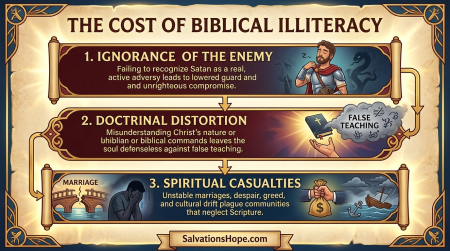
Knowing Your Enemy
Scripture explicitly warns that our adversary is a real, malevolent entity:
“Be alert and of sober mind. Your enemy the devil prowls around like a roaring lion looking for someone to devour.” (1 Peter 5:8)
When believers treat Satan as a mere “symbol of evil,” they discard the spiritual armor God provides, fighting an invisible war as though they are at peace.
The Power of Truth-Driven Holiness
Churches and individuals who abandon biblical doctrine and absolute moral standards inevitably experience spiritual decline. Conversely, those anchored in the authority of Scripture experience renewal, stability, and growth. As Jesus declared:
“Sanctify them by the truth; your word is truth.” (John 17:17)
Holiness cannot be sustained apart from immersion in the Word. The Holy Spirit uses the objective truth of Scripture to transform our desires, guard our families, and strengthen our witness.
Taking Up the Sword Anew: Practical Steps for Spiritual Renewal
Moving from spiritual defeat to victory requires an intentional choice to pick up the neglected weapon.
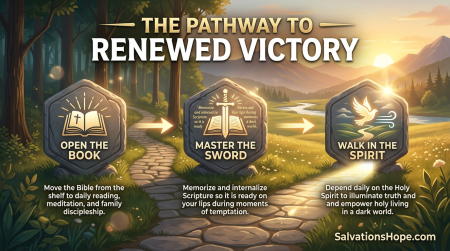
Key Principles for Reclaiming the Weapon
- Prioritize Daily Intake: Make regular Bible reading a non-negotiable spiritual discipline. Let God speak to your heart before the noise of the culture drowns out His voice.
- Engage in Sound, Biblical Community: Plant yourself in local churches and fellowships that faithfully preach and uphold the full counsel of God’s Word without apology.
- Stand Firm in Holiness: Live differently than the surrounding world. By letting the Word dwell in you richly (Colossians 3:16), you equip yourself to resist temptation and advance God’s Kingdom.
Key Takeaways for Personal Study
- Examine Your Practice: Is your Bible sitting unopened on a shelf, or is it active in your daily life as a weapon against temptation?
- Guard Against Drift: How can you deepen your understanding of Scripture to protect yourself and your family from cultural confusion?
What practical change can you make this week to ensure you are regularly lifting the Sword of the Spirit in your daily walk with Christ?
Fight with Confidence
Pneumatological Warfare and Divine Assurance
Spiritual warfare is never meant to be driven by guilt, fear, or a sense of legalistic duty. Approaching the intake of God’s Word as mere “spiritual homework” misses the reality of our condition: we are engaged in an active war against an enemy seeking to wreck lives, shatter marriages, and enslave souls.
When believers grasp the origin and supernatural power of the Sword of the Spirit, our posture shifts from passive vulnerability to confident victory.
By exploring the Holy Spirit’s role in inspiring, illuminating, and empowering the Word of God, we learn how to stand firm in the darkest nights—confident in both our weapon and our Divine Defender.
The Holy Spirit and the Sword: Inspiration, Illumination, and Power
The Bible is called “the sword of the Spirit” (Ephesians 6:17) because the Third Person of the Trinity is intimately involved in every aspect of its production, understanding, and application.
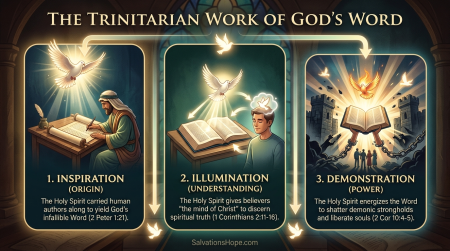
Divine Origin: Exegesis of 2 Peter 1:20–21
Peter explains how the Scriptures came into existence:
“Above all, you must understand that no prophecy of Scripture came about by the prophet’s own interpretation of things. For prophecy never had its origin in the human will, but prophets, though human, spoke from God as they were carried along by the Holy Spirit.”
The Greek verb translated “carried along” (pheromenoi) was used in nautical contexts to describe a ship’s sails being filled and driven by the wind. The biblical authors were not passive typewriters; rather, as they wrote, the Holy Spirit superintended their words, ensuring that what was written was the very breath and truth of God (Theopneustos) (2 Timothy 3:16).
Spiritual Illumination: Exegesis of 1 Corinthians 2:14–16
Apart from the Holy Spirit, human intellect alone cannot grasp the life-transforming power of God’s Word:
“The person without the Spirit does not accept the things that come from the Spirit of God but
considers them foolishness… But we have the mind of Christ.” (1 Corinthians 2:14, 16)
The Holy Spirit does not merely give us a book; He gives us “the mind of Christ”—the spiritual discernment to understand truth, recognize subtle deception, and apply God’s directives in daily life.
Demolishing Strongholds: The Divine Authority of the Gospel
When the Holy Spirit energizes the Word in the mouth and life of a believer, human arguments and demonic fortresses crumble.
Scripture
Function
Exegetical Principle
Psalm 119:11
Internal Protection
“I have hidden your word in my heart that I might not sin against you.” Scripture memorization fortifies the soul against internal compromise.
Romans 1:16
Saving Power
“For I am not ashamed of the gospel, because it is the power of God that brings salvation to everyone who believes…” The Gospel (dynamis) shatters Satan’s hold on human hearts.
2 Corinthians 10:4–5
Spiritual Demolition
“The weapons we fight with are not the weapons of the world. On the contrary, they have divine power to demolish strongholds…” Spiritual weapons tear down intellectual pride and sinful mental habits.
Taking Thoughts Captive
Paul’s military metaphor in 2 Corinthians 10:5—“taking captive every thought to make it obedient to Christ”—pictures a conquering soldier taking prisoners of war.
Whenever temptation, fear, ungodly philosophy, or despair enters our minds, the Spirit-empowered believer uses Scripture to arrest that thought, evaluate it against truth, and align it with the lordship of Jesus Christ.
The Unseen Defender: Tested for Maturity, Never Abandoned
There are seasons when the Holy Spirit leads us into wildernesses of testing or dark trials—not to abandon us to the enemy, but to refine our faith and build spiritual maturity (James 1:2–4).
In these moments, believers are commanded to:
“Be on your guard; stand firm in the faith; be courageous; be strong.” (1 Corinthians 16:13)
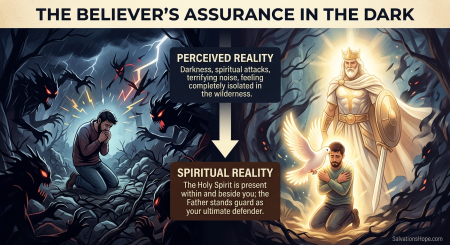
Just as a father watches over his young son spending his first night in the dark woods—standing nearby fully armed and ready to intervene—our Heavenly Father and the Holy Spirit are ever-present in our trials (Psalm 46:1; Hebrews 13:5).
We do not fight for a distant God; we fight with an indwelling Spirit who shields us and guarantees our ultimate victory.
Key Takeaways for Personal Study & Application
- Shift Your Posture: Stop viewing Bible study as a burden or homework. Approach Scripture as taking up your primary defense weapon against an active adversary.
- Fortify Your Home: Establish regular rhythms of family Scripture reading and prayer. Hiding God’s Word in the home acts as a primary defense against spiritual ruin and marital decay.
- Stand Confident in Trials: When walking through dark seasons or heavy temptation, remember that the Holy Spirit is standing guard. Use the Word of God boldly, knowing that the battle belongs to the Lord.
In what specific area of your life or mindset do you need to stop fighting with human effort and start wielding the Sword of the Spirit to tear down a stronghold?