
Seasoned & Shining
Living as Heaven’s Citizens in an Unbelieving World
“You are the salt of the earth, but if salt has lost its taste, how shall its saltness be restored? It is no longer good for anything except to be thrown out and trampled under people’s feet. You are the light of the world. A city set on a hill cannot be hidden.”— Matthew 5:13–14
Around the year A.D. 130—just one century after the death and resurrection of Jesus Christ and decades after the Apostle John penned Revelation—whispers and rumors echoed through the halls of the Roman Empire.
The rumors were terrifying. Society believed this rapidly growing sect was made up of atheists who rejected traditional family and civic values, subversive radicals who sought to turn the world upside down, and cannibals who gathered in secret meetings to consume human flesh and blood.
To the Roman mind, these Christians were dangerous. The imperial government enacted laws to suppress them, yet the Church grew. They arrested and executed believers, yet more people confessed Christ.
- Why did the Gospel spread under violent opposition?
- What made non-believers both despise early Christians and desperately desire to join them?
A cultured seeker named Diognetus wanted to know the truth. He knew the rumors, but he recognized a logical disconnect: if Christians were murderers and cannibals, why was there no body count? Why were they the ones being slaughtered while offering no violent resistance?
When Diognetus reached out to a Christian teacher—who humbly referred to himself only as “a disciple”—he received an answer preserved through history as The Epistle to Diognetus. This ancient letter reveals a living demonstration of Jesus’ mandate in the Sermon on the Mount: To be the Salt of the Earth and the Light of the World.
Exegeting the Allegations (Biblical & Historical Context)
To understand early Christian identity, we must examine why the world misunderstood them—and how scripture refutes those misunderstandings.
Ancient Accusation
The World’s Misconception
The Biblical Reality
“Atheists”
Refused to worship Caesar or bowing to Greco-Roman idols.
They worshiped the one true God rather than man-made deities (1 Thess. 1:9).
“Cannibals”
Misunderstood third-hand reports of eating “body and blood.”
They partook in the Lord’s Supper—spiritual communion in the body and blood of Christ (1 Cor. 11:23–26).
“Subversives”
Refused to engage in sinful civic rituals and idol worship.
They were exemplary, law-abiding citizens living out 1 Peter 2:13–17.
The early believers were called “atheists” because they refused to bow to culture’s idols. Their identity was rooted not in earthly nationalism or political allegiance, but in the Kingdom of God.
The Paradox of the Christian Walk
The anonymous author of The Letter to Diognetus gives us an extraordinary snapshot of how the early Church lived out biblical theology in everyday life:
“The thing that makes Christians different from other people isn’t what country they live in or what language they speak or what customs they practice… They simply live wherever they happen to find themselves; they follow local customs in food and clothing and manners; and yet they display to us their wonderful and paradoxical way of life. They live in their own countries, but as people whose true home is elsewhere… They marry like everybody else; they have babies; but they don’t destroy fetuses. They have a common table, but not a common bed… They pass their days on earth, but they are citizens of heaven. They obey the government’s laws, and at the same time they live lives that surpass any laws. They love all men, and are persecuted by all… They are reviled, and bless; they are insulted, and repay the insult with honor; they do good, yet are punished as evil-doers. When punished, they rejoice… yet those who hate them are unable to give any reason for their hatred.”
Exegeting the Paradox
Notice how this early Christian witness mirrors core Apostolic doctrines:
- In the World, Not of the World (John 17:14–16): Christians did not retreat into isolated communes, nor did they invent a holy dialect. They engaged their culture in matters of everyday life (food, clothing, language) while remaining untainted by its morality.
- Sanctity of Life and Purity of Marriage (Hebrews 13:4): In a Roman culture where infant exposure (abandonment) and abortion were common, Christians protected the unborn. In a culture saturated with sexual immorality, they shared their food freely (“a common table”) but kept their marriages sacred (“not a common bed”).
- Heavenly Citizenship (Philippians 3:20): They respected civil law, but their ultimate authority was King Jesus. Their radical obedience to God made them the most law-abiding, peaceful citizens in the empire.
Theological Application — Preserving Salt & Uncovered Light
Why did the Roman Empire fail to extinguish the early Church? Because God assigned His people an illustrious position that they refused to forsake.
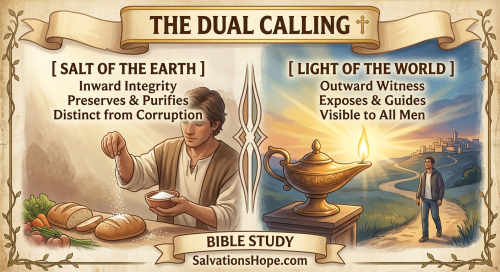
- Salt Must Retain Its Taste (Matthew 5:13)
Salt prevents corruption and adds flavor. But salt is only useful if it remains chemically distinct from the meat it preserves. If Christians assimilate into the culture—compromising on sexual ethics, the sanctity of life, and devotion to Christ—they lose their saltiness and become useless to the Kingdom.
- Light Must Not Be Hidden (Matthew 5:14–16)
Light exposes darkness and guides the lost. Early Christians did not hide their faith out of fear. When reviled, they blessed. When punished, they rejoiced. Their good works shone so brightly that even their enemies could find no legitimate charge against them (1 Peter 2:12).
As we reflect on the witness of the early Church and the words of Christ, consider these questions for personal reflection:
- Cultural Engagement: In what ways are you actively engaging the culture around you without conforming to its sinful patterns (Romans 12:2)?
- Distinctive Living: If someone examined your daily life, where would they see the “paradox” of heavenly citizenship—in your finances, your marriage, or your response to hostility?
- Preserving Saltness: Are there areas in your life where spiritual compromise threatens to make your testimony lose its “flavor”? How can you return to biblical distinctiveness today?
The Extraordinary "Ordinary"
“You are the salt of the earth… You are the light of the world. A city set on a hill cannot be hidden.”— Matthew 5:13, 14
What does it truly mean to follow Jesus?
When Jesus sat on the mountainside and uttered the famous words of the Sermon on the Mount, He was not speaking to religious elites, political rulers, or world-renowned scholars. He was speaking to ordinary people—fishermen, tax collectors, mothers, and tradesmen.
Yet, Jesus made a radical statement about these everyday believers: “You are the salt of the earth… You are the light of the world.”
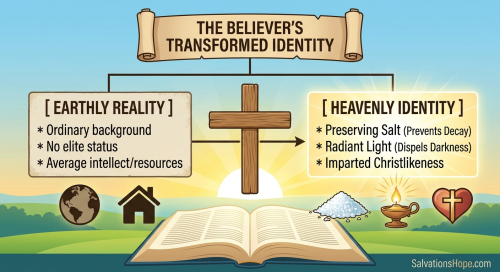
Maybe you feel completely ordinary. You come from an ordinary family, work an ordinary job, live in an ordinary home, and possess ordinary talents. You aren’t wealthier, smarter, or better looking than the person next to you.
Yet, in the hands of Christ, the ordinary becomes extraordinary.
- Salt is only salt if it retains its flavor.
- Light is only light if it shines into the dark.
- A Christian is truly a Christian when they reflect the likeness of Christ.
When you belong to Jesus, you take on His flavor and radiance, drawn into His grand mission to glorify the Father and redeem a fallen world.
The Human Condition (Salt & Decay)
When Jesus describes believers as salt and light, He offers a profound affirmation of His followers—and a sobering diagnosis of the world.
In the ancient Near East, salt was the primary means of preservation. Without refrigeration, meat was rubbed with salt to arrest the natural process of decomposition.
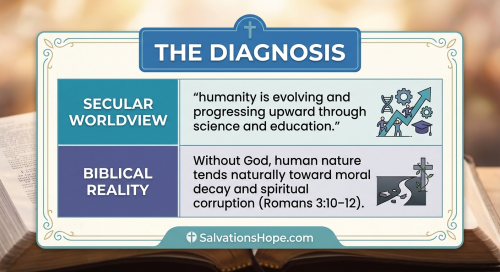
While technological and scientific progress advances, human nature apart from God does not improve. Wars become more devastating, families more fractured, addictions more rampant, and moral foundations more confused.
The only element preventing complete moral decay in society is the preserving salt of the Holy Spirit working through the Christlike conduct of ordinary believers.
Cultural Ignorance (Light & Darkness)
Jesus’ statement that believers are the “light of the world” implies that the world, left to its own devices, exists in spiritual darkness (John 3:19).
We live in the information age, yet we do not live in the wisdom age. Society possesses mountains of data, but lacks fundamental spiritual truth:
- Who is God?
- How are we saved from sin?
- How ought we to live before our Creator?
This vital knowledge does not originate from media networks, university faculties, or internet algorithms. Spiritual illumination comes only through Jesus Christ, the Light of the World (John 8:12), and shines through those who follow Him.
Theological Reflection — Humility Without Shame
Understanding our identity as salt and light leaves no room for either arrogance or timidity.
The Dual Pitfalls
The Biblical Alternative
Arrogance (Self-Righteousness)
Recognizing that we have no inherent superiority; our flavor and light come entirely from Christ (1 Cor. 4:7).
Timidity (Shame)
Refusing to be intimidated by the world’s power or intellect, standing firm in God’s calling (Romans 1:16).
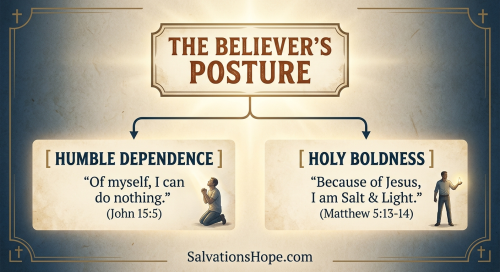
A young child singing “This Little Light of Mine” possesses deeper spiritual wisdom than a brilliant scholar who rejects Christ. As believers, we do not need to feel inferior to the powerful or elite of this age. We hold our heads high—not because of who we are, but because of who Jesus is and we belong to Him.
Practical Application
- Assessing Your "Flavor": In what ways does your daily conduct serve as a preservative against moral decay in your workplace, school, or community?
- Uncovering Your Light: Are there areas in your life where fear or social pressure has led you to put a "bowl" over your witness (Matthew 5:15)? How can you let your light shine more brightly this week?
- Balancing Boldness and Humility: How does knowing that your spiritual identity is a gift from Christ prevent you from becoming arrogant toward non-believers?
Exegetical Cross-References for Further Study
- 1 Corinthians 1:26–31 — God’s choice of the humble and weak to confound the wise.
- Colossians 4:6 — Speech seasoned with salt.
- Philippians 2:14–15 — Shining as lights in the midst of a crooked generation.
The Tension of the Christian Calling
“Neither do people light a lamp and put it under a bowl. Instead they put it on its stand, and it gives light to everyone in the house. In the same way, let your light shine before others, that they may see your good deeds and glorify your Father in heaven.”— Matthew 5:15–16
What does it take to fulfill Christ’s command to be salt and light? It requires holding two essential truths in perfect biblical balance: we must be distinct from the world, and we must be engaged with the world.
- Distinctness without Engagement: Salt that remains in the shaker cannot prevent decay; a lamp hidden under a basket illuminates nothing.
- Engagement without Distinctness: Salt that loses its saltiness is useless; light that matches the darkness is no longer light.
The Christian path rejects both total compromise and complete isolation. As Jesus prayed for His disciples in John 17:15–18, we are sent into the world, yet preserved from the evil one.
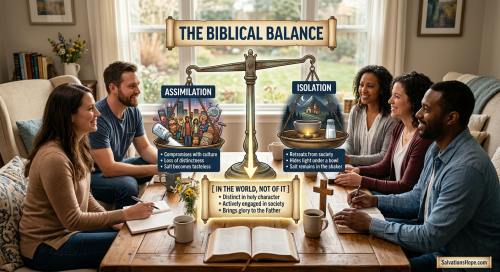
The Dual Mandate
- The Call to Be Distinct ("You are the Salt")
Salt must maintain its distinct chemical composition to serve as a preservative. In the same way, a believer must possess a distinct moral and spiritual character rooted in the Holy Spirit.
If our values, priorities, speech, and ethics are indistinguishable from the culture around us, we have rendered our witness useless (Matthew 5:13).
- The Call to Be Engaged ("On Its Stand")
Salt cannot flavor or preserve food while remaining on the shelf. Light cannot guide travelers if it is hidden beneath a container.
Jesus calls His followers out of comfortable, holy enclaves and into the public square—into ordinary workplaces, neighborhoods, schools, and civic life. Our good works are intended to be seen by men—not for our own self-aggrandizement, but so that others may glorify our Father in heaven (Matthew 5:16).
Historical Witness — Distinct Yet Present
This holy tension between distinctness and engagement defined the early Church. As noted in The Letter to Diognetus, second-century Christians did not retreat into private colonies or wear unique attire. They lived in the same cities, worked the same jobs, and spoke the same languages as their pagan neighbors—yet their lives presented a radical contrast:
Cultural Norm in the Roman Empire
The Distinct Christian Witness
Abortion & Infant Exposure
Protected human life by rejecting abortion and adopting abandoned infants.
Sexual Promiscuity & Divorce
Practiced strict marital fidelity (“a common table, but not a common bed”).
Emperor Worship & Idolatry
Confessed “Jesus is Lord,” refusing to worship Caesar or civic idols.
Because Christians lived directly alongside non-believers rather than withdrawing into isolation, these moral differences were impossible to ignore. Their proximity made their holy lives striking, convicting, and deeply disruptive to Roman society.
The Power of God Revealed
Living as salt and light naturally provokes a reaction. When believers reside right next door while living by a completely different moral authority, society cannot remain indifferent.
Historically, this dynamic produced two responses: persecution and conversion.
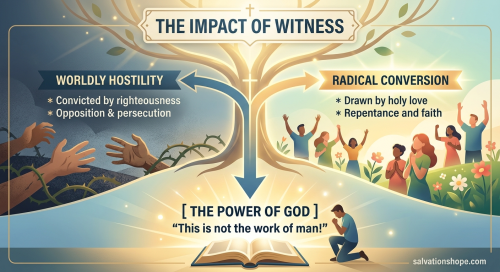
Even as the Roman government increased its executions, the Church continued to grow. Observers realized that human resolve alone could not explain how Christians endured suffering with joy, loved their enemies, and maintained unwavering purity.
As the author of The Letter to Diognetus marveled:
“Do you not see them exposed to wild beasts to make them deny the Lord, and yet not defeated? Do you not see that the more of them who are punished, the greater becomes the number of the rest? This does not seem to be the work of man: this is the power of God!”
What it Means to Follow Christ in a Dark and Decaying World
- Citizens of Heaven: Our true identity is grounded in Christ, making us strangers and pilgrims in the present age (1 Peter 2:11).
- Ordinary, Yet Extraordinary: God uses everyday believers to preserve society from corruption and illuminate the truth of the Gospel.
- Different, Yet Involved: We fulfill our calling by remaining morally distinct from culture while actively loving and serving those around us.
When we live as true salt and light, our neighbors will see our good deeds, recognize the supernatural origin of our faith, and give glory to our Father in heaven.
Final Reflection
- Self-Assessment: Do you lean more toward assimilation (becoming too much like the world) or isolation (withdrawing from those who don't share your faith)? How can you correct this balance?
- Practical Engagement: What is one concrete way you can get out of the "salt shaker" this week to serve someone in your community or workplace who does not know Christ?
- Enduring Opposition: How does remembering that Christian distinctiveness historically provoked both opposition and revival encourage you when facing cultural pushback today?
Series Bibliography & Further Reading
- Scripture: Matthew 5:13–16; John 17:11–19; 1 Peter 2:11–17
- Historical Sources: The Epistle of Mathetes to Diognetus (c. A.D. 130)
- Theological Works: The Cost of Discipleship by Dietrich Bonhoeffer
The Source of the Light
never walk in darkness, but will have the light of life.'”— John 8:12
Why are believers called to be salt and light? Ultimately, our calling points to something far greater than human effort or moral self-improvement: it is to shine with the light of God so that a dark world is drawn to Him.
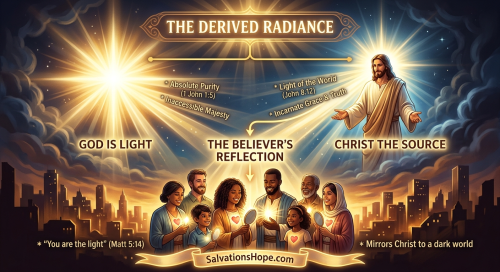
The only reason Jesus can call His followers “the light of the world” (Matthew 5:14) is because He Himself is the original Source. As Scripture declares:
“God is light, and in him is no darkness at all.” –1 John 1:5
“I am the light of the world. Whoever follows me will never walk in darkness, but will have the light of life.” –John 8:12
When Christians live as light, they do not generate their own radiance. They act like the moon, reflecting the blinding, glorious light of the Sun of Righteousness into the dark corners of the earth.
Exegeting the Incarnation — Grace Over Coercion
In The Letter to Diognetus, the second-century Christian writer explains to his pagan inquirer why Christians live such radically distinctive lives. The lifestyle of believers is not rooted in human philosophy or moral pride, but in the astounding reality of the Incarnation:
“Truly God himself, the almighty and invisible Creator of all things, has sent from heaven and placed among people Christ who is the truth, and has firmly established him in their hearts. God did not, as one might have imagined, send a servant or an angel… but he sent the very Creator and Fashioner of all things… to whom all things are subject.”
How Did God Enter the World?
God did not enter human history as a tyrant to frighten or destroy. He came in gentle humility and persuasive love:
- Not by Force: Violence has no place in the character of God.
- Not in Vengeance: He came to call, not to pursue us with judgment.
- As a Savior: Sent as a King sending His Son, who is Himself King, taking on human flesh to win human hearts.
The Heart of the Gospel — The "Sweet Exchange"
The letter to Diognetus reaches its theological peak when explaining the Cross—what theologians call imputation or penal substitutionary atonement (2 Corinthians 5:21):
“He himself took on him the burden of our sins. He gave his only Son as a ransom for us, the holy one for the transgressors, the blameless for the wicked, the righteous for the unrighteous, the incorruptible for the corruptible, the immortal one for them that are mortal…
O sweet exchange! O unsearchable operation! O benefits surpassing all expectation! that the wickedness of many should be hid in a single righteous One, and that the righteousness of One should justify many transgressors!”
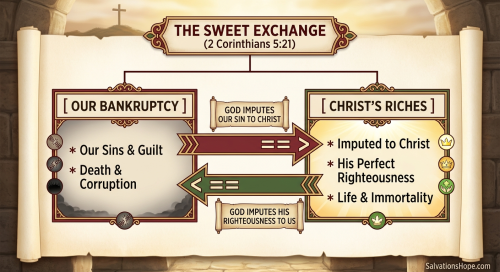
God accomplished two vital things through the Gospel:
- He convinced us of our utter helplessness: Showing us that our own nature cannot achieve eternal life.
- He revealed the Savior: Leading us to trust Him as our Nourisher, Father, Teacher, Counselor, Healer, Wisdom, Light, Honor, Glory, Power, and Life—our everything.
Imitating the Kindness of God
When a person truly grasps this “sweet exchange,” their life is flooded with joy. Love for God naturally spills over into love for neighbor.
How Do We Imitate God?
The early Church understood that imitating God is not achieved through human notions of greatness:
Human Views of Power & Majesty
God’s Definition of True Greatness
Ruling over neighbors and subjects
Carrying the burden of those who are weak
Bullying and intimidating the vulnerable
Using advantages to help and uplift others
Hoarding wealth and flexing status
Distributing God’s gifts generously to those in need
“He who carries the burden of his neighbor; he who uses whatever advantage he has over someone to help that person; he who takes what God gives him and distributes it to people in need… becomes an imitator of God. Then you will see while you are still on earth that God in the heavens rules over the universe.” — Letter to Diognetus
Bearing the Cross, Shining the Light
Throughout history, many have worn a cross, but far fewer have borne the cross. Many claim the title of “Christian,” yet fail to reflect the warmth, light, and self-sacrificing love of Jesus Christ.
Yet, what a marvel it is when true believers know Jesus as their Light! When we experience His grace replacing our spiritual bankruptcy with His glorious riches, we cannot help but become like Him. We become eager to serve others, winning them not through force or arrogance, but through cross-shaped love.

Discussion Questions
- The Sweet Exchange: How does meditating on Christ taking your sin and giving you His righteousness change your daily motivation for living a holy life?
- Imitating God: Who in your sphere of influence needs you to "carry their burden" or use your resources to help them this week?
- Reflecting the Light: In what area of your life can you shift from merely wearing the cross to truly bearing the cross in loving service?
- Scripture: Matthew 5:13–16; John 8:12; 1 John 1:5; 2 Corinthians 5:21; 1 Peter 2:11–17
- Historical Text: The Epistle of Mathetes to Diognetus (c. A.D. 130)