
The Art of Spiritual Deception
Unmasking the Schemes of Our Adversary
The Anatomy of Demonic Deception
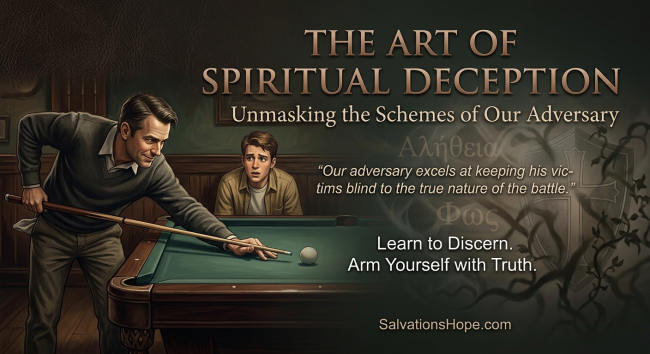
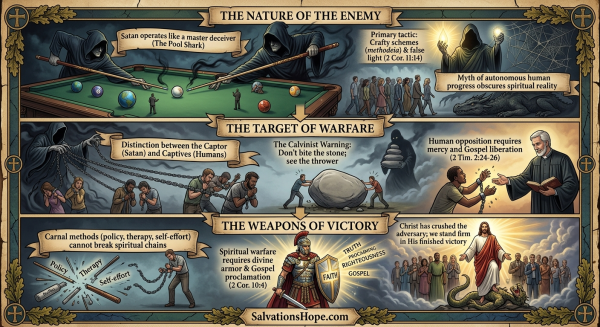
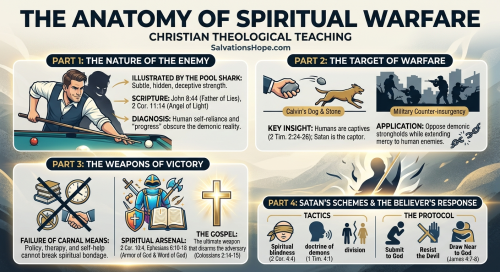
If you have ever spent an evening in a billiards hall, you may have witnessed the subtle craft of a pool shark. On the surface, he appears completely unremarkable. He blends into the crowd, hesitates before placing a modest wager, and even loses his first few games—intentionally. He misses shots that seem easy and feigns relief when a ball happens to drop. He leaves his opponents convinced that his victories are nothing more than strokes of good luck. His target leaves the table broke, yet firmly convinced that one more game could win it all back. The victim never realizes they were hopelessly outmatched from the very first break.
This mechanical display of calculated misdirection offers a striking illustration of a profound spiritual reality: our spiritual enemy rarely reveals his full strength when executing his deceptions.
Scripture warns us that the greatest danger Christians face is not always overt, terrifying hostility, but the quiet, systematic deception of an adversary who excels at keeping his victims blind to the true nature of the battle.
The Anatomy of Demonic Deception
To understand how Satan operates, we must turn to sound biblical exegesis rather than cultural folklore or sensationalism. Scripture presents the adversary not as a myth, but as a strategic, highly capable spiritual force whose primary tactic is falsehood.
In His confrontation with the religious leaders of His day, Jesus unmasks the character of the devil:
“You are of your father the devil, and your will is to do your father’s desires. He was a murderer from the beginning and does not stand in the truth, because there is no truth in him. When he lies, he speaks out of his own character, for he is a liar and the father of lies.” (John 8:44)
The Greek term used here for “father” (patēr) indicates origin and source. Satan is not merely a liar; he is the originator of deceit itself. Furthermore, Jesus connects spiritual murder directly to falsehood. The devil’s ultimate goal is destruction—the total ruin of human lives—but his primary instrument for achieving that destruction is deception. Just as a pool shark uses false confidence to lure a player to financial ruin, Satan uses subtle lies to lead individuals and societies into moral and spiritual death.
The Strategy of Subtle Schemes (Ephesians 6:11–12)
Writing to the church at Ephesus, the Apostle Paul exposes the nature of spiritual warfare:
“Put on the whole armor of God, that you may be able to stand against the schemes of the devil. For we do not wrestle against flesh and blood, but against the rulers, against the authorities, against the cosmic powers over this present darkness, against the spiritual forces of evil in the heavenly places.” (Ephesians 6:11–12)
A critical word in this passage is “schemes” (Greek: methodeia), from which we derive the English word methodology. It refers to deliberate, calculated strategies, craftiness, and cunning plans. Satan does not engage believers in chaotic, random assaults; he employs well-crafted, tailored methodologies designed to exploit human vulnerability.
Paul reminds us that our primary battle is not against human agents—”flesh and blood”—but against an organized hierarchy of spiritual forces. When we reduce moral decay, societal conflict, or personal struggles to mere human shortcomings, we fall into the exact trap the adversary has set.
The Illusion of Light (2 Corinthians 11:14)
In his second letter to the Corinthians, Paul addresses false teachers who were infiltrating the church, noting that their deceit mirrors their master’s tactic:
“And no wonder, for even Satan disguises himself as an angel of light.” (2 Corinthians 11:14)
The word translated “disguises” (metaschēmatizō) means to transform one’s outward appearance or mask one’s true character. Satan rarely approaches a person offering outright damnation; instead, he presents temptation as freedom, sin as self-fulfillment, and foolishness as enlightenment. He allows his targets to feel as though they are in control—even letting them experience temporary “wins”—while quietly securing their entrapment.
The Cultural and Personal Blindspot
When we examine the state of the world through a biblical lens, the influence of this spiritual deception becomes glaringly evident.
The Myth of Autonomous Progress
Modern culture insists that human problems can be solved strictly through human means: better policy, increased funding, higher education, or psychological self-help. Yet despite unprecedented advancements in knowledge, technology, and wealth, society remains crippled by conflict, addiction, broken families, and moral despair.
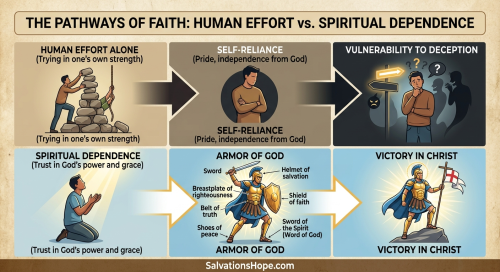
We look at systemic evil, geopolitical warfare, and widespread violence and treat them as mere policy failures or socio-economic issues. In doing so, we ignore the underlying biblical diagnosis: there is an active, evil force working behind human rebellion. Believing that spiritual problems can be solved with purely human effort is like a casual pool player believing he can defeat a seasoned professional simply by trying a little harder on his next shot.
The Trap of Self-Reliance in the Believer’s Life
This same subtlety routinely plays out in our personal walk with God. Consider how sin often manifests in our lives:
- The False Sense of Control: We fall into anger, lust, bitterness, or pride, and tell ourselves, "That was just a temporary lapse. I'll exercise better self-discipline next time."
- The Strategic Retreat: Satan may temporarily pull back his pressure, allowing us to go weeks or months without a major failure. We congratulate ourselves on our moral strength, completely unaware that our pride is setting us up for a far greater fall (1 Corinthians 10:12).
- The Cycle of Defeat: Because we misdiagnose the problem as a mere lack of willpower, we rely on human effort rather than spiritual repentance and reliance on the Holy Spirit.
Standing in God's Strength
Recognizing the reality and subtlety of our spiritual adversary is not meant to induce fear, but to drive us to the only true source of victory: Jesus Christ.
Rightly Identifying the Enemy
We must stop treating our primary battles as purely interpersonal or political. When interpersonal conflicts arise in marriages, churches, or communities, we must remember Paul’s admonition in Ephesians 6:12: our ultimate struggle is not against the person across the room, but against the spiritual forces exploiting human weakness.
Renouncing Carnal Weapons
Paul writes in 2 Corinthians 10:4:
“For the weapons of our warfare are not of the flesh but have divine power to destroy strongholds.”
We cannot defeat a spiritual adversary using fallen human methods. Education, self-help techniques, and raw willpower have their place in natural life, but they cannot break sin’s power or dismantle demonic deception. Victory requires spiritual weapons: prayer, proclaiming Scripture, genuine repentance, and reliance on the Holy Spirit.
While Satan is far stronger than any individual human, he is utterly powerless against the Lord Jesus Christ. Through His death and resurrection, Christ disarmed the rulers and authorities and put them to open shame (Colossians 2:15).
Our call as Christians is not to fight for victory in our own strength, but to stand firm in the victory that Christ has already achieved (Ephesians 6:13). When we walk in humility, stay grounded in sound biblical truth, and continually depend on God’s grace, the adversary’s deceptions lose their hold over us.
Questions to Consider:
In what areas of your daily life are you most tempted to rely on your own willpower rather than seeking God’s power through prayer and His Word?
How might viewing difficult personal relationships through the lens of Ephesians 6:12 change your attitude toward the people involved?
What practical habits can you build this week to ensure you are actively putting on the “whole armor of God” (Ephesians 6:13–18) rather than walking in spiritual self-reliance?
Strategic Target Selection
Demonic Warfare vs. Human Redemption
Understanding the nature of our spiritual enemy directly alters how we view and engage with human opponents. When we misidentify the source of spiritual hostility, our responses become misguided, destructive, and ultimately counterproductive to the Gospel.
Scripture compels us to distinguish between the captives of the kingdom of darkness and the captor who holds them.
Exegetical & Historical Analysis: Flesh, Blood, and Spiritual Captivity
The Calvinist Illustration: The Dog and the Stone
In his Institutes of the Christian Religion (Book I, Chapter 17), the Reformer John Calvin uses a vivid analogy to illustrate human short-sightedness in times of trial and conflict.
Imagine a boy who throws a stone at a dog. When the stone strikes, the dog yelps in pain, turns around, and furiously bites the stone. The dog vents its rage entirely on the object that hit it, completely blind to the hand that hurled it.
Calvin observed that believers often act like the dog when they focus their wrath entirely on human instruments rather than recognizing God’s sovereignty and the spiritual forces operating behind the scenes. When someone wrongs or persecutes us, human nature tempts us to direct all our fury, hatred, and desire for vengeance toward that person. In doing so, we ignore the principal instigator—Satan—and fail to respond with biblical wisdom.
“When a person causes us harm, we must look beyond the immediate instrument to understand the greater spiritual reality at play, lest we waste our strength fighting the stone while ignoring the one who threw it.”
The Dynamics of Spiritual Captivity (2 Timothy 2:24–26)
Paul instructs Timothy on how a minister of God ought to handle opposition and hostile individuals:
“And the Lord’s servant must not be quarrelsome but kind to everyone, able to teach, patiently enduring evil, correcting his opponents with gentleness. God may perhaps grant them repentance leading to a knowledge of the truth, and they may come to their senses and escape from the snare of the devil, after being captured by him to do his will.” (2 Timothy 2:24–26)
Paul’s choice of language here offers key insights into human opposition:
- Captured (ezōgrēmenoi): This term refers to taking someone alive as a prisoner of war. Unbelievers who oppose the Gospel are not merely "evil people doing evil things"; spiritually, they are prisoners of war who have been snared (pagis) by the adversary.
- Hope for Repentance (metanoia): Unlike fallen angels, human beings are capable of being granted repentance by God's grace. Their current hostility does not preclude their future redemption.
If an army is seeking to liberate a nation from a brutal dictator, its strategy does not involve obliterating the brutalized civilian population or those forcibly conscripted into the regime’s army. Strategic military force targets the leadership structure, the command-and-control centers, and the core regime loyalists—while offering liberation and amnesty to the captives.
In spiritual warfare, our weapons—prayer, truth, love, and the proclamation of the Gospel—are aimed at dismantling Satanic strongholds (2 Corinthians 10:4–5) so that captives can be rescued, not destroyed.
The Dual Realities: Grace and Human Accountability
Distinguishing between the enemy and his captives does not mean absolving human beings of moral guilt.
The Inadequacy of "The Devil Made Me Do It"
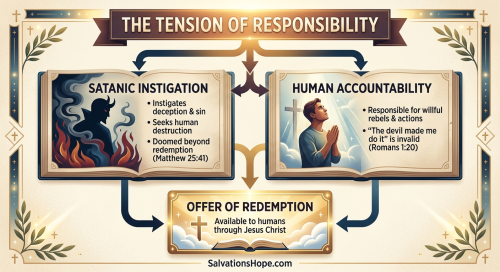
While Satan actively deceives and prompts human wickedness, Scripture never allows human beings to shift the blame away from their own choices. In Romans 1:20, Paul notes that humanity is “without excuse” (anapologētos).
Just as a soldier who commits war crimes cannot escape justice by pleading that he was “merely following orders,” a human being who aligns with Satan’s rebellion remains fully accountable for their actions before God. To reject God’s truth is a deliberate act of the human will (John 3:19).
The Asymmetry of Redemption
There is a fundamental theological difference between the destiny of fallen angels and the potential destiny of fallen humans:
- The Final Judgment of Demons: Satan and his angels are confirmed in their rebellion. Scripture reveals no plan of redemption for angelic beings (Hebrews 2:16). Eternal fire is explicitly prepared for “the devil and his angels” (Matthew 25:41).
- The Open Door for Humanity: As long as a human being has breath, the offer of salvation in Jesus Christ remains available (2 Peter 3:9). God has historically transformed His fiercest human enemies into His most devoted servants—the Apostle Paul himself being a prime example (1 Timothy 1:13–15).
Practical Hermeneutics: Loving Enemies in Light of Spiritual Reality
When Jesus issues His radical command in the Sermon on the Mount, He provides the practical blueprint for how believers ought to engage with human opponents:
“But I say to you who hear, Love your enemies, do good to those who hate you, bless those who curse y
ou, pray for those who abuse you.” (Luke 6:27–28)
This command is not emotional sentimentality; it is a strategic stance grounded in spiritual discernment. When we realize that our human persecutors are captives of the true adversary, our ultimate goal shifts from retaliation to redemption. We stop viewing them as irredeemable targets of our wrath and begin viewing them as potential brothers and sisters in Christ who desperately need liberation from spiritual darkness.
Think of a person or group you find difficult to love or forgive. Are you responding to them as the primary enemy (the stone), or are you recognizing the spiritual deception behind their actions?
How do we hold people morally accountable for their wrongdoings while still maintaining a spirit of mercy and praying for their salvation?
How can you adjust your prayer life this week to focus less on asking God to remove hostile people and more on praying for their spiritual liberation from the adversary’s hold?
The Futility of Carnal Weapons and the Supremacy of the Gospel
Once we recognize both the subtle deception of our adversary and the spiritual captivity of our human neighbors, we face a crucial tactical question: With what weapons do we engage in this war?
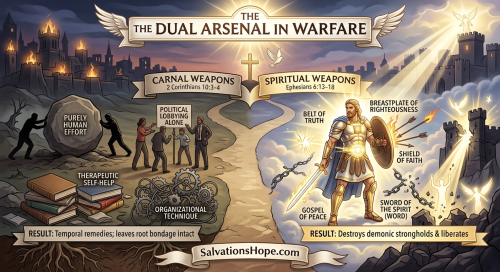
A tragic tendency in contemporary Christianity is the reliance on human-centered methodologies to solve spiritual crises. When the Church adopts the world’s toolkits—relying solely on sociology, politics, therapy, or administrative programs to address deep-seated spiritual bondage—it brings paper airplanes to a heavy artillery fight.
Scripture does not reject practical human efforts, but it unmasks their absolute inadequacy as ultimate solutions to spiritual problems.
Exegetical Blueprint: Spiritual Armor & Gospel Power
To engage the adversary effectively, we must rely on the spiritual arsenal God Himself provides in His Word.
The Nature of Spiritual Strongholds (2 Corinthians 10:3–5)
In addressing the church at Corinth, Paul draws a sharp contrast between worldly methods and divine power:
“For though we walk in the flesh, we are not waging war according to the flesh. For the weapons of our warfare are not of the flesh but have divine power to destroy strongholds. We destroy arguments and every lofty opinion raised against the knowledge of God, and take every thought captive to obey Christ.” (2 Corinthians 10:3–5)
Paul uses military terminology here:
- "Of the flesh" (sarkika): Refers to humanly devised, natural, or fallen mechanisms. When the Church relies exclusively on carnal weapons—such as mere rhetoric, political power, or self-effort—it attempts to fight a spiritual entity on terrain where human capability is entirely insufficient.
- "Strongholds" (ochyrōmata): Refers to fortresses or spiritual strongpoints. In context, Paul defines these strongholds as deceptive philosophies, worldly mindsets, and prideful arguments (logismous) that set themselves up against the true knowledge of God.
Only weapons forged by God possess the “divine power” (dynata tō Theō) necessary to demolish these deep-seated deceptions.
Paul’s Apostolic Commission (Acts 26:17–18)
When Jesus commissioned the Apostle Paul on the Damascus Road, He clearly outlined the spiritual purpose of the Gospel message:
“I am sending you to open their eyes, so that they may turn from darkness to light and from the power of Satan to God,
that they may receive forgiveness of sins and a place among those who are sanctified by faith in me.” (Acts 26:17–18)
Notice the progression in this passage:
- Illumination (“open their eyes”): The Gospel exposes the adversary’s lies and reveals truth.
- Transfer of Allegiance (“from darkness to light, from the power of Satan to God”): Human liberation occurs not through political emancipation or psychological self-realization, but through being rescued from Satan’s domain (Colossians 1:13).
- Redemption (“forgiveness of sins”): The root problem of human guilt is resolved through faith in Jesus Christ.
Satan is not intimidated by human intellect, social programs, or institutional authority. The one thing that dismantles his kingdom is the uncompromised proclamation of the Gospel of Jesus Christ.
Theological Reflection: Why the Gospel Terrifies the Adversary
It might sound counterintuitive or bleak to emphasize the formidable power of Satan. However, in the economy of God’s revelation, the enemy’s dreadfulness highlights the supreme glory of our Savior.
If our problem were merely a lack of education, a teacher would suffice. If our problem were merely a lack of policy, a politician would suffice. If our problem were merely psychological dysfunction, a therapist would suffice.
However, because humanity is captive to a fallen spiritual prince and bound under the penal guilt of sin, only a Divine Redeemer could rescue us.
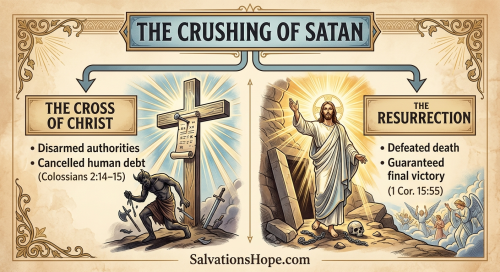
- The Legal Disarming (Colossians 2:14–15): At the Cross, Jesus canceled the record of debt that stood against us with its legal demands. In doing so, He disarmed the ruler of darkness and put spiritual authorities to open shame, triumphing over them. Satan’s ultimate weapon—accusing us of sin before God—was stripped from his hands.
- The Final Doom (Revelation 20:10): Satan operates as an already-sentenced criminal awaiting the final execution of his judgment. His time is short, and his doom is certain.
When believers rely on prayer, sound biblical doctrine, holy living, and the proclamation of Christ’s death and resurrection, they utilize the very instruments God ordained to enforce Christ’s victory over the darkness.
Summary & Synthesis of the Complete Study
Questions to Consider:
Where has your local church or small group inadvertently relied on “carnal weapons” (social initiatives, human techniques, programs) rather than prayer and Scripture to address spiritual struggles?
How does knowing that Satan is already a defeated adversary change the way you approach personal temptations or share your faith with others?
What specific piece of the spiritual armor in Ephesians 6:13–18 (Truth, Righteousness, Gospel Readiness, Faith, Salvation, the Word, Prayer) do you most need to activate in your daily life right now?
Satan’s Strategic Countermeasures
Blindness, Compromise, and Disruption
As we progress deeper into our study of spiritual warfare, a critical reality emerges: the adversary does not retreat simply because a believer or a church recognizes his existence. In fact, the clearer our grasp of the Gospel, the more focused his opposition becomes.
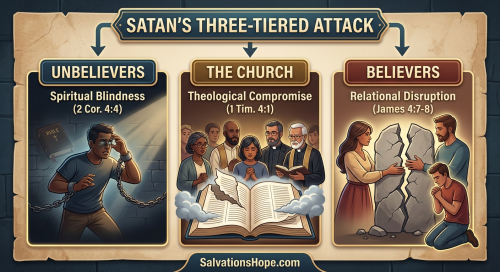
Satan’s primary objective is to prevent unbelievers from coming to the light of Christ and to render believers spiritually paralyzed, joyless, and ineffective. When we examine Scripture’s tactics, we see that his offensive strategy relies on three main battlegrounds: intellectual blindness, theological compromise, and relational disruption.
The Tactics of the Adversary Spiritual Blindness and the Veil over Unbelief (2 Corinthians 4:3–4)
Modern society often frames skepticism, secularism, and rejection of the Gospel as hallmarks of intellectual enlightenment, higher education, or progressive thought. However, the Apostle Paul exposes the spiritual reality behind unbelief:
“But if our gospel be hid, it is hid to them that are lost: In whom the god of this world hath blinded the minds of them which believe not,
lest the light of the glorious gospel of Christ, who is the image of God, should shine unto them.” (2 Corinthians 4:3–4)
- The “God of This World” (ho theos tou aiōnos toutou): Paul uses this title not to suggest that Satan possesses ultimate sovereignty, but to highlight his temporary, pervasive influence over a fallen world system that resists God.
- Judicial and Demonic Blindness (etyphlōsen): Unbelief is ultimately not an intellectual deficiency or a lack of evidence; it is a spiritual veil (kekalymmenon). Satan actively darkens human perception so that individuals remain oblivious to the beauty, glory, and necessity of Jesus Christ.
When people mock the Bible or dismiss the reality of demonic forces, they are demonstrating the very blindness the adversary has cultivated within them.
Theological Compromise and Deceiving Spirits (1 Timothy 4:1)
When Satan cannot prevent a church from existing, he attempts to hollow it out from within by attacking its doctrine. Paul explicitly warns Timothy about this ongoing threat:
“Now the Spirit expressly says that in later times some will depart from the faith by devoting themselves to
deceitful spirits and teachings of demons…” (1 Timothy 4:1)
Paul traces false teaching directly back to its spiritual origin: “teachings of demons” (didaskaliais daimoniōn).
Throughout history and in contemporary culture, when leaders or institutions deny the authority and inerrancy of Scripture, reject the bodily resurrection of Christ, deny the exclusivity of Jesus for salvation (John 14:6), or dismiss the reality of hell and spiritual judgment, they often do so under the guise of “modern scholarship” or “bringing religion up to date.” Yet Scripture unmasks this intellectual posture: those who abandon core biblical truths are unwittingly echoing and advancing demonic doctrines designed to neutralize the Gospel.
Relational Disruption and Intimidation (Ephesians 4:26–27; James 4:7–8)
For faithful, vibrant churches and mature Christians who hold fast to sound doctrine, Satan changes his tactics. When he cannot destroy them through false teaching, he seeks to paralyze them with internal strife and personal attacks.
In Ephesians 4:26–27, Paul warns, “Do not let the sun go down on your anger, and give no opportunity to the devil.” The word for “opportunity” (topos) means a foothold, a beachhead, or territorial entry. Unforgiveness, suspicion, envy, and petty squabbling are not merely human personality clashes; they are strategic footholds the enemy exploits to destroy unity and ruin a church’s public witness.
Satan frequently targets dedicated believers with intense doubts, spiritual fatigue, and accusations regarding their salvation (Revelation 12:10). While he can never pluck a genuine believer out of Christ’s hand (John 10:28–29), he seeks to rob us of the joy of our salvation, rendering us timid, exhausted, and ineffective in sharing the Gospel with others.
Practical Hermeneutics: The Dual Command to Submit and Resist
How does a Christian stand firm against an enemy who is so persistent, subtle, and malicious? The Apostle James provides the definitive scriptural protocol:
“Submit yourselves therefore to God. Resist the devil, and he will flee from you. Draw near to God, and he will come near to you.” (James 4:7–8a)
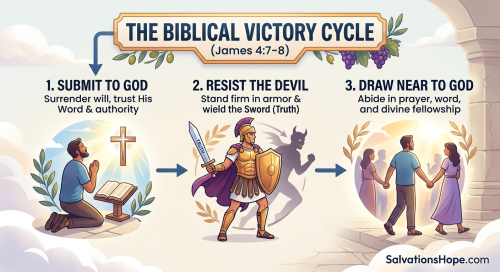
Notice the vital order in James’ directive:
- Submission First (hypotagēte): Resistance to the devil is completely ineffective without prior submission to the lordship of Jesus Christ. Trying to fight demonic deception in our own authority or while living in unrepentant sin leaves us exposed.
- Active Resistance (antistēte): We do not flee from the devil; we stand our ground (Ephesians 6:13). When we counter his lies with the truth of God’s Word—just as Jesus did in the wilderness (Matthew 4:1–11)—the enemy is forced to flee (pheuxetai).
- Relational Proximity (engisate): Victory is not merely defensive; it is found in drawing near to God in prayer, worship, and Scripture. As we draw near to Him, His presence becomes our ultimate fortress and strength.
From Captivity to Victory
If you have realized through this study that you have been living without Jesus—or perhaps relying on your own strength while trapped in subtle patterns of sin—understand that today is the day of liberation.
The adversary is a master deceiver, but he is defeated. Christ has already disarmed him on the cross. The call of the Gospel is to abandon the doomed, deceptive kingdom of darkness, surrender your life to Jesus Christ in faith, and step into the light of His grace and eternal joy.
And for those who already belong to Christ: recognize the true nature of the battle, put on the whole armor of God, guard the unity of your fellowship, and proclaim the Gospel with bold, unshakable confidence.
Questions to Consider:
How does understanding 2 Corinthians 4:4 change your perspective and patience when sharing the Gospel with friends or family members who reject Christ?
In what ways can you actively protect your local church from Satan’s schemes of gossip, division, and distrust this week?
What specific promise in Scripture can you memorize and speak aloud the next time the adversary attacks you with doubt, discouragement, or temptation?
Satan’s Tactical Spectrum: From Occult Entrapment to Bureaucratic Malice
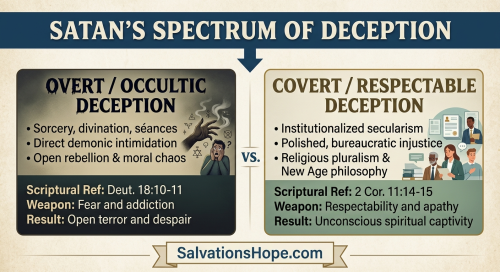
As we analyze the final dimensions of spiritual warfare, we encounter what appears to be a stark paradox in the adversary’s strategy. On one hand, Satan manifests through overt demonic involvement, occult practices, and explicit terror. On the other, he operates through polished, respectable, and thoroughly institutionalized means.
The Apostle John provides the overarching theological context that explains both extremes:
“Whoever makes a practice of sinning is of the devil, for the devil has been sinning from the beginning. The reason
the Son of God appeared was to destroy the works of the devil.” (1 John 3:8)
Christ came not merely to reform human behavior or offer ethical guidance, but to systematically dismantle (lysē) the dark infrastructure of the devil. To understand the magnitude of Christ’s victory, we must examine the full spectrum of Satan’s methods.
Exegetical and Historical Analysis: The Two Extremes of Demonic Infiltration
The Danger of Overt Occultism (Deuteronomy 18:10–12)
Throughout redemptive history, God explicitly warned His covenant people against dabbling in spiritual realms apart from His divine authority:
“There shall not be found among you anyone who burns his son or his daughter as an offering, anyone who practices divination or tells fortunes or interprets omens, or a sorcerer or a charmer or a medium or a necromancer or one who inquires of the dead, for whoever does these things is an abomination to the Lord.” (Deuteronomy 18:10–12a)
When individuals toy with horoscopes, tarot cards, Ouija boards, or mediums, they rarely intend to surrender their lives to evil. Often, it begins as entertainment, curiosity, or a search for spiritual guidance. However, Scripture unmasks these practices as invitations to demonic bondage.
Whether in individual cases of occultic harassment or in historical instances where totalitarian regimes leaned into esoteric, occult philosophy, the result of open demonic alignment is always the same: destruction, terror, and the devaluation of human life bearing the image of God (Genesis 1:27).
The Danger of Respectable Secularism (2 Corinthians 11:14–15)
While overt occultism terrifies many, Satan achieves equal—if not greater—success through quiet, respectable deception.
In The Screwtape Letters, C.S. Lewis famously observed that humanity falls into two equal and opposite errors regarding demons: to disbelieve in their existence entirely, or to feel an unhealthy obsession with them. Decades later, in The Screwtape Letters preface and related essays, Lewis further articulated how severe evil often manifests in padded executive offices rather than sordid dens of iniquity:
“The greatest evil is not now done in those sordid ‘dens of iniquity’… It is not done even in concentration camps and labour camps. In those we see its final result. But it is conceived and ordered (moved, seconded, carried, and minuted) in clean, carpeted, warmed, and lighted offices, by quiet men with white collars and cut fingernails and smooth-shaven cheeks who do not need to raise their voice.”
From a biblical perspective, a quiet corporate executive or policymaker who operates as though God does not exist serves the adversary’s agenda just as effectively as a practicing occultist.
To destroy the image of God through institutionalized devaluation of human life in a sterile clinical setting accomplishes the exact same spiritual end as an ancient pagan ritual. To educate a generation through sophisticated academic frameworks to believe that truth is relative and God is irrelevant is as spiritually lethal as placing them under a sorcerer’s spell.
The Swing Between Materialism and False Spirituality
When a culture rejects the Gospel, it rarely remains in a state of pure secular neutrality for long. Human beings are inherently spiritual creatures made for worship (Ecclesiastes 3:11).
When post-Christian societies abandon biblical Christianity, they typically swing from materialist secularism into paganism, pantheism, or New Age syncretism. Satan readily fills the spiritual vacuum with doctrines that feel “enlightened” or “new,” but are simply repackaged versions of his original lie in the Garden: “You will be like God” (Genesis 3:5).
Theological Synthesis: The Comprehensive Defeat of the Adversary
Regardless of whether Satan approaches as a roaring lion through direct persecution (1 Peter 5:8) or as a subtle serpent through institutional compromise (Genesis 3:1), his goal is singular: to sever human beings from their Creator and drag them into eternal ruin.
Yet the overarching message of the New Testament is not the terrifying reach of Satan, but the absolute triumph of Jesus Christ.
Jesus repeatedly demonstrated His authority over demonic powers, casting them out with a word and declaring, “If it is by the Spirit of God that I cast out demons, then the kingdom of God has come upon you” (Matthew 12:28).
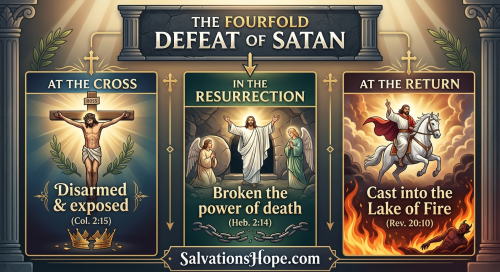
The crucial blow was struck at Calvary. Hebrews 2:14–15 declares that through His death, Jesus rendered powerless “him who holds the power of death—that is, the devil—and free those who all their lives were held in slavery by their fear of death.”
Believers do not fight in their own strength or authority. We walk in the authority of the exalted Christ, protected by His armor and relying on His Spirit.
Our enemy’s ultimate destiny is already sealed. Revelation 20:10 assures us that the devil who deceived the nations will be “thrown into the lake of fire and sulfur… and will be tormented day and night forever and ever.”
Walking in Liberty and Light
Spiritual warfare is neither a myth to be ignored nor a cause for panic. It is a present reality in which believers are called to stand fast, clothed in the truth of God’s Word and reliant on the finished work of Jesus Christ.
Whether the adversary attempts to deceive you through subtle cultural pressures, theological compromise, personal temptation, or direct spiritual fear, the remedy remains unchanged: Submit to God, ground yourself in the unadulterated Gospel, put on the whole armor of God, and stand firm in the victory of the Lord Jesus Christ.
Questions to Consider:
In what ways do you see “respectable,” institutionalized secularism acting as a spiritual snare in modern society today?
How can a Christian maintain a balanced, biblically sound view of spiritual warfare without slipping into either obsession with demonic power or complete denial of it?
Reflecting on the whole study, what is one major area in your daily life or ministry where you need to stop relying on human effort and start relying on the spiritual weapons God has provided?
The Defeat of the Tempter: How the Cross Unarmed the Adversary
While it is crucial to understand the subtle schemes and pervasive influence of the adversary, the central focus of Christian theology is never Satan—it is Jesus Christ, the Triumphant King.
The ultimate turning point of human history occurred not through military conquest, philosophical revolution, or human moral advancement, but on a Roman cross outside the walls of Jerusalem.
“Now is the judgment of this world; now will the ruler of this world be cast out.
And I, when I am lifted up from the earth, will draw all people to myself.” (John 12:31–32)
At first glance, Calvary appeared to be the adversary’s ultimate victory—the execution of the sinless Son of God. Yet in the mysterious sovereignty of God, Satan’s greatest apparent triumph became his ultimate, irreversible defeat.
Exegetical Analysis: The Victory Over Temptation and Disobedience
To grasp how the Cross dismantled Satan’s power, we must examine how Jesus succeeded where every other human being failed: in absolute, unyielding obedience to the Father despite the fiercest temptations imaginable.
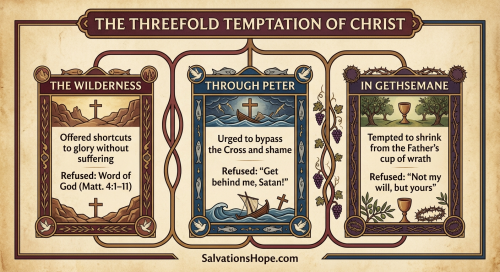
The Temptation to Bypass the Cross (Matthew 4:1–11; 16:21–23)
Throughout his earthly ministry, the adversary repeatedly urged Jesus to abandon the path of humble, sacrificial suffering for immediate, worldly glory.
In the Wilderness (Matthew 4:8–10): Satan offered Christ all the kingdoms of the world in exchange for a single act of homage. The temptation was to secure the nations without enduring Calvary’s agony. Jesus countered with Scripture and refused the shortcut.
Through the Apostle Peter (Matthew 16:22–23): When Jesus revealed that He must go to Jerusalem, suffer, and be killed, Peter rebuked Him. Jesus recognized the spiritual source behind Peter’s words, declaring, “Get behind me, Satan! You are a hindrance to me. For you are not setting your mind on the things of God, but on the things of man.”
The Agony of Choice (John 12:27–28; Luke 22:42)
As the hour of His execution approached, the spiritual weight intensified. Jesus did not face death as a mere martyr, but as the Lamb of God who would bear the judicial wrath of God for human sin (2 Corinthians 5:21).
“Now is my soul troubled. And what shall I say? ‘Father, save me from this hour’? But for this purpose I have come to this hour.
Father, glorify your name.” (John 12:27–28a)
In the Garden of Gethsemane, under intense psychological and spiritual pressure, Christ prayed until His sweat became like great drops of blood (Luke 22:44). Where the First Adam succumbed to temptation in a pristine garden (Genesis 3), the Last Adam (1 Corinthians 15:45) triumphed over temptation in a dark garden, surrendering His human will completely to the Father:
“Father, if you are willing, remove this cup from me. Nevertheless, not my will, but yours, be done” (Luke 22:42)
The Overcoming of Hatred and Retaliation (Luke 23:34; 1 Peter 2:23)
The adversary’s final attempt to corrupt Christ’s sinlessness was to provoke hatred, malice, or self-preservation in Him. As the crowds mocked Him, the soldiers beat Him, and the religious leaders taunted Him to come down from the cross, Jesus possessed the divine power to summon legions of angels to destroy His executioners (Matthew 26:53).
Instead of yielding to vengeance, Jesus fulfilled the prophecy of Isaiah 53:7 and demonstrated divine love:
“When he was reviled, he did not revile in return; when he suffered, he did not threaten,
but continued entrusting himself to him who judges justly.” (1 Peter 2:23)
“Father, forgive them, for they know not what they do.” (Luke 23:34a)
By remaining sinless through the ultimate crucible of suffering (Hebrews 4:15), Jesus completely broke the power of the tempter. Satan could find no foothold of disobedience, pride, or hatred in Him (John 14:30).
Practical Hermeneutics: Walking in the Sinless Victory of Christ
Christ’s refusal to yield to temptation on the cross provides both the grounding for our salvation and the pattern for our daily spiritual life.

We Have a High Priest Who Sympathizes (Hebrews 2:18; 4:15–16): Because Jesus experienced the full force of temptation without yielding, He understands our struggles. We can approach His throne of grace with bold confidence, knowing we will find mercy and help in times of need.
We Reject the World’s Shortcuts: Satan continuously offers believers shortcuts—to financial security through dishonesty, to emotional fulfillment through immorality, or to influence through compromise. Following Christ means choosing the Father’s path of obedience over the adversary’s sweet-sounding shortcuts.
We Overcome Malice Through Grace: When others wrong, slander, or persecute us, human nature demands retaliation. Yet looking to the Cross empowers us to extend forgiveness (Ephesians 4:32), defeating Satan’s attempt to trap us in bitterness and hatred.
Where in your life are you tempted to choose an easier, unbiblical shortcut instead of walking the harder path of faithful obedience?
How does remembering Jesus’ prayer on the Cross (“Father, forgive them“) help you extend forgiveness to someone who has deeply hurt you?
When facing intense temptation or spiritual fatigue, how can you practically lean on the truth that Jesus has already disarmed the tempter?
The Unmasking of the Liar and the Silence of the Accuser
As we examine the divine mechanics of Calvary, we see that the Cross did not merely neutralize Satan’s role as the Tempter; it simultaneously dealt a fatal blow to two of his most insidious roles: Satan the Liar and Satan the Accuser.
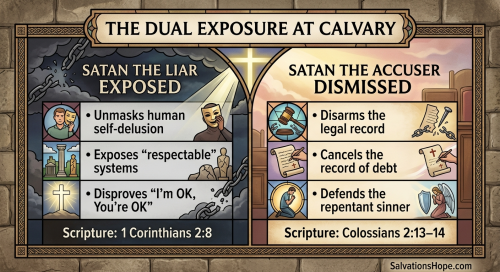
Exegetical Analysis: Exposing the World System (1 Corinthians 2:7–8)
Humanity consistently prefers to maintain a delusion of inherent moral goodness and cultural progress. Satan cultivates this self-justifying lie, persuading society that its legal, philosophical, and religious frameworks are fundamentally sound.
Yet when God Incarnate walked among us, those exact “respectable” systems conspired to execute Him.
“But we impart a secret and hidden wisdom of God, which God decreed before the ages for our glory. None of the rulers of this age understood this, for if they had, they would not have crucified the Lord of glory.” (1 Corinthians 2:7–8)
The Collapse of Human Pretense
At the trial and execution of Jesus, two of the most sophisticated human institutions of the ancient world were brought to bear:
- The Sanhedrin: Representing the pinnacle of religious orthodoxy, biblical scholarship, and formal piety.
- The Roman Magistrate (Pontius Pilate): Representing the pinnacle of jurisprudence, administrative law, and civil order.
When confronted with absolute Truth and Sinless Holiness, both institutions collapsed into corrupt self-preservation, injustice, and state-sanctioned murder.
Calvary unmasked the myth that human culture is fundamentally neutral or good. It shattered the modern lie that “I’m okay and you’re okay.” If human nature and earthly systems were spiritually sound, they would have embraced the Son of God. Instead, they crucified Him. By bringing the hidden corruption of human religion and politics into the light, Jesus permanently exposed the bankrupt nature of the world system ruled by the adversary (John 12:31).
Exegetical Analysis: The Cancellation of Debt (Colossians 2:13–14; Revelation 12:10–11)
When Satan cannot keep a person blinded by self-righteous pride, he shifts to the opposite tactic: despair through accusation.
The title “Satan” (Śāṭān) literally means adversary or prosecuting attorney, while “Devil” (Diabolos) means slanderer. His strategy is to point to God’s holy law, highlight our real sins, and demand our eternal condemnation.
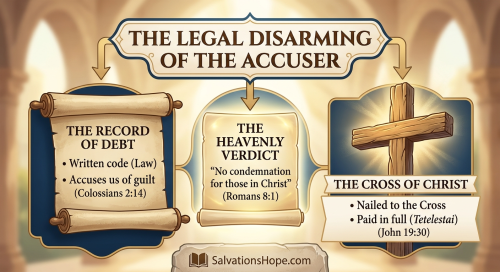
The Cancellation of the Certificate of Debt (Colossians 2:13–14)
In his letter to the Colossians, the Apostle Paul uses precise Greco-Roman legal terminology to describe how Jesus disarmed our spiritual prosecutor:
“And you, who were dead in your trespasses and the uncircumcision of your flesh, God made alive together with him,
having forgiven us all our trespasses, by canceling the record of debt that stood against us with its legal demands.
This he set aside, nailing it to the cross.” (Colossians 2:13–14)
- The Record of Debt (cheirographon): Refers to a handwritten certificate of indebtedness or a signed IOU. In theological terms, it represents the cumulative moral debt humanity owes under the demands of God’s broken law.
- Canceling (exaleipsas): Means to wipe out, erase completely, or blot out so that no trace of the original writing remains. Ancient ink lacked acid, meaning it did not bite into the papyrus or parchment; it could be wiped away with a wet sponge.
- Nailed to the Cross: Jesus took the legal document containing every charge, every failure, and every secret sin, and paid it in full through His substitutionary death. When Jesus cried out, “It is finished” (Tetelestai—a commercial and legal term meaning “paid in full”), the debt was permanently expunged (John 19:30).
The Defeat of the Heavenly Prosecutor (Revelation 12:10–11)
Because the debt is fully paid, Satan’s standing in the heavenly courtroom is entirely destroyed:
“And I heard a loud voice in heaven, saying, ‘Now the salvation and the power and the kingdom of our God and the authority of his Christ have come, for the accuser of our brothers has been thrown down, who accuses them day and night before our God. And they have conquered him by the blood of the Lamb and by the word of their testimony…'” (Revelation 12:10–11a)
This truth is vividly demonstrated in the account of the penitent thief crucified beside Jesus (Luke 23:39–43). That man was a convicted criminal with a lifetime of evil deeds, unable to offer any good works or moral reformation to defend himself. Yet when he turned to Jesus in simple faith (“Lord, remember me when You come into Your kingdom”), his entire record of debt was erased instantly. He received no condemnation—only the personal assurance of Paradise.
When Satan attempts to drive a believer to despair by reminding us of our past sins, our defense is not to argue our own righteousness, but to point to our Heavenly Advocate, Jesus Christ the Righteous (1 John 2:1), whose blood wiped the record clean.
Practical Hermeneutics: Overcoming Accusation with Divine Justification
Understanding the defeat of the Liar and the Accuser transforms how we respond to guilt, self-doubt, and spiritual warfare.

- Distinguish Between Demonic Accusation and Holy Spirit Conviction: Conviction from the Holy Spirit is specific, points to the Cross, and draws us toward God in repentance. Demonic accusation is vague, crushing, and drives us away from God in shame.
- Stand on Objective Legal Justification (Romans 8:33–34): Paul asks the ultimate courtroom question: “Who shall bring any charge against God’s elect? It is God who justifies. Who is to condemn? Christ Jesus is the one who died—more than that, who was raised—who is at the right hand of God, who indeed is interceding for us.”
- Wield the Blood of the Lamb: Victory over spiritual despair is not found in emotional self-talk, but in pleading the finished, penal-substitutionary work of Jesus Christ over our lives.
- Exposing False Comfort: How does the Cross confront the worldly mindset that human beings are "basically good" and don't need a Savior?
- Handling Guilt: When you make a mistake or fall into sin, do you tend to retreat into self-condemnation (yielding to the Accuser) or run directly to the Cross for forgiveness (resting in the Advocate)?
- Conquering by Testimony: How can you use "the blood of the Lamb and the word of your testimony" (Revelation 12:11) to encourage a brother or sister in Christ who is struggling under intense spiritual guilt?
The Disarming of the Killer and the Disgrace of the Mocker
As our theological study culminates, we reach the final, decisive blows dealt to our spiritual adversary at Calvary. Having unmasked Satan as the Tempter, the Liar, and the Accuser, Scripture proceeds to reveal how Jesus systematically stripped the enemy of his most terrifying weapon—death itself—while exposing his pride to public disgrace.

Exegetical Analysis: The Disarming of Death (Hebrews 2:14–15; Matthew 27:50–53)
Throughout human history, physical death and the dread of what lies beyond have served as Satan’s primary instruments of psychological bondage. The author of Hebrews explains how Christ’s incarnation and substitutionary death disarmed this terror:
“Since therefore the children share in flesh and blood, he himself likewise partook of the same things, that through death
he might destroy the one who has the power of death, that is, the devil, and deliver all those who through
fear of death were subject to lifelong slavery.” (Hebrews 2:14–15)
The Nullification of Demonic Power
The Greek word translated as “destroy” or “render powerless” is katargeō, which means to invalidate, render inoperative, or strip of efficiency. Satan held “the power of death” not because he possesses sovereign authority over human life (Job 1:12), but because human sin brought the legal penalty of spiritual and physical death (Romans 6:23).
By taking our sins upon Himself and satisfying the legal demands of God’s justice, Jesus stripped death of its punitive sting (1 Corinthians 15:55–57).
The Dramatic Signs of Liberation (Matthew 27:51–53)
The immediate aftermath of Christ’s death provided a physical manifestation of this spiritual reality:
“And behold, the curtain of the temple was torn in two, from top to bottom. And the earth shook, and the rocks were split. The tombs also were opened. And many bodies of the saints who had fallen asleep were raised… (Matthew 27:51–52)
The tearing of the veil signified direct access to God’s presence, while the opening of the tombs demonstrated that the grave had lost its permanent hold on God’s people. Death was transformed from a hopeless prison into a conquered gateway to eternal glory (Romans 8:38–39).
Exegetical Analysis: The Triumphant Disgrace of the Adversary (Colossians 2:15)
Satan’s original rebellion was rooted in pride (1 Timothy 3:6), and he continuously mocks God’s truth, making righteousness appear foolish and sin seem desirable. Yet at the Cross, God orchestrated a profound reversal.
“He disarmed the rulers and authorities and put them to open shame, by triumphing over them in him [or in the cross].” (Colossians 2:15)
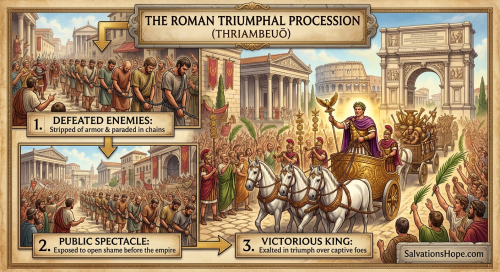
Paul utilizes vivid imagery from a Roman military thriambos (triumphal parade). When a Roman general achieved a decisive victory, he marched his defeated enemies through the streets of Rome, stripped of their armor, chained, and exposed to public humiliation before the entire city.
At Calvary:
- The World Mocked Christ (Luke 23:35–37): Human spectators and spiritual forces taunted Jesus as weak and helpless.
- The Table Turned at His Death (Luke 23:47–48): The Roman centurion confessed, "Certainly this man was innocent!" while the crowd beat their breasts in deep shame and remorse.
- The Spiritual Reality Exposed: In the unseen realm, Christ disarmed the demonic principalities, exposing their complete powerlessness before the universe. Satan’s proudest moment became his most humiliating defeat.
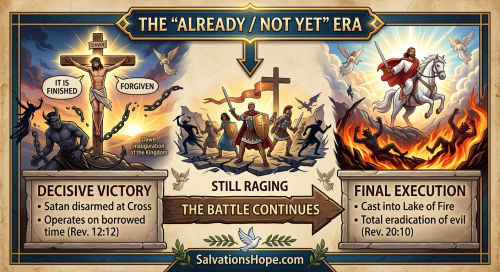
Theological Synthesis: The Dethroned Tyrant and the "Already / Not Yet"
The Cross achieved the permanent dethronement of the adversary, initiating a cascade of spiritual liberation:
- The Penitent Thief (Luke 23:42–43): Rescued from the threshold of hell into Paradise.
- The Roman Centurion (Mark 15:39): A hardened gentile soldier brought to saving faith.
- Joseph of Arimathea & Nicodemus (John 19:38–40): Secret believers who abandoned fear of man to publicly identify with Christ.
Understanding the Present Conflict (Revelation 12:12)
If Satan is defeated, why does the world continue to experience severe spiritual darkness, war, and corruption? Scripture answers this in Revelation 12:12:
“Rejoice, then, O heavens and you who dwell in them! But woe to you, O earth and sea, for the devil has
come down to you in great wrath, because he knows that his time is short!”
The decisive battle in the cosmic war was fought and won at Calvary. Satan is a dethroned tyrant operating on a short leash, living on borrowed time. His current fury is not a sign of his victory, but a manifestation of his desperate, doomed rage. He knows his final destination is the Lake of Fire (Revelation 20:10).
Comprehensive Conclusion: Standing Fast in the King's Victory
Throughout this theological study, we have systematically examined the reality of spiritual warfare:
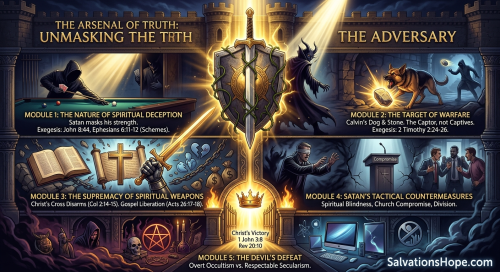
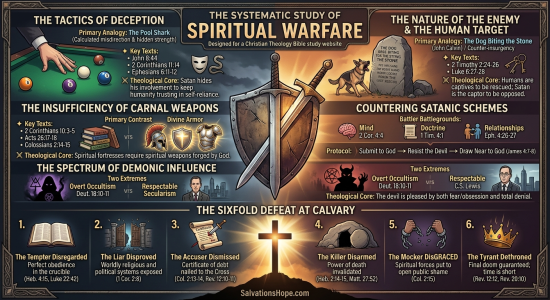
- Unmasked the Adversary: Satan operates like a master deceiver, hiding his hand while keeping victims captive.
- Identified the True Target: Our struggle is against demonic powers, not flesh-and-blood human beings who need Gospel liberation.
- Renounced Carnal Weapons: Human philosophy, therapy, and politics cannot break spiritual strongholds—only the armor of God and the Word of God can.
- Exposed Satan’s Schemes: He utilizes blindness, false doctrine, and division to disrupt God’s church.
- Analyzed the Broad Spectrum of Deception: From overt occultism to polished, respectable secularism, his goal remains human destruction.
- Proclaimed Christ’s Total Triumph: On the Cross, Jesus disregarded the Tempter, disproved the Liar, defended against the Accuser, disarmed the Killer, disgraced the Mocker, and dethroned the Tyrant.
If you are bound by persistent sin, spiritual fear, or demonic deception, look to the Cross. Jesus Christ has broken the power of the enemy. Submit your life to Him, take up the sword of the Spirit, and walk in the unshakable freedom of Satan’s Conqueror!
- Overcoming the Fear of Death: How does the truth of Hebrews 2:14–15 change the way a Christian approaches personal mortality, grief, or severe illness?
- Recognizing the “Already/Not Yet”: How does knowing that Satan is already defeated but still raging help explain the intense spiritual struggles we experience in the world today?
- Personal Commitment: Having completed this entire study on spiritual warfare, what is one major mind-set or practice you need to transform in your daily walk with God?