
The Danger of a "Buried" Word
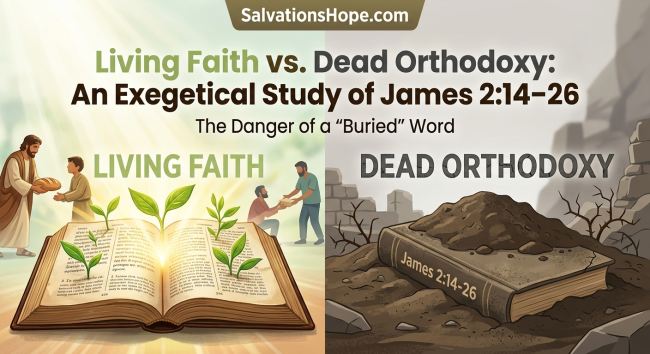
Living Faith vs. Dead Orthodoxy
Some time ago in the Democratic Republic of the Congo, the local Bible Society observed an unusual phenomenon. Scripture sales were skyrocketing across the country, yet a closer examination revealed something unsettling: the spiritual climate of the surrounding communities remained entirely unchanged. Local churches were not growing in Christlikeness, nor were unbelievers flocking to hear the Gospel.
Upon investigation, the Bible Society discovered the underlying cause. When building new churches, congregations bought Bibles in bulk and buried them directly in the foundation. They believed that placing physical copies of Scripture around the perimeter would act as a talisman to ward off evil spirits.
The Bibles were present, but they were buried. They were treated as superstitious objects rather than the living, active Word of God (2 Timothy 3:16–17; Hebrews 4:12). The result was a superficial form of Christianity that possessed the Word in physical proximity, yet remained devoid of its transforming power.
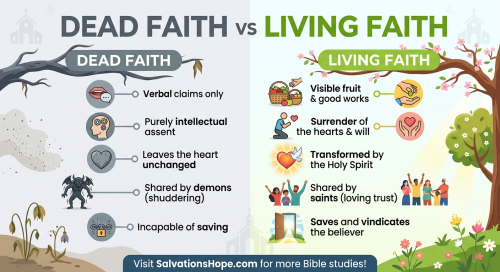
This tragic phenomenon perfectly illustrates the core message of James 2: a dead faith does not work. A faith that is purely vocal, intellectual, or ritualistic—yet produces no real fruit—is spiritually useless and incapable of saving the soul.
“What good is it, my brothers, if someone claims to have faith but has no deeds? Can such faith save him? Suppose a brother or sister is without clothes and daily food. If one of you says to him, Go in peace; stay warm and well fed, but does nothing about his physical needs, what good is it? In the same way, faith by itself, if it is not accompanied by action, is dead. But someone will say, “You have faith; I have deeds.” Show me your faith without deeds, and I will show you my faith by my deeds. You believe that there is one God. Good! Even the demons believe that—and shudder. O foolish man, do you want evidence that faith without deeds is useless? Was not our father Abraham justified by what he did when he offered his son Isaac on the altar? You see that his faith and his actions were working together, and his faith was made complete by what he did. And Scripture says, Abraham believed God, and it was credited to him as righteousness, and he was called God’s friend. You see that a person is justified by what he does and not by faith alone. In the same way, was not even Rahab the prostitute justified by what she did when she gave lodging to the spies and sent them off in a different direction? As the body without the spirit is dead, so faith without deeds is dead.”(James 2:14–26)
Contextual Context & Structural Overview
In chapter 1, James establishes the foundational mandate of true Christian discipleship: “Be doers of the word, and not hearers only, deceiving yourselves.” — James 1:22 He goes on to define genuine religion as active mercy combined with moral purity: caring for orphans and widows in their distress and keeping oneself unspotted from the world (James 1:27). Moving into chapter 2, James exposes two major counterfeits of genuine faith:
- Nice Talk without Real Action (James2:14–17)
- Correct Belief without Spiritual Life (James2:18–19)
He then grounds his thesis in Old Testament examples (James2:20–26) to demonstrate that true saving faith inevitably reveals itself in obedience.
Nice Talk vs. Real Action
James opens this section with two rhetorical questions designed to search the human heart:
“What good is it,my brothers,if someone claims to have faith but has no deeds?Can such faith save him?”(v.14)
The Greek construction of the second question expects an emphatic negative answer: “That kind of faith cannot save him, can it?” James is not contrasting faith and works as two rival paths to God; rather, he is contrasting living faith with a spurious claim to faith.
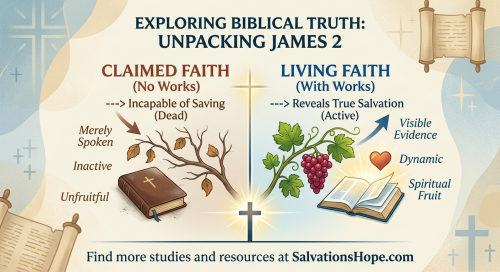
To illustrate, James offers a concrete scenario: a fellow believer is lacking basic clothing and daily sustenance (v.15). A church member offers a pious farewell: “Go in peace; stay warm and well fed” (v.16).
The phrase “Go in peace” translates to the Hebrew farewell (“Shalom”), equivalent to a modern “Goodbye and good luck!” James highlights the utter vanity of such empty well-wishes: a hungry person cannot eat a sympathetic speech.
This principle echoes throughout Scripture:
God be in him? Dear children, let us not love with words or tongue but with actions and in truth.” (1 John 3:17–18)
Jesus warns those who offered no relief to the hungry, thirsty, or destitute that their lack of mercy shows they lack a saving relationship with Him and will face final judgment. (Matthew 25:41–43)
James concludes this illustration with a definitive principle:
“In the same way, faith by itself, if it is not accompanied by action, is dead.” (James 2:17)
Correct Belief vs. Demonic Orthodoxy (James 2:18–19)
James anticipates an objector who seeks to treat faith and works as separate spiritual gifts: “You have faith; I have deeds” (v.18). James rejects this false dichotomy immediately. Faith is invisible in its essence; it can be demonstrated only through visible fruit.
He then targets those who rely on intellectual assent or theological correctness as proof of salvation:
“You believe that there is one God. Good! Even the demons believe that—and shudder.” (James 2:19)
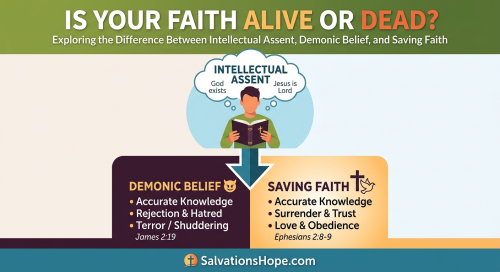
The confession “God is one” refers directly to the Shema (Deuteronomy 6:4), the foundational creed of Israelite monotheism. James commends the doctrine as orthodox (“Good!”), but immediately exposes its insufficiency when isolated from personal surrender.
Consider the Gospel accounts:
- Mark 1:24: The demon cries out, "I know who You are—the Holy One of God!"
- Luke 8:28: Another demon declares, "What do You want with me, Jesus, Son of the Most High God?"
The fallen angels possess refined systematic theology. They recognize the oneness of God, the deity of Christ, the certainty of coming judgment, and the reality of heaven and hell. Yet their orthodoxy produces no love, no loyalty, and no repentance. It produces only terror—they shudder. The Greek word for shudder is φρίσσω (phrissó or phrissō) In usage (such as in ancient Greek literature and the New Testament in James 2:19), it means to shake or recoil because of intense fear, awe, or dread.
Therefore, intellectual agreement with sound doctrine—what theologians call dead orthodoxy—is not equivalent to saving faith. One can affirm the Apostles’ Creed, believe in the historical resurrection, and affirm biblical inerrancy, yet remain spiritually dead if there is no radical allegiance to King Jesus.
Living Faith Exemplified: Abraham and Rahab (James 2:20–26)
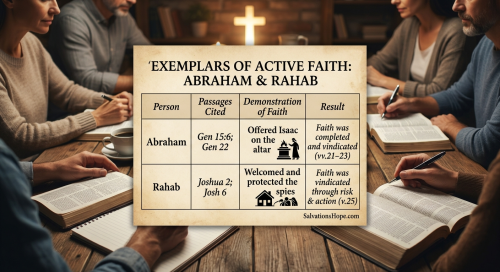
To prove that true faith always acts, James cites two Old Testament witnesses from opposite ends of the social and moral spectrum: Abraham (the venerable patriarch) and Rahab (the Gentile prostitute).
Person
Passages Cited
Demonstration of Faith
Result
Abraham
Gen15:6; Gen22
Offered Isaac on the altar
Faith was completed and vindicated (vv.21–23)
Rahab
Joshua2; Josh6
Welcomed and protected the spies
Faith was vindicated through risk & action (v.25)
Harmonizing James and Paul
When James states that “a person is justified by what he does and not by faith alone” (v.24), he uses the word justified (ó) in a complementary sense to the Apostle Paul:
- Paul’s Emphasis (Romans 3:28): Addresses the ground of salvation—how a sinner is declared righteous before a holy God (by grace through faith apart from legalistic works of the law).
- James’s Emphasis (James 2:24): Addresses the proof of salvation—how a person's claim to faith is vindicated or shown to be genuine before the world.
As the Reformers noted: “We are saved by faith alone, but the faith that saves is never alone.” Abraham was credited with righteousness early in his journey (Genesis 15:6), but decades later, his willingness to offer Isaac (Genesis 22) brought that faith to its intended fulfillment and proved its authenticity.
Summary Comparison: Dead Faith vs. Living Faith
Personal Application & Reflection
- Examine Your Confession: Are you relying on a past event, a prayer, or doctrinal knowledge as assurance of salvation, while living a life unaffected by the Gospel?
- Move Beyond Verbal Pity: Where in your local church or community can you turn comfortable words (“I’ll pray for you”) into tangible relief (food, clothing, presence, material support)?
- Cultivate Active Obedience: Is your belief in God driving you to love Him with all your heart, soul, mind, and strength (Deuteronomy 6:5), or is it merely passive agreement?
“For as the body without the spirit is dead, so faith without deeds is dead.” (James 2:26)
Righteousness Through an Active Faith
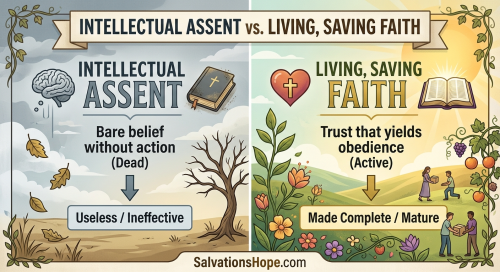
What does genuine, saving faith actually look like? In James 2:20–24, the apostle James addresses a fatal misconception: the idea that faith can exist as mere intellectual assent without transforming how a person lives.
Using the supreme Old Testament example of the “lofty patriarch” Abraham, James demonstrates that living faith works. It goes into action, and it is the very instrument through which we are counted right before God. True faith does not merely nod at God’s truth—it trusts His character, obeys His voice, and willingly entrusts everything to His sovereignty.
“Do you want to be shown, you foolish person, that faith apart from works is useless? Was not Abraham our father justified by works when he offered up his son Isaac on the altar? You see that faith was active along with his works, and faith was completed by his works; and the Scripture was fulfilled that says, “Abraham believed God, and it was counted to him as righteousness”—and he was called a friend of God. You see that a person is justified by works and not by faith alone.” (James 2:20–24)
- Justification and Active Faith: True saving faith is never passive or inert; it inherently expresses itself through obedience.
- The Maturity of Faith (teleioō): Faith is perfected, completed, and demonstrated when tested by trial and action.
- Friendship with God vs. Conformity to the World: Abraham’s radical separation from pagan Ur to covenant obedience marks the boundary between divine friendship and worldly compromise.
In James 2:20, James addresses the reader forcefully: “You foolish person, do you want evidence that faith without deeds is useless?” To anchor his argument in undisputed biblical history, James turns to the father of the covenant himself: Abraham.
Faith Initiated: Called Out of Darkness
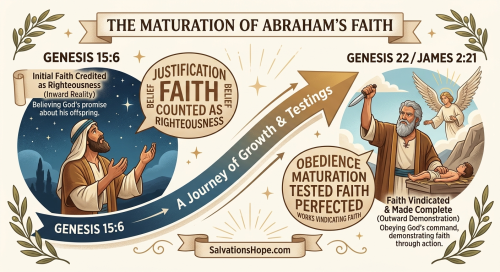
Abraham did not earn God’s favor through innate righteousness. He grew up in an idolatrous culture, surrounded by family members who worshiped pagan gods (Joshua 24:2). Yet, when God called him out of Ur of the Chaldeans, Abraham believed God’s covenant promise—that through his offspring, all nations on earth would be blessed.
Genesis 15:6 records the foundational truth of the Gospel: “Abraham believed the LORD, and he credited it to him as righteousness.” He was justified by grace through faith long before he performed any religious ritual or law-keeping work.
Faith Tested: The Supreme Sacrifice
Decades passed. Abraham and Sarah waited until old age—Abraham at 100—before the covenant child, Isaac, was born. Isaac was not merely a beloved son; he was the sole bearer of the divine promise.
Then came the ultimate test (Genesis 22). God commanded Abraham to offer Isaac as a sacrifice on Mount Moriah. On human terms, this command seemed to contradict God’s earlier promises. Yet, Abraham did not hesitate. He rose early, journeyed to the mountain, built the altar, and bound his son.
As the Author of Hebrews reveals, Abraham’s obedience was anchored in a profound theological logic:
“Abraham reasoned that God could even raise the dead, and so in a manner of speaking he did receive Isaac back from death.” (Hebrews 11:19)
Before the knife could fall, the Angel of the LORD stopped him and provided a ram caught in the thicket as a substitute. God spared Isaac, pointing ahead to the only time He would ever require a human sacrifice: when God the Father offered His own Son, Jesus Christ, on the cross to save the world.
Faith Perfected: The Greek Term teleioō
James writes:
“You see that his faith and his actions were working together, and his faith was made complete by what he did.” (James 2:22)
The phrase “made complete” translates the Greek verb (teleioō), which signifies bringing something to its intended goal, maturity, or full expression.
Abraham’s action on Mount Moriah did not replace his faith; rather, it matured and validated the faith he professed decades earlier in Genesis 15. His faith and works were perfectly synchronized.
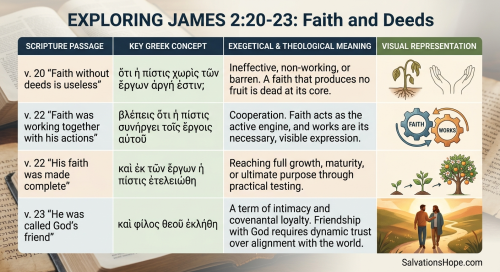
Exegetical Breakdown: James 2:20–24
Scripture Passage
Key Greek Concept
Exegetical & Theological Meaning
v. 20 “Faith without deeds is useless”
ὅτι ἡ πίστις χωρὶς τῶν ἔργων ἀργή ἐστιν;
Ineffective, non-working, or barren. A faith that produces no fruit is dead at its core.
v. 22 “Faith was working together with his actions”
βλέπεις ὅτι ἡ πίστις συνήργει τοῖς ἔργοις αὐτοῦ
Cooperation. Faith acts as the active engine, and works are its necessary, visible expression.
v. 22 “His faith was made complete”
καὶ ἐκ τῶν ἔργων ἡ πίστις ἐτελειώθη
Reaching full growth, maturity, or ultimate purpose through practical testing.
v. 23 “He was called God’s friend”
καὶ φίλος θεοῦ ἐκλήθη
A term of intimacy and covenantal loyalty. Friendship with God requires dynamic trust over alignment with the world.
The Impossibility of Inactive Faith
Consider the alternative premise that James refutes:
- Premise A: A person claims to possess true, saving faith in God.
- Premise B: The same person consistently refuses to obey God, remaining attached to the world and withholding obedience (e.g., Abraham staying in Ur or refusing to trust God with Isaac).
- Conclusion: If faith does not move the will to obedience, it remains mere intellectual assent—no different than the belief of demons (James 2:19). Therefore, non-working faith cannot justify.
True saving faith, by its very nature, transforms the human heart and inevitably issues into active trust, risk, and radical obedience. Real faith is not merely agreeing with biblical doctrine; it is trusting God enough to step out in risk and radical obedience. Abraham left his homeland and offered his son because he believed God’s promises were sure. True faith joins God’s side, even when the worldly cost is high. True covenant intimacy with God requires turning away from the idolatrous patterns of the culture around us.
Discussion Questions
How does Abraham’s life demonstrate that justification by faith is accompanied by a life of obedience?
What is the difference between trying to earn salvation through good works and letting your faith be completed through action?
How does the concept of teleioō (maturity/completeness) help clarify James’ statement that Abraham was “justified by what he did”?
What “Isaacs” (possessions, security, plans) might God be calling us to surrender in trust to Him today?
Do James and Paul Contradict Each Other?
Understanding Justification, Faith, and Works in Scripture
If you have been grounded in Christian doctrine, reading James 2:24 for the first time can feel like a theological alarm going off:
“You see that a person is justified by works and not by faith alone.” (James 2:24)
Your immediate thought might be: Wait, what?
If you know the teachings of the Apostle Paul, you are likely familiar with verses such as Romans 3:28:
“For we maintain that a person is justified by faith apart from the works of the law.” (Romans 3:28)
On the surface, these two biblical authors appear to stand directly opposed to one another:
- Paul: Justified by faith apart from works.
- James: Justified by works and not by faith alone.
Is there a fundamental flaw in the New Testament? Does James contradict Paul? To answer this clearly, we must look at the context: who each author was addressing, what problems they were solving, and how they uniquely defined their terms.
Context & Definitions — Who Are They Addressing?
The Bible was written for us, but not originally to us. To understand Paul and James, we must recognize the specific spiritual errors they were confronting.
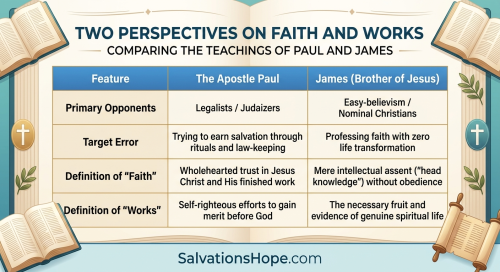
Feature
The Apostle Paul
James (Brother of Jesus)
Primary Opponents
Legalists / Judaizers
Easy-believers / Nominal Christians
Target Error
Trying to earn salvation through rituals and law-keeping.
Professing faith with zero life transformation.
Definition of “Faith”
Wholehearted trust in Jesus Christ and His finished work.
Mere intellectual assent (“head knowledge”) without obedience.
Definition of “Works”
Self-righteous efforts to gain merit before God.
The necessary fruit and evidence of genuine spiritual life.
Paul’s Target: Legalism
In books like Romans and Galatians, Paul combats those who believe they can earn points with God, earn their salvation, and deserve eternal life through ritual observance or moral law-keeping.
When Paul insists that we are saved by “faith apart from works,” he means that true, saving faith relies entirely on the merit of Jesus Christ, not our own goodness.
James’s Target: Antinomianism (Licentiousness)
James addresses a completely different problem: careless believers who are “all talk and no walk.” They show favoritism, ignore the poor, and live indistinguishably from the world.
When James speaks against “faith alone,” he is describing an idle, superficial faith—an intellectual acknowledgement of truth that leaves the heart cold and hands empty. James concludes that this kind of dead “faith” cannot save anyone.
Harmony in Scripture — Paul on Works, James on Grace
Paul Teaches the Necessity of Works
A common misconception is that Paul teaches only grace while James teaches only works. A closer examination of their writings reveals complete harmony.
Paul never taught that good works are irrelevant. Rather, he taught that good works are the result—not the cause—of salvation:
“For it is by grace you have been saved, through faith—and this is not from yourselves, it is the gift of God—not by works, so that no one can boast. For we are God’s handiwork, created in Christ Jesus to do good works, which God prepared in advance for us to do.” (Ephesians 2:8–10)
Throughout his letters, Paul consistently connects saving faith with active obedience, using phrases like:
- "The obedience of faith" (Romans 1:5)
- "Faith expressing itself through love" (Galatians 5:6)
- "Your work produced by faith" (1 Thessalonians 1:3)
James Teaches the Foundation of Grace
Far from promoting a system of salvation earned by human merit, James repeatedly anchors his letter in God’s sovereign grace and mercy:
- Generous Grace: "God gives generously to all without finding fault." (James 1:5)
- Divine Provision: "Every good and perfect gift is from above..." (James 1:17)
- Sovereign New Birth: "He chose to give us birth through the word of truth..." (James 1:18)
- Focused on Christ: "Believers in our glorious Lord Jesus Christ..." (James 2:1)
- Triumphant Mercy: "Mercy triumphs over judgment." (James 2:13)
- Sustaining Grace: "God opposes the proud but shows favor to the humble." (James 4:6)
As A. W. Tozer perceptively observed: “To escape the error of salvation by works, we have fallen into the error of salvation without obedience.”
Scripture guards us against spiritual errors on both sides:
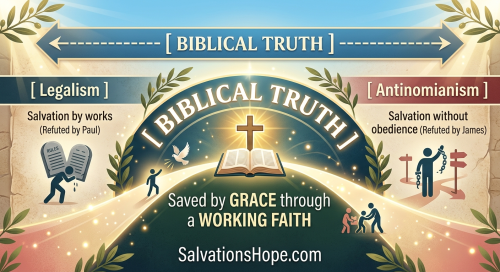
- Paul’s Emphasis: Works do not save you. Only Christ's merit saves.
- James’s Emphasis: Saved people manifest good works. A transformed life proves saving faith.
Both Apostles stand shoulder to shoulder in agreement: We are saved by grace alone through faith alone, but the faith that saves is never alone—it is an active, living faith.
Reflection & Discussion Questions:
Have you ever leaned too far toward legalism (trying to earn God’s favor) or cheap grace (professing faith without lifestyle change)?
In your own words, how would you explain the difference between doing good works to be saved versus doing good works because you are saved?
What is one practical way your faith can “go into action” in your community or church this week?
Living Faith Works: Right with God Through Active Faith
The Nature of Saving Faith
How are we made right with God? The consistent testimony of Holy Scripture is that we are saved by grace alone through faith alone in Jesus Christ alone. Yet, across church history, a crucial question arises: What kind of faith actually saves?
In James chapter 2, the apostle addresses a counterfeit form of faith—a passive, intellectual assent that produces no transformation. New Testament scholar Douglas Moo captures James’ core argument precisely:
” It is absolutely vital to understand that the main point here in James is not that works must be added to faith, but that genuine faith includes works.”
We do not say, “I am saved by faith plus the good things I do.” Rather, we proclaim, “I am saved by a living faith in Jesus Christ, and that genuine faith inevitably moves me to love God, obey His Word, and serve others.”
Living faith works. You are justified before God by a dynamic, active faith. To show this universal truth, James pairs two figures from opposite ends of the biblical narrative: a lofty patriarch and a lowly prostitute.
Two Witnesses: From the Patriarch to the Prostitute
If living faith were only for the religious elite, we might expect James to cite only spiritual giants. Instead, he sets two contrasting lives side by side to show that God’s salvation works the same way for all who believe.
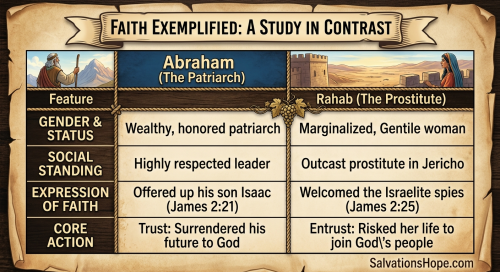
Feature
Abraham (The Patriarch)
Rahab (The Prostitute)
Gender & Status
Wealthy, honored patriarch
Marginalized, Gentile woman
Social Standing
Highly respected leader
Outcast prostitute in Jericho
Expression of Faith
Offered up his son Isaac (James 2:21)
Welcomed the Israelite spies (James 2:25)
Core Action
Trust: Surrendered his future to God
Entrust: Risked her life to join God’s people
Abraham: Trust That Sacrifices
Abraham is the father of faith. Yet Scripture records that Abraham was originally an idol worshiper in Ur of the Chaldees (Joshua 24:2). Even after God called him, Abraham repeatedly failed and sinned. He was not saved by a pristine life or merit he earned.
He was saved by grace through faith. As Hebrews 11 records:
- By faith Abraham obeyed when called to go to an unknown land (Heb. 11:8).
- By faith, he lived as a stranger in the land of promise (Heb. 11:9).
- By faith he offered up Isaac, trusting that God was able even to raise him from the dead (Heb. 11:17–19).
To ensure no one assumes this active faith belongs only to revered patriarchs, James introduces Rahab:
lodging to the spies and sent them off in a different direction?” — James 2:25
The Historical Narrative (Joshua 2 & 6)
- The Mission: Joshua sends two spies into Canaan to scout the fortified city of Jericho. They seek shelter at the house of Rahab, situated directly on the city wall.
- The Risk: When the King of Jericho discovers the spies, he demands their arrest. Rahab makes a decisive choice: she hides the spies under stalks of drying flax on her roof and redirects the king's soldiers elsewhere.
- The Confession: Rahab goes to the roof and utters a profound theological confession: "I know that the Lord has given you the land... for the Lord your God, He is God in heaven above and on the earth beneath" (Joshua 2:9, 11).
- The Covenant & Scarlet Cord: She requests mercy for her family. The spies instruct her to tie a scarlet cord in her window—a sign of protection. When Jericho’s walls collapse under God’s judgment, Rahab’s section of the wall stands firm, and her entire household is spared.
The Theological Fruit
Rahab didn’t just hold a mental belief that Israel’s God was powerful. She acted on it. She abandoned her pagan allegiance, risked her life, and cast her lot with God’s covenant people.
As a result, Rahab was not only rescued from physical judgment; she was incorporated into the assembly of Israel. She became the wife of Salmon, the mother of Boaz, an ancestor of King David, and ultimately part of the genealogy of Jesus Christ (Matthew 1:5).
What If Rahab Had Only Believed?
Consider a crucial logical question: What if Rahab had said, “I believe your God is the true God,” but refused to shelter the spies?
Would that be saving faith? Believing that God exists and that He is strong is necessary, but it is not saving on its own. Real faith caused Rahab to commit her destiny to the Lord. Had she kept her belief private and refused to act, her “faith” would have left her dead beneath the ruins of Jericho.
Hebrews 11:31 confirms this truth:
“By faith the prostitute Rahab, because she welcomed the spies, was not killed with those who were disobedient.”
Neither Abraham nor Rahab earned salvation by meritorious works. Both were sinners saved by grace through a living faith that went into action.
The Diagnosis: Dead Faith vs. Living Faith
James uses stark, uncompromising language to contrast dead orthodoxy with living faith:
- "What good is it, my brothers, if a man claims to have faith but has no deeds? Can such faith save him?" (James 2:14) — Answer: No.
- "Faith by itself, if it is not accompanied by deeds, is dead." (James 2:17)
- "Faith without deeds is useless." (James 2:20)
- "As the body without the spirit is dead, so faith without deeds is dead." (James 2:26)
Intellectual Assent vs. Saving Trust
James uses the illustration of a corpse. A body without a spirit is dead; it produces no breath, no movement, and no warmth. Likewise, a profession of faith that produces no love, obedience, or service is spiritually dead.
- Nice words cannot feed a hungry person (James 2:15–16). Words without action are useless.
- Correct doctrine alone cannot save. James notes that even the demons hold accurate theology: “You believe that there is one God. Good! Even the demons believe that—and shudder” (James 2:19). Demons know the truth about Jesus, but they possess no love, loyalty, or submission to Him.
Theoretical knowledge belongs in the head; saving faith takes root in the heart and transforms the life.
Whether you look at a patriarch like Abraham or an outcast like Rahab, God’s way of salvation has always been the same: redemption by grace through a living, active faith.
Take time to examine your heart before God today:
- Is your faith living or dead?
Is your relationship with Christ an active, trusting reliance, or merely a set of historical facts you agree with? - Are you resting in Christ’s finished work?
Do you count solely on Jesus’ blood and righteousness for your standing before God? - Does your faith move you to action?
Are you willing to obey God when it costs you something? Are you willing to risk your reputation, comfort, or status to align with Christ and His church, as Rahab did?
Prayer for a Living Faith
Heavenly Father, keep us from the delusion of a dead, passive faith. We confess that we are saved entirely by Your grace through faith in Your Son, Jesus Christ. We pray that You would grant us a vibrant, living faith—a faith that trusts Your promises, loves Your truth, obeys Your commands, and actively seeks the good of others. Where our hearts are cold, revive us by Your Holy Spirit. May our lives bring glory to Your holy name. In Jesus’ name, Amen.