
The Blunder of Pride
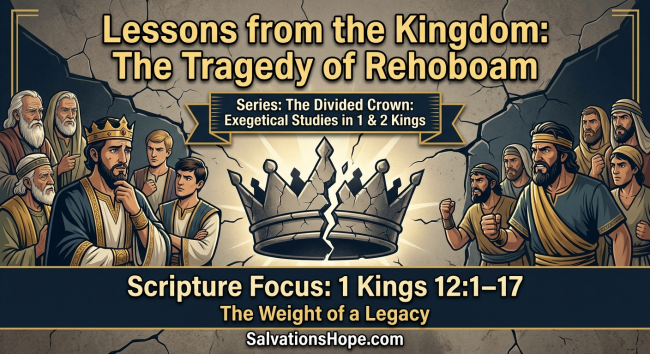
The Divided Crown
The Weight of a Legacy
Leadership transitions are rarely smooth, but few handoffs in biblical history were as momentous as the transfer of the throne from Solomon to his son Rehoboam. David and Solomon had built Israel into a unified regional powerhouse over eighty years. Under Solomon’s reign, Israel experienced unprecedented security, massive architecture, and economic expansion.
Yet, this golden age carried hidden costs. Centralized royal projects required heavy taxation, labor levies, and an expanding state apparatus. While the people tolerated these demands under Solomon’s recognized wisdom and God-given mandate, the burden created widespread economic exhaustion.
When Rehoboam stepped into power, he inherited a united nation at a critical crossroads. Public goodwill remained, but people sought relief. The central question facing the new king was not merely economic—it was theological: Would he lead as a servant under Yahweh, or attempt to rule as an autocrat?
The Request for Servant Leadership (1 Kings 12:1–5)
yoke on us, and we will serve you.” — 1 Kings 12:4
The Israelite delegation, led by Jeroboam, met Rehoboam at Shechem—a location deeply tied to covenant renewal in Israel’s history (Joshua 24). Their proposal was simple and fair: relieve the economic strain, and they would pledge unconditional loyalty.
Exegetically, the key term here is “yoke” (‘ōl in Hebrew). In the Old Testament, the yoke represents subjugation and servitude. While God raised up Solomon to build the Temple, his late-reign practices increasingly mirrored the oppressive structures of surrounding pagan nations rather than the covenant community outlined in Deuteronomy 17:14–20.
Rehoboam asked for three days to consider the petition (v. 5). While taking time to seek counsel seems wise on the surface, his later actions reveal a dangerous lack of spiritual discernment and pastoral concern for God’s people.
The Counsel of the Elders vs. The Culture of the Court (1 Kings 12:6–11)
To navigate the situation, Rehoboam sought input from two distinct groups of advisors:
The Wisdom of the Elders (vv. 6–7)
answer them, then they will be your servants forever.” (v. 7)
The older advisors, who had served under Solomon, understood a foundational covenant principle: true biblical authority is grounded in servanthood. Their advice echoed the heart of shepherd-leadership. By humbling himself to meet the flock’s legitimate needs, the king would secure their lasting loyalty.
The Arrogance of the Young Men (vv. 8–11)
“My little finger is thicker than my father’s thighs. And now, whereas my father laid on you a heavy yoke, I will add to your yoke…” (vv. 10–11)
Rehoboam rejected the wisdom of the mature statesmen and turned instead to his peers—young men raised in the isolation of royal privilege. Their strategy was built on fear, intimidation, and hyper-masculine bravado.
The phrase “I will discipline you with scorpions” refers to severe whips fitted with barbed metal ends. Culturally, this language signaled a shift from covenant care to outright despotism. Rehoboam chose self-exaltation over divine wisdom.
The Blunder of Pride
Rehoboam’s choice highlights several key theological and pastoral truths:
- The Trap of Echo Chambers: Rehoboam sought advisors who mirrored his own desires for power. Flattery and agreement were valued over truth and wisdom.
- Misunderstanding Biblical Authority: Biblical leadership in both the Old and New Testaments is defined by stewardship, not self-gratification (Mark 10:42–45). God grants authority to bless and protect the people, not to exploit them.
- Sovereignty Behind the Tragedy: Scripture notes that this turn of events was "a turn of affairs brought about by the LORD" (1 Kings 12:15) to fulfill the prophecy spoken against Solomon’s idolatry (1 Kings 11:29–39). Human pride and folly remained fully responsible for the choice, yet God accomplished his overarching purpose in judgment.
The Rupture of the Kingdom (1 Kings 12:12–17)
When Rehoboam spoke to the people with harshness and contempt, the response was swift and catastrophic:
“What portion have we in David? We have no inheritance in the son of Jesse. To your tents, O Israel!” (1 Kings 12:16)
In moments, eighty years of national unity dissolved. Ten northern tribes seceded, leaving Rehoboam with only Judah and small portions of Benjamin.
Rehoboam assumed his title guaranteed obedience. He failed to see that positional authority, without Godly character and servant-hearted ministry, inevitably leads to ruin.
The Root of Israel's Division
The narrative of 1 Kings 12 marks a critical turning point in Israel’s redemptive history. After Solomon’s long, prosperous reign, his son Rehoboam traveled to Shechem to be crowned king over a united Israel. However, the golden age of the united monarchy was already cracking because of Solomon’s late-life idolatry and heavy taxation (1 Kings 11:1–13).
When Rehoboam assumed office, he inherited a pivotal moment. The northern tribes, led by Jeroboam, approached the new ruler with a simple, reasonable request: lighten the harsh forced labor and tax burdens Solomon imposed, and they would faithfully serve him.
The Breakdown of Respect
At the core of Rehoboam’s downfall was a complete absence of respect across six critical areas:
- Respect for History: Rehoboam acted as though the struggles, covenants, and national heritage preceding his rise were irrelevant.
- Respect for His Predecessor: Rather than build on Solomon's diplomatic legacy, Rehoboam arrogantly sought to overshadow him.
- Respect for Seasoned Wisdom: He discarded the counsel of the elder statesmen who had served under Solomon, choosing the reckless advice of his young peers instead.
- Respect for the High Office: He viewed the throne not as a sacred stewardship, but as a platform for self-aggrandizement and unchecked authority.
- Respect for the Covenant People: Instead of shepherding the nation with care and justice, he viewed the citizens as subjects to be exploited.
- Respect for Yahweh: He failed to seek God’s direction, operating entirely out of personal ambition and human pride.
Because Rehoboam showed no respect for the people, his office, or his God, he forfeited the respect of the nation, directly provoking the division of Israel into two separate kingdoms.
The Heart of True Leadership
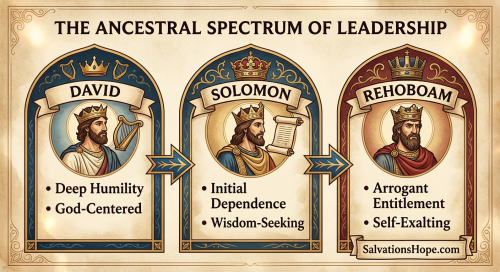
Scripture repeatedly highlights a sharp contrast between humble, God-fearing servant-leaders and self-absorbed tyrants. We see this contrast clearly when comparing Rehoboam with his predecessors, David and Solomon.
Ruler
Initial Heart Attitude
View of God and Israel
The Result
David
Humility & Gratitude
Viewed the kingship as an unmerited gift; acknowledged his own lowliness (2 Samuel 7:18).
God established an everlasting covenant with his house.
Solomon
Dependency & Reverence
Recognized his youth and inexperience; prayed for wisdom to govern God’s vast people (1 Kings 3:7–9).
God granted him unprecedented wisdom, honor, and wealth.
Rehoboam
Pride & Entitlement
Saw himself as superior to his predecessors; treated the populace as instruments for his own power (1 Kings 12:13–14).
The nation fractured, losing ten tribes to the Northern Kingdom.
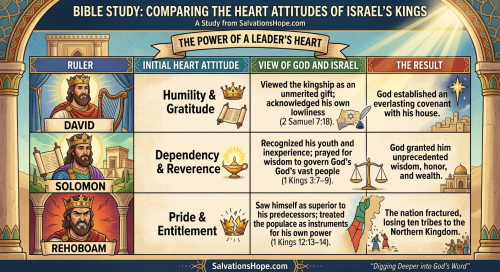
- David’s Posture: After receiving God’s covenant promises, King David sat before the Lord and asked, “Who am I, Sovereign Lord, and what is my family, that you have brought me this far?” (2 Samuel 7:18). He understood that the crown was a high calling, not a personal right.
- Solomon’s Posture: Early in his reign, Solomon acknowledged his insufficiency: “I am only a little child and do not know how to carry out my duties… So give your servant a discerning heart to govern your people” (1 Kings 3:7, 9). Solomon felt small, and God made his kingdom great.
- Rehoboam’s Posture: Rehoboam felt larger-than-life and treated an entire nation like small shoes to step on. He behaved like an overconfident rookie athlete who brags before accomplishing anything of real value. His hot air and bravado led directly to disaster.
Biblical Power Is Given for Service, Not Dominance
Scripture consistently turns worldly models of power upside down. As Jesus would later teach His disciples, “Whoever wants to become great among you must be your servant” (Mark 10:43). When leaders treat authority as a personal power trip rather than a sacred trust, division and resentment inevitably follow.
Pride Precedes the Fall
Rehoboam’s posture illustrates Proverbs 16:18: “Pride goes before destruction, a haughty spirit before a fall.” When we ignore history, reject the counsel of wise believers, and refuse to rely on the Lord, we set ourselves up for failure in our families, churches, and communities.
Dependency on God Is True Strength
The best leaders are not those who claim to have all the answers or who revel in the perks of authority. Spiritual leadership belongs to those who recognize their limitations and rely entirely on the grace, wisdom, and strength God provides.
Divine Sovereignty in the Division of the Kingdom
Beyond the Political Surface
“Now King Solomon loved many foreign women, along with the daughter of Pharaoh: Moabite, Ammonite, Edomite, Sidonian, and Hittite women, from the nations concerning which the Lord had said to the people of Israel, “You shall not enter into marriage with them, neither shall they with you, for surely they will turn away your heart after their gods.” Solomon clung to these in love. He had 700 wives, who were princesses, and 300 concubines. And his wives turned away his heart. For when Solomon was old his wives turned away his heart after other gods, and his heart was not wholly true to the Lord his God, as was the heart of David his father. For Solomon went after Ashtoreth the goddess of the Sidonians, and after Milcom the abomination of the Ammonites. So Solomon did what was evil in the sight of the Lord and did not wholly follow the Lord, as David his father had done. Then Solomon built a high place for Chemosh the abomination of Moab, and for Molech the abomination of the Ammonites, on the mountain east of Jerusalem. And so he did for all his foreign wives, who made offerings and sacrificed to their gods. And the Lord was angry with Solomon, because his heart had turned away from the Lord, the God of Israel, who had appeared to him twice 10 and had commanded him concerning this thing, that he should not go after other gods. But he did not keep what the Lord commanded. Therefore the Lord said to Solomon, “Since this has been your practice and you have not kept my covenant and my statutes that I have commanded you, I will surely tear the kingdom from you and will give it to your servant.” (1 Kings 11:1–11)
“ But I will take the kingdom out of his son’s hand and will give it to you, ten tribes. Yet to his son I will give one tribe, that David my servant may always have a lamp before me in Jerusalem, the city where I have chosen to put my name. And I will take you, and you shall reign over all that your soul desires, and you shall be king over Israel. And if you will listen to all that I command you, and will walk in my ways, and do what is right in my eyes by keeping my statutes and my commandments, as David my servant did, I will be with you and will build you a sure house, as I built for David, and I will give Israel to you.” (1 Kings 11:35–38)
“So the king did not listen to the people, for it was a turn of affairs brought about by the Lord that he might fulfill his word,
which the Lord spoke by Ahijah the Shilonite to Jeroboam the son of Nebat.” (1 Kings 12:15)
From a human vantage point, the narrative of Israel’s division seems to be a straightforward political tragedy: Solomon was brilliant, his son Rehoboam was foolish, and Jeroboam was a pragmatic leader who tapped into popular discontent over heavy taxation and centralized state power. When the ten northern tribes broke away from the Davidic monarchy to crown Jeroboam, human analysis might conclude that the people simply chose the better leader and made a clean break.
However, the inspired narrator of 1 Kings invites us to look deeper. History is not merely a sequence of political maneuvers or human errors. Scripture explicitly reveals the invisible Hand at work behind human events:
“So the king did not listen to the people, for this turn of events was from the Lord, that He might fulfill His word…” (1 Kings 12:15)
To understand the rupture of the monarchy, we must look beyond political foolishness and examine the theological reality behind the scenes: God’s sovereign administration of covenantal promises and covenantal warnings.
The Root of the Crisis: Covenant Unfaithfulness (1 Kings 11:1–8)
To understand the judgment, we must evaluate Solomon’s reign through the lens of God’s covenantal law.
At the beginning of his reign, Solomon demonstrated exemplary humility. When offered anything he wished, he asked for wisdom to govern God’s people righteously (1 Kings 3:7–9). His reign opened with prayer, wisdom, and the construction of the Temple in Jerusalem. Over time, however, Solomon’s heart drifted from devotion to political pragmatism and self-indulgence.
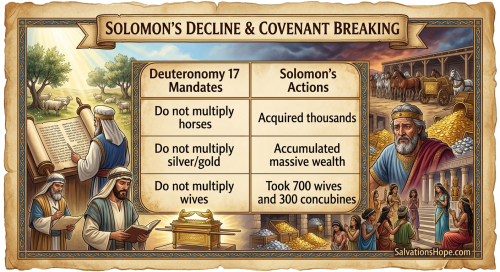
The author of Kings highlights how Solomon directly violated the royal prohibitions set forth in Deuteronomy 17:14–20:
“Now King Solomon loved many foreign women along with the daughter of Pharaoh: Moabite, Ammonite, Edomite, Sidonian, and Hittite women, from the nations concerning which the Lord had said to the sons of Israel, ‘You shall not associate with them, nor shall they associate with you, for they will surely turn your heart away after their gods.’ Solomon held fast to these in love.” (1 Kings 11:1–2)
Solomon’s foreign marriages were not merely personal moral failings; they were political alliances rooted in pagan compromise. What began as diplomatic syncretism—building high places for his foreign wives’ deities (1 Kings 11:7–8)—led to the compromise of Israel’s worship. Solomon did not outright deny the Lord; rather, he embraced religious pluralism, treating the God of Israel as merely one among many options.
The Divine Sentence: Promises and Threats Enforced (1 Kings 11:9–13)
God’s response to Solomon demonstrates both His absolute holiness and His unswerving faithfulness to His covenant with David.
“Therefore the Lord said to Solomon, ‘Because you have done this, and have not kept My covenant and My statutes, which I have commanded you, I will surely tear the kingdom from you, and will give it to your servant.'” (1 Kings 11:11)
In this sentence, two key theological principles operate simultaneously:
- Divine Retribution & Covenant Curse: Disobedience to God's law yields severe national consequences (cf. Deuteronomy 28).
- Covenantal Grace & Davidic Promise: God limits the immediate scope of the judgment out of fidelity to His covenant with David:
David and for the sake of Jerusalem which I have chosen.” (1 Kings 11:13)
The unconditional element of the Davidic Covenant (2 Samuel 7:12–16) ensured that the lamp of David would not be extinguished entirely, even when David’s descendants stumbled.
The Prophetic Mandate to Jeroboam (1 Kings 11:29–39)
Before the political division ever took place in the public square, God announced it through the prophet Ahijah the Shilonite. When Ahijah met Jeroboam in the field, he tore his new cloak into twelve pieces and offered ten to Jeroboam (1 Kings 11:30–31).
God’s offer to Jeroboam was generous and conditional:
“Then it shall be, if you listen to all that I command you and walk in My ways, and do what is right in My sight by observing My statutes and My commandments, as My servant David did, then I will be with you and build you an enduring house as I built for David, and I will give Israel to you.” (1 Kings 11:38)
When Rehoboam later acted recklessly, rejecting the elders’ counsel and threatening the northern tribes with heavier burdens (1 Kings 12:1–14), he was entirely responsible for his moral folly. Yet, Scripture frames this human stubbornness within divine providence: “the turn of events was from the Lord” (1 Kings 12:15).
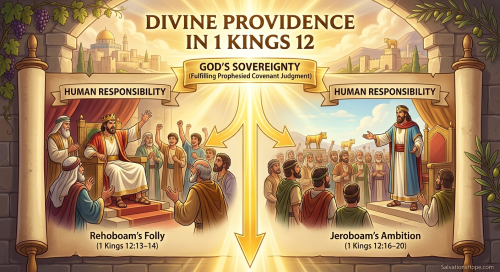
- The Dual Reality of Human Responsibility and Divine Sovereignty:
Rehoboam’s political foolishness was genuine and morally culpable, yet it served as the secondary means through which God executed His righteous decree. God orchestrates the flow of history without becoming the author of human sin. - The Illusion of Pure Political Solutions:
To the northern tribes, crowning Jeroboam seemed like a triumph for local governance and liberty. Yet human political restructuring apart from spiritual fidelity to God yields only temporary relief. Without underlying covenantal obedience, human systems inevitably fall into decay. - God’s Control Over Contemporary History:
The same Lord who governed the rise and division of ancient Israel remains active today. Behind national headlines, political shifts, and global instability, God works out His eternal decrees—disciplining rebellion, preserving a faithful remnant, and advancing His ultimate kingdom through Jesus Christ, the perfect Son of David.
Leaders We Deserve: When Political Convenience Replaces Covenant Fidelity
The Mirror of History
It is a common temptation in every era to attribute a nation’s spiritual and moral decay solely to the corruption of its leaders. We readily critique the thrones and parliaments while absolving the pews and the public square. Yet, divine narrative in Scripture presents a far more piercing reality: a culture often gets precisely the leaders its spiritual posture demands.
As we continue our study through 1 Kings, Israel’s political fracture after King Solomon’s reign offers a timeless theological lesson. Politicians are not the only ones who need to grasp the weight of 1 Kings 12—ordinary citizens must pay equal heed. While previous studies focused on Solomon’s tragic drift, Rehoboam’s foolish arrogance, and Jeroboam’s calculating ambition, we must now turn our attention to the unsung protagonist of this tragedy: the people of Israel.
The Burden of the Flesh, Not the Defilement of the Altar (1 Kings 12:1–5)
Following the death of Solomon, the assembly of Israel gathered at Shechem to negotiate terms with the young heir, Rehoboam:
his heavy yoke on us, and we will serve you.” (1 Kings 12:4)
Under Solomon, Israel experienced unprecedented architectural expansion and militarization. However, this required heavy taxation and conscripted labor (1 Kings 4:7–19; 5:13–18). The ten northern tribes felt the economic squeeze of a ballooning state apparatus and sought relief—demanding limited government, lower burdens, and greater local freedom.
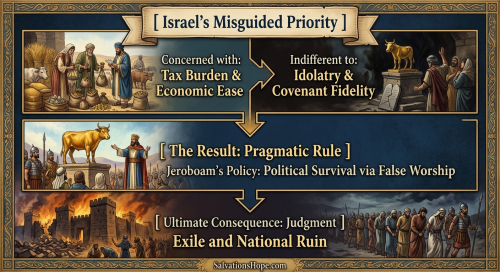
Notice what the people’s petition lacks. Solomon had committed egregious covenantal infidelity—marrying foreign wives, erecting high places for Chemosh and Molech, and introducing pagan idolatry into the heart of the covenant land (1 Kings 11:1–8). Yet the people offered no protest against these blasphemies. They complained bitterly about their taxes, but breathed not a word about the pagan altars. They demanded economic liberation, yet remained indifferent to spiritual purity.
The assembly viewed their national dilemma almost exclusively through a horizontal lens—focusing on political freedom and personal prosperity—while completely ignoring their vertical covenant with YHWH.
The Rise of Jeroboam: Pragmatism as Redemption (1 Kings 12:16–20)
When Rehoboam rejected wise counsel and threatened even greater tyranny, the northern tribes revolted and crowned Jeroboam, son of Nebat, king.
In Jeroboam, the people saw an ideal champion: a capable, self-made reformer ready to deliver them into a bright new era of economic ease and state sovereignty. Yet by choosing a leader based entirely on temporal promises and indifferent to God, Israel received a ruler who prioritized political survival over divine truth.
The Anatomy of Self-Made Religion
Taking Promises into Human Hands (1 Kings 11:37–38; 12:26–29)
God had previously sent the prophet Ahijah to Jeroboam with an explicit covenant promise:
and will build you a sure house, as I built for David.” (1 Kings 11:38)
Despite this divine guarantee, Jeroboam acted out of geopolitical anxiety rather than faith. Looking at the map, he reasoned:
people will turn again to their lord, to Rehoboam king of Judah…” (1 Kings 12:27)
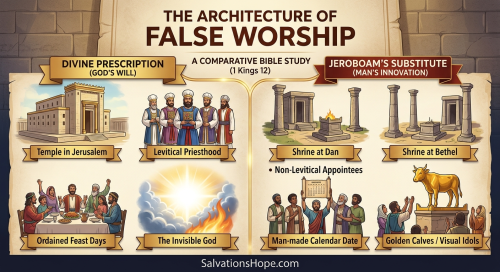
Rather than trusting YHWH to preserve his royal line, Jeroboam took matters into his own hands. He established rival religious sanctuaries at Bethel (in the south) and Dan (in the north), constructing two golden calves and proclaiming:
“It is too much for you to go up to Jerusalem. Behold your gods, O Israel, who brought you up out of the land of Egypt” (1 Kings 12:28).
The Mechanics of "Religion of Convenience"
Jeroboam’s state-sanctioned religion was a masterclass in political pragmatism. It flourished because it offered the people absolute convenience:
- Geographic Convenience: Citizens no longer needed to make the arduous pilgrimage up to Jerusalem. Local shrines were established near their backyards.
- Social Convenience: Jeroboam appointed non-Levitical priests from all classes, democratizing the priesthood to align with political favor rather than divine holiness (1 Kings 12:31).
- Calendar Convenience: He devised a feast on the fifteenth day of the eighth month—a feast of his own invention—to mirror and replace the prescribed feasts in Judah (1 Kings 12:32–33).
To the worldly mind, Jeroboam’s strategy was brilliant. It consolidated his power, stabilized his borders, and gave the public a user-friendly, low-demand spirituality. But Scripture records the true weight of his actions: “And this thing became a sin” (1 Kings 12:30).
The Consequences of Secularized Faith
Humanly devised religion promises liberty, but it delivers ruin. Jeroboam’s political maneuver provoked YHWH’s righteous anger. The judgment was both personal and corporate:
- Dynastic Annihilation: God pronounced the total destruction of the house of Jeroboam, cutting off his family line completely (1 Kings 14:10–11).
- National Dispersion: The ten northern tribes, having embraced state-sponsored idolatry, set off on an unyielding trajectory of spiritual decay. Centuries later, in 722 BC, Assyria invaded, dismantling the northern kingdom and dispersing the tribes into historical obscurity (2 Kings 17:21–23).
What appeared to be a pragmatic policy for national security became the precise instrument of their total destruction. This historical narrative serves as a diagnostic tool for the modern believer and the contemporary church.
The Trap of Moral Indifference
When Christians evaluate political, social, or personal life purely through economic output and individual liberty—while remaining indifferent to biblical holiness and truth—we invite spiritual decay. A society that prioritizes pocketbook issues over God’s righteous standards will inevitably produce leaders who put political survival above divine truth.
The Danger of "User-Friendly" Faith
Jeroboam’s idol worship succeeded because it catered to human ease. Whenever the church seeks to make worship more convenient by compromising God’s word, diluting His holiness, or substituting human wisdom for biblical command, it creates modern golden calves. Man-made religion may feel comfortable in the short term, but its end is spiritual death.
“There is a way that seems right to a man, but its end is the way to death.” (Proverbs 14:12)
The Folly of Human Rulers and the True Sovereign
The Distraction of Earthly Power
Every generation faces the temptation to mistake political systems for ultimate solutions. Whether debating the expansion or reduction of government authority, lower or higher taxes, or competing social philosophies, human history reveals a persistent truth: no political framework can resolve the spiritual condition of the human heart.
While civic stewardship and political discourse have their rightful place, Scripture consistently warns against prioritizing material systems over spiritual reality. When a culture elevated political strategy above allegiance to the living God, it inevitably reaped destruction.
In 1 Kings 11–12, the narrative of Israel’s division provides a sober warning regarding the limits of human leadership and the danger of heart-level idolatry.
The Fallibility of Human Kings: The Folly of Self-Reliance (Rehoboam)
In 1 Kings 12, Rehoboam succeeded his father, Solomon. Facing a kingdom weary from heavy labor and taxation, Rehoboam sought counsel from the elders who had served his father and from his younger peers.
who had grown up with him and stood before him.” (1 Kings 12:8)
Rehoboam’s primary failure was not merely rejecting the counsel of the elders; it was his complete failure to inquire of Yahweh. The narrative portrays a ruler operating entirely out of human arrogance. By ignoring God’s wisdom, Rehoboam’s pride precipitated the kingdom’s tragic division, leaving him with only two tribes (Judah and Benjamin).
The Peril of Heart Division (Solomon and Jeroboam)
Scripture contrasts Solomon’s and Jeroboam’s administrative approaches, yet both ultimately collapsed for the same fundamental reason: apostasy.
Characterized by centralized authority, expansive civil projects, and significant taxation. Despite his wisdom and initial devotion, 1 Kings 11 shows how his heart turned away toward idolatry through foreign wives (1 Kings 11:4). His political success could not shield the nation from divine judgment.
Raised up in opposition to Solomon’s heavy-handed administration, Jeroboam led the ten northern tribes. Yet, fearing his subjects would return to Jerusalem to worship, he set up golden calves at Dan and Bethel (1 Kings 12:28–30). His pragmatic attempt to secure political power through religious compromise brought immediate judgment upon his house.
Leader
Administrative Style
Spiritual Condition
Exegetical Outcome
Solomon
Centralized / Expanded Government
Heart turned after other gods (1 Kings 11:4)
Division of the Kingdom promised
Rehoboam
Authoritarian / Inexperienced
Failed to seek Yahweh (1 Kings 12:8)
Loss of 10 Tribes
Jeroboam
Decentralized / Pragmatic
Instituted state-sponsored idolatry (1 Kings 12:28)
Divine judgment on his line
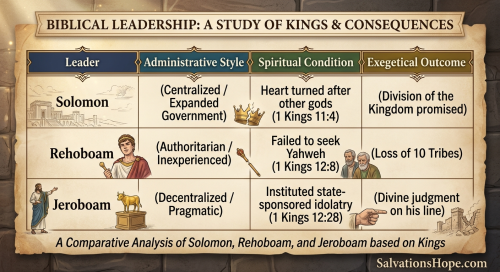
The biblical text demonstrates that whether governance leans toward heavy expansion or populist reform, administrative skill divorced from obedience to God leads to ruin.
The Idolatry of Princes
Throughout the Old Testament, the covenant people frequently placed their hope in human rulers rather than Yahweh. The Psalmist directly addresses this human tendency:
“It is better to take refuge in the Lord than to trust in princes.” (Psalm 118:9)
The Hebrew term for “princes” (nedivim) refers to nobles, rulers, or those in positions of political power. The text explicitly reminds the reader of human mortality and inability to provide ultimate salvation (teshu’ah).
When a society relies primarily on political candidates, economic platforms, or legislative agendas to secure its future, it elevates created institutions above the Creator—a foundational breach of the First Commandment.
Christological Fulfillment: The Greater King
God’s response to human failure in governance is not abandoning his people, but promising a perfect King. In the Gospel of Matthew, Jesus explicitly addresses his royal lineage and superiority over Israel’s historic monarchy.
“The queen of the South will rise up at the judgment with this generation and condemn it, for she came from the ends of the earth to hear the wisdom of Solomon, and behold, something greater than Solomon is here.” (Matthew 12:42)
Earthly Rulers vs. King Jesus
- Authority and Wisdom: While Rehoboam boasted without substance and Solomon’s wisdom was compromised by sin, Jesus possesses infinite wisdom and true righteousness.
- Method of Conquest: Earthly kings establish dominion through military force, economic leverage, or political maneuvering. Christ establishes his kingdom by laying down his life as a ransom for sin (Mark 10:45) and conquering death through his resurrection.
- Scope of Reign: Human kingdoms are temporal and geographically bound; the kingdom of Christ is eternal and encompasses every nation, tribe, and tongue (Revelation 11:15).
Jesus reigns as the true King of kings and Lord of lords (Revelation 19:16). He does not coerce heart allegiance through earthly policy, but transforms human hearts through grace, truth, and the indwelling of the Holy Spirit.
Pastoral Application & Reflection
- Examine Your Ultimate Trust
Where does your primary hope lie during political or economic uncertainty? While civic engagement is a biblical responsibility (Romans 13:1–7), our ultimate security rests in the sovereign governance of God. - Prioritize the Throne of the Heart
The trajectory of a nation is deeply connected to the spiritual state of its people. Earthly leaders come and go, but the vital question for every believer remains: Is Jesus actively reigning as Lord over your life, decisions, and priorities? - Commit to Prayer over Anxiety
Scripture instructs believers to pray for those in authority (1 Timothy 2:1–2). Rather than placing ultimate trust in human leaders or devolving into political despair, the church is called to intercede faithfully, recognizing that God holds the hearts of kings in his hand (Proverbs 21:1).
Politics as Usual and the Ultimate King
The Perennial Frustration with Political Rhetoric
During every major campaign season, voters find themselves weary of political hyperbole, mudslinging, and partisan posturing. If you evaluated politicians purely by their self-promotional rhetoric, they would seem flawless, selfless statesmen proposing perfect solutions. Conversely, listening to their opponents paints them as reckless opportunists whose policies threaten societal ruin. By Election Day, many Christians long for a return to what seems like a golden era—a time when public debate was supposedly dignified, noble, and focused purely on the common good.
However, Scripture directly cautions against this idealizing nostalgia. In Ecclesiastes 7:10, the Teacher writes:
“Do not say, ‘Why were the old days better than these?’ For it is not wise to ask such questions.”
Historical reflection confirms this biblical wisdom. Slanderous rhetoric and aggressive campaigning are not modern inventions; they have long characterized human governance.
Historical Context: Human Nature Across the Ages
Looking back at democratic history reveals that political discourse has frequently been harsh and partisan:
- The Early American Republic: Despite the shared bond of the Founding Fathers, the presidential elections of 1796 and 1800 between John Adams and Thomas Jefferson were marked by fierce personal accusations, warnings of moral collapse, and severe character attacks.
- The Antebellum Era: The election of 1828 between Andrew Jackson and John Quincy Adams featured intense personal attacks targeting family members, leading to profound emotional toll and distress.
- The Civil War Era: Abraham Lincoln was routinely maligned by political opponents and contemporary press with harsh caricatures and personal insults, despite his revered place in American history today.
- Modern Campaigning: The 19th and 20th centuries continued this trend, from baseless rumors regarding figures like Grover Cleveland to high-stakes political advertising during the Cold War era designed to exploit public fears.
Political strategy frequently shifts depending on immediate goals. Rivals often level harsh criticism during primary contests, only to offer lavish praise when forming a unified ticket later. Opposing economic or foreign policies are dismissed in one season, only to be adopted and defended in the next.
Why has political discourse so frequently appealed to conflict rather than elevated reasoning? Because human nature responds readily to emotion and fear. As Winston Churchill famously remarked regarding the limitations of electorate dynamics, democratic systems reflect the flaws of the humans who participate in them. Yet, despite these imperfections, democratic processes and free elections remain preferable to tyranny, where power is seized through violence rather than ballots.
The Promise of Micah 4:3
While human systems offer temporary order, Scripture directs our ultimate hope beyond earthly rulers. The prophet Micah provides a vision of true, lasting governance:
“He will judge between many peoples and will settle disputes for strong nations far and wide.” (Micah 4:3)
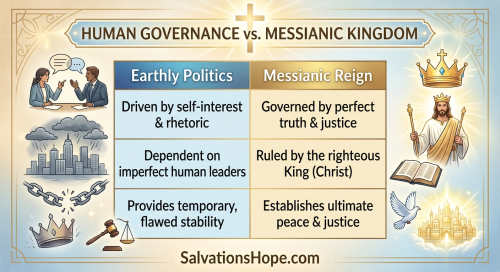
Micah prophesied during a period of severe social injustice, political corruption, and impending judgment for Judah and Israel. Leaders exploited the vulnerable, and judges accepted bribes. Amid human failure, God revealed a future restoration centered on the Messiah’s reign.
Human politicians rely on persuasion, political compromise, and emotional appeals because human wisdom is limited and corrupted by fallenness. By contrast, the Messiah judges with absolute righteousness and omniscient truth. He does not need to campaign, flatter, or malign others; His justice is pure and flawless.
Micah 4:3 continues by describing weapons of war being transformed into tools of cultivation—plowshares and pruning hooks. Earthly politics can restrain evil through laws and government structures, but it can never transform the human heart or bring ultimate global peace. True transformation comes only through the reign of Jesus Christ.
Theological Implications for Believers
- Guard Against Political Idolatry
Psalms warns us, “Do not put your trust in princes, in human beings, who cannot save” (Psalm 146:3). Government is an institution ordained by God to maintain order (Romans 13:1–7), but it is not the Savior. Expecting political parties to deliver spiritual redemption or perfect justice will always lead to disillusionment. - Engage with Stewardship and Gratitude
Even in flawed systems, Christians can be grateful for the freedom to participate, vote, and advocate for justice. Rather than withdrawing into cynicism or resorting to toxic discourse, believers are called to bring truth, gracious speech, and moral integrity into the public square (Colossians 4:6). - Anchor Hope in the Kingdom of God
Earthly campaigns and administrations come and go, but the Kingdom of God is eternal. Christians live as citizens of heaven while residing on earth (Philippians 3:20), recognizing that our ultimate peace rests in the return and reign of King Jesus.
Kingdom Ethics in Political Campaigns
The Ministry of Truth and Respect: Rejecting Malicious Speech
As believers navigate the noise and intensity of election seasons, it is easy to default to pragmatic standards—evaluating political strategies merely by whether they win votes, maintain status quo norms, or outperform authoritarian alternatives. However, Scripture calls on followers of Christ to be subject to every area of life, including political engagement, to the supreme authority of God’s Word.
For the Christian engaged in public life, the central question must not be, “Is this method effective?” but rather, “Does this conduct honor God?”
Modern political strategy often relies heavily on character assassination, misleading framing, and exaggerated attacks. Yet, an exegetical examination of biblical ethics reveals that God views truthfulness and respect as non-negotiable requirements for His people.
- Leviticus 19:16, 18 anchors public speech in covenant community ethics: “Do not go about spreading slander among your people… Love your neighbor as yourself.”
Old Testament law explicitly links slanderous speech to violating the command to love one’s neighbor. Distorting facts or circulating unverified rumors about a political opponent directly opposes God’s moral order. - Ephesians 4:25–31 highlights the spiritual weight of our words: “Get rid of all bitterness, rage and anger, brawling and slander, along with every form of malice.”
Paul warns that unwholesome speech grieves the Holy Spirit and gives the adversary a legal foothold in human relationships.
Theological Insight
Vigorous public debate and principled disagreement over policy are not inherently sinful; rigorous discourse is crucial for discernment in civic life. However, when campaigns descend into deception and malice, they create an atmosphere aligned with spiritual darkness. Conversely, political discourse characterized by truth, integrity, and respect creates space for genuine justice and public flourishing.
The Principle of Humility: Recognizing Human Limitations
A defining feature of contemporary campaigning is self-exaltation. Candidates frequently boast of past successes and make grandiose promises about future economic prosperity, taking personal credit for broad systemic shifts.
Scripture calls for a sober, humble assessment of human governance:
“Let another praise you, and not your own mouth; someone else, and not your own lips.” (Proverbs 27:2)
Political leaders often claim direct responsibility for economic growth or stability. Yet, macro-level economic outcomes depend on complex factors, market participation, and divine providence far beyond the direct control of an individual officeholder. Claiming total control over national outcomes is civic hubris. Scriptural wisdom encourages leaders to act with restraint, recognize the limits of their authority, and give honor where it is due.
Character over Wealth: The Illusion of Financial Power
Political systems frequently become dominated by financial elites, leading voters to wonder whether personal wealth and political connections have displaced character, wisdom, and moral integrity as primary qualifications for leadership.
“Better a poor man whose walk is blameless than a rich man whose ways are perverse.” (Proverbs 28:6)
“The rich rules over the poor, and the borrower is the slave of the lender.” (Proverbs 22:7)
“Bread is made for laughter, and wine gladdens life, and money answers everything.” (Ecclesiastes 10:19)
While wealth itself is not inherently sinful, Scripture warns repeatedly against the spiritual dangers of riches and the temptation to place ultimate trust in financial power.
When political platforms rely primarily on economic promises, tax concessions, or legislative giveaways to purchase public favor, they treat material wealth as the ultimate solution to human problems. Real political renewal cannot be achieved solely through legislative reforms or campaign finance laws; it requires faithful civic participation by individuals of genuine wisdom, humility, and moral integrity.
Biblical Standards of Governance and Justice
Scrutinizing modern political discourse through a biblical lens reveals a contrast between contemporary partisan platforms and Scriptural mandates for governance. Rather than reducing public policy to fiscal redistribution or party loyalty, Scripture defines authority’s purpose on two core pillars: integrity and justice.
- The Mandate of Justice: Biblically, government exists to restrain evil and protect the vulnerable (Romans 13:1–4). Justice (mishpat) requires defending those who cannot defend themselves (Psalm 82:3–4).
- The Primacy of Divine Institutions: Scripture establishes foundational institutions—chiefly marriage (Genesis 2:24) and the sanctity of human life (Genesis 1:27)—prior to the state. Civil authorities are tasked with preserving these structures rather than redefining or undermining them for political expediency.
Exegesis of Key Texts on Civil Authority and Human Life Proverbs 24:11–12
The Duty to Intervene for the Defenseless
“Rescue those who are being taken away to death; hold back those who are stumbling to the slaughter.
If you say, “Behold, we did not know this,” does not he who weighs the heart perceive it?
Does not he who keeps watch over your soul know it, and will he not repay man according to his work?” (Proverbs 24:11–12)
The imperative to deliver (hatzel) is an unconditional obligation to safeguard human life from unlawful destruction. Ignorance or political compromise offers no moral defense before God. When state policies permit the termination of unborn life, believers are called to advocate for legal protections that uphold the intrinsic value of every image-bearer (ImagoDei). Personal objection without public action fails the biblical standard of stewardship.
The Purpose of the Magistrate
“For rulers are not a terror to good conduct, but to bad… For he is God’s minister to you for good.” (Romans 13:3–4)
Civil rulers serve as divine agents (diakonos), accountable to God for executing justice. A government fulfills its divinely ordained role only when it protects the most basic human right: the right to life. Political agendas that accommodate or subsidize the destruction of embryonic and fetal life abandon this foundational civic duty.
Theological Assessment of Public Policy and Culture
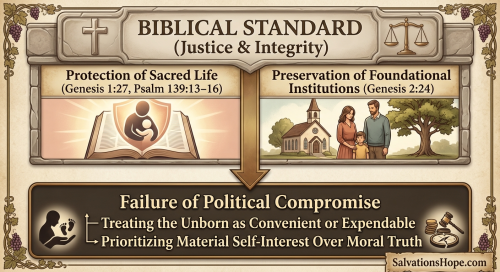
- The Imperative of Internal Consistency: Holding a personal conviction regarding the sanctity of life while supporting policies that enable its destruction creates a theological contradiction. True biblical conviction requires aligning public action with divine truth.
- Cultivating a Culture of Life: A society that prioritizes personal convenience, financial comfort, or career continuity over the preservation of human life reflects a profound moral collapse. Believers are called to reject self-interested voting patterns, praying and advocating instead for leaders who uphold righteousness, protect the helpless, and honor God’s design for human flourishing (Micah 6:8).
The Limits of Human Governance & The Eternal Kingdom
The Limits of Earthly Power vs. The Mission of the Church
Political systems are inherently derivative; human legislation reflects a culture’s moral fabric rather than creating it. Scripture establishes that civil authority can restrain outward evil and promote civic order (Romans 13:1–4), but it lacks the divine capacity to transform the human heart (Ezekiel 36:26).
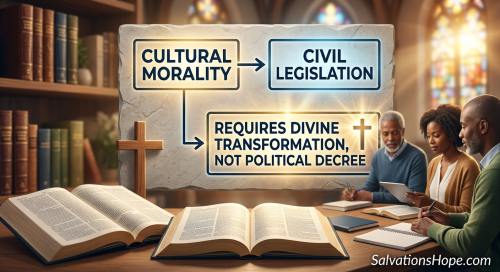
The Power of the Gospel and Spiritual Resilience
Spiritual conversion precedes lasting cultural change. The Church’s mandate is not dependence on state enforcement, but faithful witness to divine truth regardless of regime hostility (Acts 5:29). Historical Christianity flourished under adverse political powers without reliance on civil decrees. Biblical covenantal structures—such as marriage and the family—derive their validity directly from God (Genesis 2:24), independent of state authority. Panicked reliance on political victory betrays a misunderstanding of kingdom power.
Exegesis of Micah 4:2–4 & Isaiah 2:2–4: Escatological Peace
Human effort cannot construct an ultimate utopia. Scripture frames global peace and the eradication of poverty not as political achievements, but as Christ’s eschatological work upon His return.
Text
Exegetical Principle
Application
Micah 4:2
“The law will go out from Zion”
Universal righteousness stems from divine instruction, not human policy.
Micah 4:3
“They will beat their swords into plowshares”
Ultimate disarmament and geopolitical peace are executed solely by Christ’s judgment.
Micah 4:4
“Every man will sit under his own vine”
True security and flourishing proceed from God’s kingdom covenant, freeing believers from cynicism.
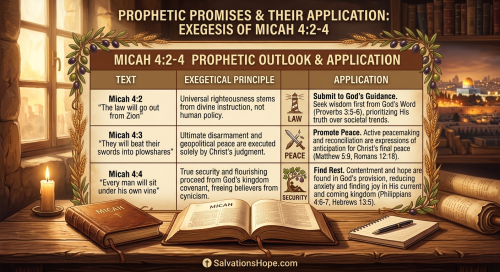
many peoples and settle disputes for strong nations far and wide.” (Micah 4:2–3)
Active Christian Citizenship as Kingdom Ambassadorship
Believers operate as an “advance team” for Christ’s coming reign. Waiting for His return does not justify passivity; it demands active, kingdom-aligned stewardship.
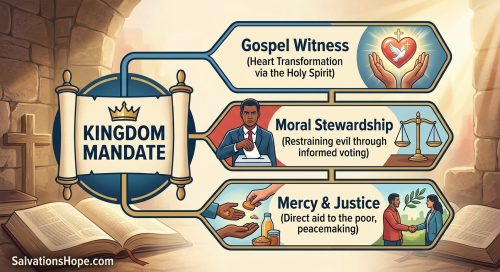
- Personal Mercy over Systemic Reliance: Directly alleviate poverty and protect life using personal and ecclesiastical resources, while advocating for societal justice (James 1:27).
- Pragmatic Stewardship: Engage the electoral process to support candidates who restrain moral decline, recognizing political action as a secondary instrument under God’s sovereignty.
- Unceasing Prayer: Intercede continually for political leaders (1 Timothy 2:1–2), the salvation of souls, and the return of Christ to establish His eternal reign.
Questions to Consider:
- In what areas of life (work, ministry, family) are you tempted to rely on your own confidence rather than seeking wise counsel and praying for divine wisdom?
- How can we cultivate a heart of humble gratitude like David when God places us in positions of influence or responsibility?
- What steps can we take in our daily spiritual walks to ensure we treat others with Christlike respect and service?
- In what subtle ways can personal or political priorities challenge Christ’s supreme authority in our lives?
- How does understanding God’s ultimate sovereignty over world events comfort you when political environments feel unstable or uncertain?
- In what ways are we prone to evaluate leaders (or our own life decisions) solely by material or pragmatic standards rather than spiritual ones?
- Where do you see the subtle temptation of a “religion of convenience” in modern culture and worship practices today?
- When faced with pressure or uncertainty, how can we avoid “taking matters into our own hands” like Jeroboam, and instead rest in God’s promises?
- Read 1 Kings 12:1–16. What specific warning does Rehoboam’s decision-making process offer regarding how we seek counsel today?
- In what ways can good political or social goals subtly become idols in the life of a Christian?
- Read Psalm 146. How does meditating on God’s sovereignty change your perspective on current national and global events?
- In what ways can we guard our hearts against political hostility while remaining faithfully engaged as citizens?
- How does understanding the prophetic promise of Micah 4:3 change your perspective on current political events?
- What steps can you take this week to ensure your primary hope remains anchored in the Kingdom of Christ rather than earthly institutions?
- How can Christian political activists ensure that their campaign methods reflect biblical truthfulness rather than pragmatic polarization?
- What is the practical difference between robust policy debate and malicious slander in public discourse?
- What concrete steps can churches take to encourage believers from ordinary backgrounds to pursue public service based on wisdom and godly character?