
Politics of Envy

Excellence, Envy, and Integrity
The Peril of Excellence in a Fallen World
Human experience teaches a bitter paradox: success is often unsafe. From childhood playground rivalries to high-stakes politics in modern corporate boardrooms, excellence often breeds resentment rather than admiration. When peers cannot or will not raise their own standards, they often drag high achievers down.
This dynamic is not merely a modern sociological phenomenon; it is a profound spiritual reality rooted in a fallen world. For the Christian navigating a hostile workplace or secular culture, striving for excellence with integrity often makes them a target.
This tension finds its ultimate biblical illustration in Daniel’s life. As we examine Daniel 6, we discover that godly character does not immunize a believer against human envy—in fact, it often intensifies it. Yet the narrative also shows how God vindicates those who remain steadfast in faithfulness, proving that even a den of lions is safer under God’s sovereignty than a workplace ruled by malice.
To understand Daniel’s ordeal, we must examine the historical and theological setting of Daniel 6.
- The Historical Setting: The Persian Empire under King Darius has recently conquered Babylon. To govern efficiently, Darius appoints 120 satraps, overseen by three administrators, with Daniel first among them (Daniel 6:1–2).
- The Root Cause (Excellence): Daniel distinguished himself above the other administrators and satraps because an excellent spirit was in him (Daniel 6:3). King Darius even planned to set him over the whole kingdom.
- The Human Response (Envy and Conspiracy): Instead of celebrating Daniel's competence and integrity, his peers sought grounds to accuse him. Crucially, Scripture notes: "They could find no ground for complaint or any fault, because he was faithful, and no error or fault was found in him" (Daniel 6:4).
Integrity as an Indictment
In a corrupt administration, Daniel’s flawless work ethic and absolute honesty were not viewed as assets; they were perceived as an existential threat. Envy drives insecure, corrupt people to destroy what they cannot match. Because Daniel could not be discredited professionally, his rivals realized they had to target his devotion to God:
“Then the men said, ‘We shall not find any ground for complaint against this Daniel unless we find it in connection with the law of his God'” (Daniel 6:5).
The Trap of Compromise
Daniel’s adversaries manipulated King Darius into signing an irrevocable decree: anyone who prays to any god or man other than the king for thirty days shall be thrown into the den of lions (Daniel 6:7). For Daniel, the choice was stark. Compliance meant safety, career advancement, and peace with his peers. Refusal meant a brutal death.
Daniel’s story offers three vital theological truths for believers facing opposition, envy, and backstabbing in their daily vocations.
Godly Excellence Provokes Spiritual Opposition
The world often rewards mediocrity and tolerates compromise, but uncompromising righteousness exposes the darkness around it. Jesus warned His disciples that the world would hate them because it hated Him, not because they did evil, but because their lives exposed evil (John 7:7, 15:18–19). When you refuse to cut corners, engage in office gossip, or compromise your ethics, your very presence becomes a living rebuke to others. Expect resistance when you live out a standard of biblical excellence.
Faithful Routine Defeats Fearful Pressure
How did Daniel respond to the death decree?
“When Daniel knew that the document had been signed, he went to his house where he had windows in his upper chamber open toward Jerusalem. He got down on his knees three times a day and prayed and gave thanks before his God, as he had done previously” (Daniel 6:10)
Daniel did not panic, riot, or scheme. Decisively, he did not change his routine. His private devotion to God was so deeply ingrained that public threats could not alter it. When workplace pressures mount, our anchor must not be defensive strategy, but steady, disciplined communion with God.
God's Sovereignty Overrules Human Malice
Daniel was ultimately cast into the lions’ den. From a human perspective, envy had won. But God intervened: “My God sent his angel and shut the lions’ mouths, and they have not harmed me, because I was found blameless before him” (Daniel 6:22).
The text highlights a profound reversal: Daniel’s accusers, along with their families, met the very fate they intended for him (Daniel 6:24). God proved that you are safer in a den of lions in the center of God’s will than you are sitting comfortably among envious conspirators outside of it.
Workplace life can be exhausting, hurtful, and intimidating. When dishonest peers sabotage your hard work or punish your honesty, it is easy to grow cynical or compromise just to fit in.
Yet, Daniel’s story calls us to a higher standard. We are called to work not merely for human bosses, but as unto the Lord (Colossians 3:23). Even if human peers resent your success, God sees your integrity. Stand firm, maintain your character, and trust that the God who shut the mouths of the lions is still sovereign over every boardroom, office, and classroom today.
Faithfulness Amid Political Hostility
“It pleased Darius to set over the kingdom 120 satraps, to be throughout the whole kingdom; and over them three high officials, of whom Daniel was one, to whom these satraps should give account, so that the king might suffer no loss. Then this Daniel became distinguished above all the other high officials and satraps, because an excellent spirit was in him. And the king planned to set him over the whole kingdom. Then the high officials and the satraps sought to find a ground for complaint against Daniel with regard to the kingdom, but they could find no ground for complaint or any fault, because he was faithful, and no error or fault was found in him. Then these men said, “We shall not find any ground for complaint against this Daniel unless we find it in connection with the law of his God.” Then these high officials and satraps came by agreement to the king and said to him, “O King Darius, live forever! All the high officials of the kingdom, the prefects and the satraps, the counselors and the governors are agreed that the king should establish an ordinance and enforce an injunction, that whoever makes petition to any god or man for thirty days, except to you, O king, shall be cast into the den of lions. Now, O king, establish the injunction and sign the document, so that it cannot be changed, according to the law of the Medes and the Persians, which cannot be revoked.” Therefore King Darius signed the document and injunction.” (Daniel 6:1–9)
Daniel 6 presents one of the most remarkable examples of uncompromising integrity in holy Scripture. Placed in a high-ranking executive position within an ungodly empire, Daniel demonstrates how a follower of God ought to conduct themselves in the public sphere. However, as Daniel’s godliness and exceptional competence bring him prominence, they simultaneously attract intense hostility.
This passage reveals the recurring biblical motif of spiritual and cultural opposition God’s people face—a reality in which corrupt systems and envious rivals act as “prowling predators” against those who walk in unyielding allegiance to God.
Position, Distinction, and Administrative Oversight (Dan 6:1–3)
After Babylon fell, King Darius established a decentralized governance structure with 120 satraps overseen by three chief administrators (or commissioners). Daniel, an exiled Judean devoutly committed to Yahweh, was named one of these top three executives.
exceptional qualities that the king planned to set him over the whole kingdom.” (Daniel 6:3)
The phrase translated as “exceptional qualities” (or “an extraordinary spirit,” Aramaic: rūaḥ yattīrā) highlights that Daniel’s excellence was not purely administrative skill or strategic brilliance, but an inward spiritual quality granted by God. His flawless stewardship protected the state from financial loss and corruption, leading Darius to consider elevating Daniel over the entire realm.

Integrity Under the Microscope (Dan 6:4–5)
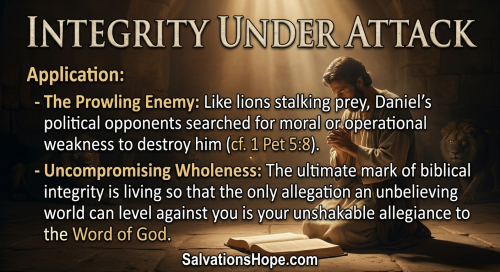
When Daniel was set for promotion, the political establishment reacted with jealousy and malice. The administrators and satraps meticulously investigated Daniel’s personal and professional life to uncover negligence, bribery, or moral scandal.
“They could find no corruption in him, because he was trustworthy and neither corrupt nor negligent. Finally, these men said, ‘We will never find any basis for charges against this man Daniel unless it has something to do with the law of his God.’” (Daniel 6:4–5)
The Aramaic terms emphasize two critical traits:
- Trustworthiness (amīn): Faithful, reliable, and loyal.
- Freedom from Negligence (šālū): Free from carelessness or incompetence.
Finding no flaw in his public stewardship, his enemies recognized that the only way to ensnare Daniel was to create an inescapable conflict between the civic law of the Persian Empire and the divine law of God (dāṯ ‘ělāhēh).
Egotism, Deception, and the Deification of the State (Dan 6:6–9)
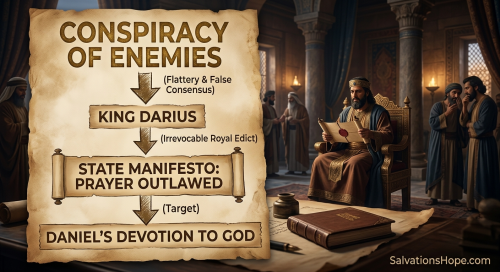
Knowing the king’s prideful vulnerability, the officials approached Darius under the guise of civic unity and loyalty. They proposed an imperial decree (qěyām): for thirty days, no one could petition any god or human except King Darius himself. Anyone violating the decree would be thrown into the lions’ den.
“’Now, Your Majesty, issue the decree and put it in writing so that it cannot be altered—in accordance with the law of the Medes and Persians, which cannot be repealed.’ So King Darius put the decree in writing.” (Daniel 6:8–9)
The officials falsely claimed that all the chief administrators agreed to this—a conspiracy built on deceit, as Daniel was clearly excluded from this counsel. By elevating the monarch as the sole mediator of prayer and favor, the decree functionally deified state authority and outlawed true worship.
- The Idolatry of the State: When government positions itself as the supreme authority over conscience and faith, it usurps the divine order. The decree sought to eliminate allegiance to Yahweh and replace it with total reliance on the state.
- Flattery as a Weapon: The enemy often uses ego and moral-relativistic flattery to build systems hostile to righteous living.
Key Takeaways for Today’s Believer
- Conduct Above Reproach: In an era prone to corporate and political corruption, Christians are called to demonstrate impeccable honesty and diligence, so that critics have no legitimate grounds for accusation (Phil 2:14–15).
- Anticipate Opposition to Godliness: Living righteously will not always earn the world’s favor; often, genuine godliness exposes surrounding corruption, triggering resentment and envy.
- God’s Sovereignty Over Human Schemes: Though wicked men scheme in secret, the sovereign God of Israel remains on His throne. Human laws and political decrees can never override the eternal authority of God’s Kingdom.
Labor Among Lions
Faithfulness, Spiritual Integrity, and God’s Sovereignty in Hostile Environments
“Now when Daniel learned that the decree had been published, he went home to his upstairs room where the windows opened toward Jerusalem. Three times a day he got down on his knees and prayed, giving thanks to his God, just as he had done before. Then these men went as a group and found Daniel praying and asking God for help. So they went to the king and spoke to him about his royal decree: “Did you not publish a decree that during the next thirty days anyone who prays to any god or human being except to you, Your Majesty, would be thrown into the lions’ den?” The king answered, “The decree stands—in accordance with the law of the Medes and Persians, which cannot be repealed.” Then they said to the king, “Daniel, who is one of the exiles from Judah, pays no attention to you, Your Majesty, or to the decree you put in writing. He still prays three times a day.” When the king heard this, he was greatly distressed; he was determined to rescue Daniel and made every effort until sundown to save him. Then the men went as a group to King Darius and said to him, “Remember, Your Majesty, that according to the law of the Medes and Persians no decree or edict that the king issues can be changed.” So the king gave the order, and they brought Daniel and threw him into the lions’ den. The king said to Daniel, “May your God, whom you serve continually, rescue you!” A stone was brought and placed over the mouth of the den, and the king sealed it with his own signet ring and with the rings of his nobles, so that Daniel’s situation might not be changed. Then the king returned to his palace and spent the night without eating and without any entertainment being brought to him. And he could not sleep. At the first light of dawn, the king got up and hurried to the lions’ den. When he came near the den, he called to Daniel in an anguished voice, “Daniel, servant of the living God, has your God, whom you serve continually, been able to rescue you from the lions?” Daniel answered, “May the king live forever! My God sent his angel, and he shut the mouths of the lions. They have not hurt me, because I was found innocent in his sight. Nor have I ever done any wrong before you, Your Majesty.” The king was overjoyed and gave orders to lift Daniel out of the den. And when Daniel was lifted from the den, no wound was found on him, because he had trusted in his God. At the king’s command, the men who had falsely accused Daniel were brought in and thrown into the lions’ den, along with their wives and children. And before they reached the floor of the den, the lions overpowered them and crushed all their bones.” (Daniel 6:10–24)
The Hostile Work Environment
Every day, Christian believers carry out their callings in environments indifferent to, or openly hostile to, the Gospel. As pressure builds, the temptation to compromise, hide, or alter our spiritual walk can feel overwhelming.
Daniel 6 offers a timeless study in spiritual integrity under pressure. A change in imperial policy suddenly made standard corporate advancement conflict with absolute devotion to God. The narrative shows how Daniel responded when his daily obedience to God was declared illegal, delivering a profound roadmap for believers navigating difficult workplaces today.
The Context of the Decree
King Darius issued a royal edict: for thirty days, no one could petition any god or human except the king, or face death in the lions’ den. Envious high officials engineered the law specifically to trap Daniel, whose exceptional integrity and work ethic left him faultless in his duties (Dan. 6:4–5).
- Unwavering Spiritual Rhythm (v. 10):
“When Daniel learned the decree had been published, he went home to his upstairs room, where the windows opened to Jerusalem. Three times a day he got down on his knees and prayed, giving thanks to his God, just as he had done before.”
Daniel did not act out of defiance toward Darius, but out of supreme allegiance to God. Notice three key elements of his prayer pattern:
- Direction toward Jerusalem: Grounded in Solomon’s prayer at the dedication of the Temple (1 Kings 8:46–52), acknowledging God’s covenant promises even in exile.
- Posture of Humility: Kneeling reflected dependence, reverence, and submission to the King of Kings rather than to imperial decree.
- Posture of Gratitude: He gave thanks despite mortal danger, showing that his peace rested on God’s sovereignty rather than earthly security.
- Imperial Impotence vs. Divine Power (vv. 11–18):
Darius was deeply distressed and spent all day trying to rescue Daniel, yet the rigid “law of the Medes and Persians” (v. 14–15) bound his royal power. Human rulers, even at the peak of earthly dominion, face distinct limitations. In contrast, God’s power operates outside human systems and constraints.
- Vindication and Covenant Protection (vv. 19–23):
“My God sent his angel, and he shut the mouths of the lions. They have not hurt me, because I was found innocent in his sight.” (v. 22)
Daniel’s deliverance was an unmistakable act of God. The text specifically highlights that Daniel was unharmed “because he trusted in his God” (v. 23). God vindicated His servant not because Daniel had political power, but because he maintained faith.
- Refuting the Skeptics (v. 24):
The immediate destruction of Daniel’s accusers demonstrates that the lions were neither pacified nor full. This detail undergirds the historical reality of the divine miracle: God neutralized the threat exclusively for His faithful servant.
Dealing with a Hostile Workplace
Based on Daniel’s conduct and God’s intervention in Daniel 6, here are four biblical principles for believers working in challenging or anti-Christian environments:
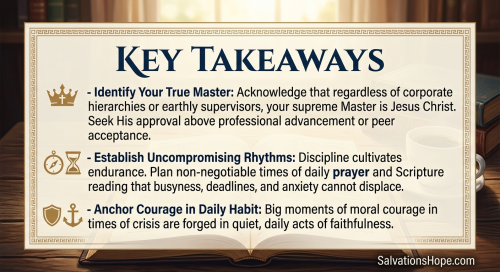
Establish an Unshakeable Spiritual Discipline: Daniel’s spiritual strength during the crisis came directly from his routine before it. He prayed three times daily, “just as he had done before” (Dan. 6:10).
Cultivate Impeccable Professional Integrity: The administrators could find no corruption or negligence in Daniel’s work (Dan. 6:4). His enemies had to target his faith because his professional record was blameless.
Maintain Absolute Allegiance to God Over Human Systems: When forced to choose between divine commandment and human mandate, Daniel chose obedience to God (cf. Acts 5:29). He did so without arrogance, political maneuvering, or public outrage, relying entirely on God’s justice.
Trust in God’s Vindication and Deliverance: Daniel did not attempt to rescue himself or retaliate against his conspirators. He committed his spirit to the Lord and allowed God to fight his battle.
Application: Your public endurance in times of trial depends on your private habits of prayer and Word study. Do not wait for workplace pressure to build before establishing a steady devotional life. Excellence in your career is a powerful witness. Ensure that your work ethic, honesty, and diligence leave no room for valid criticism from superiors or colleagues. Respect authority and obey company policies whenever possible (Rom. 13:1). However, when workplace culture or policies demand moral compromise or faith denial, your primary allegiance must remain with Christ. When falsely accused or targeted for your beliefs, avoid reacting out of bitterness or malice. God sees your faithfulness and remains sovereign over every workplace dynamic, trial, and outcome.
Reflection
Working “among lions” is rarely easy, but Daniel’s life shows that unwavering faith in a sovereign God turns places of trial into monuments to His power. When we establish daily spiritual routines, work with uncompromised integrity, and entrust our safety to God, He receives glory through our perseverance.
Covenant Fidelity and Divine Sovereignty in Exile
“But Daniel resolved that he would not defile himself with the king’s food, or with the wine that he drank.” — Daniel 1:8a
To rightly divide the Book of Daniel, we must observe both its historical setting and its primary theological focus.
- Historical Context (605 B.C.)
The narrative opens during the first Babylonian deportation under King Nebuchadnezzar. Yahweh’s permissive sovereignty brought judgment on Judah for covenant unfaithfulness (Daniel 1:1–2; cf. 2 Kings 24:1–4). The Babylonians forcibly removed Daniel and his companions, young Judean nobles, from Jerusalem.
- Cultural Assimilation Strategy
The Babylonians used systemic re-education: they changed their names (tying them to pagan deities), taught them Chaldean literature and language, and fed them from the king’s table (Daniel 1:3–7). The aim was complete worldview indoctrination and a shift of allegiance.
- Genre
Narrative theology integrated with apocalyptic literature. Daniel shows how God’s covenant people should live faithfully under pagan rule while awaiting God’s ultimate reign.
The Conflict Over the Royal Food (Daniel 1:8–16)
The Hebrew term gā’al (“defile”) in verse 8 reveals the issue wasn’t merely dietary preference, but covenantal loyalty. The royal provisions likely violated Levitical food laws regarding unclean animals and improper slaughtering practices (Leviticus 11; Deuteronomy 14).
The king’s court routinely offered portions of the food and wine to Babylonian idols (such as Bel-Marduk) before consumption. Participation signified communion with pagan deities. In the ancient Near East, eating at the king’s table implied covenantal dependency and ultimate allegiance to the earthly monarch rather than Yahweh.
Daniel “purposed in his heart” (śām ‘al-lēb). In Hebrew anthropology, the heart (lēb) is the center of intellect, volition, and moral commitment. Daniel’s refusal was a proactive theological choice, not a reactive impulse.
Divine Intervention and Favor (Daniel 1:9, 17)
- God’s Sovereignty: In Daniel 1:9, Scripture notes that "God gave Daniel favor and compassion" in the sight of the chief eunuch. Divine grace accompanied human wisdom.
- Vindication: The 10-day trial of pulse (legumes/vegetables) and water showed that physical strength and intellect depend not on pagan indulgence but on divine providence (Daniel 1:15). God blessed their obedience by granting them superior wisdom and skill (Daniel 1:17).
Lifelong Sanctification and Uncompromising Integrity (Daniel 6)
The principle established in Daniel’s youth bore fruit throughout his entire life:
Integrity under Scrutiny: Over sixty years later, under Persian rule, Daniel’s political rivals sought grounds to complain about his administration. Daniel 6:4 records that “they could find no ground for complaint or any fault, because he was faithful.”
Rhythm of Faithfulness: When King Darius issued an irrevocable decree prohibiting prayer to any god or man except himself, Daniel maintained his established habit: praying toward Jerusalem three times a day with his windows open (Daniel 6:10). His public fidelity was the direct result of decades of private devotion.
Theological Synthesis
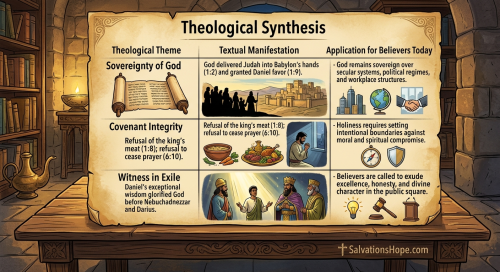
Theological Theme
Textual Manifestation
Application for Believers Today
Sovereignty of God
God delivered Judah into Babylon’s hands (1:2) and granted Daniel favor (1:9).
God remains sovereign over secular systems, political regimes, and workplace structures.
Covenant Integrity
Refusal of the king’s meat (1:8); refusal to cease prayer (6:10).
Holiness requires setting intentional boundaries against moral and spiritual compromise.
Witness in Exile
Daniel’s exceptional wisdom glorified God before Nebuchadnezzar and Darius.
Believers are called to exude excellence, honesty, and divine character in the public square.
Resisting Modern Cultural Assimilation
The narrative of Daniel serves as a blueprint for Christian living in a post-Christian culture (cf. 1 Peter 2:11–12).
- In Academics & Culture: Students and young adults face intense pressures to conform to modern secular ideologies, systemic immorality, and intellectual anti-Christian bias. Resisting defilement begins with a heart's resolve before temptation.
- In the Workplace: Professional environments often tempt believers to sacrifice ethical integrity for promotion—whether through deception, compromising the Sabbath/worship, or dishonest reporting.
Developing Early Habits of Holiness
Spiritual firmness in crisis is built through daily, quiet obedience. Daniel’s conviction before the lions in Daniel 6 was forged when he turned down the royal diet in Daniel 1. Convictions established in youth become the anchor of moral character in old age.

Faithful Excellence in Exile
To understand Daniel’s life, we must look beyond his personal accomplishments and see God’s hand at work amid a harsh historical reality. In 605 BC, Nebuchadnezzar, King of Babylon, besieged Jerusalem. Daniel and other noble-born youths were uprooted from their families and homeland and taken into exile in Babylon. They were part of a displaced, conquered people living under an imperial superpower.
The Babylonians pursued aggressive re-education. The Babylonians gave foreign captives new names honoring Babylonian deities, taught them the literature and language of the Chaldeans, and fed them from the royal table (Daniel 1:3–7). The goal was complete cultural and spiritual indoctrination.
On a human level, Daniel had every reason to adopt a victim mindset. He faced forced relocation, cultural isolation, and direct threats to his covenant faith. Yet the author of Daniel makes a vital theological point in Daniel 1:17: “To these four young men God gave knowledge and understanding of all kinds of literature and learning.”
Daniel’s wisdom came not from royal training or personal grit, but from divine grace. God matched Daniel’s commitment to holy living (Daniel 1:8) with sovereign empowerment.
Excellence Across a Lifetime
When tested in his youth, Daniel chose not to compromise his devotion to God. However, his faith did not lead to withdrawal from secular learning. Instead, Daniel engaged rigorously with his host culture’s literature and science without absorbing its pagan worldview.
When King Nebuchadnezzar examined Daniel and his companions, he found them “ten times better than all the magicians and enchanters in his whole kingdom” (Daniel 1:20). Daniel pursued academic and administrative excellence as a primary way to witness Yahweh’s supreme authority.
Decades later, the Medo-Persian Empire conquered Babylon. Regimes shifted and leaders changed, but Daniel’s character remained unshakeable under King Darius.
exceptional qualities that the king planned to set him over the whole kingdom.” — Daniel 6:3
Even as an elderly statesman, Daniel was so trustworthy that corrupt political rivals found “no corruption in him, because he was trustworthy and neither negligent nor corrupt” (Daniel 6:4). His life shows that godly character is not a seasonal trend but a lifelong witness.
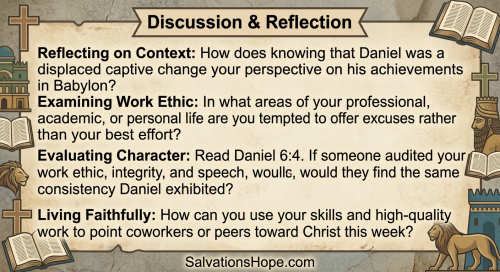
Reclaiming Work as Worship (Vocatio)
In Christian theology, our work is not merely a means of survival, but a context for stewardship and witness. As Paul writes in Colossians 3:23–24, believers are called to labor as if serving the Lord Christ directly. Daniel viewed his administrative duties as service ultimately to the God of Israel, not just to earthly monarchs.
Overcoming Excuses Through Sovereign Trust
It is easy to blame difficult circumstances—hostile work environments, unfair treatment, or cultural friction—for poor attitude or substandard effort. Daniel faced systemic oppression and religious persecution, yet he offered neither bitter complaints nor subpar labor. His reliance on God converted trial into testimony.
Holy Distinction Without Isolation
Daniel did not retreat from public life or assimilate into pagan morality. He occupied a faithful middle ground: distinct in conviction and outstanding in competence.
Living Under the Ultimate Sovereign
Fidelity and Prayer from Daniel
Throughout the Book of Daniel, the narrative contrasts the transient power of earthly monarchies with God’s enduring kingdom. In Daniel 6, Daniel serves under Darius the Mede in the Achaemenid Empire. As one of three chief administrators overseeing 120 satraps, Daniel excelled because an “extraordinary spirit was in him” (Dan. 6:3).
This success provoked envy among his colleagues, who systematically looked for grounds of corruption or negligence to ruin him. Finding no ethical or professional compromise in Daniel, his rivals targeted his allegiance to the Mosaic Law—specifically his religious devotion. They persuaded Darius to issue an irrevocable royal decree prohibiting petition to any god or man except the king for thirty days, punishable by death in the lions’ den (Dan. 6:6–9).
The Hierarchy of Authority: Coram Deo at Work
Daniel lived in a cultural reality where kings held absolute, life-and-death authority over their subjects. Yet Daniel understood the theological principle the Apostle Paul later articulated in Colossians 3:23–24: ultimate authority resides in God alone.
- Earthly Power vs. Divine Sovereignty: Daniel recognized his earthly rulers (Nebuchadnezzar, Belshazzar, Darius) as temporary custodians of authority under God’s sovereign dispensation (Dan. 2:21).
- The Priority of Approval: Rather than seeking his peers' favor or sacrificing his integrity to secure royal favor, Daniel prioritized Coram Deo—living before the face of God. When human law contradicts divine commandment, faithful allegiance belongs exclusively to God (cf. Acts 5:29).
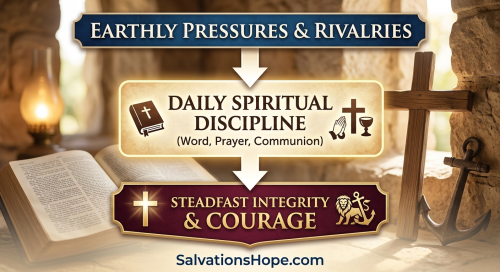
Disciplined Spiritual Habit as the Engine of Courage
Daniel’s decision to open his window toward Jerusalem and pray three times a day after the decree (Dan. 6:10) was not provocative defiance, but the persistent observance of an established spiritual discipline (“as he had done previously”).
- Dependence, Not Self-Sufficiency: Daniel's public position carried immense pressure, administrative burden, and hostility. His steadfast courage in the lion's den was not a sudden burst of heroism, but the natural outcome of a daily, continuous walk with God.
- The Theology of Prayer: Daniel's prayer was an acknowledgment of absolute dependence. He was not too busy to pray; his immense responsibilities made prayer non-negotiable.
The Cultural Threat of Distraction and Hurry
In modern culture, the primary threat to spiritual fidelity often manifests not as a royal decree, but as persistent busyness, hurry, and functional isolation.
Just as fast-paced modern conveniences can inadvertently erode the intentional rhythms of family communion and shared life, an unstructured, hurried lifestyle erodes our spiritual intimacy with God. Relationships—both divine and human—require dedicated time. Without intentionally structured patterns of communion, believers inevitably experience:
- Spiritual Atrophy: Feeling distant from God and depleted by daily demands.
- Relational Erosion: Frustration, isolation, and burnout within family and work life.
- Moral Vulnerability: Compromise born out of self-reliance or self-preservation.
The Lion's Den and the Ultimate Delivery
The account of Daniel in the lions’ den (Daniel 6) is frequently taught as a moral example of courage for children and adults alike. However, an exegetical reading of the text within its canonical and historical context reveals a deeper, profoundly eschatological message.
Set against the backdrop of the Medo-Persian Empire under Darius the Mede, Daniel’s steadfast devotion to Yahweh—manifested in his refusal to compromise his prayer life despite a royal decree—sets up a dramatic confrontation between human tyranny and divine sovereignty.
Through a Christological and Pauline lens, Daniel’s deliverance serves as a theological type: a foreshadowing of the final judgment, the resurrection of the dead, and God’s ultimate victory over the powers of darkness.
The Peril, the Protector, and the Paradigm
In Daniel 6, the immediate antagonists are corrupt bureaucratic officials and a manipulated king. Yet biblical exegesis pushes us past the human actors. The narrative points to a cosmic reality in which the adversary orchestrates human opposition to God’s people.
As the apostle Peter warns:
“Your enemy the devil goes around like a roaring lion looking for someone to devour. Resist him, standing firm in the faith” (1 Peter 5:8–9).
While the literal lions in Daniel’s den were restrained by God’s angel, the theological reality is that those outside of saving faith remain vulnerable to the ultimate “man-eater”—Satan. Conversely, those anchored in covenant relationship with God are sealed against spiritual destruction, regardless of physical outcomes.
The Paradox of Deliverance and Martyrdom (2 Timothy 4:17–18)
A rigorous theology of suffering must account for the divergent fates of the faithful:
- Sometimes God rescues His servants from physical death (as He did with Daniel).
- At other times, He permits them to seal their testimony with their blood (as seen in the early church martyrs and countless believers throughout history).
In both instances, ultimate safety is guaranteed. The early martyrs understood that physical death is not defeat when met in faithful witness to Christ. To deny Christ under pressure is to yield to the spiritual devourer, whereas dying in faith secures eternal life.
This paradox is captured by Paul facing his own execution under Nero:
rescue me from every evil attack and will bring me safe to his heavenly kingdom” (2 Timothy 4:17–18)
The Den as a Type of the Final Judgment (Daniel 12:2–3)
Daniel’s narrative does not end in isolation; it anticipates the cosmic culmination the book reveals later. What happened in the lions’ den functions as a historical micro-chasm of the macrocosmic final judgment:
- The righteous (Daniel) are vindicated and spared.
- The wicked accusers are handed over to the very destruction they plotted for others.
This theme finds its explicit theological fulfillment in Daniel’s final vision:
“Multitudes who sleep in the dust of the earth will awake: some to everlasting life, others to shame and everlasting contempt. Those who are wise will shine like the brightness of the heavens, and those who lead many to righteousness, like the stars for ever and ever” (Daniel 12:2–3)
The biblical text explicitly ties the historical rescue in Chapter 6 to the future bodily resurrection and the division of humanity based on covenant relationship with God.
Theological Application for the Believer
- Reorienting the Horizon: Human evaluation of our circumstances is often shortsighted. Walking with God may temporarily cost social standing, comfort, or safety. However, Scripture demands that believers judge their present reality through the lens of the eschaton—the final outcome.
- The Folly of Temporal Compromise: Trading eternal security for short-term earthly gain or self-preservation is spiritually catastrophic. As Jesus and the prophets repeatedly emphasize, gaining the whole world while forfeiting one’s soul is an infinite loss.
- Assurance in Divine Justice: The book of Daniel’s overarching theological comfort is that God ultimately makes things right for those who trust Him. Whether through temporal rescue or resurrection glory, a sovereign, righteous God securely holds the believer’s destiny.