Walking in Divine Power
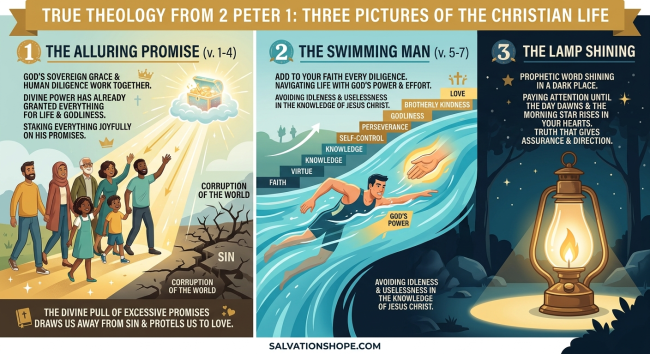
Three Pictures of the Christian Life
The Divine Power of Precious Promises
“Simeon Peter, a servant and apostle of Jesus Christ, To those who have obtained a faith of equal standing with ours by the righteousness of our God and Savior Jesus Christ: May grace and peace be multiplied to you in the knowledge of God and of Jesus our Lord. His divine power has granted to us all things that pertain to life and godliness, through the knowledge of him who called us to his own glory and excellence, by which he has granted to us his precious and very great promises, so that through them you may become partakers of the divine nature, having escaped from the corruption that is in the world because of sinful desire. For this very reason, make every effort to supplement your faith with virtue, and virtue with knowledge, and knowledge with self-control, and self-control with steadfastness, and steadfastness with godliness, and godliness with brotherly affection, and brotherly affection with love. For if these qualities are yours and are increasing, they keep you from being ineffective or unfruitful in the knowledge of our Lord Jesus Christ. For whoever lacks these qualities is so nearsighted that he is blind, having forgotten that he was cleansed from his former sins. Therefore, brothers, be all the more diligent to confirm your calling and election, for if you practice these qualities you will never fall. For in this way there will be richly provided for you an entrance into the eternal kingdom of our Lord and Savior Jesus Christ. Therefore I intend always to remind you of these qualities, though you know them and are established in the truth that you have. I think it right, as long as I am in this body, to stir you up by way of reminder, since I know that the putting off of my body will be soon, as our Lord Jesus Christ made clear to me. And I will make every effort so that after my departure you may be able at any time to recall these things. For we did not follow cleverly devised myths when we made known to you the power and coming of our Lord Jesus Christ, but we were eyewitnesses of his majesty. For when he received honor and glory from God the Father, and the voice was borne to him by the Majestic Glory, “This is my beloved Son, with whom I am well pleased,” we ourselves heard this very voice borne from heaven, for we were with him on the holy mountain. And we have the prophetic word more fully confirmed, to which you will do well to pay attention as to a lamp shining in a dark place, until the day dawns and the morning star rises in your hearts, knowing this first of all, that no prophecy of Scripture comes from someone’s own interpretation. For no prophecy was ever produced by the will of man, but men spoke from God as they were carried along by the Holy Spirit.” (2 Peter 1)
As we examine 2 Peter 1, the Apostle presents a profound framework for the believer’s walk. We can summarize the core message of this passage through three striking, vivid pictures:
- The alluring promise (symbolized here by a sweet, irresistible reward)
- The swimming man navigating an ocean current
- The lamp shining in a dark night
These metaphors trace out the mechanics of Christian perseverance, showing how God’s sovereign grace and human diligence unite to produce a life marked by holiness, love, and unshakable assurance.
The Source of Our New Life
The foundational truth of the Christian life is that God has already granted us everything for life and godliness (v. 3). Believers are not left to manufacture righteousness through their own fallen willpower. Instead, we have been given “divine power” and rescued from the world’s corruption through knowing Him who called us by His own glory and excellence.
This divine power becomes practically effective in our daily lives when we stake everything joyfully on His precious and very great promises (v. 4).
- Just as an irresistible reward draws us forward with anticipation, the exceeding greatness of God's promises exerts a magnetic, divine pull upon the believer’s soul.
- When we keep these eternal promises before our eyes, they draw us away from sin and propel us into the excellent way of brotherly kindness, love, and eternal life.
Diligence Against the Current: Active Zeal, Not Passive Laziness
God’s divine power is never given to make believers idle or passive. Instead, verses 5-8 command us to make every effort to supplement our faith with moral excellence, knowledge, self-control, perseverance, godliness, brotherly kindness, and love.
Peter portrays the spiritual reality of living in a fallen world like a man swimming against a powerful ocean current:
- The Resistance: The remaining sin in our corrupted hearts and the relentless pressures of unrighteousness in the world act like an undertow, constantly pulling us back toward destruction.
- The Law of Spiritual Momentum: In the Christian life, no one who merely treads water stays in the same place. A passive stance always results in drifting backward. Therefore, we must labor diligently, stroking forward against the current of internal evil desires and external temptations.
In verse 10, Peter urges us to be even more diligent in confirming our calling and election. This does not mean we earn our salvation through works; rather, it means our faith’s reality is verified by our fruit. The proof that we trust God’s promises is the diligence with which we stake our lives on them as we pursue Christlikeness.
The Sure Word: A Lamp Shining in the Dark
As Peter nears the end of this section, he focuses on the ultimate anchor of our hope: the return of our Lord Jesus Christ. To ground believers’ faith, Peter appeals to his eyewitness testimony of Christ’s majesty on the Mount of Transfiguration (vv. 16–18). What Peter, James, and John witnessed was a breathtaking, partial preview of Christ’s future glory.
In verse 19, Peter compares the prophetic word of this future hope to a lamp shining in a dark place:
dark place, until the day dawns and the morning star rises in your hearts.”
This prophetic word of hope functions just like the sweet allure of God’s promises mentioned in the opening verses—it keeps us anchored on the narrow path of righteousness, piercing the darkness of this present age until the ultimate dawn breaks and Christ returns.
Empowered by Hope to Lead Lives of Love
2 Peter 1 delivers a unified, urgent pastoral message to the Church: Be a people empowered by hope in order to lead lives of love.
The Christian life is sustained when our confidence in the coming day of eternal joy transforms how we live right now. Let your hope in Christ’s return keep you steadfast against the current, diligent in virtue, and compassionate in this world’s present night.
Are you keeping God’s precious promises actively before your mind, allowing them to allure you away from temptation?
In what areas of your spiritual walk have you found yourself “treading water” or drifting backward with the current?
How does the certainty of Christ’s return motivate you to love others today?
2 Peter 1:19–20: Reason or Manner
Connecting the Prophetic Word
To rightly divide the Word of Truth, believers must pay careful attention to the structural links in Sacred Scripture. In 2 Peter 1:19–20, the Apostle Peter commands the Church to pay close attention to the prophetic word regarding the return and glory of Jesus Christ, describing it as a lamp shining in a dark place.
To grasp the full force of this directive, however, you must see how verse 20 flows directly from verse 19.
Grammatical Connection: A Continuous Thought
Many modern translations separate verse 20 from verse 19 with a sentence break (or an added conjunction), which can obscure the underlying flow of thought. In the original Greek text, verse 20 begins with a participle—“knowing this first”—indicating that verse 20 is not an isolated thought but a crucial modifier of the command in verse 19.
When we synthesize the two verses, the core message becomes clear: Pay attention to the prophetic word… knowing this first, that no prophecy of Scripture comes from one’s own interpretation.
Because Peter grounds our reception of Scripture in what we must know, verse 20 serves as a key to how we approach and value God’s prophetic truth.
Two Theological Interpretations: Reason vs. Manner
Theologians and scholars generally view the connection between verse 19 and verse 20 in one of two distinct, complementary ways:
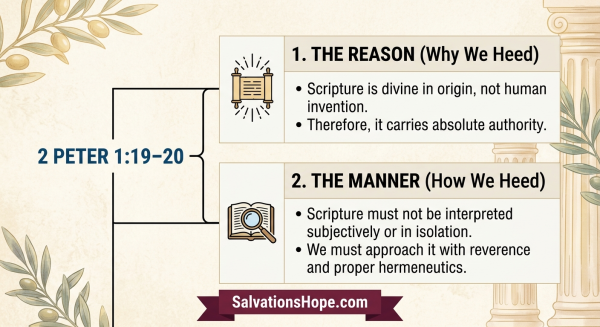
Verse 20 as the Reason (Why We Give Heed)
- The Concept: Under this view, verse 20 provides the grounding rationale for obeying verse 19.
- Paraphrase: “Pay close attention to the prophetic Scriptures because you know, above all, that no Scripture originated from human impulse or private origin.”
- Theological Impact: We can trust the Bible completely because its prophecies do not stem from human imagination. Its divine origin demands our complete devotion and attention.
Verse 20 as the Manner (How We Give Heed)
- The Concept: Under this view, verse 20 provides the guiding principle or rule of engagement for studying the Bible.
- Paraphrase: “Pay close attention to the prophetic Scriptures by keeping this primary rule in mind: no prophecy is open to personal, arbitrary interpretation.”
- Theological Impact: Believers must guard against subjective, isolated readings of the Word. Approaching Scripture requires humility, proper hermeneutics, and alignment with the broader counsel of God’s Spirit-inspired Truth.
Whether Peter is establishing the divine authority that demands our attention (the Reason) or the hermeneutical guardrail that directs our study (the Manner), the overarching lesson remains vital for the modern Church:
Honor the Source: Scripture is uniquely inspired by the Holy Spirit, making it fully trustworthy amidst a dark world.
Handle with Care: Because God’s Word is not human speculation, believers must approach biblical interpretation with reverent diligence, relying on the Holy Spirit rather than self-willed opinions.
Unlocking 2 Peter 1:20: Who Has the Authority to Interpret Prophecy?
When reading 2 Peter 1:20, believers often pause at Peter’s famous declaration: “Knowing this first, that no prophecy of Scripture is of any private interpretation…” (NKJV) (Or in the RSV: “No prophecy of scripture is a matter of one’s own interpretation.”)
How should we understand this verse? Does it describe how prophets originally received their messages from God, how an authority structure governs biblical interpretation, or how individual believers must handle the text responsibly?
To discern biblical truth, it helps to weigh three prominent views of this passage and see how Scripture interprets Scripture.
View 1: The Prophet’s Interpretation of History
Some respected evangelical scholars suggest verse 20 is not about how readers apply or understand prophecy today, but about how ancient prophets originally received it. Under this view, Peter says no Old Testament prophet looked at world events and offered a private human commentary on history. This reading links verse 20 directly to verse 21:
- Prophecy did not originate from a human author’s private evaluation of history.
- Instead, holy men spoke as the Holy Spirit moved them.
While this interpretation rightly emphasizes Scripture’s divine origin, it may overlook the immediate, practical warning Peter gives his audience about the coming of false teachers.
View 2: Institutional Authority Over Scripture
A second historical interpretation argues that because no private individual can interpret Scripture independently, believers must rely solely on church tradition and official magisterial decrees to determine the text’s true meaning.
However, examining the passage reveals key limitations with this approach:
- Absence in the Text: The biblical text itself makes no mention of an ecclesiastical office replacing individual readers as the sole authoritative interpreter.
- The Principle of Sola Scriptura: The New Testament consistently teaches that church leadership and tradition are accountable to Scripture, not the other way around (Acts 17:11).
When institutional tradition overrides biblical authority, the Word of God can easily become obscured. True biblical theology holds that Scripture is the ultimate judge over all human institutions and traditions.
View 3: A Warning Against Self-Serving Distortions
The third view holds that Peter forbids believers and teachers from imposing their own subjective opinions or personal whims on the Bible. Scripture carries a single, God-inspired truth (v. 21), and readers cannot twist its meaning to fit personal desires.
Why View 3 Fits the Context Best
When studying any passage, context is key. Looking at the surrounding chapters in 2 Peter clarifies why this third view is the most compelling:
The Threat of False Teachers: Immediately following this passage, Peter warns: “But there were also false prophets among the people, even as there will be false teachers among you…” (2 Peter 2:1)
Throughout this epistle, Peter’s primary concern is countering deceptive teachers who manipulate God’s Word for personal gain or self-justification.
The Danger of Distortion: In 2 Peter 3:15–16, Peter explicitly describes how these false teachers handle holy writings, including the letters of the Apostle Paul: “…which untaught and unstable people twist to their own destruction, as they do also the rest of the Scriptures.” (2 Peter 3:16)
Notice that these false teachers did not outright reject the Scriptures or deny their divine inspiration. Instead, they twisted them to suit their own agendas.
Handling the Word of Truth
In light of Peter’s full letter, 2 Peter 1:20 functions as a crucial guardrail for every Bible reader. Because Scripture originated from the Holy Spirit and carries divine authority, no individual is entitled to treat God’s Word as a canvas for personal preference or arbitrary reinterpretation. We must come to the Bible with humility—seeking the objective truth God has revealed rather than reshaping the text to fit our own ideas.
The Way in Which We Should Heed the Word
The Objective Nature of Biblical Truth (2 Peter 1:19–20)
that no prophecy of Scripture is of any private interpretation.” — (2 Peter 1:19a, 20)
Peter’s call to heed the prophetic word is directly linked to his solemn warning about interpretation. The apostle commands believers to fix their hearts and minds attentively upon God’s Word. However, he immediately establishes the foundational principle that governs all biblical study: Scripture’s true meaning does not originate in or depend on the reader’s mind.
Objective vs. Subjective Interpretation
Scripture is governed by objective truth, not subjective human experience.
- Objective Truth: The biblical text's meaning is anchored in God’s original intent. It is fixed, unchanging, and absolute.
- Subjective Fallacy: The assumption that Scripture's meaning changes with every new reader, culture, or circumstance, or that it can be reshaped to suit personal preferences.
The first rule of biblical exegesis is to acknowledge that Scripture has one true meaning intended by God, alongside many false interpretations invented by men. Believers must not approach the text assuming that their first impression, emotion, or personal desire represents divine truth. Instead, we are called to humble our intellects and submit our minds to tracing out the exact meaning the Holy Spirit has already deposited in the text.
Divine Inspiration: God’s Meaning over Man’s Ideas (2 Peter 1:21)
“For no prophecy ever came by the impulse of man, but men moved by the Holy Spirit spoke from God.” (2 Peter 1:21)
Verse 21 provides the essential theological basis for why Scripture cannot be interpreted according to personal whim. The text is not malleable like clay, open to being molded by human desire. It carries a solid, firm, and sovereign divine intent.
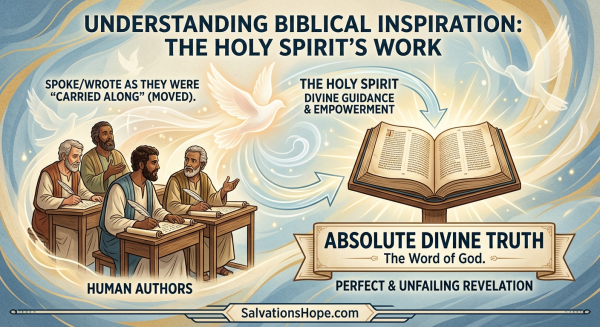
Because God spoke through human authors by the power of the Holy Spirit, Scripture’s words carry divine authority. We dare not force our own ideas into the Bible; our duty is to extract God’s ideas from it (exegesis, not eisegesis).
Contextual Integration & Application (2 Peter 1:1–19)
To fully appreciate Peter’s doctrine of Scripture, we must see how verses 20 and 21 serve his primary objective in the epistle.
- Confirming Our Calling: In chapter 1, Peter’s main aim is to urge believers to confirm their calling and election (v. 10) and enjoy the blessed assurance of salvation.
- The Evidence of Faith: Genuine saving faith (v. 1) necessarily produces spiritual fruit: virtue, knowledge, self-control, steadfastness, godliness, brotherly affection, and love (vv. 5–7).
- The Divine Provision: God has already granted us everything we need for life and godliness (v. 3). His “precious and very great promises” (v. 4) activate this divine power.
Finding Hope in the Word
Where do we find these sanctifying promises to sustain us against worldliness and guard our hearts? We find them in God’s prophetic Word (v. 19). When doubt, trials, or spiritual fatigue arise, believers must turn to Scripture—daily, patiently, and deeply.
Approach with Humility: Always come to Scripture seeking God’s original intent rather than validation for your existing opinions.
Anchor in Divine Authority: Remember that the Bible is not a collection of human musings, but the exact truth revealed by the Holy Spirit.
Fuel Your Hope: As the Apostle Paul reinforces in Romans 15:4, “Whatever was written in former days was written for our instruction, that through endurance and through the encouragement of the Scriptures we might have hope.”
The Sacred Trust of Truth
Three Essential Principles for Engaging God’s Word
In 2 Peter 1:20–21, the Apostle Peter establishes a foundational truth about Divine Revelation: Scripture is not human invention or personal imagination, but God’s Word, spoken through individuals carried along by the Holy Spirit.
Because Scripture originates directly from the Mind of God rather than human impulse, our approach to reading, studying, and applying it must reflect its divine origin. To faithfully handle God’s Word and live under its authority, believers must embrace three foundational commitments: intellectual discipline, heartfelt humility, and total dependence on the Holy Spirit.
The Call to Diligent Discipline
Imagine a commander delivering a vital, encoded message to soldiers trapped in hostile territory. The recipient does not gather opinions, debate preferences, or guess at the contents. Instead, they devote intense effort to decoding the exact instructions, knowing that survival depends entirely on understanding the commander’s actual intent.
Similarly, God has communicated His will to humanity through human language. His Word comes to us in specific historical contexts, vocabulary, and grammar. Faithful interpretation requires rigorous diligence to uncover what God intended to communicate, rather than injecting our own preconceived notions into the text.
- Exegesis Over Eisegesis: True biblical study demands exegesis—drawing out the author's intended meaning—rather than eisegesis, reading our own biases or cultural assumptions into the text.
- The Duty of Diligence: Understanding Scripture requires real labor. It involves careful reading, grammatical analysis, contextual examination, and honoring the languages in which God chose to reveal His Truth.
- Empowered Living: The more disciplined we are in rightly handling the Word of God, the more clearly we understand His promises and the more effectively we walk in righteousness.
The Necessity of True Humility
Accepting the Bible as God’s inspired Word requires genuine humility. Scripture frequently challenges human nature, confronting our pride, exposing our sins, and demanding changes in how we think, feel, and act.
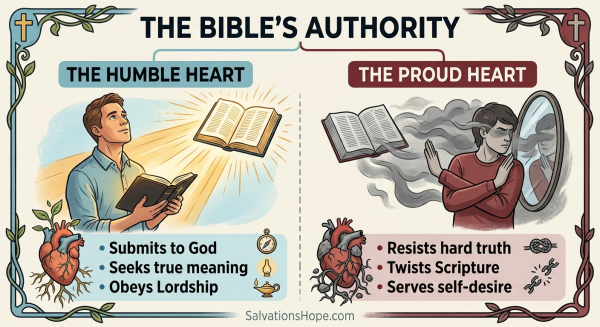
When confronted with difficult or uncomfortable biblical truths, the proud heart warps the text to fit personal desires or modern sensibilities. Conversely, the humble heart yields to Christ’s lordship and accepts God’s instructions even when they contradict natural inclinations. Sound interpretation flows from a contrite, teachable spirit ready to obey.
Absolute Dependence on the Holy Spirit
We cannot manufacture humility in our own strength; it is a fruit of the Holy Spirit. Because human nature naturally resists divine authority, we constantly need the Spirit’s assistance whenever we open the Scriptures.
“For no prophecy ever came by the impulse of man, but men moved by the Holy Spirit spoke from God.” (2 Peter 1:21)
- Illumination, Not New Revelation: The Holy Spirit's work in the believer is not to give brand-new messages outside Scripture, but to illuminate the truth already recorded. He softens our hardened hearts, removes our spiritual blindness, and grants us the desire to submit to God's Word.
- Full-Circle Inspiration: The same Spirit who inspired the human authors to write Scripture now works in readers' hearts to receive and obey that message.
Walking in the Light of God's Word
Because God’s Word is entirely divine, we must approach it with the utmost reverence. Let us devote ourselves daily to reading and studying the Scriptures with unwavering diligence, heartfelt humility, and prayerful reliance on the Holy Spirit—trusting that as we yield to His Truth, He will guide our steps and transform our lives.
Spiritual Discernment and the Battlefield of the Mind
1 Corinthians 2 & 2 Timothy 3
In a world governed by human philosophy, moral relativism, and spiritual apathy, the gospel of Jesus Christ often sounds nonsensical to the unregenerate mind. Scripture reminds us that spiritual warfare is ultimately a battle over truth and perception. To stand firm in the Christian life, believers must understand how God imparts wisdom, how the unrenewed mind perceives God’s truth, and how Scripture functions as our absolute standard for warfare and discipleship.
The Divine Divide: Natural vs. Spiritual Mindset
understand them because they are spiritually discerned.” (1 Corinthians 2:14)
Humanity is divided into two fundamental categories regarding spiritual reality: the natural (unspiritual) person and the spiritual person.
Without the Holy Spirit, human reason alone cannot apprehend the gospel. God’s truth is not merely difficult for the unspiritual man to grasp; to him, it appears as utter foolishness (mōria in Greek, from which we get “moron”). The barrier is not a lack of intellect, but a lack of spiritual life. Spiritual truth requires spiritual illumination.
Just as physical eyes are required to perceive light, the Holy Spirit’s presence is required to perceive and embrace divine truth. Regeneration precedes spiritual understanding; God must open the heart’s eyes before a person can behold the beauty and authority of His Word.
The Authority of the Spiritual Man and the Mind of Christ
the mind of the Lord so as to instruct him?’ But we have the mind of Christ.” (1 Corinthians 2:15–16)
The Spirit-led believer has spiritual discernment to evaluate all things—culture, philosophies, doctrines, and moral choices—through Scripture. Conversely, worldly critics cannot rightly judge or evaluate the spiritual believer because they do not understand the Spirit who drives the believer’s life.
Quoting Isaiah 40:13, Paul highlights God’s transcendent wisdom, which no mere mortal can advise or correct. Yet, through the Holy Spirit’s grace, believers have been granted the mind of Christ. This means we are equipped to think as God thinks, adopting Christ’s values, principles, and perspective on reality.
The Bible: The Believer’s Battlefield Manual
Living as a Christian in a fallen world is not a passive existence; it is active spiritual warfare. Scripture serves as the inspired, infallible manual of operation provided by our Sovereign Commander.
Inspired and Authorized by God
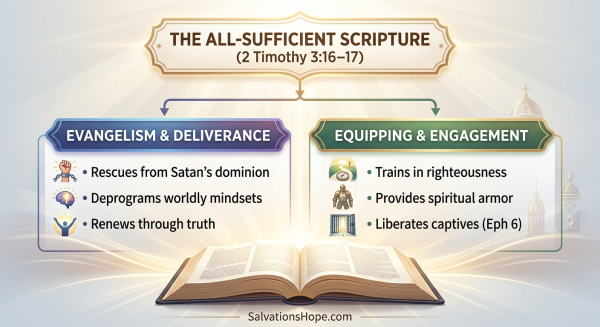
Scripture is God-breathed (theopneustos, 2 Timothy 3:16). It carries absolute divine authority and the full weight of God’s wisdom to govern the believer’s faith and practice.
Truth That Liberates
Evangelism is an act of spiritual rescue (Colossians 1:13). The Word of God is the tool used to win people from the enemy’s kingdom, break through deceptive strongholds, and reprogram worldly thinking by renewing the mind (Romans 12:2).
Comprehensive Equipping for Spiritual Warfare
Scripture thoroughly equips the believer for every good work (2 Timothy 3:17). In spiritual conflict, Paul instructs believers to take up the Armor of God (Ephesians 6:10–19), featuring the Sword of the Spirit—the spoken and applied Word of God—as our chief offensive weapon against demonic deception.
Rely on the Holy Spirit in Evangelism: When sharing the gospel, remember that human cleverness cannot convert a heart. We must depend on the Holy Spirit to give spiritual sight to those blinded by sin.
Anchor Your Worldview in the Word: Test every secular philosophy and cultural trend against Scripture’s objective truth. Don’t let worldly standards judge your faith.
Engage Daily in the Spiritual Battle: Treat the Bible not merely as a book of devotion, but as your essential wartime manual. Read, memorize, and pray through Scripture to stay fully equipped against the enemy’s schemes.
Scriptural Cross-References
- 2 Timothy 3:16–17: All Scripture’s inspiration and sufficiency for equipping the saint.
- Ephesians 6:10–19: The whole armor of God and spiritual warfare tactics.
- Romans 12:2: Renewing the mind rather than conforming to the world.
- 2 Corinthians 10:4–5: Destroying arguments and taking every thought captive to obey Christ.
Divine Revelation and Human Inability
The Uniqueness of God’s Word
“But, as it is written, “What no eye has seen, nor ear heard, nor the heart of man imagined, what God has prepared for those who love him”— these things God has revealed to us through the Spirit. For the Spirit searches everything, even the depths of God. For who knows a person’s thoughts except the spirit of that person, which is in him? So also no one comprehends the thoughts of God except the Spirit of God. Now we have received not the spirit of the world, but the Spirit who is from God, that we might understand the things freely given us by God. And we impart this in words not taught by human wisdom but taught by the Spirit, interpreting spiritual truths to those who are spiritual. The natural person does not accept the things of the Spirit of God, for they are folly to him, and he is not able to understand them because they are spiritually discerned.” (1 Corinthians 2:9–14)
Throughout history, political regimes and religious movements have produced foundational texts to guide human thought and behavior. Political ideologies have produced works like the Communist Manifesto and Mao’s Little Red Book, while world religions point to human-authored texts like the Quran.
However, the Christian Scriptures occupy a category entirely of their own. The Bible is not a product of human philosophy or intellectual evolution; it is the inspired, breathed-out Word of God (2 Timothy 3:16).
As the Apostle Paul writes in 1 Corinthians 2:13:
interpreting spiritual truths to those who are spiritual.” (1 Corinthians 2:13)
Because the Scriptures originate from God, they reveal what finite human reason could never discover independently:
prepared for those who love him…” (1 Corinthians 2:9)
The Bible is God’s ultimate revelation to humanity, revealing God’s deep things, the gospel of salvation, and the blueprint for Christian holiness. Yet, precisely because its origin and substance are divine, a profound theological issue arises when natural humanity attempts to engage with it.
The Core Dilemma: Man’s Spiritual Blindness
The difficulty in human understanding lies not in a flaw in Scripture, but in man’s fallen nature. 1 Corinthians 2:14 articulates the dilemma directly:
not able to understand them because they are spiritually discerned.”
The New American Standard Bible (NASB) renders this literally:
“But a natural man does not accept the things of the Spirit of God…”
This raises a fundamental theological question: If Scripture reveals God’s saving truth, but fallen humanity lacks the innate capacity to comprehend or accept it, how can anyone come to faith? What good is divine revelation to a spiritually dead heart?
To address this question, we must examine the biblical definitions of the key terms Paul uses in verse 14.
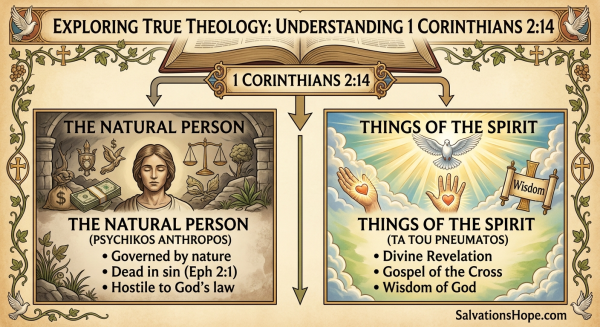
"The Natural Person" (Psychikos Anthropos)
In Pauline theology, the “natural man” refers to unregenerate humanity—anyone not born again by the Holy Spirit (John 3:3–5). The natural man is governed solely by human instinct, reason, and fallen nature and lacks the indwelling Holy Spirit. Scripture describes the natural man not merely as uninformed or struggling, but as spiritually dead in trespasses and sins (Ephesians 2:1) and inherently hostile toward God (Romans 8:7).
"The Things of the Spirit of God" (Ta Tou Pneumatos)
This phrase encompasses the entirety of God’s revealed truth:
- God's divine character and moral law.
- The message of the cross and Christ crucified (1 Corinthians 1:18, 23).
- The eternal mystery of God's redemptive plan hidden from worldly wisdom.
To the natural mind, these spiritual realities do not merely sound unfamiliar; they appear utterly foolish (moria).
Moral Inability vs. Divine Illumination
The obstacle described in 1 Corinthians 2:14 is not an intellectual limitation, but a moral and spiritual inability. The natural man possesses human intellect, but his fallen mind lacks spiritual discernment (anakrino—to appraise, evaluate, or judge spiritually).
This reality yields two vital biblical truths:
- The Doctrine of Total Depravity: Sin has affected every aspect of human nature, including the mind (the noetic effects of sin). Left to himself, man cannot welcome, submit to, or spiritually comprehend divine truth.
- The Necessity of Holy Spirit Illumination: Scripture alone reveals God's truth, but the Holy Spirit must open the heart's eyes to see and embrace that truth (2 Corinthians 4:4–6). Divine revelation requires divine illumination.
The Word of God stands alone in its divine authority and perfection. Yet, because of human depravity, the written Word cannot win a soul to God through human persuasion or intellectual argument alone.
How then does God overcome this barrier? He does so by the supernatural work of the Holy Spirit, who regenerates the heart, removes spiritual blindness, and grants the capacity to receive His truth.
The Unregenerate Mind: A look at the "Natural Man"
To fully grasp the doctrine of salvation and the necessity of divine grace, we must examine how Scripture characterizes humanity before the Holy Spirit’s regenerating work. Paul addresses this condition extensively in 1 Corinthians 2, contrasting fallen humanity’s mind with the mind God renews.
Defining the "Natural Man"
The term “natural man” (Greek: psuchikos) refers to someone who operates solely within fallen human nature, without the Holy Spirit’s influence. Scripture defines natural individuals as those lacking the Spirit of God. In Jude 19, Scripture describes such people as those who create divisions and live by worldly instincts precisely because they are “devoid of the Spirit.
By contrast, the “spiritual man” (pneumatikos) is one whose heart and intellect have been transformed by divine grace. As Paul explains in 1 Corinthians 2:12, believers do not receive the spirit of the world, but “the Spirit who is from God, that we might understand the things freely given us by God.” Without this divine gift, an individual remains strictly in a natural state.
What Are "The Things of the Spirit"?
Paul notes in 1 Corinthians 2:14 that the natural man does not accept “the things of the Spirit of God,” viewing them instead as sheer folly. Contextually, these “things” center directly on the core of the Gospel—the message of the cross.
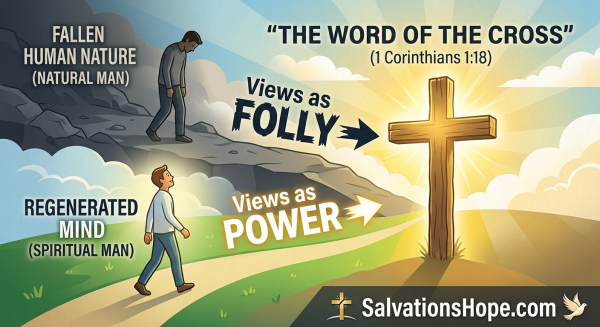
The Word of the Cross as Divine Wisdom
“For the preaching of the cross is to them that perish foolishness; but unto us which are saved it is the power of God.” (1 Corinthians 1:18)
both Jews and Greeks, Christ the power of God, and the wisdom of God.” (1 Corinthians 1:23-24)
The message of the cross is not merely an abstract historical account; it is a profound strike against human pride. It reveals that human effort cannot accomplish righteousness, declaring that salvation is entirely of grace, so that no human being might boast in the presence of God” (1 Corinthians 1:29).
Furthermore, the cross demands self-crucifixion. As Paul writes in Galatians 6:14, the cross of Christ crucifies the world to the believer and the believer to the world. To an unrenewed heart, a worldview that strips away self-reliance and places all glory in a crucified Savior appears entirely absurd.
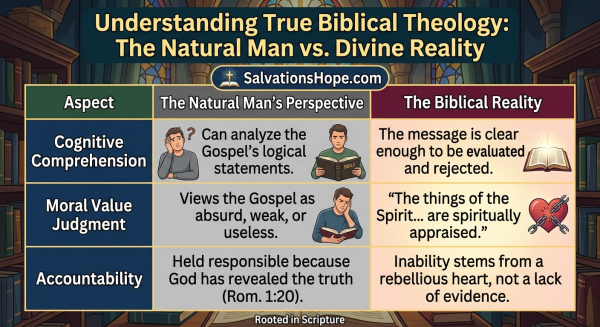
Intellectual Capacity vs. Moral Inability
Aspect
The Natural Man’s Perspective
The Biblical Reality
Cognitive Comprehension
Can analyze the Gospel’s logical statements.
The message is clear enough to be evaluated and rejected.
Moral Value Judgment
Views the Gospel as absurd, weak, or useless.
“The things of the Spirit… are spiritually appraised.”
Accountability
Held responsible because God has revealed the truth (Rom. 1:20).
Inability stems from a rebellious heart, not a lack of evidence.
Comprehension vs. Valuation
If an unrenewed person were genuinely incapable of understanding the basic linguistic meaning of the Gospel, they could not be held morally accountable for rejecting it (cf. Romans 1:20). However, the natural man does comprehend the proposition of the Gospel—and precisely because he cannot grasp its demand for humility and repentance, he deems it foolishness.
The issue lies in spiritual discernment or appraisal (anakrino). In 1 Corinthians 2:14–15, Paul uses this judicial term to describe how value is assigned:
- The natural man lacks the moral and spiritual framework required to cherish divine truth.
- He can restate Christian doctrines accurately, yet he perceives no intrinsic beauty, supreme worth, or personal necessity in them.
The doctrine of the “natural man” highlights the absolute necessity of God’s sovereign grace in salvation. Fallen human beings do not fail to embrace the Gospel because they lack intellectual power or information; rather, their unrenewed desires reject the humbling reality of the cross.
Only when the Holy Spirit regenerates an individual—opening blind eyes and renewing the heart—can they recognize the word of the cross not as foolishness, but as the supreme wisdom and power of God. A “natural man” is an unregenerate person living apart from the Holy Spirit. The “things of the Spirit” center on the crucified Christ, which confronts human pride. The natural man is morally unable to treasure divine truth and needs the Holy Spirit to grant a new heart and spiritual sight.
The Word of the Cross and the Pride of Man
Human nature inherently resists divine truth. Left to our own fallen instincts, we recoil from the Holy Scriptures and reject the message of the cross. When presented with the gospel—a summons to surrender completely to a crucified Savior—the unregenerate mind dismisses it as foolishness.
This resistance stems from a fundamental conflict of values. People label advice “foolish” when it asks them to sacrifice something they treasure for something they value less. The natural man considers the gospel foolish because it demands the total surrender of self-reliance, autonomy, and self-exaltation—things he prizes above all else.
The Divine Dismantling of Human Boasting
A central message of Paul’s opening chapters in First Corinthians is that God orchestrated redemption specifically to eliminate every foundation of human pride:
- Confounding Human Wisdom: God chose what the world considers foolish, weak, low, and despised to shame the wise and the strong (1 Corinthians 1:27–28).
- Eliminating Human Merit: God arranged salvation so that no individual can boast in His presence (1 Corinthians 1:29).
- Directing All Glory to the Lord: Redemption ensures that whoever boasts must boast exclusively in the Lord (1 Corinthians 1:31).
The natural man rejects this framework not because he lacks intellectual capacity, but because he craves human praise and personal autonomy. He delights in self-made achievements and relies on his intellect, talents, or status. Being called to leave these self-justifying credentials behind to trust entirely in a crucified Messiah appears absurd to a heart devoted to self-glory.
As Jesus declared in John 5:44, true faith is impossible so long as one seeks glory from other people rather than from the only true God. Saving faith requires an absolute shift in glory—from self to Christ.
The Necessary Work of the Holy Spirit
How can someone who naturally rejects the cross come to treasure Christ as God’s supreme wisdom and power?
Scripture shows that spiritual matters must be discerned spiritually (1 Corinthians 2:14–15). The natural person cannot evaluate or embrace divine reality without supernatural intervention. Through the Holy Spirit. The Spirit exposes our deep spiritual poverty and helpless condition. The Spirit reveals the supreme beauty, sufficiency, and glory of Christ crucified. Believers receive the Spirit from God so that they may understand what God has freely given them, granting them “the mind of Christ” (1 Corinthians 2:12, 16).
When the Spirit works within us, our value system is radically reordered. What was once dismissed as foolishness becomes our most treasured truth.
Category
The Natural Mind
The Spirit-Led Mind
Response to the Cross
Views it as foolishness and an obstacle to pride.
Views it as God’s supreme wisdom and power.
Primary Value
Self-reliance, personal autonomy, and human praise.
The glory of God and Christ’s righteousness.
Basis of Boasting
Human strength, intellect, or achievements.
The cross of Jesus Christ alone (Galatians 6:14).
Scriptural Alignment
Distorts or rejects God’s word to suit earthly desires.
Submits humbly to Scripture as divine truth.
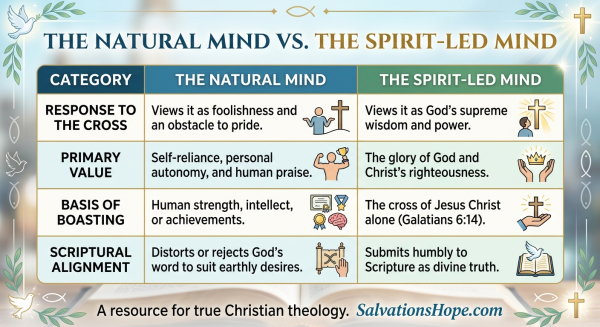
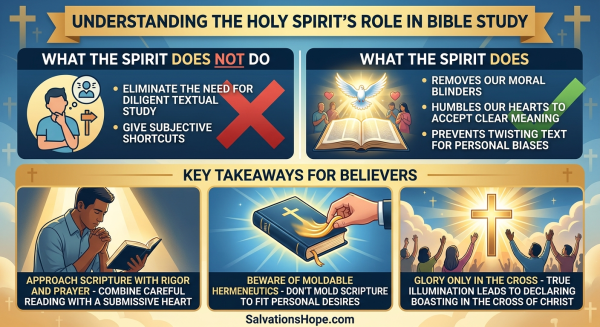
Scripture serves as the believer’s foundational guide for the Christian life and spiritual warfare. They provide the truth we need to break free from darkness, reshape our thought patterns, and equip us for righteous living. However, because human nature leans toward self-justification, the Holy Spirit’s role is indispensable in our study of the Bible.
Correctly Understanding the Spirit’s Role in Bible Study
- What the Spirit Does Not Do: The Spirit does not eliminate the need for diligent, disciplined textual study, nor does He bypass the text to give subjective shortcuts.
- What the Spirit Does: The Spirit removes our moral blinders, humbling our hearts so we readily accept the text's clear meaning rather than twisting it to fit our personal biases.