A Modern Day Nero
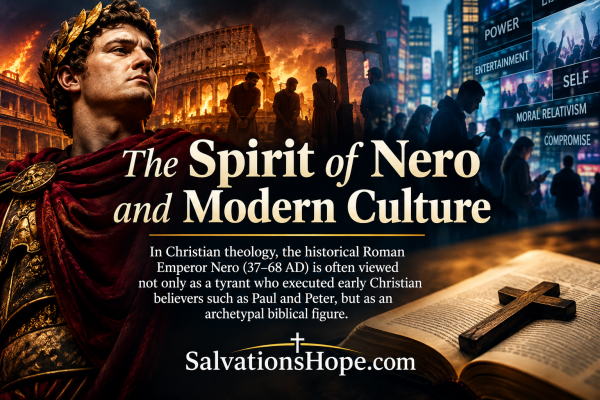
The Spirit of Nero and Modern Culture
In Christian theology, the historical Roman Emperor Nero (37–68 AD) is often viewed not only as a tyrant who executed early Christian believers such as Paul and Peter, but as an archetypal biblical figure. Early church writers and modern commentators alike link Nero’s regime to the “spirit of anti-Christ” or “beast” described in New Testament apocalyptic literature (such as 2 Thessalonians 2 and Revelation 13).
When theologians speak of the “Spirit of Nero,” they generally refer to a cluster of ideological and cultural characteristics. The total rejection of God-given order in favor of absolute self-definition (“I am God/creator of my own reality”). The deliberate blurring or rewriting of God’s created boundaries regarding gender, sexuality, and the human body. Institutional or cultural pressure against those who uphold biblical standards of morality and creation theology.
Nero’s Reign and Sexual Ethics
To understand how the “Spirit of Nero” is applied conceptually to modern debates, theologians examine historical accounts of Nero’s reign (such as those recorded by Roman historians Suetonius and Tacitus):
- The Re-Engineering of Identity:
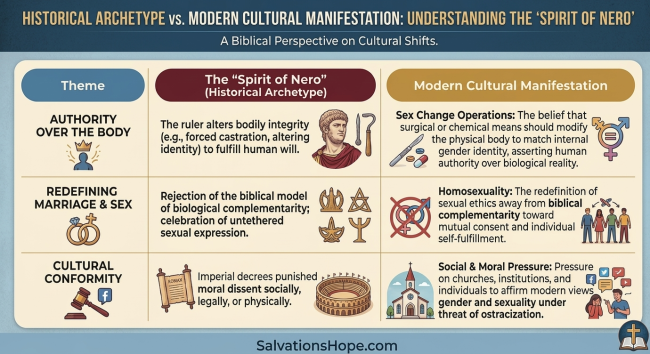
Historical texts record that Nero publicly and ritualistically subverted traditional marriage and identity. Most notably, Nero took Sporus, a young boy, castrated him, and attempted to legally, socially, and physically transition Sporus into a woman to serve as his wife.
- The Subversion of God's Design:
For early Christian writers, such acts were not merely eccentric abuses of power; they reflected a pagan worldview that saw human nature as malleable clay shaped by human desire, rather than a sacred design created by God.
- Sporus:
Sporus was a young Roman slave who was forcibly castrated—having his penis and testicles amputated by a surgeon—as an act of violence, mutilation, and political-psychological play by Nero
- Modern Gender-Affirming Surgery:
Modern gender mutilation encompasses reconstructive and plastic procedures (such as vaginoplasty, phalloplasty, or adadictomy) designed to distort gender dysphoria and align a person’s body with their gender identity.
- Unreliable Internal Feelings:
Passages like Jeremiah 17:9 caution that human emotions and internal senses of self can be misleading and are not absolute arbiters of truth. Consequently, traditional teaching emphasizes evaluating subjective internal feelings about identity against objective biblical standards and biological design, rather than treating them as infallible indicators of reality.
Creation Order vs. Self-Creation
From a traditional theological perspective, biblical critique regarding homosexuality and gender transitions rests upon creation theology:
The Creation Mandate (Genesis 1–2)
God intentionally creates humanity as male and female (Genesis 1:27). This biological and spiritual distinction is declared “very good” (Genesis 1:31). Jesus affirms this in Matthew 19:4–5, teaching that marriage is uniquely designed between one man and one woman, uniting two distinct, complementary halves of humanity.
The Anti-Creation Paradigm (The Spirit of Nero)
The “Spirit of Nero” describes a worldview that rejects objective divine design in favor of subjective internal authority:
- Autonomy over Authority: Instead of receiving bodily gender and sexuality as gifts from the Creator, human desire claims the authority to alter, dismantle, or reinvent those realities.
- The Exchange of Truth (Romans 1): In Romans 1:21–27, Paul—writing during the era of Roman imperial excess—describes a spiritual sequence in which humanity rejects the Creator, leading to confusion about natural relationships and the worship of creation over the Creator.
Concept to Modern Cultural Topics
In a theological bible study framework, the connection between Nero’s era and modern culture can be examined through three key themes:
Scripture References for Study
“So God created mankind in his own image, in the image of God he created them; male and female he created them.” (Genesis 1:27)
“Therefore shall a man leave his father and his mother, and shall cleave unto his wife: and they shall be one flesh.” (Genesis 2:24)
God establishes the reality of male and female and the foundation of covenantal, complementary marriage.
“Wherefore God also gave them up to uncleanness through the lusts of their own hearts, to dishonor their own bodies between themselves: who changed the truth of God into a lie, and worshipped and served the creature more than the Creator, who is blessed for ever. Amen. For this cause God gave them up unto vile affections: for even their women did change the natural use into that which is against nature: and likewise also the men, leaving the natural use of the woman, burned in their lust one toward another; men with men working that which is unseemly, and receiving in themselves that recompence of their error which was meet.” (Romans 1:24–27)
Paul critiques the Roman world’s departure from God’s natural design, highlighting how spiritual autonomy leads to sexual and bodily confusion.
“Now our Lord Jesus Christ himself, and God, even our Father, which hath loved us, and hath given us everlasting consolation and
good hope through grace, comfort your hearts, and establish you in every good word and work.” (2 Thessalonians 2:3–4)
The “man of lawlessness” exalts himself above divine law. In Scripture, lawlessness often refers to rejecting God’s established moral and creation boundaries.
“that we henceforth be no more children, tossed to and fro, and carried about with every wind of doctrine, by the sleight of men, and cunning craftiness, whereby they lie in wait to deceive; but speaking the truth in love, may grow up into him in all things, which is the head, even Christ:” (Ephesians 4:14–15)
Believers are called to hold fast to divine truth and speak it in love, rather than be carried away by shifting cultural winds.
Spiritual Application
A holistic theological response emphasizes both conviction and compassion:
- Upholding Truth with Grace: While early Christian writers opposed the moral decay of Nero's Rome, they were instructed to treat all individuals with dignity and offer the gospel to everyone (1 Peter 2:12–17).
- The Body as a Temple: 1 Corinthians 6:19–20 notes that the human body is designed to be a temple of the Holy Spirit, meant to be honored according to God’s design rather than reshaped by cultural trends or individual desire.
- Hope and Restoration: Scriptural theology holds that fulfillment comes not from reshaping the body or redefining identity through human authority, but from finding ultimate identity in Christ (Galatians 2:20).
Roman Ideology Under Nero and Modern Political Culture
In Christian political theology, Rome is rarely treated merely as an ancient empire. Across Scripture—from Daniel’s visions to the Book of Revelation—Rome serves as an archetype of earthly power, representing political authority that opposes the Kingdom of God.
While two millennia separate the reign of Emperor Nero (54–68 AD) from today’s geopolitical landscape, a theological comparison reveals striking structural and ideological parallels between Nero’s Rome and contemporary political culture. Understanding these similarities helps believers discern how ancient patterns of power reemerge in modern political life.
Imperial Cult vs. Political Idolatry
Under Nero, the Imperial Cult reached a peak of personal exaltation. While previous emperors were often deified after death, Nero sought divine honors in life, styling himself after Apollo and Sol Invictus (the Unconquered Sun). Civic loyalty was tied directly to honoring the ruler and the state as ultimate sources of order, prosperity, and truth.
While modern democracies rarely build literal temples to rulers, contemporary politics frequently demands a similar form of total allegiance:
- Politics as Totalizing Worldview: Political movements on both the left and right often function as secular religions, offering competing visions of redemptive history, moral purity, and ultimate truth.
- Messianic Expectations: Citizens increasingly look to political leaders, parties, or state apparatuses for salvation from societal ills—a role the New Testament reserves exclusively for Jesus Christ (1 Timothy 2:5).
- Biblical Insight: In Revelation 13, the "Beast" demands worship through absolute compliance in civic and economic life. When political allegiance eclipses devotion to God, civic participation transforms into idolatry.
Subjective Autonomy and the Re-Engineering of Order
Nero’s reign was characterized by a philosophical rejection of traditional Roman moral boundaries (mos maiorum) in favor of absolute imperial autonomy. Historians like Tacitus recorded that Nero reshaped legal, social, and personal structures according to his own will, treating objective reality and tradition as malleable tools for self-expression and political power.
Modern political ideologies increasingly treat objective reality—including human nature, morality, and biological truth—as constructs to be redefined by state power or individual autonomy:
- The State as Moral Arbiter: Rather than acknowledging an objective moral law higher than human government (such as the natural law articulated in Romans 2:14–15), modern political structures often claim the authority to redefine fundamental ethical principles.
- Technocratic Control: Legislative or judicial decrees reshape human identity, family structures, and moral norms, reflecting a worldview in which human authority supersedes divine design.
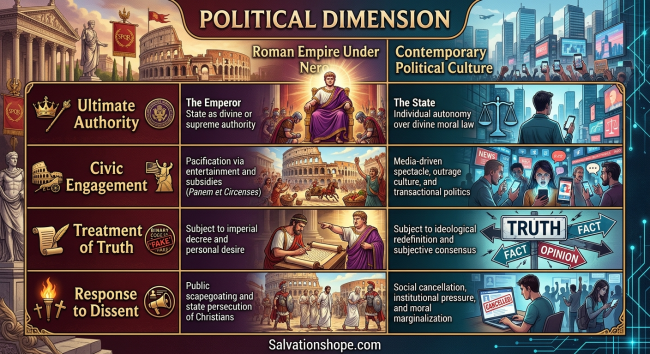
The Bread and Circuses (Panem et Circenses) Strategy
The Roman poet Juvenal coined “bread and circuses” to describe the imperial strategy of keeping the populace pacified with material handouts (free grain) and sensational public entertainment (gladiatorial games, chariot races, and theatrical spectacles). Nero was infamous for extravagant public spectacles designed to distract the citizenry from state corruption, economic decline, and his own tyrannical overreach.
Contemporary political systems rely heavily on entertainment, outrage, and material dependency to maintain control and direct public focus. Anything to distract the masses from what is really going on.
- Political Spectacle & Media Outrage: Modern political discourse is driven by media cycles designed to sensationalize conflict, provoke emotional reactions, and entertain rather than foster wisdom or truth.
- Transactional Loyalty: Governments often secure political compliance by offering short-term economic incentives or protection from manufactured cultural anxieties, trading genuine civic virtue for public pacification.
- Biblical Insight: Paul warns in 2 Timothy 3:4–5 of a culture marked by being "lovers of pleasure rather than lovers of God," where superficial entertainment replaces moral seriousness.
Scapegoating and the Marginalization of Truth-Tellers
When the Great Fire of Rome devastated the city in 64 AD, rumors implicated Nero himself. To deflect blame, Nero targeted the fledgling Christian community—a marginalized group already disdained for refusing to participate in pagan rituals and civic idolatry. Tacitus noted that Christians were punished not necessarily for arson, but for their perceived “hatred of the human race” (odium humani generis) due to their refusal to conform to Roman cultural practices. Modern political discourse routinely employs ideological scapegoating to consolidate power and enforce cultural conformity:
- Villainization of Dissent: Political factions frequently select target groups—often religious orthodoxies or cultural dissidents—and frame them as existential threats to societal progress or safety.
- The Cost of Moral Conviction: Believers who hold fast to historic Christian ethics on life, marriage, truth, and authority increasingly face social ostracism, institutional pressure, or legal penalties for refusing to bow to state-sanctioned orthodoxy.
Summary Comparison
Takeaway for the Church Today
The parallels between Nero’s Rome and modern politics powerfully remind us that political systems routinely seek to usurp authority that belongs to God alone.
Scripture does not call Christians to withdraw from society or succumb to despair, but rather to walk as “strangers and exiles” (1 Peter 2:11) whose ultimate allegiance belongs to a different King. By understanding these ancient political patterns, believers can resist political idolatry, speak truth with courage and grace, and maintain a prophetic witness in an ever-changing world.
Roman Ideology and Modern American Political Culture
In Christian political theology, the Roman Empire serves as a recurring biblical archetype of earthly power that seeks self-exaltation and opposes divine order. From Daniel’s prophetic visions to Revelation’s apocalyptic imagery, imperial Rome illustrates how political institutions attempt to usurp God’s authority over creation, truth, and governance.
Although contemporary American politics operates within a democratic republic rather than an autocratic principate, a theological examination reveals striking structural, moral, and cultural parallels between late Roman imperial ideology and today’s political and cultural beliefs in the United States.
Radical Autonomy, Gender Subversion, and Elagabalus
While Nero demonstrated imperial overreach and moral decay in the 1st century, the 3rd-century Emperor Elagabalus (Marcus Aurelius Antoninus, reigned 218–222 AD) represents the ultimate ancient expression of subjective identity overriding biological and social reality.
Roman historians Cassius Dio and Herodian recorded that Elagabalus:
- Rejected Biological Reality: Expressed a strong desire to transition away from biological maleness, explicitly asking physicians to perform surgical procedures to alter his anatomy—offering vast sums of money to any doctor who could perform a primitive sex-change operation.
- Subverted Social and Linguistic Norms: Preferred to be addressed as a "lady" or "queen" rather than "lord" or "emperor"; wore makeup, wigs, and women's attire; and married a man while claiming the role of a wife.
- Overthrew the Sacred Order: Forced the Roman Senate to elevate his eastern deity (Elagabal) above Jupiter, subverting Rome's traditional moral and religious order to accommodate his personal identity and desires.
In Roman political thought, power was tied to self-mastery and adherence to natural order (lex naturae). To Roman observers, Elagabalus exemplified imperial hubris—the belief that supreme political and individual authority grants humans the right to reshape the body, language, and sacred institutions according to internal desire.
Modern Parallel
In contemporary U.S. political culture, the philosophical foundation seen in Elagabalus’s reign has become central to legislative, medical, and social discourse:
- The Sovereign Self: Both cultural movements and state policy increasingly view individual gender identity and sexual expression as subjective choices that supersede objective biological reality.
- State-Sanctioned Bodily Alteration: Modern medicine and political advocacy champion surgical and chemical interventions to alter human bodies to match internal gender identities—a modern fulfillment of the technological desire Elagabalus sought through 3rd-century medicine.
- Redefining Created Order: Like Elagabalus's subversion of language and marriage, modern institutions often enforce new linguistic protocols (preferred pronouns) and redefine foundational concepts such as marriage, male, and female.
- Theological Insight: From a biblical creation framework (Genesis 1:27), humanity is made intentionally as male and female. When political systems or individuals assert authority over biological design, they engage in self-deification, replacing the Creator's design with human self-creation (Romans 1:25).
Political Idolatry and the Totalitarian Impulse
Imperial Rome operated around the Imperial Cult, which treated the emperor as Dominus et Deus (“Lord and God”). The state maintained cohesion by demanding civic homage to the empire’s leaders and values. Civic loyalty was inseparable from ideological compliance.
While the United States does not have an emperor, American political culture increasingly mirrors the Imperial Cult through political idolatry:
- Politics as Secular Religion: Factions across the political spectrum treat party platforms and cultural ideologies as totalizing worldviews that offer moral salvation, ultimate meaning, and absolute truth.
- Demand for Total Compliance: Citizens, businesses, and religious organizations face immense institutional pressure to publicly affirm prevailing cultural dogmas, echoing ancient Roman demands for public incense-burning to state gods.
Imperial Rome vs. Contemporary U.S. Politics
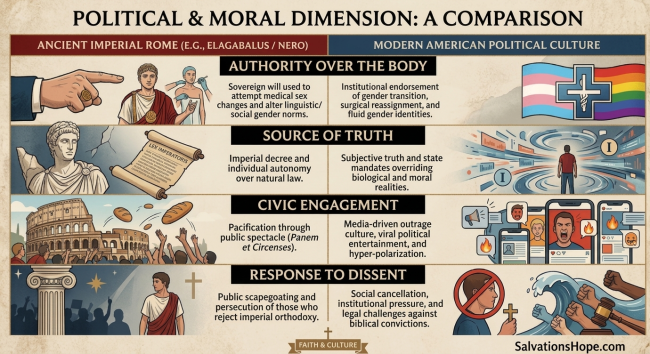
The structural and moral similarities between late Roman imperial culture and modern American politics illustrate a recurring spiritual reality: when a society abandons the Creator, it inevitably seeks to redefine creation itself.
Historical accounts of emperors like Elagabalus show that the urge to re-engineer human identity and enforce compliance is not unique to modern times. Scripture calls Christians to respond not with anger or political idolatry of their own, but with prophetic clarity and Christlike compassion:
- Stand Firm in Divine Order: Believers must uphold the truth of Genesis 1—that biological sex and human dignity are intentional gifts from God, not malleable constructs.
- Reject Political Idolatry: Salvation belongs to God, not to any political party, candidate, or human system (Psalm 146:3).
- Offer True Restoration: While secular culture promises freedom through self-creation, genuine freedom and identity are found only through redemption in Jesus Christ (Galatians 2:20).
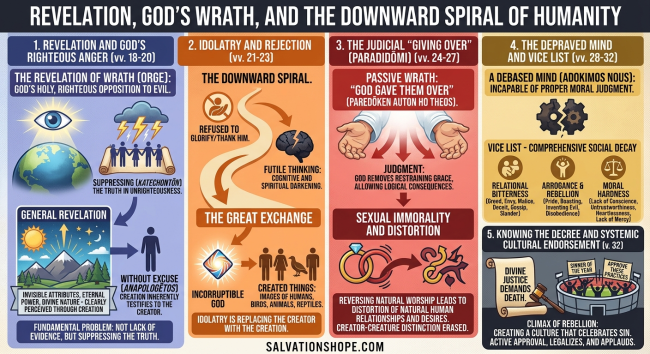
Progression of Divine Wrath and Human Suppression (Romans 1:18–32)
In Romans’ opening chapter, the Apostle Paul presents an unvarnished diagnosis of humanity’s moral condition. Romans 1:18–32 outlines the systemic shift from rejecting God’s self-revelation to complete moral and intellectual disintegration.
This passage shows that divine judgment is not merely a future apocalyptic event, but an ongoing reality—often manifested as God granting humanity its own desire for autonomy.
Revelation and God's Righteous Anger (vv. 18–20)
- The Revelation of Wrath (Orge): God’s wrath is His holy, righteous opposition to evil. It is revealed against those who actively "suppress" (katechontōn) the truth in unrighteousness.
- General Revelation: Paul asserts that God’s invisible attributes—His eternal power and divine nature—are clearly perceived through creation (general revelation).
- Without Excuse (Anapologētos): Because creation inherently testifies to the Creator, no human being can claim ignorance. Humanity's fundamental problem is not a lack of evidence, but suppressing the truth.
Idolatry and Rejection (vv. 21–23)
- The Downward Spiral: Although humanity knew God, they refused to glorify or thank Him.
- Futile Thinking: The refusal to honor the Creator leads directly to cognitive and spiritual darkening.
- The Great Exchange: Humanity did not stop worshiping; instead, they exchanged the glory of the incorruptible God for created things—images of humans, birds, animals, and reptiles. Idolatry replaces the Creator with creation.
The Judicial "Giving Over" (Paradidōmi) (vv. 24–27)
- Passive Wrath: Three times in this passage, Paul uses the phrase "God gave them over" (paredōken auton ho Theos). This describes a form of divine judgment in which God removes His restraining grace and allows humanity to experience the logical consequences of its choices.
- Sexual Immorality and Distortion: Reversing the natural worship of God leads to the distortion of natural human relationships and desires. When the Creator-creature distinction is erased, the foundational design of human identity and sexuality collapses.
The Depraved Mind and Vice List (vv. 28–32)
- A Debased Mind (Adokimos Nous): Because people saw no value in retaining the true knowledge of God, God gave them over to a mind incapable of proper moral judgment.
- Comprehensive Social Decay: Paul outlines a catalog of social sins:
Relational Bitterness: Greed, envy, malice, deceit, gossip, slander.
Arrogance & Rebellion: Pride, boasting, inventing new ways of doing evil, disobedience to parents.
Moral Hardness: Lack of conscience, untrustworthiness, heartlessness, and lack of mercy.
Knowing the Decree and Systemic Cultural Endorsement (v. 32)
- Climax of Rebellion: The final stage of societal judgment is not merely sinning, but creating a culture that celebrates it.
- Active Approval: Paul notes that despite knowing divine justice demands death for such practices, society actively encourages, legalizes, and applauds those who engage in them.
Modern Culture in the USA
When evaluating contemporary trends through the lens of Romans 1, Scripture provides a clear diagnostic framework for understanding present cultural shifts:
The Primary judgment facing a culture is often not immediate fire from heaven, but God allowing a society to experience the full fruit of its autonomy. While Romans 1 explicitly mentions sexual perversion, Paul deliberately includes sins like greed, gossip, arrogance, and lack of mercy in the same list. The entire moral infrastructure suffers when God is excluded. Romans 1 sets up the necessity of the Gospel introduced in Romans 1:16–17. The depth of human ruin highlights the necessity and power of God’s grace through Jesus Christ.
Biblical Truth and Critical Social Frameworks
Across modern culture, noble-sounding desires to confront societal wrongs, eliminate oppression, and seek justice are widespread. However, beneath the surface of today’s cultural movements—often called “woke culture”—lies a worldview largely derived from secular Critical Social Theory (CST).
While scripture calls believers to champion true biblical justice, defend the vulnerable, and love their neighbors, traditional biblical theology diverges fundamentally from the ideological foundations of secular social theories.
The Source of Truth
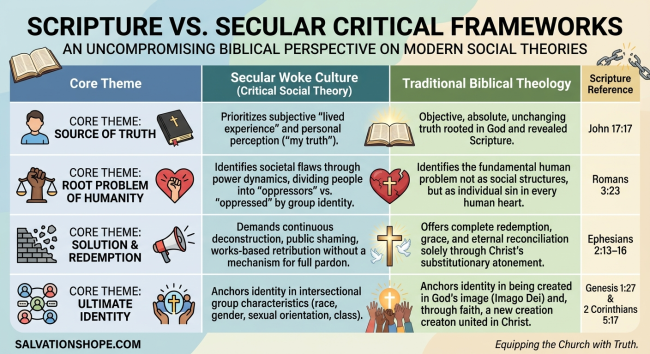
Secular critical frameworks operate from epistemological individualism and postmodern skepticism. Knowledge and moral authority are grounded in “lived experience,” elevating subjective perspective (“my truth”) over universal reality. Because power structures control narrative definitions, people often dismiss objective claims as tools of domination.
Scripture teaches that truth is neither constructed by human culture nor dependent on personal perception. God Himself is the ultimate standard of truth, revealed definitively through Jesus Christ and the infallible Word of God (John 17:17). Truth exists independently of human experience; rather, human experience must be tested against, and submitted to, the objective reality of God’s Word (Psalms 119:160).
Problem of Humanity
Critical Social Theory analyzes the human condition through power dynamics. Evil is defined structurally, categorizing humanity into identity groups of “oppressors” or “oppressed.” Evil resides primarily within systems, traditions, and dominant identity groups rather than within the individual soul.
While the Bible acknowledges that fallen human beings can create unjust systems (Isaiah 10:1–2), it locates the primary cause of injustice within the human heart. Sin is a universal condition affecting every individual regardless of race, class, gender, or social status (Romans 3:23). Redefining sin primarily as a conflict between socio-political groups ignores the reality that every individual stands guilty before a holy God.
Solution, Redemption, and Reconciliation
Because secular critical frameworks lack a transcendent moral arbiter, they offer no ultimate mechanism for grace, absolution, or final forgiveness. Resolution requires continuous political activism, deconstruction, public shaming, and endless moral restitution. Because guilt is collective and structural, genuine atonement is impossible.
The Gospel provides what secular ideologies cannot: absolute pardon, divine mercy, and true unity. Jesus Christ paid the full penalty for human sin through His substitutionary death on the cross (Ephesians 2:13–16). Biblical redemption replaces condemnation with grace, enables genuine forgiveness among individuals, and unites former enemies into one body through Christ without requiring endless works of self-justification.
Ultimate Identity
Intersectional frameworks define human value and identity primarily through collective group categories (race, gender, class, sexual orientation). An individual’s standing and moral authority depend on where they sit on a matrix of privilege and oppression.
The Bible establishes human worth on two bedrock theological realities:
- Creation: Every human being possesses inherent dignity and value because they are created in the image of God (Genesis 1:27).
- Recreation: For believers, ultimate identity is found in Jesus Christ (2 Corinthians 5:17). Secondary demographic distinctions do not define a believer’s spiritual standing or standing before God (Galatians 3:28).
What Is Going On in the USA Today?
In the United States today, these opposing worldviews actively shape the culture, institutions, and daily life:
Institutional and Cultural Shifts:
Critical social theories, which gained rapid traction across higher education, corporate boardrooms, media, and government institutions over the last decade, continue to strongly influence public discourse. Concepts like privilege, systemic power dynamics, and intersectionality have become standard language in mainstream institutions.
Cultural and Political Friction:
A significant cultural counter-movement has emerged. Many communities, state legislatures, and public figures actively push back against critical theory frameworks in public school curricula, corporate diversity policies, and local governance. This friction has created deep political and social polarization.
The Church's Struggle:
The American Church finds itself at a critical crossroads. Some congregations have embraced secular, critical frameworks under the banner of social justice, often risking compromise of core biblical doctrines about sin, truth, and salvation. Conversely, other believers risk responding to cultural pressures with political animosity rather than gospel-centered love, truth, and grace.
Followers of Christ are called neither to adopt secular ideologies passively nor to react with ungodly hostility. Instead, believers must exercise discernment (Colossians 2:8), hold firmly to Scripture’s sufficiency, and actively pursue true, biblical justice—caring for the needy, defending the oppressed, and proclaiming the only true source of eternal reconciliation: the Gospel of Jesus Christ.
Navigating the Cultural Divide: The Church at the Crossroads
The American cultural landscape is shaped by deep ideological friction. Over the past decade, critical social theories—emphasizing systemic power dynamics, intersectionality, and institutional privilege—have heavily influenced higher education, corporate boardrooms, media, and government institutions. At the same time, a powerful cultural and political counter-movement has emerged across state legislatures, local school boards, and civic communities, pushing back against these frameworks.
For the American Church, this polarization is not merely a political dilemma; it is a profound theological crossroads. Believers face intense pressure from two distinct directions:
- The temptation of accommodation: Embracing secular critical frameworks under the banner of social justice, often at the risk of compromising biblical doctrines of sin, objective truth, and personal salvation.
- The temptation of reaction: Responding to cultural pressures with partisan animosity, defensive tribalism, or anger rather than gospel-centered truth and grace.
To remain faithful, the Church must evaluate these cultural currents through Scripture and anchor its identity in the Gospel’s unchanging truth.
Analyzing the Cultural Current
To engage contemporary culture effectively, Christians must understand the intellectual streams shaping modern public discourse. Critical social theories trace their roots to critical philosophy and neo-Marxism, seeking to analyze society through the framework of power dynamics between oppressor and oppressed groups.
Points of Contact with Biblical Truth
Christians can recognize certain legitimate concerns within these frameworks:
- A concern for the vulnerable: Scripture repeatedly commands God’s people to defend the oppressed, plead for the widow, and care for the orphan (Isaiah 1:17; Proverbs 31:8–9). God is passionately concerned with justice (mishpat) and righteousness (tsedaqah).
- An awareness of systemic sin: Human sin is not merely individual; it infects cultures, institutions, and legal systems. Biblical history recognizes corporate solidarity in sin and historical injustices (e.g., Daniel’s confession of his people's corporate sins in Daniel 9).
Fundamental Theological Divergence
Despite these points of contact, critical social theories diverge fundamentally from a Christian worldview at their foundational axioms:
The Definition of Sin and Salvation: Critical theory locates the root of human suffering in oppressive societal structures and power imbalances, making liberation a political or social achievement. Scripture, however, teaches that all human evil stems from rebellion against God (Romans 3:23). Salvation cannot be achieved through systemic restructuring or human activism; it comes solely through the atoning work of Jesus Christ on the cross (Ephesians 2:8–9).
Anthropology: Critical theory categorizes human beings primarily by group identity (race, gender, class, or status). The Christian gospel declares that every human being is made in the image of God (Imago Dei) and finds their primary identity—whether in sin or in redemption—in relation to Adam or to Christ (Genesis 1:27; 1 Corinthians 15:22).
“If we reduce sin to a structural flaw and salvation to political liberation, we empty the cross of Christ of its power, replacing the vertical reconciliation between God and humanity with horizontal activism.”
The Danger of Two Extremes
The current polarization places believers at risk of falling into two distinct errors: syncretism on the left and secularized tribalism on the right.
Theological Compromise and Syncretism
Some congregations, driven by a commendable desire for justice and compassion, have uncritically adopted secular analytical frameworks. When critical theory becomes the hermeneutical lens through which Scripture is read, biblical categories are reinterpreted:
- Truth is subordinated to power dynamics, suggesting that objective truth claims are merely tools of dominant groups.
- Sin is redefined strictly as societal oppression rather than spiritual rebellion against a holy God.
- Reconciliation is divorced from the blood of Christ and made contingent on endless social restitution.
This path leads to a “social gospel” that may address temporal inequities while neglecting eternal redemption, ultimately leaving souls untransformed by the grace of God.
Political Animosity and Cultural Reaction
Conversely, many believers and communities react to secular ideological shifts with fear, bitterness, and partisan hostility. When the Church allows political affiliation to shape its ethos rather than the Kingdom of God, it exhibits several concerning traits:
- Tribalism over Truth: Adopting the outrage culture of the surrounding world, treating political opponents as ultimate enemies rather than image-bearers for whom Christ died.
- Defensiveness: Resisting honest self-examination about historical injustices or present-day partiality for fear of ideological capitulation.
- Loss of Witness: Trading the prophetic voice of the Church for the pragmatic power plays of political partisanship.
A Biblical Framework for the Church's Witness
How, then, shall the Church live and speak in this cultural moment? Scripture provides a clear, robust paradigm for engaging a fractured world without compromising the faith.
Upholding Objective Truth with Radical Grace
In a culture that views truth as a social construct tied to power, the Church must unapologetically proclaim that Jesus Christ is the Way, the Truth, and the Life (John 14:6). Truth is rooted in the character of God and has been once for all delivered to the saints (Jude 1:3). However, this truth must never be wielded as a weapon of self-righteousness. As the Apostle Paul exhorts, speaking the truth in love must characterize every aspect of Christian witness (Ephesians 4:15).
Pursuing Biblical Justice Rooted in Righteousness
The Bible calls believers to an active, comprehensive concern for justice that transcends partisan politics:
- Impartiality: Scripture explicitly condemns partiality, whether favoring the rich or showing illicit deference to the poor (Leviticus 19:15).
- Charity and Mercy: True biblical justice means defending the vulnerable, practicing generosity, and seeking the peace and prosperity of the communities God has placed us in (Jeremiah 29:7; James 1:27).
- The Power of the Gospel: Only the Gospel of Jesus Christ can truly heal humanity's deep racial, social, and economic divisions, breaking down the dividing wall of hostility to create one new humanity in Christ (Ephesians 2:14–16).
Embracing a Prophetic, Non-Partisan Identity
The Church is an embassy of heaven, not a subsidiary of any political party or ideological movement. To navigate cultural friction, congregations must resist co-optation from the left or the right. A prophetic witness speaks truth to power, calls out injustice wherever it appears, and refuses to baptize secular political agendas.
It maintains a posture of humility, recognizing that the Church’s primary weapon is prayer, the proclamation of the Word, and the transformative love of Christian community.
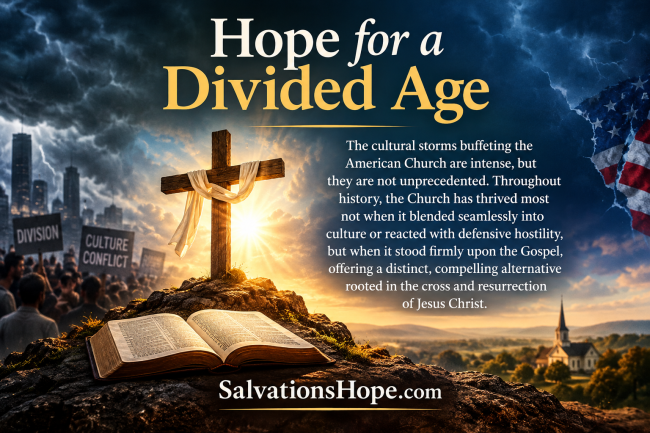
Hope for a Divided Age
The cultural storms buffeting the American Church are intense, but they are not unprecedented. Throughout history, the Church has thrived most not when it blended seamlessly into culture or reacted with defensive hostility, but when it stood firmly upon the Gospel, offering a distinct, compelling alternative rooted in the cross and resurrection of Jesus Christ.
Let us heed the call to reject both the compromise of worldly ideologies and the bitter spirit of partisanship. By holding fast to biblical truth, practicing authentic love, and looking forward to the city whose designer and builder is God, the Church can shine as a beacon of hope, unity, and healing in a deeply polarized world.