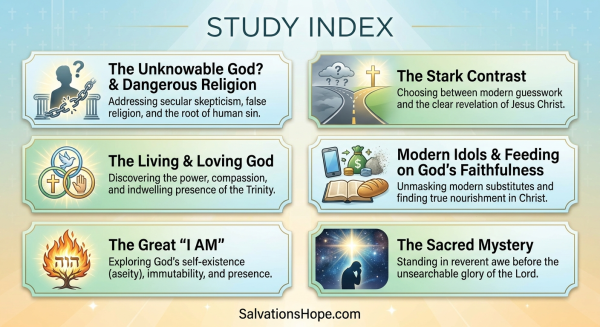
The Modern Dilemma
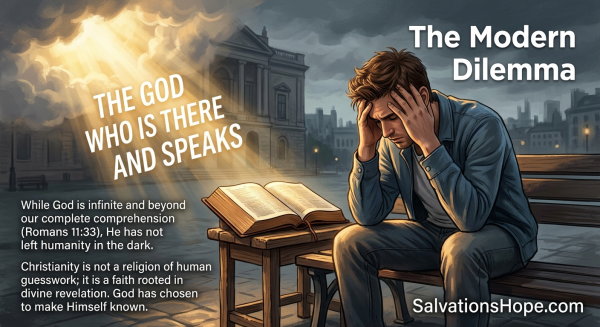
The God Who Is There and Speaks
The Modern Dilemma of an "Uninvolved" God
In our cultural landscape, many people resonate with veteran journalist Roger Rosenblatt’s perspective. In his writing about the divine, Rosenblatt captures a sentiment many modern thinkers share: he believes God exists. Still, he sees Him as utterly distant, unknowable, and detached from human affairs. In this view, prayer becomes quiet wonder rather than petition, and any claim that God cares for us personally is dismissed as human arrogance.
While this perspective presents faith as humble and modest, it leaves humanity isolated in a silent universe. Theological consensus states that God is incomprehensible but knowable. As Christians, how do we evaluate this view in light of Scripture? Does God truly remain silent and distant, or has He revealed Himself?
Is God Unknowable and Silent?
Because God is infinite and the human mind is finite, humanity can never fully exhaust or understand the depths of God’s entire being, thoughts, or plans.
so are my ways higher than your ways, and my thoughts than your thoughts.” (Isaiah 55:8-9)
Humanity can truly and personally know God because He has chosen to reveal Himself. Knowing God is not an intellectual puzzle to solve, but a relationship the Creator initiates. Christianity holds that God broke the ultimate silence by entering human history. The Scriptures are viewed as God’s active, living voice. Therefore, when people read or hear the biblical text, God is actively speaking.
The Experience of “The Silence of God”: Theology recognizes that humans frequently feel that God is silent, a painful experience documented heavily in the Bible (such as in the book of Job or the dark prayers of the Psalms). Christian thinkers usually attribute this experience to:
Human Limitations: Spiritual dullness, distraction, or unconfessed sin can hinder a person’s ability to perceive God’s presence.
Sovereign Purpose: Times of perceived silence are often understood as periods of testing or refining a person’s faith, pushing them to seek God deeply rather than relying on emotional experiences.
Alternative Forms of Communication: God may not speak in an audible or dramatic fashion, but rather in a “still, small voice” (1 Kings 19:12) or through the ordinary providential events of daily life.
- The Cultural View: Rosenblatt argues that trying to know what God thinks or seeking answers from Him is misguided. He suggests that genuine faith is simply "wonder" without seeking or finding.
- The Biblical Truth: While God is infinite and beyond our complete comprehension (Romans 11:33), He has not left humanity in the dark. Christianity is not a religion of human guesswork; it is a faith rooted in divine revelation. God has chosen to make Himself known.
“God, who at sundry times and in divers manners spake in time past unto the fathers by the prophets, hath in these last days spoken unto us by his Son, whom he hath appointed heir of all things, by whom also he made the worlds; who being the brightness of his glory, and the express image of his person, and upholding all things by the word of his power, when he had by himself purged our sins, sat down on the right hand of the Majesty on high” (Hebrews 1:1–3)
“No man hath seen God at any time; the only begotten Son, which is in the bosom of the Father, he hath declared him.”( John 1:18)
Throughout history, God has spoken through His prophets, and ultimately, He has spoken fully and clearly through His Son, Jesus Christ. Jesus is described as the exact representation of God’s being. Knowing Christ means knowing God’s heart, mind, and character.
Does God Care and Get Involved?
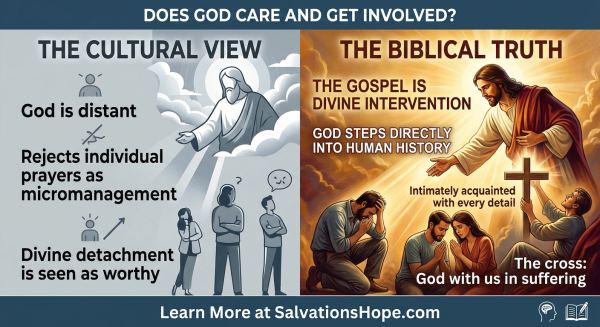
Secular humanism and materialism view the universe as a self-sustaining system governed by fixed natural laws rather than supernatural guidance. The idea that God listens to specific prayers or cares about individual lives is rejected as “micromanagement” or “good-hearted arrogance.” In secular thought, events—whether natural disasters, personal hardships, or historical milestones—happen through chance, human agency, or scientific causes, not divine design or intervention.
- The Cultural View: The prevailing thought is that a worthy God leaves us completely alone. Analysts warn that popular culture often reshapes how people perceive the divine (such as redefining love, prosperity, or morality to match current societal trends) rather than allowing Scripture to inform culture.
- The Biblical Truth: Scripture teaches that God cares about intimate details of human life, comparing it to numbering the hairs on a person's head (Luke 12:7) or knowing every sparrow (Matthew 10:29–31). The heart of the Gospel is not divine detachment, but divine intervention and incarnation—God stepping directly into human history and suffering to rescue us. Far from being indifferent, Scripture portrays a God intimately acquainted with every detail of His creation.
“O LORD, thou hast searched me, and known me. Thou knowest my downsitting and mine uprising, thou understandest my thought afar off. Thou compassest my path and my lying down, and art acquainted with all my ways. For there is not a word in my tongue, but, lo, O LORD, thou knowest it altogether.” (Psalm 139:1–4)
“Are not two sparrows sold for a farthing? And one of them shall not fall on the ground without your Father. But the very hairs of your head are all numbered. Fear ye not therefore; ye are of more value than many sparrows.” (Matthew 10:29–31)
Jesus explicitly rejected the idea that God is uninvolved. He taught that not even a sparrow falls to the ground outside the Father’s care, and that the very hairs on our heads are numbered. Prayer is not manipulation; it is a relational lifeline, children speaking to a loving Father who invites us to cast our anxieties on Him.
“casting all your care upon him; for he careth for you.” (1 Peter 5:7)
Morality, Image-Bearing, and Relationship
The secular view holds that morality, “image-bearing,” and relationship are grounded in human nature, biology, and social contracts, completely decoupled from divine authority. Because secularism does not presuppose a Creator, it translates the supernatural language of theology into immanent, functional, and evolutionary realities.
- The Cultural View: Rosenblatt detaches God from morality, suggesting we simply hope we behave in ways God might approve of, though we can never truly know. He also rejects the notion that humans are made in God's image.
- The Biblical Truth: Scripture affirms that human dignity rests entirely on the Imago Dei—the truth that God deliberately created every human being in His image (Genesis 1:27). Because God is holy and moral, His character defines goodness. He has not left us to guess at morality; He has written His law on our hearts and given us His Word as a lamp to our feet (Psalm 119:105).
Reflection Questions:
The Appeal of Distance: Why do you think a distant, uninvolved God is an appealing concept to many people in modern culture today?
Personal Experience vs. Scripture: Have you ever felt like God was silent or distant during a difficult season? How does the biblical picture of Jesus comforting and weeping with His people challenge that feeling?
The Purpose of Prayer: How does viewing God as a loving Father (rather than an indifferent cosmic force) change the way you approach prayer and bring your specific requests to Him?
The belief that “the only thing you can be sure of about God is that you can’t be sure of anything” offers quiet resignation, but no real hope. The Christian faith offers something infinitely better: a God who spoke, a God who entered our pain in Jesus Christ, and a God who invites us to call Him “Abba, Father.” We do not have to wander in the dark; an intimately near God knows us, loves us, and redeems us.
Confronting "Dangerous Religion" and the Problem of Evil
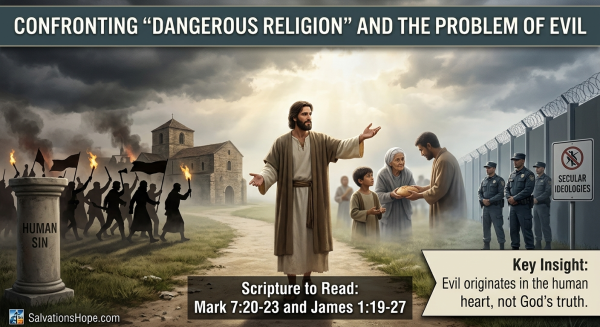
- The Cultural View: From the crusades and inquisitions to modern terrorism, history is littered with atrocities committed in the name of God. Thinkers like Roger Rosenblatt and novelist Salman Rushdie—who faced decades of death threats for his writing—argue that religion itself is a "poison in the blood." They suggest that claiming to know God’s will leads to fanaticism, so it is safer to keep God as an unknowable mystery or eliminate Him from human affairs altogether.
- The Biblical Truth: The Bible does not deny that religion can be weaponized; in fact, Scripture explicitly warns against false religion, hypocrisy, and violence masquerading as piety. However, the root cause of human cruelty is not belief in God—it is human sin.
Simply removing God does not eradicate human evil. In fact, secular ideologies in the 20th century that attempted to purge God from society (such as totalitarian Communist regimes) led to unprecedented oppression and the loss of tens of millions of lives. The issue is not that humans believe in God, but that human hearts are corrupted by sin.
“And he said, That which cometh out of the man, that defileth the man. For from within, out of the heart of men, proceed evil thoughts, adulteries, fornications, murders, thefts, covetousness, wickedness, deceit, lasciviousness, an evil eye, blasphemy, pride, foolishness: all these evil things come from within,and defile the man.” (Mark 7:20–23)
Jesus consistently confronted the religious leaders of His day who used God’s name to exploit and harm others. He taught that evil does not originate in God’s truth but in the human heart. True religion, according to Scripture, is marked by humility, love, mercy, and caring for the vulnerable—never by coercion or violence.
distress and to keep oneself unspotted by the world.” (James 1:27)
The Remedy for False Ideas About God
When people do terrible things in God’s name, the cultural reaction is to throw out all religious claims and conclude that no one can know what God is actually like.
The solution to false or toxic religion is not religion; it is true religion. We correct distorted views of God not by abandoning Him, but by turning to His ultimate self-revelation in Jesus Christ.
Jesus did not use force to compel obedience; He laid down His life for His enemies (Romans 5:8). When we look at the cross, we see the definitive response to religious violence: God taking the brunt of human cruelty onto Himself to forgive us and reconcile us.
“Ye have heard that it hath been said, Thou shalt love thy neighbour, and hate thine enemy. But I say unto you, Love your enemies, bless them that curse you, do good to them that hate you, and pray for them which despitefully use you, and persecute you; that ye may be the children of your Father which is in heaven: for he maketh his sun to rise on the evil and on the good, and sendeth rain on the just and on the unjust. For if ye love them which love you, what reward have ye? Do not even the publicans the same? And if ye salute your brethren only, what do ye more than others? Do not even the publicans so? Be ye therefore perfect, even as your Father which is in heaven is perfect.” (Matthew 5:43–48)
“Recompense to no man evil for evil. Provide things honest in the sight of all men. If it be possible, as much as lieth in you, live peaceably with all men. Dearly beloved, avenge not yourselves, but rather give place unto wrath: for it is written, Vengeance is mine; I will repay, saith the Lord. Therefore if thine enemy hunger, feed him; if he thirst, give him drink: for in so doing thou shalt heap coals of fire on his head. Be not overcome of evil, but overcome evil with good.” (Romans 12:17–21)
Unlike ideologies that promote hostility, Christ commands His followers to love their enemies, pray for those who persecute them, and overcome evil with good. When Christians commit acts of violence or arrogance, they are acting in direct opposition to the command and example of Jesus.
Reflection Questions:
Recognizing the Weight of Pain: How can we empathetically listen to people like Salman Rushdie who have suffered due to religious violence, while still pointing them toward the true character of God?
False Religion vs. Faithful Following: In what ways did Jesus challenge the “dangerous religion” of the Pharisees and religious elites during His earthly ministry?
Evaluating the Root Cause: Why is identifying human sin (rather than belief in God) essential for properly understanding the violence and cruelty present in human history?
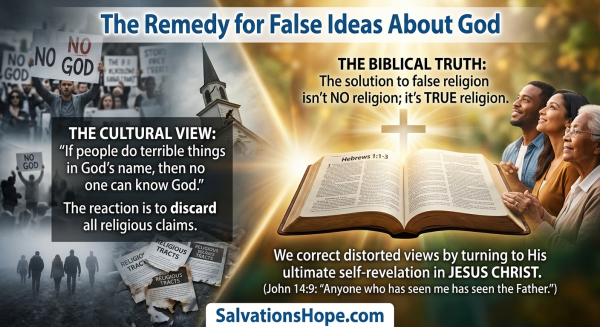
We do not need to defend human atrocities done in God’s name. Instead, we must humbly acknowledge human sin, reject counterfeit faith, and point a hurting world to Jesus Christ—the true image of the invisible God, who reveals a Father of boundless grace, justice, and sacrificial love.
Exposing Modern Idols and Feeding on the Living God
From a secular, psychological, and sociological perspective, the concepts of “exposing modern idols” and “feeding on the living God” translate directly into human behavior, cultural obsession, and the universal search for psychological fulfillment.
Stripped of theological language, modern idolatry is the psychological projection of ultimate value onto finite things, while “feeding on the living God” represents the human need to cultivate internal resilience, authentic connection, and deep intrinsic meaning.
- The Cultural View: Modern society prides itself on having moved past ancient idolatry. We no longer bow down to wooden or stone statues. However, in our attempt to reduce God to an unknowable mystery or eliminate Him, we inevitably construct new, subtle "false gods" to fill the void.
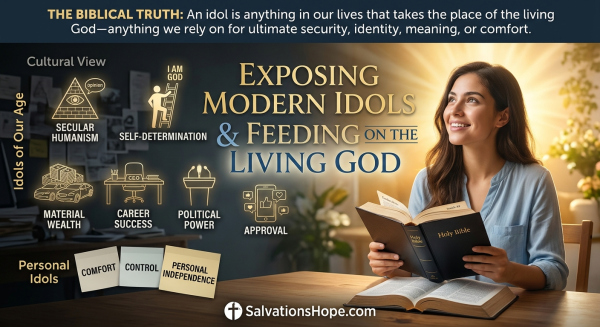
- The Biblical Truth: An idol is anything in our lives that takes the place of the living God—anything we rely on for ultimate security, identity, meaning, or comfort. When culture claims God is silent or distant, it usually sets up alternative deities in His place.
The Idols of Our Age: Secular humanism (making human opinion the supreme authority), self-determination, material wealth, career success, political power, and approval from culture.
The Idols in Our Personal Lives: Comfort, control, approval, and personal independence. When we treat these good things as ultimate things, they become false gods that leave us empty.
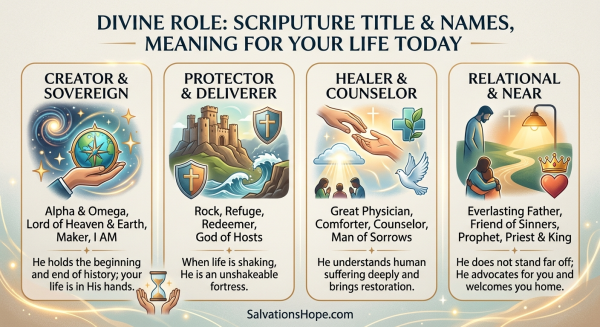
Scripture repeatedly calls us away from dead, artificial substitutes to the one true God who reveals Himself through a rich abundance of divine names and titles.
The Names and Character of the One True God
Trying to comprehend God’s fullness is like trying to capture the universe’s galaxies through a child’s simple prism. Yet, God actively desires to be known! He doesn’t leave us guessing; He reveals His character through His Word and through Jesus Christ.
Look at how Scripture reveals the majestic identity of our God:
- Yahweh / YHWH: The covenant-keeping, self-existent "I AM WHO I AM".
- Elohim: The mighty Creator God associated with power and authority.
- Adonai: Lord and Master.
- El Shaddai: God Almighty, the all-sufficient one.
- El Elyon: Most High God.
- El Olam: Everlasting God
"Feeding on His Faithfulness" — Finding True Nourishment
What does it mean to “feed on His faithfulness”? It means we daily nourish our hearts on His infinite attributes: His goodness, mercy, power, presence, promises, and love. Ultimately, it means drawing life from Jesus Christ, the Bread of Life (John 6:35).
Plunging into the knowledge of God is like stepping into a bottomless ocean—we can never reach the bottom, yet its waters endlessly refresh our minds and restore our souls.
- The Cultural View: If God cannot be known, human beings must feed their souls on human wisdom, self-help philosophy, or temporary worldly pleasures.
- The Biblical Truth: In Psalm 37:3, the Psalmist offers a striking command for daily Christian living:
“Trust in the Lord, and do good; dwell in the land, and feed on His faithfulness.” (Psalm 37:3)
The Ultimate Answer — Eternal Life in Knowing Him
On the final night of His earthly life before going to the cross, Jesus prayed a prayer that defines the core purpose of human existence:
“And this is eternal life, that they may know You, the only true God, and Jesus Christ whom You have sent.” (John 17:3)
Eternal life is not merely a future destination after death; it is an intimate, present relationship with the living God.
No matter where you are in your spiritual walk, you can know God more than you do now and be closer to Him than you are today. It is time to leave behind the false gods of our culture and draw near to the God who loves you more than you know—the eternal, immortal, invisible King, the only wise God, to whom be honor and glory forever and ever. Amen.
Reflection Questions:
Identifying Modern Idols: What are some “false gods” or subtle idols that dominate our culture today? Which ones do you find most tempting to trust instead of God?
Plumbing the Depths of God’s Character: Look over the table of divine names above. Which title of God speaks most directly to the situation or trial you are facing right now?
Practical Spiritual Growth: What does “feeding on God’s faithfulness” look like in your daily routine? How can you spend time this week meditating on His Word and drawing closer to Him?
The Stark Contrast — Human Speculation vs. Divine Revelation
The concept of “The Stark Contrast—Human Speculation vs. Divine Revelation” represents a foundational divide in epistemological thought, contrasting truth discovered through human intellect with truth received from a higher power. From a secular perspective, this dichotomy is not seen as a conflict between human error and perfect divine truth, but as a historical and psychological framework that human societies use to categorize different forms of knowledge, authority, and certainty.
- The Cultural View: Many secular commentators argue that because God is beyond human reason, He must be completely unknowable and uninvolved. From this vantage point, claims to know God are dismissed as arrogant, while embracing ignorance is framed as "generous and modest." However, this perspective makes an illogical leap: it assumes that because one person does not know God, no one can know God.
- The Biblical Truth: While it is true that human intellect alone cannot reach up to God, the heart of the Christian faith is that God has reached down to us. Christianity does not rely on human guessing games; it rests entirely on God's intentional self-revelation.
When we place modern secular philosophy side by side with the teachings of Jesus, we encounter a stark, unmistakable choice:
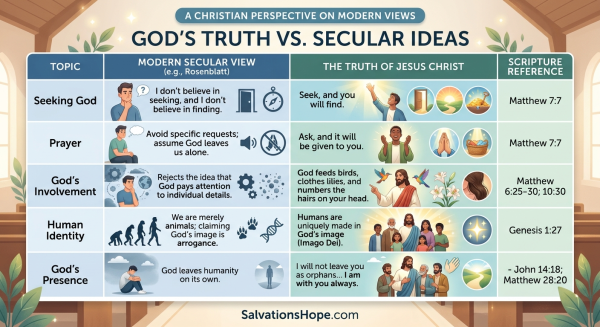
True Modesty vs. Spiritual Presumption
From a secular perspective, the tension between true modesty and spiritual presumption is viewed through psychology, social ethics, and cognitive science. Rather than framing these concepts as relationships with a deity, a secular approach redefines them as measures of intellectual humility, self-awareness, and psychological health.
- The Cultural View: Proponents of an unknowable God claim that stripping faith of specific doctrines makes religion "more generous and modest."
- The Biblical Truth: Is it truly generous to strip away the promises of God's love, comfort, and eternal life? Is it modest for a human being—who admits to knowing nothing about God—to flatly contradict the Jesus who came from the Father?
True modesty is not making our own spiritual ignorance the universal rule. True humility is acknowledging our finite limitations and submitting to what God has clearly revealed about Himself through His Son.
but he that sent me is true, whom ye know not. But I know him: for I am from him, and he hath sent me.”(John 7:28–29)
“O righteous Father, the world hath not known thee: but I have known thee, and these have known that thou hast sent me. And I have declared unto them thy name, and will declare it: that the love wherewith thou hast loved me may be in them, and I in them.”(John 17:25–26)
Jesus speaks with unique, absolute authority because He alone knows the Father intimately from all eternity. He did not come to offer speculative opinions, but to reveal God’s true character, truth, and sacrificial love to humanity.
The Joy of Being Known and Loved
The idea of a distant, unknowable God might seem convenient at first—it allows us to pursue our own lives without accountability or spiritual commitment. But it leaves us in a cold, lonely universe where prayer goes unheard, and life has no ultimate divine purpose.
If God genuinely wants to be known—if He has spoken in Scripture, befriended us in Jesus Christ, and offered us eternal life—then ignoring Him is a tragic loss. Knowing Him, however, brings the greatest possible joy, freedom, and transformation.
Reflection Questions:
Evaluating Authority: Who is better qualified to tell us what God is like: a culture that openly admits its own ignorance of God, or Jesus Christ, who demonstrated God’s power, holiness, and love in history?
The Nature of True Humility: Why is accepting God’s divine revelation in Jesus an act of true humility, whereas insisting God cannot be known is actually a form of spiritual pride?
Personal Application: How does knowing that God tracks every detail of your life—down to the hairs on your head—change the way you bring your daily worries and prayers to Him this week?
Final Takeaway:
God is not silent: He has spoken clearly through His Son, Jesus Christ (John 1:18).
God is not distant: He cares deeply about the details of your life and invites you to ask, seek, and knock (Matthew 7:7).
True faith is relational: Rather than settling for cold wonder toward an unknown deity, we are invited into a personal, loving relationship with our Heavenly Father.
The Power of the Living God
- The Cultural View: Modern skepticism often treats God as a static, abstract concept, a distant force, or a dead philosophical formula. In this view, God neither acts in history nor intervenes in individual human lives.
- The Biblical Truth: Scripture repeatedly reveals God as "the living God." He is not an idle spectator, a cold principle, or an artificial idol. He is dynamic, all-powerful, and actively involved in human history and in restoring individuals.
Throughout Scripture, the living God acts decisively on behalf of those who trust Him:
Creation & Deliverance: The living God spoke the cosmos into existence, parted the Red Sea for Israel, and spoke from the fire at Mount Sinai (Deuteronomy 5:26).
Protection & Victory: Young David defeated Goliath because he stood in the authority of “the living God” (1 Samuel 17:36). King Hezekiah witnessed Jerusalem rescued from Assyria because the enemy insulted the living God (2 Kings 19:16). Daniel survived the lions’ den because he trusted the God who “is the living God and endures forever” (Daniel 6:26).
Because He is real and active, our hearts were made to hunger for Him above all else.
“My soul thirsts for God, for the living God. When can I go and meet with God?” (Psalm 42:2)
Jesus Christ — The Exact Representation of the Living God
From a secular and historical perspective, the phrase “the exact representation of the living God” is viewed not as a metaphysical or supernatural reality, but as a theological claim developed by early Christian writers like the author of Hebrews. Secular historians and critical biblical scholars evaluate Jesus of Nazareth as a first-century Jewish teacher, prophet, or healer who lived and died in Roman-occupied Palestine, rather than as an incarnate deity. Scholars and secular thinkers (such as those exploring a “secular Jesus”) reframe his legacy around his earthly, humanitarian ethics—focusing on anti-establishment social critiques, compassion for the marginalized, and calls for economic and moral justice rather than metaphysical claims about divine substance.
- The Cultural View: Many find it comfortable to leave God wrapped in a vague, intellectual fog—claiming all religions are equally uncertain or that no one can truly know Him.
- The Biblical Truth: When the spiritual fog clears, we see Jesus Christ. God has not left Himself to human speculation; He has fully revealed Himself in flesh and blood. When Peter confessed, "You are the Christ, the Son of the living God" (Matthew 16:16), he recognized that Jesus is the exact representation of God's being (Hebrews 1:3).
Everything Jesus says, God says. Everything Jesus does, God does. Everything Jesus is, God is.
His Words: Jesus spoke with absolute divine authority, teaching truth that cuts through human tradition.
His Miracles: He healed the paralyzed, restored sight to the blind, quieted raging storms with a word, and raised the dead.
His Presence: Jesus declared clearly, “Anyone who has seen me has seen the Father” (John 14:9).
To reject or ignore Jesus is to reject the living God Himself.
From Judgment to Adoption
A secular view of “From Judgment to Adoption” shifts the concepts from a supernatural, theological framework to an anthropological, sociological, and psychological one. In religious thought—particularly Christian theology—this phrase describes the spiritual transition of a human being from a state of condemnation under divine law (Judgment) to becoming a child of God through grace (Adoption).
- The Cultural View: Seeing God as distant means we never have to face our sin, be accountable, or need a Savior.
- The Biblical Truth: Turning away from the living God carries solemn consequences. Scripture warns that it is "a dreadful thing to fall into the hands of the living God" (Hebrews 10:31) when we persist in unbelief and sin. Left on our own, we are estranged from Him.
Yet, through the Gospel of Jesus Christ, God offers astonishing grace and transformation:
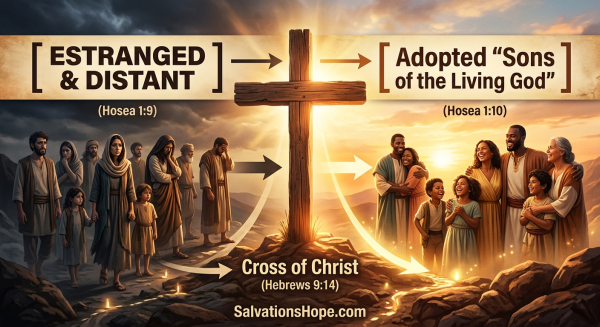
Redemption through His Blood: Jesus offered Himself to cleanse our consciences so that “we may serve the living God” (Hebrews 9:14).
A New Identity: Where it was once said, “You are not my people,” believers are now called “sons of the living God” (Hosea 1:10).
The Temple of God: The Holy Spirit dwells within believers, making us “the temple of the living God” (2 Corinthians 6:16).
Living Testimony: Through faith, your life becomes a message of hope—a “letter from Christ… written not with ink but with the Spirit of the living God” (2 Corinthians 3:3).
Reflection Questions:
The Character of the Living God: Contrast a “dead idol” or an abstract force with the biblical description of “the living God.” How does knowing God is alive change what you expect when you pray?
Seeing God in Jesus: Read John 14:8–10. How does focusing on the person, teachings, and compassion of Jesus remove the “fog” around what God is really like?
Living as a “Letter from Christ”: Paul says believers are letters from Christ written by the Spirit (2 Corinthians 3:3). What message about the living God is your life showing to those around you?
Final Takeaway:
God is Active: The living God speaks, heals, saves, and reigns forever.
Jesus is the Full Revelation: You don’t have to wonder what God is like—look at Jesus Christ, the Son of the living God.
Faith Brings Transformation: Through Jesus, we move from spiritual darkness to becoming the living God’s temple and testimony.
The Loving God — Divine Power Driven by Divine Compassion
From a secular perspective, the concept of a loving god—or divine power driven by divine compassion—is viewed through the lenses of anthropology, psychology, philosophy, and sociology rather than as a supernatural reality. Secular thinkers like Ludwig Feuerbach argued that gods are human projections. The idea of a “loving, compassionate deity” reflects humanity’s deep emotional desire for security, unconditional acceptance, and protection against a neutral, often indifferent universe. From an evolutionary standpoint, empathy, altruism, and compassion are survival traits that helped early human tribes cooperate and bond. Attributing these traits to a higher power serves as a cultural mechanism to reinforce prosocial behavior, trust, and community stability.
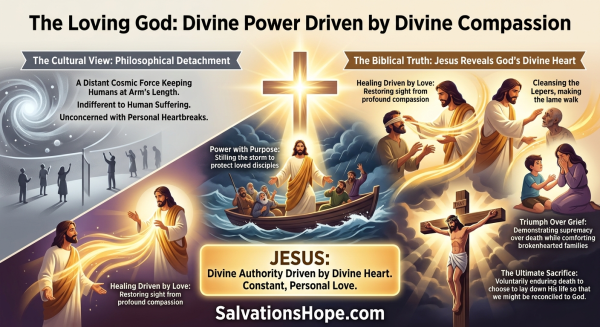
- The Cultural View: Philosophical detachment presents God as a distant cosmic force that keeps humans at arm's length. Under this view, if God exists, He remains indifferent to human suffering and unconcerned with our personal heartbreaks.
- The Biblical Truth: Jesus does not merely reveal God's divine authority; He reveals God's divine heart. Throughout the Gospels, Christ's miraculous power is consistently tied to His deep, personal love for individuals.
Power with Purpose: When Jesus stilled the storm on the Sea of Galilee, He was not simply demonstrating control over the elements—He was protecting the disciples He loved.
Healing Driven by Love: When He restored sight to the blind, cleansed the lepers, and made the blind walk, His actions flowed from profound compassion.
Triumph Over Grief: When Jesus raised the dead, He demonstrated His supremacy over death while simultaneously comforting brokenhearted families.
The Ultimate Sacrifice: At the cross, Jesus voluntarily endured suffering and death, demonstrating that He chose to lay down His life so that we might be reconciled to God.
Scripture summarizes God’s nature in three profound words: “God is love” (1 John 4:8, 16).
Experiencing the Depth of Christ's Love
From a secular or non-religious perspective, “experiencing the depth of Christ’s love” is understood not as a supernatural or divine event, but as a psychological, emotional, and social phenomenon. The feeling of being deeply loved or accepted—often personified through the figure of Jesus—triggers the brain’s attachment and reward systems, releasing neurochemicals like oxytocin and dopamine that reduce stress and fear. The “depth” of love attributed to Christ is viewed by secular humanists as an idealization of radical empathy, unconditional positive regard, and self-sacrifice that humans are capable of showing one another.
- The Cultural View: Viewing God as an unknowable mystery leaves us spiritually empty and reduces faith to cold speculation.
- The Biblical Truth: The Christian call is not to stay at a distance in intellectual ambiguity, but to experience the vastness of divine love. The Apostle Paul prayed that believers would have the spiritual strength to comprehend the full dimensions of Christ's love—a love so vast that it surpasses human intellect alone.
“…to know this love that surpasses knowledge—that you may be filled to the measure of all the fullness of God.” (Ephesians 3:19)
As we receive this love through faith, it transforms our character. The true evidence that someone genuinely knows the loving God is that they grow to reflect His sacrificial love toward others.
The Indwelling Spirit and the Trinitarian Promise
From a secular, historical-critical, and psychological perspective, the concepts of the Indwelling Spirit and the Trinitarian Promise are analyzed not as divine realities, but as sophisticated socio-cultural mechanisms, linguistic frameworks, and psychological constructs that helped early Christianity survive, unify, and offer a powerful emotional appeal to its adherents. Rather than evaluating the theological truth of these doctrines, a secular view examines why these ideas developed, how they functioned in human society, and what psychological needs they met.
- The Cultural View: God is far away, leaving humanity to navigate life in complete isolation.
- The Biblical Truth: God is not distant. As the Apostle Paul declared to the Athenians, God is near to everyone and desires that people seek Him and find Him (Acts 17:27).
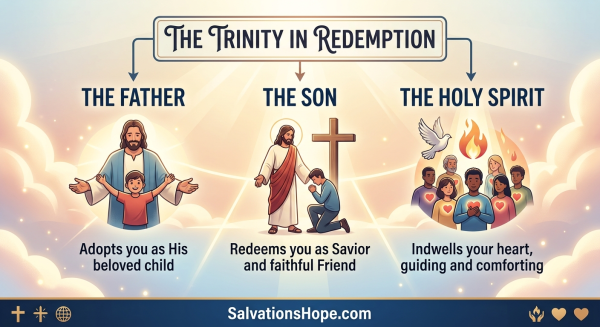
In the Gospel, God comes as close as possible by indwelling believers through the Holy Spirit. Through the work of the Trinity, our relationship with God is fully realized:
God the Father adopts us into His family and watches over every detail of our lives.
God the Son reconciles us to God, serving as our Savior, Advocate, and Friend.
God the Holy Spirit lives within believers, empowering us, conforming us to the image of Christ, and providing comfort and direction in every season.
Reflection Questions:
Love in Action: How does viewing Jesus’ miracles through the lens of compassion (rather than just power) alter your understanding of God’s character?
Reflecting God’s Heart: If the evidence of knowing God is becoming a more loving person, what is one practical way you can demonstrate Christ’s love to someone in your life this week?
The Nearness of God: How does the reality of the Holy Spirit living within you comfort you during times when God feels distant or silent?
Final Summary:
God’s Nature: God is not a cold, unfeeling force; He is the living, loving Father who actively draws near to us.
God’s Revelation: In Jesus Christ, we see love fully demonstrated on the cross and through His resurrection.
God’s Presence: Through the Holy Spirit, the living God makes His home within believers, providing strength, comfort, and ongoing transformation.
The Great "I AM" — The Mystery and Meaning of God’s Name
From a secular, historical-critical, and linguistic perspective, scholars analyze the phrase “I AM” (ehyeh) and the divine name Yahweh (YHWH) in Exodus 3:14–15 through ancient Near Eastern texts, Hebrew grammar, and the evolution of religious thought, rather than as supernatural revelation.
- The Cultural View: Modern culture frequently attempts to remold God into whatever humans want Him to be. People say, "I like to think of God as..." or "My God would never..." as though God adjusts His identity, values, or character to suit shifting human preferences and social trends.
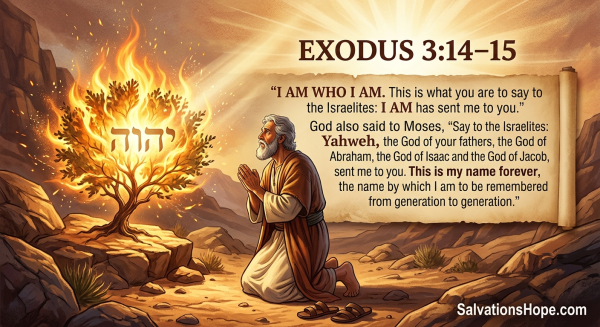
- The Biblical Truth: God does not adapt Himself to match human imagination. When Moses encountered the Lord at the burning bush and asked for His name, God revealed Himself not as a vague energy field or a flexible concept, but as the supreme, personal Lord of reality.
The divine name Yahweh (often translated as “the Lord” in English Bibles and derived from the Hebrew root for “being”) reveals that God is completely self-existent, eternal, and distinct from everything He created.
Understanding God's "Aseity" and Immutability
Why can God truthfully say “I AM WHO I AM,” while no human being ever could?
Self-Existence (Aseity): If a human says “I am who I am,” it is not strictly true. Our existence depends on our parents, our surroundings, time, and ultimately God Himself. We are contingent beings. God, however, possesses aseity (from the Latin a se, meaning “from Himself”). He did not come into existence; He depends on no one to sustain Him, and He has no beginning or end. He is the ultimate source of all life.
Unchanging Nature (Immutability): Because God is self-existent and sovereign over creation, He never changes. As Malachi 3:6 declares: “I, Yahweh, do not change.”
No Weaknesses to Overcome: He cannot acquire new wisdom or outgrow flaws because He is already infinitely perfect.
No Re-invention: God never updates His character or morals to match human culture. He is not “whoever you want Him to be”—He is who He is.
Absolute Dependability: Because His character and promises never shift, His Word remains completely trustworthy from generation to generation.
High and Holy, Yet Present and Near
From a secular perspective, the phrase “High and Holy, Yet Present and Near” maps onto a universal tension in human psychology, philosophy, and sociology: the balance between the transcendent and the imminent. Rather than describing a literal deity, a secular analysis views these concepts as expressions of how humans experience meaning, structure reality, and navigate existence.
- The Cultural View: An unchangeable, self-existent God sounds distant, cold, or disconnected from practical human struggles.
- The Biblical Truth: God's self-existence does not mean He remains in isolated detachment. When Yahweh revealed His name to Moses, He was stepping in to rescue Israel from Egyptian slavery. The "I AM" was not simply stating that He exists—He was declaring, "I AM HERE with you."
Deliverance: For the enslaved Israelites, Yahweh’s presence meant the end of oppression because no human empire could stand against the eternal “I AM.”
Relationship: For believers today, His presence guarantees freedom from spiritual bondage and the privilege of walking in a daily, covenant relationship with Him.
Worship: When we sing “Hallelujah” (Hallelu-Yah), we are directly praising Yahweh—glorifying the great “I AM.”
Yet, as glorious as the name Yahweh was to Israel, God was not done revealing Himself. To fully grasp the magnitude of “I AM WHO I AM,” we must turn our eyes to Jesus Christ.
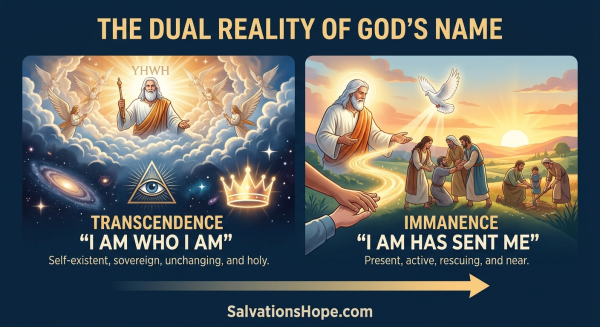
Discussion Questions:
Reclaiming God’s Sovereign Identity: How does remembering that God is “I AM WHO I AM” guard us against creating a “god” in our own image that simply mirrors our personal desires?
The Comfort of Immutability: In a world where culture, relationships, and circumstances change constantly, how does God’s unchanging nature (Malachi 3:6) give you peace?
Praising Yahweh: How does knowing the deep meaning of the name Yahweh change how you read the Old Testament and worship God in prayer?
The Sacred Mystery — Knowing God and Standing in Awe
A secular view of the sacred mystery and standing in awe replaces the traditional idea of a personal deity with a direct, naturalistic encounter with the vastness of the universe, nature, and human consciousness. Instead of looking toward a supernatural creator, secular awe is triggered by physical reality—such as deep-space imagery, towering ancient forests, oceanic expanses, or the intricate complexity of biological evolution.
- The Cultural View: Modern skepticism often assumes that unless something can be fully dissected, cataloged, and comprehended by human reason, it cannot be trusted. Conversely, religious presumption sometimes falls into the trap of thinking we have "figured God out"—reducing the Almighty to a manageable set of doctrines or a predictable formula.
- The Biblical Truth: The more God reveals Himself to us, the more we realize the sheer depth of His glory. Growth in the Christian life does not lead to cozy familiarity or spiritual pride; it leads to deeper reverence, wonder, and holy awe.
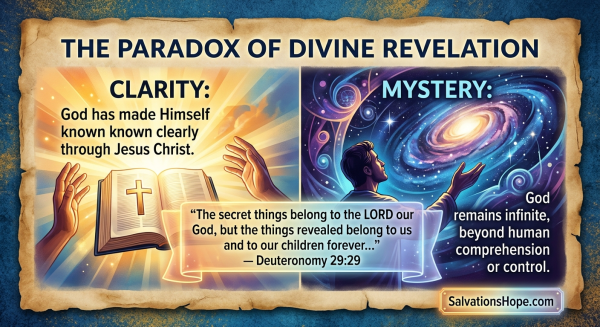
Scripture shows that even as God draws near to His people, He protects the majesty of His holy name and identity.
Old Testament Encounters with the Mysterious Stranger
Throughout the Old Testament, God repeatedly revealed His presence while withholding the full extent of His identity from those who sought to manage or box Him in:
Jacob at Peniel (Genesis 32:29): After wrestling with a divine messenger all night, Jacob asked, “Please tell me your name.” The response was a gentle rebuke and a blessing: “Why do you ask my name?” Jacob received grace and a new identity (Israel), but he was not permitted to possess or control God’s name.
Manoah and His Wife (Judges 13:18): When the parents of Samson asked the Angel of the LORD His name, He replied: “Why do you ask my name? It is beyond understanding” (or “It is wonderful”). In an instant, He ascended into heaven in a flame.
Why did God withhold His name in these encounters?
To Guard His Sovereignty: God is not a subject to be analyzed or a deity whose power can be manipulated through incantations or name-dropping.
To Remind Us of His Infinity: No human label, word, or concept can ever fully contain the fullness of “I AM WHO I AM.”
The Unsearchable Name — Revelation and Reverence
Even today, in an age of fuller revelation—where we know God as our Father, call upon the saving name of Jesus, and are baptized into the name of the Father, Son, and Holy Spirit—we must never treat God with casual indifference or intellectual arrogance.
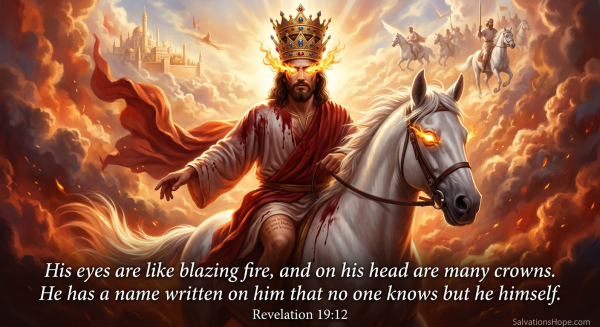
In the final book of the Bible, Jesus is revealed in cosmic glory, crowned as King of kings. Yet, Scripture notes that He possesses “a name written on him that no one knows but he himself.”
What we DO know brings boundless joy, salvation, and assurance.
What we DO NOT know inspires eternal wonder, humility, and worship.
Jesus is the name above all names, the great “I AM” made flesh—yet He remains the infinite God whose glory extends far beyond human comprehension. True faith rests securely in what God has revealed, while bowing in humble adoration before the mystery of who He is.
Reflection and Discussion Questions:
Balancing Intimacy and Reverence: How can we cultivate a close, personal relationship with God as our Father while maintaining deep reverence for His infinite majesty?
The Danger of Presumption: In what ways do Christians sometimes act as if they have “figured God out”? How does Revelation 19:12 challenge that mindset?
Worship in Wonder: When was the last time you were brought to silent awe by the mystery and glory of God? How does reflecting on His vastness refresh your spirit?