Zombie Church
The Sardis Syndrome
The "Living Dead" Church in Revelation 3:1–6
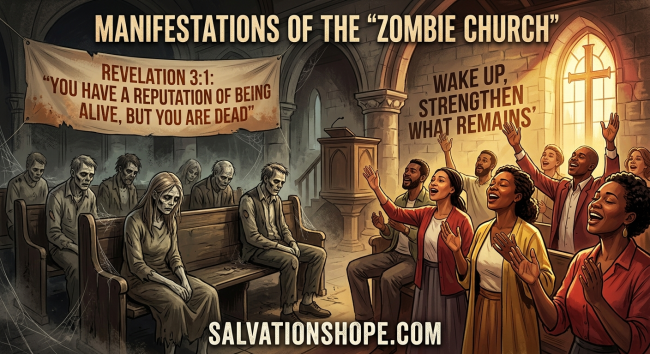
“And to the angel of the church in Sardis write: ‘The words of him who has the seven spirits of God and the seven stars. I know your works. You have the reputation of being alive, but you are dead. Wake up, and strengthen what remains and is about to die, for I have not found your works complete in the sight of my God. Remember, then, what you received and heard. Keep it, and repent. If you will not wake up, I will come like a thief, and you will not know at what hour I will come against you. Yet you have still a few names in Sardis, people who have not soiled their garments, and they will walk with me in white, for they are worthy. The one who conquers will be clothed thus in white garments, and I will never blot his name out of the book of life. I will confess his name before my Father and before his angels. He who has an ear, let him hear what the Spirit says to the churches.” (Revelation 3:1–6)
Modern Parallels to Ancient Realities
Every Halloween, culture indulges in a playful obsession with the macabre. Children dress up in ghastly attire—skeletons, ghosts, or graphic figures of death—pretending to be dead while pulsing with vibrant, youthful life. In modern cinema, horror narratives frequently center on the trope of the zombie: physical bodies devoid of actual life, yet walking, moving, and infecting others with their death.
While such imagery functions as mere pop-culture fiction, the New Testament warns of a far more unsettling spiritual reality: a church that appears physically active yet is spiritually dead.
In the Book of Revelation, the Lord Jesus Christ speaks to seven historic assemblies in Asia Minor. When He addresses the church in Sardis (Revelation 3:1–6), He exposes a terrifying phenomenon: a congregation that did the exact opposite of a Halloween costume. Rather than vibrant living people pretending to be dead, it was a gathering of spiritually dead people pretending to be alive.
The City and the Church of Sardis
To understand Christ’s indictment, we must examine both the historical context of Sardis and the literary structure of His message.
The Historical Background of Sardis
Located about 30 miles south of Thyatira, Sardis was an ancient city once the proud capital of the Lydian Empire. Famous for its wealth and impregnable mountain fortress, Sardis fell twice to invaders (Cyrus of Persia in 549 BC and Antiochus the Great in 218 BC) because of a single fatal flaw: overconfidence that led to spiritual and physical slumber. The city’s guards felt so secure atop their high cliffs that they failed to keep watch, allowing enemy soldiers to scale the rocks silently in the night.
By the late first century AD, Sardis rested entirely on its past glory. It had a grand history, but its present reality was decay and complacency.
Christ’s Self-Revelation (v. 1a)
“To the angel of the church in Sardis write: These are the words of him who holds the seven spirits of God and the seven stars…”
Jesus reveals Himself with two attributes directly from Revelation 1:
- "The seven spirits of God": A reference to the fullness and perfection of the Holy Spirit (cf. Isaiah 11:2; Revelation 4:5). Christ alone possesses the Spirit who imparts true, biologically transcending life (zoe).
- "The seven stars": Representing the leaders/angels of the churches (Revelation 1:20). Christ maintains sovereign authority over His church.
By introducing Himself this way, Christ reminds Sardis that true spiritual life comes only through the Holy Spirit, whom He dispatches into His church.
The Indictment: Reputation vs. Reality (v. 1b)
Unlike His letters to Ephesus, Pergamum, or Thyatira, Christ offers no initial word of commendation to the church at Sardis. He moves immediately to diagnosis:
“I know your deeds; you have a reputation (onoma) of being alive, but you are dead (nekros).”
The False Name (Onoma)
The Greek word translated as “reputation” is onoma, literally meaning “name.”
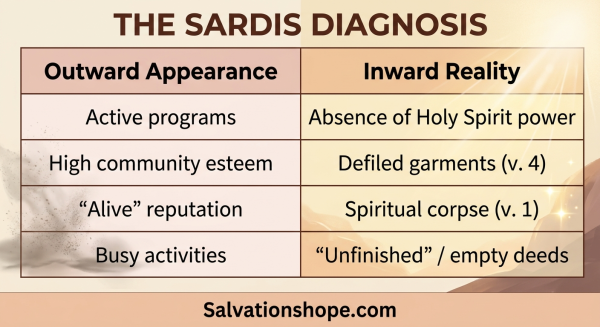
The World’s Assessment: To surrounding congregations, denominational experts, and community members, Sardis was a model church. They had a “name” for vitality. They likely had impressive meeting places, robust budgets, bustling program schedules, and high attendance.
The Sociological Illusion: A church can maintain high activity through human energy, financial capital, and organizational efficiency long after the Holy Spirit has ceased moving within it.
The Divine Diagnosis (Nekros)
Christ uses the absolute term nekros—a corpse. While the congregation engaged in religious performance—wearing an attractive mask of orthodoxy, fellowship, and ministry—behind the mask lay spiritual death. They were going through the motions of faith without the life giving power of the Holy Spirit.
The Theological Problem: Unfinished Works (v. 2)
“Wake up! Strengthen what remains and is about to die, for I have found your deeds unfinished (plēroō) in the sight of my God.”
Why does Christ classify their deeds as “unfinished” or “incomplete” (ou plēroō)?
Activity Without Authenticity: The works were outwardly impressive but lacked the essential inward motivation—faith rooted in true union with Christ and love for God (cf. 1 Corinthians 13:1–3).
Form Without Power: Like the Pharisaical hypocrisy condemned in the Gospels, Sardis held to a form of godliness while denying its power (2 Timothy 3:5). They performed religious tasks, but not to the standard of God’s holy requirements.
Just as a physical zombie moves without genuine biological life, a church operating in spiritual death mimics ministry without generating eternal fruit. Left unchecked, such a congregation exerts a lethal influence: it converts seekers not to Christ, but to a lifeless form of institutional religion.
The Imperatives: Christ’s Mandate for Renewal (vv. 2–3)
Christ does not leave Sardis without hope. He issues five urgent, imperative commands:
- Be Watchful (Grēgoreō): "Wake up!" This command would ring clearly in Sardis, recalling the historical moments when their city fell because the sentries fell asleep.
- Strengthen (Stērizō): Consolidate and revive the small sparks of genuine faith that remain before they are entirely extinguished.
- Remember (Mnēmoneuō): Call to mind the apostolic gospel they originally received and heard.
- Hold Fast (Tēreō): Cling strictly to divine truth rather than cultural popularity or religious routine.
- Repent (Metanoeō): Turn decisively from self-sufficiency and dead orthodoxy back to dependence on the living Christ.
The Warning (v. 3b): “If you do not wake up, I will come like a thief, and you will not know at what time I will come to you.”
If they refuse to repent, Christ will come in sudden temporal judgment—removing their lampstand and exposing their emptiness.
Application for the Contemporary Church
The message to Sardis remains a sobering warning for the modern church.
Resist Evaluating Ministry by Metrics: Buildings, budgets, and baptism counts can obscure an underlying lack of spiritual health. God evaluates a church by heart purity, gospel fidelity, and reliance on the Spirit.
Beware of “Dead Orthodoxy”: Correct creedal statements combined with active church schedules do not automatically equate to spiritual life.
Cultivate Inward Reality Over Outward Impression: True spiritual vitality manifests in holiness, sincere love, prayerfulness, and radical obedience—not merely in dynamic production or public reputation.
Exegetical Deep-Dive: The Mechanics of Spiritual Hypocrisy
To fully unpack Christ’s indictment in Revelation 3, we must analyze the theological root of the Sardis condition: hypocrisy (hypokrisis).
While Revelation 3 exposes the corporate reality of a dead church, Christ’s teachings in the Gospels and the Pastoral Epistles detail the individual mechanisms that produce this phenomenon.
Etymology and Exegesis of the "Mask"
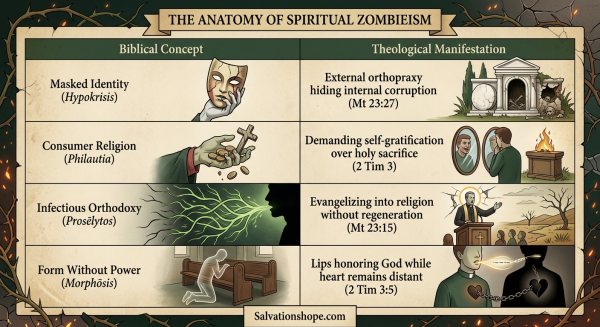
The English word hypocrite derives from the Greek theatrical term ὑποκριτής (hypokritēs), which originally denoted an actor on stage who wore an exaggerated visual mask to portray a persona.
In biblical theology, hypocrisy occurs when an individual or congregation engages in spiritual performance—wearing a mask of piety and orthodoxy—while the heart remains unregenerate or severely decayed.
The Self-Deception Factor: Unlike stage actors who know they are performing, spiritual hypocrites often fall victim to self-deception. They mistake religious busyness for genuine sanctification and confuse the acclaim of peers with the approval of God.
The “Whitewashed Tomb” Paradigm: Jesus used vivid, ceremonial imagery in Matthew 23:27–28 to describe this dichotomy:
Whitewashed Exterior (Ritual Purity) Internal Decay (Dead Men’s Bones)
In ancient Israel, tombs were whitewashed annually to prevent passersby from accidentally touching them and incurring ceremonial uncleanness (Numbers 19:16). The bright, pristine exterior hid rotting corpses within. Likewise, a “zombie church” maintains a polished public reputation—fine architecture, smooth production, engaging programs—while housing spiritual deadness.
The Consumer Gospel: The "Goodies" vs. The Gospel
The Demands of the Unrenewed Heart
A primary driver of church deadness is the shift from covenantal discipleship to consumerist gratification. In a Halloween framework, masked participants demand treats under the implicit threat of disruption. In an unrenewed church culture, congregants operating in the flesh exert similar pressure:
They demand a “candy gospel”—messages focused on self-fulfillment, comfort, and low commitment—rather than the radical call to take up the cross (Luke 9:23). When leadership fails to deliver their preferred religious preferences, conflict and division follow, revealing a heart seeking self-gratification rather than the glory of God.
The Infectious Nature of Dead Orthodoxy (Matthew 23:15)
Dead churches aren’t necessarily dormant; they are often aggressively misdirected. Jesus warned the Pharisees:
and when he becomes one, you make him twice as much a child of hell as you are.” (Matthew 23:15)
When a spiritually dead church engages in evangelism or recruitment without the regenerating power of the Gospel, it converts people to religious institutionalism rather than to saving faith in Christ. It multiplies spiritual deadness, inoculating converts against genuine grace by giving them false assurance through outward participation.
Sociological and Pastoral Diagnostics: "Religion Up, Morality Down"
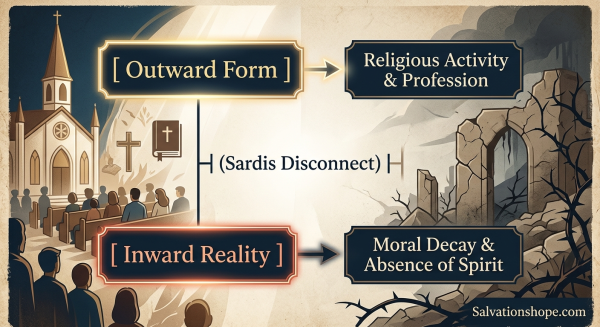
The disconnect between public religious profession and private moral practice is an empirical hallmark of the Sardis condition.
"Nominalism" (In Name Only)
When culture embraces high levels of religious affiliation alongside rampant moral decay—such as widespread greed, sexual immorality, dishonesty, and relational breakdown—it mirrors the prophetic critique in Matthew 15:8:
“These people honor me with their lips, but their hearts are far from me.”
Biblical faith is never purely conceptual or verbal; true regeneration (palingenesia, Titus 3:5) inevitably produces visible, transformed ethical fruit.
Living for Pleasure vs. Living for God (1 Timothy 5:6; 2 Timothy 3:2–5)
Paul offers an explicit theological definition of the “living dead” in the Pastoral Epistles:
“But she that liveth in pleasure is dead while she liveth.” (1 Timothy 5:6)
The Greek word spatalaō refers to self-indulgent, luxurious, or sensuous living. Prioritizing personal comfort over spiritual fidelity induces a state of functional spiritual death.
“For men shall be lovers of their own selves, covetous, boasters, proud, blasphemers, disobedient to parents, unthankful, unholy, without natural affection, trucebreakers, false accusers, incontinent, fierce, despisers of those that are good, traitors, heady, highminded, lovers of pleasures more than lovers of God; having a form of godliness, but denying the power thereof: from such turn away.” (2 Timothy 3:2–5)
Paul lists characteristics of the end-time fallen condition: lovers of self (philautoi), lovers of money (philargyroi), and lovers of pleasure rather than lovers of God. The climax of his description is verse 5: “…having a form (morphōsis) of godliness, but denying its power (dynamis).”
Morphōsis refers to the external outline or silhouette. The zombie church retains the outline of Christian tradition—doctrines, order of service, vocabulary—while actively denying or operating apart from the supernatural dynamis (power) of the Holy Spirit that transforms lives.
The Remedy: Moving from Reputation to Resurrection
The message of Revelation 3 and the broader biblical witness is clear: Christ offers complete restoration to the dead or dying church that turns to Him.
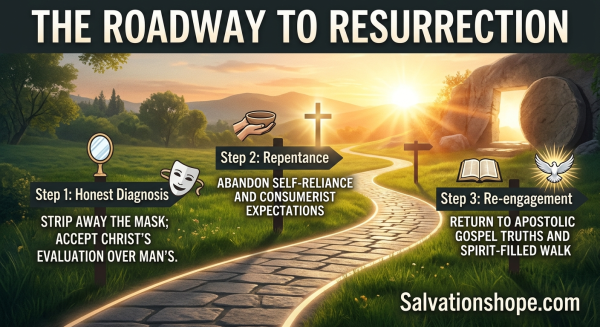
Strip Away the Mask: Leaders and congregations must prioritize divine approval over human accolades, auditing their ministries not merely by numerical metrics (attendance, building size, budget) but by spiritual fruit (holiness, prayerfulness, love, gospel fidelity).
Reclaim the Power of the Gospel: A form of godliness cannot save or sanctify. Churches must rely entirely on the Holy Spirit’s conviction, regeneration, and ongoing empowering.
Walk in True Life: Genuine spiritual vitality appears when the inward heart matches the outward testimony—when a church stops pretending to be alive and relies fully on the resurrected Lord who alone holds the breath of life.
Historical and Canonical Perspectives: Can the Dead Live Again?
Having diagnosed the nature of spiritual deadness (hypokrisis) and its systemic manifestation in the “zombie church,” we arrive at the central theological question posed by Revelation 3: Is the divine diagnosis of death an irreversible sentence, or an invitation to resurrection?
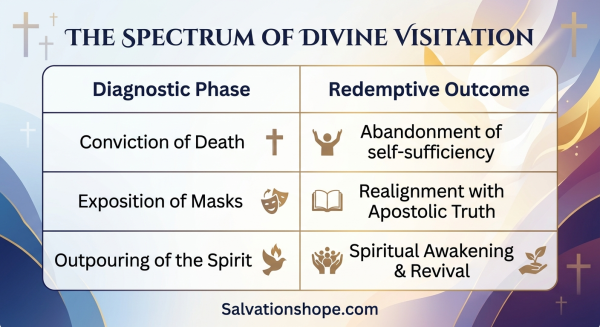
When Christ confronts Sardis with the words, “You have a reputation of being alive, but you are dead” (Revelation 3:1), He does not announce an impending funeral, but breaks their self-deception and calls them to spiritual awakening.
Historical Precedents: Reformation and Awakening
The history of the global Church demonstrates that Christ repeatedly brings life out of spiritual decay.
The Reformation Paradigm (October 31, 1517)
The confluence of Halloween (All Hallows’ Eve) and the Protestant Reformation provides a striking historical illustration of Christ renewing a deadened church. By the early 16th century, medieval Western Christendom exhibited many characteristics of the Sardis church:
Worldly Stature vs. Spiritual Power: The institutional church possessed immense political influence, architectural splendor, vast wealth, and elaborate clerical vestments.
Ritual Without Regeneration: Religious life was saturated with sacramental performance and human traditions, yet the lay public was largely cut off from personal faith in Jesus Christ and illiterate in the Scriptures.
When Martin Luther posted the 95 Theses on October 31, 1517, he sparked a movement that stripped away dead traditions (traditiones humanae) in favor of the living word of God (Sola Scriptura) and divine grace (Sola Gratia). Through the Holy Spirit’s dynamic work, churches across Europe became living centers of gospel vitality rather than formal religious monuments.
Historical Cycles of Revival
The Reformation was not an isolated event. Throughout church history, God has repeatedly intervened in periods of acute spiritual decline:
The First and Second Great Awakenings (18th–19th Centuries): In periods marked by rationalism, moral decay, and institutional deadness, the Spirit of God moved powerfully through faithful preaching, calling dead churches back to vibrant spiritual life.
Local Congregational Renewal: Time and again, when a remnant within a dying church begins to mourn its condition and seek God in prayer, Christ visits that congregation with fresh spiritual life.
Old Testament Parallels: The Vision of the Dry Bones (Ezekiel 37:1–14)
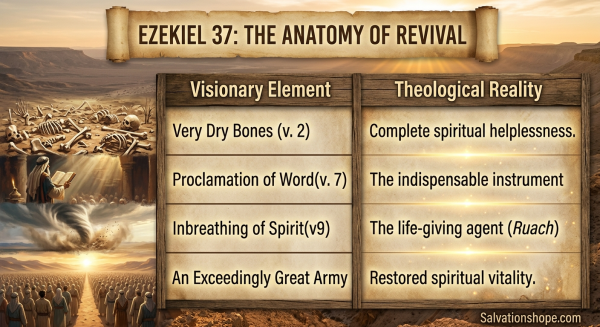
Ezekiel’s vision of the Valley of Dry Bones illustrates the theological mechanics of divine revival nowhere more vividly.
Exegesis of Ezekiel 37:1–10
The Condition (v. 1–2): The prophet is taken to a valley filled with bones that were “very dry”—symbolizing a state of prolonged death, devoid of biological or spiritual life.
The Question (v. 3): God asks, “Son of man, can these bones live?” Humanly speaking, the answer is impossible; it requires divine intervention.
The Dual Agents of Revival (v. 4–10):
The Proclamation of the Word: Ezekiel is commanded to prophesy to the dead bones. Divine restoration always works alongside the bold proclamation of God’s truth.
The Invocation of the Breath/Spirit (Ruach): The word ruach denotes breath, wind, and the Holy Spirit. Structure alone (bones, sinews, flesh) produces only a corpse; life returns only when the Ruach enters the body.
Application to Revelation 3
Ezekiel 37 provides the Old Testament framework for Christ’s message to Sardis. A church can possess the organizational structure of ministry (bones and flesh) yet remain a corpse until the Holy Spirit breathes zoē (true life) into it once again.
Exhortation to the Contemporary Church
The message of Revelation 3:1–6 culminates not in condemnation, but in an urgent invitation to true life.
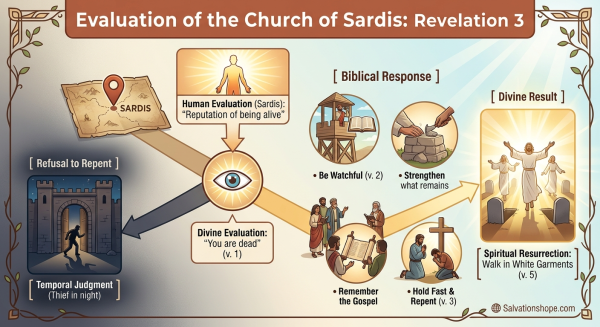
Acknowledge the Need for Life: Revival begins when a congregation abandons self-congratulatory metrics and honestly accepts Christ’s evaluation of its spiritual state.
Return to the Sources of Life: True renewal requires returning to apostolic preaching, fervent prayer, and unreserved submission to the Holy Spirit.
The Promise to the Overcomer (v. 5): To those in Sardis who resist the surrounding deadness, Christ promises that they will be clothed in white garments, their names will never be erased from the Book of Life, and He will confess their names before His Father.
The God who raised Christ from the dead, transformed the dry bones in Ezekiel’s vision, and revived His Church during the Reformation remains fully able to bring new life to any congregation today. A “zombie church” does not have to remain dead—by the power of the Word and the Holy Spirit, the dead can indeed come alive.
The Fivefold Mandate for Awakening (Revelation 3:1–3)
When Christ diagnoses a congregation as spiritually dead, He does not immediately write its obituary. Instead, He issues a sovereign “Wake-Up Call” consisting of five sharp imperative verbs in Revelation 3:2–3.
To experience genuine revival, a dead or dying congregation—and the faithful remnant within it—must pay close attention to this divine recovery strategy.
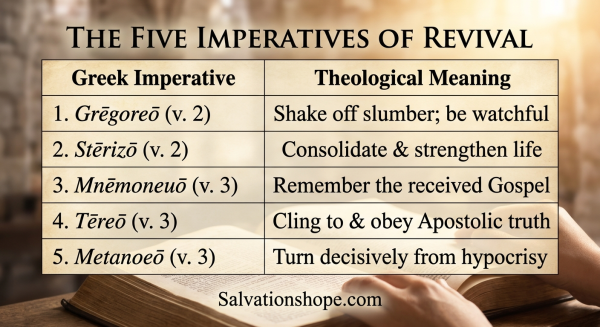
The Imperative to Awaken: Grēgoreō (v. 2a)
“Wake up!” (γίνου γρηγορῶν) Christ uses a present participle imperative, commanding continuous, heightened vigilance.
The Historical Echo: As noted in Section I, Sardis twice fell to invading armies because sentries fell asleep on top of seemingly invincible cliffs.
The Spiritual Reality: Even genuine believers can be lulled into spiritual slumber by heavy institutional activity. Congregations often mistake bustling schedules for spiritual vitality while failing to notice the subtle erosion of truth:
Fervent Prayer Replaced by Programs: Activity flourishes, yet prayer meetings disappear or degrade into perfunctory routines.
Moral Failure in High Places: Religious media, music, and publishing proliferate, yet prominent leaders fall into unrepentant immorality without corporate grief or church discipline.
Doctrinal Drift: Historic creeds remain printed in hymnals, but self-help therapeutic humanism replaces the expository preaching of Scripture.
To “wake up” requires shattering the illusion that high activity equals spiritual health and soberly acknowledging the congregation’s true state.
The Imperative to Consolidate: Stērizō (v. 2b)
“Strengthen what remains and is about to die…” (στήρισον τὰ λοιπὰ) The verb stērizō means to establish, fortify, or render firm. Even in a church that is fundamentally dead, Christ acknowledges that a spark of life or a few sound elements may still linger. Renewal does not always require burning down the institution; it requires identifying and fortifying the remaining biblical priorities—earnest prayer, faithful biblical teaching, and sincere fellowship—before they are entirely extinguished.
The Theology of the Remnant (Revelation 3:4–5)
“Yet you have a few people in Sardis who have not soiled their clothes. They will walk with me, dressed in white, for they are worthy.” (v. 4)
A key concept in biblical theology is the remnant (leimma)—the small minority within a corrupt covenant community that remains faithful to God (cf. 1 Kings 19:18; Isaiah 10:20–22; Romans 11:5).
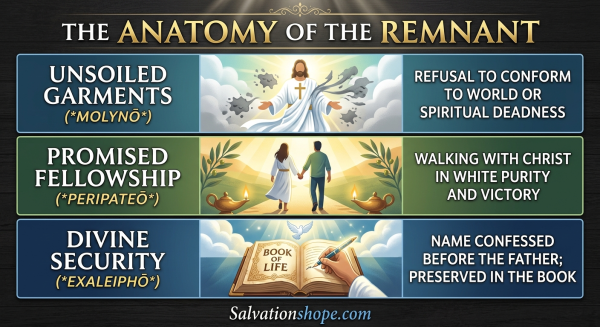
Spiritual Purity in a Graveyard (Molynō)
The metaphor of “soiled garments” (molynō, to defile or stain) speaks to moral and spiritual compromise. In Sardis, where dead religion was the norm, a faithful few refused to let the pervasive spiritual slumber compromise their devotion to Christ.
Encouragement to Faithful Believers: If you are a Spirit-led believer stuck in a dying congregation, Christ knows your name. Your personal standing with Him is secure, regardless of the spiritual state of the institution around you.
The Danger of Isolationism: Personal security, however, is not a license for spiritual apathy. Faithful believers are not called to abandon concern for the broader church, but to serve as divine instruments for its awakening.
The Eschatological Promises to the Overcomer (vv. 5–6)
Christ grants three profound promises to those who overcome the deadness of their environment:
Clothed in White Garments: Representing Christ’s imputed righteousness, moral purity, and ultimate eschatological victory (Revelation 7:14; 19:8).
Name Preserved in the Book of Life: A stark contrast to human church rosters. While a dead church may praise a person’s name on earth, Christ guarantees their permanent enrollment in the heavenly citizenship register (Philippians 4:3; Revelation 21:27).
Confessed Before the Father: Jesus promises to publicly validate and acknowledge His faithful remnant before God and the angels (cf. Matthew 10:32).
Exhortation: From Observation to Action
Christ concludes His letter with the universal imperative: “He who has an ear, let him hear what the Spirit says to the churches” (v. 6).
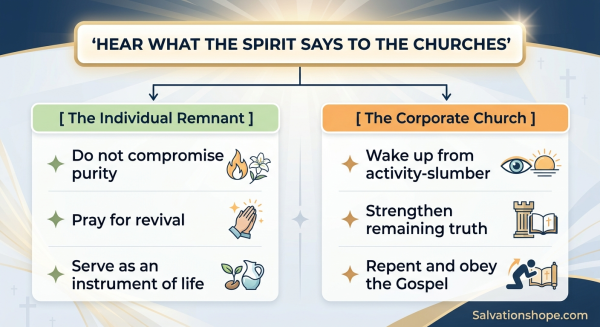
For contemporary believers and church leaders, this text demands action:
Conduct a Sober Audit: Stop measuring church health only by numbers, building projects, or community popularity. Assess whether the Holy Spirit’s power and biblical authority are genuinely present.
Refuse Spiritual Slumber: Reject the temptation to drift along with dead orthodoxy or religious consumerism.
Become Agents of Awakening: Pray fervently, hold fast to apostolic truth, and ask the Lord of the Church to pour out His Spirit once again—transforming spiritual graveyards into living witnesses for His glory.
Exegetical Deep-Dive: The Dual Pillars of Revival—Word and Spirit (Revelation 3:3a)
In Revelation 3:3a, the Lord Jesus commands the church at Sardis: “Remember, therefore, what you have received and heard; obey it, and repent.”
This imperative reveals the foundational truth of biblical renewal: True revival requires neither novel human techniques nor trendy pragmatic models; it requires returning to the original apostolic deposit.
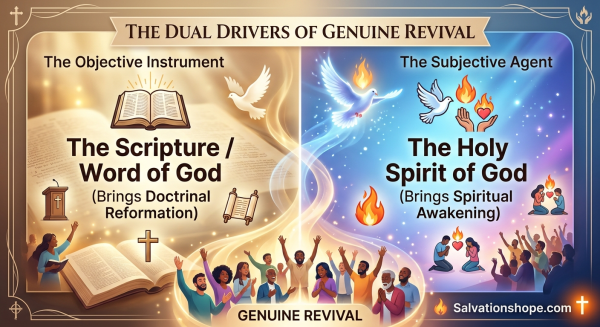
The Inseparable Synthesis: Word and Spirit
In Reformed biblical theology, the Word of God (Logos/Rhema) and the Spirit of God (Pneuma) operate in absolute cohesion:
Word Without Spirit: Results in institutional legalism, cold intellectualism, or dead orthodoxy—a detailed map without the fuel to travel.
Spirit Without Word: Results in ungrounded subjectivism, emotionalism, or theological drift—an engine without a steering mechanism.
For a church of the living dead to experience genuine resurrection, doctrinal reformation (reclaiming the authority and clarity of Holy Scripture) must be matched by spiritual revival (experiencing the regenerating and animating power of the Holy Spirit).
Two Manifestations of the "Zombie Church"
Spiritual deadness in the Church takes many forms; it manifests across a theological spectrum.
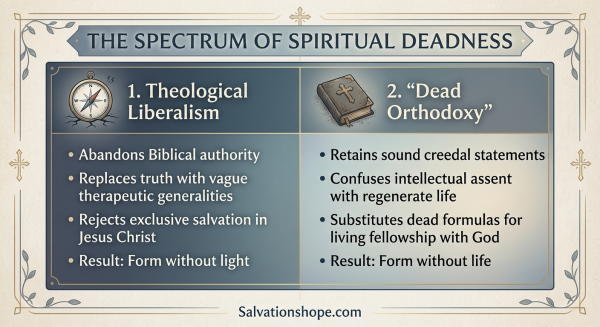
The Lightless Path: Theological Liberalism
When a church abandons the absolute authority of Holy Scripture (Sola Scriptura), it loses its spiritual illumination. To remain culturally palatable, such institutions often replace clear biblical commands with ambiguous, non-judgmental generalities.
When human research, modern culture, or philosophical trends replace divine revelation, the church forfeits the light bulb of truth entirely, leaving its adherents to stumble in spiritual darkness.
The Lifeless Skeleton: "Dead Orthodoxy"
Crucially, Christ’s indictment in Revelation 3:1 applies just as strongly to conservative or traditionalist churches that possess pristine creeds yet lack divine vitality.
Formula vs. Reality: It is entirely possible to maintain precise definitions, systematic theology, and rigorous instructional classes while remaining spiritually dead. This condition mirrors a perfect recipe without food, or a flawlessly preserved specimen without breath.
Knowledge Without Devotion: Believers in this state may take pride in their doctrinal correctness, intellectual precision, and rejection of emotionalism, yet remain untouched by conviction of sin, grief over spiritual compromise, or the indwelling joy of the Holy Spirit.
The Judgment of the Heart: As Christ affirmed in Matthew 15:8, correct verbal confession (“honors me with their lips”) is meaningless if the inner affections remain alienated from God (“heart is far from me”).
Directives for the Remnant in a Dying Church
For Spirit-filled believers in a spiritually decayed or dying congregation, Christ’s call offers both cautious discernment and active direction.
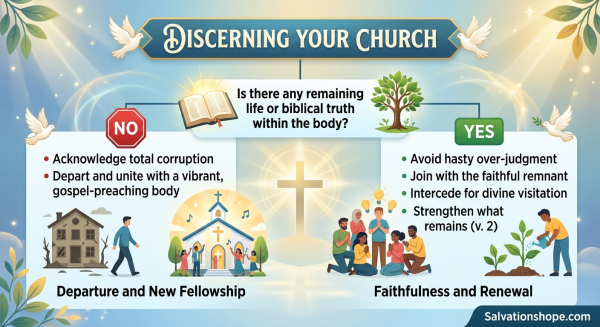
Exercise Humility and Avoid Rash Judgment
While Christ possesses omniscient, infallible knowledge of a church’s true state (Revelation 2:2, 3:1), human discernment is limited. Believers must guard against self-righteous pride, recognizing that God may still have hidden works of grace or an unremembered remnant within a seemingly cold congregation.
Know When to Depart vs. When to Stand
The Call to Depart: If a congregation has completely abandoned the core gospel, denied biblical authority, and shows total moral and spiritual decay without a faithful remnant, believers should join a healthy, living local assembly.
The Call to Stand: Where sparks of biblical truth and genuine faith linger, Christ calls His remnant to remain as agents of awakening—strengthening what remains (stērizō), engaging in persistent prayer, and seeking the power of the Holy Spirit for corporate renewal.
The Promise of Resurrection
The letter to Sardis—and the broader witness of Revelation 3—stands as an enduring testament to the grace of Jesus Christ. When the Lord of the Church exposes hypocrisy and pronounces the diagnosis of death, He does so to drive His people to repentance. To every individual and congregation willing to lay down the mask of religious performance, turn from empty routine, and seek the living Lord: the Spirit stands ready to breathe new life.
“He who has an ear, let him hear what the Spirit says to the churches.” (Revelation 3:6)