
The Divine Mirror

How Great Are You?
The Weight of Calling
It can be spiritually dangerous to miscalculate who you are—either through false humility or unwarranted pride. For anyone called to share the Gospel, disciple others, or lead within Christ’s church, a sobering question naturally arises: “Who am I to be speaking for God? Who am I to lead His people?”
At first glance, such hesitation sounds pious. Moses questioned his eloquence at the burning bush; Isaiah felt undone by his unclean lips in God’s throne room. Yet Scripture teaches that shrinking back from our calling because of human inadequacy can undermine the very grace God has bestowed on us.
To boldly witness, teach, or lead, we must first answer the foundational question: How great are you?
The Believer’s Identity: Partakers of the Divine Nature
From a purely earthly and secular perspective, human beings are often viewed as frail, finite, and fallen creatures subject to the whims of biology, history, and circumstance. However, the New Testament reveals a staggering theological reality for those born again through faith in Jesus Christ: believers receive a derivative, grace-infused greatness rooted in God Himself.
Consider the Apostle Peter’s words in 2 Peter 1:4:
“He has granted to us his precious and very great promises, so that through them you may become partakers of the divine nature, having escaped from the corruption that is in the world because of sinful desire.”
What Does It Mean to Be a "Partaker of the Divine Nature"?
The concept of becoming a partaker of the divine nature (Greek: theion koinōnoi physeōs) stands as one of the most sublime concepts in Christian soteriology. While theologians throughout church history—from the early Greek Church Fathers to contemporary Reformed and evangelical scholars—have debated the precise nuances of this verse, historic orthodox Christianity maintains essential guardrails:
- No Loss of Human Distinction: It does not mean humans become ontologically divine, absorbed into the essence of the Creator (pantheism or deification in the non-Christian sense), or possessors of divine attributes such as omniscience, omnipresence, or moral omnipotence. The Creator-creature distinction remains absolute.
- Ethical and Spiritual Transformation: Instead, it signifies something breathtakingly profound: an inward renewal where the believer shares in God’s moral qualities, holiness, love, and eternal life by grace rather than by inherent nature.
Union with God (Mystical Union)
Through regeneration, believers are brought into living, vital communion with the Triune God—Father, Son, and Holy Spirit. This union is not merely legal or forensic (though justification is foundational); it is deeply relational and vital, akin to a branch grafted into a vine (John 15). The believer participates in the divine life by virtue of being united to Christ, who is both fully God and fully man.
The In-Dwelling Life and Moral Transformation
The indwelling Holy Spirit imparts God’s character and life, transforming the human inner nature from the inside out. As believers cooperate with grace through the spiritual disciplines, the fruit of the Spirit (Galatians 5:22–23) manifests in their lives—reflecting God’s own patience, kindness, goodness, and love.
As the Apostle Paul writes to the Colossians regarding the immense riches and mystery of the Gospel (Colossians 1:27):
“God chose to make known how great among the Gentiles are the riches of the glory of this mystery, which is Christ in you, the hope of glory.”
Theological Dimensions and Historical Context
To fully grasp the depth of Peter’s teaching, it helps to examine how this doctrine interacts with broader biblical themes:
The Contrast with Worldly Corruption: Peter notes that this divine participation occurs as believers escape “the corruption that is in the world because of sinful desire.” The world system operates on decay, selfishness, and death. Conversely, the divine nature operates on incorruptibility, divine love, and eternal life.
The Role of Divine Promises: Notice the instrument of this transformation: precious and very great promises. God’s word is not merely informative; it is performative and transformative. Believers lay hold of these promises by faith, allowing divine truth to reshape their desires, thoughts, and actions.
The Eastern and Western Windows: In Eastern Orthodox theology, this concept is often closely associated with theosis (deification or divinization), emphasizing participation in God’s uncreated energies. In Western Protestant theology, it is frequently understood through the lens of sanctification, union with Christ, and the renewal of the Imago Dei (the Image of God). Despite differing vocabularies, both traditions affirm that salvation is far more than legal pardon—it is radical transformation and sharing in the life of God.
Practical Implications for the Believer
Understanding one’s identity as a partaker of the divine nature carries profound practical weight for daily Christian living:
Overcoming Shame and Defeat: When believers view themselves solely through the lens of human frailty and past sin, discouragement easily takes root. Remembering that God has infused His life and nature within them provides supernatural strength to resist temptation.
Living with Purpose and Holiness: Because we share in a holy nature, sin is fundamentally out of character for a Christian. Holiness is not merely a list of rules to follow under duress, but the natural expression of a renewed heart.
A Source of Enduring Hope: The indwelling presence of Christ serves as the “hope of glory”—a guarantee that the process of redemption begun in this life will culminate in the complete glorification of body and soul in the age to come.
The Source of Christian Authority for Witness and Leadership
Why are you qualified to witness for Christ? Why does any ordinary Christian have the right—and the duty—to proclaim the way of salvation?
The answer does not lie in natural charisma, theological degrees, or flawless moral performance. Our authorization comes entirely from our union with Christ:
You are someone who has Christ in you. The living, resurrected Savior makes His home in the believer, providing the message, the power, and the presence needed for evangelism.
You partake of the divine nature. You do not speak from your own wisdom; you bear testimony to a divine reality you have personally tasted and experienced.
You carry a God-like greatness by grace. This is not a greatness of human ego, but a borrowed, reflective glory—the image of God restored and elevated through redemption.
Reflection Questions
Reframing Inadequacy: How does viewing your identity through the lens of 2 Peter 1:4 change how you see your everyday opportunities to share your faith?
Avoiding Extremes: How can a Christian balance a biblical understanding of being a “partaker of the divine nature” without falling into the theological error of human deification or pride?
The Indwelling Christ: In what practical ways does the reality of “Christ in you, the hope of glory” (Colossians 1:27) give you courage when facing fear or hesitation in Christian leadership or witness?
For further study, read 2 Peter 1 and Colossians 1, paying close attention to how the Apostles ground Christian ethics and ministry not in human effort, but in divine identity.
Beholding and Becoming

The Divine Mirror
In a world driven by self-image, performance, and external validation, Christian identity offers a radically different starting point. We often measure our worth by our accomplishments, our failures, or others’ opinions. But Scripture invites us into a vastly different reality—one rooted not in human striving, but in divine reflection. The core spiritual principle is profound yet simple: We become what we behold.
The Apostle Paul captures this dynamic in 2 Corinthians 3:18:
from one degree of glory to another. For this comes from the Lord who is the Spirit.”
This study explores the sacred connection between beholding God’s glory and being transformed into His likeness, and why believers so often drastically underestimate the profound greatness God has placed within them through His indwelling Spirit.
The Theological Truth: Beholding Leads to Becoming
In the ancient world, mirrors were made of polished bronze and offered only a dim, distorted reflection (a concept Paul touches on earlier in his letters). But under the New Covenant, believers look upon the glory of God in the face of Jesus Christ with an “unveiled face.”
The Principle of Reflection: The more you revere, gaze upon, and ponder God’s majesty, holiness, and love, the more your character is re-formed to mirror Him.
The Agent of Transformation: This is not self-help or behavioral modification. The text states that this transformation comes “from the Lord, who is the Spirit.” When the Holy Spirit dwells in you, spiritual growth becomes an organic, supernatural progression.
Progressive Sanctification: Notice the trajectory: “from one degree of glory to another.” Christian maturity is a journey. You are not expected to reflect Christ’s full glory overnight; rather, the Spirit steadily works within you, moving you upward through successive stages of grace.
The Problem: Underestimating God’s Estimate
Because this transformation happens by the Spirit from the inside out, the world—and often our own self-doubt—fails to recognize the profound dignity God has bestowed on a child of God.
If you are a born-again believer in Jesus Christ, the Creator of the universe has made your heart His temple. Yet, how often do we look at our weaknesses, our past mistakes, or our daily struggles and conclude that we are ordinary, insignificant, or disqualified?
We often underestimate ourselves by human standards, just as others underestimate us by outward appearances. But God does not judge by outward appearances; He judges by the treasure He has placed within earthen vessels (2 Corinthians 4:7).
Biblical Precedents
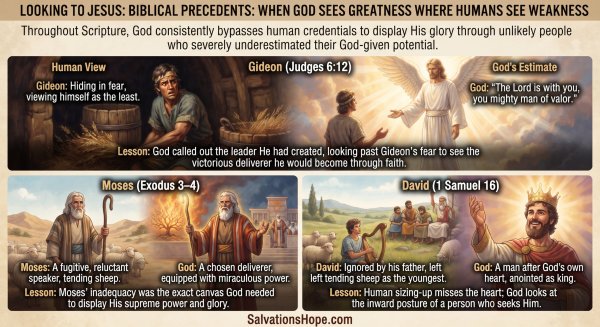
When God Sees Greatness Where Humans See Weakness
Throughout Scripture, God consistently bypasses human credentials to display His glory through unlikely people who severely underestimated their God-given potential.
Gideon (Judges 6:12)
The Human View: Hiding in a winepress in fear, Gideon viewed himself as the least in his family and his clan as the weakest in Manasseh.
God’s Estimate: The Angel of the Lord greets him as, “The Lord is with you, you mighty man of valor.”
The Lesson: God called out the leader He had created, looking past Gideon’s fear to see the victorious deliverer he would become through faith.
Moses (Exodus 3–4)
The Human View: A fugitive and a reluctant speaker with a stutter who spent forty years tending sheep in the desert. He begged God to send someone else.
God’s Estimate: A chosen deliverer, equipped with miraculous power to rescue a nation from bondage.
The Lesson: Moses’ inadequacy was the exact canvas God needed to display His supreme power and glory.
David (1 Samuel 16)
The Human View: Ignored by his own father when the prophet Samuel came to town, left out in the fields tending sheep because he was merely the youngest.
God’s Estimate: A man after God’s own heart, anointed to be king over Israel.
The Lesson: Human sizing-up misses the heart; God looks at the inward posture of a person who seeks Him.
Reflection Questions
Personal Assessment: In what areas of your life do you tend to underestimate the Holy Spirit’s work in you, focusing on your flaws rather than His transforming power?
The Gaze: What does it practically look like for you to “behold the glory of the Lord” in your daily routine this week?
Shifting Perspectives: How would your daily decisions, confidence, and interactions change if you fully accepted God’s estimate of your identity in Christ?
Walking in Incremental Glory
God’s Spirit lives inside you. You are not static; you are actively moving from one degree of glory to another. Stop measuring your worth by temporary standards or past failures. Fix your eyes on Christ, let the Spirit do His transforming work, and step boldly into the greatness God has authored in your life.
The Pain of Being Underestimated
As we continue to look at how God works when others misjudge us, we see a powerful pattern throughout Scripture: men whom God called, yet whose own families and leaders failed to recognize what the Lord was doing in them.
- Joseph: Hated for His God-Given Dreams
In Genesis, Joseph received dreams from God showing he was destined for greatness. How did his brothers react? They despised him because his calling involved leadership over them, and they persecuted him, trying to ruin his life. Yet, God used that exact path of rejection to position Joseph to save a nation.
- Moses: Snubbed by His Own Countrymen
When Moses first spoke up to try to liberate his countrymen, the Israelites initially snubbed him. If Moses had lived by what his countrymen thought, he would have quit. If he had based his worth on what Pharaoh thought of him, he would have quit. Instead, he had to anchor his identity in what God had made him to be.
- David: The Overlooked Shepherd and Underestimated Warrior
David was not highly esteemed by his family. When the prophet Samuel came to Jesse’s house to anoint the next king of Israel, David—the youngest—was left out in the fields tending sheep because his family assumed the “kid” of the family couldn’t possibly be God’s choice.
Later, during the crisis with Goliath:
His brother Eliab grew angry at David, accusing him of being a troublemaker who was only there to watch the battle.
King Saul underestimated him, telling David he was just a youth facing a massive veteran warrior.
When we read the story of David and Goliath, we sometimes think David was just a lucky kid. But David knew he had already been anointed as the future king. He wasn’t acting on a whim; he was acting as God’s anointed. He reminded Saul, “When a bear or a lion came and tried to take the sheep, I killed it. I can take out this giant too.” David was a bear-killer and a lion-killer whose brothers and king couldn’t see it—until God made it happen.
The Lesson: Don’t let others underestimate you. Sometimes it comes from your own family members, and you cannot let what they say about you permanently limit you.
A Personal Reflection: Growing Up as “The Scrub”
This dynamic doesn’t only happen in biblical history; it happens in everyday life. Growing up, I had four older brothers and three older sisters. Being the youngest boy, I was always called “the baby” or “the scrub.” Now that I am grown up, my older siblings who are still alive always look to me for help and spiritual advice.
My point is this: when you grow up in a family, especially as the youngest sibling, people may underestimate what you are capable of. It doesn’t matter so much if they just think you’re still the little kid in the backyard, but when you are underestimated spiritually, or in terms of God’s calling, it can hold you back.
Some mature adults in ministry are still mentally and emotionally held back by what their parents or siblings said to them long ago. If you want to serve the Lord or step into a new season of ministry, don’t go by others’ opinions, even if they share your last name.
Think of Jesus.
Looking to Jesus: The Ultimate Example
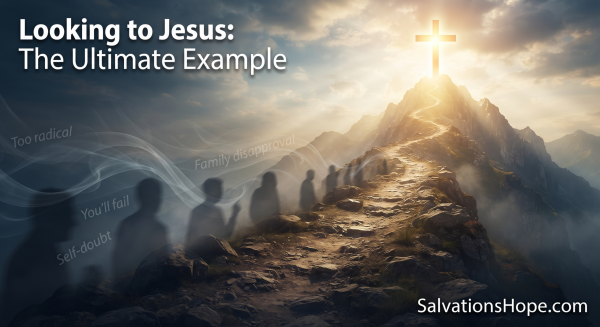
At one point, Jesus’ own brothers thought he was out of his mind, and His hometown neighbors didn’t believe in Him. If the Son of God faced skepticism from His immediate family, you may have family members or peers who think you are getting “a little too big for your britches” when you begin to live boldly for Christ. When you choose to be a dedicated ambassador for Jesus Christ:
- It is time to listen to Jesus Christ, not the naysayers around you. You also have to be careful not to listen to the naysayer within you—don't let your inner voice join the chorus of self-doubt.
The Internal Naysayer: Underestimating Yourself
Beyond the skepticism of family and peers, one of the greatest obstacles we face is the enemy living right inside our own minds: self-doubt. When God calls us to step out in faith, we often look at our limitations, point out our flaws, and tell God He has the wrong person.
Moses: The Educated Leader Who Felt Tongue-Tied
When God told Moses to go to Pharaoh and demand, “Let My people go,” Moses protested, “I can’t speak well.”
The Reality: Was that actually true? Scripture tells us in Acts 7:22 that Moses was instructed in all the wisdom of the Egyptians and was “mighty in his words and in his deeds.”
God’s Reminder: God gently but firmly redirected Moses, asking, “Who gives man his mouth?” (Exodus 4:11).
Gideon: The “Wimpy” Warrior Hiding in a Winepress
When the Angel of the Lord appeared to Gideon, he didn’t thank God for the compliment; instead, he protested: “If the Lord is with us, why has all this happened? “My clan is the weakest in Manasseh, and I am the least in my father’s house.” (Judges 6:15). Gideon saw himself as the wimpiest guy in the wimpiest family of the wimpiest tribe. But God called him a “mighty warrior”—and before the story was over, through the power of God’s presence, he became exactly that.
Jeremiah: The Young Prophet Who Felt Too Small
When God called Jeremiah to be a prophet to the nations, Jeremiah’s immediate defense was, “Ah, Lord God! Behold, I do not know how to speak, for I am only a youth.” (Jeremiah 1:6). But God touched his mouth, put His words into him, and appointed him to build and to plant.
The Theology of Divine Empowerment vs. Self-Deprecating Prowess
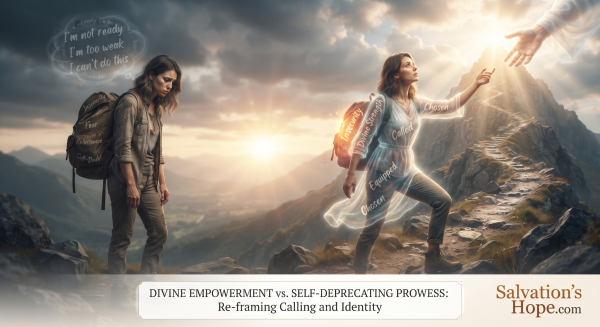
Re-framing the Intersection of Calling and Identity
At the heart of a vibrant Christian walk lies a tension every believer eventually faces: balancing recognition of human frailty with bold steps into divine assignment. Too often, believers mistake self-deprecation for holiness. We wrap our insecurities, fears, and reluctance in the pious language of humility, as if refusing to participate in God’s work honors Him.
However, a rigorous theological examination of Scripture reveals a starkly different reality. To shrink back from God’s call under the banner of “humility” is not submission; it is small faith and implicit disobedience. When the Creator of the universe appoints, equips, and indwells a believer, questioning His choice affronts His wisdom and power.
The Sin of False Modesty
Scripture is replete with examples of individuals who tried to use “humility” as an excuse to reject God’s call—and how God responded to them:
Moses at the Burning Bush (Exodus 3–4): When God called Moses to deliver Israel from Egyptian bondage, Moses offered a barrage of excuses: “Who am I that I should go?” (Exodus 3:11) and “Pardon your servant, Lord. I have never been eloquent… I am slow of speech and tongue” (Exodus 4:10). While Moses sounded humble, his resistance frustrated God. The issue was never Moses’ eloquence; it was God’s presence (“I will be with you”).
Gideon in the Winepress (Judges 6): When the angel of the Lord called Gideon a “mighty warrior,” Gideon looked at his circumstances and self-worth, protesting, “My clan is the weakest in Manasseh, and I am the least in my family” (Judges 6:15). Yet God bypassed Gideon’s self-assessment to accomplish extraordinary victory.
In both cases, God did not praise their self-doubt. He overrode it. True faith takes God at His word: if He calls, He equips.
Deconstructing False Humility: The Theology of Inward Denial
False humility stems from a subtle form of pride. While it appears outwardly modest, it is actually deeply self-obsessed because it keeps the spotlight on human limitation rather than divine capability.
When a Christian says, “I could never do that; I’m just a nobody,” they are committing a subtle theological error. They are measuring the task against their native resources rather than against the limitless reservoir of the Holy Spirit.
Denying the Indwelling Spirit: To claim you can accomplish nothing of eternal significance when the third person of the Trinity dwells inside you denies the active power of regeneration and sanctification.
Shifting the Focus to Self: Ironically, hyper-focusing on your flaws keeps the attention on yourself. True freedom comes when you stop obsessing over how inadequate you are and start marveling at how adequate He is through you.
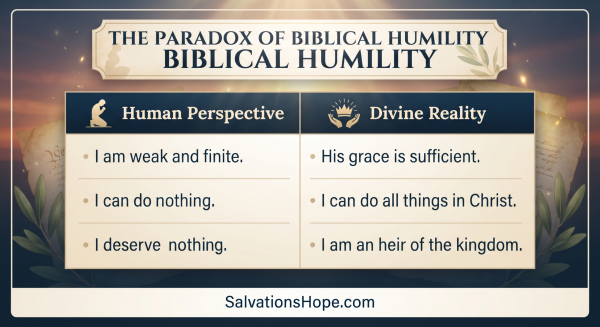
Healthy Humility: The Paradox of Grace-Driven Strength
True biblical humility does not require us to lie about who we are in Christ. It requires a precise, objective alignment with reality: Apart from Him, we are bankrupt; united with Him, we are conduits of divine power.
The Vine and the Branches (John 15)
Jesus grounds our humility not in self-hatred, but in organic union. A branch does not strain, sweat, or stress to produce fruit; it simply remains attached to the vine. The sap flows naturally. When we recognize that all spiritual vitality originates from Christ, arrogance becomes impossible, and paralyzing insecurity becomes unnecessary.
The Magnifying Glass of Divine Majesty
True humility is never achieved by staring inward at our failures; it is forged by gazing outward at God’s holiness. Like Isaiah in the temple, who cried out, “Woe to me! I am ruined!” (Isaiah 6:5) only after seeing the Lord high and exalted, a clear vision of God naturally humbles the human heart while simultaneously empowering it for service (as Isaiah immediately answered, “Here am I. Send me!”).
Stepping Out of the Shadows
God’s call invites you to leave behind the crippling cocoon of self-doubt. When you are gripped by the greatness of your calling and the sufficiency of your Savior, small faith dies, and bold, Spirit-empowered obedience takes its place.
Stop measuring your worth by your past failures, your critics, or your natural limitations. Embrace your identity as a temple of the Holy Spirit, step out of the shadows of underestimation, and watch what Almighty God will accomplish through a heart fully surrendered to His power.
Valuing Others in the Kingdom
Finally, healthy humility shapes how we view those around us. While it recognizes the profound dignity and greatness God has placed within you, it also recognizes that someone else who has been born again is destined to be a prince or a princess in God’s kingdom, just as you are—and they may even have a higher role. Being humble does not mean shrinking back from your God-given importance in His eyes; rather, it means recognizing your immense value to Him and that same tremendous value and royal identity in every other believer. Stop underestimating what God can do through you, drop the false humility that calls God a liar, anchor your worth in Christ, and walk forward in the Holy Spirit’s transforming power—from one degree of glory to another.
The Ultimate Question: “How Great Are You?”
When we synthesize what Scripture actually declares about the redeemed believer, the picture is breathtaking. We often struggle to accept our true spiritual identity because it feels too grand, yet Scripture repeatedly drives the point home. If you belong to Jesus Christ through the new birth, consider the staggering titles and realities assigned to you:
You Are the Light of the World
Jesus said He is the light of the world, but in Matthew 5 He turns to His followers and declares, “You are the light of the world.” Christ shines through you into a dark and wandering generation.
You Possess a New, Good Heart
A common misconception is that a believer’s heart is irredeemably evil and nothing but bad. While it is true that we still wage war against the remaining flesh and sinful nature, Scripture teaches that if you are born again, God has placed a new heart within you. Jesus describes the good soil as a “noble and good heart” (Luke 8:15). Because you possess the life of Christ, your inner core has been transformed to produce good things.
You Are an Heir of the Universe
As a child of God, you are an heir of the King of the universe. Because everything belongs to Christ—and Christ belongs to God—the Apostle Paul writes, “all things are yours” (1 Corinthians 3:21–23). Romans 8:32 reminds us that the Father who did not spare His own Son will graciously give us all things along with Him.
You Are Royalty and God’s Special Possession
Scripture heaps identity upon identity:
- You are part of a chosen race and a royal priesthood.
- You belong to a holy nation.
- You are God's own treasured possession (1 Peter 2:9).
You Are God’s Living Temple
Your body is not merely ordinary flesh; it is a temple of the Holy Spirit, who dwells within you.
You Are an Overcomer Destined for Exaltation
The Word says that believers are strong, that the Word of God abides in them, and that they have overcome the evil one (1 John 2:14). Furthermore, Scripture poses an astonishing rhetorical question: “Do you not know that we are to judge angels?” (1 Corinthians 6:3). One day, sons and daughters of the King will be elevated to positions of cosmic administration, serving alongside Christ in ways that surpass even the angelic hosts.
Living Up to Your Name

How great are you? In human terms, on our own, we are dust. But united to Christ, indwelt by the Holy Spirit, and clothed in His righteousness, we are royal ambassadors of the Most High God.
With that profound greatness comes a name—and a calling to walk worthy of the One who has redeemed us, transforming us from one degree of glory to another.
What Is Your Name? The Power of Divine Identity
In biblical history, a name was never just a convenient label or a random choice; it represented a person’s identity, character, and destiny. Throughout Scripture, God has a habit of renaming people—not based on who they are in their weakness, but on who they are destined to become by His grace.
- Abraham:
His original name, Abram, meant “exalted father.” Yet for decades, he had no children—making his name a mockery to human eyes. But God changed his name to Abraham, meaning “father of a multitude.” Though he had no kids at the time, he became the father of a great nation and the spiritual father of all who share his faith. God gave him a name, and it stuck because it was true.
- Jacob:
His name literally meant “trickster” or “grabber.” True to his name, he spent his early years cheating and scheming. But after an all-night wrestling match with the Angel of the Lord, God renamed him Israel, which means “one who wrestles with God and man and wins.” Instead of being remembered as a low-down snake, he was transformed into a mighty man of God.
- Simon to Peter:
Jesus’ impulsive disciple was nicknamed Peter, meaning “the rock.” Did he look like a rock right away? Not at all. He denied Christ three times, and even later caved to peer pressure in Antioch (as Paul recounts in Galatians 2). The “rock” could blow it pretty badly. But Jesus knew what He was doing. Eventually, Peter stood firm, wrote immortal epistles, and was ultimately crucified upside down for his testimony. He became the rock Christ named him to be.
- James and John:
Jesus gave these ordinary fishermen a fiery nickname: Boanerges, meaning “Sons of Thunder.” By grace, they grew into mighty, roaring apostles of the Lord Jesus Christ.
- Saul to Paul:
Saul was a violent persecutor and killer of the church. Yet when Christ met him on the road to Damascus, He renamed and remade him. Paul later wrote, “By the grace of God I am what I am, and His grace toward me was not in vain” (1 Corinthians 15:10). God gave this former enemy a new identity and made him history’s greatest missionary theologian.
You Are What God Calls You

If you take nothing else away from this study, memorize these six life-changing words: You are what God calls you. You do not have the right to call yourself something different than what God says you are.
If God has saved you, redeemed you, and placed His Holy Spirit within you, then your identity is no longer bound to your past failures, your family’s old nicknames, your self-doubt, or the world’s low expectations. If God gives you a name, that is who you become. If God gives you a mission, that is what you will accomplish by His power. Stop letting the world—and stop letting your own inner voice—name you. Step into the reality of your divine identity, anchor your worth in Christ, and watch how the Lord transforms you from one degree of glory to another.
Reputation or Reality? Breaking Free from the Phony Image
Our eagerness to impress others is the ultimate mark of insecurity. When we are not content with who we really are on the inside, we construct a phony image on the outside. Because we lack deep confidence in God’s unconditional acceptance and approval, we spend our lives frantically trying to win the applause, validation, and approval of other people.
The French philosopher Blaise Pascal captured this human tragedy brilliantly in his Pensées: “We are not satisfied with the life we have in ourselves and our own being. We want to lead an imaginary life in the eyes of others, and so we try to make an impression. We strive constantly to embellish and preserve our imaginary being, and neglect the real one… We would cheerfully be cowards if that would acquire us a reputation for bravery.”
How About You?
Would you rather do something brave that nobody else noticed, or get a medal of valor for something you didn’t actually do?
Would you rather be generous and have nobody know about it, or be stingy yet impress others with public donations to charity?
Would you rather be wise and have people think you’re foolish, or be foolish and have people think you’re wise?
Would you rather be holy and have people despise you, or be corrupt and have people admire you?
God commands us to get real.
The Trap of Superficiality and Hypocrisy
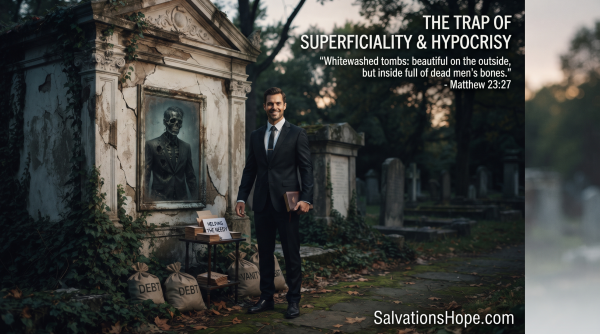
We often get caught up in surface-level appearances—trying to impress others with fashion, fast cars, and fancy houses. The result? We become superficial, vain, and often drown ourselves in debt. But vanity about our appearance is not the only pitfall. Take inherently noble activities like giving to the needy, praying, or spiritual disciplines. When our sole motivation is to be seen by others, it becomes spiritually fatal. We turn into phonies and hypocrites.
Jesus described these kinds of hypocrites as whitewashed tombs: they look pristine and impressive on the outside, but inside they are full of rottenness, decay, and spiritual death (Matthew 23:27).
The Warning of the Sermon on the Mount
In Matthew 6:1–4, Jesus addresses this dangerous obsession with public reputation head-on:
“Be careful not to do your ‘acts of righteousness’ before men, to be seen by them. If you do, you will have no reward from your Father in heaven. So when you give to people in need, do not announce it with trumpets… so that your giving may be in secret. Then your Father, who sees what is done in secret, will reward you.”
If Jesus is right—and He is—why do so many people, including religious people, want their names trumpeted far and wide when they support a cause? Why do organizations name buildings after donors, and why do donors let them?
Because public recognition works, it raises money. Donors get their names engraved on seats, windows, pipe organs, and university endowments. The charities get their funding, and the donors get their flattering articles. But as Jesus warned, that public reputation is all the reward they will ever get, forfeiting the deeper, eternal reward from the heavenly Father.
Guarding the Secret Place
If we are truly in tune with God, we will act purely out of love, without caring who gets the credit. In fact, Jesus teaches that we should actively go out of our way to keep our righteous acts hidden:
- Secret Giving: Do your charitable deeds with as little fanfare as possible, letting your left hand not know what your right hand is doing (Matthew 6:3–4).
- Secret Prayer: When you pray, go into your room, close the door, and pray to your unseen Father (Matthew 6:6).
- Secret Fasting: When you fast, wash your face and look normal, so it is obvious only to your Father who sees in secret (Matthew 6:18).
Even in the professional and business world, maintaining an image of piety can be a calculated strategy. As a famous quote notes: “I do not believe in God, but I want my banker, my lawyer, and my doctor to do so.” People use an image of honesty and trustworthiness to get ahead. But cultivating an outward reputation while neglecting inner reality leaves you hollow.
Ditching the Mask
If your life is built entirely on impressing others, you will never amount to anything of genuine eternal value. You become a mask with no soul—with no real “you” hiding behind the façade. People may applaud your performance, but they aren’t loving the real you; they are simply captivated by the mask you manufactured.
Value inner reality over outer reputation. Strip away the pretense, anchor your identity in Christ, and live entirely for the One audience that matters.
Get Real: The Ultimate Exchange
You may enjoy the temporary benefits when your ability to impress others helps you secure status, comfort, or the things you want in life, but at what catastrophic cost?
Jesus cut straight to the heart of this existential dilemma when He asked:
“What good will it be for a man if he gains the whole world, yet forfeits his soul?” (Matthew 16:26).
If you live to impress others, you forfeit your soul twice over. You lose your soul in this life because you surrender your true self to a manufactured persona, becoming an empty actor walking across a stage. And you lose your soul in the life to come because you have fundamentally alienated yourself from God, caring infinitely more about the passing opinions of fickle people than about the eternal verdict of your Creator.
Only when you break free from the theater of human approval and anchor your focus on what God thinks of the real you can you finally shed the mask and become a genuine human being.
The Omniscience of God: Living Before an Audience of One
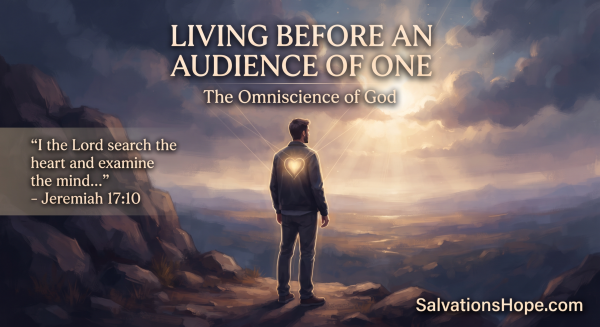
God knows you and me inside and out. No performance, no filter, and no polished façade can deceive Him. Scripture declares with sobering clarity:
according to what his deeds deserve” (Jeremiah 17:10).
You can fool most of the people most of the time. You can curate your image, manage your reputation, and mask your insecurities so effectively that everyone around you applauds. But you cannot fool God. He looks past the external presentation and gazes straight into the heart’s motives. His assessment of you is the only one that carries eternal weight.
Until that profound reality sinks deep into your consciousness, you cannot truly accept or believe the reality of Christ, nor can you step into the authentic identity God created you to occupy. As Jesus challenged the religious establishment of His day:
“How can you believe if you accept praise from one another, yet make no effort to obtain the praise that comes from the only God?” (John 5:44).
The Triple Trap of Human Approval
The drive to impress others manifests in different ways depending on your social environment, but every single variation forms an impenetrable barrier between you and authentic discipleship:
- The Trap of Shallowness: If the people around you are shallow, superficial, and consumer-driven, and you spend your energy trying to impress them, you will be too busy chasing triviality to ever follow Christ.
- The Trap of Moral Pretense: If the people around you admire goodness, morality, and philanthropy, and you try to impress them, you will spend your life locked in hypocrisy. You will be so busy pretending to be righteous that you will never seek the genuine, supernatural inner transformation that grows out of a true love for Jesus.
- The Trap of Fear: If the people around you are hostile toward Christ, cynical about faith, or dismissive of holy living, and you crave their approval, you will shrink back. As John 12:43 notes regarding those who loved human praise more than God's praise, you will be too terrified of social rejection to stand for the truth.
Before you can ever begin to get real—before you can ever transition from playing a part to living authentically—you must subject your heart to a rigorous, repetitive examination.
If you want to reorient your soul, you must ask yourself three foundational questions:
- What does God think of me?
- What does God think of me?
- What does God think of me?
Until that question is the single most dominant, overriding concern in our minds, Jesus makes it clear that we will find it impossible to place genuine, saving faith in Him. We must echo the uncompromising declaration of the Apostle Paul:
I would not be a servant of Christ” (Galatians 1:10).
How to Get Real
Are you still trying to win others’ approval, or are you ready to live for God? If you remain hopelessly addicted to human applause, no amount of reasoning will break through your ego’s defense mechanisms. But if you desire God’s true approval—if you are finally ready to drop the mask and get real—here is the path forward:
Be Brutally Honest with God About Your Sin
God already knows the worst about you down to the smallest detail, but you need to come to terms with what God already sees. You must drop your self-justifications and admit that God is entirely right in viewing you as a sinner in desperate need of mercy.
“If we claim to be without sin, we deceive ourselves and the truth is not in us. If we confess our sins, he is faithful and just and will forgive us our sins and purify us from all unrighteousness. If we claim we have not sinned, we make him out to be a liar, and his word has no place in our lives” (1 John 1:8–10).
Getting real is intensely humbling, and it can be deeply painful to have our excuses stripped away. Yet the only alternative is to call God a liar by pretending we are spiritually healthy on our own.
Enter the New Reality and New Life Provided by Christ
Once you have confessed your sin and abandoned your self-reliance, you must cross the threshold into the new life God provides:
- Believe that Jesus is the eternal Son of God.
- Trust that His blood shed on the cross washes away your guilt.
- Rely on the power of His indwelling Spirit to rescue you from a lifetime of phoniness, empowering you to love God and serve others from a pure heart.
Getting real in the eyes of God requires walking in obedience to His design. As the Apostle John summarizes:
commanded us. Those who obey his commands live in him, and he in them” (1 John 3:23–24).
Rest Secure in the Grace of God

Once you truly trust Jesus and begin loving others from the overflow of His grace, a profound liberation takes place: You no longer have anything to prove to anyone. You can finally rest completely secure in God’s unconditional acceptance. This divine security revolutionizes your daily existence and radically simplifies your decision-making.
Whenever you face a crossroads, a temptation, or a choice between public praise and private integrity, the calculation becomes effortless. You simply look to your Father and say to yourself: “Whose approval do I want? I want God’s approval. What course of action is most pleasing to His heart? That, and that alone, is what I will do.”
Take off the mask. Step out of the exhausting spotlight of human opinion. Embrace your true identity in Christ, and live every moment in the radiant, liberating reality of His unfailing grace.