A Troubled Monopoly
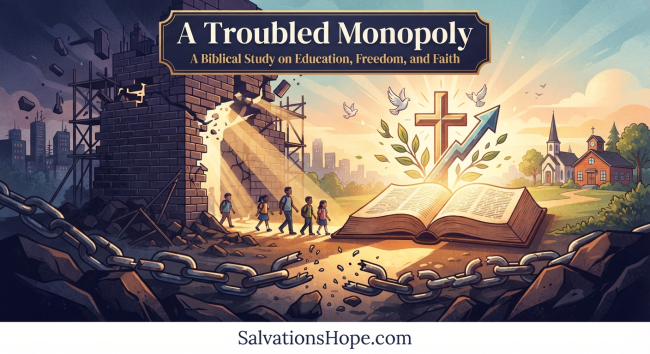
Study on Education, Freedom, and Faith
The Parable of the Computer Monopoly
“The earth is the Lord’s, and everything in it, the world, and all who live in it.” — Psalm 24:1
Imagine a scenario where the government mandates that every child must have a home computer. To ensure fairness, the state provides them “free of charge” funded by massive, across-the-board tax increases. However, there is a catch: the computers and operating systems must come exclusively from a government monopoly. Private alternatives like Apple or Dell are disqualified from funding.
When citizens object—arguing that taxation without educational choice is unfair, or that lower-income families are left with no real options—the government responds that everyone is “free” to buy whatever computer they want, provided they pay out of pocket on top of their taxes.
Then comes the final, most striking restriction: anyone who accepts a government computer is strictly forbidden from using it for religious purposes. No Bible software, no Christian emails, no visits to faith-based websites. Monitoring software ensures compliance, backed by the threat of legal action.
While some cheer the “free” technology and unionized government workers celebrate their secured monopoly, families of faith find themselves cornered: taxed to fund a system that actively excludes their deepest convictions.
While this computer scenario is entirely imaginary, it serves as a striking modern parable for a very real and pressing debate in our culture today.
Who Owns Education?: The Lordship of Christ
In our imaginary scenario, the state assumes total authority over a child’s intellectual and developmental future, declaring what must be used, who must build it, and how it must be run.
In a Christian worldview, the foundational question of education is not, “What does the state want?” but rather, “To whom do our children belong?”
- Creation and Stewardship: Scripture teaches that children are a heritage from the Lord (Psalm 127:3) and that parents are explicitly commanded to raise them "in the training and instruction of the Lord" (Ephesians 6:4).
- The Danger of Statism: When the state claims an absolute monopoly over the formation of young minds—and crowds out parental choice through financial coercion—it oversteps its God-given sphere of authority. Romans 13 outlines the government's role as maintaining justice and punishing evil, not acting as an all-encompassing surrogate parent or spiritual gatekeeper.
How does viewing education as a stewardship entrusted to parents rather than the government change how we evaluate school funding and educational freedom?
The Illusion of "Free" and the Burden of Monopoly
Many citizens in our parable supported the plan simply because they heard the word “free.” But as the story reveals, nothing provided by a government monopoly is truly free; it is paid for through heavy taxation, stripping citizens of their purchasing power and financial liberty.
Furthermore, a monopoly destroys competition and personal stewardship:
- The Parable of the Talents (Matthew 25:14–30): Jesus praised stewards who exercised creativity, responsibility, and initiative with what was entrusted to them. Monopolies breed stagnation, uniformity, and a lack of accountability.
- Economic and Educational Justice: When lower-income families are taxed for a monolithic system and left with no financial alternative, true freedom of choice vanishes. True justice empowers families, especially the vulnerable, rather than trapping them in a "take-it-or-leave-it" state model.
The Exclusion of Faith: Render to Caesar vs. Surrender to Caesar
The most alarming aspect of the parable is the ban on religious use. Citizens are forced to pay for a public system that explicitly censors and sidelines God.
This mirrors growing cultural pressures that attempt to push faith out of the public square under the banner of “neutrality.” But true neutrality toward God is an illusion. As Jesus declared,
“Whoever is not with me is against me” (Matthew 12:30).
- The Scope of Lordship: Colossians 1:16 reminds us that “all things have been created through him and for him.” This includes logic, science, technology, history, and education. To carve out a mandatory sphere of life—like learning—and declare it off-limits to Christ is to demand a surrender of our allegiance that belongs to God alone.
- The Rights of Conscience: Christian parents have a moral obligation to pass on the faith to the next generation (Deuteronomy 6:6–7). A system that penalizes religious citizens by taxing them while denying them educational tools that align with their conscience violates basic fairness and religious liberty.
Standing Firm in Freedom
The fictional “Troubled Monopoly” highlights the dangers of letting human institutions overreach their God-given boundaries. When the state claims total control over education and seeks to banish God from the learning process, it creates a system burdened by unfairness and spiritual compromise.
As Christians navigating debates over education, funding, and cultural freedom, we are called to advocate for systems that honor parental responsibility, uphold economic fairness, and keep the door wide open for the truth of God’s Word in every area of life.
Equipping the Next Generation: Perspective on Education and Stewardship
The Stewardship of Raising Children
“Train up a child in the way he should go, and when he is old he will not depart from it.” — Proverbs 22:6
As believers, we recognize that children are a heritage from the Lord (Psalm 127:3). God has entrusted parents—not the state—with the sacred responsibility of nurturing, disciplining, and instructing their children in the ways of truth and righteousness (Ephesians 6:4, Deuteronomy 6:6–7).
However, in modern society, Christian parents often find themselves navigating a complex educational landscape dominated by a government-controlled monopoly. Just as we must examine all cultural systems through the lens of Scripture, we are called to evaluate how our children are formed, what values they absorb, and where our ultimate allegiance lies.
The Mandate of Parental Authority vs. State Control
In Deuteronomy 6, God commands parents to teach His commandments diligently to their children when they sit at home, walk along the road, lie down, and get up. This comprehensive discipleship requires an environment where God’s truth is foundational, not marginalized.
- The Illusion of Neutrality: Secular educational systems often claim to be "religiously neutral." Yet, as Jesus noted, “Whoever is not with me is against me” (Matthew 12:30). In attempting to remove God from the classroom, public schooling does not become neutral; rather, it effectively neutralizes and bans biblical truth, replacing it with a secular worldview.
- The Principle of Stewardship: Romans 14:12 reminds us that each of us will give an account of ourselves to God. Handing over the primary intellectual and spiritual formation of children to a system that excludes God requires deep prayer and discernment regarding our God-given stewardship.
Examining the Fruit: Truth, Safety, and the Reality on the Ground
Jesus taught a timeless principle for evaluating systems and influences: “By their fruit you will recognize them” (Matthew 7:16). When assessing educational options, we must look past institutional rhetoric and examine the actual spiritual, emotional, and physical environment our children experience.
- Spiritual and Moral Direction: Scripture warns us not to be conformed to the pattern of this world (Romans 12:2). When schools promote ideologies that contradict God's design for creation, gender, and morality, children face intense pressure to compromise their faith.
- The Fruits of Peace vs. Fear: God has not given us a spirit of fear, but of power, love, and a sound mind (2 Timothy 1:7). Yet, modern classrooms are frequently plagued by an environment of hostility, bullying, or violence that breeds anxiety rather than peaceful learning.
While many dedicated teachers labor faithfully within public schools, the structural system as a whole often struggles to honor biblical foundations or protect students from worldly influences.
Freedom of Choice and True Educational Liberty
Throughout Scripture, God honors freedom of conscience and personal responsibility. He invites His people to choose whom they will serve (Joshua 24:15).
- The Injustice of Monopolies: A system that taxes all citizens while restricting financial support exclusively to a single, secular institution deprives families of true liberty of conscience.
- Empowering Families: Proverbs 13:20 encourages us to walk with the wise. Christian parents should prayerfully consider what environments best foster wisdom, character, and devotion to Christ—whether that involves Christian private schooling, homeschooling, or actively engaging as salt and light in their communities (Matthew 5:13–16).
Raising children in a culture that often opposes biblical values is one of the greatest challenges facing Christian families today. We are called to be wise as serpents and harmless as doves (Matthew 10:16), carefully evaluating where we place our children for the crucial formative hours of their youth.
Guarding Hearts and Minds: Education, Truth, and Secular Humanism
The Battle for the Next Generation
tradition and the basic principles of this world rather than on Christ.” — Colossians 2:8
In an era of shifting cultural landscapes, education is never neutral. Every classroom operates on a foundational worldview—it either builds upon the Rock of divine truth or shifts upon the sinking sand of human philosophy.
Today, Christian families face a profound cultural and spiritual crossroads regarding how and where children are educated. To understand the modern state of education, we must examine its spiritual lineage, test its claims against Scripture, and anchor our families firmly in Christ.
The Modern Educational Monopoly
National teachers’ unions, such as the National Education Association (NEA), wield enormous political influence. Official union resolutions explicitly oppose the use of public funds for private, parochial, or non-public schools, striving to preserve a government-funded educational monopoly.
More revealing than the financial protectionism, however, are the union’s ideological claims. Official NEA resolutions state that public education serves as the “cornerstone of our social, economic, and political structure”—placing the institution above the family and the church—and claims “utmost significance in the development of our moral, ethical, spiritual, and cultural values.”
Biblical Reflection: Who Holds the Mandate?
Talk about them when you sit at home and when you walk along the road, when you lie down and when you get up.”
Ephesians 6:4: “Fathers, do not provoke your children to anger; instead, bring them up in the training and instruction of the Lord.”
Scripture places the primary responsibility for the moral, spiritual, and intellectual training of children squarely upon parents and the faith community—not the secular state. When an institution claims the “utmost significance” in shaping spiritual and moral values while excluding God, it encroaches upon a domain reserved for the Creator.
The Historical Roots of Secular Schooling
How did government-run education arrive at a place where prayer, Jesus, and the Bible are sidelined, yet spiritual and moral claims are boldly asserted? The answer lies in the vision of the architects of modern public schooling.
Horace Mann: Replacing God with the State
Known as the “father of public education” in the mid-19th century, Horace Mann was a Unitarian who rejected the divinity of Christ. He pushed to centralize education under government authority, replacing community and religious schooling. Mann wrote:
“What the church has been for medieval man the public school must become for democratic and rational man. God will be replaced by the concept of the public good… The common schools… shall create more far-seeing morality than has ever existed among communities of men.”
John Dewey: Humanism in the Classroom
In the early 20th century, philosopher John Dewey shaped the trajectory of American teachers’ colleges. A signer of the Humanist Manifesto and first president of the American Humanist Association, Dewey explicitly rejected biblical faith:
“Faith in the prayer-hearing God is an unproved and outmoded faith. There is no God, and there is no soul… There is no room for fixed, natural law or moral absolutes.”
Dewey viewed education as the engine of social reform, declaring that “the teacher is always the prophet of the true god and the usherer of the true kingdom of god.”
Discerning Truth from Deceptive Philosophy
When an educational system attempts to impart morality while denying the Moral Lawgiver, it substitutes divine truth for human tradition.
As the Apostle Paul warned in Colossians 2:8, believers must be vigilant against “hollow and deceptive philosophy.” While many dedicated Christian educators work faithfully inside public schools to shine Christ’s light and care for students, the underlying framework and institutional leadership of modern public schooling often reflect the humanistic blueprints laid by Mann and Dewey.
Comparing Worldviews
Feature
The Humanistic Framework
The Biblical Framework
Ultimate Authority
Human reason, state consensus, and social progress
The unchanging Word of God (Psalm 119:160)
Source of Morality
Relative, evolving cultural norms and public utility
Absolute moral law established by a holy Creator
View of the Child
Raw material for social engineering and state shaping
Image-bearer of God entrusted to parents
Primary Educator
The State / Institutional Bureaucracy
Parents, anchored in the local church
The monopoly of secular humanism in public education poses a serious challenge for Christian families. As theologian J. Gresham Machen wisely observed regarding educational monopolies:
“A public-school system … is of benefit only if it is kept healthy at every moment by the absolutely free possibility of the competition of private schools… but when once it becomes monopolistic it is the most perfect instrument of tyranny which has yet been devised.”
Navigating these challenges requires discernment, grace, and intentional discipleship. Whether children attend public, private, or homeschool environments, families must actively counter secular philosophies with biblical truth.
Training Up Disciples: Inquiry into Educational Stewardship
The Mandate of Christian Formation
Throughout Scripture, the education of children is never presented as a neutral, secular, or purely administrative function of the state. Rather, it is portrayed as a sacred, non-negotiable duty entrusted directly to parents under the sovereign authority of God. In Deuteronomy 6:6-7, the Lord commands:
Talk about them when you sit at home and when you walk along the road, when you lie down and when you get up.”
This foundational charge establishes that the formation of the human mind and soul is an act of worship and discipleship. When contemporary society constructs a monolithic, state-run educational apparatus that systematically excludes the counsel of God, it challenges the divine order. Believers today are increasingly recognizing that reforming a secular system is insufficient; instead, Christian families are called to examine the very presuppositions of modern public education through the lens of Scripture, seeking alternatives that honor Christ as the supreme source of all wisdom and knowledge.
The Biblical Philosophy of Education: Discipleship vs. Indoctrination
Education is inherently theological. There is no such thing as a religiously neutral curriculum; every subject—whether history, science, literature, or mathematics—is interpreted through a specific worldview. It either acknowledges the Creator God who sustains the universe by His power or operates on secular humanist assumptions that push the Creator to the margins.
The Apostle Paul warns the Colossian church against falling prey to secular philosophies that lack the foundation of Christ:
and the elemental spiritual forces of this world rather than on Christ.” (Colossians 2:8)
When children spend the formative hours of their youth immersed in an institutional environment where secularism is the established orthodoxy, they are being shaped by human tradition rather than divine truth. Proverbs 22:6 instructs parents to “Start children off on the way they should go, and even when they are old they will not turn from it.” The Hebrew term for “train” (chanak) implies dedicating a child according to their unique design and developmental gifting. A state monopoly on education tends toward homogenization and forced conformity, standardizing minds to fit the needs of a secular collective rather than cultivating individual Christian stewardship and spiritual discernment.
The Call to Non-Conformity: Analyzing Romans 12:2
At the heart of the Christian educational debate lies the call to radical spiritual transformation. The Apostle Paul writes in Romans 12:2:
Then you will be able to test and prove what God’s will is—his good, pleasing and perfect will.”
For generations, well-meaning believers attempted to reform public educational systems from within, hoping to reintroduce voluntary prayer, tone down evolutionary dogma, or adjust moral instruction. Yet, as the cultural landscape has shifted, many Christian parents have realized that attempting to patch a broken, secular paradigm falls short of biblical obedience.
To be conformed to this world (sunschematizo) means to allow oneself to be pressed into an external mold designed by a society in rebellion against God. The public school monopoly, by its structural exclusion of divine truth, inevitably presses children into a secular mold. True Christian education, by contrast, seeks the transformation (metamorphosis) of the mind through the continuous washing of God’s Word. If Christ is Lord over all creation, He must be Lord over the classroom. Entrusting the daily, seven-hour mental formation of a child to an institution that operates independently of His authority runs contrary to the radical allegiance demanded of His disciples.
Practical Stewardship: Exploring Faithful Alternatives
Recognizing the limitations and spiritual hazards of state-run monopolies has led millions of Christian families to reclaim their God-given responsibility through alternative educational pathways. This revival of independent Christian schooling and home-based discipleship represents a profound return to biblical stewardship.
1. The Heritage of Home Schooling
Home education provides an environment where parents can weave biblical truths into the fabric of daily academic life. Far from isolating children from reality, home instruction allows for a personalized, rigorous academic approach anchored in a Christian worldview. As resources, curricula, and cooperative networks have multiplied, families have found robust support systems that foster both intellectual excellence and strong familial bonds.
2. Christ-Centered Private Schools
For families seeking a community-based approach, parent-controlled Christian schools and parochial institutions offer an environment where teachers and administrators share the same foundational faith. In these settings, academic rigor is not divorced from moral accountability; rather, every discipline is taught with the explicit recognition that “the fear of the Lord is the beginning of wisdom” (Proverbs 9:10).
Embracing these alternatives often requires financial sacrifice, as families pay taxes for a public system while simultaneously funding private alternatives. Yet, viewing education as an investment in eternal souls reframes this cost as an act of faithful stewardship.
Freedom of Thought and the Illusion of Unity
Defenders of the public school monopoly often argue that a unified, state-run educational system is essential for social cohesion, warning that alternatives lead to societal fragmentation. From a biblical perspective, however, true unity is not achieved through government-enforced ideological uniformity, but through the reconciling power of Jesus Christ, who breaks down dividing walls of hostility (Ephesians 2:14).
A free society relies upon genuine freedom of conscience and thought—freedoms that are hollowed out when a government-run institution spends the formative years of childhood shaping how citizens think, speak, and perceive reality. Proverbs 23:23 urges believers:
“Buy the truth and do not sell it—wisdom, instruction and insight as well.”
The church must champion educational pluralism because truth fears no competition. When parents are empowered to choose educational models that reflect their deepest convictions, society becomes healthier, more intellectually vibrant, and genuinely free.
Reclaiming the Mind for Christ
The challenge to the educational monopoly is, at its core, a theological awakening. It is a declaration that our minds, and the minds of our children, belong to the Creator who redeemed them. As Christian families evaluate their educational choices, the guiding principle must not be mere convenience or social tradition, but radical obedience to the Lordship of Christ.
If we are to be transformed by the renewing of our minds, we must ensure that the environment shaping those minds points unwaveringly toward the Truth. Let us prayerfully consider how we steward the education of the next generation, ensuring that Christ—and not the state—holds the preeminent place in our children’s intellectual and spiritual formation.
Questions for Reflection
In what practical ways can your family ensure that Christ remains the central authority in your children’s daily learning and worldview development?
How does the command in Romans 12:2 challenge the way Christians approach institutional systems that conflict with biblical values?
What steps can your local church or community take to better support families choosing alternative Christian education or home schooling?