
Discipline of the Ear
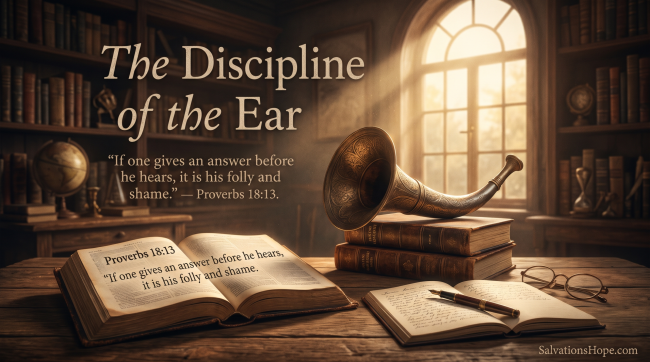
Hearing the Word
“If one gives an answer before he hears, it is his folly and shame.” (Proverbs 18:13)
In contemporary Christian circles, apologetics (apologia, 1 Peter 3:15) is often mischaracterized as verbal combat—an arsenal of syllogisms, historical evidence, and rhetorical countermeasures meant to win debates. Yet the biblical witness shows that Christian persuasion is fundamentally pastoral, grounded in epistemic humility, love, and attentive listening.
Before we can speak truth with authority, we must receive truth in submission; before we can dismantle false worldviews, we must understand them; and before we can call an individual to repentance, we must perceive who they are.
Effective Christian apologetics rests upon a threefold discipline of listening: hearing God’s revelation, discerning cultural contexts, and attending to the individual soul.
Apologetics does not originate in human intellect or philosophical autonomy; it comes from divine self-disclosure. The Apostle Paul writes:
“So faith comes from hearing, and hearing through the word of Christ.”(Romans 10:17)
The Greek noun akoē (“hearing”) underscores that reception precedes proclamation. The apologist is not an originator of truth but an emissary (presbeuomen, 2 Corinthians 5:20) who delivers a message received from another. Consequently, the first and most critical act of apologetics is to sit beneath the authority of Holy Scripture.
rightly handling the word of truth.”(2 Timothy 2:15)
Exegetical Fidelity: The call to be a workman who has “no need to be ashamed, rightly handling the word of truth” (2 Timothy 2:15, orthotomounta ton logon tēs alētheias) demands rigorous study. We cannot defend doctrines we have merely skimmed.
“knowing this first of all, that no prophecy of Scripture comes from someone’s own interpretation. For no prophecy was ever produced by the will of man, but men spoke from God as they were carried along by the Holy Spirit.” (2 Peter 1:20–21)
Submission to the Communion of Saints: We are warned against private interpretations divorced from the historic body of Christ (2 Peter 1:20–21). Listening to mature teachers, historical creeds, and seasoned practitioners anchors our apologetic in tested orthodoxy rather than novel human speculation.
A speaker who has not first been a hearer inevitably communicates their own opinions rather than the living Word of God.
Hearing the Culture
The biblical model of engagement never operates in an anthropological vacuum. In Acts 17, the Apostle Paul provides the archetypal paradigm for contextual apologetics at the Areopagus in Athens.
and all their kinsmen under their command.” (1 Chronicles 12:32)
Paul at the Areopagus (Mars Hill)
Observational Attentiveness: Paul walked through Athens and examined their objects of worship (anatheōrōn, Acts 17:23). He did not launch into a generic synagogue sermon; instead, he engaged their local milieu.
Contextual Comprehension: Recognizing he was addressing Stoic and Epicurean philosophers, he adjusted his starting point. To Jews, Paul argued from the Old Testament Scriptures (graphai); to Greeks, he reasoned from general revelation and providence and even quoted their own pagan poets—Aratus and Epimenides (Acts 17:28)—to subvert their idolatry from within.
Biblical Faithfulness: Contextualization is not accommodation. Paul used their cultural categories not to dilute the Gospel, but to confront their ignorance and call them to repentance before the resurrected Christ (Acts 17:30–31).
Like the sons of Issachar, “men who had understanding of the times, to know what Israel ought to do” (1 Chronicles 12:32), the modern apologist must listen carefully to the assumptions of the ambient culture:
The Academic Milieu: Entering a secular university requires understanding its dominant presuppositions—naturalism, expressive individualism, moral relativism—alongside the distinct existential temptations faced by emerging adults.
Religious Worldviews: Engaging our Muslim neighbors demands more than a textbook familiarity with the five pillars. It requires understanding how Islamic orthodoxy varies regionally and doctrinally—from Sunni orthodox communities in Pakistan to contextual expressions across North Africa or Southeast Asia, to diaspora communities navigating Western post-secularism.
Hearing the Soul
Modern apologetics’ greatest failure is reducing image-bearers (Imago Dei, Genesis 1:26–27) to ideological caricatures. When we address abstract belief systems rather than concrete human beings, we violate the royal law of love (James 2:8).
“The purpose in a man’s heart is like deep water, but a man of understanding will draw it out.” (Proverbs 20:5)
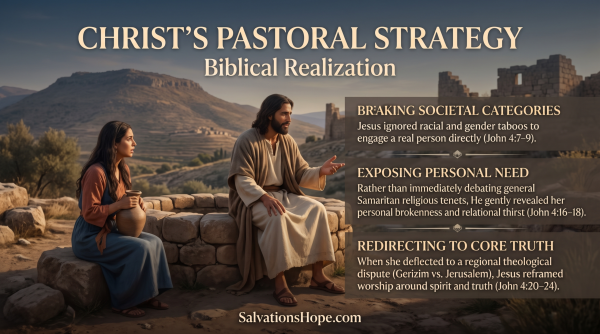
Christ’s interaction with the Samaritan woman at Jacob’s well (John 4) models this personalized discernment:
Rejecting the Fallacy of the Label
A person may wear a religious badge without adhering to its formal dogmas:
The Nominal Roman Catholic: A person baptized in the Roman communion may have never read the Catechism of the Catholic Church or embraced Tridentine theology. Approaching them with polemics against Vatican councils is an exercise in futility if their real struggle is moral guilt, practical atheism, or familial trauma.
The Cultural Adherent: Two individuals bearing the title “Muslim,” “Protestant,” or “Agnostic” will often share little in experiential grounding, doubts, or desires.
Proverbs 18:13 names pre-emptive answering as folly and shame (iwweleth and kəlimmāh). Patient listening honors the person’s dignity and reveals the actual stumbling block (skandalon) preventing them from embracing the Cross.
The Apologetic Synthesis
Apologetic fidelity demands a unified triadic discipline:
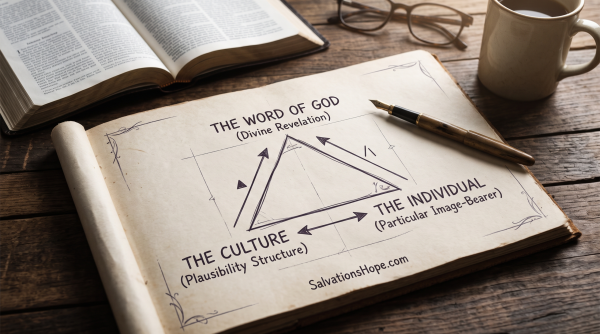
Know the Word: Faithfully exegete the Scriptures so that your defense is rooted in God’s revealed truth, not human rhetoric.
Know the Context: Understand the philosophical and sociological patterns that shape how your hearers perceive reality.
Know the Person: Listen long and deep to draw out the heart’s true condition, answering not merely a theological argument, but a living soul in need of redemption.
When Apologetics Misses the Mark
The primary danger in defending the faith is the temptation to win an argument at the expense of scriptural integrity. An apologetic strategy may seem intellectually formidable, socially palatable, or culturally respectable, yet if it contradicts God’s self-revelation, it ceases to be Christian witness and becomes human accommodation.
Apologetics is not the art of reshaping biblical doctrine to satisfy contemporary secular dogmas; it is the faithful proclamation and reasoned defense of God’s revealed truth in the face of human rebellion. When we alter theology to remove offense, we empty the cross of its power.
The Peril of Theological Accommodation: Redefining Creation
When engaging an environment thoroughly committed to naturalistic paradigms—such as materialist accounts of origins—apologists are often tempted to harmonize biblical doctrine with the prevailing consensus simply to lower the barrier of belief. The motivation seems strategic: make Christianity acceptable to the intellectual establishment by asserting that biblical theology meshes seamlessly with standard evolutionary naturalism.
This approach, however, frequently demands a theological cost that Scripture forbids:
Erosion of Exegetical Authority: Genesis 1–3 is reduced to mere poetry or primitive mythology to avoid cultural embarrassment. Yet Jesus Himself affirmed the historical reality of the creation account, grounding the definition of marriage in the fact that God “made them male and female” at the beginning (Matthew 19:4–5).
Theological Incoherence Regarding Sin and Death: Scripture explicitly connects physical and cosmic death to the historical fall of man (Romans 5:12). If millions of years of carnage, disease, predation, and extinction preceded human agency, death is no longer the “last enemy” introduced by human rebellion (1 Corinthians 15:26), but rather the divine instrument of creation. This inevitably dismantles Adam’s federal headship and distorts the redemptive work of the Second Adam, Jesus Christ.
An apologetic that surrenders biblical fidelity to appease scientific materialism gains immediate cultural respectability, but it surrenders the very gospel it purports to defend.
The Reality of a Groaning Cosmos
A second common misstep appears in simplistic natural theology. An apologist, eager to argue for divine benevolence from the natural world, might point to sunsets, mountain peaks, and intricate biological systems as proof that nature functions as an unblemished showcase of God’s goodness and flawless design.
While the heavens declare the glory of God (Psalm 19:1), presenting nature as an unmarred display of divine perfection ignores the central biblical doctrine of the Fall.

The Reality of the Curse: Genesis 3:17–19 records the cosmic rupture following human disobedience: the ground itself is cursed, bringing forth thorns, thistles, and sweat. Genesis 6–8 further records a deluge of cataclysmic judgment that shattered early topography and climate.
The Bondage to Decay: In Romans 8:20–22, the Apostle Paul describes creation’s present state as subject to futility (mataiotēs) and groaning in the pains of childbirth. Parasites, tsunamis, congenital disabilities, and lethal pathogens exist alongside order and beauty.
Pretending that the universe operates as a harmonious machine ignores the profound reality of human suffering. When an apologist claims the present world is a seamless mirror of God’s goodness, observant skeptics rightly point to agonizing natural evil. Biblical apologetics does not deny nature’s brokenness; it explains it through human rebellion and divine judgment, pointing forward to the cosmic renewal promised in Christ.
The False Solution to Suffering
Confronted with profound suffering and evil, apologists may attempt to shield God’s moral goodness by compromising His supreme rule. The argument suggests that suffering occurs because certain events operate outside of God’s sovereign control, foresight, or ability to intervene—framing the Almighty as a well-meaning observer doing His best against tragic, uncontrollable forces.
This theological retreat directly contradicts the continuous testimony of Scripture:
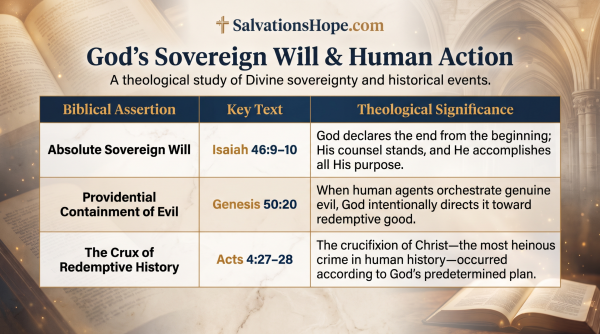
Scripture never resolves the problem of evil by stripping God of His omnipotence. While moral creatures actively sin against God’s moral commands, their actions never escape His comprehensive providential rule. A deity who cannot govern all contingencies is not the God of Abraham, Isaac, and Jacob, nor can such a deity guarantee the final victory over evil and death.
Preserving the Center of Apologetic Witness
Every attempt to soften biblical truth to suit the philosophical trends of the age results in theological collapse:
- Accommodation produces syncretism, subordinating God's Word to the changing assumptions of human culture.
- Naive optimism produces skepticism, ignoring the biblical reality of the curse and the existential weight of pain.
- Diminished sovereignty breeds despair, presenting a God too weak to uphold His promises or to triumph over evil.
Apologetics must remain tethered to God’s whole counsel. Our goal is never to invent a more palatable religion, but to faithfully present the reality of God as He has revealed Himself: the holy Creator who judged a rebellious world, the sovereign Lord who directs history, and the merciful Redeemer who stepped into our suffering to conquer death once and for all.
The Cost of Ignoring Cultural Context
An apologetic argument can be logically sound and fully biblical, yet miss the mark if delivered to the wrong audience. Apologetics is an act of translation—communicating immutable divine truth into a listener’s specific epistemic landscape. When we fail to discern our hearers’ philosophical, religious, or sociological background, we waste energy answering questions no one is asking while leaving the real barriers to faith unaddressed.
Scripture repeatedly warns against misdirected speech. Proverbs 25:11 notes that a word fitly spoken is like apples of gold in settings of silver; conversely, an unfitting word—regardless of its factual accuracy—falls flat. Effective witness requires us to identify the listener’s presuppositions so we don’t waste time defending ground they already share or using reasoning our audience instinctively rejects.
Discerning the Theological Starting Point
One common tactical error is arguing for foundational assumptions that the hearer already accepts. This squanders opportunities to address the decisive doctrinal divides.
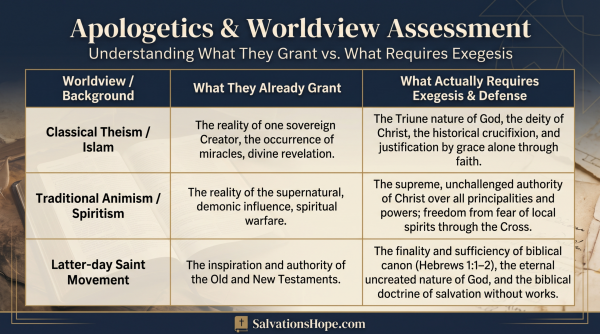
To lecture a Muslim on the cosmological argument or to prove to an animist that unseen spirits exist is an exercise in misplaced effort. The apologist must locate the hinge point of disagreement. For the animist, the question is not whether the spirit realm exists, but who reigns over it. For the Latter-day Saint, the issue is not whether the Bible is inspired, but whether additional modern revelations are necessary or doctrinally consistent with apostolic truth.
Navigating Semantic Equivocation: The Hindu Paradigm
A lack of contextual awareness often leads to semantic confusion—using Christian words that mean something entirely different in the listener’s conceptual framework.
When speaking to someone immersed in Eastern pantheism or classical Hinduism, proclaiming “Jesus is God” often fails to challenge their worldview:
- Polytheistic Incorporation: In a framework that accommodates millions of localized deities (devas), adding Jesus of Nazareth to the pantheon poses no difficulty. The claim is absorbed rather than confronted.
- Monistic Collapse: In philosophical Vedantic thought, where all reality is fundamentally unified (Brahman), and the self (Atman) is identical with the divine, claiming Christ's divinity merely states what they believe is ultimately true of every human being.
Before the apologist can meaningfully proclaim Christ’s singular divine status, they must establish the biblical Creator-creature distinction (Genesis 1:1; Isaiah 40:25–26). God is not an impersonal cosmic essence identical to the universe, nor is He one deity among many. He is the self-existent, transcendent Lord who created all things ex nihilo. Only after dismantling pantheistic monism does the unique incarnation of the eternal Word (John 1:1, 14) carry its intended theological weight.
When Cold Evidentialism Fails
Context also dictates the mode of persuasion. Western evidentialist apologetics was forged largely in response to modernism—an era defined by rationalism, linear logic, and scientific empiricism. However, when engaging individuals formed by postmodern epistemology, traditional syllogisms and historical evidential proofs frequently fail to register.
Postmodern thought tends to view claims of objective, universal truth with skepticism, often interpreting them as bids for power. In such contexts, presenting an airtight logical chain can be perceived as coercive rather than convincing.
Scripture models a multidimensional apologetic that engages more than purely propositional deduction:
- Embodied Apologetics: Jesus stated, "By this all people will know that you are my disciples, if you have love for one another" (John 13:35). Authentic, sacrificial Christian community provides a tangible plausibility structure for those who distrust abstract truth claims.
- Existential Longing: While a postmodern framework may deny metaphysical absolutes, image-bearers cannot fully suppress their inherent thirst for purpose, reconciliation, and transcendence. Welcoming the skeptic into Christian worship, fellowship, and acts of redemptive mercy allows the beauty of the Gospel to confront their worldview organically.
The Pauline Example of Contextual Adaptability
The Apostle Paul summarized this apologetic flexibility in 1 Corinthians 9:20–22:
I have become all things to all people, that by all means I might save some.”
Paul did not change the Gospel message, but he adapted his vocabulary, reference points, and opening arguments to suit his hearers. To argue effectively for the faith:
- Ascertain the listener's actual worldview rather than combating an assumed opponent.
- Clarify shared terminology so that biblical terms retain their proper theological definitions.
- Select the appropriate entry point that meets the hearer where their specific questions and cultural assumptions lie.
The Danger of Bypassing the Individual Soul
A defense of the Christian faith can be rooted in Scripture, sharp in logic, and tailored to the surrounding culture, yet completely miscarry if it treats a living human being as an abstract debate opponent. The third critical error in apologetics is overlooking the individual soul.
Scripture never models ministry as an intellectual lecture to anonymous minds. It portrays the cure of souls as discerning the specific motivations, wounds, doubts, and moral struggles behind a person’s stated objections.
Solomon observed:
“The purpose in a man’s heart is like deep water, but a man of understanding will draw it out.” (Proverbs 20:5)
The term translated as “draw it out” (yadlenna) evokes drawing water up from a deep, hidden well. Most apologetic queries are just the surface bucket; the real issue lies beneath layers of personal history. When we answer the surface question without plumbing the heart’s depths, our apologetics remains misdirected.
Discerning Intellectual Objections vs. Existential Pain
When someone voices skepticism about core biblical convictions, our immediate impulse is often to respond with evidence: cite external authorities, outline textual reliability, or present philosophical frameworks. Yet vocal objections often reflect acute personal anguish rather than a genuine intellectual crisis.
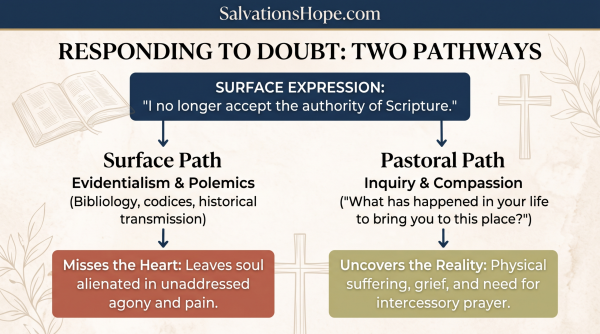
When someone in deep distress cries out that they can no longer trust God or His Word, an aggressive presentation on textual transmission treats a bleeding wound with an academic syllabus. They don’t need a lecture on ancient codices; they need the body of Christ to minister comfort, intercede in prayer, and offer tender care (Galatians 6:2).
A simple, discerning question—asking why their convictions have shifted—often reveals that the problem is not a sudden flaw in the biblical text, but an overwhelming burden of sorrow.
Uncovering the Root: Four Classic Objections Reexamined
Scripture warns that “answering a matter before hearing it” is foolishness (Proverbs 18:13). The same verbal complaint can arise from entirely distinct motives, each requiring a different pastoral response.
Objection A: “Christianity is Anti-Intellectual and Unscientific”
The Academic/Presuppositional Root: The individual may genuinely believe the natural sciences undermine Christian theism. Here, a reasoned defense tracing the Christian origins of modern empirical inquiry and the theological foundations of scientific methodology is entirely appropriate.
The Social/Relational Root: The individual may have recently entered an environment—such as a university setting—where secular conformity is the price of social acceptance. Often, they offer no new evidence; instead, the pressure to gain peer approval makes biblical convictions seem obsolete. Gently probing their reasons reveals whether their objection rests on evidence or merely on a desire to fit in with a new crowd.
Objection B: “Evil and Pain Disprove a Sovereign, Good God”
The Theoretical Dilemma: The hearer may have encountered a formal philosophical presentation of the problem of evil. This calls for a biblical theodicy—tracing the reality of the Fall, the moral necessity of creaturely responsibility, and the cross of Christ where divine justice and suffering meet.
The Bereaved Heart: The individual may be reeling from sudden tragedy, chronic illness, or devastating betrayal. Offering a detached, theoretical discourse to someone sitting in the ruins of personal grief is an act of spiritual insensitivity. Scripture commands us to “weep with those who weep” (Romans 12:15). In the crucible of grief, compassionate presence must precede theological exposition.
Objection C: “The Church is Entirely Hypocritical”
The Intellectual Deflection: A skeptic may point to moral inconsistencies among believers as an excuse to dismiss the Gospel. Logically, a poor performer butchering a piece of music reflects poorly on the musician, not the composer. A hypocrite merely demonstrates their failure to emulate Christ, whose perfection remains untarnished.
The Wound of Spiritual Abuse: The objection often conceals a history of betrayal. If the person was raised by abusive parents who maintained a pious public image, or was exploited by a leader claiming spiritual authority, their complaint is not a debate point. It is a cry of moral outrage against injustice. Dismissing their pain with quick analogies ignores the gravity of the wound. The apologist must first listen, validate their righteous indignation against sin, and demonstrate how fiercely Jesus Himself condemned those who harm the vulnerable (Matthew 18:6).
Objection D: “The Exclusivity of Christ is Arrogant”
The Cultural Dogma: Pluralism teaches that claiming exclusive truth is inherently conceited. The necessary response points out that Christ Himself made absolute claims regarding salvation (John 14:6; Acts 4:12), making Christian exclusivity a matter of submission to revelation rather than personal pride.
The Personal Bruise: The person may have encountered believers who wielded biblical doctrine with callous superiority. Before defending Christ’s uniqueness, the apologist must determine whether the hearer has been deeply alienated by arrogant behavior. If so, our task begins with repentance for that poor witness, demonstrating that true faith in the Gospel produces profound humility: we are merely beggars telling other beggars where to find bread.
Discerning Moral Resistance vs. Conceptual Confusion
Sometimes, objections about religious strictness and moral rules hide a deeper refusal to surrender one’s life to God.
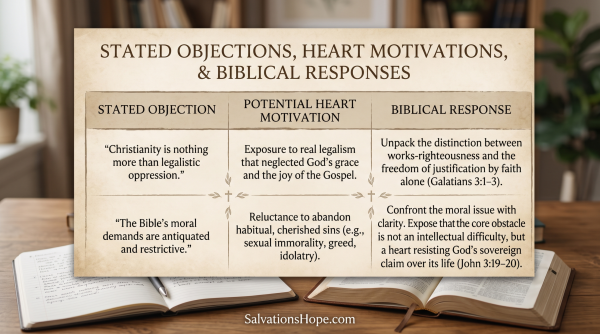
When an objection stems from a desire to justify personal sin, piling up intellectual arguments will not resolve the issue. In such cases, the problem is not a lack of light, but an active rejection of it. The apologist must move from abstract debate to a clear, loving call to repentance and faith.
The Master’s Paradigm: Directing the Word to the Heart
Jesus Christ’s ministry exemplifies this penetrating, individualized engagement. He never spoke to people as generic types:
To Nicodemus, a self-assured master of the law, Christ confronted intellectual presumption with the mystery of regeneration: “You must be born again” (John 3:3, 7).
To the Samaritan Woman, weighed down by moral failure and social isolation, He bypassed liturgical disputes and gently brought her hidden brokenness into the light of divine mercy (John 4:16–18).
To the grieving Martha, struggling to comprehend her brother’s death, He offered neither a rebuke nor a simple tear, but a theological anchor: “I am the resurrection and the life” (John 11:25).
Jesus heard what lay beneath His words. He perceived the unspoken questions, secret anxieties, and stubborn rebellions in every heart.
The Complete Apologetic Architecture
To remain faithful to God’s calling, Christian witness must hold all three dimensions in balance:
- Know Divine Revelation: Ground every argument in the authoritative, uncompromised Word of God, refusing to alter doctrine to appease modern sentiment.
- Understand Cultural Context: Discern the underlying philosophies, languages, and assumptions shaping the world around you so you can speak meaningfully to your hearers.
- Love the Individual: Listen patiently, ask probing and compassionate questions, and perceive the particular soul before you.
Only when our defense of the faith is anchored in God’s truth, informed by the listener’s world, and driven by Christlike love for the individual can our apologetics strike its mark—not merely silencing arguments, but winning souls to the glorious hope of salvation.
Winning Souls, Not Debates: The Pastoral Theology of Apologetics
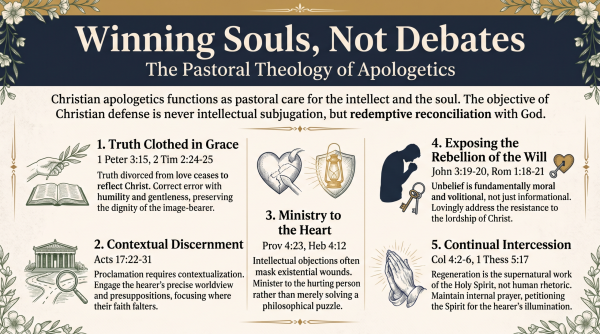
Christian apologetics functions as pastoral care for the intellect and the soul. The objective of Christian defense is never intellectual subjugation, but redemptive reconciliation with God (2 Corinthians 5:18–20).
Truth Clothed in Grace
Truth divorced from love ceases to reflect Christ. Intellectual dominance alienates the hearer; Christlike humility and gentleness must mediate sound doctrine. Correct doctrinal and philosophical error without stripping the hearer of their dignity as an image-bearer of God (imago Dei).
Contextual Discernment
Faithful proclamation requires theological contextualization. Just as Paul engaged the Athenians at the Areopagus by addressing their specific framework, defending the faith requires engaging the hearer’s precise presuppositions rather than reciting scripted polemics. Discern the individual’s worldview. Avoid proving premises they already concede; concentrate theological energy strictly where their faith falters.
Ministry to the Heart
Intellectual objections routinely mask existential fractures. Resistance regarding the problem of evil, divine judgment, or institutional hypocrisy often emerges from personal trauma rather than abstract philosophy. Expose the spiritual and emotional roots beneath intellectual objections—Minister to the wounded person rather than merely solving the philosophical puzzle.
Exposing the Rebellion of the Will
Unbelief is fundamentally moral and volitional, not merely informational. Fallen humanity actively suppresses divine truth to preserve autonomy and evade accountability to a holy Creator. Once trust is established, lovingly address the moral barrier. The obstacle is rarely a lack of evidence, but an unwillingness to surrender to Christ’s lordship.
Continual Intercession
Regeneration is exclusively the supernatural work of the Holy Spirit (Titus 3:5), not the triumph of human rhetoric or dialectics. Maintain internal prayer during external dialogue, petitioning the Spirit for the hearer’s illumination and for discernment to perceive their core spiritual need.