Divine Drama
Messianic Secrecy
Why the Messiah Commanded Silence Before the Cross
The interaction between human secondary agency and divine primary agency resembles a stage play. In this analogy, the Roman soldiers, the Jewish mob, and Pontius Pilate are the actors, each acting with their own intentions and decisions. However, the playwright—Yahweh, in this case—writes the script and directs the play, and determines its outcome. While the actors can improvise and make choices, the playwright ultimately controls the narrative, just as human actions unfold within the context of divine guidance.
A survey of Mark’s narrative reveals a persistent textual strategy where Jesus commands silence following exorcisms, healings, and revelations of His messianic status:
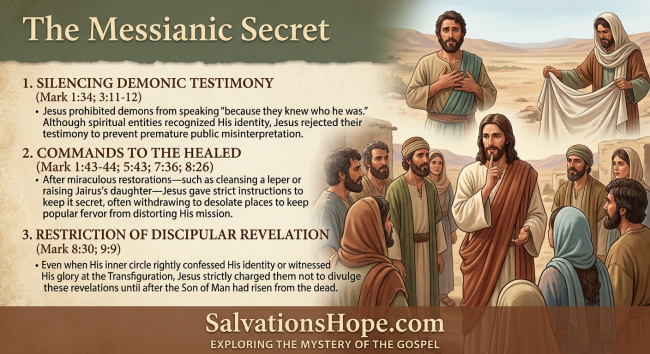
- Silencing Demonic Testimony (Mark 1:34; 3:11-12): Jesus prohibited demons from speaking "because they knew who he was." Although spiritual entities recognized His identity, Jesus rejected their testimony to prevent premature public misinterpretation.
- Commands to the Healed (Mark 1:43-44; 5:43; 7:36; 8:26): After miraculous restorations—such as cleansing a leper or raising Jairus's daughter—Jesus gave strict instructions to keep it secret, often withdrawing to desolate places to keep popular fervor from distorting His mission.
- Restriction of Discipular Revelation (Mark 8:30; 9:9): Even when His inner circle rightly confessed His identity or witnessed His glory at the Transfiguration, Jesus strictly charged them not to divulge these revelations until after the Son of Man had risen from the dead.
The Turning Point in Caesarea Philippi
“And Jesus went on with his disciples to the villages of Caesarea Philippi. And on the way he asked his disciples, “Who do people say that I am?” And they told him, “John the Baptist; and others say, Elijah; and others, one of the prophets.” And he asked them, “But who do you say that I am?” Peter answered him, “You are the Christ.” And he strictly charged them to tell no one about him. And he began to teach them that the Son of Man must suffer many things and be rejected by the elders and the chief priests and the scribes and be killed, and after three days rise again. And he said this plainly. And Peter took him aside and began to rebuke him. But turning and seeing his disciples, he rebuked Peter and said, “Get behind me, Satan! For you are not setting your mind on the things of God, but on the things of man.” (Mark 8:27–33)
Located geographically and structurally at the midpoint of Mark’s Gospel, the narrative shift in Caesarea Philippi redefines Jewish messianic expectations in light of redemptive suffering.
Verses 27–30: The Confession of Peter: Jesus initiates the dialogue with a two-part inquiry: first concerning popular opinion (“Who do people say I am?”), which elicits answers that reference prophetic predecessors like Elijah or John the Baptist; and second, pressing the disciples’ personal conviction (“Who do you say I am?”). Peter acts as the spokesman, asserting: “You are the Christ” (Greek: Christos, translating the Hebrew Mashiach). Jesus immediately warns them not to tell anyone, indicating that while Peter’s title was accurate, his framework was incomplete.
Verses 31–33: The First Passion Prediction and Rebuke: Immediately after the confession, Jesus teaches that the Son of Man must (Greek: dei, indicating divine necessity based on prophetic fulfillment) suffer, be rejected by the Sanhedrin, be killed, and rise after three days. Peter takes Jesus aside to rebuke Him. In first-century Jewish thought, the Messiah was expected to be a victorious, triumphant king who would overthrow Roman oppression, not a crucified victim.
Jesus turns, looks at the disciples, and delivers a severe response: “Get behind me, Satan! For you are not setting your mind on the things of God, but on the things of man” (v. 33). To advocate a cross-less Messianic vision is to succumb to a satanic temptation that avoids the divine decree of atonement.
Resolving the Messianic Secret
The function of the Messianic Secret is pedagogical and Christological:
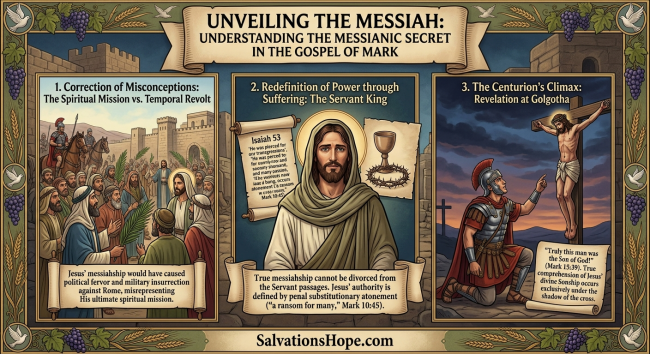
- Correction of Misconceptions: Unchecked proclamation of Jesus' messiahship would have caused political fervor and military insurrection against Rome, misrepresenting His ultimate spiritual mission.
- Redefinition of Power through Suffering: True messiahship cannot be divorced from the Servant passages of Isaiah 53. Jesus' authority is defined not by temporal conquest, but by penal substitutionary atonement ("a ransom for many," Mark 10:45).
- The Centurion's Climax: The secrecy is lifted only at Golgotha. When Jesus breathes His last, the Roman centurion declares, "Truly this man was the Son of God!" (Mark 15:39). In Mark, true comprehension of Jesus' divine Sonship occurs exclusively under the shadow of the cross.
The Imperatives of Discipleship
Calling the crowd together with His disciples, Jesus outlines three conditional demands for authentic Christian discipleship in Mark 8:34–38:
- Self-Denial (Greek: aparneomai): A radical renunciation of self-sovereignty and autonomous human ambition, submitting entirely to God’s reign.
- Taking Up the Cross: A public willingness to endure social rejection, persecution, and physical death for Christ’s sake, following the Master’s path.
- Following Him (Greek: akoloutheo): Continuous obedience and alignment with His life, teaching, and sacrificial ethos.
Jesus establishes a paradoxical spiritual principle: attempting to preserve one’s physical or temporal self leads to eternal loss, whereas losing one’s life for the sake of the Gospel results in ultimate salvation (v. 35).
Questions to Consider:
- How does Jesus’ prohibition of testimony in Mark 1:34 and 8:30 prevent popular culture from defining His ministry according to human criteria?
- Why does Mark 8:31 attach divine necessity (Greek: dei) to the Messiah’s suffering and death? How does Old Testament prophecy (e.g., Isaiah 53) inform this requirement?
- In what ways might modern Christians succumb to Peter’s error by desiring a “cross-less” Christianity that focuses on personal gain rather than self-denial and cross-bearing?
The Willing Sacrifice
Victim or Sovereign Victor?
When reflecting on the crucifixion of Jesus Christ, secular historians and casual readers alike often view the Passion through a purely tragic lens—a compassionate teacher caught in a web of political corruption, religious jealousy, and mob violence. Viewed strictly through human eyes, Golgotha appears to be the tragic end of a promising movement. However, a careful, hermeneutically rigorous reading of Scripture reveals a radically different reality: Christ was never a passive victim of human circumstances or fate. Throughout His trial, scourging, and execution, Jesus exercised absolute divine sovereignty, intentionally laying down His life as a planned redemptive sacrifice for humanity. This study explores how the Passion narrative highlights Christ’s supreme authority, deliberate purpose, and unfathomable love as He willingly accomplished the work of salvation.
Sovereign Intent: Setting His Face Toward Jerusalem
Jesus did not accidentally encounter hostility in Jerusalem, nor did the Sanhedrin’s plotting catch Him off guard. His journey to the cross was orchestrated with divine precision from eternity past. As Luke records in a pivotal turning point of his Gospel, “When the days drew near for him to be taken up, he set his face to go to Jerusalem” (Luke 9:51). The phrase “set his face” reflects resolute determination, echoing the prophetic description of the Suffering Servant in Isaiah 50:7: “Therefore I have set my face like a flint, and I know that I shall not be put to shame.”
Knowing precisely the betrayal, torture, and agonizing death that awaited Him, Jesus willingly initiated the final ascent to the Holy City. He timed His arrival to coincide with Passover, deliberately entering the capital to fulfill Old Testament types and prophecies as the true and ultimate Passover Lamb (1 Corinthians 5:7). Every step toward Jerusalem affirmed His covenant obligation to redeem His people.
Absolute Authority Over Life and Death
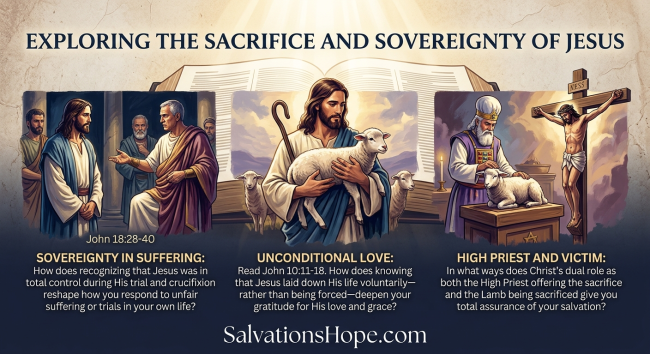
Even in Gethsemane, when the armed detachment arrived to arrest Him, Jesus offered a dramatic display of His majesty: at the utterance of His divine identity (“I am,” John 18:6), the soldiers drew back and fell to the ground. Furthermore, when standing before Pontius Pilate, Jesus reminded the Roman governor of the true hierarchy of power: “You would have no authority over me at all unless it had been given you from above” (John 19:11). Jesus did not die because He was powerless to stop it; He died because He exercised His power to permit it.
The Paradoxical Roles: High Priest and Spotless Victim
The Epistle to the Hebrews highlights the unique theological grandeur of Christ’s sacrifice through a series of profound biblical paradoxes. Under the Old Covenant Levitical system, the offices of priest and sacrificial victim were inherently separate: the high priest offered the blood of an unblemished animal on behalf of the people year after year. In the New Covenant, however, Jesus uniquely embodies both roles simultaneously, achieving what centuries of animal sacrifices could never accomplish.
- High Priest and Offering: As our great High Priest according to the order of Melchizedek, Christ officiates the ultimate act of atonement. Yet, instead of bringing the blood of goats and calves, He offered Himself without spot to God (Hebrews 7:26–27, 9:12–14).
- Good Shepherd and Sacrificial Lamb: He is the Good Shepherd who actively guards and lays down His life for the sheep (John 10:11), while also fulfilling Isaiah 53:7 as the silent, submissive Lamb led to the slaughter to bear the sins of many.
Substitutionary Atonement and Active Obedience
Understanding Christ’s voluntary submission is essential to grasping penal substitutionary atonement. Jesus was not merely exposed to human malice; He stood as our representative and substitute, bearing God’s righteous wrath against sin. As Paul writes in 2 Corinthians 5:21,
“For our sake he made him to be sin who knew no sin, so that in him we might become the righteousness of God.”
Christ’s active obedience was crucial to this work. Throughout His life and culminating in His death, He fulfilled every requirement of the divine law that humanity had broken. His submission in Gethsemane was an act of supreme covenantal devotion. He endured the agony of the cross out of profound love for the Father and unbounded grace toward helpless sinners (Galatians 2:20; Ephesians 5:2).
“Not my will, but yours, be done” (Luke 22:42)
Triumphant Completion: "It Is Finished"
The final moments of Jesus’ earthly life further highlight His complete sovereignty. Rather than fading into delirium or physical exhaustion, Jesus remained fully in control of His faculties until the work of redemption was complete. John records that after receiving the sour wine, Jesus declared,
“It is finished!” (John 19:30)
The Greek term used here—Tetelestai—is a victory cry meaning “paid in full,” commonly used in ancient business to signify that a debt had been completely discharged.
Immediately after this proclamation, Luke records that Jesus cried out in a loud voice,
“Father, into your hands I commit my spirit!” (Luke 23:46)
He then voluntarily gave up His spirit. In ancient crucifixion, victims succumbed to asphyxiation and loss of vital functions against their will. Christ, however, yielded His spirit as a sovereign act of dismissal once He accomplished His redemptive mission.
Questions to Consider:
The Sovereign Divine Purpose
Substitutionary Atonement, and Eternal Trinitarian Glory in the Suffering Servant
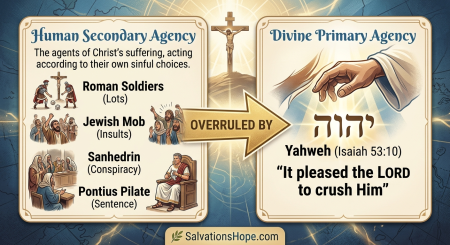
In historical accounts of the crucifixion, human actors dominate the foreground. Roman soldiers cast lots for Christ’s seamless tunic (John 19:23–24); the surrounding crowds hurl verbal abuse (Mark 15:29–32); and the Sanhedrin congratulates itself on neutralizing a theological threat (Matthew 26:65–66).
However, redemptive history operates through dual agency: human moral responsibility works alongside divine sovereignty (Genesis 50:20; Acts 2:23). When evaluating who was ultimately satisfied or fulfilled by the events of Golgotha, scripture directs our focus beyond secondary human agents to Yahweh Himself.
Hermeneutical Analysis: Yahweh as the Active Subject
Isaiah 53:10 (Hebrew: YHWH) places the God of Israel as the primary agent of the Servant’s suffering:
“Yet it pleased the LORD to crush him; he has put him to grief…” — Isaiah 53:10a (ESV)
The Hebrew verb דָּכָא (daka’) denotes crushing, bruising, or shattering to pieces. The text does not say Yahweh merely permitted hostile men to crush the Servant; it assigns Yahweh the initiation and execution of the judicial act. While men acted out of malice and self-interest, God was executing a deliberate, eternal decree of redemption (Acts 4:27–28).
Exegesis of Hāpēṣ (חָפֵץ) — Understanding Divine "Pleasure"
Philological Analysis of Isaiah 53:10
To avoid theological misconceptions, we must examine the term חָפֵץ (hāpēṣ), translated as “pleased” or “delighted in.”
Hebrew Term
Transliteration
Lexical Meaning
Exegetical Application in Isaiah 53:10
חָפֵץ
Hāpēṣ
To desire, take delight in, resolve, or purpose
Refers to Yahweh’s sovereign resolve and delight in the outcome and purpose of the atonement, not sadistic delight in physical agony.
דָּכָא
Daka’
To crush, shatter, bruise
The severity of the divine judgment poured out upon the substitute.
חָלָה
Hālāh (Hiphil: heḥĕlî)
To make sick, grieve, cause pain
Yahweh subjecting the Servant to grief for redemptive purposes.
Theological Clarification: Dispelling Misconceptions
The assertion that Yahweh was “pleased to crush Him” can be misinterpreted without rigorous hermeneutics:
- Error 1: Divine Sadism. The Father does not possess a vengeful passion for inflicting suffering upon the innocent.
- Error 2: Divine Child Abuse. The Son was not an unwilling victim forced into punishment against His will.
- Error 3: Malicious Pleasure. The "pleasure" (ḥēpeṣ) of God refers to His sovereign pleasure in accomplishing redemption, upholding His justice, and glorifying His name (Isaiah 46:10; Ephesians 1:5, 9).
The Father’s delight was rooted in the purpose, obedience, and ultimate efficacy of the Servant’s sacrifice, not in the physical trauma of crucifixion in isolation.
Volitional Harmony — The Trinitarian Pact of Redemption
Jesus’s suffering on the cross was an act of mutual Trinitarian resolve (Pactum Salutis). Christ was not coerced into the atonement; He entered into it willingly out of love for the Father and the elect.
The Father’s Sovereign Purpose (Isaiah 53:10 ) and The Son’s Voluntary Submission (John 10:17–18)
No one takes it from me, but I lay it down of my own accord.” (John 10:17–18)
“And walk in love, as Christ loved us and gave himself up for us, a fragrant offering and sacrifice to God.”(Ephesians 5:2)
“Then I said, ‘Behold, I have come to do your will, O God, as it is written of me in the scroll of the book.’”(Hebrews 10:7)
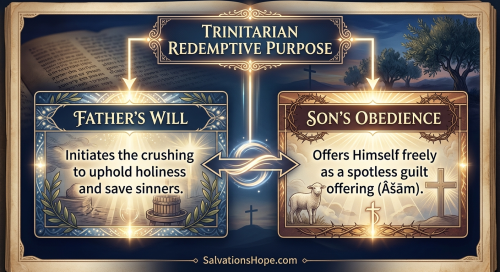
The Father’s act of striking the Servant and the Son’s voluntary surrender form a single, harmonious work of divine love and righteousness.
Old Testament Typology — The "Fragrant Offering" & The Guilt Offering
To understand how a death can be a “pleasing aroma” (רֵיחַ נִיחֹחַ, rêaḥ nîḥōaḥ), we must examine its Old Testament covenantal background:
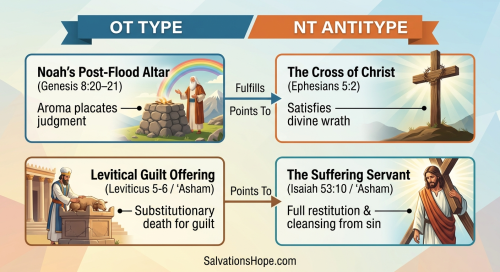
“Then Noah built an altar to the Lord and took some of every clean animal and some of every clean bird and offered burnt offerings on the altar. And when the Lord smelled the pleasing aroma, the Lord said in his heart, “I will never again curse the ground because of man, for the intention of man’s heart is evil from his youth. Neither will I ever again strike down every living creature as I have done.”(Genesis 8:20–21)
After the flood’s divine judgment, Noah offered clean animals. Yahweh smelled the “pleasing aroma” (rêaḥ nîḥōaḥ) and covenanted not to destroy the earth again by water. The aroma was pleasing because it represented covenantal atonement and restoration.
“The Lord called Moses and spoke to him from the tent of meeting, saying, “Speak to the people of Israel and say to them, When any one of you brings an offering to the Lord, you shall bring your offering of livestock from the herd or from the flock. “If his offering is a burnt offering from the herd, he shall offer a male without blemish. He shall bring it to the entrance of the tent of meeting, that he may be accepted before the Lord. He shall lay his hand on the head of the burnt offering, and it shall be accepted for him to make atonement for him. Then he shall kill the bull before the Lord, and Aaron’s sons the priests shall bring the blood and throw the blood against the sides of the altar that is at the entrance of the tent of meeting.” (Leviticus 1–5)
The laying on of hands symbolized the transfer of guilt to an unblemished substitute (Leviticus 4:28–31). The substitute’s death satisfied the demands of God’s holy law.
Isaiah 53:10 as the ‘Āšām (אָשָׁם)
“Yet it was the will of the Lord to crush him; he has put him to grief, when his soul makes an offering for guilt,
he shall see his offspring; he shall prolong his days; the will of the Lord shall prosper in his hand.” (Isaiah 53:10)
Isaiah 53:10 specifically identifies the Servant’s soul as an אָשָׁם (‘āšām)—a guilt offering:
“…when his soul makes an offering for guilt [‘āšām], he shall see his offspring; he shall prolong his days…”
Under the Mosaic Law, the ‘āšām was offered when a covenant breach required restitution and satisfaction. Jesus, as the true ‘āšām, paid the complete debt owed by sinners to divine justice, providing full satisfaction to God.
Penal Substitutionary Atonement & The Resolution of the Divine Dilemma
A God who excuses sin without satisfaction is not just (Exodus 34:7; Proverbs 17:15). How can a righteous God justify the ungodly while remaining completely holy Himself?
- Divine Holiness Requires Punishment
- Divine Love Desires Salvation
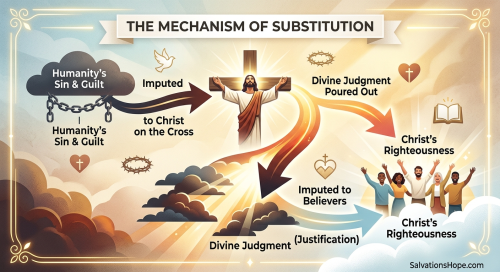
The Cross resolves this tension through Penal Substitutionary Atonement. God’s righteous wrath against sin is satisfied, and His covenant love is poured out upon redeemed sinners.
Exegetical Synthesis of Isaiah 53:11
“Out of the anguish of his soul he shall see and be satisfied; by his knowledge shall the righteous one,
my servant, make many to be accounted righteous, and he shall bear their iniquities.” (Isaiah 53:11)
- "He shall see and be satisfied" (יִרְאֶה יִשְׂבָּע): Yahweh beholds the completed work of the Servant and is fully satisfied. Divine wrath against sin is propitiated (Romans 3:25; 1 John 2:2).
- "Make many to be accounted righteous" (יַצְדִּיק): Forensic justification. The Servant bears the guilt of the many, and His righteousness is reckoned to them.
Resurrection, Exaltation, and the Eternal Triune Joy
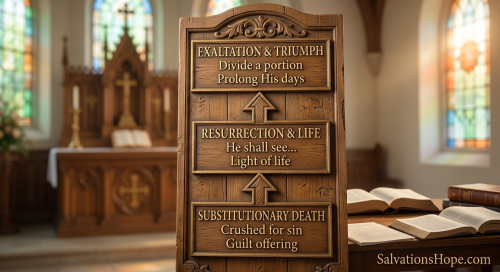
Isaiah 53:10–12 does not end in the grave; it transitions directly from substitutionary suffering to resurrection and exaltation:
- Vindication & Resurrection: “He shall see his offspring; he shall prolong his days…” (v. 10b). Though He poured out His life unto death, He rises to see His spiritual descendants (the redeemed) and live forevermore.
- Eschatological Victory: “Therefore I will divide him a portion with the many, and he shall divide the spoil with the strong…” (v. 12a). The Servant is awarded the ultimate victory for His obedience unto death (Philippians 2:8–11).
The Ultimate Basis for Divine Delight
Why was Yahweh pleased to crush Him?
- The Vindication of Divine Justice: The cross shows that God does not overlook evil; He fully judges it (Romans 3:25–26).
- The Magnification of Divine Grace: The infinite cost of the sacrifice reveals the depth of Trinitarian love (John 3:16; Romans 5:8).
- The Glorification of the Son: Through His humiliation, Christ earns the name above every name and receives a redeemed bride from every nation, tribe, and tongue (Revelation 5:9–12).
Questions to Consider:
- How does understanding God as the primary agent in Christ’s death change our perspective on Good Friday?
- In what ways does the voluntary nature of Christ’s sacrifice preserve God’s character against accusations of unfairness or cruelty?
- How does the Old Testament concept of the guilt offering (‘āšām) deepen your appreciation for Christ’s work on the cross?
- How does the promise of resurrection in Isaiah 53:10–12 inform our understanding of the ultimate purpose of Christ’s suffering?
The Gospel Displayed in Power and Grace
Extent of Human Depravity and the Magnitude of Divine Redemption
In evangelical teaching, we often speak of God’s love in abstract, comfortable terms. However, Scripture presents divine love not as passive sentiment, but as active, costly, and intrusive redemption.
This study uses the narrative of Yeshua the Lord and his son Adam as an allegorical illustration (parable) to illuminate key biblical truths:
The Allegory:
- Yeshua the Lord represents God the Father and Jesus Christ (the Lord who stoops and dies).
- Adam represents fallen humanity (living up to his namesake, the original transgressor).
- The Theological Reality: God’s love is magnified not by overlooking human corruption, but by descending directly into it to pay the ultimate ransom.
The Anatomy of Rebellion
“For the wrath of God is revealed from heaven against all ungodliness and unrighteousness of men, who by their unrighteousness suppress the truth. For what can be known about God is plain to them, because God has shown it to them. For his invisible attributes, namely, his eternal power and divine nature, have been clearly perceived, ever since the creation of the world, in the things that have been made. So they are without excuse. For although they knew God, they did not honor him as God or give thanks to him, but they became futile in their thinking, and their foolish hearts were darkened. Claiming to be wise, they became fools, and exchanged the glory of the immortal God for images resembling mortal man and birds and animals and creeping things. Therefore God gave them up in the lusts of their hearts to impurity, to the dishonoring of their bodies among themselves, because they exchanged the truth about God for a lie and worshiped and served the creature rather than the Creator, who is blessed forever! Amen.” (Romans 1:18–25)
“And he said, “There was a man who had two sons. And the younger of them said to his father, ‘Father, give me the share of property that is coming to me.’ And he divided his property between them. Not many days later, the younger son gathered all he had and took a journey into a far country, and there he squandered his property in reckless living.” (Luke 15:11–13)
In Romans 1, the Apostle Paul outlines humanity’s downward spiral into sin. Humanity’s fall is not merely a mistake; it is a deliberate, unprovoked rejection of God’s benevolent lordship. The Greek term for ungodliness (asebeia) denotes an active refusal to reverence God despite His obvious goodness and provision.
Yeshua, Lord, was a brilliant, honest, and loving father who provided everything his son needed. Yet, for no logical reason, Adam turned against him. Adam hated everything his family stood for, dropped his father’s name, took on aliases, and fled into a lifestyle of party-going, addiction, and organized crime. The more his father tried to connect, the more Adam resented Him.
Expository Breakdown
- Rejection of Unmerited Favor: Like Adam, fallen humanity rebels against a Father who has been nothing but good (Romans 2:4). Sin is fundamentally relational treason.
- The Illusion of Autonomy: Adam assumed dropping his father’s name made him "his own man." Scripture reveals that abandoning God does not yield freedom—it yields slavery to sin (John 8:34).
- Self-Destructive Blindness: Sin distorts human logic. Adam plunged deeper into danger, blinding himself to the inevitable destruction ahead.
The Delusion of Self-Sufficiency
pitiable, poor, blind, and naked.” (Revelation 3:17–18)
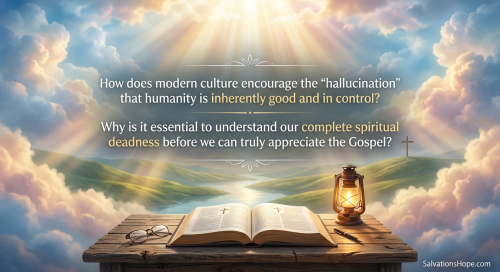
In Ephesians 2:1, Paul describes sinners as being “dead in transgressions and sins” (nekros). A spiritually dead person is not merely sick or wounded; they are utterly incapacitated, lacking any ability to revive themselves. Despite this state, the human heart manufactures spiritual hallucinations, convincing itself that all is well.
As Adam’s drug habit escalated, he began stealing from his own supply and skimming money from his dangerous gangster boss. He deluded himself into believing no one would notice. When the boss found out and marked him for death, Adam panicked, fled to an abandoned building, and tried to cope by consuming even more drugs. He collapsed on a filthy floor in a pool of his own vomit, dying and unaware of his true condition.
Expository Breakdown
- The Compounding Nature of Sin: Sin requires greater sin to maintain its illusion. Adam moved from use to theft, and from theft to terror.
- The Spiritual Hallucination: A person lying unconscious in their own filth while dreaming of royalty pictures spiritual blindness (Revelation 3:17). Unregenerate humanity believes it is "doing fine" while standing on the brink of judgment.
- Total Helplessness: Adam could not clean himself, defend himself, or revive himself. His survival depended entirely on an outside intervention.
The Stooping God
Let this mind be in you, which was also in Christ Jesus: who, being in the form of God, thought it not robbery to be equal with “God: but made himself of no reputation, and took upon him the form of a servant, and was made in the likeness of men: and being found in fashion as a man, he humbled himself, and became obedient unto death, even the death of the cross.” (Philippians 2:5–8)
“For we ourselves also were sometimes foolish, disobedient, deceived, serving divers lusts and pleasures, living in malice and envy, hateful, and hating one another. But after that the kindness and love of God our Saviour toward man appeared, not by works of righteousness which we have done, but according to his mercy he saved us, by the washing of regeneration, and renewing of the Holy Ghost;” (Titus 3:3–5)
“And as for thy nativity, in the day thou wast born thy navel was not cut, neither wast thou washed in water to supple thee ; thou wast not salted at all, nor swaddled at all. None eye pitied thee, to do any of these unto thee, to have compassion upon thee; but thou wast cast out in the open field, to the lothing of thy person, in the day that thou wast born. And when I passed by thee, and saw thee polluted in thine own blood, I said unto thee when thou wast in thy blood, Live; yea, I said unto thee when thou wast in thy blood, Live. I have caused thee to multiply as the bud of the field, and thou hast increased and waxen great, and thou art come to excellent ornaments: thy breasts are fashioned, and thine hair is grown, whereas thou wast naked and bare. Now when I passed by thee, and looked upon thee, behold, thy time was the time of love; and I spread my skirt over thee, and covered thy nakedness: yea, I sware unto thee, and entered into a covenant with thee, saith the Lord GOD , and thou becamest mine.” (Ezekiel 16:4–8)
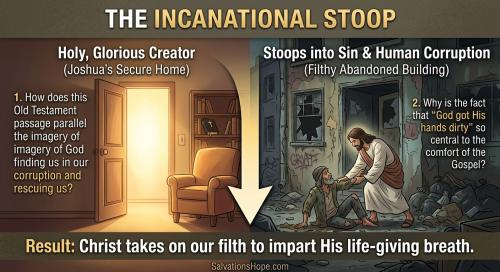
Philippians 2 contains the Kenosis passage, describing how Christ, existing in the form of God, emptied Himself by taking the form of a servant. The holy Creator did not remain at a distance; He entered into the filth of a fallen world to rescue those who hated Him.
Knowing his son’s peril, Yeshua, Lord, left his secure, beautiful home and entered the filthy abandoned building. He found Adam unconscious, face-down in his own vomit, blue-faced and suffocating. Overwhelmed by horror, disgust, and compassion, Yeshua threw his best suit onto the filthy floor. He cleared his son’s airways and placed his mouth over Adam’s foul lips, breathing life back into his listless lungs until Adam spluttered and breathed again.
Expository Breakdown
- Holy Disgust vs. Sovereign Love: God is holy; sin is genuinely repulsive to Him (Habakkuk 1:13). Yet, His love moves Him to act despite His holy aversion to our moral filth.
- Incarnational Condescension: Jesus did not wait for us to clean ourselves up. He descended into our "dank pit of evil" (Titus 3:4–5).
- Impartation of Life: Just as Yeshua breathed life into Adam, God breathes spiritual life into dead sinners through the Holy Spirit (Ezekiel 37:9–10; John 20:22).
Substitution and Propitiation
“And as for thy nativity, in the day thou wast born thy navel was not cut, neither wast thou washed in water to supple thee; thou wast not salted at all, nor swaddled at all. No eye pitied thee, to do any of these unto thee, to have compassion upon thee; but thou wast cast out in the open field, to the lothing of thy person, in the day that thou wast born. And when I passed by thee, and saw thee polluted in thine own blood, I said unto thee when thou wast in thy blood, Live; yea, I said unto thee when thou wast in thy blood, Live. I have caused thee to multiply as the bud of the field, and thou hast increased and waxen great, and thou art come to excellent ornaments: thy breasts are fashioned, and thine hair is grown, whereas thou wast naked and bare. Now when I passed by thee, and looked upon thee, behold, thy time was the time of love; and I spread my skirt over thee, and covered thy nakedness: yea, I sware unto thee, and entered into a covenant with thee, saith the Lord GOD, and thou becamest mine. for all have sinned, and come short of the glory of God; being justified freely by his grace through the redemption that is in Christ Jesus: whom God hath set forth to be a propitiation through faith in his blood, to declare his righteousness for the remission of sins that are past, through the forbearance of God; to declare, I say , at this time his righteousness: that he might be just, and the justifier of him which believeth in Jesus.” (Romans 3:23–26)
“For when we were yet without strength, in due time Christ died for the ungodly. For scarcely for a righteous man will one die: yet peradventure for a good man some would even dare to die. But God commendeth his love toward us, in that, while we were yet sinners, Christ died for us. Much more then, being now justified by his blood, we shall be saved from wrath through him. For if, when we were enemies, we were reconciled to God by the death of his Son, much more, being reconciled, we shall be saved by his life.”(Romans 5:6–10)
“For he hath made him to be sin for us, who knew no sin; that we might be made the righteousness of God in him.” (2 Corinthians 5:21)
In Romans 5:6–10, Paul uses four descriptors for humanity: powerless, ungodly, sinners, and enemies. He emphasizes that Christ died for us while we were in this state. The theological terms substitution (Christ taking our place) and propitiation (Christ satisfying God’s righteous wrath) form the foundation of our justification.
Just as Adam began breathing, the gangster boss burst through the door with a gun raised to execute Adam. Without hesitation, Yeshua, Lord, threw his own body between the killer’s gun and his son. The bullets meant for Adam slammed into Yeshua. As he fell, dying, blood gushing from his wounds, Yeshua used his final ounce of strength to draw his weapon and destroy the killer, securing Adam’s permanent safety.
The bullets were meant for Adam because of his foolish choices and debts. Yeshua stepped into the line of fire. On the cross, Jesus bore the penalty intended for us (Galatians 3:13). By absorbing the fatal strike, Yeshua eliminated the enemy threatening his son. Through His death, Christ defeated the power of sin, death, and the devil (Hebrews 2:14–15). Salvation is free to us, but it cost God everything. The Gospel is not God ignoring sin, but God taking the hit for sin Himself (Romans 3:25–26).
The Melting of the Heart
“And I will pour upon the house of David, and upon the inhabitants of Jerusalem, the spirit of grace and of supplications: and they shall look upon me whom they have pierced, and they shall mourn for him, as one mourneth for his only son, and shall be in bitterness for him, as one that is in bitterness for his firstborn.”(Zechariah 12:10)
“Or despisest thou the riches of his goodness and forbearance and longsuffering; not knowing that the goodness of God leadeth thee to repentance?”(Romans 2:4)
“Herein is love, not that we loved God, but that he loved us, and sent his Son to be the propitiation for our sins.” “We love him, because he first loved us.”(1 John 4:10, 19″
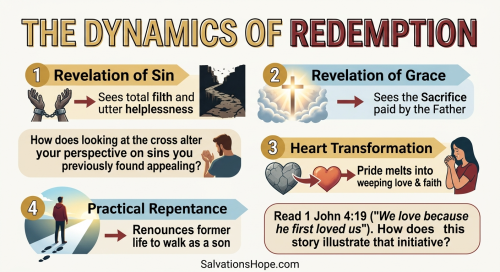
Repentance (metanoia) is a radical change of mind and heart. Biblical repentance is not produced by self-effort or legalistic terror alone, but by a divine revelation of the crucified Savior. As Romans 2:4 states, “God’s kindness is intended to lead you to repentance.”
Adam regained consciousness and realized his awful condition and smell. He saw his boss dead, and then he saw his father—vomit-smeared, bullet-riddled, and dead on the floor. In that moment, Adam’s pride, hostility, and resentment completely melted away. Understanding the magnitude of his father’s love, Adam wept, abandoned his gang life on the spot, and embraced his identity as a son.
True conviction comes when we look upon the One whom our sins have pierced (Zechariah 12:10). We realize our sin caused His suffering. When Adam saw his father covered in his filth and blood, bragging and rebellion became impossible. Self-righteousness cannot survive at the foot of the cross.
The Fullness of Divine Pardon
“Behold, for peace I had great bitterness: But thou hast in love to my soul delivered it from the pit of corruption:
For thou hast cast all my sins behind thy back.”(Isaiah 38:17)
“I, even I, am he that blotteth out thy transgressions for mine own sake, and will not remember thy sins.” (Isaiah 43:25)
“For as the heaven is high above the earth, So great is his mercy toward them that fear him.
As far as the east is from the west, So far hath he removed our transgressions from us.” (Psalm 103:11)
“He will turn again, he will have compassion upon us; he will subdue our iniquities;
and thou wilt cast all their sins into the depths of the sea.”(Micah 7:19)
“And they shall teach no more every man his neighbour, and every man his brother, saying, Know the LORD: for they shall all know me, from the least of them unto the greatest of them, saith the LORD: for I will forgive their iniquity, and I will remember their sin no more.” (Jeremiah 31:34)
Scripture uses vivid spatial and physical metaphors to describe what God does with the sins of the redeemed:
- Behind His Back: Isaiah 38:17 (Out of sight)
- As Far as East from West: Psalm 103:12 (Out of reach)
- Depths of the Sea: Micah 7:19 (Irretrievable)
- Remembered No More: Jeremiah 31:34 (Covenantal removal)
- Swept Away Like Mist: Isaiah 44:22 (Out of existence)
When Adam returned home to take his rightful place in the Lord’s family, he wasn’t put on probation. He was not treated as a second-class citizen or constantly reminded of his disgusting past. The penalty was fully paid, the enemy was slain, and the adoption was secure.
Four Dimensions of Ultimate Forgiveness
Biblical Metaphor
Scripture Reference
Theological Meaning
Behind God’s Back
Isaiah 38:17
God no longer sets our sins before His face in judgment.
East from West
Psalm 103:11–12
Infinite distance; our guilt cannot be reunited with us.
Depths of the Sea
Micah 7:19
Sins are buried where no accusation can retrieve them.
Blotted Out / Forgotten
Isaiah 43:25; Jer 31:34
God chooses never to credit our sin to our account again.