

Doctrine of Creation and Providence
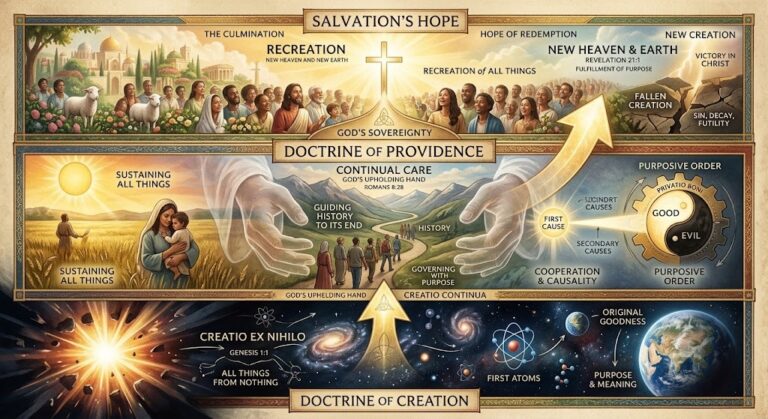
Introduction
The opening words of Scripture, “In the beginning, God created the heavens and the earth” (Genesis 1:1), are among the most profound and consequential ever written. In a single sentence, the Bible establishes the most basic truths about reality: the world is not eternal, nor is it the product of random forces, blind chance, or impersonal necessity. It exists because of the free, wise, and sovereign act of God. With majestic simplicity, Genesis declares that everything—visible and invisible, material and spiritual—owes its being to the will and word of the Creator.
This verse is more than a statement about origins; it is a declaration of worldview. From this foundation flows the rest of Scripture: God is the Maker of all, and His creation is the stage upon which His glory is displayed and His redemptive plan unfolds. Creation is not a backdrop for human stories but the theater of God’s covenant faithfulness and the arena in which His purposes are revealed.
The Statement of Faith of Salvation's Hope captures this truth in two concise sentences:
“God created the universe from nothing and made all things very good. God governs all things in accordance with His perfect character and eternal plan for His glory and the good of His people.”
Contained here are two doctrines that together provide the structure of a Christian understanding of life and ministry:
1: Creation: Everything originated with God. He is not part of the universe but wholly other, its sovereign Maker. He brought it into existence ex nihilo—out of nothing—and He declared it to be “very good” (Genesis 1:31). Creation affirms both the goodness of the material world and the radical dependence of all things on the Creator.
2: Providence: God has not abandoned His creation to chance, fate, or impersonal laws. He continues to uphold, direct, and govern all things with perfect wisdom, goodness, and purpose. From galaxies orbiting in deep space to the fall of a sparrow and the numbering of hairs on our heads (Matthew 10:29–30), all things are subject to His care. Providence reassures us that God is not only the Author of history but its Sustainer and Lord.
Together, these doctrines form the foundation of the Christian worldview. They teach that life is neither random nor self-generated, but originates, endures, and finds its meaning under God’s sustaining hand. Human history is not a meaningless chain of accidents but the unfolding of God’s eternal plan. To confess creation and providence is to confess that the world is purposeful, ordered, and saturated with divine meaning.
Implications for Ministry
For Salvation's Hope, this confession is not peripheral—it shapes every act of ministry. At weddings, officiants declare that marriage rests in God’s created order. At funerals, ministers proclaim that death itself cannot thwart God’s providential plan. In hospitals, prisons, and military contexts, chaplains assure the suffering that they are not abandoned to chaos but held in the care of a sovereign Father. Ministry coaches remind leaders that diligence is required but outcomes belong to God (Proverbs 16:9). Creation grounds human dignity, while providence anchors human hope.
Implications for Ministry Sciences
This confession also establishes the intellectual framework for the interdisciplinary pursuit called Ministry Sciences. Psychology, sociology, anthropology, leadership theory, and philosophy all provide valuable insights into human behavior, development, and flourishing. Yet, without the doctrines of creation and providence, these disciplines drift into reductionism—explaining life only in terms of biology, culture, or economics.
By rooting all interdisciplinary engagement in these doctrines, Ministry Sciences ensures that theories of flourishing, care, and leadership are interpreted through a scriptural, heart-determined worldview, anchored in theology and clarified by Christian philosophy.
God the Creator
Biblical Witness
The Bible opens with a thunderous declaration: “In the beginning, God created the heavens and the earth” (Genesis 1:1). This simple but majestic verse establishes three non-negotiable truths:
The creation narrative in Genesis 1–2 describes God’s six-day work of creation, climaxing with His evaluation: “God saw all that He had made, and it was very good” (Genesis 1:31). This goodness is echoed in Exodus 20:11, grounding the Sabbath command in God’s own rhythm of creation and rest: “In six days the LORD made heaven and earth, the sea, and all that is in them.”
Creation, then, is not an accident of nature or a human construct; it is the intentional handiwork of the living God.
Creation and Genre
When we ask what kind of story Genesis is, we must avoid two opposite errors:
On one side is reducing Genesis to myth, like claiming “the stork brought the baby.” Such reduction robs the text of its revealed truth.
On the other side is reading Genesis as if it were a modern scientific manual, expecting it to provide exhaustive data on biology, cosmology, or physics.
Instead, Genesis is divine revelation. It communicates in literary and theological form that God created all things, that creation is good, and that humans are uniquely His image-bearers. Christians may differ in how literally or figuratively to interpret aspects of the narrative, but the central confession is shared: “In the beginning, God created the heavens and the earth.”
That is absolute truth, not myth.
Creation Ex Nihilo
The doctrine of creation ex nihilo—creation “out of nothing”—is essential to the Christian worldview.
Unlike pagan myths where gods fashion order from eternal matter, the Bible insists that only God is eternal. Matter is not divine, nor is it self-existent. God freely spoke, and all things came to be. This truth protects the Creator-creature distinction and reminds us that creation is radically dependent upon God at every moment.
Historical Witness
From the earliest creeds, the church has confessed God as Creator of heaven and earth. The Nicene Creed (A.D. 325, revised 381) begins:
“I believe in one God, the Father Almighty, Maker of heaven and earth, and of all things visible and invisible."
The early church stood against Greek philosophies that claimed matter was eternal and Gnostic systems that dismissed matter as evil. Instead, Christians proclaimed the goodness of creation as God’s gift. Later, Reformers like Calvin emphasized that creation ex nihilo magnifies God’s sovereignty: He depends on nothing, while everything depends on Him.
Implications for Ministry Sciences
The doctrine of God the Creator forms the starting point for Ministry Sciences, shaping how we understand human flourishing and interpret interdisciplinary insights.
Summary:
God the Creator is the origin of all things, bringing the universe into being out of nothing, declaring it very good, and distinguishing Himself from it while remaining intimately involved.
For Salvation's Hope clergy—officiants, ministers, chaplains, and coaches—this doctrine grounds ministry in the conviction that every person bears God’s image, every family reflects God’s design, and every act of culture and mission unfolds within God’s creation.
For Ministry Sciences, it ensures that all theories of flourishing—whether psychological, sociological, or philosophical—are interpreted through the lens of creation and remain consistent with a scriptural, heart-determined worldview.
God the Provider (Providence)
Biblical Witness
Creation is only the beginning of God’s relationship with the world. The same God who spoke the universe into existence continues to sustain it, direct it, and provide for it. Providence is God’s ongoing involvement with His creation—His preservation of all things, His governance of history, and His provision for creatures.
Scripture makes this truth clear:
Providence is not just about cosmic order; it encompasses both the rise and fall of nations (Daniel 2:21) and the smallest details of life.
The Nature of Providence
The term providence comes from the Latin providere (“to foresee, to provide”). Biblically, it includes three interrelated dimensions:
1: Preservation – God sustains creation in existence. Colossians 1:17 teaches that Christ “is before all things, and in Him all things hold together.” Without His sustaining power, creation would collapse into nothingness.
2: Government – God directs creation toward His intended purposes. Daniel 2:21 affirms: “He changes times and seasons; He deposes kings and raises up others.” History is not ruled by chance or fate but by divine sovereignty.
3: Provision – God supplies for the needs of His creatures. Acts 14:17 says: “He did not leave Himself without testimony: He has shown kindness by giving you rain from heaven and crops in their seasons; He provides you with plenty of food and fills your hearts with joy.”
In short, providence assures us that nothing is random, everything is purposeful, and God is personally involved.
Against Deism and Fatalism
Two distortions threaten the biblical doctrine of providence:
Providence is neither distance nor determinism. It is fatherly care—the wise, sovereign, and loving involvement of God in every detail of life.
Historical Witness
Christians throughout history have clung to providence as a source of courage and comfort.
Theological Importance
Providence links creation with redemption. The same God who made the world also sustains and governs it for the sake of His glory and His people’s good. Providence gives believers assurance in every season:
History has meaning – God directs it toward His purposes.
Suffering has context – God weaves even hardship into His redemptive plan.
Ministry has hope – Outcomes do not rest on human strength alone but on God’s sovereign grace.
This doctrine is therefore both profoundly theological and deeply pastoral.
Implications for Ministry Sciences
Providence profoundly shapes the scriptural and heart-determined worldview that grounds Ministry Sciences. It ensures that interdisciplinary insights are not seen as ultimate explanations but as observations within the framework of God’s providential rule.
Conclusion: Creation and Providence in Life and Ministry
The doctrines of Creation and Providence are not abstract speculations but the very ground of Christian theology, worship, and ministry.
1: Creation declares: “In the beginning, God created the heavens and the earth” (Genesis 1:1). Everything originates from God’s sovereign word. We are not accidents of biology or products of impersonal forces but image-bearers of the Creator, designed for dignity, community, and stewardship.
2: Providence proclaims: “The LORD reigns” (Psalm 97:1). The God who made all things also sustains, governs, and directs all things toward His glory and His people’s good (Romans 8:28; Ephesians 1:11). Life is not random; history is not meaningless. From sparrows falling to galaxies spinning, all unfolds under His wise care.
Creation gives us origin and dignity; providence gives us meaning and hope. Together, they testify that we belong to a world made and sustained by God.
This confession lies at the heart of the Salvation's Hope Statement of Faith:
“God created the universe from nothing and made all things very good. God governs all things in accordance with His perfect character and eternal plan for His glory and the good of His people.”
For the church, this means worshiping the Creator and trusting the Provider. For Christian Leaders Alliance clergy, it means ministering with confidence that every person bears God’s image and that every moment is under His care. For Ministry Sciences, it means integrating interdisciplinary insights within the unshakable framework of God’s creative and providential rule.