

The Doctrine of the Future
Introduction
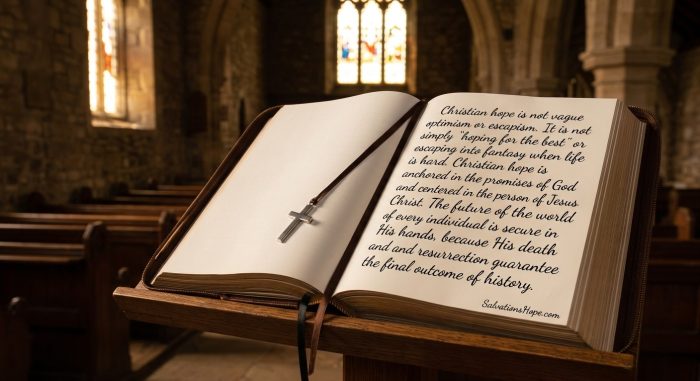
Christian hope is not vague optimism or escapism. It is not simply “hoping for the best” or escaping into fantasy when life is hard. Christian hope is anchored in the promises of God and centered in the person of Jesus Christ. The future of the world and of every individual is secure in His hands, because His death and resurrection guarantee the final outcome of history.
The Statement of Faith of Salvation's Hope expresses this truth with clarity and balance:
“Christ will return visibly to rule the world and to make all things new. God’s people will be raised bodily
from death to eternal life in the new creation. God’s enemies will be punished with eternal hell.”
This confession highlights four essential realities:
Together, these truths form the foundation of Christian eschatology—the doctrine of last things. They provide both hope and warning: hope for those who belong to Christ, who await His appearing with joy; and warning for those who resist Him, who must face His judgment.
Why This Matters
Historical Witness
The Organic Human Dimension
The organic human identity struggle—our longing for wholeness, justice, and permanence—finds its resolution in these eschatological promises. Humans ache for renewal, for life beyond death, for wrongs to be righted. Eschatology declares that these longings are not illusions but foretastes of what God has promised: new creation, resurrection life, and the final defeat of evil.
The Visible Return of Christ
The return of Jesus is not a hidden event or a symbolic idea—it is the climactic moment of history when the risen Lord will be revealed to the whole world.
Jesus Himself promised:
“They will see the Son of Man coming on the clouds of heaven with power and great glory.” (Matthew 24:30)
Paul echoes the same truth:
“The Lord Himself will come down from heaven, with a loud command, with the
voice of the archangel and with the trumpet call of God.” (1 Thessalonians 4:16)
Characteristics of His Coming
Theological Significance
The Renewal of All Things
When Christ returns, His work will not be limited to the rescue of individual souls. The entire cosmos will be transformed. Salvation is not escape from creation but the renewal of creation itself.
Biblical Foundations
The entire biblical story—from Genesis to Revelation—moves toward this renewal. What was lost in Eden will be restored and fulfilled in the new creation.
The Prophetic Vision
The prophets used vivid imagery to describe this new world:
This vision is not fantasy but a promise grounded in God’s faithfulness.
Theological Significance
The renewal of all things underscores that God will finish what He began. Creation is not discarded but redeemed. Heaven and earth will be reunited (Revelation 21:1–3):
Christian hope is therefore creational, not escapist. We do not long to abandon the earth for some disembodied spiritual existence; we long for its renewal, restoration, and perfection.
Historical Witness
Early Christians endured persecution with confidence in “the age to come,” when creation would be renewed and justice restored.
The Resurrection of the Body
The renewal of creation is inseparable from the resurrection of God’s people. Salvation is not merely about the soul escaping the body but about the transformation of the whole person—body and spirit—into glory.
Paul declares with confidence:
“The Lord Jesus Christ… will transform our lowly bodies so that they will be like His glorious body.”(Philippians 3:20–21)
This is the heart of Christian hope: we will be raised bodily, not as ghosts or disembodied spirits, but as redeemed humans restored to God’s original design.
Biblical Description of the Resurrection Body
The New Testament paints a consistent picture of what resurrection life will be like:
Theological Significance
The resurrection of the body affirms several core truths:
Historical Witness
Implications for Clergy
For Salvation's Hope the doctrine of the resurrection of the body carries profound implications for how they teach, counsel, and lead.
Clergy do not promote a Gnostic view of humanity that pits body against soul, treating the physical as evil and the spiritual as good. Instead, we uphold an organic human view: the soul is not merely spirit but the union of spirit and body. Death tears this union apart, but resurrection restores it in glory. The Christian hope is not disembodied existence but a new creation where spirit and body are perfectly reunited in a glorified form.
The Larger Vision
By teaching the resurrection of the body, clergy affirm that salvation is not an escape from physicality but its renewal. This doctrine gives the church language to address both ancient Gnostic errors and modern debates in gender and identity studies:
Thus, clergy proclaim a hope that is both deeply human and deeply divine: we will be raised as organic humans—spirit and body reunited—glorified in Christ forever.
Views of the Resurrection of the Body
Modern Philosophy
Postmodern Philosophy
Christian Philosophy
Summary Table
Perspective
Body & Identity
Meaning of Resurrection
Hope Offered
Modern
Body valued, but death final. Resurrection reduced to metaphor.
Legacy, progress, or memory.
Temporary; no final victory over death.
Postmodern
Body and self fluid, socially constructed.
One narrative among many, not universal truth.
Subjective interpretations; no lasting hope.
Christian
Body essential; spirit and body organic and inseparable.
Real, physical, glorified resurrection like Christ’s.
Eternal life, wholeness, justice, and victory over death.
Implications for Ministry Sciences
The doctrine of the resurrection of the body guards Ministry Sciences from two persistent distortions:
Instead, Ministry Sciences affirms the organic human view: body and spirit are created together, designed to be united, temporarily separated by death, and ultimately reunited in a glorified resurrection body. This holistic anthropology reshapes how we interpret the insights of various fields.
Psychology
Wholeness Beyond Fragmentation
Modern psychology often focuses on mental or emotional well-being but may neglect the physical or spiritual dimensions of identity. Postmodern psychology sometimes deconstructs the “self” into fluid, unstable fragments.
Sociology/Anthropology
Community Restored in the Body
Cultures across history develop burial rituals and myths of an afterlife, often reflecting deep intuitions about continuity of identity. Modern sociology may reduce these rituals to social cohesion, while anthropology frames them as cultural constructions.
Philosophy
Identity, Justice, and Continuity
Philosophy wrestles with questions of personal identity and the continuity of the self beyond death. Materialist philosophies deny survival beyond the body; dualistic philosophies sever the soul from the body.
Gender Studies
Embodiment and Identity
Gender studies often deconstruct embodiment, treating gender as a purely social construct or fluid performance detached from biology. At the same time, older cultural views sometimes reduced men and women to rigid stereotypes that ignored shared dignity.
The Integrative Vision
Without the resurrection, Ministry Sciences risks either:
With the resurrection, Ministry Sciences interprets every discipline through the organic human lens:
In the resurrection, spirit and body are permanently reunited, identity is fulfilled, and creation itself is made whole
Eternal Life or Eternal Judgment
The resurrection will not be universally joyous. Daniel 12:2 warns: “Multitudes who sleep in the dust of the earth will awake: some to everlasting life, others to shame and everlasting contempt.”
Paul echoes:
“They will be punished with everlasting destruction and shut out from the presence of the Lord” (2 Thessalonians 1:9).
Jesus Himself speaks of the final separation:
“Depart from Me, you who are cursed, into the eternal fire prepared for the devil and his angels” (Matthew 25:41).
Revelation 20:15 adds:
“Anyone whose name was not found written in the book of life was thrown into the lake of fire.”
The doctrine of hell is sobering but essential. To omit it is to distort the gospel. Faithful leaders must proclaim both the promise of eternal life and the warning of eternal judgment.
Historical Witness
The church has always confessed Christ’s return, the resurrection of the body, and final judgment. The Apostles’ Creed declares: “He will come to judge the living and the dead… I believe in the resurrection of the body, and the life everlasting.”
Throughout history, believers have lived in light of this hope. Augustine described the Christian life as a pilgrim journey toward the City of God. Reformers insisted on the certainty of Christ’s visible return. Modern global Christianity emphasizes the kingdom hope of renewed creation.
Conclusion
The doctrine of the future teaches:
This is both hope and warning. As believers, we await His return with joy, knowing that creation and our bodies will be renewed. As leaders, we must faithfully proclaim both the promise of eternal life and the reality of eternal judgment.
For clergy, this doctrine grounds ministry in eternal perspective. For Ministry Sciences, it ensures that every interdisciplinary insight into human hope, history, and destiny is interpreted in light of Christ’s visible return and final renewal.
“He who testifies to these things says, ‘Yes, I am coming soon.’ Amen. Come, Lord Jesus” (Revelation 22:20).