

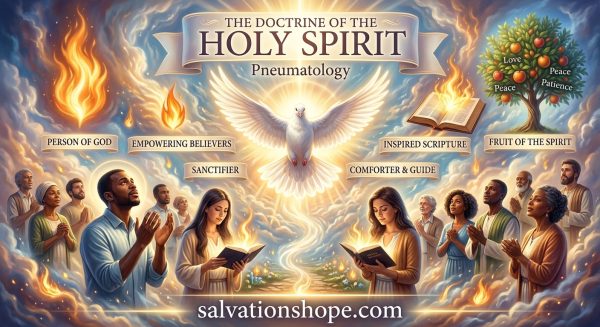
The Doctrine of the Holy Spirit
Introduction
The Christian life and ministry are impossible without the Holy Spirit. He is not an optional add-on to the Christian faith but its very lifeblood. From the first page of Scripture to the last, the Spirit of God is active and indispensable. In Genesis, He hovers over the waters of creation (Genesis 1:2). Throughout Israel’s history, He inspires the prophets to speak God’s Word (2 Peter 1:21). At the incarnation, He overshadows Mary so that the eternal Son takes on human flesh (Luke 1:35). At Jesus’ baptism, He descends like a dove and empowers the Messiah for His earthly ministry (Luke 3:22; 4:1,18). At Pentecost, He fills the disciples, birthing the church and empowering its mission to the nations (Acts 2). And in Revelation, the Spirit and the Bride together cry, “Come!” pointing to the Spirit’s role in bringing history to its renewal in Christ (Revelation 22:17).
The Statement of Faith of Salvation's Hope summarizes the Spirit’s work with clarity and comprehensiveness:
“The Holy Spirit gives new birth, unites us to Christ, assures us of His love, forms us in His character, equips us with His gifts, and empowers us to be His ambassadors.”
This statement shows that everything the Spirit does is Christ-centered and gospel-shaped. He regenerates us so we can belong to Christ. He indwells us so we can live in communion with Christ. He assures us that we are loved by the Father in Christ. He sanctifies us, forming Christ’s likeness in our lives. He equips us with gifts so we can serve as Christ’s body. He empowers us for mission so we can bear witness to Christ in the world.
Theological Significance
The Spirit is not an impersonal force, an abstract energy, or a vague feeling. He is the third person of the Holy Trinity—eternal, divine, holy, and personal. The Nicene Creed rightly calls Him “the Lord, the Giver of Life, who proceeds from the Father and the Son, who with the Father and the Son is worshiped and glorified.” To deny His personhood or His deity is to misunderstand God Himself. To minimize His role is to drain Christianity of its power.
The Spirit is the life-giver—the one who brings creation into existence, who raises Jesus from the dead, and who gives believers new birth and eternal life. He is the truth-bearer—the one who inspires Scripture, illuminates hearts, and leads the church into truth. He is the holiness-maker—the one who transforms us into Christ’s likeness and produces His fruit in our lives. And He is the power-bringer—the one who gifts, emboldens, and empowers the church for witness, service, and mission.
The Holy Spirit Is God
From the earliest days of the church, Christians have confessed the full divinity of the Holy Spirit. He is not a created being, nor an impersonal force, nor simply the “energy of God.” He is the third person of the Trinity—eternal, divine, personal, and worthy of worship together with the Father and the Son.
Biblical Witness
The Bible speaks of the Spirit as God in multiple ways:
Historical Confession
The Nicene Creed (381) affirms:
“I believe in the Holy Spirit, the Lord and Giver of Life, who proceeds from the Father and the Son, who with the Father and the Son is worshiped and glorified, who spoke by the prophets.”
Here the church safeguarded three truths:
1: The Spirit is divine — called “Lord” and “Giver of Life.”
2: The Spirit is personal — proceeding from the Father and the Son, actively speaking through the prophets.
3: The Spirit is worthy of worship — adored alongside the Father and the Son, not as a lesser being but as true God.
This confession countered heresies such as Pneumatomachianism (“Spirit-fighters”), which reduced the Spirit to a created power. The creed insists: to deny the Spirit’s deity is to deny the fullness of the Trinity.
Theological Reflection
The Spirit is:
The Spirit’s deity is not an abstract doctrine but vital for salvation. Only God can give life, forgive sins, and transform hearts. If the Spirit were less than God, He could not unite us to Christ or empower us for mission.
Five Areas of the Spirit’s Mighty Impact
The Spirit’s ministry can be seen in five interrelated areas: life, union, truth, holiness, and power.
1. Life: New Birth and Living Water:
Jesus told Nicodemus: “No one can enter the kingdom of God unless they are born of water and the Spirit… You must be born again” (John 3:5,7). Natural birth brings physical life; spiritual rebirth brings eternal life.
Ezekiel 36:26–27 promised this renewal: “I will give you a new heart and put a new Spirit in you.” The Spirit gives faith itself, stirring hearts to trust Christ.
Jesus calls Him “living water” (John 7:37–39). Just as water is essential in the desert, so the Spirit is essential for true life. His presence guarantees abundant life now and eternal life to come. Paul calls the Spirit a “down payment” of future glory (Ephesians 1:14).
2. Union: Indwelling, Assurance, Prayer, and Worship
The Spirit unites us with Christ and with one another. Paul writes: “Christ in you, the hope of glory” (Colossians 1:27), and “It is no longer I who live, but Christ lives in me” (Galatians 2:20). This indwelling is the Spirit’s work.
Assurance: Romans 5:5 — “God’s love has been poured into our hearts through the Holy Spirit.” Romans 8:15–16 — the Spirit enables us to cry “Abba, Father,” testifying that we are God’s children.
Prayer: Romans 8:26–27 — “The Spirit intercedes for us through wordless groans.” He prays within us, aligning our hearts with God’s will.
Temple: The church corporately (1 Corinthians 3:16) and believers individually (1 Corinthians 6:19) are temples of the Holy Spirit. Worship and prayer in the Spirit become the offering of our lives as living sacrifices.
Unity: The Spirit baptizes us into one body (1 Corinthians 12:13). Across lines of race, class, and culture, He unites believers in love that reflects the unity of Father, Son, and Spirit.
3. Truth: Inspiration, Illumination, Discernment, Guidance
The Spirit is the Spirit of Truth (John 16:13). His work includes:
Inspiration: “Men spoke from God as they were carried along by the Holy Spirit” (2 Peter 1:21). All Scripture is God-breathed (2 Timothy 3:16).
Illumination: Having inspired the Bible, He opens hearts to understand, love, and obey it (1 Corinthians 2:12). Without Him, Scripture remains unread or misunderstood.
Discernment: He exposes Satan’s lies and applies God’s Word to daily life, keeping us from ignorance of the enemy’s schemes.
Guidance: Sometimes extraordinary (Acts 16:6–10), often ordinary through Spirit-shaped wisdom, He leads individuals and churches into God’s will.
The Spirit not only reveals God’s truth but forms in us “the mind of Christ” (1 Corinthians 2:16).
4. Holiness: Freedom and Christlikeness
The Spirit is holy and makes God’s people holy. Paul writes: “Through Christ Jesus the law of the Spirit who gives life has set you free from the law of sin and death” (Romans 8:2).He frees us from sin’s dominion and transforms us into Christ’s likeness:
Transformation: “We all… are being transformed into His image with ever-increasing glory, which comes from the Lord, who is the Spirit” (2 Corinthians 3:18).
Fruit: “The fruit of the Spirit is love, joy, peace, patience, kindness, goodness, faithfulness, gentleness, self-control” (Galatians 5:22–23).
Holiness is not primarily external rules but Christ being formed in us (Galatians 4:19).
5. Power: Gifts, Boldness, Victory, Revival
The Holy Spirit empowers God’s people for mission and ministry. Without His presence, the church is a lifeless institution; with Him, it becomes the living body of Christ on earth.
Gifts: Equipped for Service
The Spirit sovereignly distributes spiritual gifts to every believer (1 Corinthians 12:4–11). These gifts are diverse—ranging from extraordinary (prophecy, healing, miracles) to ordinary yet vital (teaching, serving, encouraging, leading, giving). The point is not personal glory but the building up of the body (Ephesians 4:12). No believer is gift-less; each is a vessel of God’s empowering presence. In the organic human framework, gifts are not synthetic talents manufactured by culture but Spirit-bestowed capacities rooted in God’s design and directed toward His mission.
Boldness: Courage Beyond Personality
Spirit-filled believers speak and act with courage (Acts 4:31). Boldness is not mere temperament or extroversion but the Spirit of Christ living within us. It transforms fear into testimony, weakness into strength, hesitation into witness. Whether in the pulpit, prison, or public square, Spirit-empowered boldness gives voice to the gospel with clarity and conviction. This resolves the organic human identity struggle of insecurity—believers no longer rely on self-image but on Spirit-empowered identity in Christ.
Victory: Triumph in Christ
John declares: “Greater is He that is in you than he that is in the world” (1 John 4:4). The Spirit secures triumph over Satan, sin, and death. This victory is both personal (freedom from bondage, strongholds, and despair) and cosmic(assurance that Christ’s kingdom is advancing against the gates of hell). Victory is not a human achievement but a Spirit-given reality, assuring believers that no scheme of the enemy can ultimately prevail.
Revival: Transformation of Communities
At times, the Spirit works not only in individuals but in sweeping, corporate movements. Pentecost (Acts 2) and the Ephesian awakening (Acts 19:10) show how entire societies can be shaken by revival. Such outpourings bring rapid conversions, deep repentance, and cultural renewal. Jesus promised this gift to all who ask: “How much more will the Father give the Holy Spirit to those who ask Him!” (Luke 11:13). Revival reminds us that Christianity is not maintained by human programs but propelled by Spirit fire.
Historical Witness
The church’s testimony across the centuries underscores the Spirit’s indispensable role:
Throughout history, the church has confessed that without the Spirit there is no new birth, no sanctification, no mission, and no power for witness.
Implications for Ministry Sciences
The Spirit’s work anchors Ministry Sciences in a biblical worldview. Without Him, interdisciplinary insights remain partial, limited to human effort or cultural constructs. With Him, the human sciences are integrated into a vision of flourishing rooted in new birth, truth, holiness, and power.
Psychology: New Birth and Inner Renewal
Sociology/Anthropology: Spirit-Filled Community
Philosophy: Truth and Illumination
Leadership Studies: Spirit-Empowered Servanthood
Gender Studies: Spirit-Restored Identity
The Integrative Vision: The Spirit and the Organic Human
Without the Spirit, interdisciplinary insights reduce flourishing to therapy, social reform, or self-construction. With the Spirit, Ministry Sciences integrates them into a biblical vision where true flourishing comes through reconciliation with God, the new creation in Christ, and the Spirit’s renewing power.
Conclusion:
The doctrine of the Holy Spirit proclaims that He is God, the Lord and Giver of Life, the One who gives new birth, unites us to Christ, assures us of God’s love, forms us in holiness, equips us with gifts, and empowers us for mission.
For clergy, this doctrine ensures that ministry is not human effort but Spirit-filled service. For Ministry Sciences, it ensures that all theories of growth, truth, and power are interpreted through the reality of the Spirit’s transforming work.
“Not by might, nor by power, but by my Spirit, says the Lord Almighty” (Zechariah 4:6)