
The Fellowship of His Sufferings
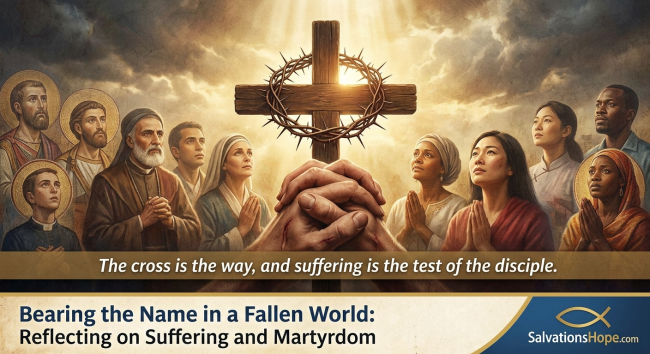
A Theological Examination
Christian Martyrdom and Perseverance
“If they persecuted me, they will persecute you also” (John 15:20)
The subject of Christian suffering and martyrdom often tests the limits of modern theological reflection. In a Western cultural context dominated by comfort, security, and institutional stability, the graphic reality of violent persecution can feel distant, even foreign. Yet, the biblical witness and church history unite in declaring that suffering is not an anomalous deviation from the Christian life; rather, it is an intrinsic dimension of bearing the name of Christ in a fallen world.
To confront the reality of persecution is to confront the cruciform shape of the Gospel itself. The following theological study examines the enduring nature of Christian martyrdom, bridging ancient church history with contemporary persecution, and anchoring both in the theological imperative of the cross.
The Eschatological Horizon of Hatred: John 15 and the World
The foundational premise of Christian persecution is rooted in the words of Jesus on the night of His betrayal. In John 15:18–20, Christ prepares His disciples for the inevitable collision between the Kingdom of God and the structures of a rebellious world:
“If the world hates you, keep in mind that it hated me first. If you belonged to the world, it would love you as its property. As it is, you do not belong to the world, but I have chosen you out of the world. That is why the world hates you. Remember the words I spoke to you: ‘No servant is greater than his master.’ If they persecuted me, they will persecute you also.”
The Theology of Antagonism
The world’s hostility toward the believer is not random; it is deeply theological. Because Christ exposed the sin and moral bankruptcy of the world (John 7:7), the world sought His destruction.
When disciples are incorporated into Christ through faith and baptism, they become living reminders of divine authority and moral accountability. The presence of grace acts as a prophetic indictment against systemic injustice and secular autonomy. Consequently, the antagonism once directed solely at the Master naturally overflows onto the servants.
Two Eras, One Witness: The Continuity of Martyrdom
The unity of the global and historical Church is vividly displayed across the centuries through the unbroken lineage of witnesses (martyres). The Greek word martys signifies a legal witness—one who testifies to the truth of an event, even unto death.
The Modern Witness: A Song in the Midst of Violence
Consider a chilling account from our contemporary era, documented by journalist Mark Danner during a violent assault by ruthless soldiers on an evangelical village:
There was one, in particular, the soldiers talked about that evening: a girl whom they had raped many times during the course of the afternoon, and through it all, this girl had sung hymns, strange evangelical songs, and she had kept right on singing, even after everything they had done, then they shot her in the chest.
She had lain there with the blood flowing from her chest, and had kept on singing–a bit weaker than before, but still singing. And the soldiers, stupefied, had watched and pointed. Then they had grown tired of the game and shot her again, and she sang still, and their wonder began to turn to fear–until finally they had unsheathed their machetes and hacked through her neck, and at last the singing had stopped.
This modern account presents a profound theological picture: the inexplicable power of transcendent joy and spiritual resolve in the face of brutal earthly terror. The psychological confusion and eventual fear of the tormentors (stupified… wonder began to turn to fear) echo the spiritual dynamics of spiritual warfare, where the unyielding faith of the martyr exposes the ultimate impotence of earthly violence.
The Ancient Witness: Blandina of Lyons (A.D. 177)
Centuries earlier, a parallel testimony unfolded in the amphitheater of Lyons, Gaul. Blandina, a young Christian slave in her early twenties, stood trial alongside her fellow believers under the Roman governor.
- The Demand for Apostasy: The prisoners were ordered to offer allegiance (to divine Caesar as lord) to secure their release. The vast majority refused, choosing fidelity to Christ over temporal preservation.
- Escalating Torments: Blandina endured horrific abuses—from daily whippings and iron racks to being exposed in the arena and attacked wild beasts. Despite her frail physical frame, her spiritual endurance confounded her persecutors.
- The Radiant Countenance: An eyewitness account preserved in church history notes that amid her battered and bloody state, her face shone with supernatural grace: "She looked as if she were invited to a wedding feast, not thrown to the beasts."
Even after being torn by animals, her tormentors subjected her to further torture until a soldier finally ended her earthly life with a sword.
Comparative Matrix of Witness
Attribute
Ancient Martyrdom (Blandina, A.D. 177)
Modern Martyrdom (Evangelical Village, Modern Era)
Setting
Roman Amphitheater / Public Arena
Village / Domestic Sphere
Primary Aggressors
Imperial Roman Authorities
Armed Militants / Ideological Forces
Core Conflict
Refusal to declare Caesar as Lord
Refusal to renounce evangelical faith
Manifestation of Grace
Radiant countenance (“wedding feast”)
Unbroken praise and hymn-singing
Method of Execution
Wild beasts, torture, and final sword
Gunshot wounds, machetes
The Theology of the Cross: Dying to Live
The cross of Christ is simultaneously an objective substitutionary atonement and a subjective pattern for Christian living. Jesus explicitly linked discipleship to execution and self-denial:
For whoever wants to save his life will lose it, but whoever loses his life for me will save it” (Luke 9:23–24).
The Daily Cross vs. The Literal Cross
- The Metaphorical Application: In ordinary Christian discipleship, taking up the cross involves the daily mortification of sinful desires, selfish ambitions, and the surrender of personal autonomy to the lordship of Christ.
- The Literal Application: For millions throughout history—and continuing into the present day, as documented by scholars like Paul Marshall in Their Blood Cries Out—this call retains its stark, literal fulfillment. Believers under totalitarian regimes, militant ideologies, and religious persecution face actual execution for refusing to apostatize.
Union with Christ in Suffering (Koinonia)
The Apostle Paul desired nothing more than to experience the deep mystery of union with Christ:
participation in his sufferings, becoming like him in his death” (Philippians 3:10)
The Gospel is not evidence of divine abandonment; rather, it is a profound participation (koinonia) in the sufferings of Christ, sealing the believer’s identity as an heir of the Kingdom.
The testimonies of Blandina and the unnamed modern singer challenge the contemporary church to reevaluate its understanding of discipleship, comfort, and perseverance. Persecution—whether arising from ideological intolerance, militant opposition, or secular hostility—remains a reality for the global body of Christ.
To embrace the way of the cross is to recognize that temporal life is subordinate to eternal truth. As believers meditate on the sacrifice of the Savior who went before them, they are fortified by the promise that no amount of violence, suffering, or oppression can separate them from the love of God manifested in Christ Jesus our Lord.
The Crucible of Faith: Communist Cruelty and Christian Resilience
The Imperative of Historical and Spiritual Memory
In the providence of God, the Church is called to bear witness to the truth across every epoch of human history, enduring both seasons of peace and eras of profound tribulation. With the geopolitical collapse of numerous twentieth-century communist regimes, a dangerous cultural amnesia threatens the global body of Christ. There is a tendency to forget the systematic, ideological atrocities inflicted upon Christians by totalitarian Marxist-Leninist governments, and a corresponding oversight regarding the vast populations currently living under surviving communist autocracies.
To ignore this history is to neglect the suffering of the global mystical body of Christ. Scripture commands the faithful to “remember those in prison as if you were together with them in prison, and those who are mistreated as if you yourselves were suffering.” Therefore, an examination of historical and contemporary communist cruelty is not merely a political or historical exercise; it is a vital theological imperative. It exposes the inherent hostility of totalitarian materialism toward the Kingdom of God, celebrates the triumphant endurance of the saints, and calls the global Church to vigilant intercession.
The Soviet Paradigm: Ideological Militancy and Totalitarian Destruction
The ideological foundation of communism is rooted in historical materialism and militant state atheism. Karl Marx famously characterized religion as “the opium of the people,” framing institutional faith not merely as an error, but as an oppressive structure that must be entirely dismantled to usher in the socialist utopia. When Vladimir Lenin and the Bolsheviks seized power in Russia during the 1917 revolution, this theoretical hostility was translated into immediate, ruthless state action.
Church property was systematically expropriated by the state, and the Church was strictly prohibited from any involvement in education or public life. Clergy and prominent lay leaders were designated as “class enemies” and subjected to summary executions or indefinite imprisonment. Under the subsequent dictatorship of Joseph Stalin, this persecution escalated into industrialized slaughter on an unprecedented scale.
Historical records and Soviet secret police archives reveal the staggering dimensions of this assault:
- The Decapitation of the Hierarchy: Approximately 200,000 Russian Orthodox priests, monks, and nuns were brutally slaughtered.
- The Gulag Archipelago: Another 500,000 clergy and religious adherents were imprisoned or exiled to the frozen wastes of Siberia, where up to 90 percent perished in the brutal labor camps.
- Methods of Execution: Soviet security archives document that while the majority of priests were shot or hanged, communist death squads frequently employed sadistic torture, including crucifying pastors on their own church doors or stripping them, soaking them in water, and leaving them to freeze to death during the bitter Russian winter.
Alongside the clergy, tens of millions of ordinary Christian believers suffered internal exile, exhaustive interrogation, starvation, torture, and martyrdom. This blueprint of terror was subsequently exported across the Soviet bloc, where satellite regimes replicated the systematic suppression of Christian life.
The Theology of Herod: Contemporary Survival in China
The collapse of the Soviet Union did not extinguish the Marxist-Leninist impulse. Millions of believers remain under the yoke of communist power in nations such as Vietnam, Cuba, North Korea, and the People’s Republic of China.
The rationale driving modern Chinese communist policy toward Christianity was laid bare by the government’s own state-run news service following the collapse of European communism. Observing that “the church played an important role in the change” in Eastern Europe, the state organ declared: “If China does not want such a scene to be repeated in its land, it must strangle the baby while it is still in the manger.”
This strategy echoes the wicked machinations of King Herod, who sought to slaughter the infant Jesus of Nazareth before He could grow into His redemptive ministry. Totalitarian regimes recognize an inherent threat in a sovereign allegiance that transcends the state. Because Christian faith confesses that “Jesus is Lord,” Caesar’s absolute authority is fundamentally subverted. Consequently, Beijing has sought to crush independent expressions of faith before they expand.
The Dynamics of Modern Persecution in China
Human Rights Watch and various international monitors have extensively documented the brutality inflicted upon unregistered believers. A chilling example from the 1990s in Shaanxi province illustrates the calculated humiliation and violence directed at house church Christians suspected of foreign contact:
- Officers stripped Christian men to the waist in front of detained female believers.
- Authorities coerced twenty-six local non-Christian citizens, under threat of identical punishment, to beat each Christian one hundred times with bamboo rods.
- The male believers were beaten until their bodies were covered in gaping, bleeding wounds.
- Following the bludgeoning, the victims were suspended in the air and lashed across their backs until they lost consciousness and hovered near death.
Despite such terror, Christianity in China has experienced remarkable growth—so much so that there are arguably more believers in China today than members of the Chinese Communist Party. Recognizing that total eradication is impossible, the regime has shifted toward a policy of forced co-optation and regulated suppression.
Worship is legally permitted only under the auspices of state-sanctioned bodies such as the Three-Self Patriotic Movement and the Chinese Patriotic Catholic Association. As the head of China’s Religious Affairs Bureau explicitly stated in 1996, the registration apparatus exists to secure absolute government “control over places for religious activities as well as over all religious activities themselves.”
Within registered structures:
- Government-appointed officials dictate homiletical content and pastoral appointments.
- Prohibited theological topics include creation, abortion, and the Second Coming of Christ.
- The religious education of children under eighteen years of age is strictly outlawed.
Millions of Chinese Christians, refusing to bow to an atheistic state’s usurpation of Christ’s headship over the Church, choose to worship in clandestine house churches. These communities face constant property demolition, heavy fines, and the sentencing of leaders to grueling “re-education through labor” camps. Tragically, this ongoing suffering frequently escapes the notice of Western diplomats and media, who often display profound ignorance regarding the distinction between state-approved associations and underground house churches.
The Caribbean Witness: The Martyrdom of "El Hermano de la Fe"
In other communist domains, such as Cuba under decades of Castro’s rule, the Church has survived and grown solely through divine grace and the extraordinary courage of believers who count the cost of discipleship. The memoirs of Cuban poet and political prisoner Armando Valladares preserve the unforgettable testimony of a man known simply as El Hermano de la Fe (The Brother of the Faith).
Imprisoned for twenty-two years, this unassuming believer transformed the brutal forced-labor camps and prison yards into sanctuaries of transcendent worship:
- Improvised Liturgy: Utilizing salt-codfish boxes covered with a sheet as an altar and a simple wooden cross, he preached powerful daily sermons with primitive beauty and magnetic spiritual authority.
- Subversive Hymnody: He composed hymns and wrote the lyrics onto discarded cigarette packages, distributing them to fellow prisoners for corporate worship despite violent interruptions from prison guards wielding clubs and boots.
- Underground Scripture: Possessing a Bible was categorized as a grave subversive crime; yet, through hidden means, he maintained a pocket-sized Scriptures from which he continually nourished the flock.
- Christlike Servanthood: When exhausted or sick prisoners fell behind in heavy agricultural labor or failed to meet impossible rock-breaking quotas, the Brother of the Faith—despite his own skeletal, hunger-wasted frame—secretly completed their workloads to shield them from savage beatings.
When struck by brutal guards, he refused bitterness, standing erect, looking into his tormentor’s eyes, and declaring: “May God pardon you.”
The culmination of his earthly witness mirrored the passion of Christ and the martyrdom of Stephen. Surrounded by the gray ashy dust, the blood, and the cruelty of the camps, this frail man raised his arms toward heaven and pleaded for mercy upon his executioners, echoing the words of the Savior on the cross: “Father, forgive them, for they do not know what they do” (Luke 23:34; cf. Acts 7:60). In response, a burst of machine-gun fire tore open his breast, sealing his faithful testimony in blood.
The Triumphant Church
The historical and ongoing record of communist cruelty serves as a stark reminder of the biblical reality that the Church militant exists in a fallen world characterized by enmity against God. The apostle Paul reminds believers that “our struggle is not against flesh and blood, but against the rulers, against the authorities, against the powers of this dark world and against the spiritual forces of evil in the heavenly realms” (Ephesians 6:12).
Totalitarian ideologies demand absolute, religious-like devotion to the state, making the free worship of the Triune God an intolerable challenge to their authority. Yet, the blood of the martyrs has consistently proven to be the seed of the Church. From the frozen Gulags of Siberia to the clandestine house churches of China and the prison camps of Cuba, communist regimes have sought to annihilate the Christian faith through violence, co-optation, and psychological terror.
In every instance, however, they have underestimated the power of the resurrection. Believers like the Brother of the Faith demonstrate that earthly powers possess no jurisdiction over a soul anchored in Christ. As the global Church reflects upon these testimonies of historic and contemporary cruelty, it is summoned to fervent prayer, active solidarity with the persecuted, and an unshakeable confidence in the promise of our Lord: “In this world you will have trouble. But take heart! I have overcome the world” (John 16:33).
Understanding Global Persecution and the Christian Response
The Crucible of Faith: The Reality of Modern Persecution
The global Church exists today in a state of profound tension between the triumphant promise of Christ—that the gates of hell shall not prevail against His Church—and the agonizing reality of earthly suffering. Throughout history, persecution has served as both the crucible in which genuine faith is tested and refined, and a reminder of the inherent friction between the Kingdom of God and the principalities of this world.
When examining the specific hostilities faced by Christians in various regions dominated by militant Islam, a faithful theological approach requires a delicate balance. It demands absolute fidelity to truth and an unflinching acknowledgment of human suffering, coupled with a Christ-like commitment to justice, mercy, and discernment that avoids blanket generalizations of entire populations.
Nuance and Discernment: The Call for Truth Without Stereotyping
A sound theological study must begin by properly framing the actors involved. Scripture consistently calls believers to evaluate situations with righteousness and truth, avoiding the pitfalls of prejudice while remaining wide-awake to the realities of evil and oppression.
- Distinguishing Extremism from Populations: It is historically and socially inaccurate to characterize every adherent of Islam as a violent persecutor. Across the globe, many ordinary Muslims live peaceably with their neighbors, and countless individuals recoil at the extremist violence perpetrated in the name of their religion.
- Recognizing Systemic Ideology: Simultaneously, orthodox Christian theology cannot ignore the systemic, institutionalized opposition to the Gospel found in militant Islamist ideologies and totalitarian regimes.
- The Biblical Mandate for Honesty: Scripture calls believers to "speak every man truth with his neighbor" (Ephesians 4:25). Honesty demands that we neither exaggerate nor sweep under the rug the documented persecution, martyrdom, and displacement of our brothers and sisters in Christ.
Institutionalized Oppression: The Case of the Arabian Peninsula
In nations where state governance and religious law are inextricably fused, the profession of Christian faith carries a devastating earthly cost.
- The Totalitarian State: In regions such as Saudi Arabia, the legal framework explicitly prohibits any public expression of faith outside of state-sanctioned Islam. The ban on Christian worship—ranging from public services to private prayer and the wearing of religious symbols—creates an environment of constant surveillance and fear.
- The Vulnerability of Foreign and Local Workers: While geopolitical and economic factors often afford foreign workers from influential Western nations a degree of informal leniency if their faith remains entirely hidden, migrant workers from less powerful nations face severe harassment and abuse. Far worse is the fate of native citizens: because citizenship and religious identity are legally bound, an indigenous believer is officially classified as an apostate, facing severe legal penalties up to capital punishment.
- The Complicity of Silence: The international community’s response to these human rights abuses is frequently compromised by economic pragmatism. When nations prioritize trade and petroleum over human dignity and religious freedom, they echo the pragmatic compromises of the ancient world, turning a blind eye to the suffering of the faithful for the sake of political expediency.
State-Sponsored Militancy and the Weaponization of Blasphemy
In nations where militant factions or governments enforce strict religious uniformity—such as Iran, Afghanistan, and Pakistan—the legal apparatus is frequently weaponized against religious minorities.
- The Charge of Blasphemy: Accusations of blasphemy serve as a convenient legal mechanism to silence dissent, seize property, or eliminate Christian witnesses. Believers are often subjected to extreme judicial penalties, including public execution, imprisonment, or mob violence, simply for confessing the name of Jesus Christ.
- The Shifting Landscape: Even in regions historically known for cultural pluralism and relative tolerance, such as Indonesia, the rise of militant factions has disrupted long-standing social harmonies. The systematic destruction of houses of worship signals an alarming erosion of religious liberty, forcing local Christian communities to navigate an increasingly hostile social climate.
Territorial Expansion, Historical Atrocities, and Systematic Erasure
The history of the twentieth and twenty-first centuries contains dark chapters where ideological and territorial expansionism has intersected with religious violence, resulting in the attempted erasure of Christian populations.
The systematic massacres of Armenian Christians in the early twentieth century by Turkish authorities stand as a grim historical testament to the destructive capacity of state-sponsored religious nationalism.
In contested regions like Nagorno-Karabakh, ethnic and religious identities have frequently been weaponized, leading to horrific acts of violence, displacement, and the destruction of cultural and religious heritage. Eyewitness accounts of atrocities—ranging from mutilation to summary execution—evoke the deepest agonies of spiritual warfare manifest in physical brutality.
Perhaps nowhere has this dynamic been more intensely concentrated than in Sudan. Under the former governance of the National Islamic Front, state policy sought to forcibly impose Islamic law across the nation, presenting non-Muslims with a devastating ultimatum: conversion or destruction. The resulting humanitarian catastrophe—marked by the systematic murder of Christian men, the crucifixion of believers, the institutionalization of chattel slavery where human beings are bartered for livestock, and the forced confinement of millions—represents one of the greatest moral failures of the modern era. As scholar Paul Marshall notes, the global community’s apathy toward these atrocities bears an unsettling resemblance to the world’s indifference during the Holocaust.
The Theological Response: Suffering, Resilience, and Hope
How must the global Church respond to these harrowing realities? Scripture provides a comprehensive framework for understanding and reacting to persecution.
“Remember them that are in bonds, as bound with them; and them which suffer adversity, as being yourselves also in the body.” — Hebrews 13:3
Persecution is not an anomaly in Christian history; it is an expected reality for those who follow a crucified Savior. The Apostle Paul reminds believers that “all that will live godly in Christ Jesus shall suffer persecution” (2 Timothy 3:12). When one part of the body suffers, the entire body suffers with it.
Believers in free nations have a moral and spiritual obligation to lift up their persecuted brothers and sisters in prayer, raise awareness, and use lawful advocacy to pressure governments and international bodies to protect religious freedom.
Even amidst intense brutality, the Christian calling remains tethered to the radical love of Christ, praying for persecutors while holding fast to the unshakeable hope of the resurrection. Earthly kingdoms rise and fall, but the Kingdom of God advances triumphantly, sustained by the blood of the martyrs and the unfailing faithfulness of our Lord, Christ Jesus.
Christian Persecution, the Body of Christ, and the Call to Witness
Solidarity in the Fire: The Global Reality of the Cross
Throughout church history, the trajectory of the Christian movement has been marked not merely by cultural ascendance, but by the refining fire of persecution. Jesus explicitly prepared His disciples for this reality, stating, “If the world hates you, keep in mind that it hated me first” (John 15:18).
While believers are not the sole demographic to suffer under oppressive regimes and hostile ideological frameworks, Christians remain a primary target globally. From historical suppression behind the Iron Curtain to contemporary underground fellowships in regions governed by hostile political ideologies or militant religious opposition, the church faces systematic tribulation.
For decades, international media and ministries have cataloged firsthand accounts from listeners in restricted nations like communist-era China, Russia, Indonesia, and various Arabic-speaking lands. These testimonies reveal a persistent truth: the global church lives out the reality of the cross daily.
The Ecclesiological Imperative: Remember the Body
The primary theological foundation for responding to the persecuted church is rooted in the doctrine of the Body of Christ (1 Corinthians 12:12–26). Because the church is an interconnected spiritual organism united by the Holy Spirit, the suffering of one member inherently affects all. To ignore the persecuted is to detach oneself from the physiological reality of Christ’s body.
Scriptural Mandates for Solidarity
- Empathy through Identification: Hebrews 13:3 commands, "Remember those in prison as if you were their fellow prisoners, and those who are mistreated as if you yourselves were suffering." This transcends passive sympathy; it demands active, empathetic identification with believers enduring chains.
- Vocal Advocacy: Proverbs 31:8 urges believers to "Speak up for those who cannot speak up for themselves." Christian solidarity requires utilizing whatever platform, voice, or influence available to advocate for justice and religious liberty on the global stage.
- Persistent Intercession: Prayer is not a secondary alternative to action; it is a primary spiritual weapon. Interceding for the persecuted acknowledges our reliance on God's sustaining grace for those facing torture, imprisonment, and social ostracization.
Lent, Martyrdom, and the Imitation of Christ
In the traditional Christian calendar, seasons like Lent provide a profound liturgical and spiritual framework for contemplating suffering, sacrifice, and ultimate surrender to God.
“The blood of the martyrs is the seed of the church.” — Tertullian
Drawing Strength from Heroic Witness
- The Courage of Confession: Martyrs throughout history and across contemporary battlegrounds demonstrate a faith that reckons eternal realities higher than temporal preservation. Their courage serves as a mirror for comfortable Western or institutional churches, exposing spiritual apathy.
- The Theology of the Cross: Suffering for Christ is not viewed in Scripture as an anomaly, but as a fellowship in His sufferings (Philippians 3:10). When believers stand firm under pressure, they physically manifest the cost of discipleship, reminding the wider church that the Christian life is anchored in self-denial and cross-bearing (Luke 9:23).
An Apologetic Appeal: The Inquiry of the Outsider
The reality of Christian persecution poses a profound philosophical and apologetic question to those outside the faith: What compels individuals to choose execution over apostasy?
When men and women willingly face imprisonment, torture, and death rather than utter a simple recantation of their faith, it forces an objective observer to evaluate the substance of their conviction. Mass psychological delusion cannot account for centuries of millions laying down their lives with peace and forgiveness on their lips.
The ultimate query raised by the blood of the martyrs is whether Jesus of Nazareth is truly worth following to the absolute end. If Christ is merely a moral teacher, a martyr’s death for His name is tragic foolishness. But if He is the resurrected Lord, the Son of the Living God, then following Him—even unto death—is the only rational response to infinite grace.
Whether one sits inside the household of faith or stands outside examining its claims, the testimony of the persecuted church demands a verdict. For the believer, it is a call to deeper prayer, fierce solidarity, and radical devotion. For the seeker, it is an invitation to examine the incomparable worth of Jesus Christ—the One who endured the ultimate cross so that humanity might find eternal life.
Framework of Persecution
Refining and Testing
Throughout Scripture and church history, when the social and physical costs of following Christ rise from minor discomfort to total sacrifice, the internal condition of a believer’s heart is laid bare.
In Christian theology, hardship and persecution serve a specific function in God’s sovereignty: refining and testing.
- The Sifting of the Wheat and Chaff: John the Baptist spoke of Christ holding a winnowing fork to "clear his threshing floor, gathering his wheat into the barn and burning up the chaff" (Matthew 3:12). Culturally comfortable Christianity allows nominal believers and genuine believers to sit in the same pews without obvious distinction. Severe persecution acts as a sudden, intense winnowing wind.
- The Parable of the Soils (Matthew 13:20–21): Jesus explicitly described what happens to those without deep spiritual roots when persecution arises:"The seed falling on rocky ground refers to someone who hears the word and at once receives it with joy. But since they have no root, they last only a short time. When trouble or persecution comes because of the word, they quickly fall away."
What Happens to "Sunday-Only" / Nominal Christians?
When a culture transitions from supporting or tolerating Christianity to actively hunting and punishing Christians, those who “play church” (professing faith culturally or socially without genuine regeneration or the indwelling power of the Holy Spirit) typically experience three major behavioral and spiritual outcomes:
Sudden and Rapid Apostasy (Falling Away)
Without the Holy Spirit to produce supernatural faith and endurance, self-preservation becomes the primary human instinct.
- Self-Reliance Fails: Human willpower, moral upbringing, and religious nostalgia are insufficient to withstand the threat of execution or losing everything one owns.
- Rationalization: Nominal believers will rationalize their retreat. They may argue that "God knows my heart, so I don't need to physically identify as a Christian," or they will simply abandon the faith entirely to retain their homes, bank accounts, and lives.
Compromise and Syncretism
Rather than making a clean break, many will attempt to redefine Christianity to align with the demands of the state or culture.
- Denying the Offense of the Cross: To avoid persecution, nominal expressions of faith will soften doctrines that conflict with the persecuting power.
- Compliance for Survival: Historical precedents (such as the Lapsi during Roman persecutions or the German Christians movement under the Nazi regime) show that cultural churchgoers frequently capitulated to imperial decrees, offering incense or pledging allegiance to secular authorities to protect their families and assets.
Betrayal and Informing (Matthew 24:10)
One of the most sobering biblical warnings about end-time or severe persecution is interpersonal betrayal within religious communities:
Jesus warned:
“At that time many will turn away from the faith and will betray and hate each other” (Matthew 24:10
- The Mechanics of Betrayal: Under intense pressure, individuals lacking the Spirit often turn in genuine believers—sometimes to prove their own loyalty to the state, to avoid punishment, or out of resentment toward those whose unwavering faith exposes their own compromise.
The Contrast: The Role of the Holy Spirit in Resistance
The theological reason non-regenerate churchgoers cannot endure such trials lies in the absent source of power: the Holy Spirit.
Dimension
“Playing Church” (Flesh/Self-Reliance)
Spirit-Filled Believer (Regenerated)
Source of Strength
Human resolve, intellect, emotions
Supernatural grace and power (Acts 1:8)
Primary Motivation
Comfort, reputation, self-preservation
Glory of God, eternal reward (Philippians 1:21)
Reaction to Loss
Despair, anger, spiritual collapse
Joy in heavenly inheritance (Hebrews 10:34)
Response to Persecutors
Fear, hatred, or capitulation
Love, prayer, boldness (Acts 4:29–31)
The Holy Spirit's Work During Severe Persecution
- Supernatural Boldness: In Acts 4, when faced with explicit threats of imprisonment and violence, the apostles prayed not for safety, but for boldness—and they were filled with the Holy Spirit to speak God’s word courageously.
- Witness in Courtrooms (Mark 13:11): Jesus promised that when believers are arrested and brought to trial, the Holy Spirit gives them words and wisdom that human preparation cannot manufacture.
- Eternal Perspective over Temporal Wealth: In Hebrews 10:34, early Christians “joyfully accepted the confiscation of [their] property” because they knew they possessed “better and lasting possessions.” This joy in the face of loss is humanly irrational; it is a direct fruit of the Holy Spirit.
The Ultimate Theological Outcome: Purification of the Church
While severe persecution destroys the illusion of cultural Christianity, historical and theological patterns show it produces a purified, highly potent Church:
- The Death of Cultural Christianity: The nominal crowd vanishes, leaving behind only those whose faith is rooted in genuine conversion and Spirit-empowered conviction.
- Underground Resiliency: The true Church shifts from large-scale corporate gatherings to resilient, organic, subterranean networks driven by deep fellowship and intense reliance on prayer and Scripture.
- Powerful Witness: Paradoxically, the sight of Spirit-filled believers enduring loss, imprisonment, and death with joy and love often acts as a compelling witness that brings persecutors and onlookers to faith (as seen with Stephen's martyrdom inspiring Paul in Acts 7–8).
If severe persecution were to strike American Christianity, those merely “playing church” would lack the spiritual bedrock needed to stand. Human conviction crumbles under the threat of death and financial ruin. Only those indwelt and empowered by the Holy Spirit possess the supernatural grace to love their enemies, joyfully accept the loss of earthly wealth, and remain faithful unto death (Revelation 2:10).