
Understanding the Gift of Tongues
A Biblical Perspective
The Tension and the Confusion
Few spiritual topics spark as much intense emotion, longing, and division within the modern church as glossolalia—the biblical practice of speaking in tongues.
Millions of believers experience a profound sense of spiritual movement, uttering spontaneous sounds and syllables distinct from any human language they have acquired. For many, this is cherished as a premier blessing and evidence of the Holy Spirit’s active presence.
Conversely, this creates deep spiritual anxiety for others:
- The Anxious Seeker: Believers who earnestly desire this gift but remain silent, fearing their faith is somehow "second-rate" or lacking spiritual depth.
- The Hesitant Dabbler: Those who attempt private vocal expressions during prayer or corporate worship, yet quietly wrestle with doubt—wondering if they are tapping into a divine mystery or simply generating human noise.
- The Skeptic: Both secular observers and cessationist Christians who dismiss the phenomenon entirely, attributing it to psychological excess, emotionalism, or even darker spiritual forces.
Navigating these extremes requires turning away from cultural noise and anchoring our understanding firmly in the authority of Scripture.
The Biblical Reality: Beyond the Extremes
When evaluating speaking in tongues, the global church often falls into two opposing ditches:
- The Elevation Error: Elevating tongues as the definitive yardstick of spiritual maturity, implying that any Christian lacking this gift is bereft of the Spirit’s fullness.
- The Dismissal Error: Rejecting the phenomenon entirely as psychological manipulation, mental imbalance, or demonic imitation.
Scripture corrects both errors.
What the Bible Teaches
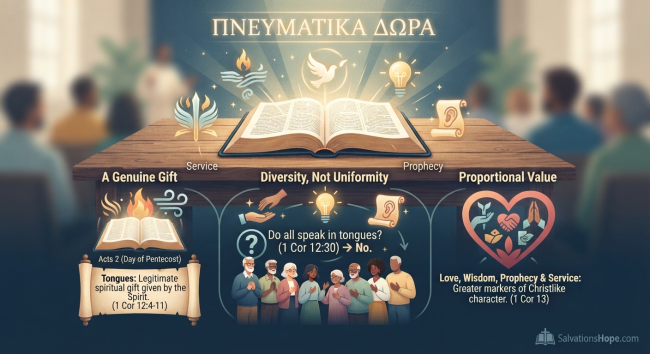
- A Genuine Gift: The New Testament clearly records tongues as a legitimate spiritual gift distributed by the Holy Spirit (1 Corinthians 12:4–11). It manifested initially on the Day of Pentecost (Acts 2) as recognizable human languages for the proclamation of the Gospel, and later as a gift of ecstatic praise and edification requiring interpretation within corporate gatherings (1 Corinthians 14).
- Diversity, Not Uniformity: The Apostle Paul explicitly dismantles the notion that every believer must possess the same gift. In his rhetorical questions to the Corinthian church, he asks, "Do all speak with tongues?" with the clear grammatical expectation of a "no" answer (1 Corinthians 13:30).
- Proportional Value: While tongues have a valid place in private prayer and structured corporate settings, Scripture consistently ranks love, wisdom, prophecy, and acts of service as far more essential markers of Christlike character (1 Corinthians 13:1–3, 14:1–5).
Pastoral Counsel for Every Believer
Whether you speak in tongues, long to do so, or have never experienced the gift, Scripture offers liberating truth and pastoral wisdom for your walk with God:
- If you do not speak in tongues: Release any lingering feelings of spiritual inferiority. The Holy Spirit distributes His gifts "to each one individually as He wills" (1 Corinthians 12:11). Your standing before God is secured entirely by the finished work of Jesus Christ, not by the manifestation of any sign gift.
- If you desire the gift: Keep an open heart to the sovereign work of the Spirit, but avoid frantic striving or manufactured emotionalism. Guard your heart against pride or discouragement, remembering that God honors all genuine, faith-filled prayer.
- If you do possess the gift: Practice it with humility and biblical order. Value what God has given you, but heed Paul’s directive to prioritize love, mutual edification, and harmony within the body of Christ above all else (1 Corinthians 14:12).
And there are diversities of activities, but it is the same God who works all in all.” — 1 Corinthians 12:4–6
The Corinthian Problem: Navigating Glossolalia and Spiritual Anxiety
True Measure of Maturity: The Agony of the Marginalized Believer
Across the globe, the landscape of contemporary Christian worship is marked by a deep yearning for authentic spiritual power. For many believers, however, this yearning is accompanied by a profound sense of spiritual inadequacy. Consider the heartfelt testimony of a believer from Nigeria who shared an experience common to countless Christians trapped in environments dominated by charismatic performance:
“This has been disturbing me so much. I’ve come out in several altar calls concerning the power of the Holy Ghost. Yet nothing seems to happen. When I go to fellowship, I see some people falling in the power of the Holy Ghost, bursting in tongues, proclaiming, prophesying and lots of things, but I don’t seem to find myself there. I feel as if I’m not worthy to be in their midst. In fact, I’m envying them. I feel like crying.”
This poignant cry exposes a deep pastoral crisis within modern evangelicalism. When a fellow believer measures their standing before God not by the finished work of Christ or the quiet fruit of the Spirit, but by ecstatic manifestations—specifically glossolalia (speaking in tongues)—the church creates an internal caste system. Those who manifest the desired phenomena are elevated to an elite tier of “super-spiritual” Christians, while those who do not are relegated to the margins, left to wrestle with doubt, shame, and spiritual despair.
To heal this pastoral wound, we must turn to the Scriptures, specifically examining the historical precedent set by the ancient church in Corinth. By dissecting the theological errors of the Corinthian congregation and contrasting them with the apostolic corrections delivered by the Apostle Paul, we can dismantle unbiblical patterns of worship and re-anchor our understanding of spiritual maturity in biblical reality.
The Theological Root: Deconstructing the "Two-Stage" Paradigm
The psychological distress experienced by believers who do not speak in tongues is rarely accidental; it is almost invariably the product of a specific, systematized theological framework. In various Pentecostal and charismatic circles, believers are taught a two-stage initiation model of Christian experience:
- Stage One (Regeneration): An individual hears the gospel, places their faith in Jesus Christ, receives Him as Savior, and is born again by the Holy Spirit. At this juncture, the believer is spiritually alive, yet perceived as spiritually incomplete or static.
- Stage Two (The Baptism of the Holy Spirit): Subsequent to conversion, the believer must actively seek a “second blessing”—often termed the baptism of the Holy Spirit. This experience is viewed as a dynamic power boost necessary for effective Christian living, and traditional pneumatology within these circles dictates that the indispensable, normative sign of this baptism is speaking in tongues. This dualistic framework introduces an artificial hierarchy into the body of Christ. It bifurcates the church into two classes:
- The Spirit-Baptized Elite: Those who have manifested tongues, characterized as spiritually mature, powerful, and uniquely favored.
- The Carnal Sub-Class: Those who have not spoken in tongues, implicitly or explicitly labeled as lower-level, hindered by unconfessed sin, lacking faith, or spiritually deficient.
Scriptural Correction of the Tiered Model
When evaluated against the breadth of New Testament teaching, this two-stage model collapses. While the Book of Acts records instances where believers spoke in tongues upon receiving the Holy Spirit (e.g., Acts 2, 10, 19), these historical narratives describe unique, transitional redemptive-historical moments rather than prescriptive blueprints mandated for every believer across all eras.
Furthermore, the Apostle Paul explicitly dismantles the notion that a single spiritual gift is universally required or distributed. In his masterclass on spiritual unity and diversity within the body of Christ, Paul poses a series of rhetorical questions designed to demolish the idea of a uniform sign gift:
Do all speak in tongues? Do all interpret?”(1 Corinthians 12:29-30)
The expected grammatical answer in Greek to every single one of these questions is a resounding no. Not all speak in tongues. Therefore, to make glossolalia the universal badge of Spirit baptism is to contradict apostolic theology directly and to lay an unbiblical burden upon the shoulders of God’s children.
The Ancient Echo: Disorder and Division in Corinth
The modern anxieties surrounding tongues are modern iterations of an ancient malady. The early church in Corinth was uniquely infatuated with spiritual gifts, particularly those that were audible, ecstatic, and sensational. In a Greco-Roman culture that prized rhetorical flourish, ecstatic utterance, and dramatic public displays of divine favor, the Corinthians elevated tongues above all other expressions of faith.
This misplaced zeal corrupted their corporate gatherings. Instead of being assemblies characterized by edification, order, and love, Corinthian worship services devolved into chaotic spectacles. Large numbers of individuals would simultaneously voice ecstatic utterances without interpretation, creating an environment of deafening noise, confusion, and spiritual elitism. Unbelievers walking into these assemblies would not encounter the convicting, orderly presence of God; instead, they would rightly conclude that the gathering was entirely mad (1 Corinthians 14:23).
The Pauline Prescription for Public Worship
Rather than abolishing the gift of tongues, the Apostle Paul—inspired by the Holy Spirit—regulated its practice to restore order, dignity, and communal edification. In 1 Corinthians 14:27-28, Paul outlines explicit boundaries for the corporate assembly:
- Strict Limitation: In any given public worship service, only two or at most three individuals should speak in tongues.
- Sequential Order: They must never speak simultaneously; rather, they must speak one at a time, exercising self-control and yielding the floor to one another.
- Mandatory Interpretation: A tongue must never be spoken publicly without an accompanying interpretation. If no interpreter is present, the individual must remain silent in the assembly and keep the utterance strictly between themselves and God.
These apostolic directives carry profound theological weight: The primary goal of corporate worship is the edification of the body, not the unchecked emotional release of the individual. When worship lacks intelligibility, love is absent, and the primary purpose of the gathering is subverted.
The Supreme Measuring Stick: Love Over Ecstasy
To decisively cure the Corinthian obsession with sensational gifts, Paul interrupts his discourse on spiritual gifts (1 Corinthians 12–14) with one of the most sublime theological poetry in all of Scripture: 1 Corinthians 13.
“If I speak in the tongues of men and of angels, but have not love,
I am only a resounding gong or a clanging cymbal.” (1 Cor. 13:1)
- Tongues will cease.
- Knowledge will pass away.
- Prophecies will vanish.
- BUT LOVE NEVER FAILS.
Paul makes a striking theological contrast. He acknowledges the exotic nature of tongues—even imagining the hypothetical capability of speaking the very languages of heavenly angels—and declares that without agape love, the speaker is nothing more than discordant, empty noise.
In doing so, Paul entirely redefines the metric of spiritual maturity. In the kingdom of God, spiritual depth is never measured by:
- The volume or frequency of ecstatic speech.
- The outward intensity of physical manifestations during prayer.
- The possession of flashy, highly visible spiritual gifts.
Instead, spiritual maturity is measured by Christ-likeness, sacrificial service, patience, humility, and enduring love. The believer who quietly serves the marginalized, exhibits profound patience in affliction, and loves their neighbor with the self-giving love of Christ is infinitely more spiritually advanced than a tongue-speaker devoid of grace.
For the believer burdened by feelings of inadequacy because they do not speak in tongues, the apostolic message of 1 Corinthians offers profound liberation. You are not a second-class Christian. You are not missing a vital component of salvation, nor are you spiritually deficient.
The gospel of Jesus Christ does not offer a tiered salvation or a fragmented adoption into the family of God. Through faith in Christ, every believer receives the fullness of the Holy Spirit (Ephesians 1:13-14), is co-heir with Christ, and possesses every spiritual blessing in the heavenly realms (Ephesians 1:3). Do not let unbiblical peer pressure, noisy spectacles, or man-made hierarchies rob you of your peace in Christ. Rest secure in the truth that the highest mark of the Spirit’s indwelling is not a vocal utterance, but a heart transformed by the boundless, unfailing love of God.
The Architecture of Divine Grace: Recovering the Biblical Paradigm of Order in Worship
In contemporary evangelical and charismatic discourse, a persistent cultural assumption equates the magnitude of divine manifestation with sensory intensity. The prevailing narrative often suggests that the Holy Spirit moves with greater velocity and efficacy where decibel levels peak, emotional volatility surges, and physical phenomena such as mass prostration—commonly styled as being “slain in the Spirit”—are cultivated. This paradigm, however, fundamentally inverts the scriptural witness regarding the divine nature. The God of Scripture is fundamentally a God of Order (ho theos tês akatasias ou estin, alla tês eirênês), whose power operates not through chaotic emotionalism, but through the deliberate, intelligible communication of truth that redeems and transforms the human soul.
The Pauline Correction: Intelligibility Over Ecstasy
To understand the biblical weighting of charismatic expression versus orderly edification, one must examine the crucible of early church worship in Corinth. The Apostle Paul addresses a community intoxicated by spiritual gifts, misusing them to project status rather than to build up the body. In 1 Corinthians 14:33, Paul lays down an immutable theological axiom:
“For God is not a God of disorder but of peace—as in all the congregations of the Lord’s people.”
Paul’s argument is not an anti-charismatic polemic; rather, it is a call to theological maturity. He explicitly validates the authenticity of glossolalia (speaking in tongues), noting of his own practice, “I thank God that I speak in tongues more than all of you” (1 Cor. 14:18). Yet, when gathered in corporate assembly, Paul prioritizes structural intelligibility: “In the church I would rather speak five intelligible words to instruct others than ten thousand words in a tongue” (1 Cor. 14:19).
In the economy of the God of Order, spiritual gifts are given for oikodome—the structural building up of the church. Uninterpreted ecstasy breeds fragmentation and confusion, alienating the outsider and leaving the believer uninstructed. True spiritual power manifests most profoundly when the mind is fully engaged by the clear proclamation of divine truth.
Physical Prostration: The Theology of Human Fragility
A critical hermeneutical error in modern movements is the elevation of physical collapse—people falling backward during worship gatherings—into a distinct spiritual gift or a metric of superior spirituality. A rigorous exegetical survey of the canon reveals that falling under pressure is never categorized as a charism (charisma).
Instead, physical collapse is intrinsically linked to creaturely limitation and weakness:
- The Psychology of Mass Suggestion: Physical falling can be induced by psychological pressure, hypnotic leadership techniques, or group hysteria, where social contagion overrides individual autonomy.
- The Weight of Divine Holiness: Even when precipitated by a genuine, overwhelming sense of the divine presence, human prostration is a symptom of frailty. It signifies that the finite, fallen human frame is temporarily overwhelmed by infinite glory.
As Jonathan Edwards observed during the First Great Awakening, fainting or collapsing is an accidental side-effect predominantly affecting those of a “weaker frame.” It is an indicator of human limitation, not divine endorsement. To institutionalize falling as an objective sign of advanced spiritual attainment is to confuse the weakness of the vessel with the power of the Potter.
Historical Precedents: The Great Awakenings and Korean Revivals
Church history provides a sobering corrective to the contemporary obsession with manufactured physical phenomena. During the mid-18th-century Great Awakening in America, massive crowds gathered under the preaching of luminaries like Jonathan Edwards and George Whitefield. Physical manifestations—crying out, trembling, and falling—were frequent occurrences as individuals confronted the harrowing reality of their sin before a holy God.
Significantly, Edwards and Whitefield maintained a pastoral, matter-of-fact detachment toward these physical reactions. They understood tha
- Spiritual transformation is verified by enduring fruit, not ephemeral physical episodes.
- Many who remained entirely upright experienced profound, life-altering regeneration.
- Conversely, some who fell exhibited no long-term evidence of grace or repentance.
Similarly, during the earth-shaking Korean revivals of the early 20th century—which catalyzed the exponential growth of Christianity on the Korean peninsula—believers were frequently overwhelmed by conviction, sometimes falling to the ground in deep remorse and prayer. The revivalists did not orchestrate, market, or amplify these physical reactions. They viewed them as incidental side-effects, promptly helping the fallen to their feet and anchoring them in the stabilizing words of divine forgiveness and the steady discipline of discipleship.
Anchoring the Soul in the God of Order
The phrase “slain in the Spirit” is a theological construct of human invention rather than a doctrinal mandate of divine revelation. Fainting under emotional or spiritual pressure is neither a badge of honor nor a mark of shame.
The measure of authentic pneumatic power is not how far the body falls, but how high the soul is lifted in holiness, truth, and steadfast love for Jesus Christ. In a world characterized by systemic confusion and emotional turbulence, the church must model the serene, formidable beauty of the God of Order—submitting every manifestation of faith to the governance of truth, love, and intelligible grace.
The Fireplace of the Spirit: Harmonizing Liveliness and Order in Christian Worship
The Dynamics of Worship
In the landscape of modern Christian ecclesiology, few tensions are as palpable—or as frequently mishandled—as the delicate balance between divine order and spiritual fervor. A superficial reading of church history often presents a false dichotomy: communities must choose either the rigid, predictable liturgical structures that safeguard theological orthodoxy or the spontaneous, expressive manifestations of the Holy Spirit that characterize charismatic renewal.
However, a robust biblical theology rejects this bifurcation. Liveliness and orderliness are not antithetical forces vying for dominance; rather, they are complementary dimensions of a healthy, Spirit-filled body of Christ. Just as a physical fire requires both the containment of a hearth and the volatile energy of combustion to fulfill its purpose, the church requires both structural integrity and charismatic vitality to honor God and edify believers.
The Corinthian Caution and the Contemporary Pendulum
To understand the biblical synthesis of order and liveliness, one must examine the pastoral challenges addressed by the Apostle Paul in the New Testament. The early church in Corinth leaned heavily toward unbridled enthusiasm. Their worship assemblies frequently devolved into cacophony, characterized by unregulated speaking in tongues, overlapping prophecies, and individualistic displays of spiritual gifts that overshadowed corporate edification (1 Corinthians 14:26-33).
Yet, contemporary Western Christianity often errs in the exact opposite direction. Many congregations have traded the chaotic hubbub of Corinth for the sterile predictability of a mausoleum. These gatherings are so sedate, controlled, and meticulously managed that the unpredictable, catalytic movement of the Holy Spirit is effectively quenched.
- The Danger of Excess: Unchecked emotionalism and lack of protocol obscure the message of the Gospel, rendering the church incomprehensible to outsiders and disorganized before God (1 Corinthians 14:23).
- The Danger of Stagnation: Complete institutionalization reduces corporate worship to a mechanical performance. When a service relies entirely on a single paid minister delivering a prepared sermon while the pews remain a passive audience, the priesthood of all believers is functionally denied.
As Paul navigates these extremes, his apostolic instruction does not call for the silencing of the Spirit, but for the optimization of spiritual expression. He writes, “Do not forbid speaking in tongues. But everything should be done in a fitting and orderly way” (1 Corinthians 14:39–40). Order without liveliness is a cold tomb; liveliness without order is a destructive wildfire. True biblical worship demands both.
The Ecclesiological Metaphor: The Church as a Fireplace
The Apostle Paul warns the Thessalonian believers: “Do not put out the Spirit’s fire” (1 Thessalonians 5:19). The imagery of fire throughout Scripture denotes the purifying, illuminating, and empowering presence of God. Yet fire, by its very nature, is dynamic and potentially hazardous if left uncontained.
This yields a profound theological metaphor: The church is like a fireplace.
- The Danger of the Uncontained Explosion: When a community attempts to generate spiritual fervor outside the bounds of biblical truth, ecclesiastical order, and love, the fire spills out onto the floor. It consumes rather than warms, resulting in spiritual pride, division, and confusion.
- The Danger of the Cold Ashes: Conversely, when a church constructs a magnificent hearth of tradition, liturgy, and administrative efficiency but refuses to kindle or welcome the spark of the Holy Spirit, it is left with a heap of cold, dead ashes. There is no warmth for the weary, no light for the lost, and no dynamic power to transform human hearts.
The design of the church is to be aglow—sustained by the well-ordered flame of the Holy Spirit, where structural integrity channels spiritual power for maximum redemptive impact.
Pneumatology and the Individual Believer: Beyond Rigid Formulas
This theological synthesis extends directly from corporate worship down to the spiritual vitality of the individual Christian. A common point of theological friction involves the doctrine of the baptism with the Holy Spirit. Certain traditions have taught a rigid, two-stage formula: regeneration occurs at conversion, followed subsequently by a distinct, second-work-of-grace baptism—often dogmatically tied to the initial physical evidence of speaking in tongues.
Scripturally, forcing the sovereign work of the Holy Spirit into such a mechanical formula is unwarranted. Every believer who is united to Christ already possesses the indwelling Holy Spirit; indeed, Romans 8:9 asserts that anyone who does not have the Spirit of Christ does not belong to Him. Conversion itself is an act of pneumatic regeneration.
However, recognizing this does not mean believers have arrived at the zenith of their spiritual experience at the moment of justification. The fundamental insight within charismatic longings must be preserved: God has infinitely more to give.
- Continuous Filling: Scripture repeatedly commands believers to be continually filled with the Spirit (Ephesians 5:18, using the present continuous tense, meaning keep on being filled).
- Ongoing Progression: Christians must resist spiritual complacency. The Christian life is not static; it is an active, ongoing pursuit of grace, assurance, love, and empowerment.
- The Danger of Spiritual Arrogance: Seeking a profound encounter, an anointing, or an influx of spiritual gifts should never culminate in the static pride of having "arrived." An authentic touch from God produces humility, a deeper hunger for righteousness, and an outward-facing passion for serving others.
A Call to Continual Awakening
The church must reject the false choice between a lifeless orthodoxy and a lawless charismatic chaos. Liveliness and orderliness belong together because they reflect the very character of God, who is both a God of supreme, immutable order and a consuming fire.
For the individual believer and the corporate body alike, the mandate is clear: do not quench the Spirit, yet test everything and hold fast to what is good. Do not settle for the cold ashes of religious formalism, nor fear the orderly hearth that God has provided to channel His glorious power. Seek continually to be flooded, refilled, and empowered by the Holy Spirit, that your life and your church may burn brightly for the glory of God.
Unity in Diversity: The Symphony of the Spirit in the Body of Christ
The Tapestry of Grace
In the life of the modern church, few topics generate as much passion, debate, and occasionally division as the manifestation of spiritual gifts. Among these, the gift of speaking in tongues often occupies a contested space—elevated by some as the ultimate litmus test of spiritual maturity and the indwelling of the Holy Spirit, while minimized or avoided by others out of discomfort or theological reaction.
However, the apostle Paul’s pastoral and theological discourse in 1 Corinthians 12 offers a radically different paradigm. Rather than fostering a hierarchy of spiritual elitism or uniform conformity, Scripture presents a vision of the church as an organic, harmonious ecosystem. Here, diversity is not a weakness to be ironed out, but the very design of divine grace. Unity is found not in sameness, but in the singular, sovereign Source of all spiritual life: the Triune God.
The Place of Tongues in the Biblical Economy
To properly understand the gift of tongues, one must examine its scriptural context without minimization or exaggeration. In 1 Corinthians 12:28, Paul outlines a diverse array of ministries and empowerments distributed throughout the body:
then gifts of healing, of helping, of guidance, and different kinds of tongues.”
It is a profound theological observation that whenever Paul lists spiritual gifts across his epistles, tongues is invariably placed at the conclusion of the enumeration. Furthermore, several New Testament letters that discuss spiritual gifts and community edification omit the mention of tongues altogether.
Does this mean the gift is obsolete, inferior, or negligible? Absolutely not. Scripture is unambiguous in its instruction:
“Do not forbid speaking in tongues” (1 Corinthians 14:39).
To stifle, mock, or dismiss any authentic movement of the Holy Spirit is to grieve the Spirit Himself. Every gift given by God serves a holy purpose in edifying the body of Christ.
Yet, the corrective balance of Scripture is equally clear: we must never elevate any single manifestation to the status of a universal requirement or a mandatory badge of spiritual superiority. To claim that tongues is the definitive proof of being “truly Spirit-filled” contradicts the explicit rhetorical question of Paul later in the same chapter:
“Do all speak in tongues?” (1 Corinthians 12:30).
The grammatical structure of the Greek text demands a resounding “No.” The Holy Spirit, as a wise and sovereign Giver, distributes gifts “to each one, just as he determines” (1 Corinthians 12:11).
The Anatomy of the Body: Overcoming Comparison and Insecurity
To illustrate how diverse gifts function within the community of faith, Paul employs the brilliant, visceral metaphor of the human body (1 Corinthians 12:14–26).
- The Fallacy of Inferiority: An ear cannot look upon the eye with self-pity simply because it lacks the capacity for sight. Its function is distinct, essential, and irreplaceable. In the ecosystem of the local church, a believer possessing a quiet gift—such as administration, acts of mercy, or behind-the-scenes hospitality—must never feel spiritually disenfranchised when standing alongside someone with a public, dynamic gift like healing or prophetic utterance.
- The Fallacy of Independence: Conversely, the eye cannot say to the hand, "I don't need you!" (1 Corinthians 12:21). The human body collapses when parts attempt to function in isolation or demand that every other member mimic their exact anatomy.
“If the whole body were an eye, where would the sense of hearing be? If the whole body were an ear, where would the sense of smell be? But in fact God has placed the parts in the body, every one of them, just as he wanted them to be” (1 Corinthians 12:17–18)
Spiritual maturity involves resting secure in your God-given calling. Whether your ministry is loud and public or quiet and steadfast, your place in the body is ordained by divine wisdom.
Personality, Temperament, and the Creative Design of God
God’s commitment to diversity extends far beyond spiritual gifts; it is woven into the very fabric of human personality and temperament.
- The Quiet and Thoughtful: If you possess an introspective, contemplative nature, you are not required to adopt a loud, boisterous persona to prove you are spiritually alive. God delights in deep reflection, meditative prayer, and gentle wisdom.
- The Outgoing and Expressive: If you possess a vibrant, talkative, and energetic disposition, you do not need to suppress your warmth or transform into a detached academic to be truly godly.
The Creator does not force every believer into a spiritual cookie-cutter mold. Instead, the Holy Spirit adorns each distinct personality with a unique, custom-tailored blend of graces designed to enrich the whole community.
The Divine Source: Unity Rooted in the Trinity
True Christian unity is frequently misunderstood as uniformity. Human institutions often achieve unity by demanding that everyone think, act, speak, and worship in identical ways. But the church of Jesus Christ is bound together by a far deeper, transcendent reality.
Paul roots the diversity of the church directly in the unity of the Godhead:
There are different kinds of working, but the same God works all of them in all men” (1 Corinthians 12:4–6).
Notice the theological symmetry:
- The Holy Spirit distributes the gifts (charismata).
- The Lord Jesus directs the service (diakonia).
- God the Father empowers the work (energema).
Because every legitimate gift flows from this singular divine Source, no gift is inherently “more spiritual” than another. The gift of teaching is no more a mark of true grace than the gift of helps; the gift of tongues holds no greater inherent righteousness than the gift of administration.
Our ultimate bond is not found in shared emotional experiences, identical personalities, or the operation of the exact same spiritual manifestations. Our unity is objective, ontological, and eternal:
—and we were all given the one Spirit to drink” (1 Corinthians 12:13).
Living Out the Symphony
When a symphony orchestra performs, it does not consist solely of violins playing the exact same note at the exact same volume. The beauty, power, and emotional resonance of the music emerge precisely because the conductor harmonizes a vast array of instruments—cellos, flutes, trumpets, and percussion—each playing its unique part.
So it is with the body of Christ. Let us celebrate the rich variety of the Holy Spirit’s outpouring without envy or arrogance. Let us neither forbid the miraculous nor despise the ordinary. Bound together by one Lord, one faith, and one baptism, may our churches display to a fractured world the breathtaking reality of unity in diversity.
The Architecture of Grace
The Teleology of Spiritual Endowments
Within the framework of New Testament pneumatology, spiritual gifts (charismata) are fundamentally teleological. They are not bestowed as static artifacts or spiritual accolades to be sequestered within the trophy case of personal achievement. Rather, they are dynamic, operational capacities designed by the sovereign will of the Triune God to function within the organic unity of the body of Christ.
As the Apostle Paul articulates throughout his pastoral correspondence, every manifestation of the Spirit is fundamentally ordered toward a threefold objective:
- The ultimate glorification of God,
- The inward edification of the individual believer, and
- The corporate upbuilding of the entire ecclesial community.
When examining the specific manifestation of glossolalia—commonly known as speaking in tongues—the early church encountered significant theological and practical questions regarding its appropriate venue, purpose, and limitations. By analyzing the apostolic directives found primarily in 1 Corinthians 12 through 14, believers can construct a balanced, biblically anchored theology of spiritual gifts that honors both the immediate movement of the Holy Spirit and the overarching mandate of Christian love (agape).
The Private Dimension: Personal Edification and Communion with God
The New Testament affirms that speaking in tongues is a genuine spiritual phenomenon initiated by the Holy Spirit. In this experience, the Spirit transcends the cognitive limitations of the human intellect, moving the human spirit to commune with the Divine in an unlearned, un-translated language.
As Paul notes in 1 Corinthians 14:2:
“Anyone who speaks in a tongue does not speak to men but to God. Indeed, no one understands him; he utters mysteries with his spirit.”
The Mechanics of Private Communion
- Transcending Rational Limitations: While human language relies upon shared cognitive constructs, glossolalia operates beyond the boundaries of the conscious mind. It permits the spirit of the believer to voice profound adoration, intercession, and mystery directly to the Creator.
- Psychological and Spiritual Liberation: Countless believers across church history have testified that this gift provides a profoundly liberating dimension to their devotional life, bypassing the fatigue of conventional vocabulary to express the inexpressible depths of worship.
- Self-Edification: Paul explicitly highlights that the private utilization of this gift serves to "build up" (oikodomeo) the individual believer. It is an intimate act of spiritual fortification, anchoring the soul in communion with God before facing external trials or corporate responsibilities.
The Corporate Dimension: The Necessity of Intelligibility and Edification
While the private exercise of tongues serves to edify the individual, the corporate gathering of the local church operates under a completely different theological imperative. The primary rule governing the public assembly is unmistakable: mutual edification.
Paul addresses the Corinthian church’s disordered worship gatherings by emphasizing that an uninterpreted utterance in a public setting fails to serve the body:
You will just be speaking into the air… You will be giving thanks well enough, but the other man is not edified” (1 Cor. 14:9, 17).
The Principle of Corporate Intelligibility
- The Barrier of Noise: Without the accompanying spiritual gift of interpretation, glossolalia in a public assembly ceases to be a meaningful communicative act; to the uninitiated listener, it is indistinguishable from meaningless sound.
- The Impossibility of Agreement: True corporate worship relies upon shared participation, notably expressed through the communal affirmation of “Amen.” Believers cannot genuinely assent to a truth they cannot comprehend.
- The Danger of Confusion: When Paul considers the hypothetical scenario of unbelievers or inquirers entering an uncoordinated worship service characterized by chaotic, uninterpreted tongues, he issues a stark warning: they will conclude that the community is unstable or irrational (“Will they not say that you are out of your mind?” – 1 Cor. 14:23).
Therefore, prophetic proclamation and clear, understandable communication of God’s truth always supersede uninterpreted tongues within public worship, because intelligibility is the essential prerequisite for corporate instruction and transformation.
The Sovereignty of the Spirit and the Diversity of the Body
A crucial error within pneumatology is the homogenization of spiritual gifts—the erroneous assumption that a single gift serves as the universal benchmark of authentic spiritual maturity or baptism in the Spirit.
Paul directly challenges this reductionist view through his rhetorical questioning in 1 Corinthians 12:30:
“Do all speak in tongues?”
The grammatical structure of the original Greek demands a definitive negative response: No, not all speak in tongues.
Historical and Pneumatological Realities
- Ecclesiastical Diversity: Throughout the rich tapestry of church history, God has raised up monumental reformers, theologians, martyrs, and revivalists who never exercised the gift of tongues. Entire epochs characterized by profound spiritual awakening and biblical reformation moved forward with mighty power while operating under diverse configurations of the charismata.
- The Freedom of the Divine Wind: Jesus Himself likened the work of the Holy Spirit to the wind, which "blows wherever it pleases" (John 3:8). The Spirit cannot be confined to human formulas—neither to the erroneous doctrine that every genuine believer must speak in tongues, nor to the cessationist error that the gift has been permanently abolished.
- Sovereign Distribution: The Spirit distributes gifts "to each one, just as he determines" (1 Cor. 12:11). The presence or absence of any specific gift does not measure a Christian's standing in grace or their depth of devotion.
Walking in Love and Desiring Spiritual Empowerment
Ultimately, spiritual gifts are subordinated to the supreme ethic of the Christian faith: love. As Paul transitions from his extensive discourse on spiritual gifts into the magnificent hymn of 1 Corinthians 13, he underscores that even the most dramatic manifestations are spiritually bankrupt if divorced from agape.
The balanced theological application for the contemporary church is twofold:
- For those possessing the gift of tongues: Use it with profound gratitude for private communion, personal fortification, and adoration of God, while exercising restraint and wisdom in corporate settings to ensure that fellow believers are built up rather than alienated.
- For those who do not possess the gift: Rest secure in your identity in Christ, faithfully deploying the specific gifts entrusted to you for the edification of the body.
Above all, every believer is called to heed the apostolic exhortation:
“Follow the way of love and eagerly desire spiritual gifts” (1 Cor. 14:1)
—seeking empowerment not for personal status or spiritual pride, but purely for the building up of Christ’s church and the glory of His name.
How can your local congregation better balance the freedom of spontaneous spiritual expression with the biblical mandate for clear, orderly, and mutually edifying corporate worship?