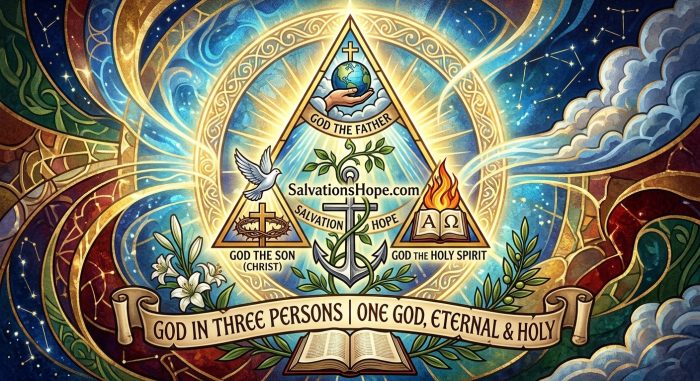
The Trinity
Understanding the Doctrine of the Trinity
At the very heart of Christian theology lies the doctrine of the Trinity, widely regarded as one of the most foundational and defining tenets of the Christian faith. Far from being a mere abstract theological puzzle, exploring what the Bible teaches about the Trinity addresses the ultimate question that drives all spiritual seeking: What is God like in His very essence?
The Core Reality: One God in Three Persons
When Scripture opens our eyes to the inner life of the Creator, it reveals a profound and awe-inspiring truth. In His eternal being, God is neither a solitary isolationist nor a pantheon of competing deities. Instead, God exists as one divine essence in three distinct persons: the Father, the Son, and the Holy Spirit.
Why the Trinity Matters for Our Faith
Understanding the Trinity shifts our perspective from simply looking at what God does for humanity to recognizing who God is in Himself. This distinction is vital for several reasons:
Foundations of the Trinity in the Old Testament
Although the specific word trinity is never explicitly found within the pages of Scripture, the foundational reality it represents permeates the entire biblical text. Derived from the Latin trinitas, the term means “tri-unity” or “three-in-oneness,” serving as a concise theological summary of the biblical teaching that God eternally exists as three distinct persons—Father, Son, and Holy Spirit—while sharing one indivisible divine essence.
A common misconception is that the doctrine of the Trinity is an exclusively New Testament revelation, emerging only after the incarnation of Jesus Christ. However, if God has eternally existed in this trinitarian reality, it would be historically and theologically anomalous to find a complete vacuum of this truth in the Hebrew Bible. While the full, explicit articulation of the Trinity awaits the New Testament, the Old Testament contains a rich tapestry of passages that strongly suggest, hint at, and outright imply a divine plurality within the Godhead.
Plurality in Creation and Divine Action
The indication of a divine plurality surfaces as early as the opening chapter of Genesis.
Evaluating Alternative Explanations
To explain away the plural verbs and pronouns in these texts, scholars have historically proposed two main alternative theories:
The Theological Conclusion: The most robust exegetical explanation is that these texts point directly to an internal dialogue and cooperation within the Godhead itself. While the Old Testament does not explicitly quantify the persons or unveil a fully developed trinitarian dogma, it firmly establishes the premise that more than one divine person is involved in these cosmic decrees and actions.
Inter-Divine Relationships and Shared Titles
Beyond plural pronouns, the Hebrew Bible features several remarkable passages where one divine person is explicitly called “God” or “Lord” while being clearly distinguished from another person who is also identified by those same supreme titles.
The Holy Spirit and the Angel of the LORD
The Old Testament also anticipates the distinct personhood of the Holy Spirit and highlights the mysterious theological figure known as the Angel of the LORD.
Key Takeaway: These passages demonstrate that the Old Testament framework is not strictly unitarian. It continually lays the groundwork for understanding God as a complex, relational unity of multiple persons.
Deep Dive: Wisdom in Proverbs 8:22–31
One of the most intensely debated Old Testament texts regarding divine personhood is found in Proverbs 8. While the earlier portion of the chapter uses personification as a literary device to invite the simple to learn, verses 22 through 31 ascribe actions to “wisdom” that go far beyond mere metaphor:
"Then I was the craftsman at his side. I was filled with delight day after day, rejoicing
always in his presence, rejoicing in his whole world and delighting in mankind" (Prov. 8:30–31).
Resolving the Translation Dilemma
Critics of trinitarian theology often point to verse 22 in older translations, arguing it teaches that this divine wisdom was created:
However, linguistic analysis of the original Hebrew text clarifies this misunderstanding:
When viewed through the lens of progressive revelation, this text speaks to the eternal, harmonious relationship between the Father and the Son (the pre-incarnate Wisdom and Word of God) at the dawn of creation, affirming distinct personhood without implying that the divine Son had a temporal beginning.
The Trinitarian Revelation in the New Testament
With the dawning of the New Testament era, redemptive history shifts dramatically. We step into the physical reality of the incarnation—the coming of the Son of God into human history. Because the historic milestone of the incarnation brings the second person of the Godhead into human space and time, it naturally ushers in a much more explicit, overt revelation of the trinitarian nature of God.
While the Old Testament lays the foundational groundwork for monotheism and hints at plurality within the Godhead, the New Testament bursts forth with simultaneous, distinct references to all three persons of the Trinity. Before exploring the theological mechanics of the Trinity in depth, we can examine the structural testimony of the New Testament through explicit passages where the Father, the Son, and the Holy Spirit are deliberately named together.
1. The Epiphany at the Baptism of Jesus (Matthew 3:16–17)
"And when Jesus was baptized, immediately he went up from the water,
and behold, the heavens were opened to him, and he saw the Spirit of God
descending like a dove and coming to rest on him; and behold, a voice from
heaven said, 'This is my beloved Son, with whom I am well pleased.'" (Matt. 3:16–17)
The baptism of Jesus serves as a breathtaking, cinematic unveiling of the triune God acting in distinct ways simultaneously:
Here, we observe three distinct persons executing three distinct, coordinated operations in a single historical moment, underscoring the relational dynamism within the unified Godhead.
2. The Mandate of the Great Commission (Matthew 28:19)
"Go therefore and make disciples of all nations, baptizing them in the
name of the Father and of the Son and of the Holy Spirit..." (Matt. 28:19)
At the culmination of His earthly ministry, Jesus leaves His disciples with the ultimate charter for the global church. The phrasing here is profoundly precise: notice the singular noun “name” governing three distinct titles.
3. Trinitarian Formulas in the Apostolic Epistles
The apostolic writers consistently weave trinitarian architecture into their theological arguments, ethical exhortations, and pastoral blessings. By examining their use of specific Greek nomenclature—frequently utilizing Gk. θεός (theos) to refer to God the Father and Gk. Κύριος (kurios) to refer to God the Son—we uncover a rich tapestry of triune thought:
The Triune Expressions Identified
Spiritual Gifts in the Body
Spirit (varieties of gifts), Lord (varieties of service), God (varieties of working)
Grace of the Lord Jesus Christ, love of God, fellowship of the Holy Spirit
One Spirit, one Lord, one God and Father of all
Foreknowledge and Salvation
Foreknowledge of God the Father, sanctifying work of the Spirit, obedience and sprinkling of the blood of Jesus Christ
Pray in the Holy Spirit, keep yourselves in the love of God, wait for the mercy of our Lord Jesus Christ
These passages demonstrate that trinitarian theology was not a late invention of fourth-century church councils; rather, it was the baseline framework of early apostolic worship and theology.
4. Textual Note: Navigating 1 John 5:7 (Comma Johanneum)
When studying biblical passages concerning the Trinity, careful teachers must exercise textual discernment, particularly regarding 1 John 5:7 in older English translations.
"For there are three that bear record in heaven, the Father, the Word, and the Holy Ghost: and these three are one." (KJV)
Why Modern Translations Omit This Verse
Because of this overwhelming textual evidence, virtually all modern translations (such as the ESV, NIV, NASB, and NRSV) omit the verse, leaving the integrity of the biblical canon anchored in pristine historical manuscripts while resting the doctrine of the Trinity firmly upon the vast array of authentic passages listed above.
Understanding the Distinct Persons of the Trinity
In Christian theology, a proper understanding of the Godhead requires recognizing not only the absolute unity of the divine essence—one God—but also the eternal distinctions among the three persons: the Father, the Son, and the Holy Spirit. While they share the exact same divine nature, power, and glory, they are distinct persons who relate to one another in personal, relational ways.
The Son is Distinct from the Father
Scripture consistently depicts Jesus Christ operating as an intermediary, advocate, and high priest before the Father.
The Holy Spirit is Distinct from the Father and the Son
The Holy Spirit is neither the Father nor the Son, a reality established through active relational dynamics within the Godhead:
Establishing the Personhood of the Holy Spirit
A recurring error in various theological and historical movements is reducing the Holy Spirit to an impersonal “force,” “energy,” or “power” wielded by God—much like electricity or gravity. However, the New Testament overwhelms this perspective with robust evidence for the Spirit’s distinct, conscious personhood.
Coordinate Relationships
In numerous passages, the Holy Spirit is placed in a strict grammatical and theological coordinate relationship alongside the Father and the Son:
Grammatical Anomalies: The Masculine Pronoun
In Greek grammar, every noun possesses a specific gender that dictates the pronouns used to refer to it.
Personal Actions and Attributes
The New Testament regularly ascribes intellectual, emotional, and volitional actions to the Holy Spirit that can only be true of a living, conscious person:
The Logical Absurdity of the "Force" Hypothesis
If the Holy Spirit were merely God’s “power” rather than a distinct person, several biblical texts would collapse into redundant nonsense:
Luke 4:14: "And Jesus returned in the power of the Spirit into Galilee" would
logically translate to: "Jesus returned in the power of the power of God into Galilee."
Acts 10:38: "God anointed Jesus of Nazareth with the Holy Spirit and with power"
would mean: "God anointed Jesus with the power of God and with power."
Exegesis and Theological Resolution of 2 Corinthians 3:17
Despite the overwhelming clarity regarding distinct personhood, interpreters sometimes stumble over complex texts, most notably 2 Corinthians 3:17:
"Now the Lord is the Spirit, and where the Spirit of the Lord is, there is freedom."
Misinterpreting "The Lord"
Casual readers often assume that “the Lord” in the first clause must refer exclusively to Jesus Christ, because Paul frequently uses “Lord” as a title for Jesus throughout his epistles. However, forcing this reading creates theological confusion by seeming to collapse the distinction between the Son and the Spirit.
The Contextual and Grammatical Solution
A careful examination of the Greek grammar and the immediate Old Testament context (which traces back to Exodus 34 and the ministry of Moses) yields a much cleaner interpretation:
Theological Harmony
This realization does not blur Trinitarian boundaries; rather, it solidifies them. Just as God the Father is designated as “Lord” and God the Son is designated as “Lord” in the robust Old Testament sense of supreme divinity, the Holy Spirit shares that exact same divine identity and name. In the New Covenant era, it is precisely the Holy Spirit who uniquely manifests the real, transforming presence of Yahweh to the hearts of believers.
The Full Deity of Each Person of the Trinity
While Scripture clearly establishes that the Father, the Son, and the Holy Spirit are distinct persons, it simultaneously and abundantly testifies that each person is fully and equally God. Understanding this core doctrine is essential for a robust grasp of Christian theology. Below, we examine the scriptural evidence for the full deity of God the Father and God the Son, along with important textual and linguistic insights.
The Sovereign Deity of God the Father
The full divinity of God the Father is foundational to both the Old and New Testaments and is rarely contested within orthodox Christianity.
The Eternal Deity of God the Son
The full deity of Jesus Christ is woven throughout the entire New Testament. Two primary passages—John 1:1-4 and John 20:28—provide definitive proof of His divine nature.
The Testimony of John 1:1-4: The Eternal Word
John’s Gospel opens with a profound theological declaration regarding the identity of Jesus:
"In the beginning was the Word, and the Word was with God, and the Word was God.
He was in the beginning with God; all things were made through him, and without him
was not anything made that was made. In him was life, and the life was the light of men." (John 1:1-4)
Addressing Alternative Translations of John 1:1
The translation of the final clause of John 1:1 (“and the Word was God”) has been challenged by groups such as the Jehovah’s Witnesses, who translate it as “the Word was a god.” Their argument rests on the observation that the Greek word for God (theos) lacks the definite article (ho) in that specific clause, leading them to argue that Jesus is merely a lesser, created heavenly being rather than Almighty God.
However, biblical scholars and classical Greek grammarians universally reject this rendering for two primary reasons:
The sentence follows a standard rule of ancient Greek syntax (often related to Colwell’s Rule). The absence of the definite article does not make the noun indefinite (“a god”); rather, it indicates that “God” functions as the predicate nominative (describing the quality or essence of the subject) rather than the subject of the sentence.
If the absence of the definite article automatically meant a word should be translated as an indefinite noun (“a god”), translators would have to apply this rule consistently throughout the same chapter. Yet, in John 1, theos appears without the definite article in several other verses where the Jehovah’s Witnesses themselves translate it simply as “God”:
Because translators apply “God” to all these instances, translating John 1:1 differently introduces an arbitrary double standard driven by theological presuppositions rather than sound linguistic principles.
The Climax of Faith: John 20:28
Another powerful, undeniable affirmation of Christ’s deity occurs near the conclusion of John’s Gospel, following the resurrection.
"Jesus said to him, 'Have you believed because you have seen me?
Blessed are those who have not seen and yet believe.'" (John 20:29)
Neither Jesus nor the Apostle John corrects Thomas. Instead, Jesus accepts the worship and title of “God,” and the narrative immediately pivots to state that this very confession is the primary purpose for which the Gospel was written: so that readers might believe that Jesus is the Christ, the Son of God, and have life in His name.
The Apostolic Witness to the Deity of Christ: Examining Thomas's Confession and New Testament Proofs
The Purpose of John's Gospel and Thomas’s Ultimate Confession
In the closing chapters of the Gospel of John, Jesus offers a profound beatitude: “Blessed are those who have not seen and yet have believed” (John 20:29). Immediately following this, the Apostle John explicitly states the overarching purpose for recording his entire biographical account: these events are written so that readers might place their faith in Christ in precisely this manner, modeling their response after the Apostle Thomas (John 20:30–31).
In other words, the structural and theological telos (purpose) of John’s Gospel is to persuade every reader to echo Thomas’s breathtaking, unambiguous confession of faith: “My Lord and my God!” (John 20:28). Because John frames his entire literary work around this climactic moment, Thomas’s declaration serves as the theological anchor of the entire narrative.
Exegetical Examination: Responding to Alternative Interpretations of John 20:28
To defend a non-trinitarian perspective, anti-trinitarian literature—such as the Jehovah’s Witnesses’ booklet Should You Believe in the Trinity?—attempts to explain away the plain meaning of John 20:28 through two primary arguments. A careful exegetical and logical analysis demonstrates that both explanations fail under scrutiny.
1. The "A God" Hypothesis
2. The "Emptied Exclamation" Hypothesis
Broader New Testament Testimony to Christ’s Full Deity
Thomas’s confession is not an isolated anomaly in the New Testament. The writers of the apostolic era uniformly present Jesus Christ as possessing the absolute fullness of divine nature, attributes, and prerogatives.
Across the New Testament canon, the apostolic witness remains consistent, unwavering, and clear: Jesus of Nazareth is fully and eternally divine, worthy of the very worship Thomas offered: “My Lord and my God.”
The Biblical Foundation of Christ’s Full Divinity
Building upon the scriptural testimony of Jesus Christ’s divine identity, biblical prophecies consistently designate the Messiah with titles reserved exclusively for Yahweh. For instance, Isaiah’s prophecy applies the majestic title “Mighty God” directly to the coming Savior. This pattern is reinforced in Isaiah 40:3:
"In the wilderness prepare the way of the Lord, make straight in the desert a highway for our God."
The Gospel of Matthew explicitly applies this passage to John the Baptist preparing the way for Jesus (Matthew 3:3), identifying Jesus as the “Lord” and “God” of the Old Testament prophecy.
This robust testimony culminates in New Testament declarations such as Colossians 2:9, where the Apostle Paul writes, “In him the whole fulness of deity dwells bodily.” This indicates that Christ is not merely a reflection or emanation of God, but possesses the absolute, unmitigated essence of the divine nature in bodily form.
The Full Divinity of the Holy Spirit
The biblical narrative establishes that the Holy Spirit shares an identical, co-equal status with the Father and the Son, possessing full divine attributes, titles, and prerogatives.
1. Trinitarian Association and Worship
In Matthew 28:19, Jesus commands His disciples to baptize believers “in the name of the Father and of the Son and of the Holy Spirit.”
2. Direct Identification with God
Scripture frequently equates the Holy Spirit with God in direct, uncompromising terms:
3. Possession of Incommunicable Divine Attributes
The Holy Spirit possesses attributes that belong exclusively to the infinite Creator, distinguishing Him entirely from any created order:
4. Performing Exclusive Divine Works
Only God possesses the power to grant spiritual regeneration—the act of imparting new spiritual life to the spiritually dead.
The Core Theological Premises of the Trinity
Analyzing the cumulative data of Scripture brings us to two foundational, non-negotiable conclusions:
If the biblical witness concluded solely with these two premises, resolving the logical framework would be straightforward. The immediate conclusion would dictate that there are three separate deities—a theological system known as tritheism or polytheism. However, Scripture fiercely and consistently maintains the absolute oneness of God. The challenge for biblical theology, therefore, is to hold these truths in perfect balance without falling into tritheism on one hand or modalism on the other.
The Foundation of Biblical Monotheism
One God in Three Persons
At the heart of historic Christian theology lies a profound and non-negotiable truth: Scripture is abundantly clear that there is one and only one God. While the doctrine of the Trinity reveals that God exists eternally in three distinct persons—Father, Son, and Holy Spirit—these persons are not merely united in purpose, will, or agreement. Rather, they are one in essence and essential nature.
To put it precisely: God is one unified, indivisible being. There are not three separate deities cooperating in a divine council; there is only one supreme, eternal God.
1. The Core Declaration: The Shema and Divine Uniqueness
From the earliest pages of the Old Testament, the absolute uniqueness of Yahweh forms the bedrock of biblical faith, sharply distinguishing Israel from the surrounding polytheistic cultures of the Ancient Near East. This singular devotion is most famously captured in the Shema Israel:
"Hear, O Israel: The Lord our God, the Lord is one. Love the Lord your God with all
your heart and with all your soul and with all your strength." (Deuteronomy 6:4-5)
Throughout the Scriptures, this uniqueness is celebrated as a defining aspect of divine majesty. When Moses sings his song of deliverance at the Red Sea, he poses a rhetorical question that brooks no rival:
"Who is like you, O Lord, among the gods? Who is like you, majestic
in holiness, terrible in glorious deeds, doing wonders?" (Exodus 15:11)
The implied answer is absolute: no one. God is entirely uncreated, incomparable, and unique, leaving no room for a rival or equal. This perspective is echoed generations later during the dedication of the temple, when King Solomon prays:
"That all the peoples of the earth may know that the Lord is God; there is no other." (1 Kings 8:60)
2. The Direct Testimonies of Isaiah: The Exclusive Deity of Yahweh
As divine revelation progresses through the prophetic literature, God Himself repeatedly steps forward to clarify His exclusive identity. The idea that multiple gods might share divine status or split worship is utterly dismantled by explicit divine declarations. When God speaks, He speaks as the singular, absolute Creator—not as one representative voice among a pantheon of peers.
Through the prophet Isaiah, Yahweh leaves zero ambiguity regarding His sovereign uniqueness:
"I am the Lord, and there is no other, besides me there is no God; I gird you, though you
do not know me, that men may know, from the rising of the sun and from the west,
that there is none besides me; I am the Lord, and there is no other." (Isaiah 45:5-6)
This exclusive claim is immediately tied to a universal call for human allegiance and redemption. Because He is the sole Creator and Savior, every person on earth is summoned to look to Him alone for salvation:
"There is no other god besides me, a righteous God and a Savior; there is none besides me.
Turn to me and be saved, all the ends of the earth! For I am God, and there is no other."
(Isaiah 45:21-22; cf. 44:6-8)
Core Theological Takeaways
The Biblical Foundation of Divine Unity
The New Testament consistently affirms the fundamental tenet of historic monotheism: there is one God. While the full revelation of the Trinity unfolds progressively across Scripture, the absolute unity of the divine essence is never compromised.
Several key passages anchor this foundational truth:
Dissecting 1 Corinthians 8:6: Unity and Diversity
First Corinthians 8:6 requires careful theological examination. When Paul identifies “one God, the Father”, he is not denying that God the Son and God the Holy Spirit are also fully God. Rather, he designates the Father as the primary persona within the Godhead in the context of creation (“from whom are all things”).
Immediately following this, Paul speaks of “one Lord, Jesus Christ, through whom are all things.”
The Three Pillars of Trinitarian Doctrine
Systematic theology synthesizes the data of Scripture into three inescapable, foundational statements:
When human logic attempts to flatten this complex mystery into a simpler formula, it inevitably collides with the explicit testimony of Scripture. Throughout church history, theologians have wrestled with these tensions, often erring by stripping away one of these three essential pillars.
The Error of Modalism
Under a modalistic framework, God acts as the Father during creation and the Old Testament era, shifts into the mode of the Son during the incarnation, and transitions into the mode of the Holy Spirit following Pentecost.
Proponents often use everyday human analogies to explain this:
Why Modalism Fails Scriptural Scrutiny
While this analogy feels intuitively simple, it fundamentally contradicts the narrative framework of the New Testament. If God is merely one person wearing different masks, several major scriptural realities become impossible:
To safeguard the narrative integrity of the Gospels and apostolic letters, the ancient church universally rejected Modalism, choosing instead to embrace the profound mystery of a triune God who exists eternally as Father, Son, and Holy Spirit.