
The Line in the Sand
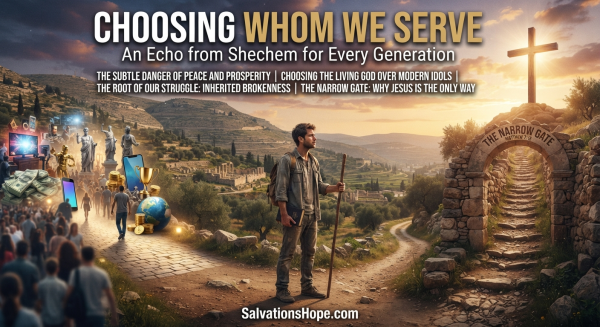
Joshua’s Final Call to Surrender
As the sun dips low over Shechem, an aging Joshua stands before the gathered tribes of Israel. This is a deeply sacred, emotional threshold. Having faithfully inherited the mantle after Moses entered glory, Joshua looks into the eyes of a people perpetually prone to wandering, acutely aware that his earthly race is nearly run. Though advanced in years, his voice rang out with the same profound urgency that Moses had carried decades before. It is a sobering spiritual truth: every single generation must hear the call of God anew. The gospel never grows old, because the human heart is always prone to wander. In this emotional and theological deep dive, we return to the historic valley of Shechem to examine the perilous trap of spiritual wavering, the hidden dangers of peace, and the timeless call to choose Christ as absolute Savior and Lord.
The Heavy Ground of Shechem
Where History Meets the Heart
To understand the emotional weight of Joshua’s final address, we must look at where he gathered the people. Shechem was not just any patch of land; it was sacred soil soaked in the promises of God.
- Abraham’s First Altar: It was the very place where Abraham first stopped and built an altar when he arrived in the Promised Land after leaving Ur of the Chaldees.
- Jacob’s Well: It was the parcel of land purchased by Jacob, bearing the deep roots of patriarchal faith.
- Joseph’s Final Resting Place: Most poignantly, it was where the bones of Joseph—brought up all the way from the bondage of Egypt—were finally laid to rest.
Joshua gathered the twelve tribes beneath the shadows of two towering peaks—Mount Ebal and Mount Gerizim. With the history of God’s miraculous rescue echoing off the canyon walls, Joshua reminded them of a vital truth: their victories were never won by their own military strategy, ingenuity, or strength. Every blessing they enjoyed was purely the gift of Almighty God.
The Subtle Danger of Peace and Prosperity
“Many times, the problems of peace are greater than the problems of war.” When Israel was fighting for survival, their reliance on God was sharp and desperate. But when the wars ended and prosperity settled in, a slow, quiet spiritual drift began. Comfort breeds complacency, and complacency opens the door to idolatry.
This dynamic hits very close to home. Just as ancient Israel tasted unprecedented blessings in a land they did not build, we in the modern West are surrounded by unearned grace and material abundance. Yet, instead of overflowing with gratitude, our culture—and often our own hearts—begins to look toward modern idols of comfort, self-reliance, and materialism.
The Peril of the Wavering Heart
When Joshua pressed the people for a decision, he was fighting a battle against spiritual instability.
- The Double-Minded Trap: In James 1:8, we are warned that a double-minded man is unstable in all his ways, drifting like a wave of the sea driven by the wind and tossed.
- The Illusion of Neutrality: Alexander the Great famously attributed his world-conquering success to one principle: not wavering. In our walk with Christ, hesitation is a thief of spiritual vitality.
- The Danger of Hypocrisy: Jesus frequently locked horns with the hypocrites of His day—people who professed one reality with their lips while living an entirely different life in secret.
Wavering in our relationship with Christ is a dangerous middle ground. It attempts to blend devotion to God with subtle compromises to the culture. But Joshua drew a hard, loving line in the sand: serve God and live, or follow after empty substitutes and face the judgment of a holy God.
A Call to Wholehearted Surrender
The message delivered at Shechem thousands of years ago still pierces our souls today. The war against our flesh and the temptation to drift into spiritual apathy is a daily reality. The gospel calls us away from the instability of a wavering heart and invites us into the unshakable peace of total commitment. Jesus Christ is not looking for part-time admirers; He calls us to wholehearted surrender as both Savior and Lord. The choice is ours, and the time to make it is now.
Where do you sense your heart currently wavering in its devotion to Christ, and what practical step can you take today to anchor yourself fully in His grace?
The Great Crossroads
Choosing the Living God Over Modern Idols
Every human heart is built as a sanctuary. The ultimate question of our existence is not what we achieve, but who sits upon the throne of our affections. Let us dive into a profound, emotional theological study on what it truly means to break away from modern idols, confront the reality of the human condition, and embrace the radical, uncompromised path of Jesus Christ.
The Divine Gift of Choice and the Identity of an "Idol Breaker"
The Apostle Paul defined a true Christian as someone who has undergone a radical turnaround: turning away from lifeless idols to serve the living and true God. In a culture obsessed with manufactured distractions and self-made gods, a follower of Christ is called to be an idol breaker.
- The Weight of Free Will: God did not create us as robots programmed to hit a button and mechanically obey. He created us in His own image, bestowing upon us the breathtaking and terrifying dignity of choice.
- The Joshua Standard: Facing a culture drifting toward compromise, Joshua drew a line in the sand: "As for me and my house, we will serve the Lord" (Joshua 24:15). That same choice faces every generation, and it ultimately faces you.
“Choose for yourselves this day whom you will serve… But as for me and my house, we will serve the Lord.” — Joshua 24:15
The Root of Our Struggle: Inherited Brokenness
When Adam and Eve stood in the Garden of Eden, God laid out a partnership built on trust. He tested them not to crush them, but to give meaning to their freedom. They chose wrongly, breaking God’s law and introducing suffering into a pristine world.
That first rebellion fractured human nature, passing down a profound spiritual inheritance:
- The Seed of Sin: We are born with an internal inclination toward self-will. As King David cried out in repentance, "Surely I was sinful at birth, sinful from the time my mother conceived me" (Psalm 51:5).
- The Age of Accountability: There comes a moment—whether at age eight, ten, or older—when moral consciousness awakens. God holds us accountable for our actions.
- The Cycle of Rebellion: We move from a nature inclined toward sin to conscious choices to sin, eventually practicing sin until our hearts grow dull without divine intervention.
The Modern Altar: What Captures Our Devotion?
Consider the Rich Young Ruler who ran to Jesus, desperate for eternal life. Jesus looked at him with deep love and issued a heartbreaking challenge: surrender your wealth, take up your cross, and follow Me. The young man walked away grieving. He wanted Christ, but he wanted his possessions and security more.
Idolatry is rarely bowing to a statue of wood or stone today. Instead, it looks like:
- The endless distraction of modern entertainment that captures our ultimate reverence and silences our deeper spiritual conversations.
- The subtle worship of comfort, money, and status.
- Anything that takes the place of absolute surrender to the Lordship of Jesus.
Through the prophet Jeremiah, God lays out the eternal choice: “Behold, I set before you the way of life and the way of death” (Jeremiah 21:8). There is no neutral ground.
The Narrow Gate: Why Jesus is the Only Way
Modern society constantly tries to engineer its own escape from the human dilemma. Philosophers suggest thinking our way out, sensory culture suggests playing our way out, and pop culture sings melancholic songs about the past. Yet, none of these human inventions can heal a broken soul or conquer the grave.
Jesus cut through every secular detour with an exclusive, life-altering declaration: “I am the way, the truth, and the life. No one comes to the Father except through me” (John 14:6).
When Jesus explained that His kingdom wasn’t about earthly political power, luxury, or driving luxury cars, but about self-denial and a bloody cross, many of His followers turned away. They wanted the crown without the cross. But true peace, permanent joy, and eternal life are found exclusively in surrendering to Him.
The Crossroads of Eternity
Embracing the Cross Before the Crown
Every day, we stand at the intersection of temporal desires and eternal realities. True spiritual transformation demands that we look past cultural illusions and face the profound choices set before us in Scripture.
Many people attempt to approach God on their own terms, relying on flawed human mechanisms rather than the finished work of Jesus Christ. Scripture warns that there is a way that seems right to a man, but its end is destruction. Consider these common false paths:
- The Deceived Conscience: Relying on an unmoored or hardened internal moral compass rather than anchoring oneself in God’s unchanging truth.
- Misplaced Sincerity: Being entirely sincere in one's beliefs—much like running the wrong way down a football field—yet missing the destination completely.
- Trusting Good Works: Trying to earn or pay your way to heaven through charity so you can boast in your own goodness, ignoring that salvation is a free gift by grace (Ephesians 2:8–9).
- Self-Reformation: Believing you can simply "do better" through sheer human willpower, which inevitably fails without the supernatural explosion of power brought by the Holy Spirit.
The Narrow Gate and Two Masters
Jesus described the spiritual landscape not as a universal highway where everyone arrives at the same place, but as a stark division requiring conscious decisions.
- The Two Ways: The broad gate and wide way lead to destruction alongside the crowds, while the narrow gate and hard way lead to eternal life, found by those who seek Him sincerely.
- The Two Masters: As Christ taught in the Sermon on the Mount, no one can serve two masters. You will inevitably love one and despise the other; you cannot serve both God and materialism.
Two Destinies: Heaven, Hell, and the Power of Grace
“No one ever had so much to say about the way to hell as Jesus Christ—and no one ever spoke of heaven with more clarity and authority.” — C.S. Lewis
- Eternity is not a distant concept; eternal life begins here and now the moment you make the choice to surrender your heart to Christ.
- While modern culture is obsessed with themes of damnation and salvation in music and media, Jesus stands uniquely as the true Gateway to heaven, preparing an eternal home for His followers.
- The blood of Jesus cleanses our past completely. You cannot change yesterday, but through the cross, your history of sin is wiped clean, and your destiny is utterly transformed.
A Solitary Decision That Echoes Generations
Like Moses—who chose the reproach of Christ over the fleeting treasures and absolute power of Egypt—every soul must enter the lonely, inner sanctuary of the heart to make a personal choice for God.
- Your parents, spouse, or children cannot make this eternal decision for you; it is a deeply personal vote of allegiance that you must cast alone.
- Faith choices ripple forward. The decision you make today casts a spiritual legacy that passes down to your children, grandchildren, and generations to come.
As you reflect on the cross and the crown today, what competing priority or master in your life is God calling you to surrender at the foot of the cross?
The Miracle of Justification: Cleansed and Remade
Have you ever laid your head on your pillow burdened by the weight of yesterday? The Gospel offers a breathtaking truth that goes far beyond simple forgiveness: justification. In theological terms, justification means God declares you righteous—just as if you had never sinned.
“Therefore, since we have been justified through faith, we have peace with God through our Lord Jesus Christ.” — Romans 5:1
When you place your trust in Christ, your past is completely gone. Cleansed, washed, and remembered no more by God. You can rest tonight knowing your slate is wiped clean.
The Urgency of Grace: Why Today Matters
Scripture never promises a tomorrow. Indecision is itself a choice; to delay making a decision for Christ is a choice to turn away. Time moves forward, and waiting only hardens the human heart.
- Delay breeds indifference: Putting off surrender makes the right decision progressively harder.
- The present is all we have: Scripture always calls believers to respond in the urgent reality of today.
The Three Pillars of a Transformed Life
What does it truly mean to surrender to Him? Genuine faith requires a comprehensive shift in heart and action, built upon three essential commitments:
- Repentance: Changing your mind about sin, recognizing how grieve-worthy it is to God, and making Him the undisputed priority of your life.
- Faith: Leaning your entire spiritual weight on Christ alone, trusting Him not just as Savior, but as Lord.
- Discipleship: Committing to follow, serve, and obey Him daily as His active disciple.
Walking in the Light of Public Faith
Throughout Scripture—from Joshua to Moses—God’s people were continually called to make their spiritual commitments public. Stepping out into the light roots an invisible internal faith into a visible, enduring reality. It is a bold declaration that Christ reigns supreme.
Have you truly made Jesus the priority of your life, or is there an area where you are still hesitant to fully surrender?