
Millennium
The Reign of Christ: An In-Depth Theological Study of Revelation 20:1-6
Defining the Millennium
When Christians discuss the “Millennium,” they are pointing to one of the most heavily debated, deeply studied, and spiritually significant passages in all of eschatology. Derived from the Latin mille (thousand) and annus (year), the term refers to the thousand-year reign of Christ mentioned explicitly in Revelation 20:1-6.
While pop culture references like the Millennium Falcon provide a quick, lighthearted hook, the reality described by the Apostle John demands our utmost reverence and rigorous theological scrutiny. This passage provides a window into cosmic redemption, the binding of Satan, the vindication of the martyrs, and the ultimate victory of our Lord.
1 And I saw an angel coming down out of heaven, having the key to the Abyss and holding in his hand a great chain. 2 He seized the dragon, that ancient serpent, who is the devil, or Satan, and bound him for a thousand years. 3 He threw him into the Abyss, and locked and sealed it over him, to keep him from deceiving the nations anymore until the thousand years were ended. After that, he must be set free for a short time.4 I saw thrones on which were seated those who had been given authority to judge. And I saw the souls of those who had been beheaded because of their testimony about Jesus and because of the word of God. They had not worshiped the beast or its image and had not received its mark on their foreheads or their hands. They came to life and reigned with Christ a thousand years. 5 (The rest of the dead did not come to life until the thousand years were ended.) This is the first resurrection. 6 Blessed and holy are those who share in the first resurrection. The second death has no power over them, but they will be priests of God and of Christ and will reign with him for a thousand years. (Revelation 20:1-6)
Theological Breakdown & Key Themes
1. The Restraint of Evil (Verses 1–3)
- The Divine Agent and Authority: An angel descends with the "key to the Abyss" and a "great chain." In biblical symbolism, keys and chains denote absolute sovereign authority belonging to God. Satan, despite his earthly influence, is entirely subject to divine restraint.
- The Identity of the Enemy: John explicitly unmasks the antagonist—he is "the dragon, that ancient serpent... the devil, or Satan." This links the final apocalyptic victory directly back to the Fall in Genesis 3.
- The Purpose of the Binding: Satan is locked in the Abyss specifically "to keep him from deceiving the nations anymore" until the thousand years are complete.
2. The Vindication of the Faithful (Verses 4–5)
- The Seated Judges and Martyrs: John witnesses thrones occupied by those granted authority to judge, alongside the souls of those martyred for holding fast to the testimony of Jesus and rejecting the marks of the beast.
- Reigning with Christ: These faithful believers "came to life and reigned with Christ a thousand years." This highlights the ultimate vindication of the persecuted church; suffering for Christ is met with eternal glorification and authority alongside Him.
- The First Resurrection: Verse 5 notes that "the rest of the dead did not come to life until the thousand years were ended." This phrase serves as a primary battleground for eschatological frameworks (such as Premillennialism, Amillennialism, and Postmillennialism), distinguishing between spiritual and physical interpretations of resurrection.
3. Security and Eternal Life (Verse 6)
- A Pronouncement of Blessing: "Blessed and holy are those who share in the first resurrection." This echoes the beatitudes of Revelation, offering ultimate pastoral comfort to believers facing trial.
- Immunity from the Second Death: The text provides a breathtaking promise: "The second death has no power over them." While physical death may touch believers, eternal separation from God (the lake of fire) has no dominion over those redeemed by Christ.
- A Royal and Priestly Calling: Believers are designated as "priests of God and of Christ," fulfilling the Old Testament trajectory of Exodus 19:6 and mirroring 1 Peter 2:9. They do not merely rest; they actively serve and reign.
Revelation 20:1-6 is not merely a puzzle for theologians to debate; it is a profound declaration of Christ’s absolute supremacy over evil, suffering, and death. Whether interpreted as a literal future earthly kingdom or a symbolic depiction of the current church age, the message to the believer remains unshakeable: Satan is on a leash, the martyrs are vindicated, and those in Christ share an eternal, unbreakable victory.
Key Takeaway: No matter the trials or deceptions present in the world today, the believer’s ultimate future is secure in the reign of Christ, where the second death holds no power.
How does understanding the binding of Satan and the security of the “first resurrection” impact the way you view trials and hardships in your daily walk with Christ today?
The Reign of Christ Now
Rethinking the Millennium in Light of Redemptive History
Few passages in Holy Scripture have sparked as much intense debate, speculation, and divergent theological systems as Revelation chapter 20. For generations, believers have poured over the text attempting to map out prophetic timelines, chart earthly kingdoms, and calculate future calendars. Yet, when we approach the book of Revelation with a rigorous, whole-Bible hermeneutic, a profoundly different and deeply encouraging picture emerges.
The position advanced by historic Christian orthodoxy—often categorized as amillennialism or, more accurately, realized millennialism—posits that the millennium is not a future, thousand-year earthly political regime. Rather, the millennium is now.
The millennium represents the entire inter-advent age: the glorious, unfolding epoch between the first coming of Jesus Christ in His incarnation, crucifixion, and resurrection, and His second coming in power and great glory. This study examines why this view is not a modern theological novelty, but the historic consensus of the universal church, anchored deeply in the structural and symbolic language of apocalyptic literature.
The Nature of Apocalyptic Literature: Symbolism vs. Literalism
The Principle of Apocalyptic Communication
To understand Revelation 20, we must first submit to the literary genre of the book itself. The apostle John explicitly states in the opening verse that the message was communicated through signs and symbols (Greek: signified, Revelation 1:1). Apocalyptic literature uses vivid imagery, numerical patterns, and cosmic metaphors to point beyond itself to profound, transcendent spiritual realities.
Consider the other major portraits within the Apocalypse:
- The Lamb with Seven Horns and Seven Eyes (Revelation 5:6): Jesus Christ is not a literal quadruped animal with multiple horns and eyes. Instead, the lamb signifies His substitutionary atonement and sacrifice, the seven horns signify absolute, divine power, and the seven eyes represent the all-seeing omniscience of God and the fullness of the Holy Spirit.
- The Holy Spirit as Seven Lamps of Fire (Revelation 4:5): The Third Person of the Trinity is not seven physical candles burning before a throne, but is pictured thus to convey the perfect, manifold operation of the Holy Spirit.
- Satan as a Great Red Dragon (Revelation 12:3): The devil is not a literal crimson reptile with seven heads and ten horns. The imagery exposes his ferocious, destructive nature, his political leverage, and his strategic opposition to God’s kingdom.
Why, then, do so many demand absolute literalism when arriving at Revelation 20 and its mention of a “thousand years”? If the numbers, chains, pits, and beasts of the surrounding chapters are understood as rich theological symbols, consistency demands that we approach the thousand-year binding of Satan with the same hermeneutical framework.
Numbers in Biblical Symbolism
In Hebrew and apocalyptic literature, numbers frequently carry theological weight rather than mathematical precision. Ten is the number of completeness or fullness (as seen in the ten commandments or ten plagues). Cubed (10 times 10 times 10), a thousand represents supreme magnitude, totality, or a complete, unbroken epoch. A “thousand years” is the divine way of describing the complete, sovereignly ordained period designated by God between Christ’s ascension and His return—a period fully under His absolute control.
Dismantling Common Objections to Present-Day Reign
When presented with the reality that Christ’s millennial reign is happening right now, believers often raise three pressing, practical objections. Let us address each one through the lens of Scripture.
+————————————————————————-+
| THE THREE PRIMARY OBJECTIONS & RESPONSES |
+—————————+———————————————+
| Objection 1: “Math & Time”| 2,000 years of church history exceeds the |
| | literal “thousand years” of Revelation 20. |
+—————————+———————————————+
| Response | Revelation is symbolic. The number 1,000 |
| | represents a complete, divine epoch. |
+—————————+———————————————+
| Objection 2: “Global Evil”| Satan appears active; the world is broken, |
| | so how can he be bound? |
+—————————+———————————————+
| Response | Satan’s binding is specific: he can no |
| | longer deceive the nations globally (Rev |
| | 20:3), allowing the gospel to go forth. |
+—————————+———————————————+
| Objection 3: “No Kingdom” | Where is the visible, physical throne |
| | and political rule of Christ? |
+—————————+———————————————+
| Response | Christ rules spiritually from heaven now; |
| | His kingdom is “not of this world” (John |
| | 18:36) until physical consummation. |
+—————————+———————————————+
1. "If Satan is bound, why is there so much evil in the world?"
Objectors look around at global suffering, moral decay, and injustice, asking: What lunatic would claim Satan is bound right now?
To answer this, we must look closely at how Revelation 20 defines Satan’s binding. Revelation 20:3 states that an angel seized the dragon “so that he might not deceive the nations any longer.”
- Before Christ: The vast majority of the global population sat in spiritual darkness, bound within the confines of localized pagan pantomimes, utterly walled off from the redemptive light of Yahweh, save for a small remnant in ethnic Israel.
- After Christ's Victory: The gospel bursts through ethnic borders. The Great Commission commands discipleship of all nations (Matthew 28:19). Satan's monopoly on global spiritual deception has been shattered. While he still prowls like a roaring lion (1 Peter 5:8) and exerts localized malice, his ultimate restraining order prevents him from stopping the unstoppable advance of Christ's church across every tribe, tongue, and nation.
2. "How can millions have refused the beast if the beast is a future figure?"
The book of Revelation introduces the beast as a terrifying antagonist of the end times. However, biblical typology teaches us that major biblical archetypes appear in preliminary, historical forms before culminating in an ultimate, final manifestation.
- The apostle John notes in his epistles that "many antichrists have come" (1 John 2:18).
- Historical figures like Roman Caesars Nero and Domitian exercised beastly, totalitarian hostility, demanding divine worship and slaughtering the saints.
- Throughout church history, secular powers have repeatedly manifested the spirit of the beast. Millions of steadfast believers have historically resisted this pressure, choosing martyrdom or faithful witness over compromise. The final eschatological beast is simply the ultimate culmination of this recurring spirit of anti-Christian tyranny.
3. "What about the first resurrection?"
Revelation 20:4–6 speaks of souls who sat on thrones, having come to life and reigning with Christ for a thousand years. This is designated as the first resurrection.
Far from referring to a physical, bodily resurrection on earth, the text explicitly specifies that these are “the souls of those who had been beheaded for the testimony of Jesus.” When a believer dies in Christ today, their physical body sleeps in the grave, but their soul immediately enters the presence of the Lord (2 Corinthians 5:8). To transition from earthly suffering into the immediate, conscious presence of the King of Kings—reigning with Him in heavenly glory—is described as the first resurrection. Those who share in this spiritual resurrection experience absolute safety from the second death.
Historical Roots: The Ancient Consensus of the Church
In modern Western Christianity—particularly within American evangelicalism—futuristic, literalistic frameworks of the millennium (such as dispensational premillennialism) are often assumed to be the default historic position of the faith.
Surprisingly, this is a relatively recent phenomenon, gaining widespread traction largely over the last two centuries through popularized commentary and study Bibles.
When we search the broader expanse of church history, we find that the view presenting the millennium as the current inter-advent reign of Christ was articulated, defended, and cherished by:
- Augustine of Hippo in The City of God, who solidified the historic understanding that the binding of Satan occurred during Christ's earthly ministry and resurrection.
- The Protestant Reformers (including Martin Luther and John Calvin), who universally rejected literal earthly millennial expectations in favor of Christ’s present spiritual reign through His Word and Spirit.
- The historic creeds and confessions of the Reformation era, which consistently frame Christ's kingdom as an established spiritual reality operating right now.
Living in the Power of the Present Reign
Recognizing that the millennium is now radically transforms how we live out our Christian faith:
- We Do Not Despair: We do not look at the world with panic, wondering if God has lost control. Christ is seated at the right hand of God, ruling over every ruler, authority, and power (Ephesians 1:20–22).
- We Engage in Mission Boldly: Because Satan’s grip on the nations is broken, the gospel possesses explosive, unstoppable power to save souls from every corner of the earth.
- We Anticipate the Final Consummation: While the kingdom reign is a present reality, we still eagerly await its physical, visible perfection when Christ returns on the clouds, raising our bodies and making all things new.
The Present Reign of Christ
The Reality of the Present Kingdom
In an age dominated by secular skepticism, cultural upheaval, and pervasive geopolitical instability, Christians frequently default to an eschatology of retreat. We look at the brokenness of our world and instinctively relegate the sovereignty of Jesus Christ to a purely future, distant horizon—waiting for an earthly millennium or a remote heavenly installation before He truly takes the reins.
However, a rigorous examination of the biblical text shatters this defeatist paradigm. The apostolic witness, the words of the prophets, and the explicit declarations of Jesus Himself converge on a breathtaking reality: Jesus Christ reigns right now. His ascension was not a retreat to a waiting room in heaven, but an enthronement at the right hand of the Majesty on high.
The Inaugurated Kingdom: The Witness of the Gospels
To understand the present reign of Christ, we must first return to the bedrock of Jesus’ earthly ministry: the proclamation of the Kingdom of God.
When Jesus burst onto the public scene in Galilee, His message was not merely a moral code or a futuristic prophecy; it was an ontological announcement. As Mark records:
“The time has come. The kingdom of God has come near. Repent and believe the good news.” (Mark 1:15)
In biblical theology, the phrase has come near (Ancient Greek: engiken) signifies an imminent, overlapping arrival. The kingdom was not merely a conceptual possibility on the distant horizon; it broke into human history in the person of Jesus of Nazareth.
The Finger of God and the Binding of the Strong Man
Jesus explicitly linked His miraculous ministry to the immediate, dynamic manifestation of His reigning power. When accused of casting out demons by demonic agency, He delivered a decisive counter-argument:
“If I drive out demons by the finger of God, then the kingdom of God has come upon you.” (Luke 11:20)
Furthermore, in Luke 17:21, responding to the Pharisees regarding when the kingdom would come, Jesus stated that “the kingdom of God is in your midst” (or within your grasp). The King was standing right in front of them. The signs, wonders, exorcisms, and moral authority displayed during His earthly walk were the beachhead of an invasive, heavenly kingdom reclaiming conquered territory.
Universal Authority: The Great Commission Mandate
If the earthly ministry was the inauguration of the kingdom, the resurrection and ascension were its official ratification. Before departing the earthly sphere, Jesus made one of the most sweeping, absolute declarations in all of human history:
“All authority in heaven and on earth has been given to me.” (Matthew 28:18)
Notice the scope: All authority. Not some authority. Not authority restricted to ecclesiastical walls or private spiritual realms. Authority encompassing the celestial heights (heaven) and the terrestrial domain (earth).
The Logic of the Commission
This universal sovereignty is the explicit theological foundation for the Great Commission that immediately follows:
“Therefore go and make disciples of all nations… and surely I am with you always, to the very end of the age.” (Matthew 28:18–20)
We do not march into hostile cultural territory as desperate insurgents trying to establish a kingdom from scratch. We go as ambassadors representing a sitting, reigning Emperor who has already conquered. The success of Christian mission is anchored not in human ingenuity, but in the immutable reality that the One sending us possesses total dominion over every governance, power, and principality.
The Apocalyptic Vision: Christ on the Cosmic Throne
Moving from the Gospels to the Apocalypse of John, the New Testament maintains a remarkably consistent vision of Christ’s present status. The Book of Revelation opens not with a picture of a sidelined Savior, but with an explicit doxology declaring His current office:
“Grace and peace to you… from Jesus Christ, who is the faithful witness, the firstborn from the dead, and the ruler of the kings of the earth.” (Revelation 1:4–5)
John does not write that Jesus will one day be the ruler of earthly kings. He writes in the present tense: He is the ruler of the kings of the earth. Caesar, local potentates, modern dictators, and democratic presidents alike operate within the sovereign boundaries permitted by the reigning King of Kings.
The Keys of Death and Hades
When the glorified Christ appears to John in Revelation 1, His posture is one of absolute cosmic mastery:
I am alive forever and ever! And I hold the keys of death and Hades.” (Revelation 1:17–18)
The possession of keys denotes administrative authority and dominion. Jesus does not say He hopes to acquire these keys in some future dispensation; He holds them now. The grave has been plundered, the ultimate enemy has been disarmed, and the portals of eternity are under His absolute lock and key.
The Center of the Throne (Revelation 5 and 6)
In the celestial throne room scenes of Revelation 5 and 6, the imagery reaches its theological zenith. John gazes into the epicenter of the universe and sees the Lamb standing—at the center of the throne (Revelation 5:6).
In ancient cosmology and political theology, seating arrangements equal sovereignty. To be at the center of the divine throne is to exercise divine rule. Moreover, it is this very Lamb who steps forward to unroll the scroll of human history, breaking its seals and orchestrating the unfolding trajectory of the cosmos (Revelation 6). History is not an unguided wheel rolling toward chaos; it is driven forward by the sovereign hand of the slain and risen Christ.
Theological Synthesis: Navigating the "Already/Not Yet"
How do we harmonize this robust biblical evidence for Christ’s present reign with the undeniable reality of suffering, evil, and rebellion still present in our world?
The historic Christian framework relies on the tension of the “Already and Not Yet”:
- Already: Jesus is currently seated at the right hand of God, reigning with absolute authority, subduing His enemies, and building His Church through the Spirit. His kingdom is a present, spiritual, and dynamic reality.
- Not Yet: While His authority is absolute, its full consummation and visible manifestation across every earthly structure await His physical, bodily return at the end of the age.
To deny His present reign is to give into a functional pessimism that strips the church of its courage. As the Reformers and Puritans understood, Christ rules the church by His Word and Spirit, and He rules the nations by His providence and power.
Living Under the Reign of the King
If Jesus reigns right now, it radically transforms how we live out our faith:
- Anxiety is Displaced by Boldness: We do not need to fear cultural shifts or political hostility. The Ruler of the kings of the earth holds our times in His hands.
- Mission Gains Ultimate Urgency and Hope: Because all authority belongs to Him, our evangelism is not a speculative venture, but a victorious harvest.
- Worship Becomes Reality: When we gather to praise Him, we are simply aligning ourselves with the objective reality of the cosmos—acknowledging that the Lamb upon the throne is worthy of all honor, glory, and power today, tomorrow, and forever.
How does viewing Jesus as the active, reigning ruler of the kings of the earth change the way you approach the cultural anxieties and personal trials you face this week?
The Binding of the Dragon
The Paradox of the Present Age
One of the most confounding hurdles for contemporary believers is reconciling the biblical declarations of Satan’s current defeat and imprisonment with the glaring, daily reality of evil, suffering, and temptation in the world. When Scripture asserts that the devil is bound, chained, and cast into the abyss, our immediate impulse is to look around at a broken world and ask: If Satan is bound, who is letting him loose?
To resolve this tension, we must abandon simplistic caricatures and return to the rich, multi-dimensional eschatology of the New Testament. The Christian life is lived out in the tension of the “already/not yet”—the overlapping of two ages. Jesus Christ has inaugurated His kingdom, decisively breaking the back of the cosmic rebellion, yet the full, unvarnished manifestation of His rule waits for the consummation of the age. Understanding this framework transforms how we view spiritual warfare, the security of the believer, and the ultimate victory of our King.
The Scriptural Basis: Jesus and the Apostles on Satan’s Binding
Our authority for believing that Satan is currently bound rests not on convoluted theological deduction, but on the explicit testimony of Jesus Christ and His apostles.
The Strong Man Bound (Matthew 12:28–29)
During His earthly ministry, Jesus confronted the religious establishment’s skepticism regarding His exorcisms by laying bare the cosmic significance of His actions:
“But if it is by the Spirit of God that I cast out demons, then the kingdom of God has come upon you. Or how can someone enter a strong man’s house and plunder his goods unless he first binds the strong man? Then indeed he may plunder his house.” (Matthew 12:29, ESV)
Jesus paints a vivid picture: Satan is the “strong man” who has long held humanity in his grip, guarding his domain. But with the advent of the Incarnation, the Greater One has arrived. Christ’s miracles, His preaching, and preeminently His death and resurrection constitute the systematic binding of the bully. Jesus invaded the strong man’s house and began plundering his possessions—rescuing souls from the dominion of darkness and transferring them into the kingdom of the beloved Son (Colossians 1:13).
Chains of Darkness (2 Peter 2:4 & Jude 6)
This concept of judicial restraint is reinforced elsewhere in the New Testament epistles:
- 2 Peter 2:4: "For if God did not spare angels when they sinned, but cast them into hell [Tartarus] and committed them to chains of gloomy darkness to be kept until the judgment..."
- Jude 6: "And the angels who did not stay within their own position of authority, but left their proper dwelling, he has kept in eternal chains under gloomy darkness until the judgment of the great day."
These passages demonstrate that the New Testament views the spiritual adversaries of God not as entirely free agents roaming the cosmos unchecked, but as captive criminals awaiting a final courtroom verdict.
Revelation 20 and the Inter-Advent Age
When we come to Revelation 20:1–3, we read of an angel descending from heaven with the key to the Abyss and a great chain:
“He seized the dragon, that ancient serpent, who is the devil, or Satan, and bound him for a thousand years. He threw him into the Abyss, and locked and sealed it over him, to keep him from deceiving the nations anymore until the thousand years were ended. After that he must be set free for a short time.”
This passage is frequently misread as a prophecy of a future, literal earthly millennium after Christ returns. However, when read through the lens of amillennial or historic premillennial frameworks that recognize symbolic apocalyptic literature, the “thousand years” represents the present church age—the entire span of time between Christ’s ascension and His glorious return.
The binding described here is precisely what Jesus accomplished at the cross, echoing His words in John 12:31–32: “Now is the judgment of this world; now will the ruler of this world be cast out. And I, when I am lifted up from the earth, will draw all people to myself.” The Greek root for “cast out” (ekballo) in John 12 links directly to the casting of Satan into the pit in Revelation 20. The cross was the courtroom and battlefield where the prince of this world was judged and restrained.
The Nature of Satan’s Restraint: What "Bound" Does Not Mean
To say Satan is bound does not mean he is impotent. Scripture balances this doctrine with sobering warnings:
“Be sober-minded; be watchful. Your adversary the devil prowls around like a roaring lion, seeking someone to devour.” 1 Peter 5:8:
If a lion is caged at a zoo, it is restrained—yet you would be a fool to step inside its enclosure. The cage limits its geographic range and its capacity to roam free, but within its bounds, it remains dangerous and ferocious.
The binding of Satan entails two profound, definitive limitations imposed by Almighty God:
The Security of the Elect
Satan can no longer orchestrate the absolute, irrevocable damnation of those whom God has redeemed. He cannot snatch Christ’s sheep out of the Father’s hand (John 10:28–29). While he can accuse, tempt, and harass believers, his legal claim over them has been shattered by the blood of the Lamb. When a believer falls into sin, it is a yielding of personal agency, not an irresistible overpowering by a master. As the apostle John reminds us: “Greater is he who is in you than he who is in the world” (1 John 4:4).
The Restraint of Global Deception
Prior to the first coming of Christ, the nations of the world sat in profound spiritual darkness, entirely given over to institutionalized idolatry and ethnic blindness, worshiping false gods that were, in reality, demonic entities (Deuteronomy 32:17; Psalm 106:37).
The primary purpose of Satan’s binding in Revelation 20:3 is explicitly stated: “…to keep him from deceiving the nations anymore until the thousand years were ended.”
With Christ’s resurrection and the outpouring of the Holy Spirit at Pentecost, this monopoly on global deception was broken. The gospel burst past the geographic and ethnic borders of Israel. God began calling out a bride from every tribe, tongue, people, and nation. Satan is no longer permitted to keep the entire globe locked in unchallenged, unmitigated ignorance of the true God. The light of the gospel shines unrestricted across the earth.
The Eschatological Horizon: The Final Loosing and Triumph
This state of restraint is not permanent in its current degree. Revelation 20 notes that “after that he must be set free for a short time.”
At the close of this present age, God will loosen the leash. Satan will be permitted to orchestrate a final, desperate, worldwide coalition of opposition against the church—often associated with the gathering of the nations and the tribulation preceding Christ’s return.
Yet, this final assault will not result in a nail-biting thriller where the forces of evil nearly triumph. When Satan gathers his ultimate coalition, Christ needs no elaborate military strategy. He will destroy the rebellion simply by the breath of His mouth and the brightness of His coming (2 Thessalonians 2:8). The end of the story has already been written at Calvary.
Practical Application for the Believer
- Reject Defeatism: Never attribute your personal sin to an irresistible demonic force (“the devil made me do it”). You serve a crucified, resurrected, and reigning Savior who has already put the serpent under His feet.
- Rest in Sovereign Security: Take immense comfort in knowing that the evil one’s leash is strictly measured by God. He can do nothing to you outside of divine permission, and even what he intends for evil, God works for your ultimate holiness and eternal good (Romans 8:28).
- Live Out the Victory: Even physical martyrdom is not defeat for the child of God. As Revelation 12:11 declares: “And they have conquered him by the blood of the Lamb and by the word of their testimony, for they loved not their lives even unto death.” Satan can kill the body, but he cannot touch the soul united to Christ.
“The Lord is reigning, the strong man is bound, and the gates of hell shall not prevail against His church.”
How does shifting your perspective from viewing Satan as completely free to viewing him as a chained, restricted adversary change the way you approach spiritual warfare in your daily life?
Navigating the Millennial Reign
A Theological Exploration of Christian Eschatology
Eschatology—the theological study of the “last things”—has captivated the hearts, minds, and scholarly pens of believers since the apostolic age. Among the most intensely debated topics within this branch of theology is the nature and timing of the millennium mentioned in Revelation 20:1-6.
Throughout church history, the faithful have studied the prophetic texts with profound reverence, recognizing that while the triumphant return of Jesus Christ is an absolute and non-negotiable cornerstone of the Christian faith, the exact mechanics of His earthly reign and its temporal relationship to history have been interpreted through several distinct lenses.
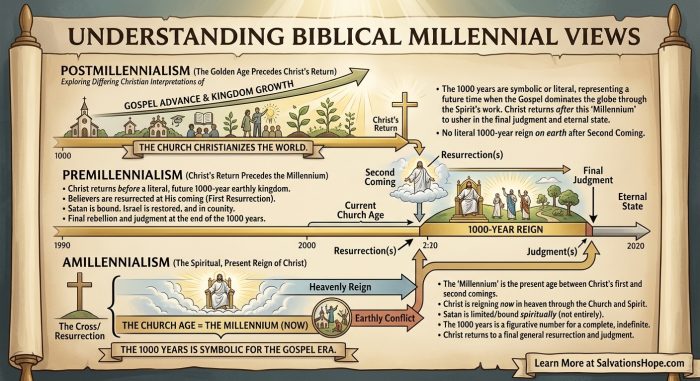
This comprehensive theological study examines the three primary historical views of the millennium—Premillennialism, Postmillennialism, and Amillennialism—alongside modern developments like Dispensationalism, evaluating their exegetical foundations, historical proponents, and pastoral implications for the global Church.
Establishing a Hermeneutical Baseline and Spirit of Charity
Before surveying the specific eschatological systems, it is vital to establish a proper theological posture. Differing views on the millennium do not constitute a departure from Christian orthodoxy, nor do they render a brother or sister in Christ a heretic. Throughout church history, towering intellects and deeply devoted martyrs have fallen across different sides of this debate.
The Christian tradition has consistently distinguished between dogma (core, non-negotiable doctrines such as the Trinity, the virgin birth, the substitutionary atonement, and the physical resurrection of Christ) and theologoumena or secondary eschatological opinions where faithful believers may legitimately differ. Approaching these texts requires intellectual humility, robust historical awareness, and a commitment to maintaining the unity of the Spirit in the bond of peace (Ephesians 4:3).
Premillennialism: The Literal Reign and Future Return
Premillennialism asserts that the return of Jesus Christ will occur before (pre-) a literal, earthly one-thousand-year reign. In this framework, the Second Coming initiates a golden age where Christ reigns visibly and physically upon the earth, sitting upon a throne in Jerusalem while His resurrected saints and the redeemed nations dwell together in peace and righteousness.
Exegetical and Historical Framework
Premillennialism finds its earliest historical expressions in the writings of early church fathers such as Justin Martyr (c. 100–165 AD) and Irenaeus (c. 130–202 AD). These early Christian thinkers read Revelation 20 in a primarily sequential and literal manner, viewing the thousand-year period as a future era of visible restoration and compensation for centuries of suffering and martyrdom.
The Theological Tension of the End
One of the most profound intellectual challenges internal to the traditional premillennial system involves the conclusion of the millennium. According to this view, after a full millennium of Christ’s perfect, physical, and visible rule over the nations—a time marked by righteousness, peace, and the direct presence of the King of kings—Satan is released from the abyss for a brief season. Astonically, the nations subjected to a millennium of divine perfection still find it within their fallen natures to follow Satan in a final, futile rebellion against Christ (Revelation 20:7-9), leading immediately to the final judgment and the creation of the new heavens and new earth.
The Rise of Dispensationalism
In the mid-19th century, a distinct variant of premillennialism emerged: Dispensationalism. Largely popularized in Britain and North America through the work of figures like John Nelson Darby and later codified by reference works like the Scofield Reference Bible, dispensationalism introduced a sharply compartmentalized view of redemptive history divided into distinct “dispensations.”
Crucially, dispensationalism popularized the doctrine of the secret rapture, wherein Christ returns invisibly to snatch away His church prior to a localized, highly intense seven-year Great Tribulation, after which He returns visibly with His saints to establish the literal millennium. While this view has exerted massive cultural influence across the English-speaking evangelical world over the last century and a half, it represents a relatively recent methodological development compared to the broader historical stream of Christian eschatology.
Postmillennialism: The Triumph of the Gospel Age
Postmillennialism teaches that Christ will return after ($\text{post-}$) the millennium. Unlike the premillennial expectation of a sudden cataclysmic intervention that inaugurates Christ’s physical reign, postmillennialists view the millennium as an extensive, figurative period of time preceding the Second Coming. During this era, the proclamation of the Gospel and the empowering work of the Holy Spirit will gradually permeate human culture, resulting in a prolonged epoch where Christian values, righteousness, and societal flourishing heavily influence the global landscape.
The Optative View of History
In this perspective, the world does not necessarily deteriorate into total moral chaos before Christ returns; rather, the “Great Commission” achieves remarkable, sweeping historical success. The kingdom of God expands like yeast through dough (Matthew 13:33), transforming educational systems, governments, arts, and families until a vast majority of the world’s population is Christianized. Only after this prolonged golden age of spiritual prosperity does Christ return visibly to consummate history, judge the living and the dead, and usher in the eternal state.
Historical Proponents and Sociological Context
Postmillennialism has historically flourished during periods of profound spiritual renewal and cultural optimism. During the First and Second Great Awakenings in America, brilliant theologians and pastors such as Jonathan Edwards and Charles Hodge articulated postmillennial visions. When witnessing mass conversions, societal reformation, and the palpable awakening of dead institutional churches, these thinkers naturally concluded that history was curving upward toward a magnificent climax driven by the irresistible power of the Gospel.
Amillennialism: The Present Reign of Christ
Amillennialism translates literally to “no millennium,” though a far more accurate descriptor is “Now-millennialism.” Amillennialists do not believe there is a literal, future, earthly one-thousand-year political or physical kingdom yet to come. Instead, they argue that the millennium described in Revelation 20 is occurring right now.
The Inaugurated Kingdom
In the amillennial framework, the binding of Satan occurred during Christ’s earthly ministry and foundational victory on the cross (Colossians 2:15; Revelation 20:1-3). The thousand-year reign represents the symbolic, complete, and perfect duration of the entire inter-advent age—the entire span of time between Christ’s First Coming (His incarnation, death, and resurrection) and His Second Coming in glory.
During this present age, Christ reigns spiritually and sovereignly from the heavenly throne room, ruling over His church and protecting the witness of the Gospel. While Satan’s ability to deceive the nations in a total, absolute sense is restrained during this era, his localized and fierce activity remains a reality. As history nears its conclusion, that restraint is temporarily lifted during a final intensification of tribulation, which is swiftly terminated by the triumphant, personal return of Jesus Christ, the resurrection of the dead, and the physical descent of the New Jerusalem (Revelation 21).
Theological Heavyweights of the Tradition
Amillennialism possesses an ancient and formidable pedigree. It was systematically formulated by Augustine of Hippo in The City of God and was subsequently embraced by the great Reformers, including Martin Luther and John Calvin. For centuries, this has stood as the default confessional eschatology for the vast majority of historical Protestant, Reformed, and Catholic traditions.
Comparative Matrix of Millennial Views
To clarify the structural differences between these three primary systems, consider the following theological comparison:
Theological System
Timing of Christ’s Return
Nature of the Millennium
Key Historical Proponents
Premillennialism
Before the Millennium
A literal 1,000-year physical reign of Christ on earth.
Justin Martyr, Irenaeus, modern Dispensationalists
Postmillennialism
After the Millennium
A figurative, highly successful era of gospel influence and societal Christianization.
Jonathan Edwards, Charles Hodge, B.B. Warfield
Amillennialism
After the Millennium
A figurative, present spiritual reign of Christ spanning the entire church age.
Augustine, Martin Luther, John Calvin
Pastoral Application: Proportionality and Essential Unity
As we navigate the rich complexities of biblical eschatology, several essential pastoral takeaways emerge for the modern believer and the local church:
- Maintain a Proper Sense of Proportion: Not every Christian doctrine carries the same weight. While the bodily resurrection of Jesus, His substitutionary atonement, and His visible return are foundational dogma, the chronological details of the millennium are secondary matters that require charity and forbearance.
- Cultivate Grace in Disagreement: Learning how to engage in iron-sharpening-iron theological discussions without fracturing Christian fellowship is a mark of spiritual maturity. Believers can passionately study prophetic texts while refusing to let secondary divisions compromise primary unity.
- Rest in the Sovereignty of Christ: Regardless of whether one embraces a premillennial, postmillennial, or amillennial framework, certain glorious certainties remain unchanged: Jesus Christ reigns supreme, Satan's power is ultimately bounded and doomed, and history is moving inexorably toward the triumphant renewal of all things.
How does your personal view of the millennium shape the way you engage with cultural challenges and share the Gospel in your everyday life?
Navigating the Millennial Reign
An In-Depth Theological Exploration of Christian Eschatology
Eschatology—the study of “last things”—has captivated the minds, hearts, and theological pens of believers since the apostolic era. Among the most debated and intensely studied components of eschatology is the millennium, the thousand-year period mentioned in Revelation 20.
Throughout church history, faithful interpreters of the Word of God have arrived at different conclusions regarding how to understand this prophetic epoch, the nature of Christ’s kingdom, and the sequence of final events.
While secondary eschatological views vary, the overarching message of Scripture remains a steady anchor for the Church: Jesus Christ reigns supreme, and the sovereign purposes of God will be fulfilled.
The Amillennial Perspective: The Present Reign of Christ
The term amillennialism—meaning “no literal thousand years”—can be somewhat misleading. Amillennialists do not deny a thousand-year period; rather, they interpret the “thousand years” of Revelation 20 as a symbolic, qualitative description of the entire church age. It spans from the first coming of Christ to His glorious second coming.
- Historical Roots: This perspective carries immense historical weight, having been embraced by foundational church fathers like Augustine, as well as monumental Protestant reformers such as Martin Luther and John Calvin.
- The Chronology of the Age: In this view, biblical history is divided into two major epochs: the Old Covenant period and the New Covenant period. With Christ’s incarnation, earthly ministry, death, resurrection, and ascension, His heavenly reign began. The kingdom of God is currently advancing through the preaching of the Gospel and the work of the Holy Spirit.
- The Binding of Satan: Amillennialists understand the binding of Satan (Revelation 20:1-3) as an accomplished reality during Christ’s earthly ministry, which restrains his ability to deceive the nations wholesale, even though his activity remains fierce and malicious.
- The Consummation: Near the conclusion of this present age, Satan is briefly loosed for a final intensification of evil, precipitating a period of tribulation. This is abruptly ended by the personal, visible return of Jesus Christ, the resurrection of the dead, the final judgment, and the renewal of the cosmos into the eternal state—heaven intersecting earth.
“Amillennialism honors the present spiritual reality of Christ’s reign while keeping the believer’s eyes fixed squarely on the sudden, triumphant return of our Lord.”
The Postmillennial Perspective: The Flourishing of the Gospel Age
Postmillennialism shares several structural similarities with amillennialism—particularly the view that the “thousand years” represent the present church age and that Christ returns after ($post$) the millennium. However, it diverges significantly regarding the trajectory of human history before that return.
- The Golden Age: Postmillennialists believe that through the powerful, pervasive influence of the Gospel, the Holy Spirit will bring about a prolonged era on earth—a "golden age"—where Christian ethics, societal structures, and nations are profoundly Christianized.
- The Triumph of Grace: In this framework, the Great Commission does not merely rescue individuals out of a sinking world; it transforms civilizations. The kingdom grows until it saturates the culture, culminating in a world where righteousness largely prevails.
- The Return of Christ: Following this prolonged period of spiritual flourishing and societal transformation, Jesus Christ will return in glory to consummate the eternal state.
- Historical Context: This view has found deep resonance during periods of profound spiritual renewal. Notably, during the First Great Awakening, theological giants like Jonathan Edwards and, later, systematic theologian Charles Hodge articulated postmillennial hope, seeing revival as the direct advance of Christ’s earthly kingdom.
The Premillennial Perspective and Dispensationalism
Premillennialism teaches that Jesus Christ will return before (pre-) a literal, future thousand-year earthly reign. Within this framework, there are historic (or covenantal) premillennial variants, but the most widely discussed variant in modern times is dispensationalism.
- Origins: Dispensationalism emerged distinctively in the mid-19th century through the work of thinkers like John Nelson Darby, later popularized widely across Britain and America through tools like the Scofield Reference Bible.
- The Secret Rapture and Sequence: Dispensationalism posits a strict dividing line between the Church and Israel, emphasizing a two-stage return of Christ: first, a secret "rapture" where believers are suddenly caught up to heaven, leaving the world behind; followed by a period of intense global tribulation, after which Christ returns physically to establish a literal, political throne in Jerusalem for a thousand years.
- A Recent Tradition: While global in its modern footprint due to American missionary and media influence over the past century and a half, dispensationalism represents a newer theological construct compared to the ancient roots of amillennialism. Theological discernment often leads many believers to weigh newer interpretations against the consensus of the historic, global Church across the centuries.
Theological Proportion: Essentials vs. Non-Essentials
At its core, our foundational statement of faith—Salvation’s Hope—does not mandate any single millennial view as a litmus test for orthodox Christian fellowship.
Scripture contains profound mysteries, and faithful, Bible-believing scholars have arrived at differing conclusions regarding prophetic texts like the book of Revelation and Daniel. Recognizing this diversity requires cultivating two vital Christian virtues:
- Maintain a Proper Sense of Proportion: Not every Christian doctrine carries the same weight. The bodily resurrection of Jesus, His substitutionary atonement, the Trinity, and salvation by grace alone through faith alone are non-negotiable essentials. Eschatological timelines, while important for study, fall into the category of non-essentials where charity must prevail.
- Practice Christian Unity in Diversity: Believers must learn how to walk together in love, intellectual humility, and grace, even when they interpret prophetic literature differently.
Whatever framework shapes your understanding of the end times, certain foundational truths remain unshakeable.
Amid differing interpretations of symbols, numbers, and timelines, we unite around the glorious reality declared across Scripture: Jesus Christ sits on the throne right now, Satan’s ultimate doom is sealed, and history is moving purposefully toward the personal, triumphant return of our Savior.
How does your personal view of the future impact the way you live out your faith, share the Gospel, and engage with the culture around you today?
Anchoring the Apocalypse
The Hermeneutical Challenge of Revelation
- Scripture Interprets Scripture
- Clear Before Difficult
- Literal Before Figurative
- Big Picture Before Small Details
The book of Revelation stands as the majestic capstone of the Christian biblical canon, yet it frequently elicits a profound paradox of fascination and frustration for believers. Filled with multi-headed beasts, celestial cycles of judgment, roaring trumpets, and sweeping cosmic visions, Revelation can easily become a playground for sensationalism, speculative timelines, and fear-driven prognostication if approached with an ungrounded hermeneutic.
To read the Apocalypse faithfully as Christian Scripture, we must first confront a foundational methodological question: How do we approach the Bible in the first place?
The master key to unlocking the riches of Revelation—and indeed the entire counsel of God—is the historic Protestant principle of Scripture interpreting Scripture (analogia scripturae). The Word of God is not an isolated collection of disjointed religious fragments, but an organic, unified tapestry woven together by a single divine Author. When we allow the broader biblical witness to illuminate its own text, the fog begins to clear, revealing the glorious majesty of Christ rather than the terror of chaos.
The Intertextual Fabric of the Apocalypse
One cannot responsibly study the final book of the New Testament while ignoring the library of the Old Testament. The Apostle John, writing in exile on the island of Patmos, was saturated in the Hebrew Scriptures.
- The Quantitative Weight: The book of Revelation contains only 404 verses, yet within these verses scholars have identified over 270 direct quotations or explicit references to the Old Testament, alongside over 500 indirect allusions.
- The Theological Implication: Statistically, John rarely coins entirely novel symbolic imagery; instead, he draws deeply from the wells of Genesis, Exodus, Isaiah, Jeremiah, Ezekiel, Daniel, and the Minor Prophets.
To understand the symbols of Revelation—such as the lampstands, the seals, the bowls of wrath, or the New Jerusalem—we cannot rely merely on modern cultural imagination or contemporary news headlines. We must trace these motifs back to their foundational roots in the Torah, the Prophets, and the Psalms. The Old Testament provides the vocabulary and grammar of Revelation; without it, the text remains an incomprehensible foreign language.
Foundational Rules of Thumb for Hermeneutical Integrity
When employing the principle of letting Scripture interpret Scripture within apocalyptic and prophetic literature, three indispensable rules of thumb guide the faithful interpreter toward sound doctrine:
1. Clarifying the Obscure with the Clear
In any corpus of literature, some passages are perspicuous (plain and direct), while others are dense and enigmatic. A sound hermeneutic dictates that clearer passages must govern the interpretation of difficult passages. When confronted with a cryptic vision in Revelation, the interpreter should look to straightforward didactic passages elsewhere in the New Testament—such as the Pauline epistles or the Gospels—to establish doctrinal boundaries rather than building dogmatic systems on ambiguous imagery.
2. Allowing the Literal to Inform the Figurative
Apocalyptic literature is inherently symbolic, utilizing heightened metaphors, numbers, and visual dramatizations. While Revelation employs rich figurative language, it does so to convey profound, objective spiritual realities. As a general rule, let more literal and historical passages provide clues to what figurative language symbolizes. The symbols point beyond themselves to actual historical, theological, and eschatological truths anchored in the redemptive work of God.
3. Grasping the Macro-Narrative Before Micro-Details
Human curiosity naturally gravitates toward the microscopic: trying to identify every symbolic beast, decode every chronological marker, or map out intricate futuristic scenarios before understanding the text’s overarching theological thrust. Faithful interpretation requires getting the big picture before trying to fill in every little detail. If our understanding of a minor symbol contradicts the sweeping redemptive trajectory of Scripture, our interpretation of that detail is fundamentally flawed.
The Macro-Narrative: The Triumphant Theme of Revelation
What, then, is the grand, overarching canvas upon which the details of Revelation are painted? What is the theological heartbeat of the entire book?
Reduced to its absolute core, the message of Revelation can be summarized in four unmistakable words: Jesus wins! Satan loses. Throughout history, believers have debated the precise timing of the millennium, the nature of the tribulation, and the mechanics of the final judgments. Believers of deep conviction and orthodox standing hold differing eschatological frameworks—whether Premillennial, Amillennial, or Postmillennial. Yet, beneath these secondary structural debates lies a rock-solid, non-negotiable theological anchor.
Many elements in Revelation may temporarily puzzle our finite minds, but no faithful Christian reading the text through the lens of the gospel can ever conclude that the story ends in the defeat of Christ and the triumph of evil. The Apocalypse is fundamentally a book of comfort, perseverance, and victory. It lifts the earthly veil to reveal that history is not careening out of control toward cosmic meaninglessness; rather, history is moving decisively toward the public, undeniable vindication of the Lamb who was slain.
and King of kings, and those who are with Him are the called and chosen and faithful.” (Revelation 17:14)
Reading with Eyes of Faith and Hope
When we approach Revelation armed with the principle of Scripture interpreting Scripture, grounded in the Old Testament, governed by sound hermeneutical rules, and anchored by the ultimate reality that Christ is victorious, the book transforms from a source of anxiety into a wellspring of profound worship.
The Apocalypse does not exist to satisfy our idle curiosities about tomorrow, but to anchor our souls in the sovereign grace of God today. No matter what trials, cultural pressures, or spiritual darkness believers face, the closing chapters of Scripture remind the Church that the darkness is temporary, the enemy is defeated, and the Lamb reigns forevermore.
How does keeping the overarching reality of Christ’s victory (Jesus wins, Satan loses) change the way you read difficult or unsettling passages of Scripture in your daily devotional life?
Navigating the Eschatological Horizon: The Theological Framework of the "Already/Not Yet"
The Twofold Horizon of Redemptive History
At the heart of New Testament eschatology lies a profound structural framework that redefines how believers understand history, time, and the cosmic reign of God. Rather than viewing history as a simple linear progression or a purely disconnected series of events, Scripture presents a dynamic interplay between two distinct yet temporarily overlapping epochs: “this present evil age” and “the age to come” (Galatians 1:4; Ephesians 1:21).
The fulcrum upon which this redemptive historical pivot turns is the incarnation, ministry, death, resurrection, and ascension of Jesus Christ. By invading human history in the meridian of time, Christ initiated an unprecedented intersection of eternity with temporality. Consequently, the church lives within a unique tension-filled epoch frequently designated in the apostolic writings as “the last days” or “the last hour” (1 John 2:18; Hebrews 1:2).
The "Already/Not Yet" Tension: The Mechanics of the Overlapping Ages
The conceptual architecture of New Testament theology is thoroughly defined by the principle of realized and futuristic eschatology, commonly summarized as the “already/not yet” dynamic. This principle dictates that fundamental realities of the coming kingdom of God have genuinely broken into the present age through Christ, yet their ultimate, universal consummation awaits the eschatological return of the Son of Man.
- The Reign of Christ: Christ is presently seated at the right hand of the Father, exercising sovereign dominion over all cosmic powers, principalities, and authorities (Ephesians 1:20–22). Yet, Scripture maintains that "we do not yet see everything subjected to him" (Hebrews 2:8), awaiting the day when every knee shall bow explicitly and universally.
- The Binding of Satan: Through His earthly ministry and decisive victory on the cross, Jesus bound the strong man, neutralizing the absolute dominion of darkness and rendering Satan's systemic deception of the nations restricted (Revelation 20:2–3; Colossians 2:15). Nevertheless, the adversary still prowls like a roaring lion (1 Peter 5:8) until his final, catastrophic confinement in the lake of fire.
- Eternal Life and New Creation: Believers have already been regenerated, translated into the kingdom of His beloved Son, and possess eternal life as a present possession (John 5:24; Colossians 1:13). Concurrently, they await the redemption of their physical bodies and the renewal of the cosmos—the physical manifestation of the new heavens and new earth (Romans 8:23; 2 Peter 3:13).
[Present Age: Passing Evil Era]———————————>
\ \
\ [OVERLAP: “The Last Days”] \
\ (Already/Not Yet Tension) \
v v
[First Coming] [Second Coming]
\ /
\ /
v v
[Age to Come: Eternal Life & New Creation]———————–>
The Theological Significance of "The Last Days"
A rigorous examination of New Testament literature reveals a dramatic shift in temporal consciousness. In Old Testament expectation, “the last days” referred broadly to the eschatological era when God would decisively intervene to judge wickedness, restore Israel, and establish His universal reign.
The apostolic writers boldly declare that with the advent of Jesus of Nazareth, these long-anticipated “last days” have officially commenced (Acts 2:16–17; Hebrews 1:1–2). The passing world system—characterized by sin, corruption, and systemic rebellion against the Creator—received a fatal, crippling blow at Calvary. Its ultimate demise is guaranteed, yet it persists in a state of terminal twilight, thrashing against the advancing borders of God’s kingdom until the parousia.
This period between the ascensional departure and the glorious return is not an accidental delay or an unintended historical parenthesis. Rather, it is the divinely appointed window of patience, grace, global mission, and spiritual warfare, during which the gospel of the kingdom is proclaimed to all nations (Matthew 24:14; 2 Peter 3:9).
Hermeneutical Principles: Interpreting Scripture with Scripture
To properly synthesize this grand biblical-theological narrative, especially when engaging apocalyptic and prophetic literature such as the Book of Revelation, sound hermeneutical methodology is indispensable.
- The Clarity of Scripture (Perspicuity): Interpreters must anchor their understanding in the clear, didactic, and straightforward instructional texts of the New Testament (such as the Pauline epistles and the Gospels) before venturing into highly symbolic, figurative, or apocalyptic literature.
- Analogia Scriptura (The Analogy of Faith): Clear passages illuminate obscure passages. When confronting complex visionary imagery, the interpreter must allow the explicit theological frameworks established elsewhere in canon—such as the "already/not yet" tension of the two ages—to serve as the interpretive lens.
- Holistic Canonical Horizon: The Bible must be read as a unified, progressive revelation pointing toward the ultimate fulfillment of God's redemptive purposes in Jesus Christ.
Living in the Twilight of the Present Age
For the modern believer, understanding this theological framework transforms how one engages with daily discipleship, suffering, and hope. Living in the overlap of the ages demands active spiritual vigilance, patience under trial, and unwavering confidence in the absolute certainty of Christ’s ultimate victory. The old order is passing away, and the eternal kingdom has already dawned in the person of the risen Lord.
How does viewing your current trials and spiritual growth through the lens of the “already/not yet” tension change the way you anticipate the return of Christ in your daily life?
The Unfolding Kingdom: A Canonical Exploration of Christ's Two-Stage Reign
The redemptive narrative of Holy Scripture is characterized by a magnificent, progressive unfolding of God’s sovereign rule. From the agricultural metaphors of the Gospels to the eschatological trajectory of Pauline epistles and the sweeping cosmic visions of Revelation, the Holy Spirit employs diverse literary genres to communicate a unified divine blueprint: the inaugurated and consummated kingdom of Jesus Christ.
Understanding how these distinct literary forms—parables, apostolic letters, and apocalyptic visions—converge upon the same central reality is essential for a robust, orthodox Christian worldview.
Phase One: The Hidden Dawn and the Planting of the Word
The earthly ministry of Jesus marked the dramatic inauguration of the kingdom of God, yet its arrival subverted contemporary expectations. Rather than immediate political liberation or cosmic upheaval, the first advent initiated a hidden, transformative phase akin to agricultural labor.
The Parabolic Paradigm
In Matthew 13, Jesus utilizes the Parable of the Weeds and the Wheat (Matthew 13:24–30) and the Parable of the Dragnet (Matthew 13:47–50) to describe the present era.
- The Planting Stage: At His first coming, the Messiah stepped into history as the divine Planter, sowing the word of the kingdom into the field of the world.
- The Interadvent Patience: During this present age, the wheat and the weeds—the sons of the kingdom and the sons of the evil one—coexist. Divine grace grants a period of forbearance, allowing the gospel to permeate human history.
- The Fishing Stage: Similarly, the dragnet gathers fish of every kind, representing the mixed composition of the visible church and the broader world during the gospel age.
“Jesus tolerates the weeds for a season, operating in a mode of patience and mercy, ensuring that the space for repentance remains open before the final, unalterable division takes place.”
Phase Two: The Consummation and the Reign of Conquest
While the first coming was characterized by sowing, suffering, and subtle growth, the second coming will be defined by harvest, judgment, and the ultimate subjugation of all hostile powers.
The Pauline Framework of Resurrection and Reign
The Apostle Paul provides a theological framework for this progression in 1 Corinthians 15:22–28, anchoring the eschatological timeline in the historic resurrection of Jesus:
“For as in Adam all die, so in Christ all will be made alive. But each in his own turn: Christ the firstfruits; then,
when he comes, those who belong to him. Then the end will come, when he hands over the kingdom to
God the Father after he has destroyed all dominion, authority, and power.” (1 Corinthians 15:22–24)
Paul articulates an explicit sequence:
- The Firstfruits: Christ’s resurrection guarantees the future resurrection of all believers at His parousia.
- The Reign of Conquest: Christ must actively reign—exercising sovereign dominion—until every opposing power, principalities, and spiritual force is placed under His feet.
- The Final Enemy: Physical death, the ultimate consequence of Adam’s fall, is decisively destroyed.
- The Eternal Subordination: Having accomplished total victory, the Son hands the kingdom over to God the Father, “so that God may be all in all” (1 Corinthians 15:28), establishing a cosmos perfectly attuned to the divine will.
Apocalyptic Unity: The Visionary Testimony of Revelation
Moving from the didactic letters of the apostles to the apocalyptic literature of the Book of Revelation, the mode of communication shifts from linear argumentation to vibrant, symbolic imagery. Yet, the theological substance remains identical.
- The Millennial Bound and Final Release: Revelation depicts the restraint of Satan, the active reign of Christ with His saints, and the ultimate defeat of rebellion at the end of the age (Revelation 20).
- The Descent of the New Creation: The book culminates not in the destruction of creation, but in its glorification—the New Jerusalem descending out of heaven as a bride adorned for her husband (Revelation 21).
- The Teleological Goal: Earth becomes the dwelling place of God, perfectly realizing the prayer taught by Jesus: "Your kingdom come, your will be done, on earth as it is in heaven" (Matthew 6:10).
Canonical Harmony Across Literary Genres
Literary Genre
Biblical Text
Primary Metaphor
Theological Focus
Parables (Gospels)
Matthew 13:24–30, 47–50
Sowing, Weeds/Wheat, Fishing
Coexistence of good and evil in the present age, followed by future sorting and harvest.
Epistles (Apostolic Letters)
1 Corinthians 15:22–28
Firstfruits, Reign of Conquest
Historical resurrection sequence, active subjugation of cosmic enemies, death destroyed.
Apocalyptic (Visionary Pictures)
Revelation 20–21
Bound Satan, Descending Bride
Cosmic triumph over evil, renewal of heaven and earth, God dwelling with humanity.
When examining these diverse scriptural corpuses, the believer must avoid the error of compartmentalization. The parables of Jesus, the theological exposition of Paul, and the visionary pageantry of John do not contradict one another; rather, they present different facets of the same glorious gemstone.
The Holy Spirit employs parables to instruct our hearts in patience, apostolic letters to ground our minds in redemptive history, and apocalyptic visions to lift our eyes to the ultimate victory of our King. Together, they assure the church that the present hidden kingdom will unfailingly blossom into an open, eternal, and all-encompassing reign of the glory of God.
Decoding the Apocalypse: Symbolism, Eschatology, Structure of Revelation
The Grammar of Apocalyptic Literature
- Different Forms, Same Truths
- Pictures Symbolize Realities
- First Coming Launched Last Days
- Visions Overlap, Same Story
- Partial Fulfillments, Then Final
When approaching the Book of Revelation, modern readers often make the critical mistake of reading an ancient apocalyptic text through the lens of modern journalistic reporting or linear historical timelines. We tend to demand photographic precision where Scripture offers profound theological imagery.
As the Apostle John draws back the heavenly veil, he employs a rich tapestry of symbols, metaphors, and Old Testament allusions to communicate transcendent spiritual realities. Understanding Revelation requires recognizing that different literary forms and vivid imagery within the text converge to declare the exact same eternal truths.
The Reality Behind the Symbol: Dragons, Lambs, and Spiritual Truths
A foundational hermeneutical rule for interpreting apocalyptic literature is that pictures symbolize realities. The imagery used throughout Revelation is designed to capture aspects of the unseen spiritual realm that transcend human photography or literalistic description.
- The Reality of Evil: When Scripture portrays the devil as a fiery red dragon with seven heads and ten horns (Revelation 12:3), it does not mean a literal reptilian beast roams the physical cosmos. Yet, this symbol conveys absolute truth. The devil is terrifying, predatory, royal in his counterfeit authority, and drenched in the blood of the saints. The dragon is a brilliant theological picture of an entity whose spiritual essence cannot be captured by a physical camera.
- The Reality of Redemption: Similarly, when John beholds Jesus Christ as a Lamb standing as though it had been slain, possessing seven horns and seven eyes (Revelation 5:6), it is a rich portrait of supreme sacrifice and omnipotent wisdom. Jesus is not literally a quadruped; rather, He is the ultimate Passover Lamb whose substitutionary atonement cleanses sin, while His seven horns and eyes signify perfect, divine power and the full operational presence of the Holy Spirit.
To dismiss the symbol is to miss the truth, but to freeze the symbol into literal physical absurdity is to miss the point. The picture serves the reality.
The Inaugurated Kingdom and the Structure of Revelation
A central pillar of biblical eschatology—particularly within an amillennial or realized-millennial framework—is that the first coming of Jesus Christ launched the last days. The entire church age, spanning from the ascension of Christ to His glorious return, constitutes the “last days” (Hebrews 1:2).
However, a common objection raised by premillennial interpreters relies on a linear reading of the text:
“Obviously, Revelation 20 comes after Revelation 19. In Chapter 19, Jesus returns as the rider on the white horse. Therefore, Jesus must return before the millennium.”
This objection assumes that the chapters of Revelation are arranged in a strict, chronological sequence where Chapter 20 always happens chronologically after Chapter 19. But a careful structural analysis of the book dismantles this assumption.
The Recapitulation (Recurrence) Principle
Revelation does not unfold like a modern novel or a chronological history textbook. Instead, it operates on a structural device known as recapitulation (or progressive parallelism). John receives a series of visions—often introduced by phrases like “And I saw”—that frequently reset the clock, covering the same overarching era from Christ’s first coming to His final return, but highlighting different facets of the spiritual conflict.
- Multiple "Comings" and Judgments: In Revelation 15 and 16, and at various other points prior to Chapter 19, scenes of divine judgment, the wrath of God, and the ultimate arrival of the end are vividly depicted.
- Telling the Story Further: The visions largely tell the same foundational story of the church age, the persecution of believers, the restraint of evil, and the ultimate triumph of Christ, while extending the theological horizon a little further forward with each successive cycle. We encounter partial fulfillments throughout history leading up to the final, cosmic fulfillment at the end of the age.
A Textual Comparison: Revelation 12 and Revelation 20
To see this structural overlapping clearly, one need only place Revelation 12 side-by-side with Revelation 20. Though separated by eight chapters, both passages describe the exact same epochal spiritual reality from complementary vantage points.
Theological Motif
Revelation 12 (The Cosmic Conflict)
Revelation 20 (The Millennial Binding)
Heavenly/Celestial Action
War breaks out in heaven; Michael and his angels defeat Satan and his demons.
An angel descends from heaven, capturing and binding Satan with a chain.
The Descent of the Adversary
Satan is cast down to the earth, filled with fury because his time is short.
Satan is cast down into the bottomless pit and locked away.
The Status of the Enemy
Operating under a severely restricted and shortened window of influence.
Imprisoned so that he might no longer deceive the nations, until his brief release.
The Reign of Christ & Saints
Satan falls, and the kingdom of our God and the authority of His Christ
Satan is bound, and Christ and His saints reign together for a thousand
The Witness of the Believer
The saints triumph over the accuser by the blood of the Lamb and the word of their testimony, loving not their lives unto death.
The souls of those who had been beheaded for the testimony of Jesus and for the word of God come to life and reign with Christ.
As any student of Scripture can observe, chronological sequencing based purely on chapter numbers fails here. Revelation 12 and Revelation 20 are parallel panels depicting the same overarching gospel age. In Revelation 12, the victory is viewed through the lens of Christ’s ascension and the ongoing spiritual warfare on earth. In Revelation 20, the same victory is viewed through the lens of Satan’s judicial restraint during the present church age.
Reading Revelation with Theological Discernment
Ultimately, while the closing chapters of Revelation (Chapters 21 and 22) undeniably point to the final state of the new heavens and new earth, earlier chapters also flash forward to the consummation of all things.
When studying the Apocalypse, we must resist the temptation to construct rigid timelines out of shifting poetic visions. By recognizing that Revelation utilizes overlapping cycles, recapitulation, and profound symbolic language, we unlock a richer, more cohesive understanding of how Scripture comforts the persecuted church, exalts the sovereign reign of Christ, and guarantees the ultimate defeat of the powers of darkness.
Key Takeaway: The Book of Revelation is not a cryptographic puzzle forecasting exact geopolitical calendars; it is a pastoral masterpiece designed to anchor our faith in the finished work of Christ, assuring us that the Lamb has already won the victory.
How does recognizing the overlapping, cyclical structure of Revelation change the way you view the present spiritual battles faced by the church today?
The Triumph of the Redeemed: The Ultimate Horizon of Christian Suffering
Understanding the Intermediate State, the First Resurrection, and the Reign of the Saints
For the early Church, the confession Kyrios Christos—Jesus is Lord—was a declaration of spiritual war against the totalitarian claims of the Roman Empire. To refuse the imperial cult, to decline the pinch of incense offered to the divine genius of Caesar, and to reject the economic and social licensure of the beast’s mark carried an immediate, terrifying penalty. Believers faced the arena, the stake, the sword, and crucifixion.
In moments of such profound persecution, a pressing, existential question faces the faithful: What happens when the believer dies? Is the violence of the oppressor the final word?
When a believer is consumed by lions, decapitated by a Roman magistrate, or burned alive as a human torch to illuminate imperial gardens, is that the end of their story? Revelation 20:4–6 answers with a resounding, glorious no. It unveils a heavenly perspective that radically reframes martyrdom, death, and the present authority of those who belong to Christ.
Exegesis of Revelation 20:4–6: The Vision of the Enthroned Souls
“I saw the souls of those who had been beheaded for the testimony of Jesus and for the word of God, and those who had not worshiped the beast or its image and had not received its mark on their foreheads or their hands. They came to life and reigned with Christ for a thousand years. The rest of the dead did not come to life until the thousand years were ended. This is the first resurrection. Blessed and holy is the one who shares in the first resurrection! Over such the second death has no power, but they will be priests of God and of Christ, and they will reign with him for a thousand years.” — Revelation 20:4–6
The Identity of the Seated
The Greek text directs our gaze to tas psychas—the souls—of the faithful witnesses. John does not see physical, resurrected bodies here; he sees disembodied spirits who have transitioned from earthly agony to heavenly glory. These individuals are characterized by two primary markers:
- Active Fidelity: They bore witness (martyria) to Jesus and held fast to the Word of God, even unto death.
- Absolute Non-Compliance: They categorically refused the worship, allegiance, and economic identification demanded by the beast and its image.
Defining the "First Resurrection"
A critical theological debate centers on the nature of the “first resurrection” (anastasis the protos). Dispensational frameworks often isolate this passage to a future, literal earthly millennium following a physical bodily resurrection. However, an amillennial or realized-heavenly framework—grounded in the structural symbolism of apocalyptic literature—understands the first resurrection as the transition of the believer’s soul into the immediate, conscious presence of Christ at death.
While unbelievers (“the rest of the dead”) remain alienated and dead in their trespasses, the believer’s soul experiences an immediate spiritual awakening and exaltation. They “come to life” in the ultimate sense—entering a realm where physical death has zero dominion over their vitality, joy, or communion with God.
Deconstructing "Soul Sleep": The Conscious Intermediate State
A common misconception in various theological circles is the doctrine of “soul sleep” (psychopannychia), the belief that upon physical death, human consciousness ceases entirely until the final bodily resurrection at the end of the age. Revelation 20 and related Pauline texts thoroughly dismantle this idea.
- Conscious Communion: In Revelation 6:10, the souls under the altar cry out with a loud voice, "O Sovereign Lord, holy and true, how long before you will judge and avenge our blood on those who dwell on the earth?" This is not the language of unconscious dormancy; it is vibrant, articulate, petitionary prayer driven by a passion for divine justice.
- The Pauline Preference: The Apostle Paul writes in Philippians 1:23 that he is hard-pressed between two options: remaining in the flesh for fruitful ministry or departing to "be with Christ, for that is far better." If death meant an unconscious void where time stands still, Paul could not logically categorize it as "far better" than active fellowship with the living churches on earth. To be absent from the body is to be immediately present with the Lord (2 Corinthians 5:8).
The Scope of Martyrdom: Dying and Living for Christ
A common hermeneutical error is restricting Revelation 20:4 exclusively to those who suffered literal decapitation. Apocalyptic literature utilizes representative imagery.
- The Spectrum of Martyrdom: The reference to the "beheaded" serves as a synecdoche—a part representing the whole—embracing every form of martyrdom: those torn apart by wild beasts, those crucified along the Appian Way, and those coated in pitch and burned alive under Nero.
- The Broader Application to All Believers: Scripture expands the definition of martyrdom beyond violent execution. Every Christian is called to a lifestyle of martyrdom—dying to self daily (Luke 9:23). Whether a believer sheds their blood in an arena or pours out their life quietly in decades of faithful service, raising children, loving difficult neighbors, and resisting cultural idolatry, they share in the exact same spiritual reality. All who give their lives to Christ participate in this spiritual triumph.
The Security of the Redeemed: Immunity from the Second Death
The passage pronounces a distinct beatitude: “Blessed and holy is the one who shares in the first resurrection! Over such the second death has no power” (Revelation 20:6).
The Powerlessness of the Second Death
The “second death” is explicitly defined in Revelation 20:14 as the lake of fire—eternal separation from God, final judgment, and perdition. For the Christian who has experienced the first resurrection (the transition into Christ’s presence), the second death is a physical and spiritual impossibility.
Priests and Kings
Those who partake in this spiritual victory hold a dual office in the heavenly realm:
- Priests of God and Christ: They have direct, unhindered access to the Holy of Holies. The temple veil is permanently torn; there are no intermediaries required except the Great High Priest Himself.
- Reigning with Christ: Far from being passive observers in heaven, believers share in the sovereign administration of Christ's kingdom. Their prayers intersect with earthly history, and their ultimate destiny is bound to the cosmic victory of the Lamb.
Living with Eternity in View
The vision of Revelation 20:4–6 was written to stabilize trembling believers facing the jaws of imperial persecution. It remains equally vital for the modern church.
When secular pressures, cultural hostility, or physical mortality threaten to overwhelm us, we must lift our eyes past the horizon of earthly suffering. The ultimate enemy—death—has been disarmed. For the believer, death is merely a doorway into heightened consciousness, unbroken communion, and immediate reigning with our Savior. We serve a risen Lord, and because He lives, our souls are eternally secure, untouchable by the second death, and destined for the physical glory of the New Heavens and New Earth.
The Realized Reign of Christ: Understanding the Millennium as Present Reality
Moving Beyond Eschatological Confusion
- Millennium = “last days,” the period between Jesus 1st and 2nd comings.
- Jesus’ kingdom reign has already begun.
- Satan is already bound and cast down.
- Millions have already refused the beast.
- “First resurrection” has already happened for souls who reign with Christ in heaven.
When believers approach the doctrine of the millennium—the thousand-year reign mentioned in Revelation 20—the conversation frequently bogs down in an intricate maze of chronological charts, interpretive systems, and theological acronyms. Believers often find themselves weighing the merits of postmillennialism, historic premillennialism, dispensational premillennialism, and amillennialism. While rigorous exegesis and systematic theology have their proper place in the life of the church, Scripture ultimately intends for eschatology to function as a catalyst for transformation, comfort, and bold discipleship, rather than remaining an academic puzzle or a speculative parlor game.
The heart of New Testament eschatology is not a timeline of future political events, but a Person: Jesus Christ reigns right now. A robust, biblically grounded theology of the millennium calls the church to transcend academic debates and anchor its faith in the absolute lordship of Christ, the binding of Satan, the intermediate state of departed believers, and the urgent call to present-day faithfulness.
The Binding of Satan and Present-Day Accountability
One of the most profound implications of Christ’s current reign is the present condition of the adversary. In Revelation 20:1-3, John describes an angel binding Satan for a thousand years so that he might no longer deceive the nations until the thousand years are completed.
The Theological Reality of a Bound Enemy
In biblical theology, this binding corresponds to the decisive defeat inflicted upon Satan by Christ through His earthly ministry, crucifixion, and resurrection. As Jesus declared during His ministry, “Now is the judgment of this world; now the ruler of this world will be cast out” (John 12:31).
- Limited Sphere of Influence: Satan is no longer able to prevent the gospel from penetrating every tribe, tongue, and nation. His universal deception of the nations has been broken.
- Personal Responsibility: Believers must discard the popular cultural trope or spiritualized excuse: "The devil made me do it." Scripture teaches that while Satan tempts, believers retain moral agency. When we sin, we yield to temptation rather than succumbing to irresistible force. James 4:7 provides our operational mandate: "Resist the devil and he will flee from you."
The Intermediate State: Comfort for the Grieving Church
Eschatology is never more pastoral than when the church faces the reality of physical death. When a believer falls asleep in Jesus, the cloud of cultural uncertainty about the afterlife dissipates under the clear light of apostolic revelation.
Where Do the Saints Go?
Scripture testifies that the moment a believer’s earthly pilgrimage ends, their soul enters directly into the conscious, joyous presence of the Lord. Paul writes that to be “absent from the body” is to be “present with the Lord” (2 Corinthians 5:8).
“We are confident, yes, well pleased rather to be absent from the body and to be present with the Lord.” — 2 Corinthians 5:8
- Reigning with Christ Now: The saints who have preceded us are not dormant in soul sleep; they are actively participating in the heavenly administration of Christ's kingdom.
- The Ultimate Consummation: This intermediate heavenly bliss is itself a precursor to the final resurrection. As taught in 1 Thessalonians 4:16-17 and Revelation 21–22, history culminates in the physical resurrection of the dead, where perfected souls are reunited with glorified, incorruptible bodies to dwell in the New Heavens and New Earth forever.
The Militant Church: Participating in Christ’s Activity Today
The millennium is not merely a future state to anticipate passively; it is a present reality in which believers are called to participate actively. Christ exercises His authority through His church, deploying His people as ambassadors of reconciliation and instruments of righteousness.
The Dynamics of Present-Day Faithful Service
- Partnering with Christ: While we wait for the final manifestation of His kingdom, we labor in His harvest fields, proclaiming the gospel, seeking justice, and showing mercy.
- Living with Urgency: As Isaiah 55:6 exhorts: "Seek the Lord while he may be found; call upon him while he is near." The present era of grace is the appointed time for repentance and turning to God.
- Confidence in the Outcome: Human history is not an uncontrolled cycle of chaos. The cosmic conflict has already been decided at Calvary. Satan loses absolutely, and Christ wins decisively. Temporary setbacks, cultural shifts, or institutional persecutions experienced by the church do not alter the final scorecard of redemptive history.
Standing Firm in the Cosmic Conflict
Ultimately, biblical eschatology demands a response of resilient, uncompromised loyalty. We do not align with the defeated powers of this age—no matter how culturally convenient, socially advantageous, or temporarily safe it might appear. Because we know who wins the war, our calling in the present is simple yet demanding: be faithful in your specific area of the battle.
Reflection & Discussion Questions
- How does viewing the millennium as a present reality change the way you approach daily temptations and personal holiness?
- In what ways does the biblical doctrine of the intermediate state provide comfort when grieving a loved one in Christ?